Nonperturbative Leakage Elimination Operator-Based Quantum Control Pulse Design Beyond the High Frequency Driving Regime
Pith reviewed 2026-06-30 06:42 UTC · model grok-4.3
The pith
The LEO protocol for leakage suppression in quantum control extends to low-frequency driving once higher-order Magnus terms are included in the Floquet expansion.
A machine-rendered reading of the paper's core claim, the machinery that carries it, and where it could break.
Core claim
By applying the Magnus expansion to Floquet dynamical localization, the authors obtain a generalized optimal control formalism that removes the high-frequency restriction on LEO pulse design; the Feshbach PQ conditions are shown to coincide with the zero-order Magnus term, while higher-order terms must be retained to maintain leakage suppression in the low-frequency regime.
What carries the argument
The Magnus expansion applied to the Floquet operator for dynamical localization, which generates the generalized control conditions that reduce to the earlier Feshbach PQ results at zeroth order.
If this is right
- Control pulses for near-perfect state transfer in spin chains can be designed at experimentally accessible low frequencies.
- Adiabatic speedup protocols in two-level systems become available without the high-frequency driving constraint.
- The same formalism applies to both time-independent and time-dependent system Hamiltonians.
- Pulse design for superconducting qubits and ion traps can target the low-frequency regime while still suppressing leakage.
Where Pith is reading between the lines
- The approach might combine with other Floquet-based techniques to produce hybrid pulse sequences that further reduce total control time.
- Convergence radius of the Magnus series could set a practical lower bound on usable frequency for a given Hamiltonian strength.
- Experimental tests on small ion-trap registers could directly measure the leakage reduction gained by retaining the first Magnus correction.
Load-bearing premise
The Magnus series converges to a useful control formalism for the system Hamiltonians considered once the driving frequency enters the low-frequency regime.
What would settle it
Numerical simulation of the one-dimensional spin-chain example showing that leakage remains above the zero-order level when the first few Magnus corrections are added at low frequency would falsify the claim that higher-order terms are required and sufficient.
Figures



read the original abstract
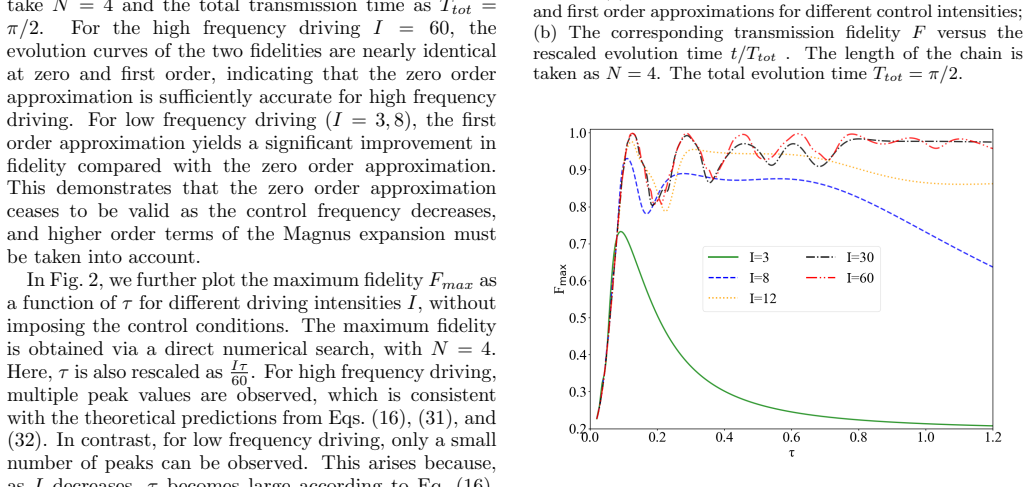
Precise quantum pulse design is central to achieving high precision quantum control, while level leakage induced by system environment coupling is the bottleneck limiting control precision. The leakage elimination operator (LEO) approach is highly effective at suppressing leakage from target subspace to other leakage spaces. The analytical control conditions under the high frequency driving limit have been derived via the Feshbach PQ partitioning technique. However, low frequency driving is experimentally more feasible, and the driving strength is subject to a fundamental physical bound. In this work, we overcome the high frequency driving limit in the pulse design by recasting the LEO protocol within the nonperturbative Floquet-Magnus framework. Applying the Magnus expansion to Floquet dynamical localization, we establish a generalized optimal control formalism that is applicable to the low frequency regime. We prove that the analytical control conditions derived via the Feshbach PQ partitioning technique are equivalent to the zero order Magnus expansion, and that higher order Magnus terms must be taken into account in the low frequency driving regime. We validate our nonperturbative framework using two examples: near perfect quantum state transfer in a one dimensional spin chain and adiabatic speedup in a two level system, corresponding to time independent and time dependent system Hamiltonians, respectively. Our results provide an effective route for designing control pulses in the low frequency regime, which is promising for practical quantum information processing tasks across diverse experimental platforms, including superconducting qubits and ion traps.
Editorial analysis
A structured set of objections, weighed in public.
Referee Report
Summary. The manuscript recasts the leakage elimination operator (LEO) protocol in the nonperturbative Floquet-Magnus framework to extend analytical control conditions beyond the high-frequency driving limit. It proves equivalence between Feshbach PQ partitioning conditions and the zero-order Magnus expansion, asserts that higher-order Magnus terms are required in the low-frequency regime, and validates the approach with examples of near-perfect state transfer in a 1D spin chain (time-independent Hamiltonian) and adiabatic speedup in a two-level system (time-dependent Hamiltonian).
Significance. If the claims hold, the work supplies a generalized optimal-control formalism applicable to experimentally feasible low-frequency driving, addressing a key practical limitation of prior LEO methods. The explicit equivalence to zero-order Magnus and the handling of both time-independent and time-dependent cases are strengths that could impact quantum control design on platforms such as superconducting qubits and ion traps.
major comments (2)
- [Abstract and Floquet-Magnus derivation] The central assertion that higher-order Magnus terms must be taken into account in the low-frequency regime (abstract, paragraph on recasting the LEO protocol) presupposes convergence of the Floquet-Magnus series for the periods and Hamiltonians considered. No explicit radius-of-convergence bound (e.g., via the standard log(2) estimate on the norm of the time-ordered exponential or Baker-Campbell-Hausdorff remainder) is supplied, nor is it verified that the low-frequency parameters in the spin-chain and two-level examples lie inside that radius. This is load-bearing for the claim that the generalized formalism remains valid and useful precisely where the high-frequency approximation fails.
- [Numerical examples] The validation section states that the framework is validated by two examples but reports no quantitative error metrics, convergence checks on the Magnus truncation, or comparison baselines against existing high-frequency LEO or perturbative methods. Without these, the numerical support for the low-frequency claim cannot be assessed beyond the stated assertions.
minor comments (1)
- [Proof of equivalence] Clarify the precise definition of the zero-order Magnus term and its relation to the Feshbach PQ conditions with an explicit equation reference to aid readers.
Simulated Author's Rebuttal
We thank the referee for the careful review and constructive comments. We address the two major comments point by point below.
read point-by-point responses
-
Referee: [Abstract and Floquet-Magnus derivation] The central assertion that higher-order Magnus terms must be taken into account in the low-frequency regime (abstract, paragraph on recasting the LEO protocol) presupposes convergence of the Floquet-Magnus series for the periods and Hamiltonians considered. No explicit radius-of-convergence bound (e.g., via the standard log(2) estimate on the norm of the time-ordered exponential or Baker-Campbell-Hausdorff remainder) is supplied, nor is it verified that the low-frequency parameters in the spin-chain and two-level examples lie inside that radius. This is load-bearing for the claim that the generalized formalism remains valid and useful precisely where the high-frequency approximation fails.
Authors: We acknowledge that the manuscript does not supply an explicit radius-of-convergence bound for the Floquet-Magnus series nor verify that the example parameters lie inside it. While the nonperturbative approach is motivated by the regime where the high-frequency approximation fails, the referee is correct that convergence must be justified for the claims to hold. In the revised manuscript we will add a dedicated paragraph discussing standard convergence criteria (including the log(2) estimate on the time-ordered exponential) and will confirm that the driving periods and Hamiltonian norms used in both numerical examples satisfy these criteria. revision: yes
-
Referee: [Numerical examples] The validation section states that the framework is validated by two examples but reports no quantitative error metrics, convergence checks on the Magnus truncation, or comparison baselines against existing high-frequency LEO or perturbative methods. Without these, the numerical support for the low-frequency claim cannot be assessed beyond the stated assertions.
Authors: We agree that the current validation lacks quantitative error metrics, Magnus-order convergence checks, and direct comparisons to high-frequency LEO baselines. In the revised version we will augment the numerical section with infidelity values for both the spin-chain state transfer and the two-level adiabatic speedup, include tables or plots showing results for successive Magnus orders to demonstrate truncation convergence, and add explicit comparisons against the zero-order (high-frequency) LEO conditions to quantify the improvement obtained by retaining higher-order terms. revision: yes
Circularity Check
No significant circularity; derivation is self-contained
full rationale
The paper's core claims consist of a mathematical proof that Feshbach-PQ control conditions equal the zero-order Magnus term and a recasting of the LEO protocol inside the Floquet-Magnus expansion. These steps are direct algebraic identifications and do not rely on parameters fitted to the target data, self-definitions, or load-bearing self-citations. The Feshbach-PQ technique is referenced as an external prior method, and no equations reduce the low-frequency extension or the necessity of higher Magnus orders to quantities defined inside the present work. The derivation therefore remains independent of its own inputs.
Axiom & Free-Parameter Ledger
Reference graph
Works this paper leans on
-
[1]
Norambuena, M
A. Norambuena, M. Mattheakis, F. J. Gonz´ alez, and R. Coto, Physics-informed neural networks for quantum control, Phys. Rev. Lett.132, 010801 (2024). 9
2024
-
[2]
Du, Z.-T
Y.-X. Du, Z.-T. Liang, W. Huang, H. Yan, and S.-L. Zhu, Experimental observation of double coherent stimulated raman adiabatic passages in three-level Λ systems in a cold atomic ensemble, Phys. Rev. A90, 023821 (2014)
2014
-
[3]
Tancara, A
D. Tancara, A. Norambuena, R. Pe˜ na, G. Romero, F. Torres, and R. Coto, Steering interchange of polariton branches via coherent and incoherent dynamics, Phys. Rev. A103, 053708 (2021)
2021
-
[4]
J. Tian, T. Du, Y. Liu, H. Liu, F. Jin, R. S. Said, and J. Cai, Optimal quantum optical control of spin in diamond, Phys. Rev. A100, 012110 (2019)
2019
-
[5]
Zeissler, Controlling a superconducting quantum processor, Nature Electronics6, 181 (2023)
K. Zeissler, Controlling a superconducting quantum processor, Nature Electronics6, 181 (2023)
2023
-
[6]
Zhang, P
Z. Zhang, P. Gokhale, and J. M. Larson, Efficient frequency allocation for superconducting quantum processors using improved optimization techniques, Phys. Rev. A111, 012619 (2025)
2025
-
[7]
P. Cai, J. J. Zha, Y. J. Xie, Q. Wei, and P. X. Wang, Rydberg-atom acceleration by tightly focused intense laser pulses, Phys. Rev. A99, 053401 (2019)
2019
-
[8]
Zhang, W
B. Zhang, W. Chen, and Z. Zhao, Generation of rydberg states of hydrogen atoms with intense laser pulses: The roles of coulomb force and initial lateral momentum, Physical Review A90, 023409 (2014)
2014
-
[9]
N. S. Keskar and R. Socher, Improving generalization performance by switching from adam to SGD, CoRR abs/1712.07628(2017), 1712.07628
work page internal anchor Pith review Pith/arXiv arXiv 2017
-
[10]
D. P. Kingma and J. Ba, Adam: A method for stochastic optimization (2017), arXiv:1412.6980 [cs.LG]
work page internal anchor Pith review Pith/arXiv arXiv 2017
-
[11]
O. V. Morzhin and A. N. Pechen, Krotov method for optimal control of closed quantum systems, Russian Mathematical Surveys74, 851 (2019)
2019
-
[12]
Van Damme, Q
L. Van Damme, Q. Ansel, S. J. Glaser, and D. Sugny, Robust optimal control of two-level quantum systems, Phys. Rev. A95, 063403 (2017)
2017
-
[13]
Z.-M. Wang, M. S. Sarandy, and L.-A. Wu, Almost exact state transfer in a spin chain via pulse control, Phys. Rev. A102, 022601 (2020)
2020
-
[14]
Viola, E
L. Viola, E. Knill, and S. Lloyd, Dynamical decoupling of open quantum systems, Phys. Rev. Lett.82, 2417 (1999)
1999
-
[15]
Vitali and P
D. Vitali and P. Tombesi, Using parity kicks for decoherence control, Phys. Rev. A59, 4178 (1999)
1999
-
[16]
Z.-M. Wang, M. S. Byrd, J. Jing, and L.-A. Wu, Adiabatic leakage elimination operator in an experimental framework, Phys. Rev. A97, 062312 (2018)
2018
-
[17]
L.-A. Wu, M. S. Byrd, and D. A. Lidar, Efficient universal leakage elimination for physical and encoded qubits, Phys. Rev. Lett.89, 127901 (2002)
2002
-
[18]
M. S. Byrd, D. A. Lidar, L.-A. Wu, and P. Zanardi, Universal leakage elimination, Phys. Rev. A71, 052301 (2005)
2005
-
[19]
del Campo, Frictionless quantum quenches in ultracold gases: A quantum-dynamical microscope, Phys
A. del Campo, Frictionless quantum quenches in ultracold gases: A quantum-dynamical microscope, Phys. Rev. A84, 031606 (2011)
2011
-
[20]
del Campo, I
A. del Campo, I. L. Egusquiza, M. B. Plenio, and S. F. Huelga, Quantum speed limits in open system dynamics, Phys. Rev. Lett.110, 050403 (2013)
2013
-
[21]
P. PV, L. DW, J. J, Y. JQ, and W. LA., Expedited holonomic quantum computation via net zero-energy- cost control in decoherence-free subspace, Scientific Reports (2016)
2016
-
[22]
Li, L.-A
Y.-Y. Li, L.-A. Wu, and Z.-M. Wang, Machine learning assisted zero-area pulse design in an open quantum system, Phys. Rev. Res.7, 033191 (2025)
2025
-
[23]
D’Alessandro,Introduction to Quantum Control and Dynamics(Chapman & Hall ; CRC, New York, 2021)
D. D’Alessandro,Introduction to Quantum Control and Dynamics(Chapman & Hall ; CRC, New York, 2021)
2021
-
[24]
Press, T
D. Press, T. D. Ladd, B. Zhang, and Y. Yamamoto, Complete quantum control of a single quantum dot spin using ultrafast optical pulses, Nature (London)456, 218 (2008)
2008
-
[25]
Farhi, J
E. Farhi, J. Goldstone, S. Gutmann, J. Lapan, A. Lundgren, and D. Preda, A quantum adiabatic evolution algorithm applied to random instances of an np-complete problem, Science292, 472 (2001)
2001
-
[26]
Albash and D
T. Albash and D. A. Lidar, Adiabatic quantum computation, Rev. Mod. Phys.90, 015002 (2018)
2018
-
[27]
T. D. Kieu, The second law, maxwell’s demon, and work derivable from quantum heat engines, Phys. Rev. Lett. 93, 140403 (2004)
2004
-
[28]
Wang, F.-H
Z.-M. Wang, F.-H. Ren, M. S. Sarandy, and M. S. Byrd, Nonequilibrium quantum thermodynamics in non- markovian adiabatic speedup, Physica A: Statistical Mechanics and its Applications603, 127861 (2022)
2022
-
[29]
Z. Niu, Y. Wu, Y. Wang, X. Rong, and J. Du, Experimental investigation of coherent ergotropy in a single spin system, Phys. Rev. Lett.133, 180401 (2024)
2024
-
[30]
Wu and J.-H
W. Wu and J.-H. An, Generalized quantum fluctuation theorem for energy exchange, Phys. Rev. Lett.133, 050401 (2024)
2024
-
[31]
Wu,One-component QM and a universal leakage elimination operator(2019/02/12)
L.-A. Wu,One-component QM and a universal leakage elimination operator(2019/02/12)
2019
- [32]
-
[33]
Dann, Interplay between external driving, dissipation and collective effects in the markovian and non- markovian regimes, Quantum9, 1740 (2025)
R. Dann, Interplay between external driving, dissipation and collective effects in the markovian and non- markovian regimes, Quantum9, 1740 (2025)
2025
-
[34]
Bukov, L
M. Bukov, L. D’Alessio, and A. Polkovnikov, Universal high-frequency behavior of periodically driven systems: from dynamical stabilization to floquet engineering, Advances in Physics64, 139 (2015)
2015
-
[35]
Grifoni and P
M. Grifoni and P. H¨ anggi, Driven quantum tunneling, Physics Reports304, 229 (1998)
1998
-
[36]
J. H. Shirley, Solution of the schr¨ odinger equation with a hamiltonian periodic in time, Phys. Rev.138, B979 (1965)
1965
-
[37]
Reitter,Scattering processes in interacting Floquet systems, Phd thesis, Ludwig-Maximilians-Universit¨ at M¨ unchen, M¨ unchen, Germany (2017), dissertation
M. Reitter,Scattering processes in interacting Floquet systems, Phd thesis, Ludwig-Maximilians-Universit¨ at M¨ unchen, M¨ unchen, Germany (2017), dissertation
2017
-
[38]
H. Zhou, X. Chen, X. Nie, J. Bian, Y. Ji, Z. Li, and X. Peng, Floquet-engineered quantum state transfer in spin chains, Science Bulletin64, 888 (2019)
2019
-
[39]
P. M. Schindler and M. Bukov, Counterdiabatic driving for periodically driven systems, Phys. Rev. Lett.133, 123402 (2024)
2024
-
[40]
K. Li, Floquet-informed learning of periodically driven hamiltonians, arXiv preprint arXiv:2509.02331 (2025)
-
[41]
Eckardt, M
A. Eckardt, M. Holthaus, H. Lignier, A. Zenesini, D. Ciampini, O. Morsch, and E. Arimondo, Exploring dynamic localization with a bose-einstein condensate, Phys. Rev. A79, 013611 (2009)
2009
-
[42]
D. H. Dunlap and V. M. Kenkre, Dynamic localization of a charged particle moving under the influence of an electric field, Phys. Rev. B34, 3625 (1986)
1986
-
[43]
E. I. Butikov, On the dynamic stabilization of an inverted 10 pendulum, American Journal of Physics69, 755 (2001)
2001
-
[44]
Lignier, C
H. Lignier, C. Sias, D. Ciampini, Y. Singh, A. Zenesini, O. Morsch, and E. Arimondo, Dynamical control of matter-wave tunneling in periodic potentials, Phys. Rev. Lett.99, 220403 (2007)
2007
-
[45]
C. Dai, Z. Shi, and X. Yi, Floquet theorem with open systems and its applications, Physical Review A93, 032121 (2016)
2016
-
[46]
Di Paolo, T
A. Di Paolo, T. Baker, A. Foley, S´ en´ echal, D, and A. Blais, Efficient modeling of superconducting quantum circuits with tensor networks, npj Quantum Information (2021)
2021
-
[47]
A. S. Wiening, J. Bergendahl, V. Leyton-Ortega, and P. Nalbach, Optimizing qubit control pulses for state preparation: As wiening et al., Quantum Information Processing24, 42 (2025)
2025
-
[48]
L.-A. Wu, G. Kurizki, and P. Brumer, Master equation and control of an open quantum system with leakage, Phys. Rev. Lett.102, 080405 (2009)
2009
-
[49]
Wang, L.-A
Z.-M. Wang, L.-A. Wu, J. Jing, B. Shao, and T. Yu, Nonperturbative dynamical decoupling control: A spin- chain model, Phys. Rev. A86, 032303 (2012)
2012
-
[50]
K. Ebrahimi-Fard, I. Mencattini, and A. Quesney, What is the magnus expansion?, arXiv preprint arXiv:2312.16674 (2023)
-
[51]
Viebahn, Introduction to floquet theory, Institute for Quantum Electronics, ETH Zurich8093(2020)
K. Viebahn, Introduction to floquet theory, Institute for Quantum Electronics, ETH Zurich8093(2020)
2020
discussion (0)
Sign in with ORCID, Apple, or X to comment. Anyone can read and Pith papers without signing in.