Doubly charmed baryon-light meson scattering in chiral effective theory with lattice constraints
Pith reviewed 2026-06-30 05:25 UTC · model grok-4.3
The pith
Chiral effective theory fitted to lattice data predicts resonance, virtual, and bound doubly charmed baryon states after extrapolation to physical quark masses.
A machine-rendered reading of the paper's core claim, the machinery that carries it, and where it could break.
Core claim
Following the determination of next-to-leading order low energy constants through fits to lattice data on elastic scattering and subsequent chiral extrapolation to physical quark masses, the unitarized amplitudes predict the appearance of resonance, virtual, and bound doubly-charmed-baryon states in the scattering of Ξcc++, Ξcc+, and Ωc c+ with π, K, and η.
What carries the argument
Unitarization of next-to-leading order S-wave scattering amplitudes in chiral effective theory, with low energy constants constrained by lattice QCD data.
If this is right
- The unitarized amplitudes yield concrete predictions for resonance, virtual, and bound states in both single- and coupled-channel processes.
- Scattering lengths, effective ranges, phase shifts, and inelasticities are obtained at physical quark masses for the considered channels.
- The calculated observables supply quantitative targets for future experimental searches and lattice simulations of doubly charmed systems.
Where Pith is reading between the lines
- Confirmation of the predicted bound states would add new members to the family of exotic hadrons containing two heavy quarks.
- The same fitting and extrapolation procedure could be applied to other heavy-baryon–meson channels to map a broader spectrum of states.
- Disagreement with future physical-mass lattice results would point to the size of higher-order corrections in the effective theory.
Load-bearing premise
The next-to-leading order low energy constants fitted to lattice data at unphysical quark masses remain reliable when extrapolated to physical quark masses.
What would settle it
A lattice simulation at physical quark masses that finds no evidence for the predicted resonance, virtual, or bound states in the relevant channels would falsify the extrapolation.
Figures

read the original abstract
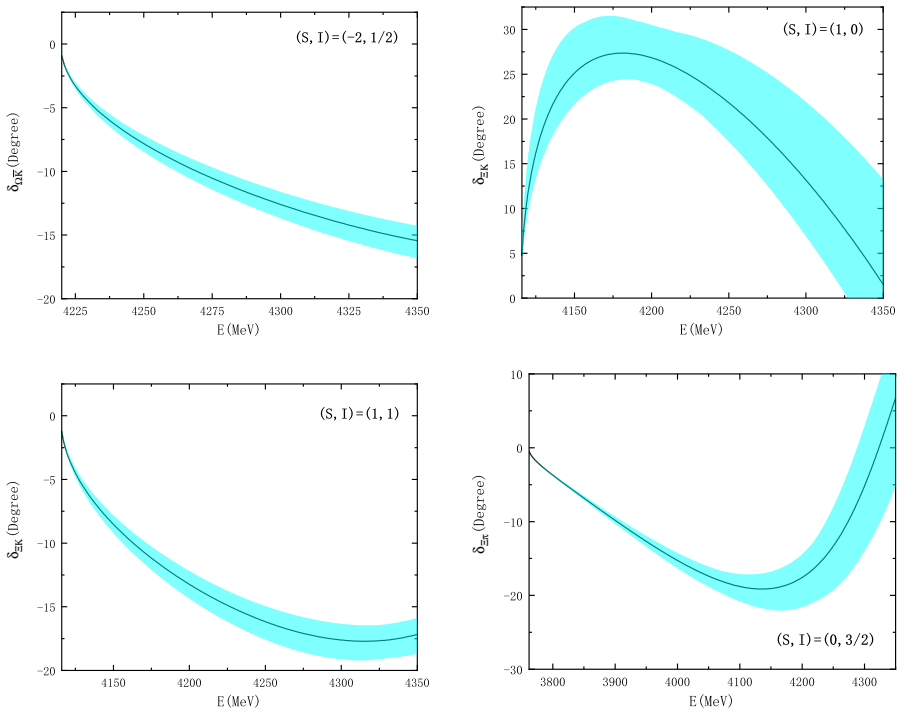
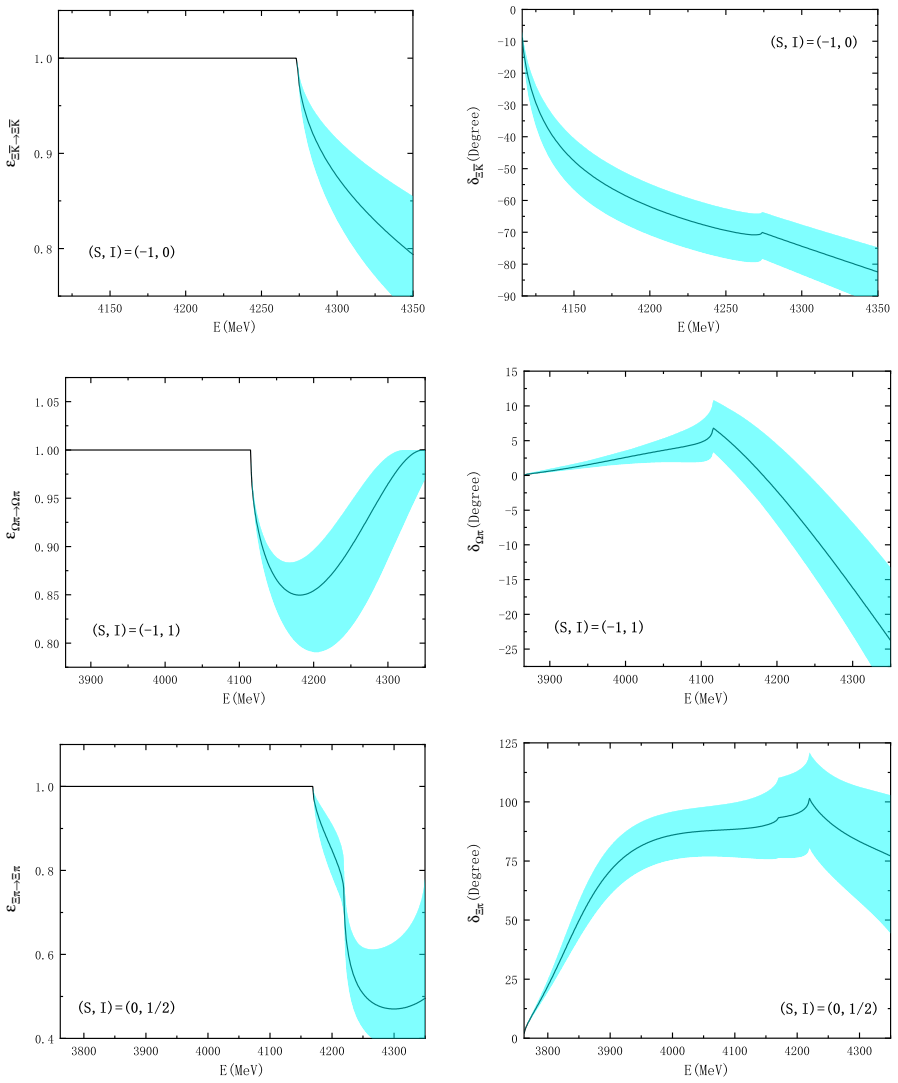
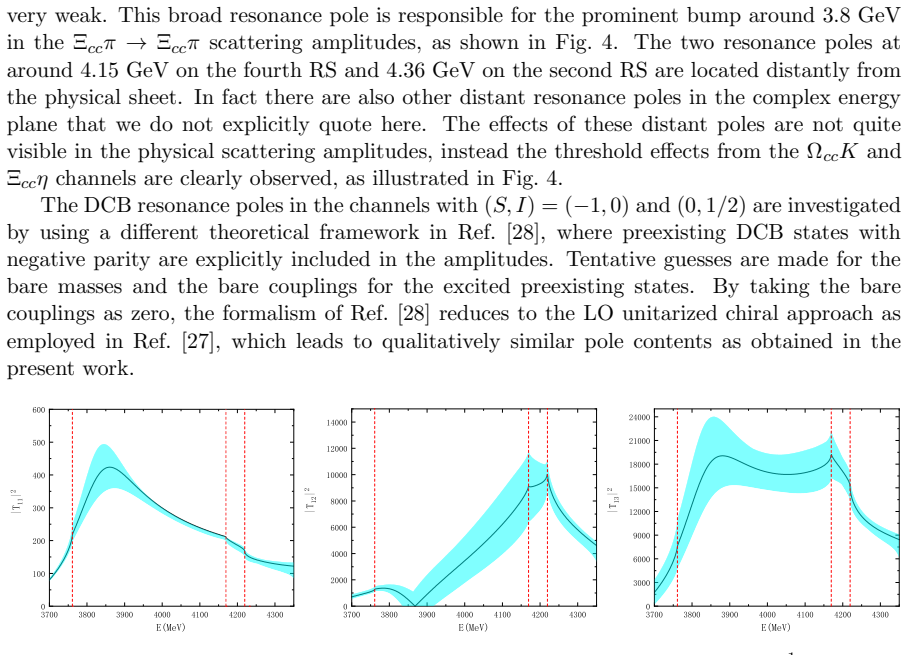
We study the scattering of the ground states of doubly charmed baryons ($\Xi_{cc}^{++},\Xi_{cc}^{+},\Omega_{cc}^{+}$) and light-flavor pseudoscalar mesons ($\pi,K,\eta$) up to the next-to-leading order within chiral effective theory. We perform the unitarization of the $S$-wave scattering amplitudes in order to study the excited doubly charmed baryons. The unknown next-to-leading order low energy constants are determined through the fits to recent lattice data in the elastic scattering processes based on the CLQCD ensembles. Following the chiral extrapolation to physical quark masses, we predict resonance, virtual and bound doubly-charmed-baryon states arising from the single- and coupled-channel scattering of $\Xi_{cc}^{++},\Xi_{cc}^{+},\Omega_{cc}^{+}$ with $\pi,K,\eta$. Furthermore, we also calculate the corresponding scattering lengths, effective ranges, phase shifts and inelasticities at physical quark masses, which could shed light on future experimental searches and lattice simulations.
Editorial analysis
A structured set of objections, weighed in public.
Referee Report
Summary. The paper develops an NLO chiral effective theory for S-wave scattering of the ground-state doubly charmed baryons (Ξcc++, Ξcc+, Ωc c+) with the light pseudoscalars (π, K, η). The amplitudes are unitarized, the unknown NLO low-energy constants are fitted to CLQCD lattice data on elastic channels, and the resulting amplitudes are extrapolated to physical quark masses to predict resonance, virtual, and bound states in both single- and coupled-channel processes; scattering lengths, effective ranges, phase shifts, and inelasticities at the physical point are also reported.
Significance. If the central extrapolation is reliable, the work supplies falsifiable predictions for exotic doubly charmed baryon states that can guide LHCb searches and future lattice simulations. The explicit use of lattice ensembles to constrain the NLO LECs is a methodological strength that partially anchors the effective theory in non-perturbative QCD input.
major comments (2)
- [Abstract and lattice-fit section] Abstract and the section describing the lattice fits: no numerical fit results (χ²/dof, covariance matrices, or parameter values with uncertainties) are presented for the NLO LECs determined from the CLQCD elastic data. Because the pole predictions rest entirely on these unshown fits, the quality of the LEC determination and the subsequent extrapolation cannot be assessed.
- [Chiral extrapolation and results] The chiral-extrapolation step (physical-mass predictions): the NLO LECs are fixed exclusively by elastic lattice data at unphysical (heavier) quark masses and then inserted into the unitarized amplitudes at the physical point. No estimate of NNLO truncation error, no sensitivity test to omitted higher-order terms, and no comparison with alternative extrapolations are supplied; this assumption is load-bearing for the claimed resonance, virtual, and bound states.
minor comments (2)
- [Effective Lagrangian section] Clarify the precise definition and numerical values of the NLO LECs (including any scale dependence) when they are first introduced.
- [Lattice data section] Add a table or figure summarizing the lattice ensemble parameters (quark masses, volumes) used in the fits for direct comparison with the physical point.
Simulated Author's Rebuttal
We thank the referee for the careful reading of our manuscript and the constructive comments. We address each major comment below. We agree that the fit results must be presented explicitly and will revise the manuscript to include them. For the extrapolation uncertainties, we will add a sensitivity analysis while noting the inherent limitations of an NLO calculation.
read point-by-point responses
-
Referee: [Abstract and lattice-fit section] Abstract and the section describing the lattice fits: no numerical fit results (χ²/dof, covariance matrices, or parameter values with uncertainties) are presented for the NLO LECs determined from the CLQCD elastic data. Because the pole predictions rest entirely on these unshown fits, the quality of the LEC determination and the subsequent extrapolation cannot be assessed.
Authors: We agree that the numerical fit results are essential for assessing the quality of the LEC determination. The fits to the CLQCD elastic data were performed, but the specific parameter values, uncertainties, χ²/dof, and covariance matrix were omitted from the text. In the revised manuscript we will add a table listing the best-fit NLO LECs with uncertainties, the χ²/dof for each fitted channel, and the covariance matrix. This will allow readers to evaluate the fit quality directly. revision: yes
-
Referee: [Chiral extrapolation and results] The chiral-extrapolation step (physical-mass predictions): the NLO LECs are fixed exclusively by elastic lattice data at unphysical (heavier) quark masses and then inserted into the unitarized amplitudes at the physical point. No estimate of NNLO truncation error, no sensitivity test to omitted higher-order terms, and no comparison with alternative extrapolations are supplied; this assumption is load-bearing for the claimed resonance, virtual, and bound states.
Authors: We acknowledge that a quantitative estimate of NNLO truncation error would strengthen the extrapolation. Performing a full NNLO analysis lies outside the scope of the present NLO study. In the revision we will add a sensitivity study in which the NLO LECs are varied within their fitted uncertainties to test the stability of the predicted poles, together with a brief discussion of the expected size of higher-order corrections inferred from the convergence pattern seen on the lattice ensembles. This provides a practical assessment of theoretical uncertainty at the current order. revision: partial
Circularity Check
No significant circularity; LECs fitted to external lattice data with extrapolation to physical point
full rationale
The derivation fits NLO low-energy constants to independent CLQCD lattice ensembles at unphysical masses, then performs chiral extrapolation and unitarization to predict poles and observables at the physical point. This uses external benchmark data as input rather than reducing any claimed prediction to a fit or self-citation by construction. No self-definitional steps, fitted inputs renamed as predictions, or load-bearing self-citations appear in the abstract or described chain. The procedure is self-contained against the external lattice constraints.
Axiom & Free-Parameter Ledger
free parameters (1)
- NLO low energy constants
axioms (2)
- domain assumption Chiral symmetry of QCD at low energies
- domain assumption Unitarization of S-wave amplitudes captures resonance physics
Reference graph
Works this paper leans on
-
[1]
J. G. Korner, M. Kramer, and D. Pirjol, Prog. Part. Nucl. Phys.33, 787 (1994), arXiv:hep- ph/9406359
arXiv 1994
-
[2]
V. V. Kiselev and A. K. Likhoded, Phys. Usp.45, 455 (2002), arXiv:hep-ph/0103169
Pith/arXiv arXiv 2002
-
[3]
J. P. Ma and Z. G. Si, Phys. Lett. B568, 135 (2003), arXiv:hep-ph/0305079
Pith/arXiv arXiv 2003
-
[4]
J. Hu and T. Mehen, Phys. Rev. D73, 054003 (2006), arXiv:hep-ph/0511321
Pith/arXiv arXiv 2006
-
[5]
C.-H. Chang, J.-P. Ma, C.-F. Qiao, and X.-G. Wu, J. Phys. G34, 845 (2007), arXiv:hep- ph/0610205
arXiv 2007
-
[6]
C.-H. Chang, C.-F. Qiao, J.-X. Wang, and X.-G. Wu, Phys. Rev. D73, 094022 (2006), arXiv:hep-ph/0601032
Pith/arXiv arXiv 2006
-
[7]
D. Ebert, R. N. Faustov, V. O. Galkin, and A. P. Martynenko, Phys. Rev. D66, 014008 (2002), arXiv:hep-ph/0201217
Pith/arXiv arXiv 2002
-
[8]
M. Karliner and J. L. Rosner, Phys. Rev. D90, 094007 (2014), arXiv:1408.5877 [hep-ph]
Pith/arXiv arXiv 2014
- [9]
-
[10]
L. Liu, H.-W. Lin, K. Orginos, and A. Walker-Loud, Phys. Rev. D81, 094505 (2010), arXiv:0909.3294 [hep-lat]
Pith/arXiv arXiv 2010
-
[11]
Z. S. Brown, W. Detmold, S. Meinel, and K. Orginos, Phys. Rev. D90, 094507 (2014), arXiv:1409.0497 [hep-lat]
Pith/arXiv arXiv 2014
-
[12]
R. Aaij et al. (LHCb), Phys. Rev. Lett.119, 112001 (2017), arXiv:1707.01621 [hep-ex]
Pith/arXiv arXiv 2017
-
[13]
R. Aaij et al. (LHCb), Phys. Rev. Lett.121, 162002 (2018), arXiv:1807.01919 [hep-ex]
Pith/arXiv arXiv 2018
-
[14]
R. Aaij et al. (LHCb), Phys. Rev. Lett.121, 052002 (2018), arXiv:1806.02744 [hep-ex]
Pith/arXiv arXiv 2018
- [15]
-
[16]
R. Aaij et al. (LHCb), Chin. Phys. C44, 022001 (2020), arXiv:1910.11316 [hep-ex] . 19
arXiv 2020
- [17]
- [18]
-
[19]
M. Mattson et al. (SELEX), Phys. Rev. Lett.89, 112001 (2002), arXiv:hep-ex/0208014
Pith/arXiv arXiv 2002
-
[20]
A. Ocherashvili et al. (SELEX), Phys. Lett. B628, 18 (2005), arXiv:hep-ex/0406033
Pith/arXiv arXiv 2005
- [21]
-
[22]
A. V. Manohar and M. B. Wise, Heavy quark physics, Vol. 10 (2000)
2000
-
[23]
M. J. Savage and M. B. Wise, Phys. Lett. B248, 177 (1990)
1990
-
[24]
Weinberg, Physica A96, 327 (1979)
S. Weinberg, Physica A96, 327 (1979)
1979
-
[25]
Gasser and H
J. Gasser and H. Leutwyler, Annals Phys.158, 142 (1984)
1984
-
[26]
Gasser, M
J. Gasser, M. E. Sainio, and A. Svarc, Nucl. Phys. B307, 779 (1988)
1988
- [27]
-
[28]
M.-J. Yan, X.-H. Liu, S. Gonz` alez-Sol´ ıs, F.-K. Guo, C. Hanhart, U.-G. Meißner, and B.-S. Zou, Phys. Rev. D98, 091502 (2018), arXiv:1805.10972 [hep-ph]
Pith/arXiv arXiv 2018
-
[29]
P.-C. Qiu and D.-L. Yao, Phys. Rev. D103, 034006 (2021), arXiv:2012.11117 [hep-ph]
arXiv 2021
- [30]
- [31]
- [32]
-
[33]
J. A. Oller and E. Oset, Phys. Rev. D60, 074023 (1999), arXiv:hep-ph/9809337
Pith/arXiv arXiv 1999
-
[34]
Z.-R. Liang, J.-Y. Yi, L. Liu, and D.-L. Yao, in 11th International Workshop on Chiral Dynamics (2025) arXiv:2504.04709 [hep-ph]
arXiv 2025
- [35]
-
[36]
Navas et al
S. Navas et al. (Particle Data Group), Phys. Rev. D110, 030001 (2024)
2024
-
[37]
A. Gomez Nicola and J. R. Pelaez, Phys. Rev. D65, 054009 (2002), arXiv:hep-ph/0109056
Pith/arXiv arXiv 2002
- [38]
-
[39]
H. Q. Zheng, Z. Y. Zhou, G. Y. Qin, Z. Xiao, J. J. Wang, and N. Wu, Nucl. Phys. A733, 235 (2004), arXiv:hep-ph/0310293
Pith/arXiv arXiv 2004
-
[40]
Z. Y. Zhou, G. Y. Qin, P. Zhang, Z. Xiao, H. Q. Zheng, and N. Wu, JHEP02, 043, arXiv:hep-ph/0406271 . 20
- [41]
-
[42]
Weinberg, Phys
S. Weinberg, Phys. Rev.130, 776 (1963)
1963
-
[43]
Z.-H. Guo and J. A. Oller, Phys. Rev. D93, 096001 (2016), arXiv:1508.06400 [hep-ph]
Pith/arXiv arXiv 2016
-
[44]
X.-W. Kang, Z.-H. Guo, and J. A. Oller, Phys. Rev. D94, 014012 (2016), arXiv:1603.05546 [hep-ph]
Pith/arXiv arXiv 2016
-
[45]
Z.-H. Guo and J. A. Oller, Phys. Lett. B793, 144 (2019), arXiv:1904.00851 [hep-ph]
Pith/arXiv arXiv 2019
- [46]
discussion (0)
Sign in with ORCID, Apple, or X to comment. Anyone can read and Pith papers without signing in.