Dynamical evolution of the pressure on the bubble wall
Pith reviewed 2026-07-01 02:01 UTC · model grok-4.3
The pith
Heating waves form too slowly to stop bubble walls near Jouguet speed
A machine-rendered reading of the paper's core claim, the machinery that carries it, and where it could break.
Core claim
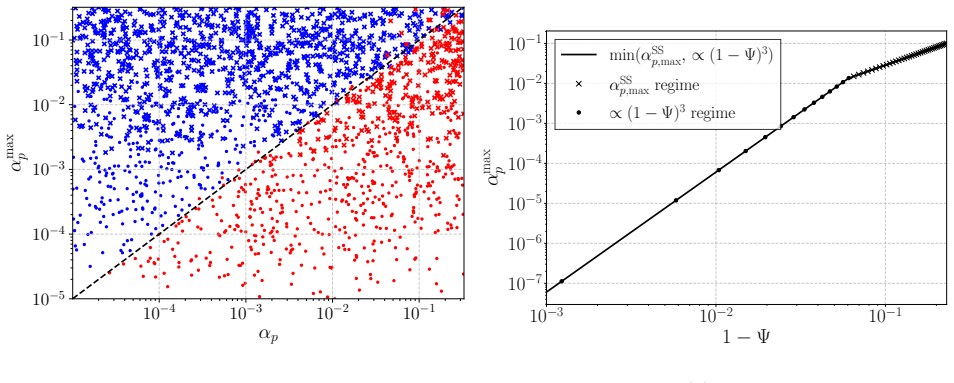
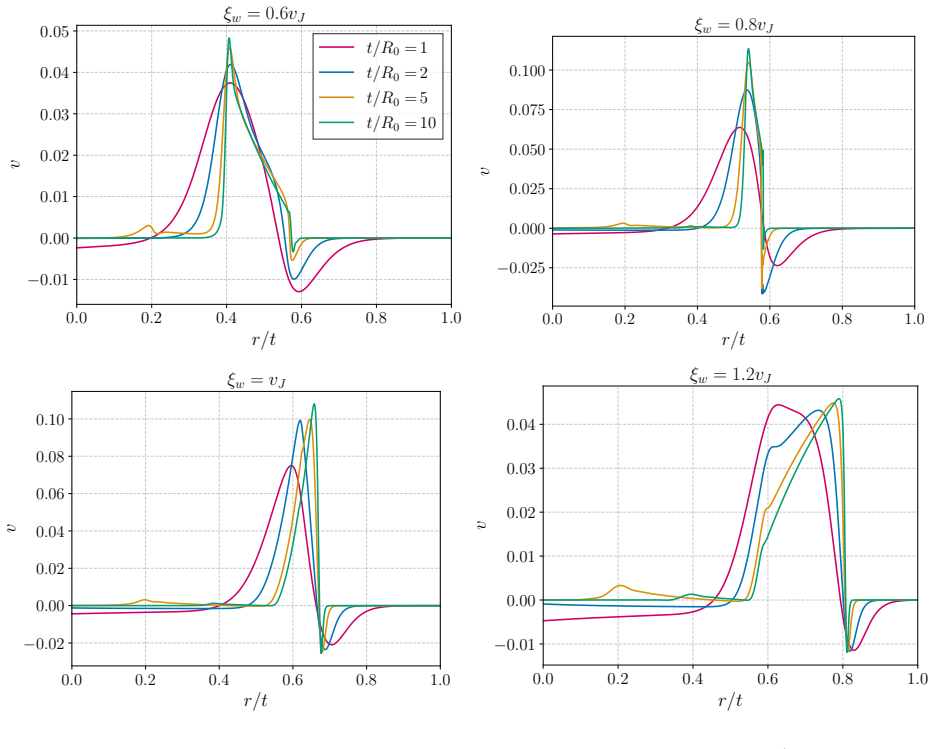
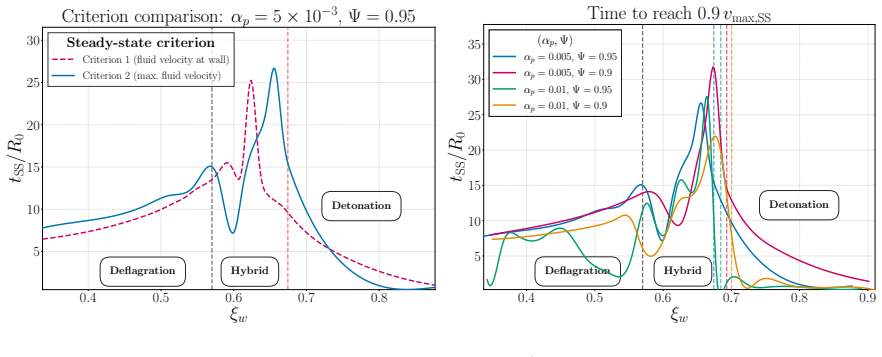
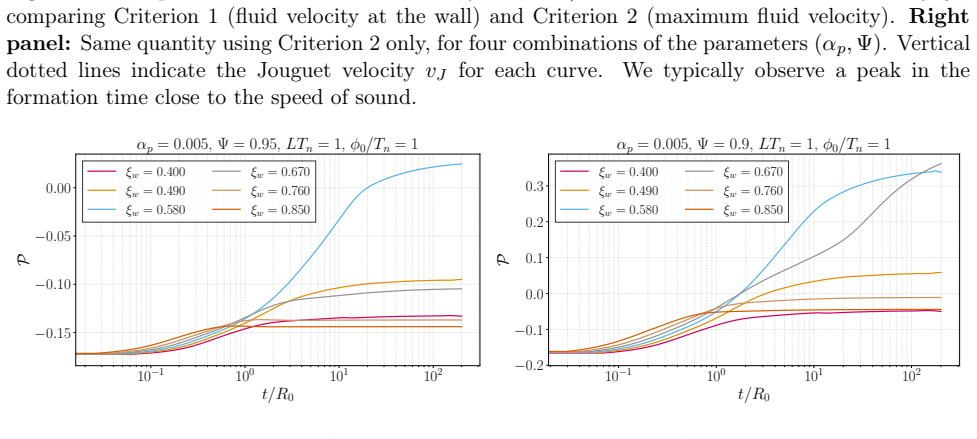
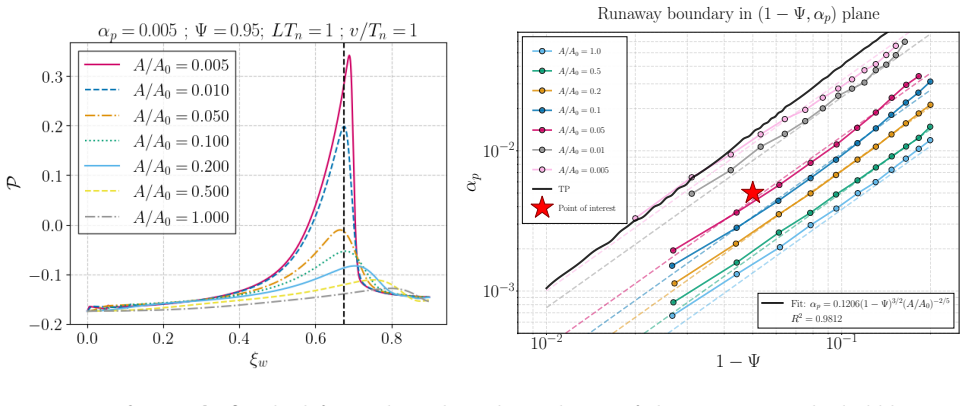
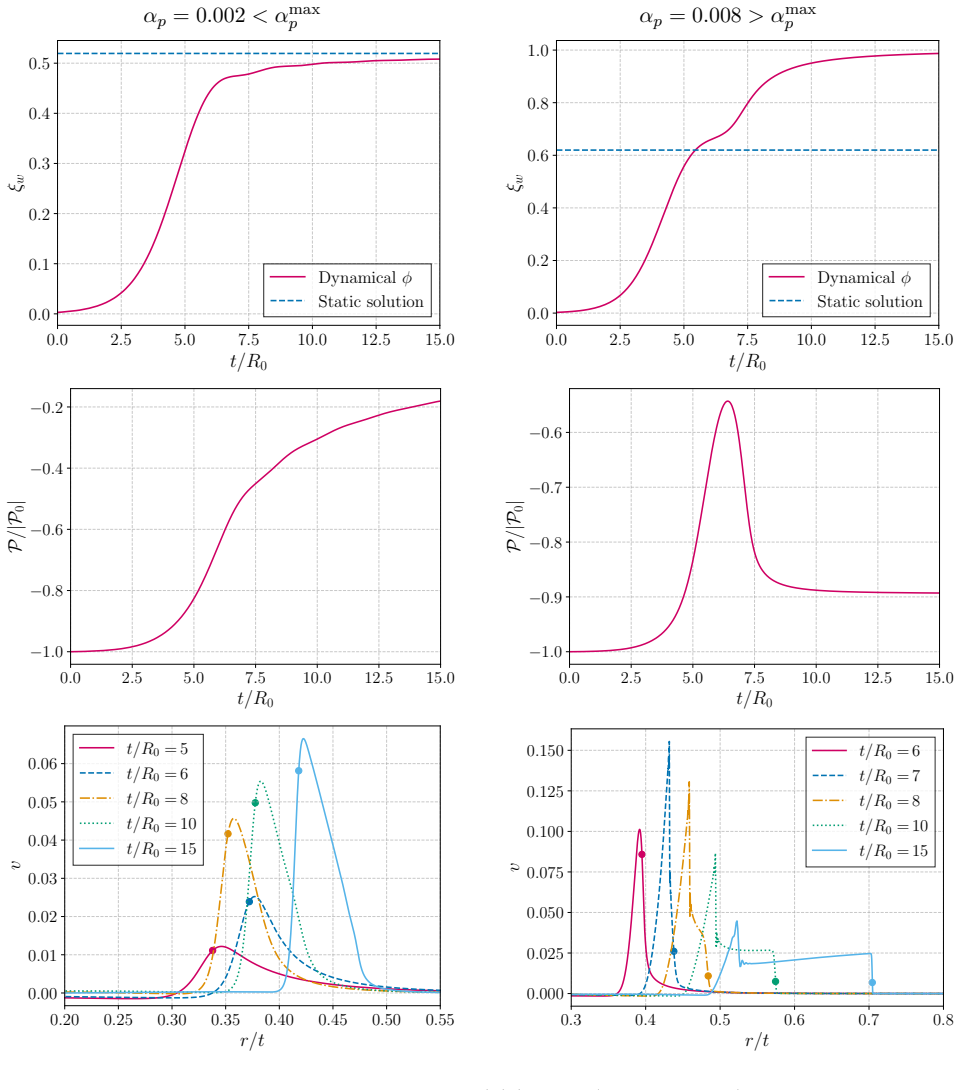
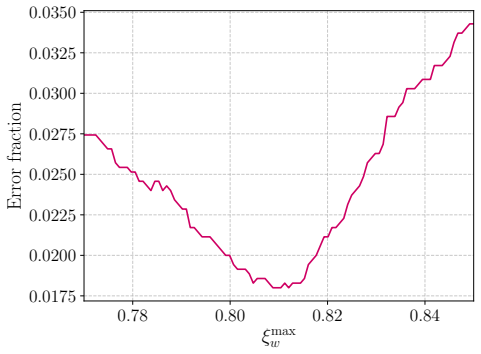
In local thermal equilibrium the pressure on the bubble wall is found by solving the hydrodynamic equations without assuming a stationary profile. The formation time of the heating wave often exceeds the wall acceleration timescale, invalidating steady-state predictions near the Jouguet velocity. A revised criterion for the maximal driving pressure is derived analytically and confirmed by simulations; it shows that hydrodynamic obstruction is less restrictive than steady-state LTE predictions suggest.
What carries the argument
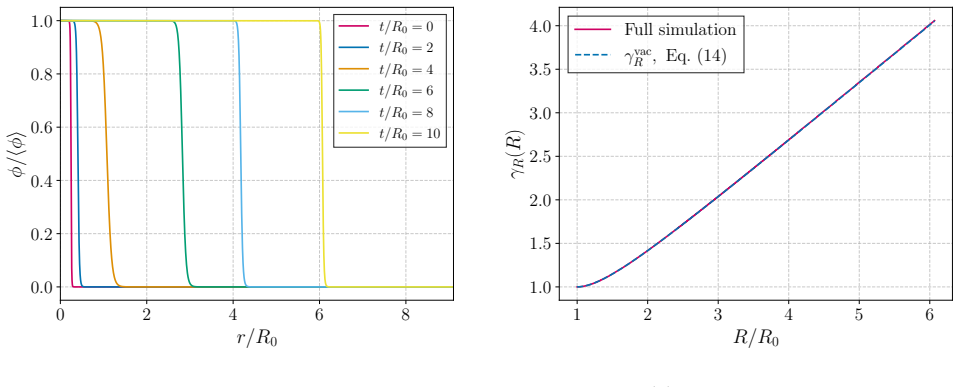
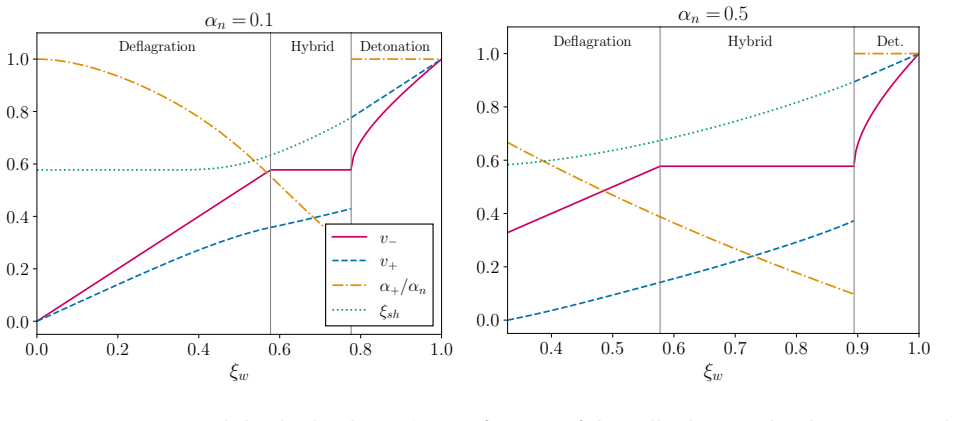
Time-dependent hydrodynamic evolution of the fluid pressure on the accelerating bubble wall under local thermal equilibrium; it computes the opposing pressure by following the delayed development of the heating wave instead of assuming an instantaneous steady state.
If this is right
- Hydrodynamic obstruction is weaker than steady-state LTE calculations had indicated.
- More walls reach detonation or runaway regimes than previously expected.
- The boundary separating deflagration/hybrid from detonation/runaway shifts to higher driving pressures.
- Gravitational-wave and baryogenesis predictions that rely on wall velocity must be recomputed.
Where Pith is reading between the lines
- The dynamical treatment could be extended to models with significant departures from local thermal equilibrium to check whether the conclusion holds.
- This shift in allowed velocities may enlarge the viable parameter space for dark-matter production linked to the same phase transition.
- Full lattice simulations of the scalar field plus plasma could directly extract wall speeds to test the new criterion.
Load-bearing premise
Local thermal equilibrium holds throughout the wall's acceleration phase.
What would settle it
A hydrodynamic simulation that measures the heating-wave formation time against the wall-acceleration time near the Jouguet velocity; if formation is always faster than acceleration, the central claim is false.
Figures


read the original abstract
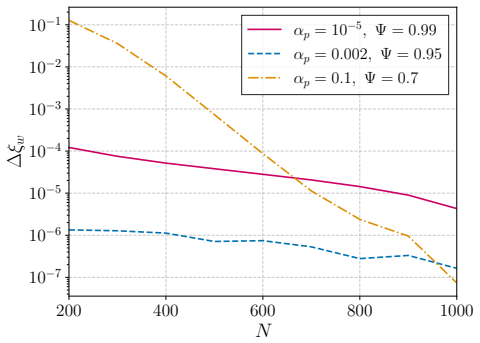
First-order phase transitions in the early Universe are pivotal for gravitational wave production, baryogenesis, and dark matter generation. A central question is whether bubble walls reach a subjouguet or ultra-relativistic velocity - a distinction governed by hydrodynamic obstruction, where plasma heating counteracts the vacuum pressure driving the wall. Traditional analyses assume steady-state fluid profiles, but these may fail during the wall's acceleration phase. We study the dynamical evolution of the pressure on the bubble wall in local thermal equilibrium (LTE), combining analytical approximations with numerical hydrodynamic simulations. Our results reveal that the heating wave's formation time often exceeds the wall's acceleration timescale, invalidating steady-state predictions near the Jouguet velocity. We derive a revised criterion for the maximal driving pressure, which separates deflagration/hybrid regimes from detonations/runaway walls. This criterion, validated by simulations, shows that hydrodynamic obstruction is less restrictive than steady state LTE predictions suggest.
Editorial analysis
A structured set of objections, weighed in public.
Referee Report
Summary. The paper claims that steady-state fluid profiles fail to describe bubble wall dynamics during the acceleration phase of first-order phase transitions. Under the local thermal equilibrium (LTE) approximation, analytical approximations combined with numerical hydrodynamic simulations show that heating-wave formation time often exceeds the wall acceleration timescale near the Jouguet velocity. This yields a revised criterion for maximal driving pressure separating deflagration/hybrid from detonation/runaway regimes, with simulations indicating that hydrodynamic obstruction is less restrictive than steady-state LTE predictions.
Significance. If the dynamical result holds, the work would refine predictions for terminal wall velocities, with direct consequences for gravitational-wave spectra, baryogenesis efficiency, and dark-matter production mechanisms. The combination of analytics and simulations to test the steady-state assumption constitutes a concrete advance, and the revised criterion supplies a falsifiable threshold that can be checked against future lattice or hydrodynamic studies.
major comments (2)
- [Abstract] Abstract: the statement that simulations 'validate the revised criterion' is not accompanied by error bars on the extracted pressure evolution, convergence tests with respect to spatial resolution or time step, or explicit criteria for selecting post-acceleration data points; without these the claim that heating-wave formation exceeds acceleration timescale remains unquantified.
- [LTE closure section] LTE closure section: the central derivation solves the hydrodynamic equations under the assumption that local thermal equilibrium persists throughout the acceleration phase, yet no estimate or test is given for the ratio of thermalization time to acceleration time near the Jouguet velocity; if this ratio is O(1) the effective wall pressure and heating-wave speed would deviate from the reported LTE profiles.
minor comments (1)
- [Figures] Figure captions should explicitly state the numerical resolution and Courant number used for the hydrodynamic runs shown.
Simulated Author's Rebuttal
We thank the referee for the careful reading of our manuscript and the constructive comments. We address each major comment below and indicate the changes planned for the revised version.
read point-by-point responses
-
Referee: [Abstract] Abstract: the statement that simulations 'validate the revised criterion' is not accompanied by error bars on the extracted pressure evolution, convergence tests with respect to spatial resolution or time step, or explicit criteria for selecting post-acceleration data points; without these the claim that heating-wave formation exceeds acceleration timescale remains unquantified.
Authors: We agree that the abstract's phrasing regarding validation would be strengthened by additional technical details. In the revised manuscript we will include error bars on the extracted pressure evolution, report convergence tests with respect to spatial resolution and time step, and state explicit criteria for selecting post-acceleration data points. These additions will allow a quantitative assessment of the heating-wave formation timescale relative to wall acceleration. revision: yes
-
Referee: [LTE closure section] LTE closure section: the central derivation solves the hydrodynamic equations under the assumption that local thermal equilibrium persists throughout the acceleration phase, yet no estimate or test is given for the ratio of thermalization time to acceleration time near the Jouguet velocity; if this ratio is O(1) the effective wall pressure and heating-wave speed would deviate from the reported LTE profiles.
Authors: The LTE closure is an explicit modeling choice stated in the manuscript. We will add to the revised text an order-of-magnitude estimate of the thermalization-to-acceleration time ratio, based on typical electroweak plasma scattering rates, showing that the ratio remains much less than unity near the Jouguet velocity for the parameter range considered. This discussion will clarify the regime of validity of the LTE profiles during the dynamical phase. revision: yes
Circularity Check
No circularity; derivation from independent hydrodynamic evolution
full rationale
The paper obtains its revised maximal-driving-pressure criterion by numerically solving the hydrodynamic equations under the LTE assumption and comparing the resulting heating-wave formation timescale to the wall acceleration timescale. This comparison and the derived separation between deflagration/hybrid and detonation/runaway regimes emerge directly from the time-dependent fluid profiles; they are not obtained by fitting parameters to the same data used for steady-state benchmarks, nor do they rest on self-citation chains or uniqueness theorems imported from the authors' prior work. The central claim is therefore self-contained against external hydrodynamic benchmarks.
Axiom & Free-Parameter Ledger
axioms (1)
- domain assumption Local thermal equilibrium (LTE) holds during the wall acceleration phase
Reference graph
Works this paper leans on
-
[1]
WittenPhys
E. WittenPhys. Rev. D30(1984) 272–285
1984
-
[2]
Kosowsky, M
A. Kosowsky, M. S. Turner, and R. WatkinsPhys. Rev. D45(1992) 4514–4535
1992
-
[3]
A. Kosowsky and M. S. TurnerPhys. Rev. D47(1993) 4372–4391, [astro-ph/9211004]
Pith/arXiv arXiv 1993
-
[4]
M. Kamionkowski, A. Kosowsky, and M. S. TurnerPhys. Rev. D49(1994) 2837–2851, [astro-ph/9310044]
Pith/arXiv arXiv 1994
-
[5]
M. Hindmarsh, S. J. Huber, K. Rummukainen, and D. J. WeirPhys. Rev. Lett.112(2014) 041301, [arXiv:1304.2433]
Pith/arXiv arXiv 2014
-
[6]
Caprini et al.JCAP04(2016) 001, [arXiv:1512.06239]
C. Caprini et al.JCAP04(2016) 001, [arXiv:1512.06239]
Pith/arXiv arXiv 2016
-
[7]
Caprini et al.JCAP03(2020) 024, [arXiv:1910.13125]
C. Caprini et al.JCAP03(2020) 024, [arXiv:1910.13125]. [8]LISACollaboration, P. Amaro-Seoane et al.arXiv:1702.00786. [9]LIGO Scientific, VirgoCollaboration, B. P. Abbott et al.Phys. Rev. Lett.116(2016), no. 6 061102, [arXiv:1602.03837]
Pith/arXiv arXiv 2020
-
[8]
V. Corbin and N. J. CornishClass. Quant. Grav.23(2006) 2435–2446, [gr-qc/0512039]
Pith/arXiv arXiv 2006
-
[9]
Kawamura et al.Class
S. Kawamura et al.Class. Quant. Grav.28(2011) 094011
2011
-
[10]
X. Gong et al.J. Phys. Conf. Ser.610(2015), no. 1 012011, [arXiv:1410.7296]. [13]TianQinCollaboration, J. Luo et al.Class. Quant. Grav.33(2016), no. 3 035010, [arXiv:1512.02076]. [14]NANOGravCollaboration, G. Agazie et al.Astrophys. J. Lett.951(2023), no. 1 L8, [arXiv:2306.16213]. [15]EPTA, InPTA:Collaboration, J. Antoniadis et al.Astron. Astrophys.678(20...
Pith/arXiv arXiv 2015
-
[11]
D. J. Reardon et al.Astrophys. J. Lett.951(2023), no. 1 L6, [arXiv:2306.16215]
Pith/arXiv arXiv 2023
-
[12]
H. Xu et al.Res. Astron. Astrophys.23(2023), no. 7 075024, [arXiv:2306.16216]
Pith/arXiv arXiv 2023
-
[13]
Kodama, M
H. Kodama, M. Sasaki, and K. SatoProg. Theor. Phys.68(1982) 1979
1982
-
[14]
S. W. Hawking, I. G. Moss, and J. M. StewartPhys. Rev. D26(1982) 2681
1982
-
[15]
J. Garriga, A. Vilenkin, and J. ZhangJCAP02(2016) 064, [arXiv:1512.01819]
Pith/arXiv arXiv 2016
- [16]
- [17]
-
[18]
M. J. Baker, M. Breitbach, J. Kopp, and L. MittnachtarXiv:2105.07481
- [19]
-
[20]
J. Liu, L. Bian, R.-G. Cai, Z.-K. Guo, and S.-J. WangPhys. Rev. D105(2022), no. 2 L021303, [arXiv:2106.05637]
arXiv 2022
-
[21]
T. H. Jung and T. OkuiarXiv:2110.04271
-
[22]
P. Huang and K.-P. XiePhys. Rev. D105(2022), no. 11 115033, [arXiv:2201.07243]
arXiv 2022
- [23]
- [24]
-
[25]
M. J. Baker, J. Kopp, and A. J. LongPhys. Rev. Lett.125(2020), no. 15 151102, [arXiv:1912.02830]
arXiv 2020
- [26]
- [27]
-
[28]
VachaspatiPhys
T. VachaspatiPhys. Lett. B265(1991) 258–261
1991
-
[29]
M. O. Olea-RomachoPhys. Rev. D109(2024), no. 1 015023, [arXiv:2310.19948]
arXiv 2024
-
[30]
V. A. Kuzmin, V. A. Rubakov, and M. E. ShaposhnikovPhys. Lett. B155(1985) 36
1985
-
[31]
M. E. ShaposhnikovNucl. Phys. B287(1987) 757–775
1987
-
[32]
D. E. Morrissey and M. J. Ramsey-MusolfNew J. Phys.14(2012) 125003, [arXiv:1206.2942]
Pith/arXiv arXiv 2012
- [33]
-
[34]
J. M. Cline and K. KainulainenPhys. Rev. D101(2020), no. 6 063525, [arXiv:2001.00568]
arXiv 2020
-
[35]
J. M. Cline and B. LaurentPhys. Rev. D104(2021), no. 8 083507, [arXiv:2108.04249]
arXiv 2021
- [36]
- [37]
- [38]
- [39]
-
[40]
E. J. Chun, T. P. Dutka, T. H. Jung, X. Nagels, and M. VanvlasselaerJHEP09(2023) 164, [arXiv:2305.10759]. 28
arXiv 2023
- [41]
-
[42]
M. Cataldi, K. Müürsepp, and M. VanvlasselaerJHEP01(2026) 058, [arXiv:2506.12123]
arXiv 2026
- [43]
- [44]
- [45]
- [46]
- [47]
- [48]
-
[49]
G. F. Giudice, H. M. Lee, A. Pomarol, and B. ShakyaarXiv:2403.03252
- [50]
-
[51]
C. Caprini and D. G. FigueroaClass. Quant. Grav.35(2018), no. 16 163001, [arXiv:1801.04268]. [57]LISA Cosmology Working GroupCollaboration, P. Auclair et al.Living Rev. Rel.26(2023), no. 1 5, [arXiv:2204.05434]
Pith/arXiv arXiv 2018
- [52]
- [53]
- [54]
-
[55]
M. Lewicki and V. VaskonenEur. Phys. J. C83(2023), no. 2 109, [arXiv:2208.11697]
arXiv 2023
-
[56]
M. Lewicki, M. Merchand, L. Sagunski, P. Schicho, and D. SchmittPhys. Rev. D110(2024), no. 2 023538, [arXiv:2403.03769]
arXiv 2024
- [57]
-
[58]
M. Dine, R. G. Leigh, P. Y. Huet, A. D. Linde, and D. A. LindePhys. Rev. D46(1992) 550–571, [hep-ph/9203203]
arXiv 1992
-
[59]
B.-H. Liu, L. D. McLerran, and N. TurokPhys. Rev. D46(1992) 2668–2688
1992
-
[60]
G. D. Moore and T. ProkopecPhys. Rev. Lett.75(1995) 777–780, [hep-ph/9503296]
Pith/arXiv arXiv 1995
-
[61]
G. D. Moore and T. ProkopecPhys. Rev. D52(1995) 7182–7204, [hep-ph/9506475]
Pith/arXiv arXiv 1995
-
[62]
J. M. Cline, A. Friedlander, D.-M. He, K. Kainulainen, B. Laurent, and D. Tucker-SmithPhys. Rev. D103 (2021), no. 12 123529, [arXiv:2102.12490]
arXiv 2021
-
[63]
B. Laurent and J. M. ClinePhys. Rev. D106(2022), no. 2 023501, [arXiv:2204.13120]
arXiv 2022
-
[64]
Y. Bea, J. Casalderrey-Solana, T. Giannakopoulos, D. Mateos, M. Sanchez-Garitaonandia, and M. ZilhãoPhys. Rev. D104(2021), no. 12 L121903, [arXiv:2104.05708]
arXiv 2021
- [65]
-
[66]
F. Bigazzi, A. Caddeo, A. L. Cotrone, and A. ParedesJHEP04(2021) 094, [arXiv:2011.08757]
arXiv 2021
-
[67]
F. Bigazzi, A. Caddeo, T. Canneti, and A. L. CotroneJHEP08(2021) 090, [arXiv:2104.12817]
arXiv 2021
-
[68]
Y. Bea, J. Casalderrey-Solana, T. Giannakopoulos, A. Jansen, D. Mateos, M. Sanchez-Garitaonandia, and M. ZilhãoJHEP09(2022) 008, [arXiv:2202.10503]. [Erratum: JHEP 03, 225 (2023)]
arXiv 2022
- [69]
- [70]
- [71]
-
[72]
G. C. Dorsch, S. J. Huber, and T. KonstandinJCAP12(2018) 034, [arXiv:1809.04907]
Pith/arXiv arXiv 2018
- [73]
-
[74]
A. Ekstedt, O. Gould, J. Hirvonen, B. Laurent, L. Niemi, P. Schicho, and J. van de VisJHEP04(2025) 101, [arXiv:2411.04970]
arXiv 2025
-
[75]
T. Konstandin and J. M. NoJCAP02(2011) 008, [arXiv:1011.3735]
Pith/arXiv arXiv 2011
-
[76]
M. Barroso Mancha, T. Prokopec, and B. SwiezewskaJHEP01(2021) 070, [arXiv:2005.10875]
arXiv 2021
- [77]
-
[78]
W.-Y. Ai, B. Garbrecht, and C. TamaritJCAP03(2022), no. 03 015, [arXiv:2109.13710]
arXiv 2022
-
[79]
S.-J. Wang and Z.-Y. YuwenPhys. Rev. D107(2023), no. 2 023501, [arXiv:2205.02492]
arXiv 2023
-
[80]
W.-Y. Ai, B. Laurent, and J. van de VisJCAP07(2023) 002, [arXiv:2303.10171]
arXiv 2023
discussion (0)
Sign in with ORCID, Apple, or X to comment. Anyone can read and Pith papers without signing in.