REVIEW 1 minor 65 references
Time-periodic Floquet modulation forms a synthetic magnonic lattice inside a single YIG device.
Reviewed by Pith at T0; open to challenge. T0 means a machine referee read the full paper against a public rubric. the ladder, T0–T4 →
T0 review · grok-4.3
2026-07-01 01:31 UTC pith:FLQJRDLH
load-bearing objection This experimental Floquet coupling of YIG magnon modes creates a synthetic lattice in one device, which is the practical advance if the stability data holds.
Experimental Realization of Synthetic Magnonic Lattice via Floquet Engineering
The pith
A machine-rendered reading of the paper's core claim, the machinery that carries it, and where it could break.
Core claim
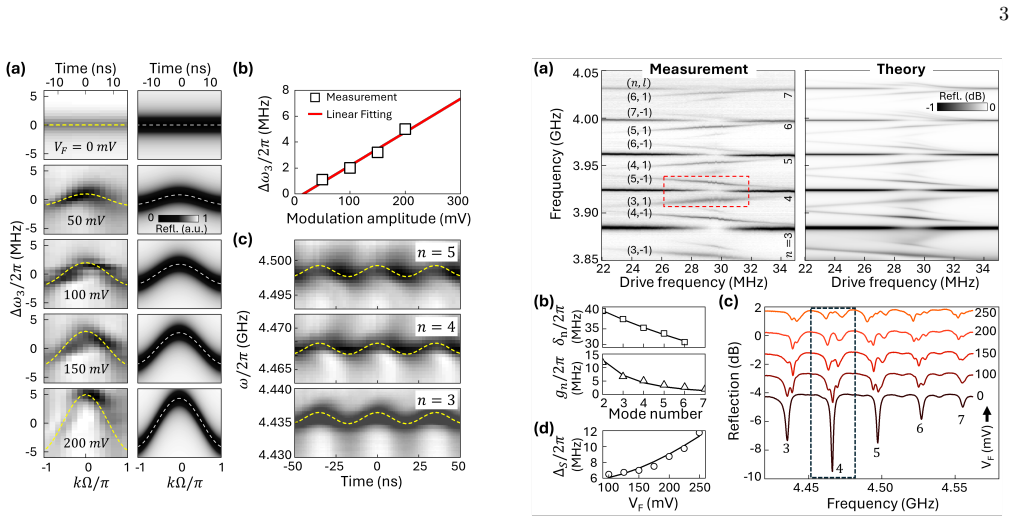
The central discovery is the experimental realization of a synthetic dimension in a magnonic system through Floquet-engineered couplings between discrete magnon modes in YIG, resulting in a tunable mode-space lattice that exhibits high-dimensional behaviors like Bloch oscillations.
What carries the argument
Floquet modulation of multimode magnon resonances to induce tunable couplings that form the synthetic lattice in frequency space.
Load-bearing premise
The Floquet modulation applied to the YIG magnon modes generates stable tunable couplings without introducing dominant losses or instabilities.
What would settle it
If the modulated system shows no evidence of mode coupling or lattice effects, such as missing Bloch oscillation signatures, the synthetic lattice formation would be disproven.
If this is right
- Electronically tunable interactions are created between discrete modes in a single device.
- A reconfigurable mode-space lattice is formed that supports Bloch oscillations.
- High-dimensional magnonic dynamics are achieved without increasing the device footprint.
- Synthetic dimensions provide a scalable and programmable route for integrated magnonic technologies.
Where Pith is reading between the lines
- This technique may allow engineering of other non-equilibrium phenomena in magnonic systems.
- Similar Floquet approaches could be adapted to different magnetic materials or device geometries.
- Programmable lattices might enable simulation of complex band structures on chip.
Editorial analysis
A structured set of objections, weighed in public.
Referee Report
Summary. The manuscript claims an experimental realization of a synthetic magnonic lattice in a single YIG device. Time-periodic Floquet modulation is used to couple discrete multimode magnon resonances in the frequency domain, creating a reconfigurable mode-space lattice that supports tunable interactions and dynamical phenomena such as Bloch oscillations, all without increasing physical device footprint.
Significance. If the experimental results hold, the work would be significant for magnonics and synthetic-dimension engineering. It demonstrates a route to high-dimensional magnonic dynamics and programmable emergent phenomena in low-loss insulators using only electronic control, addressing the patterning challenges of YIG and offering a scalable path for integrated magnonic circuits.
minor comments (1)
- The abstract states that the modulation produces 'stable, tunable couplings' without 'dominant unwanted losses or instabilities,' but the provided text contains no figures, spectra, time traces, or quantitative error analysis to evaluate this central experimental condition.
Simulated Author's Rebuttal
We thank the referee for reviewing our manuscript. The report acknowledges the potential significance of our experimental demonstration of a reconfigurable synthetic magnonic lattice in YIG via Floquet engineering, if the results hold. No specific major comments were provided in the report.
Circularity Check
No significant circularity; experimental demonstration only
full rationale
The paper reports an experimental realization of synthetic magnonic lattices via time-periodic Floquet modulation on multimode YIG resonances. No derivation chain, fitted parameters, or theoretical predictions are presented that could reduce to inputs by construction. The central claims rest on direct experimental observations of tunable couplings and phenomena such as Bloch oscillations, with no self-definitional steps, self-citation load-bearing arguments, or ansatzes smuggled via prior work. The work is self-contained as an empirical result against external benchmarks.
Axiom & Free-Parameter Ledger
Cite this review
Pith. "Pith review of Experimental Realization of Synthetic Magnonic Lattice via Floquet Engineering." pith.science (2026). https://pith.science/paper/FLQJRDLH
@misc{pith2026260630845,
  author       = {Pith},
  title        = {Pith review of: Experimental Realization of Synthetic Magnonic Lattice via Floquet Engineering},
  year         = {2026},
  howpublished = {\url{https://pith.science/paper/FLQJRDLH}},
  note         = {Machine review of arXiv:2606.30845}
}
read the original abstract
Magnonic systems, which exploit spin-wave excitations in magnetic materials, offer a promising platform for coherent information processing due to their low dissipation, strong nonlinearities, and intrinsic nonreciprocity. However, scaling magnonic circuits remains challenging, particularly with low-loss insulators such as yttrium iron garnet (YIG), which are difficult to pattern. Here, we experimentally realize a synthetic dimension in a magnonic system by coupling multimode magnon resonances in the frequency domain using time-periodic Floquet modulation. This approach enables electronically tunable interactions between discrete modes within a single YIG device, forming a reconfigurable mode-space lattice that supports functionalities such as Bloch oscillation. Our results demonstrate that high-dimensional magnonic dynamics can be achieved without increasing device footprint, establishing synthetic dimensions as a scalable and programmable route for integrated magnonic technologies. This advancement positions magnonic systems as promising platforms for engineering emergent phenomena that are inaccessible at equilibrium.
Figures


Reference graph
Works this paper leans on
-
[1]
Y. Li, W. Zhang, V. Tyberkevych, W.-K. Kwok, A. Hoff- mann, and V. Novosad, Hybrid magnonics: Physics, cir- cuits, and applications for coherent information process- ing, Journal of Applied Physics128, 130902 (2020)
work page 2020
-
[2]
D. D. Awschalom, C. R. Du, R. He, F. J. Heremans, A. Hoffmann, J. Hou, H. Kurebayashi, Y. Li, L. Liu, V. Novosad, J. Sklenar, S. E. Sullivan, D. Sun, H. Tang, V. Tyberkevych, C. Trevillian, A. W. Tsen, L. R. Weiss, W. Zhang, X. Zhang, L. Zhao, and C. W. Zollitsch, Quan- tum engineering with hybrid magnonic systems and ma- terials (invited paper), IEEE Tra...
work page 2021
-
[3]
B. Bhoi and S.-K. Kim, Chapter two - roadmap for photon-magnon coupling and its applications (Academic Press, 2020) pp. 39–71
work page 2020
-
[4]
M. Harder and C.-M. Hu, Chapter two - cavity spintron- ics: An early review of recent progress in the study of magnon–photon level repulsion (Academic Press, 2018) pp. 47–121
work page 2018
-
[5]
D. Lachance-Quirion, Y. Tabuchi, A. Gloppe, K. Usami, and Y. Nakamura, Hybrid quantum systems based on magnonics, Applied Physics Express12, 070101 (2019)
work page 2019
-
[6]
A. V. Chumak, Magnon spintronics: Fundamentals of magnon-based computing (CRC Press, Boca Raton, FL,
-
[7]
2nd ed., Chap. 6, pp. 247–302
-
[8]
B. Flebus, D. Grundler, B. Rana, Y. Otani, I. Bar- sukov, A. Barman, G. Gubbiotti, P. Landeros, J. Aker- man, U. Ebels, P. Pirro, V. E. Demidov, K. Schultheiss, G. Csaba, Q. Wang, F. Ciubotaru, D. E. Nikonov, P. Che, R. Hertel, T. Ono, D. Afanasiev, J. Mentink, T. Rasing, B. Hillebrands, S. V. Kusminskiy, W. Zhang, C. R. Du, A. Finco, T. van der Sar, Y. K...
work page 2024
-
[9]
B. Zare Rameshti, S. Viola Kusminskiy, J. A. Haigh, K. Usami, D. Lachance-Quirion, Y. Nakamura, C.-M. Hu, H. X. Tang, G. E. Bauer, and Y. M. Blanter, Cavity magnonics, Physics Reports979, 1 (2022)
work page 2022
-
[10]
X. Zhang, A review of common materials for hybrid quan- tum magnonics, Materials Today Electronics5, 100044 (2023)
work page 2023
-
[11]
X. Zhang, C.-L. Zou, L. Jiang, and H. X. Tang, Strongly coupled magnons and cavity microwave photons, Physi- cal Review Letters113, 156401 (2014)
work page 2014
-
[12]
O. O. Soykal and M. E. Flatt´ e, Strong field interactions between a nanomagnet and a photonic cavity, Physical Review Letters104, 077202 (2010)
work page 2010
-
[13]
M. Goryachev, W. G. Farr, D. L. Creedon, Y. Fan, M. Kostylev, and M. E. Tobar, High-cooperativity cav- ity qed with magnons at microwave frequencies, Physical Review Applied2, 054002 (2014)
work page 2014
-
[14]
J. A. Haigh, S. Langenfeld, N. J. Lambert, J. J. Baum- berg, A. J. Ramsay, A. Nunnenkamp, and A. J. Fer- guson, Magneto-optical coupling in whispering-gallery- mode resonators, Physical Review A92, 063845 (2015)
work page 2015
-
[15]
X. Zhang, C.-L. Zou, L. Jiang, and H. X. Tang, Cavity magnomechanics, Science Advances2, 1501286 (2016)
work page 2016
-
[16]
Q. Wang, M. Kewenig, M. Schneider, R. Verba, F. Kohl, B. Heinz, M. Geilen, M. Mohseni, B. L¨ agel, F. Ciub- otaru, C. Adelmann, C. Dubs, S. D. Cotofana, O. V. Dobrovolskiy, T. Br¨ acher, P. Pirro, and A. V. Chumak, A magnonic directional coupler for integrated magnonic half-adders, Nature Electronics3, 765 (2020)
work page 2020
- [17]
-
[18]
A. V. Chumak, P. Kabos, M. Wu, C. Abert, C. Adel- mann, A. O. Adeyeye, J. ˚Akerman, F. G. Aliev, A. Anane, A. Awad, C. H. Back, A. Barman, G. E. W. Bauer, M. Becherer, E. N. Beginin, V. A. S. V. Bit- tencourt, Y. M. Blanter, P. Bortolotti, I. Boventer, D. A. Bozhko, S. A. Bunyaev, J. J. Carmiggelt, R. R. Cheenikundil, F. Ciubotaru, S. Cotofana, G. Csaba, ...
work page 2022
- [19]
-
[20]
L. K¨ orber, C. Heins, T. Hula, J.-V. Kim, S. Thlang, H. Schultheiss, J. Fassbender, and K. Schultheiss, Pat- tern recognition in reciprocal space with a magnon- scattering reservoir, Nature Communications14, 3954 (2023)
work page 2023
-
[21]
D. D. Yaremkevich, A. V. Scherbakov, L. De Clerk, S. M. Kukhtaruk, A. Nadzeyka, R. Campion, A. W. Rush- forth, S. Savel’ev, A. G. Balanov, and M. Bayer, On-chip phonon-magnon reservoir for neuromorphic computing, Nature Communications14, 8296 (2023)
work page 2023
- [22]
-
[23]
N. Crescini, D. Alesini, C. Braggio, G. Carugno, D. D’Agostino, D. Di Gioacchino, P. Falferi, U. Gam- bardella, C. Gatti, G. Iannone, C. Ligi, A. Lombardi, A. Ortolan, R. Pengo, G. Ruoso, and L. Taffarello (QUAX Collaboration), Axion search with a quantum- limited ferromagnetic haloscope, Physical Review Letters 124, 171801 (2020)
work page 2020
-
[24]
T. Trickle, Z. Zhang, and K. M. Zurek, Detecting light dark matter with magnons, Physical Review Letters124, 201801 (2020)
work page 2020
- [25]
-
[26]
J. F. Barry, R. A. Irion, M. H. Steinecker, D. K. Freeman, J. J. Kedziora, R. G. Wilcox, and D. A. Braje, Ferrimag- netic oscillator magnetometer, Physical Review Applied 19, 044044 (2023)
work page 2023
-
[27]
D. Matatagui, O. V. Kolokoltsev, N. Qureshi, E. V. Mej´ ıa-Uriarte, C. L. Ordo˜ nez-Romero, A. V´ azquez- Olmos, and J. M. Saniger, Magnonic sensor array based on magnetic nanoparticles to detect, discriminate and classify toxic gases, Sensors and Actuators B: Chemical 240, 497 (2017)
work page 2017
- [28]
- [29]
-
[30]
D. Lachance-Quirion, Y. Tabuchi, S. Ishino, A. Noguchi, T. Ishikawa, R. Yamazaki, and Y. Nakamura, Resolving quanta of collective spin excitations in a millimeter-sized ferromagnet, Science Advances3, 1603150 (2017)
work page 2017
-
[31]
D. Lachance-Quirion, S. P. Wolski, Y. Tabuchi, S. Kono, K. Usami, and Y. Nakamura, Entanglement-based single- shot detection of a single magnon with a superconducting qubit, Science367, 425 (2020)
work page 2020
-
[32]
Y. Tabuchi, S. Ishino, T. Ishikawa, R. Yamazaki, K. Usami, and Y. Nakamura, Hybridizing ferromagnetic magnons and microwave photons in the quantum limit, Physical Review Letters113, 083603 (2014)
work page 2014
-
[33]
Y. Tabuchi, S. Ishino, A. Noguchi, T. Ishikawa, R. Ya- mazaki, K. Usami, and Y. Nakamura, Coherent coupling between a ferromagnetic magnon and a superconducting qubit, Science349, 405 (2015)
work page 2015
- [34]
-
[35]
S. P. Wolski, D. Lachance-Quirion, Y. Tabuchi, S. Kono, A. Noguchi, K. Usami, and Y. Nakamura, Dissipation- based quantum sensing of magnons with a superconduct- ing qubit, Physical Review Letters125, 117701 (2020)
work page 2020
-
[36]
A. Rashedi, M. Ebrahimi, Y. Huang, M. J. Rudd, V. A. S. V. Bittencourt, and J. P. Davis, Photonic crystal cav- ities based on suspended yttrium iron garnet nanobeams (2025), arXiv:2412.05361
-
[37]
F. Heyroth, C. Hauser, P. Trempler, P. Geyer, F. Sy- rowatka, R. Dreyer, S. Ebbinghaus, G. Wolters- dorf, and G. Schmidt, Monocrystalline freestanding three-dimensional yttrium-iron-garnet magnon nanores- onators, Physical Review Applied12, 054031 (2019)
work page 2019
-
[38]
P. Trempler, R. Dreyer, P. Geyer, C. Hauser, G. Wolters- dorf, and G. Schmidt, Integration and characterization of micron-sized YIG structures with very low Gilbert damp- ing on arbitrary substrates, Applied Physics Letters117, 232401 (2020)
work page 2020
-
[39]
P. G. Baity, D. A. Bozhko, R. Macˆ edo, W. Smith, R. C. Holland, S. Danilin, V. Seferai, J. Barbosa, R. R. Peroor, S. Goldman, U. Nasti, J. Paul, R. H. Hadfield, S. McVi- tie, and M. Weides, Strong magnon–photon coupling with chip-integrated YIG in the zero-temperature limit, Ap- plied Physics Letters119, 033502 (2021)
work page 2021
- [40]
-
[41]
A. V. Chumak, A. A. Serga, and B. Hillebrands, Magnon transistor for all-magnon data processing, Nature Com- munications5, 4700 (2014)
work page 2014
-
[42]
L. Yuan, Q. Lin, M. Xiao, and S. Fan, Synthetic Dimen- sion in Photonics, Optica5, 1396 (2018)
work page 2018
-
[43]
M. Ehrhardt, S. Weidemann, L. J. Maczewsky, M. Hein- rich, and A. Szameit, A perspective on synthetic di- mensions in photonics, Laser & Photonics Reviews17, 2200518 (2023)
work page 2023
-
[44]
L. Yuan, Y. Shi, and S. Fan, Photonic gauge potential in a system with a synthetic frequency dimension, Optics Letters41, 741 (2016)
work page 2016
- [45]
-
[46]
B. T. T. Wong, S. Yang, Z. Pang, and Y. Yang, Synthetic non-abelian electric fields and spin-orbit coupling in pho- tonic synthetic dimensions, Physical Review Letters134, 163803 (2025)
work page 2025
-
[47]
M. Ehrhardt, R. Keil, L. J. Maczewsky, C. Dittel, M. Heinrich, and A. Szameit, Exploring complex graphs using three-dimensional quantum walks of correlated photons, Science Advances7, 5266 (2021)
work page 2021
-
[48]
X.-W. Luo, X. Zhou, C.-F. Li, J.-S. Xu, G.-C. Guo, and Z.-W. Zhou, Quantum simulation of 2D topological physics in a 1D array of optical cavities, Nature Commu- nications6, 7704 (2015)
work page 2015
-
[49]
A. Dutt, Q. Lin, L. Yuan, M. Minkov, M. Xiao, and S. Fan, A single photonic cavity with two independent physical synthetic dimensions, Science367, 59 (2020)
work page 2020
-
[50]
M. Mancini, G. Pagano, G. Cappellini, L. Livi, M. Rider, J. Catani, C. Sias, P. Zoller, M. Inguscio, M. Dalmonte, and L. Fallani, Observation of chiral edge states with neutral fermions in synthetic Hall ribbons, Science349, 1510 (2015)
work page 2015
-
[51]
N. R. A. Lee, M. Pechal, E. A. Wollack, P. Arrangoiz- Arriola, Z. Wang, and A. H. Safavi-Naeni, Propagation of microwave photons along a synthetic dimension, Physical Review A101, 053807 (2020)
work page 2020
-
[52]
Z.-C. Xiang, K. Huang, Y.-R. Zhang, T. Liu, Y.-H. Shi, C.-L. Deng, T. Liu, H. Li, G.-H. Liang, Z.-Y. Mei, H. Yu, G. Xue, Y. Tian, X. Song, Z.-B. Liu, K. Xu, D. Zheng, F. Nori, and H. Fan, Simulating Chern insulators on a superconducting quantum processor, Nature Communi- cations14, 5433 (2023)
work page 2023
-
[53]
M. Xu, C. Hua, Y. Chen, and W. Yu, Frequency modu- lation on magnons in synthetic dimensions, Nature Com- munications16, 3356 (2025)
work page 2025
-
[54]
J. Xu, C. Zhong, X. Han, D. Jin, L. Jiang, and X. Zhang, Floquet cavity electromagnonics, Physical Review Let- ters125, 237201 (2020)
work page 2020
-
[55]
A. Pishehvar, Z. Wang, Y. Zhu, Y. Jiang, Z. Yan, F. Li, J. M. Jornet, J.-M. Hu, L. Jiang, and X. Zhang, On- demand magnon resonance isolation in cavity magnonics, Physical Review Applied23, 024053 (2025)
work page 2025
-
[56]
A. Pishehvar, Z. Yan, Z. Wang, Y. Jiang, Y. Huang, J. M. Jornet, L. Jiang, and X. Zhang, Resonance-enhanced flo- quet cavity electromagnonics, Physical Review Applied 24, 014026 (2025)
work page 2025
-
[57]
Z. Li, J. Sun, and F. Ma, Floquet engineering of selective magnon–magnon coupling in synthetic antiferromagnets, Applied Physics Letters123, 232406 (2023)
work page 2023
-
[58]
See Supplemental Material for theoretical derivations and experimental details, which includes Refs. [60–64]
-
[59]
A. Dutt, M. Minkov, Q. Lin, L. Yuan, D. A. B. Miller, and S. Fan, Experimental band structure spectroscopy along a synthetic dimension, Nature Communications10, 3122 (2019)
work page 2019
-
[60]
X. Zhang, C.-L. Zou, N. Zhu, F. Marquardt, L. Jiang, and H. X. Tang, Magnon dark modes and gradient memory, Nature Communications6, 8914 (2015)
work page 2015
-
[61]
K. Y. Guslienko, and A. N. Slavin, Magnetostatic Green’s functions for the description of spin waves in finite rect- angular magnetic dots and stripes, Journal of Magnetism and Magnetic Materials323, 2418 (2011)
work page 2011
-
[62]
J. Jorzick, S. O. Demokritov, C. Mathieu, B. Hillebrands, B. Bartenlian, C. Chappert, F. Rousseaux, and A. N. Slavin, Brillouin light scattering from quantized spin waves in micron-size magnetic wires, Physical Review B 60, 15194 (1999)
work page 1999
-
[63]
J. R. Eshbach, and R. W. Damon, Surface magnetostatic modes and surface spin waves, Physical Review118, 1208 (1960)
work page 1960
-
[64]
J. D. Jackson, Classical Electrodynamics (John Wiley & Sons, 2021)
work page 2021
-
[65]
Experimental Realization of Synthetic Magnonic Lattice via Floquet Engineering
M. J. Hurben, and C. E. Patton, Theory of magnetostatic waves for in-plane magnetized isotropic films, Journal of Magnetism and Magnetic Materials139, 263 (1995). 8 Supplemental Material for “Experimental Realization of Synthetic Magnonic Lattice via Floquet Engineering” S1 THEORETICAL MODELS S1.1 Hamiltonian Model S1.1.1. Hamiltonian model and reflection...
work page 1995
discussion (0)
Sign in with ORCID, Apple, or X to comment. Anyone can read and Pith papers without signing in.