Carbon encapsulation of levitated Au nanoparticles
Pith reviewed 2026-07-01 01:26 UTC · model grok-4.3
The pith
Levitated gold nanoparticles acquire a graphene-like carbon barrier during repeated laser heating in vacuum.
A machine-rendered reading of the paper's core claim, the machinery that carries it, and where it could break.
Core claim
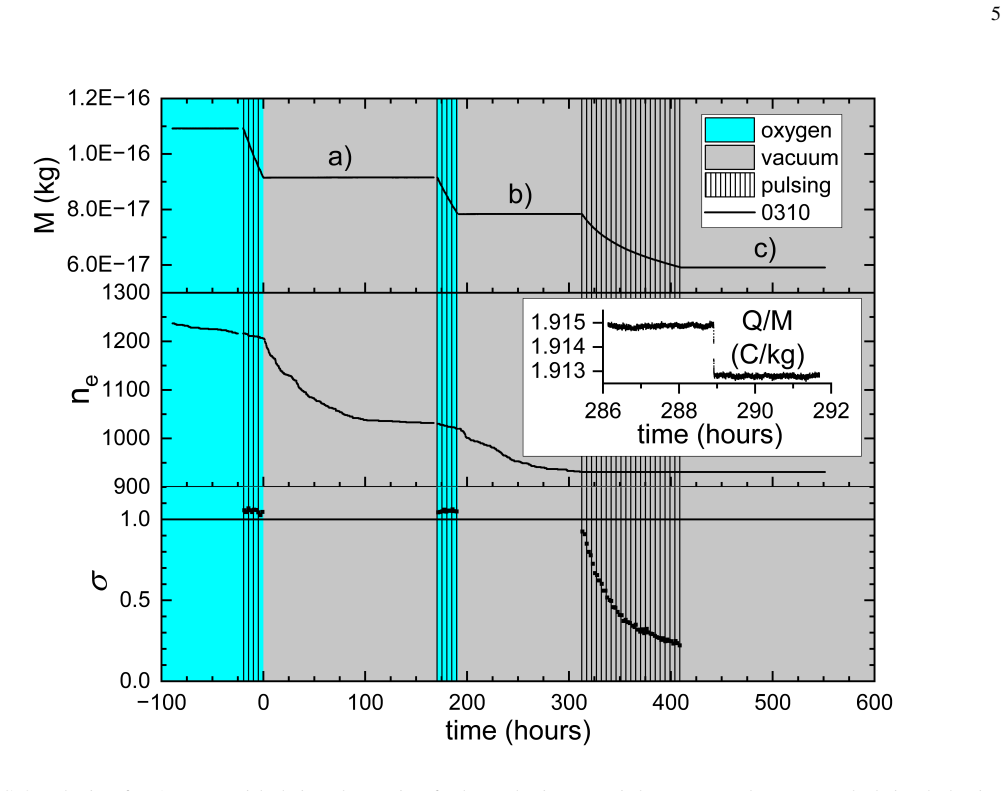
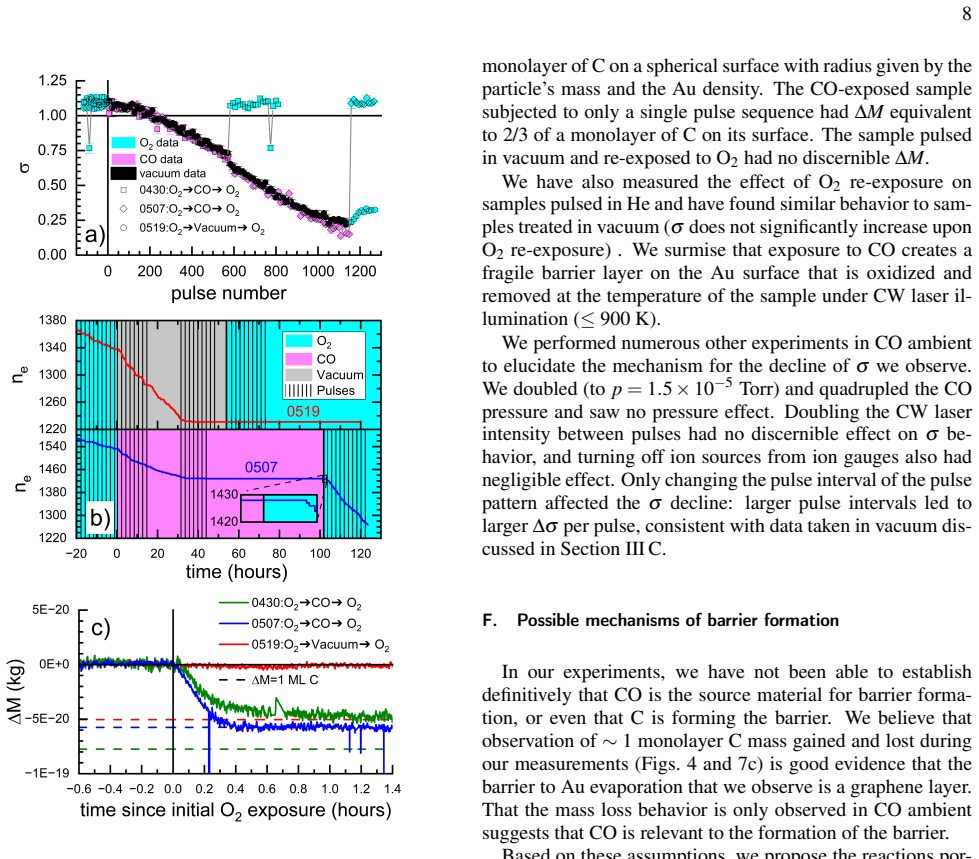
When levitated nanoscale Au particles are repeatedly heated with 532 nm laser pulses in high vacuum, they develop a barrier to evaporation observed as a slow mass increase. For particles exposed to CO, subsequent O2 exposure causes rapid mass decrease. These findings are consistent with growth and oxidation of a graphene layer on the Au. The rate of barrier formation does not depend on the pressure of carbon-containing gases added to the chamber. The authors hypothesize that a rare surface state on the solid Au particle catalyzes the reaction introducing C, with repeated laser pulse heating necessary to enable diffusion away from this state or to create fresh states allowing continued C upta
What carries the argument
A rare surface state on the solid Au particle that catalyzes carbon introduction, with repeated laser pulse heating required to enable diffusion or create fresh states for growth of the surface graphene layer.
If this is right
- The barrier forms and thickens independently of the pressure of added carbon-containing gases.
- Oxidation by O2 exposure removes the barrier and permits rapid subsequent evaporation.
- Repeated laser heating is required to sustain carbon uptake beyond what occurs in the initial exposure period.
- The process occurs in high vacuum even without deliberate addition of carbon gases.
Where Pith is reading between the lines
- The same levitation and laser-heating method could be applied to other metals to test whether similar rare surface states enable carbon encapsulation.
- If the catalytic states are defects or specific facets, particle preparation or size distribution might be used to control barrier growth rate.
- The technique isolates surface processes from substrate effects, allowing cleaner tests of vacuum surface catalysis on nanoparticles.
Load-bearing premise
The slow mass increase and rapid mass loss upon O2 exposure are caused by formation and oxidation of a graphene barrier layer rather than adsorption of contaminants, charge loss, or changes in particle shape.
What would settle it
Finding that mass changes continue at the same rate when all carbon-containing gases are eliminated from the chamber, or that O2 exposure produces no mass loss after barrier acquisition, would contradict the graphene-layer interpretation.
Figures





read the original abstract
We investigate the formation of a barrier to evaporation that develops when levitated nanoscale Au nanoparticles are exposed to pulses of 532 nm laser radiation in a high vacuum (pressure $p=10^{-8}-10^{-7}$ Torr) environment. Our data are derived from precision measurements of the charge to mass ratio ($Q/M$) of $\sim$200 nm diameter Au particles confined in a quadrupole ion trap. We characterize the development of the barrier over time as the particle is repeatedly heated with laser pulses and determine the impact of variations of the interval between pulses and of exposure to several gases added to the vacuum chamber. We observe a slow increase in the mass of particles upon prolonged exposure to the vacuum, which we attribute to the growth of a barrier layer. For particles that have acquired a barrier during exposure to CO, we observe a rapid decrease in their mass upon subsequent exposure to O$_2$. These findings are consistent with the growth and subsequent oxidation of a graphene layer on the Au that forms the barrier to evaporation. However, we have not found that the rate of formation of the barrier depends on the pressure of carbon-containing gases (CO, C$_2$H$_4$, CO$_2$) we have added to the chamber. We hypothesize that a rare surface state on the solid Au particle catalyzes the reaction that introduces C to the particle. Repeated laser pulse heating is necessary--either to enable diffusion away from this state or to create fresh states that allow continued C uptake--to facilitate the growth of the surface graphene layer.
Editorial analysis
A structured set of objections, weighed in public.
Referee Report
Summary. The paper reports precision Q/M measurements on ~200 nm levitated Au nanoparticles in a quadrupole ion trap under high vacuum (10^{-8}-10^{-7} Torr). Repeated 532 nm laser pulses produce a slow mass increase attributed to growth of a graphene barrier layer; subsequent O2 exposure after CO exposure produces rapid mass loss attributed to oxidation of that layer. The formation rate shows no dependence on added carbon-gas pressures (CO, C2H4, CO2), leading to the hypothesis that a rare surface catalytic state on solid Au, activated by laser pulsing, supplies the carbon.
Significance. If the attribution of the observed Q/M shifts to reversible graphene encapsulation holds, the result would demonstrate a laser-enabled surface-state mechanism for carbon uptake on Au that is independent of ambient carbon-gas pressure, with potential implications for nanoparticle passivation and vacuum surface chemistry. The work provides high-precision, time-resolved mass tracking in a levitated-particle platform, but the central claim rests on consistency arguments rather than direct structural verification or exclusion of alternatives.
major comments (3)
- [Abstract] Abstract (final paragraph) and main text: the claim that slow mass gain followed by rapid O2-induced loss reflects growth and oxidation of a graphene barrier is load-bearing for the surface-state catalysis hypothesis, yet no spectroscopy, Raman, or post-experiment imaging is reported to confirm the layer is graphitic carbon rather than other adsorbates.
- [Abstract] Abstract: the reported absence of dependence on added CO/C2H4/CO2 pressures directly contradicts the expectation that carbon uptake should be limited by gas-phase carbon supply; this forces the ad-hoc invocation of a 'rare surface state' whose activity requires laser pulsing, but no independent test (e.g., varying pulse energy or repetition rate while holding pressure fixed) is described to support that mechanism.
- Throughout: Q/M changes can arise from charge-state jumps or altered effective potential due to particle shape/charge distribution without net mass change; the manuscript presents no controls (e.g., simultaneous charge monitoring, shape imaging, or trap-parameter variation) to exclude these alternatives to the mass-increase interpretation.
minor comments (1)
- [Abstract] The abstract states the pressure range but does not specify the typical number of particles or total observation time per particle; adding these details would clarify the statistical basis of the reported trends.
Simulated Author's Rebuttal
We thank the referee for their careful reading of the manuscript and for highlighting these important points regarding the strength of our interpretations. We respond to each major comment below.
read point-by-point responses
-
Referee: [Abstract] Abstract (final paragraph) and main text: the claim that slow mass gain followed by rapid O2-induced loss reflects growth and oxidation of a graphene barrier is load-bearing for the surface-state catalysis hypothesis, yet no spectroscopy, Raman, or post-experiment imaging is reported to confirm the layer is graphitic carbon rather than other adsorbates.
Authors: We agree that the identification of the layer as graphitic carbon rests on consistency with the observed mass dynamics and gas-exposure responses rather than direct structural evidence. The manuscript already qualifies the claim with 'consistent with' and 'we hypothesize,' but we will revise the abstract and relevant sections to further emphasize the interpretive nature of the attribution, explicitly note the absence of spectroscopic confirmation, and discuss alternative adsorbates as possible explanations. This is a genuine limitation of the present study, which prioritizes in-situ mass tracking over ex-situ characterization. revision: partial
-
Referee: [Abstract] Abstract: the reported absence of dependence on added CO/C2H4/CO2 pressures directly contradicts the expectation that carbon uptake should be limited by gas-phase carbon supply; this forces the ad-hoc invocation of a 'rare surface state' whose activity requires laser pulsing, but no independent test (e.g., varying pulse energy or repetition rate while holding pressure fixed) is described to support that mechanism.
Authors: The pressure independence is the central experimental result that motivates the rare-surface-state hypothesis; the data show that mass gain requires repeated laser pulsing even when carbon-containing gases are present. We did vary the interval between pulses (affecting effective repetition rate) at fixed pressure and observed corresponding changes in uptake rate. We did not, however, perform a dedicated scan of pulse energy at constant pressure and repetition rate. We will revise the text to clarify the existing pulse-interval data, better motivate why the surface-state picture follows from the observations, and note the suggested pulse-energy test as a valuable direction for future work rather than claiming it has already been done. revision: partial
-
Referee: [—] Throughout: Q/M changes can arise from charge-state jumps or altered effective potential due to particle shape/charge distribution without net mass change; the manuscript presents no controls (e.g., simultaneous charge monitoring, shape imaging, or trap-parameter variation) to exclude these alternatives to the mass-increase interpretation.
Authors: We attribute the gradual, reversible Q/M shifts to mass change because they correlate specifically with laser exposure history and subsequent gas exposures (slow gain, rapid O2-induced loss) in a manner that would be coincidental for charge jumps. In our quadrupole trap, charge on these particles is typically stable between deliberate charging events. Nevertheless, the referee correctly notes the lack of explicit controls. In revision we will add a dedicated paragraph discussing charge stability in the trap, the reproducibility of the trends across multiple particles, and why alternative explanations are less parsimonious, while acknowledging that direct controls (e.g., independent charge monitoring or in-situ imaging) were not performed. revision: partial
Circularity Check
No circularity: purely observational attribution of mass changes to hypothesized graphene layer
full rationale
The paper reports direct Q/M measurements on levitated Au particles under laser pulsing and gas exposure. Slow mass increase is attributed to barrier growth and rapid O2-induced loss to oxidation, but this is an interpretive hypothesis grounded in external physical expectations about evaporation barriers rather than any equation, fit, or derivation that reduces to the data by construction. No self-citations, fitted parameters renamed as predictions, or ansatze appear in the provided text. The lack of dependence on added carbon-gas pressure is explicitly noted and leads to an open hypothesis about rare surface states, without any mathematical loop. The derivation chain is self-contained as experimental observation plus physical interpretation.
Axiom & Free-Parameter Ledger
axioms (1)
- domain assumption Changes in measured Q/M reflect changes in particle mass while charge remains constant
invented entities (2)
-
rare surface state on solid Au particle
no independent evidence
-
graphene layer on Au
no independent evidence
Reference graph
Works this paper leans on
-
[1]
Kane, B. E. , title =. 2010 , month =. doi:10.1103/PhysRevB.82.115441 , abstract =
-
[2]
and Kane,B
Nagornykh,Pavel and Coppock,Joyce E. and Kane,B. E. , title =. 2015 , doi =
2015
-
[3]
2017 , month =
Optical and magnetic measurements of gyroscopically stabilized graphene nanoplatelets levitated in an ion trap , author =. 2017 , month =
2017
-
[4]
Coppock and Pavel Nagornykh and Jacob P
Joyce E. Coppock and Pavel Nagornykh and Jacob P. J. Murphy and I. S. McAdams and Saimouli Katragadda and B. E. Kane , journal =. Dual-trap system to study charged graphene nanoplatelets in high vacuum , volume =. 2017 , doi =
2017
-
[5]
Optical Trapping and Optical Micromanipulation XV
Optical Trapping and Optical Micromanipulation XV. Optical Trapping and Optical Micromanipulation XV
-
[6]
Coppock and I
Joyce E. Coppock and I. S. McAdams and Jacob P. J. Murphy and Samuel Klueter and José Hannan and B. E. Kane , title =. Optical Trapping and Optical Micromanipulation XV, Proceedings of SPIE , editor =. 2018 , doi =
2018
-
[7]
Joyce Coppock and Quinn Waxter and José Hannan and Samuel Klueter and B.E. Kane , keywords =. High temperature measurements of levitated gold nanospheres derived from gold suspensions , journal =. 2021 , issn =. doi:10.1016/j.jqsrt.2021.107645 , note =
-
[8]
Coppock, Joyce and Waxter, Quinn and Wolle, Robert and Kane, B.E. , year =. Observation of undercooling in a levitated nanoscale liquid. doi:10.1021/acs.jpcc.2c04014 , note =
-
[9]
and Howder, Collin R
Bell, David M. and Howder, Collin R. and Johnson, Ryan C. and Anderson, Scott L. , title =. 2014 , doi =
2014
-
[10]
Buks, E. and Roukes, M. L. , journal =. Stiction, adhesion energy, and the. 2001 , month =. doi:10.1103/PhysRevB.63.033402 , note =
-
[12]
Soft-landing and optical characterization of a preselected single fluorescent particle on a tapered optical fiber , volume =
Markus Gregor and Alexander Kuhlicke and Oliver Benson , journal =. Soft-landing and optical characterization of a preselected single fluorescent particle on a tapered optical fiber , volume =. 2009 , doi =
2009
-
[13]
and Campbell, Charles T
Hemmingson, Stephanie L. and Campbell, Charles T. , title =. 2017 , doi =
2017
-
[15]
Ion optics with electrostatic lenses
Hinterberger, F. Ion optics with electrostatic lenses. CAS - CERN Accelerator School: Small Accelerators, Zeegse, The Netherlands 24 May - 2 Jun 2005. 2006. doi:10.5170/CERN-2006-012
-
[16]
and Abel, Bernd and Asmis, Knut R
Hoffmann, Benjamin and Esser, Tim K. and Abel, Bernd and Asmis, Knut R. , title =. 2020 , doi =
2020
-
[17]
Benjamin Hoffmann and Sophia Leippe and Knut R. Asmis , title =. 2024 , publisher =. doi:10.1080/00268976.2023.2210454 , abstract =
-
[18]
and Long, Bryan A
Howder, Collin R. and Long, Bryan A. and Gerlich, Dieter and Alley, Rex N. and Anderson, Scott L. , title =. 2015 , doi =
2015
-
[19]
Jacob, Georg and Groot-Berning, Karin and Wolf, Sebastian and Ulm, Stefan and Couturier, Luc and Dawkins, Samuel T. and Poschinger, Ulrich G. and Schmidt-Kaler, Ferdinand and Singer, Kilian , year =. Transmission microscopy with nanometer resolution using a deterministic single ion source , volume =. doi:10.1103/PhysRevLett.117.043001 , note =
-
[21]
Jakob, Alexander M. and Robson, Simon G. and Schmitt, Vivien and Mourik, Vincent and Posselt, Matthias and Spemann, Daniel and Johnson, Brett C. and Firgau, Hannes R. and Mayes, Edwin and McCallum, Jeffrey C. and Morello, Andrea and Jamieson, David N. , year =. Deterministic shallow dopant implantation in silicon with detection confidence upper-bound to 9...
-
[22]
2015 , doi =
Kuhlicke, Alexander and Rylke, Antonio and Benson, Oliver , title =. 2015 , doi =
2015
-
[23]
Lau, Chris Y. and Rodriguez, Daniel J. and Friese, Abigail M. and Anderson, Scott L. , title = ". 2023 , month =. doi:10.1063/5.0143948 , note =
-
[24]
Reiser, Alain and Schuh, Christopher A. , year =. Microparticle impact testing at high precision, higher temperatures, and with lithographically patterned projectiles , volume =. doi:10.1002/sia.3592 , note =
-
[25]
and Schell, Andreas W
Ricci, Francesco and Cuairan, Marc T. and Schell, Andreas W. and Hebestreit, Erik and Rica, Raúl A. and Meyer, Nadine and Quidant, Romain , title =. 2022 , doi =
2022
-
[26]
and Lau, Chris Y
Rodriguez, Daniel J. and Lau, Chris Y. and Friese, Abigail M. and Long, Bryan A. and Anderson, Scott L. , title =. 2022 , doi =
2022
-
[27]
Schönhense, G. and Spiecker, H. , title = ". 2002 , month =. doi:10.1116/1.1523373 , note =
-
[28]
Focusing a deterministic single-ion beam , volume =
Schnitzler, Wolfgang and Jacob, Georg and Fickler, Robert and Schmidt-Kaler, Ferdinand and Singer, Kilian , year =. Focusing a deterministic single-ion beam , volume =. doi:10.1088/1367-2630/12/6/065023 , note =
-
[29]
Tobalina, A. and Munuera-Javaloy, C. and Torrontegui, E. and Muga, J.G. and Casanova, J. , year =. Tailored ion beam for precise colour centre creation , volume =. doi:10.1098/rsta.2021.0271 , note =
-
[30]
Physical Review E , volume =
Li, Zhigang and Wang, Hai , title =. Physical Review E , volume =. 2003 , month =
2003
-
[31]
and Kane, B
Coppock, Joyce E. and Kane, B. E. , title =. 2024 , month =
2024
-
[32]
Lu, Chen-Hsuan and Shang, Kuang-Ming and Lee, Shi-Ri and Tai, Yu-Chong and Yeh, Nai-Chang , title =. 2022 , volume =. doi:10.1021/acsanm.2c00401 , issn =
-
[33]
2012 , doi =
Wu, Junchi and Shi, Wenwu and Chopra, Nitin , title =. 2012 , doi =
2012
-
[34]
Manipulating the functionalization surface of graphene-encapsulated gold nanoparticles with single-walled carbon nanotubes for SERS sensing , journal =. 2018 , issn =. doi:https://doi.org/10.1016/j.carbon.2018.08.068 , author =
-
[35]
How to fill or empty a graphitic onion , journal =. 1993 , issn =. doi:https://doi.org/10.1016/0009-2614(93)87208-K , author =
-
[36]
and Wilson, Robert J
Wi, Jung-Sub and Barnard, Edward S. and Wilson, Robert J. and Zhang, Mingliang and Tang, Mary and Brongersma, Mark L. and Wang, Shan X. , title =. ACS Nano , volume =. 2011 , doi =
2011
-
[37]
Kolar-Hofer, Pauline and Zampini, Giulia and Derntl, Christian Georg and Soprano, Enrica and Polo, Ester and del Pino, Pablo and Kereyeva, Nurgul and Eggeling, Moritz and Breth, Leoni and Haslinger, Michael J. and M. Fabrication of nanoparticles with precisely controllable plasmonic properties for biomedical applications , journal =. 2025 , volume =. doi:...
-
[38]
Nano Letters , volume =
Ju, Peng and Jin, Yuanbin and Shen, Kunhong and Duan, Yao and Xu, Zhujing and Gao, Xingyu and Ni, Xingjie and Li, Tongcang , title =. Nano Letters , volume =. 2023 , doi =
2023
-
[39]
, title =
Hung, Wei Hsuan and Aykol, Mehmet and Valley, David and Hou, Wenbo and Cronin, Stephen B. , title =. 2010 , doi =
2010
-
[40]
, title =
Hung, Wei Hsuan and Hsu, I-Kai and Bushmaker, Adam and Kumar, Rajay and Theiss, Jesse and Cronin, Stephen B. , title =. 2008 , doi =
2008
-
[41]
and Balci, Osman and Salihoglu, Omer and Kocabas, Coskun , title =
Oznuluer, Tuba and Pince, Ercag and Polat, Emre O. and Balci, Osman and Salihoglu, Omer and Kocabas, Coskun , title =. 2011 , month =
2011
-
[42]
, title =
Xu, Kun and Ye, Peide D. , title =. 2014 , doi =
2014
-
[43]
Watkins, William L. and Borensztein, Yves. Mechanism of hydrogen adsorption on gold nanoparticles and charge transfer probed by anisotropic surface plasmon resonance. Phys. Chem. Chem. Phys. 2017. doi:10.1039/C7CP04843B
-
[44]
and Cheng, Jin and Lassiter, J
Mukherjee, Shaunak and Libisch, Florian and Large, Nicholas and Neumann, Oara and Brown, Lisa V. and Cheng, Jin and Lassiter, J. Britt and Carter, Emily A. and Nordlander, Peter and Halas, Naomi J. , title =. 2013 , doi =
2013
-
[45]
and Large, Nicolas and Ayala-Orozco, Ciceron and Zhang, Yu and Nordlander, Peter and Halas, Naomi J
Mukherjee, Shaunak and Zhou, Linan and Goodman, Amanda M. and Large, Nicolas and Ayala-Orozco, Ciceron and Zhang, Yu and Nordlander, Peter and Halas, Naomi J. , title =. 2014 , doi =
2014
-
[46]
2024 , doi =
Ultrahigh quality factor of a levitated nanomechanical oscillator , author =. 2024 , doi =
2024
-
[47]
Kane, B. E. and Coppock, Joyce E. and Kim, Sunghyun and Westgate, Sarah , title =. 2026 , eprint =
2026
-
[48]
Kim, Sunghyun and Coppock, Joyce and Kane, B. E. , title =. 2026 , note =
2026
-
[49]
Coppock, Joyce and Kim, Sunghyun, and Westgate, Sarah and Kane, B. E. , title =. 2026 , note =
2026
-
[50]
Nano Letters , volume =
Takagi, Daisuke and Kobayashi, Yoshihiro and Hibino, Hiroki and Suzuki, Satoru and Homma, Yoshikazu , title =. Nano Letters , volume =. 2008 , doi =
2008
-
[51]
Abigail M. Friese and Audrey R. Burrows and Scott L. Anderson , abstract =. High and ultra-high temperature reaction kinetics by single nanoparticle mass spectrometry , journal =. 2025 , issn =. doi:https://doi.org/10.1016/j.ijms.2025.117435 , url =
-
[52]
Daniel J. Rodriguez and Chris Y. Lau and Bryan A. Long and Susanna An Tang and Abigail M. Friese and Scott L. Anderson , keywords =. O2-oxidation of individual graphite and graphene nanoparticles in the 1200–2200. 2021 , issn =. doi:https://doi.org/10.1016/j.carbon.2020.10.053 , url =
-
[53]
and Lau, Chris Y
Long, Bryan A. and Lau, Chris Y. and Rodriguez, Daniel J. and Tang, Susanna An and Anderson, Scott L. , title =. 2020 , doi =
2020
-
[54]
Terasawa, Tomo-o and Taira, Takanobu and Yasuda, Satoshi and Obata, Seiji and Saiki, Koichiro and Asaoka, Hidehito , title =. 2019 , month =. doi:10.7567/1347-4065/ab19ae , url =
-
[55]
C. B. Alcock and V. P. Itkin and M. K. Horrigan , title =. 1984 , publisher =. doi:10.1179/cmq.1984.23.3.309 , URL =
-
[56]
, title =
Song, Xiaowei and Lyu, Lecheng and Xu, Jinheng and Xing, Dong and Zhang, Xinxing and Zare, Richard N. , title =
-
[57]
Pamato, Martha G. and Wood, Ian G. and Dobson, David P. and Hunt, Simon A. and Vo c adlo, Lidunka. The thermal expansion of gold: point defect concentrations and pre-melting in a face-centred cubic metal. Journal of Applied Crystallography. 2018. doi:10.1107/S1600576718002248 , url =
-
[58]
, title =
Kar, Moumita and Schatz, George C. , title =. 2025 , doi =
2025
-
[59]
V. S. Gerasimov and A. E. Ershov and A. P. Gavrilyuk and S. V. Karpov and H. Suppression of surface plasmon resonance in. 2016 , url =. doi:10.1364/OE.24.026851 , abstract =
-
[60]
Barmparis, Georgios D. and Remediakis, Ioannis N. , journal =. Dependence on. 2012 , month =. doi:10.1103/PhysRevB.86.085457 , url =
-
[61]
Role of oxygen in laser-induced contamination at diamond-vacuum interfaces , author =. 2024 , month =. doi:10.1103/PhysRevApplied.22.024067 , url =
discussion (0)
Sign in with ORCID, Apple, or X to comment. Anyone can read and Pith papers without signing in.