Phenomenology of Long-Lived Dark Photons and Axion-Like Particles in a Mixed Portal Framework
Pith reviewed 2026-07-01 01:07 UTC · model grok-4.3
The pith
A mixed portal between dark photons and axion-like particles allows exotic cascades that convert long-lived states into displaced multi-photon events.
A machine-rendered reading of the paper's core claim, the machinery that carries it, and where it could break.
Core claim
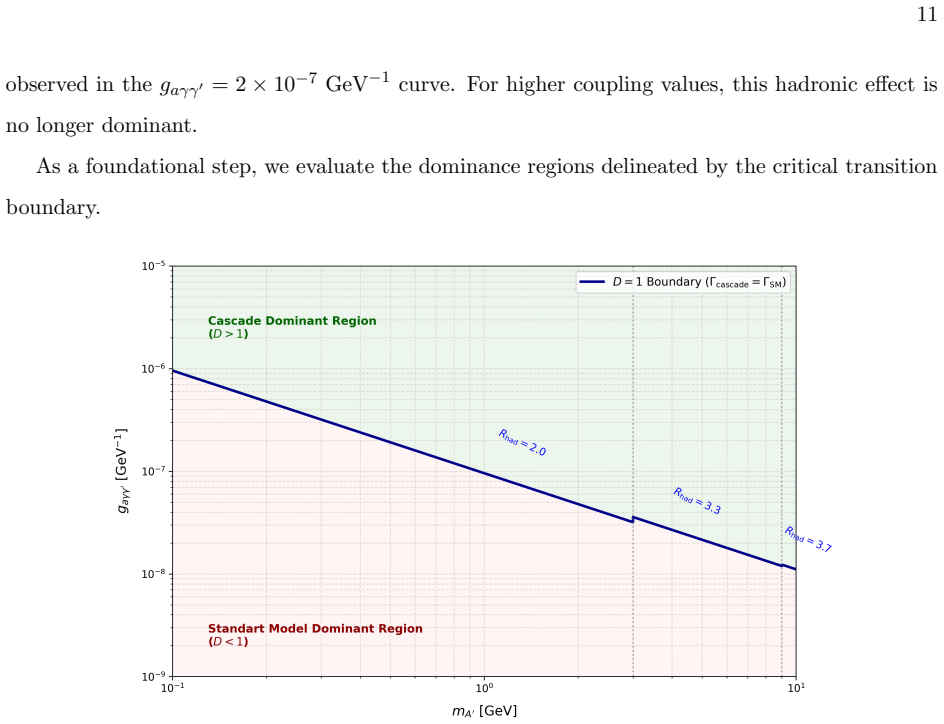
In the mixed portal framework the dark photon A' possesses two competing decay modes, the conventional A' to f f-bar and the cascade A' to a gamma to 3 gamma, whose relative strength is set by the dominance parameter D equal to the ratio of the exotic width to the Standard Model width. When D exceeds one the cascade dominates, shortening the boosted decay length and converting otherwise stable or invisible states into observable displaced multi-photon final states; the ALP can likewise behave as a long-lived particle yielding displaced diphoton signatures.
What carries the argument
The dominance parameter D = Gamma(A' to a gamma)/Gamma_SM that marks the boundary between Standard Model-dominated and cascade-dominated regimes in the mixed portal.
Load-bearing premise
The mixed portal is assumed to let both the ordinary visible decay and the exotic three-photon cascade occur at comparable or dominant rates without extra constraints that would suppress one channel.
What would settle it
Absence of displaced three-photon or diphoton vertices in the predicted mass and lifetime windows at a high-luminosity lepton collider such as the FCC-ee would falsify the mixed-portal long-lived-particle predictions.
Figures



read the original abstract
We investigate the phenomenology of a dark photon \(A'\) and an axion-like particle (ALP) ,\(a\), connected through a mixed portal framework which simultaneously allows the conventional visible decay $(A'\rightarrow f\bar f)$ and the exotic cascade process $(A'\rightarrow a\gamma\rightarrow3\gamma)$. We derive the relevant decay widths, branching ratios, and Lorentz-boosted decay lengths, and introduce a dominance parameter \(D=\Gamma(A'\to a\gamma)/\Gamma_{\rm SM}\) to distinguish Standard Model-dominated and cascade-dominated regions, with the transition occurring at $(D=1)$. A detailed analysis of both light $(0.1\leq m_{A'}\leq10~{\rm GeV})$ and heavy $(10\leq m_{A'}\leq100~{\rm GeV})$ dark-photon scenarios shows that the exotic channel can substantially modify the expected dark-photon signatures, transforming otherwise long-lived or detector-stable states into experimentally accessible displaced multi-photon events. In addition, the ALP sector itself may exhibit long-lived particle behavior, leading to distinct displaced diphoton signatures. Our results show that mixed dark-photon-ALP portals offer a rich LLP phenomenology that can be explored at future high-luminosity lepton colliders such as the FCC-ee.
Editorial analysis
A structured set of objections, weighed in public.
Referee Report
Summary. The manuscript investigates the phenomenology of a dark photon A' and an axion-like particle a in a mixed portal framework permitting both the conventional visible decay A' → f f-bar and the exotic cascade A' → a γ → 3γ. It derives the relevant decay widths, branching ratios, and Lorentz-boosted decay lengths via standard QFT techniques, introduces a dominance parameter D = Γ(A' → a γ)/Γ_SM to delineate SM-dominated (D < 1) and cascade-dominated (D > 1) regimes, and analyzes both light (0.1–10 GeV) and heavy (10–100 GeV) mass ranges, concluding that the exotic channel can convert otherwise long-lived or stable states into displaced multi-photon signatures while the ALP itself may yield displaced diphoton signals, all accessible at future lepton colliders such as the FCC-ee.
Significance. If the central claims hold, the work supplies a compact phenomenological parameterization that expands the LLP search space for dark-photon models by incorporating mixed ALP portals. The use of standard effective-field-theory methods for widths and boosted lengths, together with the explicit D-based regime separation, supplies a transparent and falsifiable framework that could directly inform experimental strategies at high-luminosity e+e− colliders.
minor comments (2)
- Abstract: the statement that the transition occurs at D=1 is clear, yet the manuscript should verify that the same numerical definition of D is applied uniformly when quoting boosted decay lengths in both the light and heavy mass regimes.
- The abstract refers to the 'mixed portal framework' without a one-sentence reminder of the underlying operators; adding this would improve accessibility for readers outside the immediate sub-field.
Simulated Author's Rebuttal
We thank the referee for the positive summary, significance assessment, and recommendation of minor revision. No major comments were listed in the report, so we provide no point-by-point responses below. We will incorporate any minor suggestions during revision.
Circularity Check
No significant circularity detected
full rationale
The paper sets up a phenomenological mixed-portal framework, derives standard EFT decay widths and boosted lengths, and defines the dominance parameter D explicitly as the ratio of partial widths to label SM-dominated vs. cascade-dominated regimes. All central claims about modified LLP signatures follow directly from these definitions plus Lorentz boosts, with no reduction of predictions to fitted inputs, no self-citation load-bearing steps, and no uniqueness theorems or ansatze smuggled in. The analysis remains self-contained within the assumed effective theory.
Axiom & Free-Parameter Ledger
free parameters (1)
- dominance parameter D
axioms (1)
- domain assumption The mixed portal allows both A' to f f-bar and A' to a gamma decays to be present at comparable rates without additional suppression mechanisms.
invented entities (1)
-
mixed portal framework
no independent evidence
Reference graph
Works this paper leans on
-
[1]
Jeanty, L. and Shuve, B. ”Long-lived particles: theory and experimental probes” ArXiv:2511.17934 (2025)
-
[2]
The CMS Collaboration, ”Search for light long-lived particles decaying to displaced jets in proton- proton collision at √s= 13.6 TeV” Rep. Prog. Phys.88,No: 3, 037801 (2025)
2025
-
[3]
Shah, A., ”Searches for long-lived particles with the ANUBIS experiment” Proceedings of Science, vol: EPS-HEP2023, 051 (2024)
2024
-
[4]
Verhaaren, C. B., et. al. ”Searches for long-lived particles at the future FCC-ee” Front. Phys.10, 967881 (2022)
2022
-
[5]
Alimena, J. et. al., ”Searching for long-lived particles beyond the Standard Model at the Large Hadron Collider”, J. Phys. G: Nucl. Part. Phys.47, 090501 (2020). 18
2020
-
[6]
Mathusla Collaboration. Alpigiani, C., et. al., ”An Update to the Letter of Intent for MATHUSLA: Search for Long-Lived Particles at the HL-LHC” ArXiv: 2009.01693
-
[7]
Cavanagh, C., et
Faser Collaboration. Cavanagh, C., et. al. ”FASER results on BSM physics”, Proceedings of Science, vol: LHCP2024, 039 (2024)
2024
-
[8]
V., Knapen, S., Papucci, M
Gligorov, V. V., Knapen, S., Papucci, M. and Robinson, D., ”Searching for long-lived particles: A compact detector for exotics at LHCb”, J. Phys. Rev. D.97, 015023 (2018)
2018
-
[9]
FASER Collaboration,”Search for Dark Photons with the FASER detector At the LHC”, Phys. Lett. B848, 138378 (2024)
2024
-
[10]
Bhattacherjee, B., Bose, C. et. al, ”Long-lived light mediators in a Higgs portal model at the FCC-ee”, Phys. Rev. D113, 035022 (2026)
2026
-
[11]
Chrzaszcz, M, Drewes, M. and Hajer, J. ”HECATE A long-lived particle detector concept for the FCC-ee or CEPC” ArXiv: 2011.01005
-
[12]
Alexander, J., et. al. ”Dark Sectors 2016 Workshop: Community Report” ArXiv:1608.08632 (2016)
work page internal anchor Pith review Pith/arXiv arXiv 2016
-
[13]
De Roeck, A.,”Searching for long-lived particles at the Large Hadron Collider and beyond” Philos Trans A Math Phys Eng Sci377(2161), 20190047 (2019)
2019
-
[14]
et.al., ” Search for long-lived particles using displaced vertices with low-momentum tracks in proton-proton collisions at √s= 13TeV.” J
The CMS Collaboration, Hayrapetyan, A. et.al., ” Search for long-lived particles using displaced vertices with low-momentum tracks in proton-proton collisions at √s= 13TeV.” J. High Energ. Phys.,191 (2026)
2026
-
[15]
and Lanfranchi, G
Fabbrichesi, M.i Gabrielli, E. and Lanfranchi, G. ”Physics of Dark Photon” Springer, Cham, (2021)
2021
-
[16]
P., Poireau, V
Lees, J. P., Poireau, V. et. al. ”Search for Invisible Decays of a Dark Photon Produced ine + e− Collisions at BaBar”, Phys. Rev. Lett.119, 131804 (2017)
2017
-
[17]
P., Poireau, V
Lees, J. P., Poireau, V. et. al. ” Search for a Dark Photon ine + e− Collisions at BaBar”, Phys. Rev. Lett.113, 201801 (2014)
2014
-
[18]
et.al., ”Dark matter targets for axion like particle searches” Phys Rev
Blinov, N. et.al., ”Dark matter targets for axion like particle searches” Phys Rev. D.100, 015049 (2019)
2019
-
[19]
”Two U(1)’s andϵcharge shifts”, Phys
Holdom, B. ”Two U(1)’s andϵcharge shifts”, Phys. Lett. B166, No:3, 196 (1986)
1986
-
[20]
G., Redondo, J
Irasstorza, I. G., Redondo, J. ”New experimental approaches in the search for axion-like particles” Progress in Particle and Nuclear Phys.102, 89 (2018)
2018
-
[21]
and Ringwald, A
Jaeckel, J. and Ringwald, A. ”The Low-Energy Frontier of Particle Physics”, Ann. Rev. Nucl. Part. Sci.,60, 405 (2010)
2010
-
[22]
Arvanitaki, A., et. al. ”String Axiverse”, Phys. Rev. D.,81, 123530 (2010)
2010
-
[23]
and Thamm
Bauer, M., Neubert, M. and Thamm. A, ”Collider probes of axion-like particles” JHEP,12, 044 (2017)
2017
-
[24]
” ALPs at Colliders”, JHEP2015, 173 (2015)
Mimasu, K., Sanz, V. ” ALPs at Colliders”, JHEP2015, 173 (2015)
2015
-
[25]
Lee, H.-S, and Yun, S
Kaneta, K. Lee, H.-S, and Yun, S. ”Portal Connecting Dark Photons and Axions”, Phys. Rev. Lett. 118, 101802 (2017)
2017
-
[26]
S., and Seo, M
DeNiverville, P., Lee, H. S., and Seo, M. S. ”Implications of the dark axion portal for the muon g-2, B factories, fixed target neutrino experiments, and beam dumps”, Phys. Rev. D98, 115011 (2018). 19
2018
-
[27]
FCC Collaboration, ”Future Circular Collider Feasibility Study Report, Volume 1 Physics, Experi- ments, Detectors”, Eur. Phys. J. C,85, 1468 (2025)
2025
-
[28]
and Williams, M
Graham, M., Hearty, C. and Williams, M. ”Searches for Dark Photons at Accelerators”, Ann. Rev. Nucl. Part. Sci.71, 37 (2021)
2021
-
[29]
Navas, et
S. Navas, et. al. (Particle Data Group), ” Review of Particle Physics” Phys. Rev. D.110, 030001, (2024)
2024
-
[30]
F, and Nugroho, C
Chen, C.R, Hsieh, Y. F, and Nugroho, C. S., ”Impacts of ALP on the Constraints of Dark Photon”, Progress of Theoretical and Experimental Physics,2026, 1 (2026)
2026
-
[31]
Beacham, J., et. al. ”Physics beyond colliders at CERN: beyond the Standard Model working group report”, J. Phys. G: Nucl. Part. Phys.47, 010501 (2020)
2020
-
[32]
FCC Collaboration, ”FCC Physics Opportunities” Eur. Phys. J. C79, 474 (2019)
2019
discussion (0)
Sign in with ORCID, Apple, or X to comment. Anyone can read and Pith papers without signing in.