Complementary Probes of Light Higgsinos: Electroweak Precision Measurements and Dark Matter Direct Detection
Pith reviewed 2026-07-01 00:49 UTC · model grok-4.3
The pith
Future electroweak precision measurements can probe light higgsinos up to 500 GeV even in compressed spectra where direct detection loses sensitivity.
A machine-rendered reading of the paper's core claim, the machinery that carries it, and where it could break.
Core claim
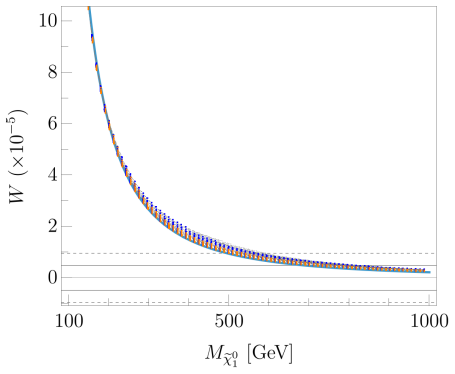
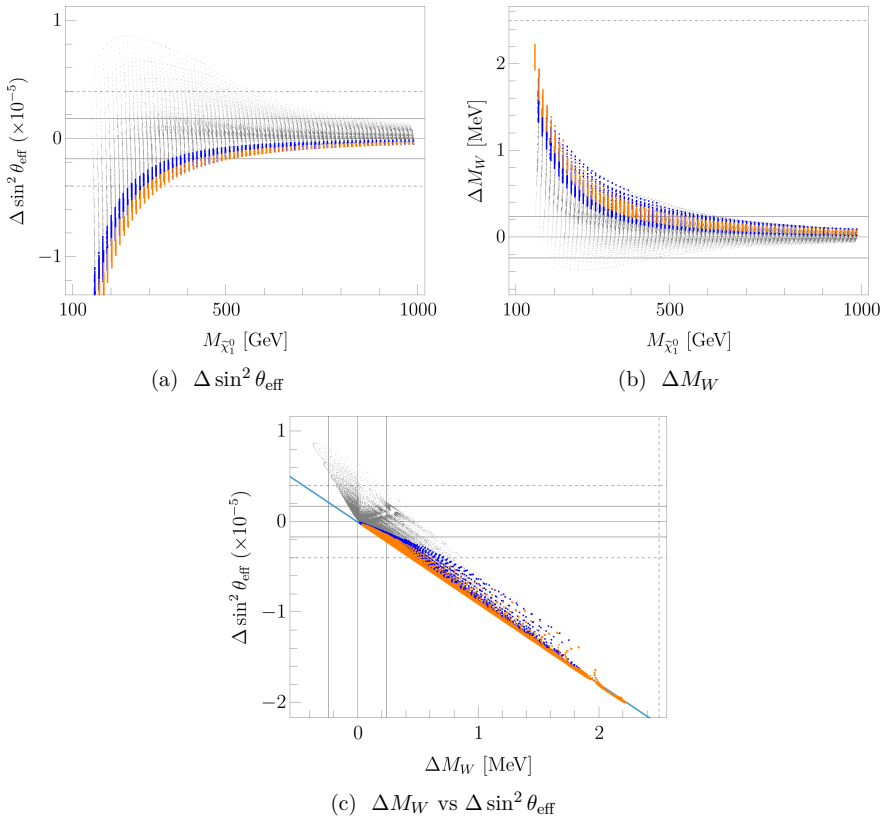
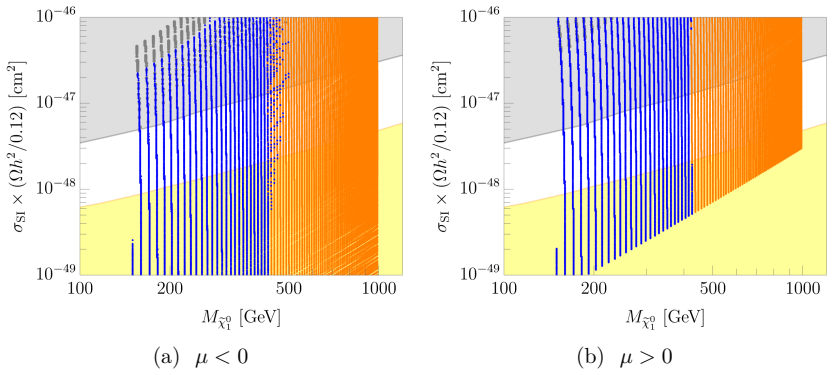
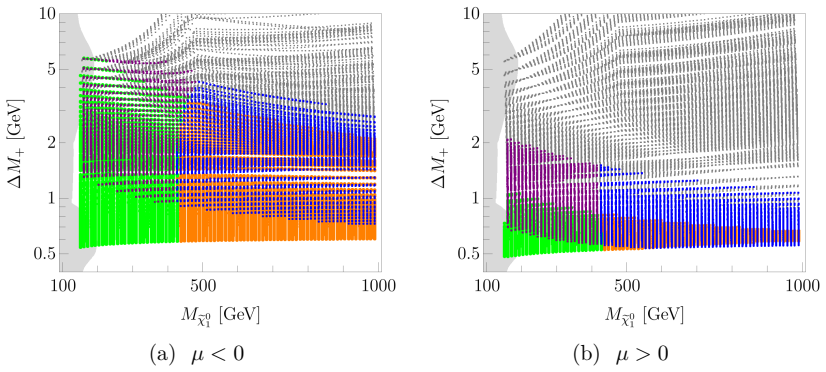
Focusing on scenarios in which charginos and neutralinos are the only light electroweakly interacting superparticles, the authors evaluate their contributions to the electroweak oblique parameters as well as to the precision observables M_W and sin²θ_eff. They find that future electroweak precision measurements provide a powerful probe of higgsinos with masses ≲ 500 GeV, including parameter regions with highly compressed spectra and spin-independent scattering cross sections below the neutrino fog. Dark matter direct detection experiments are particularly sensitive to scenarios with larger charged-neutral mass splittings induced by higgsino-gaugino mixing and can probe higgsino dark matter u
What carries the argument
Contributions of higgsino-like charginos and neutralinos to the electroweak oblique parameters and to the observables M_W and sin²θ_eff.
If this is right
- Electroweak precision measurements cover compressed higgsino spectra missed by direct detection.
- Direct detection reaches the full thermal relic mass when higgsino-gaugino mixing produces larger mass splittings.
- The two methods together test natural supersymmetry scenarios with light higgsinos across a wide range of mixing parameters.
- Regions with spin-independent cross sections below the neutrino fog remain accessible through precision observables.
Where Pith is reading between the lines
- A simultaneous null result in both channels would exclude light higgsino dark matter in the minimal setups considered.
- The same complementarity may apply to other precision observables such as the Z-pole asymmetries not calculated here.
- Non-observation could motivate searches for additional light superpartners that alter the isolated higgsino contributions.
Load-bearing premise
Charginos and neutralinos are the only light electroweakly interacting superparticles, so their contributions to precision observables can be isolated.
What would settle it
A future measurement of M_W or the oblique parameters at the projected ILC or FCC-ee precision that agrees with the Standard Model prediction for a higgsino mass of 300–400 GeV would falsify the claimed reach in the compressed-spectrum region.
Figures




read the original abstract
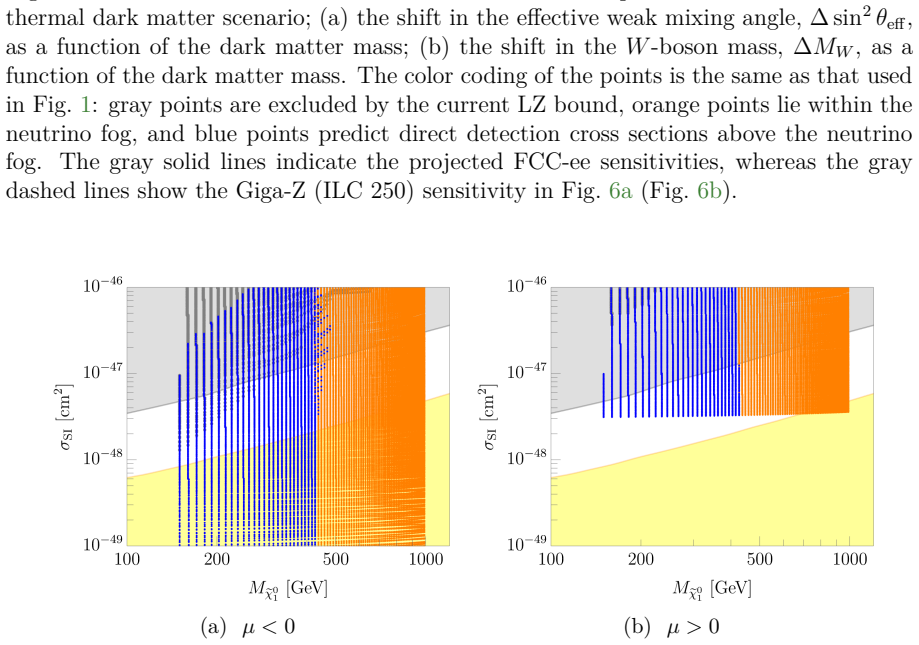
Although higgsinos are well motivated to be light from the viewpoint of naturalness, they remain difficult to detect experimentally because they interact only through electroweak interactions and typically possess a compressed mass spectrum. While higgsino dark matter can be efficiently probed by direct detection experiments when gauginos are relatively light, the sensitivity rapidly deteriorates for heavier gauginos due to the suppression of higgsino-gaugino mixing. In this paper, we investigate the prospects for probing light higgsinos through future electroweak precision measurements. Focusing on scenarios in which charginos and neutralinos are the only light electroweakly interacting superparticles, we evaluate their contributions to the electroweak oblique parameters as well as to the precision observables $M_W$ and $\sin^2\theta_{\mathrm{eff}}$. We compare the projected sensitivities of future $e^+e^-$ colliders with those of dark matter direct detection experiments. We find that future electroweak precision measurements provide a powerful probe of higgsinos with masses $\lesssim 500~\mathrm{GeV}$, including parameter regions with highly compressed spectra and spin-independent scattering cross sections below the neutrino fog. On the other hand, dark matter direct detection experiments are particularly sensitive to scenarios with larger charged-neutral mass splittings induced by higgsino-gaugino mixing, and can probe higgsino dark matter all the way up to the thermal relic mass of $\simeq 1~\mathrm{TeV}$. Our results demonstrate the strong complementarity between electroweak precision measurements and dark matter direct detection experiments in exploring light higgsinos and testing supersymmetric scenarios motivated by naturalness.
Editorial analysis
A structured set of objections, weighed in public.
Referee Report
Summary. The paper evaluates the isolated contributions of light higgsinos (with gauginos decoupled) to the oblique parameters S, T, U and to the precision observables M_W and sin²θ_eff. It computes the resulting reaches of future e⁺e⁻ colliders and compares them to spin-independent direct-detection cross sections, concluding that electroweak precision measurements can probe higgsino masses ≲ 500 GeV even for highly compressed spectra below the neutrino fog, while direct detection is more powerful for larger chargino-neutralino splittings up to the thermal-relic mass ≈ 1 TeV.
Significance. If the numerical results hold, the work supplies a concrete, forward calculation that enlarges the testable parameter space for natural SUSY by showing how precision electroweak observables remain sensitive where direct detection loses reach. The explicit scoping to the decoupled-gaugino limit and the side-by-side comparison of projected sensitivities constitute a useful addition to the literature on complementary BSM probes.
minor comments (3)
- [§3.2, Fig. 4] §3.2 and Fig. 4: the caption and text should state the precise collider luminosities and center-of-mass energies assumed for the projected M_W and sin²θ_eff uncertainties; without these numbers the quoted 500 GeV reach cannot be reproduced from the given formulae.
- [Eq. (12)] Eq. (12): the definition of the effective mixing angle used for the sin²θ_eff shift is not written explicitly; adding the standard expression (or a reference to the precise definition employed) would remove ambiguity when readers recompute the oblique-parameter contributions.
- [Table 2] Table 2: the rows for ΔM = 1 GeV and 5 GeV list the same SI cross-section value; a brief footnote explaining whether this is an approximation or an exact result for the chosen parameter slice would improve clarity.
Simulated Author's Rebuttal
We thank the referee for their positive assessment of the manuscript and for recommending minor revision. The referee summary accurately captures our focus on the decoupled-gaugino limit, the oblique-parameter and precision-observable calculations, and the complementarity with direct detection. No specific major comments were raised in the report.
Circularity Check
No significant circularity in derivation chain
full rationale
The paper performs explicit forward calculations of loop-level contributions from light charginos/neutralinos (under the stated assumption that they are the only light EW superparticles) to oblique parameters, MW, and sin²θ_eff, then compares projected reaches to DM direct detection. No step reduces a claimed prediction to a fitted input by construction, no self-citation is load-bearing for the central result, and the derivation relies on standard electroweak precision formulas applied to the SUSY spectrum. The work is self-contained against external benchmarks.
Axiom & Free-Parameter Ledger
axioms (1)
- domain assumption Charginos and neutralinos are the only light electroweakly interacting superparticles
Reference graph
Works this paper leans on
-
[1]
J. R. Ellis, K. Enqvist, D. V. Nanopoulos, and F. Zwirner,Observables in Low-Energy Superstring Models, Mod. Phys. Lett. A1(1986) 57
1986
-
[2]
Barbieri and G
R. Barbieri and G. F. Giudice,Upper Bounds on Supersymmetric Particle Masses, Nucl. Phys. B306(1988) 63–76
1988
-
[3]
A Solution to the Supersymmetric Fine-Tuning Problem within the MSSM
R. Kitano and Y. Nomura,A Solution to the supersymmetric fine-tuning problem within the MSSM, Phys. Lett. B631(2005) 58–67[hep-ph/0509039]
work page internal anchor Pith review Pith/arXiv arXiv 2005
-
[4]
Supersymmetry, Naturalness, and Signatures at the LHC
R. Kitano and Y. Nomura,Supersymmetry, naturalness, and signatures at the LHC, Phys. Rev. D73(2006) 095004[hep-ph/0602096]
work page internal anchor Pith review Pith/arXiv arXiv 2006
-
[5]
H. Baer, V. Barger, P. Huang, A. Mustafayev, and X. Tata,Radiative natural SUSY with a 125 GeV Higgs boson, Phys. Rev. Lett.109(2012) 161802 [arXiv:1207.3343]
work page internal anchor Pith review Pith/arXiv arXiv 2012
-
[6]
Radiative natural supersymmetry: Reconciling electroweak fine-tuning and the Higgs boson mass
H. Baer,et al.,Radiative natural supersymmetry: Reconciling electroweak fine-tuning and the Higgs boson mass, Phys. Rev. D87(2013) 115028 [arXiv:1212.2655]. [9]ATLASCollaboration,Searches for electroweak production of supersymmetric particles with compressed mass spectra in√s=13 TeVppcollisions with the ATLAS detector, Phys. Rev. D101(2020) 052005[arXiv:1...
work page internal anchor Pith review Pith/arXiv arXiv 2013
-
[7]
H. Fukuda, N. Nagata, H. Oide, H. Otono, and S. Shirai,Cornering Higgsinos Using Soft Displaced Tracks, Phys. Rev. Lett.124(2020) 101801[arXiv:1910.08065]. [16]ATLASCollaboration,Search for Nearly Mass-Degenerate Higgsinos Using Low-Momentum Mildly Displaced Tracks in pp Collisions at s=13 TeV with the ATLAS Detector, Phys. Rev. Lett.132(2024) 221801[arXi...
-
[8]
Higgsino Dark Matter in High-Scale Supersymmetry
N. Nagata and S. Shirai,Higgsino Dark Matter in High-Scale Supersymmetry, JHEP01(2015) 029[arXiv:1410.4549]
work page internal anchor Pith review Pith/arXiv arXiv 2015
-
[9]
Higgsino Dark Matter or Not: Role of Disappearing Track Searches at the LHC and Future Colliders
H. Fukuda, N. Nagata, H. Otono, and S. Shirai,Higgsino Dark Matter or Not: Role of Disappearing Track Searches at the LHC and Future Colliders, Phys. Lett. B781 (2018) 306–311[arXiv:1703.09675]
work page internal anchor Pith review Pith/arXiv arXiv 2018
- [10]
- [11]
-
[12]
Indirect Probe of Electroweak-Interacting Particles at Future Lepton Colliders
K. Harigaya, K. Ichikawa, A. Kundu, S. Matsumoto, and S. Shirai,Indirect Probe of Electroweak-Interacting Particles at Future Lepton Colliders, JHEP09(2015) 105[arXiv:1504.03402]
work page internal anchor Pith review Pith/arXiv arXiv 2015
-
[13]
Probing new electroweak states via precision measurements at the LHC and future colliders
L. Di Luzio, R. Gröber, and G. Panico,Probing new electroweak states via precision measurements at the LHC and future colliders, JHEP01(2019) 011 [arXiv:1810.10993]
work page internal anchor Pith review Pith/arXiv arXiv 2019
-
[14]
V. Maura, B. A. Stefanek, and T. You,Accuracy complements energy: electroweak precision tests at Tera-Z, JHEP10(2025) 022[arXiv:2412.14241]. [26]FCCCollaboration,Future Circular Collider Feasibility Study Report: Volume 1, Physics, Experiments, Detectors, Eur. Phys. J. C85(2025) 1468 [arXiv:2505.00272]. [27]CEPC Study GroupCollaboration,CEPC Conceptual De...
-
[15]
J. A. Grifols and J. Sola,One Loop Renormalization of the Electroweak Parameters inN= 1Supersymmetry, Nucl. Phys. B253(1985) 47
1985
-
[16]
Barbieri, M
R. Barbieri, M. Frigeni, F. Giuliani, and H. E. Haber,Precision Measurements in Electroweak Physics and Supersymmetry, Nucl. Phys. B341(1990) 309–321
1990
-
[17]
Drees and K
M. Drees and K. Hagiwara,Supersymmetric Contribution to the Electroweakρ Parameter, Phys. Rev. D42(1990) 1709–1725
1990
-
[18]
Drees, K
M. Drees, K. Hagiwara, and A. Yamada,Process independent radiative corrections in the minimal supersymmetric standard model, Phys. Rev. D45(1992) 1725–1743
1992
-
[19]
Barbieri, M
R. Barbieri, M. Frigeni, and F. Caravaglios,Supersymmetry signals in electroweak precision tests at LEP, Phys. Lett. B279(1992) 169–176
1992
-
[20]
P. H. Chankowski,et al.,Delta R in the MSSM, Nucl. Phys. B417(1994) 101–129
1994
-
[21]
I. Maksymyk, C. P. Burgess, and D. London,Beyond S, T and U, Phys. Rev. D50 (1994) 529–535[hep-ph/9306267]
work page internal anchor Pith review Pith/arXiv arXiv 1994
-
[22]
D. M. Pierce, J. A. Bagger, K. T. Matchev, and R.-j. Zhang,Precision corrections in the minimal supersymmetric standard model, Nucl. Phys. B491(1997) 3–67 [hep-ph/9606211]
work page internal anchor Pith review Pith/arXiv arXiv 1997
-
[23]
Supersymmetry versus precision experiments revisited
G.-C. Cho and K. Hagiwara,Supersymmetry versus precision experiments revisited, Nucl. Phys. B574(2000) 623–674[hep-ph/9912260]
work page internal anchor Pith review Pith/arXiv arXiv 2000
-
[24]
Electroweak Precision Observables in the Minimal Supersymmetric Standard Model
S. Heinemeyer, W. Hollik, and G. Weiglein,Electroweak precision observables in the minimal supersymmetric standard model, Phys. Rept.425(2006) 265–368 [hep-ph/0412214]
work page internal anchor Pith review Pith/arXiv arXiv 2006
-
[25]
S. P. Martin, K. Tobe, and J. D. Wells,Virtual effects of light gauginos and higgsinos: A Precision electroweak analysis of split supersymmetry, Phys. Rev. D 71(2005) 073014[hep-ph/0412424]
work page internal anchor Pith review Pith/arXiv arXiv 2005
-
[26]
Supersymmetry and precision data after LEP2
G. Marandella, C. Schappacher, and A. Strumia,Supersymmetry and precision data after LEP2, Nucl. Phys. B715(2005) 173–189[hep-ph/0502095]
work page internal anchor Pith review Pith/arXiv arXiv 2005
-
[27]
Precise Prediction for M_W in the MSSM
S. Heinemeyer, W. Hollik, D. Stockinger, A. M. Weber, and G. Weiglein,Precise prediction for M(W) in the MSSM, JHEP08(2006) 052[hep-ph/0604147]
work page internal anchor Pith review Pith/arXiv arXiv 2006
-
[28]
Z Pole Observables in the MSSM
S. Heinemeyer, W. Hollik, A. M. Weber, and G. Weiglein,ZPole Observables in the MSSM, JHEP04(2008) 039[arXiv:0710.2972]
work page internal anchor Pith review Pith/arXiv arXiv 2008
-
[29]
N. Nagata and G. Osaki,Electroweak precision data as a gateway to light higgsinos, JHEP07(2025) 242[arXiv:2503.20602]
- [30]
- [31]
-
[32]
S. D. Thomas and J. D. Wells,Phenomenology of Massive Vectorlike Doublet Leptons, Phys. Rev. Lett.81(1998) 34–37[hep-ph/9804359]
work page internal anchor Pith review Pith/arXiv arXiv 1998
-
[33]
M. E. Peskin and T. Takeuchi,A New constraint on a strongly interacting Higgs sector, Phys. Rev. Lett.65(1990) 964–967
1990
-
[34]
M. E. Peskin and T. Takeuchi,Estimation of oblique electroweak corrections, Phys. Rev. D46(1992) 381–409
1992
-
[35]
Electroweak symmetry breaking after LEP1 and LEP2
R. Barbieri, A. Pomarol, R. Rattazzi, and A. Strumia,Electroweak symmetry breaking after LEP-1 and LEP-2, Nucl. Phys. B703(2004) 127–146 [hep-ph/0405040]
work page internal anchor Pith review Pith/arXiv arXiv 2004
-
[36]
J. D. Wells and Z. Zhang,Effective theories of universal theories, JHEP01(2016) 123[arXiv:1510.08462]. [50]Particle Data GroupCollaboration,Review of particle physics, Phys. Rev. D 110(2024) 030001. [51]ILCCollaboration,The International Linear Collider Technical Design Report - Volume 2: Physics,arXiv:1306.6352(2013). [52]Linear ColliderCollaboration,The...
work page internal anchor Pith review Pith/arXiv arXiv 2016
-
[37]
K. Yokoya, K. Kubo, and T. Okugi,Operation of ILC250 at the Z-pole, arXiv:1908.08212(2019). [54]ILC International Development TeamCollaboration,The International Linear Collider: Report to Snowmass 2021,arXiv:2203.07622(2022). [55]Linear Collider VisionCollaboration,A linear collider vision for the future of particle physics, Eur. Phys. J. ST235(2026) 164...
- [38]
-
[39]
A. Freitaset al.,Theoretical uncertainties for electroweak and Higgs-boson precision measurements at FCC-ee,arXiv:1906.05379(2019). [58]LZCollaboration,Dark Matter Search Results from 4.2 Tonne-Years of Exposure of the LUX-ZEPLIN (LZ) Experiment, Phys. Rev. Lett.135(2025) 011802 [arXiv:2410.17036]. [59]XENONCollaboration,WIMP Dark Matter Search Using a 3....
-
[40]
Direct Detection of Electroweak-Interacting Dark Matter
J. Hisano, K. Ishiwata, N. Nagata, and T. Takesako,Direct Detection of Electroweak-Interacting Dark Matter, JHEP07(2011) 005[arXiv:1104.0228]
work page internal anchor Pith review Pith/arXiv arXiv 2011
-
[41]
Direct Search of Dark Matter in High-Scale Supersymmetry
J. Hisano, K. Ishiwata, and N. Nagata,Direct Search of Dark Matter in High-Scale Supersymmetry, Phys. Rev. D87(2013) 035020[arXiv:1210.5985]
work page internal anchor Pith review Pith/arXiv arXiv 2013
-
[42]
QCD Effects on Direct Detection of Wino Dark Matter
J. Hisano, K. Ishiwata, and N. Nagata,QCD Effects on Direct Detection of Wino Dark Matter, JHEP06(2015) 097[arXiv:1504.00915]
work page internal anchor Pith review Pith/arXiv arXiv 2015
-
[43]
M. A. Shifman, A. I. Vainshtein, and V. I. Zakharov,Remarks on Higgs Boson Interactions with Nucleons, Phys. Lett. B78(1978) 443–446
1978
-
[44]
G. Alguero,et al.,micrOMEGAs 6.0: N-component dark matter, Comput. Phys. Commun.299(2024) 109133[arXiv:2312.14894]
-
[45]
Uncertainties in WIMP Dark Matter Scattering Revisited
J. Ellis, N. Nagata, and K. A. Olive,Uncertainties in WIMP Dark Matter Scattering Revisited, Eur. Phys. J. C78(2018) 569[arXiv:1805.09795]. [66]ATLASCollaboration,Statistical Combination of ATLAS Run 2 Searches for Charginos and Neutralinos at the LHC, Phys. Rev. Lett.133(2024) 031802 [arXiv:2402.08347]
work page internal anchor Pith review Pith/arXiv arXiv 2018
-
[46]
K. J. Bae, H. Baer, and E. J. Chun,Mainly axion cold dark matter from natural supersymmetry, Phys. Rev. D89(2014) 031701[arXiv:1309.0519]
work page internal anchor Pith review Pith/arXiv arXiv 2014
-
[47]
K. J. Bae, H. Baer, and E. J. Chun,Mixed axion/neutralino dark matter in the SUSY DFSZ axion model, JCAP12(2013) 028[arXiv:1309.5365]
work page internal anchor Pith review Pith/arXiv arXiv 2013
-
[48]
K. J. Bae, H. Baer, and H. Serce,Prospects for axion detection in natural SUSY with mixed axion-higgsino dark matter: back to invisible?, JCAP06(2017) 024 [arXiv:1705.01134]
work page internal anchor Pith review Pith/arXiv arXiv 2017
-
[49]
Higgsino and Wino Dark Matter from Q-ball Decay in Affleck-Dine Baryogenesis
M. Fujii and K. Hamaguchi,Higgsino and wino dark matter from Q ball decay, Phys. Lett. B525(2002) 143–149[hep-ph/0110072]
work page internal anchor Pith review Pith/arXiv arXiv 2002
-
[50]
G. B. Gelmini and P. Gondolo,Neutralino with the right cold dark matter abundance in (almost) any supersymmetric model, Phys. Rev. D74(2006) 023510 [hep-ph/0602230]
work page internal anchor Pith review Pith/arXiv arXiv 2006
-
[51]
The effect of a late decaying scalar on the neutralino relic density
G. Gelmini, P. Gondolo, A. Soldatenko, and C. E. Yaguna,The Effect of a late decaying scalar on the neutralino relic density, Phys. Rev. D74(2006) 083514 [hep-ph/0605016]
work page internal anchor Pith review Pith/arXiv arXiv 2006
-
[52]
Dark matter production in the early Universe: beyond the thermal WIMP paradigm
H. Baer, K.-Y. Choi, J. E. Kim, and L. Roszkowski,Dark matter production in the early Universe: beyond the thermal WIMP paradigm, Phys. Rept.555(2015) 1–60 [arXiv:1407.0017]
work page internal anchor Pith review Pith/arXiv arXiv 2015
-
[53]
Han,Higgsino Dark Matter in a Non-Standard History of the Universe, Phys
C. Han,Higgsino Dark Matter in a Non-Standard History of the Universe, Phys. Lett. B798(2019) 134997[arXiv:1907.09235]
- [54]
- [55]
- [56]
discussion (0)
Sign in with ORCID, Apple, or X to comment. Anyone can read and Pith papers without signing in.