Generalised quantum interference
Pith reviewed 2026-07-01 05:56 UTC · model grok-4.3
The pith
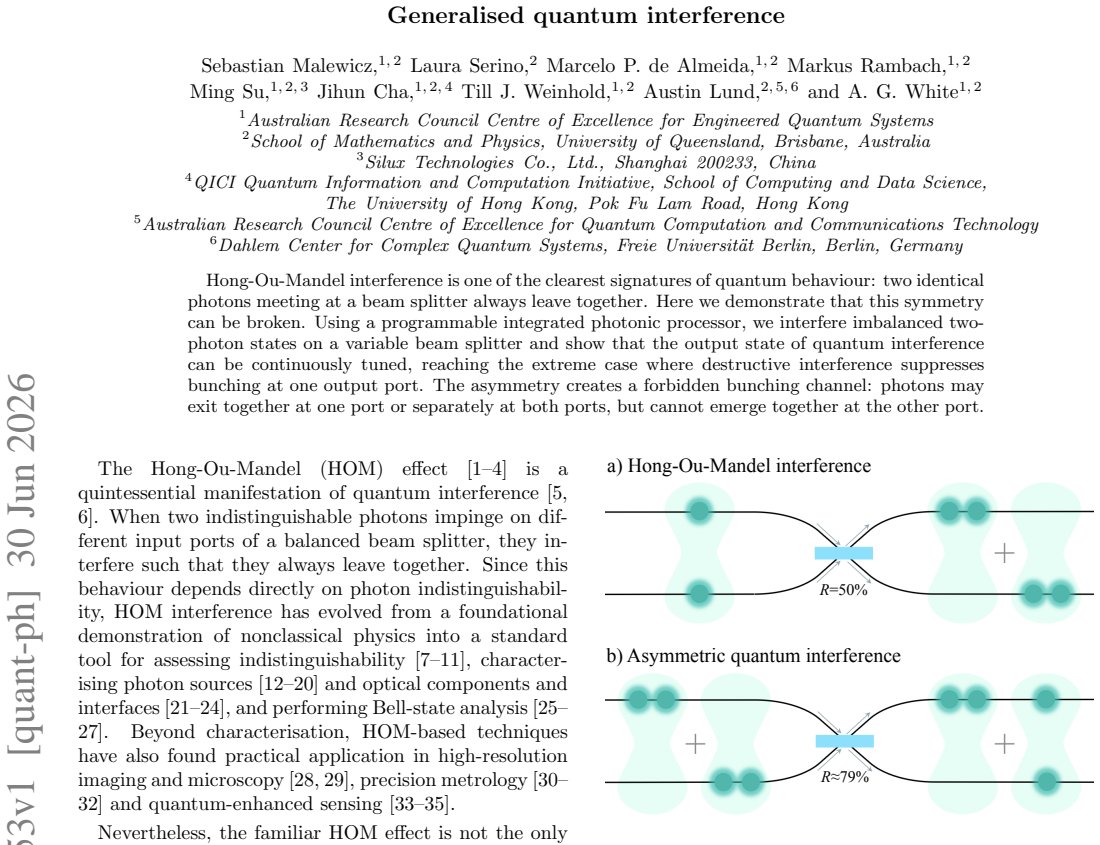
Imbalanced two-photon states on a tunable beam splitter break Hong-Ou-Mandel symmetry and create a forbidden bunching channel at one output port.
A machine-rendered reading of the paper's core claim, the machinery that carries it, and where it could break.
Core claim
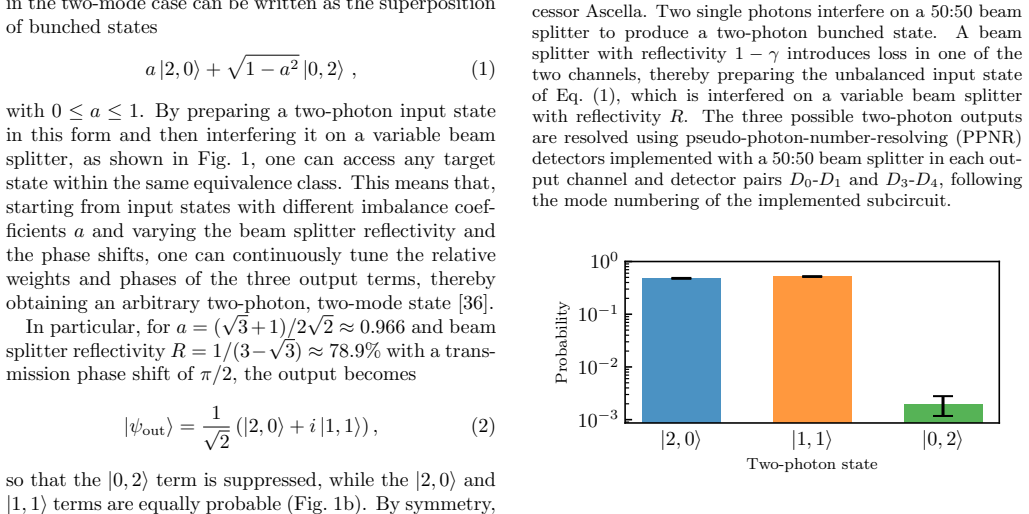
The asymmetry creates a forbidden bunching channel: photons may exit together at one port or separately at both ports, but cannot emerge together at the other port. This is achieved by interfering imbalanced two-photon states on a variable beam splitter, where the output state of quantum interference can be continuously tuned.
What carries the argument
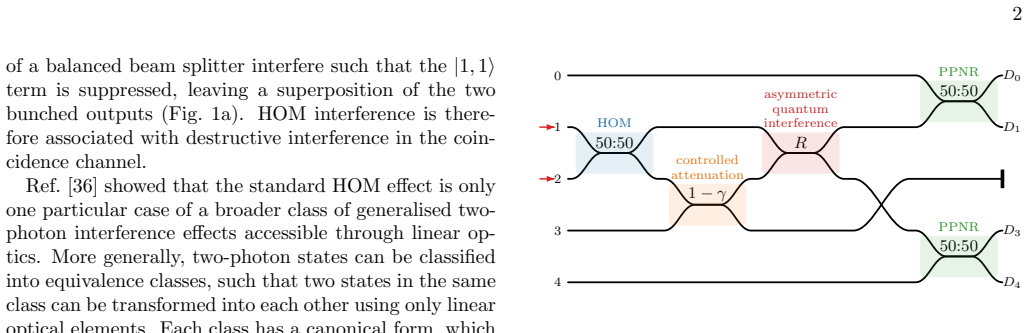
Imbalanced two-photon states interfered on a programmable variable beam splitter, which directs destructive interference to suppress specific output channels.
If this is right
- Output port selection for photon bunching can be controlled by adjusting the degree of imbalance in the input states.
- Destructive quantum interference can be directed to eliminate specific bunching events without altering the beam splitter itself.
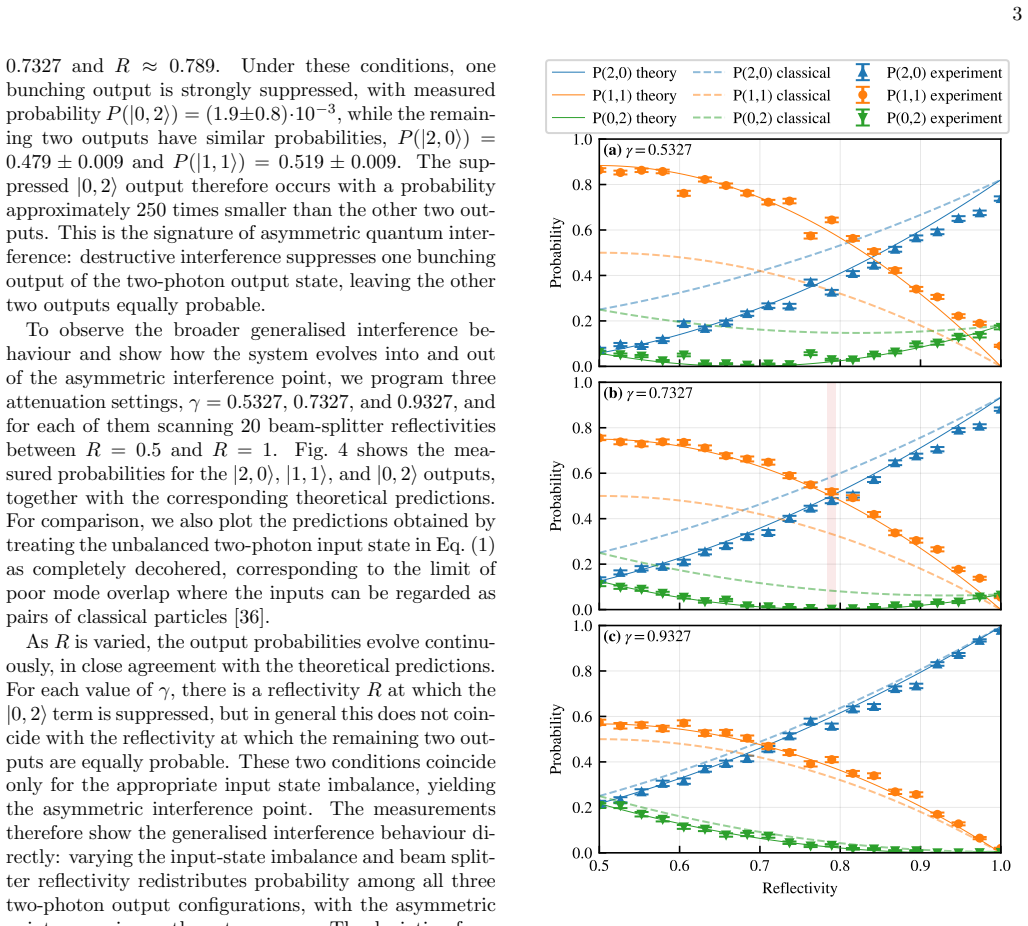
- The output state can be tuned between symmetric bunching, separate exits, and asymmetric suppression through continuous variation of the input imbalance.
Where Pith is reading between the lines
- The same imbalance principle could be applied to control interference in multi-photon or higher-dimensional photonic systems.
- Programmable processors might enable dynamic switching between different interference regimes in a single device.
- The forbidden channel provides a new degree of freedom for designing photon routing rules based on quantum statistics.
Load-bearing premise
The prepared two-photon states remain sufficiently indistinguishable in all degrees of freedom except the controlled imbalance, so that the observed tuning arises from quantum interference rather than classical distinguishability or experimental artifacts.
What would settle it
Observing a non-zero rate of coincident photon detections at the suppressed output port when the input imbalance is set to its extreme value would falsify the forbidden bunching channel.
Figures
read the original abstract
Hong-Ou-Mandel interference is one of the clearest signatures of quantum behaviour: two identical photons meeting at a beam splitter always leave together. Here we demonstrate that this symmetry can be broken. Using a programmable integrated photonic processor, we interfere imbalanced two-photon states on a variable beam splitter and show that the output state of quantum interference can be continuously tuned, reaching the extreme case where destructive interference suppresses bunching at one output port. The asymmetry creates a forbidden bunching channel: photons may exit together at one port or separately at both ports, but cannot emerge together at the other port.
Editorial analysis
A structured set of objections, weighed in public.
Referee Report
Summary. The paper claims to experimentally demonstrate generalized quantum interference beyond the symmetric Hong-Ou-Mandel effect. Using a programmable integrated photonic processor, imbalanced two-photon states are interfered on a variable beam splitter, allowing continuous tuning of the output state to the point where asymmetry produces destructive interference that strictly suppresses photon bunching at one output port while permitting it at the other or in separate ports.
Significance. If the experimental attribution to quantum interference holds after verification, the result would extend a foundational quantum optics phenomenon to asymmetric cases, enabling new forms of control over multi-photon interference with relevance to photonic quantum information processing. The programmable platform is noted as a methodological strength for tunability.
major comments (2)
- [Abstract and Experimental Results] The abstract reports an experimental result demonstrating tunable interference and a forbidden bunching channel, but supplies no data, error bars, visibility curves, or controls. This absence makes it impossible to verify the central claim or assess whether the observed suppression arises from the described generalized interference.
- [Methods and Results] The weakest assumption—that the imbalanced two-photon states remain indistinguishable in all degrees of freedom except the controlled imbalance—is not supported by explicit checks (e.g., full HOM visibility measurements or multi-parameter overlap data). Without these, classical path distinguishability cannot be excluded as an alternative explanation for the port-specific suppression.
minor comments (1)
- Clarify the quantitative range of the beam-splitter reflectivity over which the forbidden channel is observed and report the achieved visibility or suppression factor.
Simulated Author's Rebuttal
We thank the referee for their careful review and constructive comments. We address each major comment below, providing clarifications from the full manuscript and indicating where revisions will strengthen the presentation of data and controls.
read point-by-point responses
-
Referee: [Abstract and Experimental Results] The abstract reports an experimental result demonstrating tunable interference and a forbidden bunching channel, but supplies no data, error bars, visibility curves, or controls. This absence makes it impossible to verify the central claim or assess whether the observed suppression arises from the described generalized interference.
Authors: Abstracts are necessarily concise and do not contain raw data or figures. The full manuscript includes detailed experimental results with figures showing measured coincidence rates, error bars, visibility curves for the tunable interference, and control measurements in the Results section. We will revise the abstract to include a brief quantitative reference to the key visibility achieved and add explicit cross-references to the supporting figures and data. revision: yes
-
Referee: [Methods and Results] The weakest assumption—that the imbalanced two-photon states remain indistinguishable in all degrees of freedom except the controlled imbalance—is not supported by explicit checks (e.g., full HOM visibility measurements or multi-parameter overlap data). Without these, classical path distinguishability cannot be excluded as an alternative explanation for the port-specific suppression.
Authors: The manuscript reports HOM visibility measurements on the photon-pair source and discusses state preparation for the imbalanced case. We agree that additional explicit characterization for the imbalanced states would further exclude classical alternatives. We will expand the Methods section with multi-parameter overlap data and any available full visibility curves for the imbalanced inputs in the revised version. revision: partial
Circularity Check
No circularity: experimental demonstration with no derivation chain
full rationale
The manuscript is an experimental report on interfering imbalanced two-photon states in a programmable photonic processor to observe tunable output statistics, including suppression of one bunching channel. No equations, ansatzes, fitted parameters, or uniqueness theorems are presented that could reduce to inputs by construction. The central claim rests on measured coincidence counts and visibility under controlled imbalance, not on self-citation chains or redefinitions. The provided abstract and reader's assessment correctly identify the work as an experimental demonstration free of the enumerated circularity patterns.
Axiom & Free-Parameter Ledger
axioms (1)
- domain assumption Two photons prepared in imbalanced states remain quantum-mechanically indistinguishable except for the controlled imbalance.
Reference graph
Works this paper leans on
-
[1]
C. K. Hong, Z. Y. Ou, and L. Mandel, Measurement of subpicosecond time intervals between two photons by in- terference, Physical Review Letters59, 2044 (1987)
2044
-
[2]
Z. Y. Ou, C. K. Hong, and L. Mandel, Relation between input and output states for a beam splitter, Optics Com- munications63, 118 (1987)
1987
-
[3]
Fearn and R
H. Fearn and R. Loudon, Quantum theory of the lossless beam splitter, Optics Communications64, 485 (1987)
1987
-
[4]
J. G. Rarity and P. R. Tapster, Fourth-order interference in parametric downconversion, Journal of the Optical So- ciety of America B6, 1221 (1989)
1989
-
[5]
Bouchard, A
F. Bouchard, A. Sit, Y. Zhang, R. Fickler, F. M. Miatto, Y. Yao, F. Sciarrino, and E. Karimi, Two-photon interfer- ence: the Hong–Ou–Mandel effect, Reports on Progress in Physics84, 012402 (2020)
2020
-
[6]
Drago and A
C. Drago and A. M. Bra´ nczyk, Hong–Ou–Mandel inter- ference: A spectral–temporal analysis, Canadian Journal of Physics102, 411 (2024)
2024
-
[7]
Slussarenko, M
S. Slussarenko, M. M. Weston, H. M. Chrzanowski, L. K. Shalm, V. B. Verma, S. W. Nam, and G. J. Pryde, Un- conditional violation of the shot-noise limit in photonic quantum metrology, Nature Photonics11, 700 (2017)
2017
-
[8]
M. G. Raymer, S. J. van Enk, C. J. McKinstrie, and 5 H. J. McGuinness, Interference of two photons of different color, Optics Communications283, 747 (2010), arXiv: 1002.0350
work page internal anchor Pith review Pith/arXiv arXiv 2010
-
[9]
Kobayashi, R
T. Kobayashi, R. Ikuta, S. Yasui, S. Miki, T. Yamashita, H. Terai, T. Yamamoto, M. Koashi, and N. Imoto, Frequency-domain Hong–Ou–Mandel interference, Na- ture Photonics10, 441 (2016)
2016
-
[10]
Karimi, D
E. Karimi, D. Giovannini, E. Bolduc, N. Bent, F. M. Miatto, M. J. Padgett, and R. W. Boyd, Exploring the quantum nature of the radial degree of freedom of a pho- ton via Hong-Ou-Mandel interference, Physical Review A89, 013829 (2014)
2014
-
[11]
Hiekkam¨ aki and R
M. Hiekkam¨ aki and R. Fickler, High-Dimensional Two- Photon Interference Effects in Spatial Modes, Physical Review Letters126, 123601 (2021)
2021
-
[12]
Kiraz, M
A. Kiraz, M. Ehrl, T. Hellerer, ¨O. E. M¨ ustecaplıo˘ glu, C. Br¨ auchle, and A. Zumbusch, Indistinguishable Pho- tons from a Single Molecule, Physical Review Letters94, 223602 (2005)
2005
-
[13]
Kaltenbaek, B
R. Kaltenbaek, B. Blauensteiner, M. ˙Zukowski, M. As- pelmeyer, and A. Zeilinger, Experimental Interference of Independent Photons, Physical Review Letters96, 240502 (2006)
2006
-
[14]
Beugnon, M
J. Beugnon, M. P. A. Jones, J. Dingjan, B. Darqui´ e, G. Messin, A. Browaeys, and P. Grangier, Quantum in- terference between two single photons emitted by inde- pendently trapped atoms, Nature440, 779 (2006)
2006
-
[15]
Maunz, D
P. Maunz, D. L. Moehring, S. Olmschenk, K. C. Younge, D. N. Matsukevich, and C. Monroe, Quantum interfer- ence of photon pairs from two remote trapped atomic ions, Nature Physics3, 538 (2007)
2007
-
[16]
P. J. Mosley, J. S. Lundeen, B. J. Smith, P. Wasylczyk, A. B. U’Ren, C. Silberhorn, and I. A. Walmsley, Heralded Generation of Ultrafast Single Photons in Pure Quantum States, Physical Review Letters100, 133601 (2008)
2008
-
[17]
Sanaka, A
K. Sanaka, A. Pawlis, T. D. Ladd, K. Lischka, and Y. Ya- mamoto, Indistinguishable Photons from Independent Semiconductor Nanostructures, Physical Review Letters 103, 053601 (2009)
2009
-
[18]
Bernien, L
H. Bernien, L. Childress, L. Robledo, M. Markham, D. Twitchen, and R. Hanson, Two-Photon Quantum In- terference from Separate Nitrogen Vacancy Centers in Diamond, Physical Review Letters108, 043604 (2012)
2012
-
[19]
Senellart, G
P. Senellart, G. Solomon, and A. White, High- performance semiconductor quantum-dot single-photon sources, Nature Nanotechnology12, 1026 (2017)
2017
- [20]
-
[21]
Politi, M
A. Politi, M. J. Cryan, J. G. Rarity, S. Yu, and J. L. O’Brien, Silica-on-Silicon Waveguide Quantum Circuits, Science320, 646 (2008)
2008
-
[22]
D. Zhu, C. Chen, M. Yu, L. Shao, Y. Hu, C. J. Xin, M. Yeh, S. Ghosh, L. He, C. Reimer, N. Sinclair, F. N. C. Wong, M. Zhang, and M. Lonˇ car, Spectral control of non- classical light pulses using an integrated thin-film lithium niobate modulator, Light: Science & Applications11, 327 (2022)
2022
-
[23]
Babel, L
S. Babel, L. Bollmers, M. Massaro, K. H. Luo, M. Stef- szky, F. Pegoraro, P. Held, H. Herrmann, C. Eigner, B. Brecht, L. Padberg, and C. Silberhorn, Demonstration of Hong-Ou-Mandel interference in an LNOI directional coupler, Optics Express31, 23140 (2023)
2023
-
[24]
S. Gera, C. Wallace, M. Flament, A. Scriminich, M. Na- mazi, Y. Kim, S. Sagona-Stophel, G. Vallone, P. Vil- loresi, and E. Figueroa, Hong-Ou-Mandel interference of single-photon-level pulses stored in independent room- temperature quantum memories, npj Quantum Informa- tion10, 10 (2024)
2024
-
[25]
P. G. Kwiat and H. Weinfurter, Embedded Bell-state analysis, Physical Review A58, R2623 (1998)
1998
-
[26]
Calsamiglia and N
J. Calsamiglia and N. L¨ utkenhaus, Maximum efficiency of a linear-optical Bell-state analyzer, Applied Physics B 72, 67 (2001)
2001
-
[27]
M. J. Bayerbach, S. E. D’Aurelio, P. van Loock, and S. Barz, Bell-state measurement exceeding 50% suc- cess probability with linear optics, Science Advances9, eadf4080 (2023)
2023
-
[28]
Ndagano, H
B. Ndagano, H. Defienne, D. Branford, Y. D. Shah, A. Lyons, N. Westerberg, E. M. Gauger, and D. Faccio, Quantum microscopy based on Hong–Ou–Mandel inter- ference, Nature Photonics16, 384 (2022)
2022
-
[29]
Torre, A
C. Torre, A. McMillan, J. Monroy-Ruz, and J. C. F. Matthews, Sub-$\ensuremath{\mu}\mathrm{m}$axial precision depth imaging with entangled two-color Hong- Ou-Mandel microscopy, Physical Review A108, 023726 (2023)
2023
-
[30]
Lyons, G
A. Lyons, G. C. Knee, E. Bolduc, T. Roger, J. Leach, E. M. Gauger, and D. Faccio, Attosecond-resolution Hong-Ou-Mandel interferometry, Science Advances4, eaap9416 (2018)
2018
-
[31]
Y. Chen, M. Fink, F. Steinlechner, J. P. Torres, and R. Ursin, Hong-Ou-Mandel interferometry on a biphoton beat note, npj Quantum Information5, 43 (2019)
2019
-
[32]
Meskine, E
O. Meskine, E. Descamps, A. Keller, A. Lemaˆ ıtre, F. Baboux, S. Ducci, and P. Milman, Approaching Maximal Precision of Hong-Ou-Mandel Interferometry with Nonperfect Visibility, Physical Review Letters132, 193603 (2024)
2024
-
[33]
M. B. Nasr, B. E. A. Saleh, A. V. Sergienko, and M. C. Teich, Demonstration of Dispersion-Canceled Quantum- Optical Coherence Tomography, Physical Review Letters 91, 083601 (2003)
2003
-
[34]
Basiri-Esfahani, C
S. Basiri-Esfahani, C. R. Myers, A. Armin, J. Combes, and G. J. Milburn, Integrated quantum photonic sensor based on Hong-Ou-Mandel interference, Optics Express 23, 16008 (2015)
2015
-
[35]
Lyons, V
A. Lyons, V. Zickus, R. ´Alvarez Mendoza, D. Triggiani, V. Tamma, N. Westerberg, M. Tassieri, and D. Faccio, Fluorescence lifetime Hong-Ou-Mandel sensing, Nature Communications14, 8005 (2023)
2023
-
[36]
A. P. Lund, Classes of two-photon states defined by linear interactions and destructive two-photon quantum inter- ference in a single mode, Physical Review A92, 053844 (2015)
2015
-
[37]
Maring, A
N. Maring, A. Fyrillas, M. Pont, E. Ivanov, P. Stepanov, N. Margaria, W. Hease, A. Pishchagin, A. Lemaˆ ıtre, I. Sagnes, T. H. Au, S. Boissier, E. Bertasi, A. Baert, M. Valdivia, M. Billard, O. Acar, A. Brieussel, R. Mezher, S. C. Wein, A. Salavrakos, P. Sinnott, D. A. Fioretto, P.-E. Emeriau, N. Belabas, S. Mansfield, P. Senellart, J. Senellart, and N. S...
2024
-
[38]
Wang and T
H. Wang and T. Kobayashi, Phase measurement at the 6 Heisenberg limit with three photons, Physical Review A 71, 021802 (2005)
2005
-
[39]
B. H. Liu, F. W. Sun, Y. X. Gong, Y. F. Huang, Z. Y. Ou, and G. C. Guo, Demonstration of the three-photon de Broglie wavelength by projection measurement, Physical Review A77, 023815 (2008)
2008
-
[40]
Taballione, R
C. Taballione, R. van der Meer, H. J. Snijders, P. Hooi- jschuur, J. P. Epping, M. de Goede, B. Kassenberg, P. Venderbosch, C. Toebes, H. van den Vlekkert, P. W. H. Pinkse, and J. J. Renema, A universal fully reconfig- urable 12-mode quantum photonic processor, Materials for Quantum Technology1, 035002 (2021)
2021
-
[41]
Fyrillas, O
A. Fyrillas, O. Faure, N. Maring, J. Senellart, and N. Be- labas, Scalable machine learning-assisted clear-box char- acterization for optimally controlled photonic circuits, Optica11, 427 (2024)
2024
discussion (0)
Sign in with ORCID, Apple, or X to comment. Anyone can read and Pith papers without signing in.