Full-Wave Green's-Function Modeling of Collective Single-Photon Emission in Non-Markovian Open-System QED with Finite-Bandwidth Compensation of Dispersive Interactions
Pith reviewed 2026-07-01 05:39 UTC · model grok-4.3
The pith
Green's function equations track collective single-photon emission without Markovian approximations.
A machine-rendered reading of the paper's core claim, the machinery that carries it, and where it could break.
Core claim
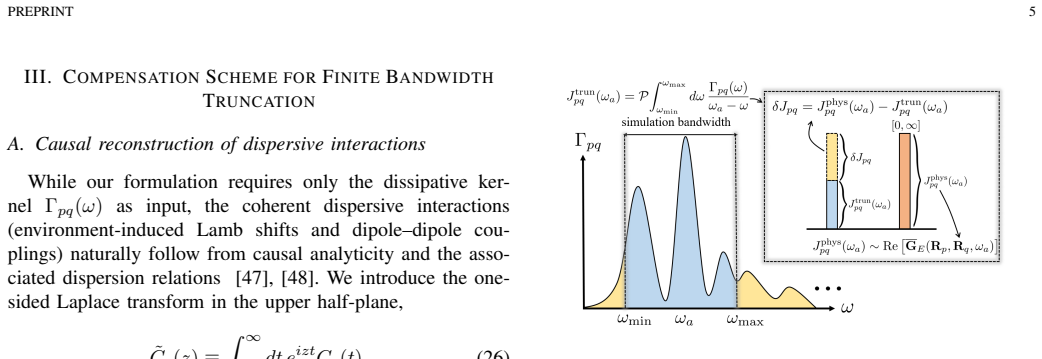
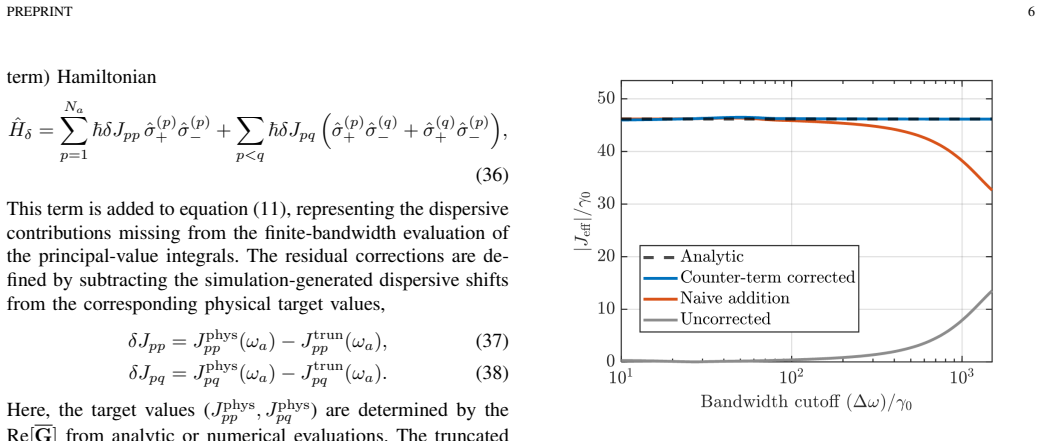
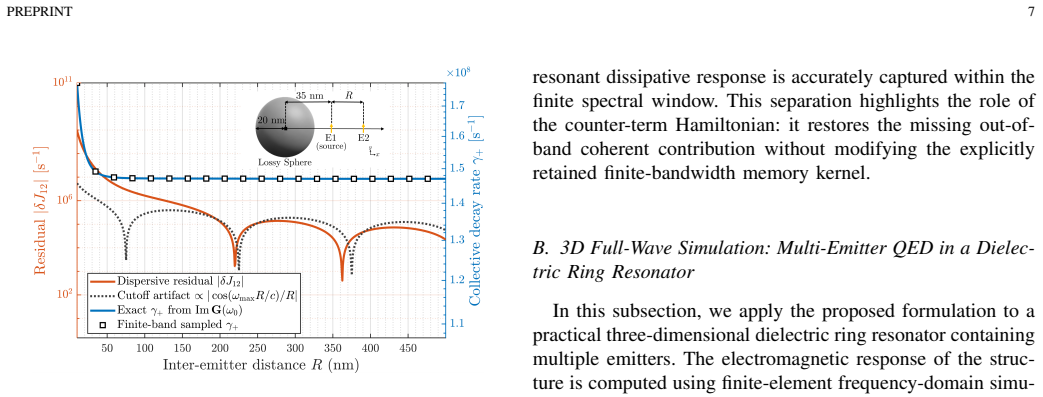
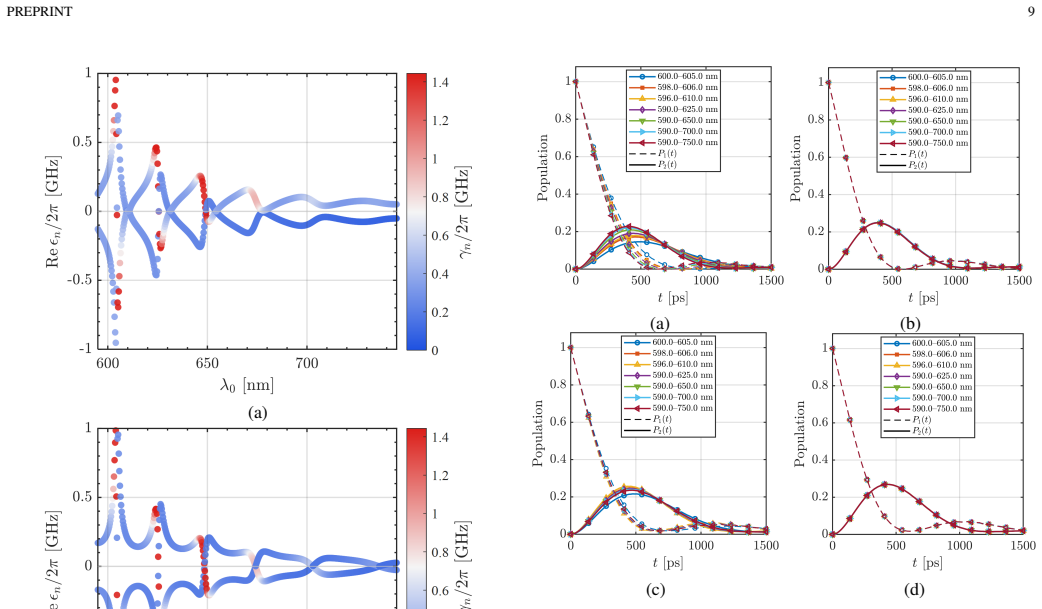
Starting from a transverse modal completeness relation of modified Langevin noise formalism, the authors derive a closed set of coupled equations for population dynamics and frequency-resolved field amplitudes in the single-excitation regime. The emitted single-photon dynamics can be modeled within the same closed set of equations without Markovian approximation in open and dissipative environments. Finite-bandwidth truncation of the spectral density produces systematic deviations in coherent dispersive interactions even when dissipative rates appear converged; a counter-term compensation scheme restores the missing dispersive contributions without modifying the retained non-Markovian memory
What carries the argument
Closed set of coupled equations for population dynamics and frequency-resolved field amplitudes, derived from the transverse modal completeness relation and augmented by a counter-term compensation scheme.
If this is right
- Collective coherent energy exchange and single-photon radiation can be simulated directly in open dissipative electromagnetic structures.
- Finite-element or other full-wave electromagnetic solvers can be incorporated into non-Markovian multi-emitter QED calculations.
- Population dynamics and emitted field amplitudes remain coupled at every frequency without requiring a separate reservoir tracing step.
- The same equation set applies from simple benchmark geometries to three-dimensional dispersive resonators.
Where Pith is reading between the lines
- The approach may extend naturally to structures whose spectral density requires adaptive bandwidth truncation during simulation.
- Because the field amplitudes are retained explicitly, the method could be combined with detection models that resolve photon arrival statistics.
- The compensation scheme isolates dispersive corrections, suggesting it could be applied to other non-Markovian master-equation truncations that suffer similar bandwidth artifacts.
Load-bearing premise
A counter-term compensation scheme can restore missing dispersive contributions from finite-bandwidth truncation without modifying the retained non-Markovian memory kernel.
What would settle it
A numerical comparison, in a known solvable geometry, between the compensated and uncompensated equations showing that dispersive interaction strengths match the exact result only after the counter-term is added while dissipative rates remain unchanged.
Figures




read the original abstract
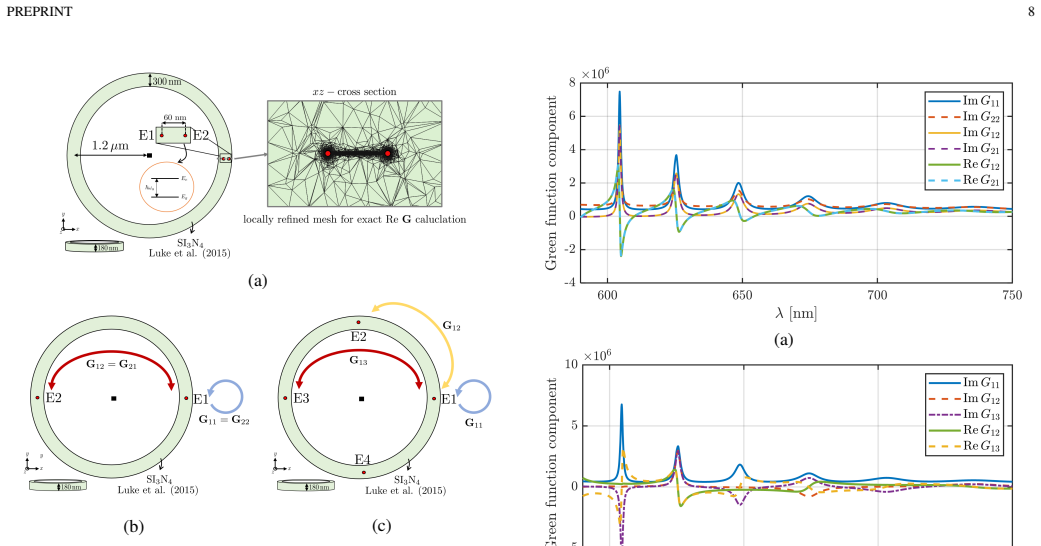
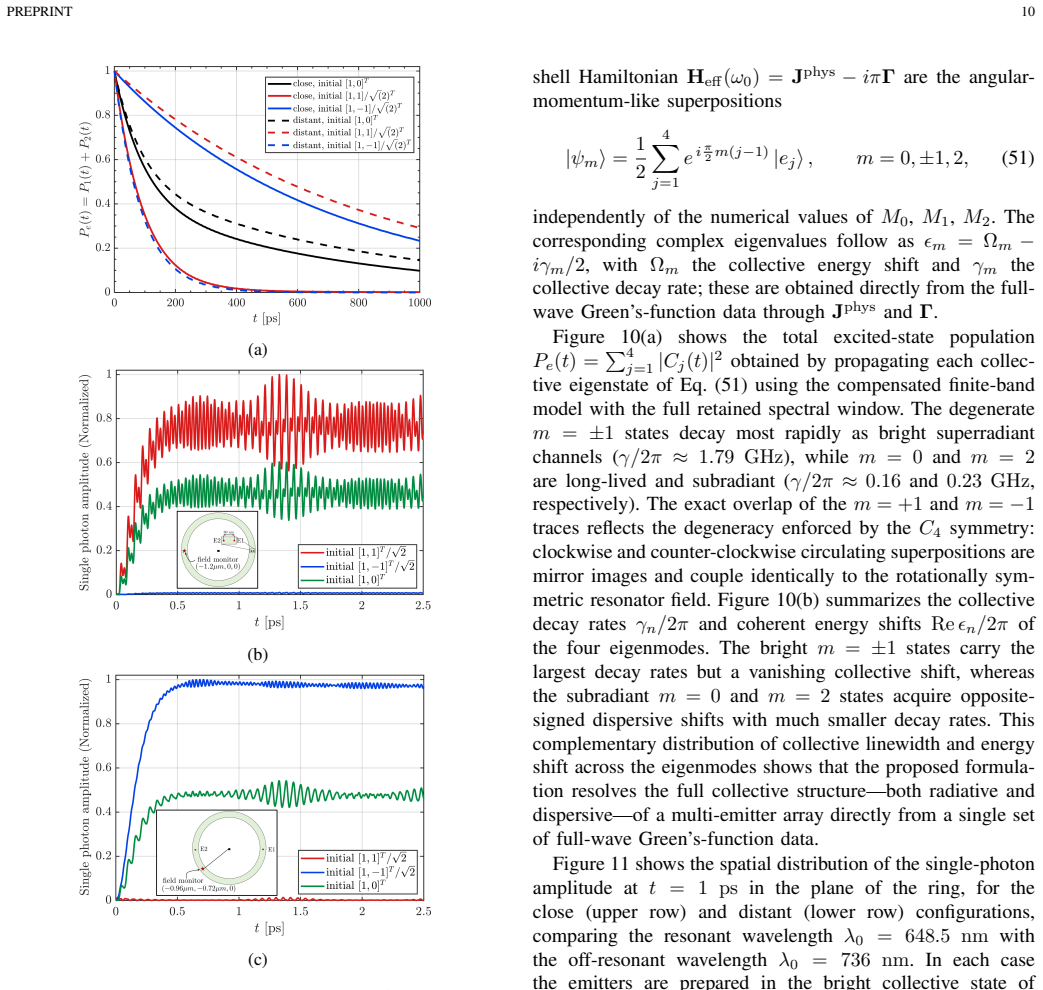
This work presents a full-wave Green's function framework for modeling collective and coherent single-photon emission from multiple quantum emitters embedded in complex electromagnetic structures. Starting from a transverse modal completeness relation of modified Langevin noise formalism, we derive a closed set of coupled equations for population dynamics and frequency-resolved field amplitudes in the single-excitation regime. Since the electromagnetic reservoir is not traced out at the level of the dynamical amplitudes, the emitted single-photon dynamics can be modeled within the same closed set of equations without Markovian approximation in open and dissipative environments. We demonstrate that finite-bandwidth truncation of the spectral density leads to systematic deviations in coherent dispersive interactions, even when dissipative rates appear converged. To restore causal consistency, we introduce a counter-term compensation scheme that restores the missing dispersive contributions without modifying the retained non-Markovian memory kernel. To validate the scheme and demonstrate the practicality of the proposed framework, we present numerical examples ranging from benchmark configurations to a three-dimensional dispersive ring-resonator structure via finite element method. These capabilities provide a practical route for rigorously incorporating full-wave electromagnetic simulations into non-Markovian multi-emitter quantum electrodynamics, enabling predictive modeling of collective emission, coherent energy exchange, and single-photon radiation in realistic open structures.
Editorial analysis
A structured set of objections, weighed in public.
Referee Report
Summary. The manuscript develops a full-wave Green's-function framework for collective single-photon emission from multiple quantum emitters in complex electromagnetic structures. Starting from a transverse modal completeness relation in the modified Langevin noise formalism, it derives a closed set of coupled equations for single-excitation population dynamics and frequency-resolved field amplitudes without tracing out the reservoir or invoking the Markov approximation. Finite-bandwidth truncation of the spectral density is shown to produce systematic errors in dispersive interactions; a counter-term compensation scheme is introduced to restore the missing dispersive contributions while leaving the retained non-Markovian memory kernel unchanged. Numerical examples, including a 3-D dispersive ring-resonator structure solved via finite-element methods, are presented to validate the approach.
Significance. If the counter-term scheme is shown to preserve the memory kernel and modal completeness without feedback into the field equations, the framework would allow direct incorporation of full-wave electromagnetic simulations into non-Markovian multi-emitter QED. This would be a useful advance for predictive modeling of collective emission and coherent energy exchange in realistic open structures.
major comments (2)
- [Abstract / compensation-scheme derivation] Abstract and the section introducing the counter-term compensation scheme: the central claim that the added counter-term restores dispersive contributions 'without modifying the retained non-Markovian memory kernel' is load-bearing for the entire construction. No explicit operator identity, commutation relation, or step-by-step derivation is supplied demonstrating that the counter-term leaves the modal completeness relation, the memory integral, and causality in the single-excitation manifold unchanged. Without this, it is impossible to verify that the compensation does not implicitly alter the frequency-resolved field equations or reintroduce the very truncation artifacts it is meant to cancel.
- [Derivation of closed equations] The derivation of the closed set of equations for population dynamics and field amplitudes (starting from the transverse modal completeness relation): the manuscript states that the electromagnetic reservoir is not traced out, yet the provided text supplies no intermediate steps showing how the single-excitation manifold remains closed once the counter-term is inserted. An explicit check that the added term does not couple back into the retained non-Markovian kernel is required.
minor comments (1)
- [Notation] Notation for the frequency-resolved field amplitudes and the precise definition of the finite-bandwidth truncation should be introduced with an equation number at first use to aid readability.
Simulated Author's Rebuttal
We thank the referee for the careful reading and constructive comments. We agree that additional explicit derivations would strengthen the presentation of the counter-term scheme and the closure of the single-excitation manifold. We address each major comment below and will revise the manuscript accordingly.
read point-by-point responses
-
Referee: [Abstract / compensation-scheme derivation] Abstract and the section introducing the counter-term compensation scheme: the central claim that the added counter-term restores dispersive contributions 'without modifying the retained non-Markovian memory kernel' is load-bearing for the entire construction. No explicit operator identity, commutation relation, or step-by-step derivation is supplied demonstrating that the counter-term leaves the modal completeness relation, the memory integral, and causality in the single-excitation manifold unchanged. Without this, it is impossible to verify that the compensation does not implicitly alter the frequency-resolved field equations or reintroduce the very truncation artifacts it is meant to cancel.
Authors: We acknowledge that the current manuscript lacks a fully expanded operator-level derivation of the counter-term properties. In the revised version we will add a dedicated appendix (or subsection) that supplies the explicit commutation relations, the operator identity showing preservation of the transverse modal completeness relation, and the step-by-step verification that the counter-term restores the missing dispersive shift while leaving the retained non-Markovian memory kernel and causality unchanged in the single-excitation manifold. This will also include a direct check confirming no feedback into the frequency-resolved field equations. revision: yes
-
Referee: [Derivation of closed equations] The derivation of the closed set of equations for population dynamics and field amplitudes (starting from the transverse modal completeness relation): the manuscript states that the electromagnetic reservoir is not traced out, yet the provided text supplies no intermediate steps showing how the single-excitation manifold remains closed once the counter-term is inserted. An explicit check that the added term does not couple back into the retained non-Markovian kernel is required.
Authors: We agree that the intermediate algebraic steps demonstrating manifold closure after insertion of the counter-term are not shown explicitly. The revised manuscript will expand the derivation section to include these steps, beginning from the transverse modal completeness relation, inserting the counter-term, and verifying that the single-excitation subspace remains closed with no additional coupling into the retained memory kernel. This will be presented both formally and with a brief numerical consistency check on a simple benchmark. revision: yes
Circularity Check
No significant circularity; derivation builds from external completeness relation and introduces independent compensation.
full rationale
The paper explicitly starts from the transverse modal completeness relation of the modified Langevin noise formalism as an input and derives the closed coupled equations for population dynamics and field amplitudes in the single-excitation regime. The counter-term scheme is presented as a new construction to restore dispersive terms without modifying the retained kernel, with no quoted equations or reductions showing that any output is equivalent to an input by definition, that a fitted quantity is relabeled as a prediction, or that a load-bearing premise collapses to a self-citation chain. The framework remains self-contained against external benchmarks because the starting relation is treated as given and the new scheme is not shown to feed back into or redefine the modal completeness or memory kernel.
Axiom & Free-Parameter Ledger
axioms (1)
- domain assumption transverse modal completeness relation of modified Langevin noise formalism
invented entities (1)
-
counter-term compensation scheme
no independent evidence
Reference graph
Works this paper leans on
-
[1]
Quantum-dot-based deterministic photon–emitter interfaces for scalable photonic quantum technology,
R. Uppu, L. Midolo, X. Zhou, J. Carolan, and P. Lodahl, “Quantum-dot-based deterministic photon–emitter interfaces for scalable photonic quantum technology,”Nature Nanotechnology, vol. 16, no. 12, pp. 1308–1317, Dec 2021. [Online]. Available: https: //doi.org/10.1038/s41565-021-00965-6
-
[2]
Epitaxial quantum dots: a semiconductor launchpad for photonic quantum technologies,
X. Zhou, L. Zhai, and J. Liu, “Epitaxial quantum dots: a semiconductor launchpad for photonic quantum technologies,”Photonics Insights, vol. 1, no. 2, p. R07, 2023. [Online]. Available: https://doi.org/10.3788/ PI.2022.R07
2023
-
[3]
M. Kianinia, Z.-Q. Xu, M. Toth, and I. Aharonovich, “Quantum emitters in 2d materials: Emitter engineering, photophysics, and integration in photonic nanostructures,”Applied Physics Reviews, vol. 9, no. 1, p. 011306, 01 2022. [Online]. Available: https://doi.org/10.1063/5.0072091
-
[4]
Integration of color centers into silicon photonic structures,
H. Quard, S. Cueff, H. S. Nguyen, N. Chauvin, and T. Wood, “Integration of color centers into silicon photonic structures,”Applied Physics Reviews, vol. 12, no. 4, p. 041326, 12 2025. [Online]. Available: https://doi.org/10.1063/5.0258819
-
[5]
Long-range cooperative resonances in rare-earth ion arrays inside photonic resonators,
D. Pak, A. Nandi, M. Titze, E. S. Bielejec, H. Alaeian, and M. Hosseini, “Long-range cooperative resonances in rare-earth ion arrays inside photonic resonators,”Commun. Phys., vol. 5, no. 1, p. 89, Apr. 2022
2022
-
[6]
Quantum optical memory for entanglement distribution,
Y . Lei, F. K. Asadi, T. Zhong, A. Kuzmich, C. Simon, and M. Hosseini, “Quantum optical memory for entanglement distribution,”Optica, vol. 10, no. 11, pp. 1511–1528, Nov 2023. [Online]. Available: https://opg.optica.org/optica/abstract.cfm?URI=optica-10-11-1511
2023
-
[7]
Colloquium: Cavity-enhanced quantum network nodes,
A. Reiserer, “Colloquium: Cavity-enhanced quantum network nodes,” Rev. Mod. Phys., vol. 94, p. 041003, Dec 2022. [Online]. Available: https://link.aps.org/doi/10.1103/RevModPhys.94.041003
-
[8]
Charge-insensitive qubit design derived from the cooper pair box,
J. Koch, T. M. Yu, J. Gambetta, A. A. Houck, D. I. Schuster, J. Majer, A. Blais, M. H. Devoret, S. M. Girvin, and R. J. Schoelkopf, “Charge-insensitive qubit design derived from the cooper pair box,” Phys. Rev. A, vol. 76, p. 042319, Oct 2007. [Online]. Available: https://link.aps.org/doi/10.1103/PhysRevA.76.042319
-
[9]
The transmon qubit for electro- magnetics engineers: An introduction,
T. E. Roth, R. Ma, and W. C. Chew, “The transmon qubit for electro- magnetics engineers: An introduction,”IEEE Antennas and Propagation Magazine, vol. 65, no. 2, pp. 8–20, 2023
2023
-
[10]
Two-qubit silicon quantum processor with operation fidelity exceeding 99%,
A. R. Mills, C. R. Guinn, M. J. Gullans, A. J. Sigillito, M. M. Feldman, E. Nielsen, and J. R. Petta, “Two-qubit silicon quantum processor with operation fidelity exceeding 99%,”Science Advances, vol. 8, no. 14, p. eabn5130, 2022. [Online]. Available: https://www.science.org/doi/abs/10.1126/sciadv.abn5130
-
[11]
C. C. Gerry and P. L. Knight,Introductory Quantum Optics. Cambridge, U.K.: Cambridge University Press, 2005
2005
-
[12]
Breuer and F
H.-P. Breuer and F. Petruccione,The Theory of Open Quantum Systems. Oxford: Oxford University Press, 2002
2002
-
[13]
Coherence in spontaneous radiation processes,
R. H. Dicke, “Coherence in spontaneous radiation processes,” Phys. Rev., vol. 93, pp. 99–110, Jan 1954. [Online]. Available: https://link.aps.org/doi/10.1103/PhysRev.93.99
-
[14]
Radiation from ann-atom system. i. general formalism,
R. H. Lehmberg, “Radiation from ann-atom system. i. general formalism,”Phys. Rev. A, vol. 2, pp. 883–888, Sep 1970. [Online]. Available: https://link.aps.org/doi/10.1103/PhysRevA.2.883 PREPRINT 13
-
[15]
Radiation from ann-atom system. ii. spontaneous emission from a pair of atoms,
——, “Radiation from ann-atom system. ii. spontaneous emission from a pair of atoms,”Phys. Rev. A, vol. 2, pp. 889–896, Sep 1970. [Online]. Available: https://link.aps.org/doi/10.1103/PhysRevA.2.889
-
[16]
Jin,The Finite Element Method in Electromagnetics, 3rd ed
J.-M. Jin,The Finite Element Method in Electromagnetics, 3rd ed. Hoboken, NJ: Wiley-IEEE Press, 2014
2014
-
[17]
Taflove and S
A. Taflove and S. Hagness,Computational electrodynamics: the finite- difference time-domain method. 2nd ed. Artech House, 06 2000, vol. 67–106
2000
-
[18]
Finite-difference time-domain methods,
F. L. Teixeira, C. Sarris, Y . Zhang, D.-Y . Na, J.-P. Berenger, Y . Su, M. Okoniewski, W. C. Chew, V . Backman, and J. J. Simpson, “Finite-difference time-domain methods,”Nature Reviews Methods Primers, vol. 3, no. 1, p. 76, Oct 2023. [Online]. Available: https://doi.org/10.1038/s43586-023-00268-1
-
[19]
Colloquium: Simulating non-markovian dynamics in open quantum systems,
M. Xu, V . Vadimov, J. T. Stockburger, and J. Ankerhold, “Colloquium: Simulating non-markovian dynamics in open quantum systems,”Rev. Mod. Phys., vol. 98, p. 021002, May 2026. [Online]. Available: https://link.aps.org/doi/10.1103/w3nw-hbjc
-
[20]
Y . Tanimura, “Numerically “exact” approach to open quantum dynamics: The hierarchical equations of motion (heom),”The Journal of Chemical Physics, vol. 153, no. 2, p. 020901, 07 2020. [Online]. Available: https://doi.org/10.1063/5.0011599
-
[21]
An efficient julia framework for hierarchi- cal equations of motion in open quantum systems,
Y .-T. Huang, P.-C. Kuo, N. Lambert, M. Cirio, S. Cross, S.-L. Yang, F. Nori, and Y .-N. Chen, “An efficient julia framework for hierarchi- cal equations of motion in open quantum systems,”Communications Physics, vol. 6, no. 1, p. 313, Oct 2023
2023
-
[22]
Input-output hierarchical equations of motion,
M. Cirio, P. Liang, and N. Lambert, “Input-output hierarchical equations of motion,”Phys. Rev. A, vol. 112, p. 012211, Jul 2025. [Online]. Available: https://link.aps.org/doi/10.1103/4q4p-z14x
-
[23]
Nonperturbative treatment of non-markovian dynamics of open quantum systems,
D. Tamascelli, A. Smirne, S. F. Huelga, and M. B. Plenio, “Nonperturbative treatment of non-markovian dynamics of open quantum systems,”Phys. Rev. Lett., vol. 120, p. 030402, Jan 2018. [Online]. Available: https://link.aps.org/doi/10.1103/PhysRevLett.120. 030402
-
[24]
Generalized theory of pseudomodes for exact descriptions of non-markovian quantum processes,
G. Pleasance, B. M. Garraway, and F. Petruccione, “Generalized theory of pseudomodes for exact descriptions of non-markovian quantum processes,”Phys. Rev. Res., vol. 2, p. 043058, Oct 2020. [Online]. Available: https://link.aps.org/doi/10.1103/PhysRevResearch.2.043058
-
[25]
Quantization of quasinormal modes for open cavities and plasmonic cavity quantum electrodynamics,
S. Franke, S. Hughes, M. K. Dezfouli, P. T. Kristensen, K. Busch, A. Knorr, and M. Richter, “Quantization of quasinormal modes for open cavities and plasmonic cavity quantum electrodynamics,”Phys. Rev. Lett., vol. 122, p. 213901, May 2019
2019
-
[26]
Quantum quasinormal mode theory for dissipative nano-optics and magnetodielectric cavity quantum electrodynamics,
L. Meschede, D. D. A. Clarke, and O. Hess, “Quantum quasinormal mode theory for dissipative nano-optics and magnetodielectric cavity quantum electrodynamics,”APL Quantum, vol. 3, no. 1, p. 016103, 01
-
[27]
Available: https://doi.org/10.1063/5.0292776
[Online]. Available: https://doi.org/10.1063/5.0292776
-
[28]
Few-mode field quantization of arbitrary electromagnetic spectral densities,
I. Medina, F. J. Garc ´ıa-Vidal, A. I. Fern´andez-Dom´ınguez, and J. Feist, “Few-mode field quantization of arbitrary electromagnetic spectral densities,”Phys. Rev. Lett., vol. 126, p. 093601, Mar 2021. [Online]. Available: https://link.aps.org/doi/10.1103/PhysRevLett.126.093601
-
[29]
Few-mode field quantization for multiple emitters,
M. S ´anchez-Barquilla, F. J. Garc ´ıa-Vidal, A. I. Fern ´andez-Dom´ınguez, and J. Feist, “Few-mode field quantization for multiple emitters,” Nanophotonics, vol. 11, no. 19, pp. 4363–4374, 2022. [Online]. Available: https://doi.org/10.1515/nanoph-2021-0795
-
[30]
Macroscopic quantum electrodynamics – concepts and applications,
S. Scheel and S. Y . Buhmann, “Macroscopic quantum electrodynamics – concepts and applications,”Acta Physica Slovaca, vol. 58, no. 5, pp. 675–809, 2008
2008
-
[31]
T. Gruner and D.-G. Welsch, “Green-function approach to the radiation- field quantization for homogeneous and inhomogeneous kramers-kronig dielectrics,”Phys. Rev. A, vol. 53, pp. 1818–1829, Mar 1996. [Online]. Available: https://link.aps.org/doi/10.1103/PhysRevA.53.1818
-
[32]
Canonical quantization of macroscopic electromag- netism,
T. G. Philbin, “Canonical quantization of macroscopic electromag- netism,”New Journal of Physics, vol. 12, no. 12, p. 123008, dec 2010. [Online]. Available: https://doi.org/10.1088/1367-2630/12/12/123008
-
[33]
Mode expansion and photon operators in dispersive and absorbing dielectrics,
O. D. Stefano, S. Savasta, and R. Girlanda, “Mode expansion and photon operators in dispersive and absorbing dielectrics,”Journal of Modern Optics, vol. 48, no. 1, pp. 67–84, 2001
2001
-
[34]
Quantizing polaritons in inhomogeneous dissipative systems,
A. Drezet, “Quantizing polaritons in inhomogeneous dissipative systems,”Phys. Rev. A, vol. 95, p. 023831, Feb 2017. [Online]. Available: https://link.aps.org/doi/10.1103/PhysRevA.95.023831
-
[35]
D.-Y . Na, T. E. Roth, J. Zhu, W. C. Chew, and C. J. Ryu, “Numerical framework for modeling quantum electromagnetic systems involving finite-sized lossy dielectric objects in free space,”Phys. Rev. A, vol. 107, p. 063702, Jun 2023. [Online]. Available: https://link.aps.org/doi/10.1103/PhysRevA.107.063702
-
[36]
A. Ciattoni, “Quantum electrodynamics of lossy magnetodielectric samples in vacuum: Modified langevin noise formalism,”Phys. Rev. A, vol. 110, p. 013707, Jul 2024. [Online]. Available: https://link.aps.org/doi/10.1103/PhysRevA.110.013707
-
[37]
——, “Direct derivation of the modified langevin noise formalism from the canonical quantization of macroscopic electromagnetism,” 2026. [Online]. Available: https://arxiv.org/abs/2603.04336
work page internal anchor Pith review Pith/arXiv arXiv 2026
-
[38]
Dissipative Channels Determine Open Electromagnetic Quantization
H. Choi, J. Gim, T. E. Roth, W. C. Chew, and D.-Y . Na, “Dissipative channels determine open electromagnetic quantization,” 2026. [Online]. Available: https://arxiv.org/abs/2606.08557
work page internal anchor Pith review Pith/arXiv arXiv 2026
-
[39]
First order maxwell operator formalism for macroscopic quantum electrodynamics,
I. Agarwal, A. Kundu, C. M. Lange, and J. D. Hood, “First order maxwell operator formalism for macroscopic quantum electrodynamics,”
-
[40]
Available: https://arxiv.org/abs/2603.27475
[Online]. Available: https://arxiv.org/abs/2603.27475
-
[41]
H. Choi, J. Seo, W. C. Chew, and D.-Y . Na, “Atom-field non-markovian dynamics in open and dissipative systems: An efficient memory-kernel approach linked to dyadic greens function and cem treatments,” 2025. [Online]. Available: https://arxiv.org/abs/2511.03561
-
[42]
Non-markovian analysis of atom-field interactions in dissipative electromagnetic environments,
H. Choi, T. E. Roth, W. C. Chew, and D.-Y . Na, “Non-markovian analysis of atom-field interactions in dissipative electromagnetic environments,”Phys. Rev. Appl., vol. 24, p. 044056, Oct 2025. [Online]. Available: https://link.aps.org/doi/10.1103/kvxk-sp94
-
[43]
Computational framework for non-Markovian multi-emitter dynamics beyond the single-excitation limit
H. Choi, W. C. Chew, and D.-Y . Na, “Computational framework for non-markovian multi-emitter dynamics beyond the single-excitation limit,” 2026. [Online]. Available: https://arxiv.org/abs/2604.02741
work page internal anchor Pith review Pith/arXiv arXiv 2026
-
[44]
Quantum emitter interacting with a dispersive dielectric object: a model based on the modified langevin noise formalism,
G. Miano, L. M. Cangemi, and C. Forestiere, “Quantum emitter interacting with a dispersive dielectric object: a model based on the modified langevin noise formalism,”Nanophotonics, vol. 14, no. 23, pp. 4019–4027, 2025. [Online]. Available: https://doi.org/10. 1515/nanoph-2024-0703
2025
-
[45]
——, “Modified langevin noise formalism for multiple quantum emitters in dispersive electromagnetic environments out of equilibrium,”Phys. Rev. A, vol. 113, p. 023720, Feb 2026. [Online]. Available: https://link.aps.org/doi/10.1103/ps9g-1b4d
-
[46]
Green’s dyadic, spectral function, local density of states, and fluctuation dissipation theorem,
Q. D. Weng Cho Chew, Wei E. I. Sha, “Green’s dyadic, spectral function, local density of states, and fluctuation dissipation theorem,”Progress In Electromagnetics Research, vol. 166, pp. 147–165, 2019
2019
-
[47]
Formal theory of quantum fluctuations from a driven state,
M. Lax, “Formal theory of quantum fluctuations from a driven state,” Phys. Rev., vol. 129, pp. 2342–2348, Mar 1963. [Online]. Available: https://link.aps.org/doi/10.1103/PhysRev.129.2342
-
[48]
Exact solution for ann-molecule— radiation-field hamiltonian,
M. Tavis and F. W. Cummings, “Exact solution for ann-molecule— radiation-field hamiltonian,”Phys. Rev., vol. 170, pp. 379–384, Jun 1968. [Online]. Available: https://link.aps.org/doi/10.1103/PhysRev.170.379
-
[50]
Causality and the dispersion relation: Logical foundations,
——, “Causality and the dispersion relation: Logical foundations,” Phys. Rev., vol. 104, pp. 1760–1770, Dec 1956. [Online]. Available: https://link.aps.org/doi/10.1103/PhysRev.104.1760
-
[51]
Broadband mid-infrared frequency comb generation in a si3n4 microresonator,
K. Luke, Y . Okawachi, M. R. E. Lamont, A. L. Gaeta, and M. Lipson, “Broadband mid-infrared frequency comb generation in a si3n4 microresonator,”Opt. Lett., vol. 40, no. 21, pp. 4823–4826, Nov
-
[52]
Available: https://opg.optica.org/ol/abstract.cfm?URI= ol-40-21-4823
[Online]. Available: https://opg.optica.org/ol/abstract.cfm?URI= ol-40-21-4823
discussion (0)
Sign in with ORCID, Apple, or X to comment. Anyone can read and Pith papers without signing in.