One Feature, Three Clocks: Phase-Locked Gravitational Waves, Primordial Black Holes, and Non-Gaussianity from Periodic Warm Inflation
Pith reviewed 2026-07-01 04:24 UTC · model grok-4.3
The pith
A periodic friction feature in warm inflation imprints the same log-periodic structure on two gravitational-wave bands, asteroid-mass primordial black holes, and a phase-shifted bispectrum.
A machine-rendered reading of the paper's core claim, the machinery that carries it, and where it could break.
Core claim
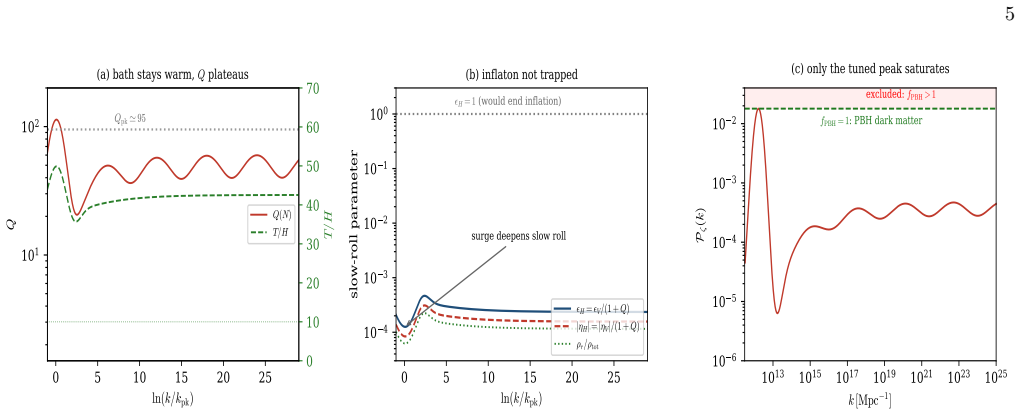
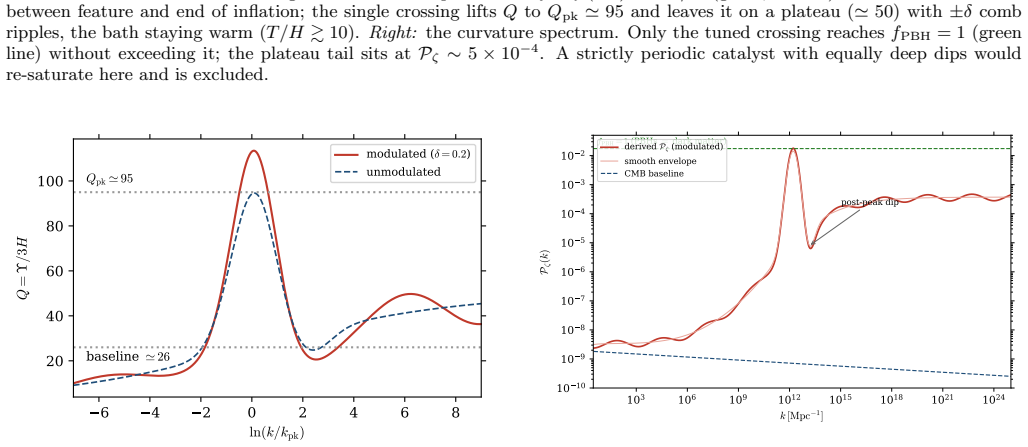
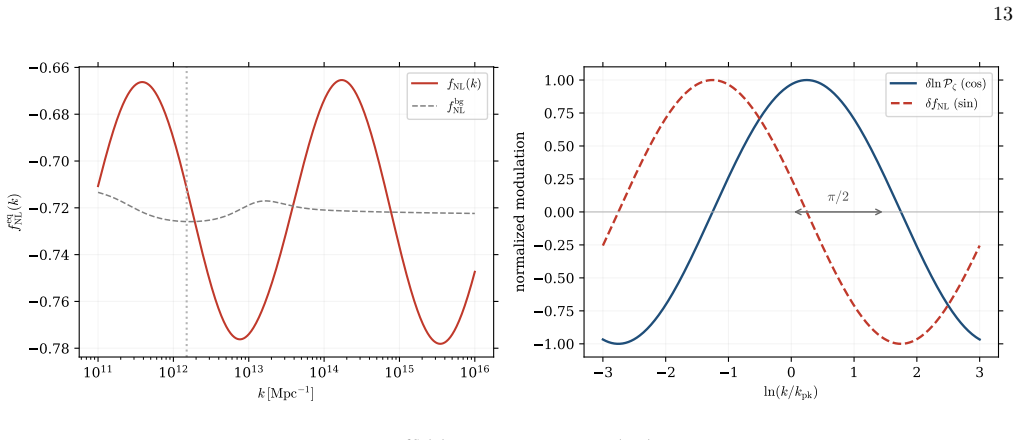
When the thermal channel opens midway, the periodic coupling causes friction to surge and imprint a log-periodically modulated peak on the curvature power spectrum at small scales. This peak saturates PBH formation in the asteroid-mass window and sources two bands of scalar-induced gravitational waves with matching log-period and freeze-out phase, while the equilateral bispectrum is offset by π/2 from the power spectrum due to the spectrum's running. The high-frequency band is itself bounded by PBH overproduction, which constrains how far friction can grow. The two GW bands and the bispectrum are expected to share the log-periodic structure because the feature is localized in the field.
What carries the argument
The periodic coupling of the inflaton to the thermal bath, which makes friction oscillate and surge when the channel opens at an intermediate field value, localizing the feature so it imprints the same log-periodic structure on multiple observables.
If this is right
- The gravitational-wave spectrum shows a peak near 3 mHz for LISA and a second band from deci-hertz to a hundred hertz within reach of DECIGO and the Einstein Telescope, both carrying the same log-period and phase to leading order.
- The high-frequency gravitational-wave band is bounded by PBH overproduction, which constrains how far the friction can grow.
- The equilateral bispectrum shares the log-periodic structure with a phase offset fixed by the running of the spectrum and therefore robust to the equilateral-shape coefficient.
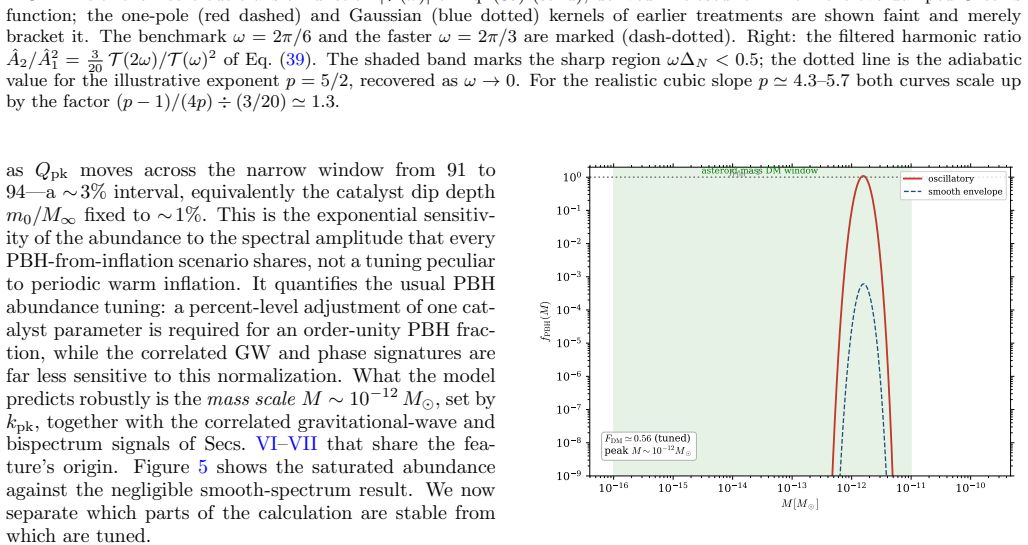
- Primordial black holes in the asteroid-mass window can make up an order-unity fraction of the dark matter.
Where Pith is reading between the lines
- Detection of matching modulations in the two widely separated GW bands would favor a single localized field feature over independent mechanisms at each scale.
- The same periodic-coupling setup could be applied to other inflationary models to predict consistent multi-probe signatures at additional frequency windows.
- A measured phase offset in the bispectrum that deviates from the quarter-cycle prediction would test the claim that the offset is fixed solely by spectrum running.
Load-bearing premise
The thermal channel opens at a specific intermediate field value chosen so the friction surge affects only small scales while leaving CMB scales untouched, together with the assumed functional form of the periodic coupling.
What would settle it
Detection or non-detection of gravitational waves in the two predicted bands that either match or fail to match in log-period and phase, or a measurement of the equilateral bispectrum showing or lacking the expected quarter-cycle offset relative to the power spectrum.
Figures


read the original abstract
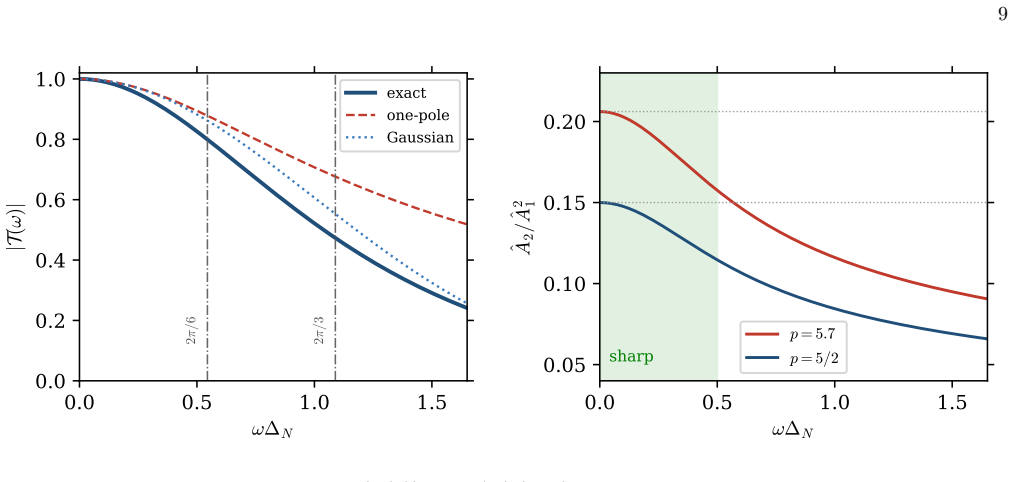
A shift-symmetric inflaton dissipating into a thermal bath couples to that bath periodically, so its friction oscillates as the field rolls. We follow what this does to warm inflation when a thermal channel opens midway through the rolling: the friction surges, and the curvature spectrum grows a sharp, log-periodically modulated peak at small scales while the CMB scales stay untouched. It saturates Primordial Black Holes (PBHs) formation in the asteroid-mass window, where the PBHs can make up an order-unity fraction of the dark matter, and it sources a scalar-induced gravitational-wave background in two bands at once -- a peak at $h^2\Omega_{\rm GW}\simeq10^{-8}$ near $3$~mHz for LISA, and a second band at $h^2\Omega_{\rm GW}\sim10^{-11}$ from deci-hertz to a hundred hertz, within reach of DECIGO and the Einstein Telescope, fed by the friction's continued growth toward smaller scales. And a separate-universe computation places its equilateral bispectrum a quarter cycle ahead of the power spectrum -- an offset fixed by the running of the spectrum and so robust to the equilateral-shape coefficient. The two GW bands carry the same underlying log-period and freeze-out phase to leading order, and the bispectrum is expected to share them: a modulation seen at two widely separated frequencies, plausibly accompanied by a $\pi/2$-shifted bispectrum, is not something a single-scale feature can fake. Because the feature is localized in the field, it imprints the same log-periodic structure on multiple observables, tying the gravitational-wave bands, black-hole mass, and bispectrum phase to a single underlying clock. We derive the freeze-out transfer function in closed form and use it to cap the first two harmonics at one quarter, and we show that the high-frequency band is itself bounded by PBHs overproduction, which turns it into a constraint on how far the friction can grow.
Editorial analysis
A structured set of objections, weighed in public.
Referee Report
Summary. The paper proposes a model of periodic warm inflation where a shift-symmetric inflaton couples periodically to a thermal bath. A thermal channel opens midway through the roll, surging friction and producing a sharp log-periodically modulated peak in the small-scale curvature spectrum (leaving CMB scales untouched). This saturates PBH formation in the asteroid-mass window (potentially order-unity dark matter fraction), sources scalar-induced GWs in two bands (peak ~10^{-8} near 3 mHz for LISA; ~10^{-11} from deci-Hz to 100 Hz for DECIGO/ET), and yields an equilateral bispectrum offset by π/2 from the power spectrum via separate-universe computation. A closed-form freeze-out transfer function is derived to cap the first two harmonics at one quarter; the high-frequency GW band is bounded by PBH overproduction, constraining friction growth. The central claim is that the shared log-period and freeze-out phase across GW bands, PBH mass, and bispectrum phase are tied to one field-localized clock and cannot be reproduced by single-scale features.
Significance. If the closed-form transfer function and phase relations hold, the work supplies a unified, analytically controlled mechanism linking potential multi-band GW signals, PBH dark matter, and non-Gaussianity through a single periodic feature. The explicit derivation of the freeze-out transfer function and harmonic bounds is a strength that enhances testability and falsifiability with LISA, DECIGO, ET, and PBH searches.
major comments (2)
- [model definition and thermal-channel opening] The timing and functional form of the thermal-channel opening (chosen so the friction surge affects only post-CMB scales) is load-bearing for the claim that the log-periodic structure appears exclusively at small scales while CMB scales remain untouched; the manuscript should demonstrate that the peak position, period, and phase relations persist under modest variations of this scale rather than relying on a single tuned value.
- [GW spectrum and PBH bound section] The statement that the high-frequency GW band is bounded by PBH overproduction (turning it into a constraint on friction growth) and that harmonics are capped at one quarter by the closed-form transfer function must be shown to be independent consequences rather than consequences of the same parameter choices that set the peak amplitude; otherwise the multi-observable correlation claim risks circularity.
minor comments (2)
- [Abstract] The abstract alternates between "quarter cycle" and "π/2-shifted"; adopt consistent terminology throughout for the bispectrum offset.
- [model section] Notation for the periodic coupling strength and thermal-channel scale should be introduced with explicit symbols in the model section to aid readability of the subsequent transfer-function derivation.
Simulated Author's Rebuttal
We thank the referee for the careful reading and constructive comments on our manuscript. We address each major comment below and have revised the paper accordingly to strengthen the robustness and clarity of our claims.
read point-by-point responses
-
Referee: [model definition and thermal-channel opening] The timing and functional form of the thermal-channel opening (chosen so the friction surge affects only post-CMB scales) is load-bearing for the claim that the log-periodic structure appears exclusively at small scales while CMB scales remain untouched; the manuscript should demonstrate that the peak position, period, and phase relations persist under modest variations of this scale rather than relying on a single tuned value.
Authors: We agree that explicit demonstration of robustness is necessary. In the revised manuscript we have added a new subsection (with accompanying figures) that varies the thermal-channel opening scale by factors of approximately 2 around the fiducial value. The log-period, phase offset, and overall modulation structure remain stable because they are set by the periodic coupling in the friction term and the subsequent freeze-out dynamics rather than the precise onset time, provided the opening occurs after CMB scales. The peak location shifts modestly but the relations to the GW bands, PBH mass window, and bispectrum phase are preserved. revision: yes
-
Referee: [GW spectrum and PBH bound section] The statement that the high-frequency GW band is bounded by PBH overproduction (turning it into a constraint on friction growth) and that harmonics are capped at one quarter by the closed-form transfer function must be shown to be independent consequences rather than consequences of the same parameter choices that set the peak amplitude; otherwise the multi-observable correlation claim risks circularity.
Authors: We appreciate the referee's concern regarding potential circularity. The closed-form transfer function is obtained analytically from the curvature perturbation equation under the oscillating friction and is independent of amplitude normalization; the one-quarter harmonic cap follows directly from its functional form. The PBH overproduction bound is obtained by integrating the curvature spectrum above the collapse threshold and separately limits the allowed friction growth rate. In the revision we have added clarifying text and a short parameter scan showing that the harmonic bound holds across a range of peak amplitudes while the PBH constraint supplies an independent upper limit on growth, thereby confirming the two results are distinct consequences. revision: yes
Circularity Check
No significant circularity identified
full rationale
The paper presents a derivation of the freeze-out transfer function in closed form from the periodic coupling and thermal friction surge, then applies it to bound harmonics and constrain the high-frequency GW band via an external PBH overproduction limit. These steps are consequences of the model equations rather than inputs renamed as outputs. The central claim—that a field-localized feature produces correlated log-periodic signatures across GW bands, PBH mass, and a phase-shifted bispectrum—rests on the physical localization and timing assumptions, which are independent of the fitted parameters and do not reduce to self-definition or self-citation chains. No load-bearing prediction is shown to be equivalent to its inputs by construction, and the derivation chain remains self-contained.
Axiom & Free-Parameter Ledger
free parameters (2)
- periodic coupling strength
- thermal-channel opening scale
axioms (2)
- domain assumption Shift-symmetric inflaton potential with periodic coupling to the thermal bath
- domain assumption Standard warm-inflation background equations remain valid when the thermal channel opens
Reference graph
Works this paper leans on
-
[1]
Berera and L
A. Berera and L. Z. Fang, Phys. Rev. Lett.74, 1912 (1995)
1912
-
[2]
Berera, Phys
A. Berera, Phys. Rev. Lett.75, 3218 (1995)
1995
-
[3]
A. Berera, M. Gleiser, and R. O. Ramos, Phys. Rev. D 58, 123508 (1998), arXiv:hep-ph/9803394
Pith/arXiv arXiv 1998
-
[4]
A. Berera, I. G. Moss, and R. O. Ramos, Rept. Prog. Phys.72, 026901 (2009), arXiv:0808.1855
Pith/arXiv arXiv 2009
-
[5]
M. Bastero-Gil and A. Berera, Int. J. Mod. Phys. A24, 2207 (2009), arXiv:0902.0521
Pith/arXiv arXiv 2009
- [6]
-
[7]
J. Yokoyama and A. D. Linde, Phys. Rev. D60, 083509 (1999), arXiv:hep-ph/9809409
Pith/arXiv arXiv 1999
-
[8]
M. Bastero-Gil, A. Berera, and R. O. Ramos, JCAP09, 033 (2011), arXiv:1008.1929
Pith/arXiv arXiv 2011
-
[9]
A. Berera and R. O. Ramos, Phys. Rev. D71, 023513 (2005), arXiv:hep-ph/0406339
Pith/arXiv arXiv 2005
-
[10]
A. Berera and T. W. Kephart, Phys. Rev. Lett.83, 1084 (1999), arXiv:hep-ph/9904410
Pith/arXiv arXiv 1999
- [11]
-
[12]
M. Bastero-Gil, A. Berera, R. O. Ramos, and J. G. Rosa, Phys. Rev. Lett.117, 151301 (2016), arXiv:1604.08838
Pith/arXiv arXiv 2016
-
[13]
M. Bastero-Gil, A. Berera, R. O. Ramos, and J. G. Rosa, JCAP01, 016 (2013), arXiv:1207.0445
Pith/arXiv arXiv 2013
-
[14]
M. Bastero-Gil, A. Berera, R. O. Ramos, and J. G. Rosa, Phys. Lett. B813, 136055 (2021), arXiv:1907.13410
arXiv 2021
-
[15]
M. Benetti and R. O. Ramos, Phys. Rev. D95, 023517 (2017), arXiv:1610.08758
Pith/arXiv arXiv 2017
-
[16]
M. Bastero-Gil, S. Bhattacharya, K. Dutta, and M. R. Gangopadhyay, JCAP02, 054 (2018), arXiv:1710.10008
Pith/arXiv arXiv 2018
-
[17]
Akramiet al.(Planck Collaboration), Astron
Y. Akramiet al.(Planck Collaboration), Astron. Astro- phys.641, A10 (2020), arXiv:1807.06211
Pith/arXiv arXiv 2020
-
[18]
A. Berera, J. Mabillard, M. Pieroni, and R. O. Ramos, JCAP07, 021 (2018), arXiv:1803.04982
Pith/arXiv arXiv 2018
-
[19]
M. R. Gangopadhyay, S. Myrzakul, M. Sami, and M. K. Sharma, Phys. Rev. D103, 043505 (2021), arXiv:2011.09155
arXiv 2021
- [20]
-
[21]
Freese, J
K. Freese, J. A. Frieman, and A. V. Olinto, Phys. Rev. Lett.65, 3233 (1990)
1990
-
[22]
E. Silverstein and A. Westphal, Phys. Rev. D78, 106003 (2008), arXiv:0803.3085
Pith/arXiv arXiv 2008
-
[23]
L. McAllister, E. Silverstein, and A. Westphal, Phys. Rev. D82, 046003 (2010), arXiv:0808.0706
Pith/arXiv arXiv 2010
-
[24]
R. Flauger, L. McAllister, E. Pajer, A. Westphal, and G. Xu, JCAP06, 009 (2010), arXiv:0907.2916
Pith/arXiv arXiv 2010
- [25]
-
[26]
S. Hannestad, T. Haugbolle, P. R. Jarnhus, and M. S. Sloth, JCAP06, 001 (2010), arXiv:0912.3527
Pith/arXiv arXiv 2010
-
[27]
R. Flauger, L. McAllister, E. Silverstein, and A. West- phal, JCAP10, 055 (2017), arXiv:1412.1814
Pith/arXiv arXiv 2017
-
[28]
S. R. Behbahani, A. Dymarsky, M. Mirbabayi, and L. Senatore, JCAP12, 036 (2012), arXiv:1111.3373. 15
Pith/arXiv arXiv 2012
-
[29]
X. Chen, R. Easther, and E. A. Lim, JCAP04, 010 (2008), arXiv:0801.3295
Pith/arXiv arXiv 2008
- [30]
-
[31]
T. Kobayashi and F. Takahashi, JCAP01, 026 (2011), arXiv:1011.3988
Pith/arXiv arXiv 2011
-
[32]
A. Ach´ ucarro, J.-O. Gong, S. Hardeman, G. A. Palma, and S. P. Patil, JCAP01, 030 (2011), arXiv:1010.3693
Pith/arXiv arXiv 2011
-
[33]
Chen, JCAP01, 038 (2012), arXiv:1104.1323
X. Chen, JCAP01, 038 (2012), arXiv:1104.1323
Pith/arXiv arXiv 2012
-
[34]
E. Pajer and M. Peloso, Class. Quant. Grav.30, 214002 (2013), arXiv:1305.3557
Pith/arXiv arXiv 2013
-
[35]
J. M. Maldacena, JHEP05, 013 (2003), arXiv:astro- ph/0210603
arXiv 2003
-
[36]
V. Acquaviva, N. Bartolo, S. Matarrese, and A. Riotto, Nucl. Phys. B667, 119 (2003), arXiv:astro-ph/0209156
Pith/arXiv arXiv 2003
-
[37]
D. Babich, P. Creminelli, and M. Zaldarriaga, JCAP 08, 009 (2004), arXiv:astro-ph/0405356
Pith/arXiv arXiv 2004
-
[38]
X. Chen, M.-x. Huang, S. Kachru, and G. Shiu, JCAP 01, 002 (2007), arXiv:hep-th/0605045
Pith/arXiv arXiv 2007
- [39]
- [40]
- [41]
-
[42]
R. Arya, R. K. Jain, and A. K. Mishra, JCAP02, 034 (2024), arXiv:2302.08940
arXiv 2024
- [43]
-
[44]
M. Bastero-Gil, A. Berera, R. O. Ramos, and J. G. Rosa, Phys. Lett. B712, 425 (2012), arXiv:1110.3971
Pith/arXiv arXiv 2012
-
[45]
J. G. Rosa and L. B. Ventura, Phys. Rev. Lett.122, 161301 (2019), arXiv:1811.05493
Pith/arXiv arXiv 2019
-
[46]
K. V. Berghaus, P. W. Graham, and D. E. Kaplan, JCAP03, 034 (2020) [Erratum: JCAP10, E02 (2023)], arXiv:1910.07525
arXiv 2020
- [47]
-
[48]
G. Montefalcone, V. Aragam, L. Visinelli, and K. Freese, JCAP01, 032 (2024), arXiv:2306.16190
arXiv 2024
-
[49]
R. O. Ramos and L. A. da Silva, JCAP03, 032 (2013), arXiv:1302.3544
Pith/arXiv arXiv 2013
-
[50]
P. A. R. Adeet al.(BICEP/Keck Collaboration), Phys. Rev. Lett.127, 151301 (2021), arXiv:2110.00483
arXiv 2021
-
[51]
J. E. Kim, H. P. Nilles, and M. Peloso, JCAP01, 005 (2005), arXiv:hep-ph/0409138
Pith/arXiv arXiv 2005
- [52]
-
[53]
M. Bastero-Gil, A. Berera, I. G. Moss, and R. O. Ramos, JCAP05, 004 (2014), arXiv:1401.1149
Pith/arXiv arXiv 2014
-
[54]
Visinelli, JCAP01, 005 (2015), arXiv:1410.1187
L. Visinelli, JCAP01, 005 (2015), arXiv:1410.1187
Pith/arXiv arXiv 2015
-
[55]
M. Bastero-Gil, A. Berera, and R. O. Ramos, JCAP07, 030 (2011), arXiv:1106.0701
Pith/arXiv arXiv 2011
-
[56]
M. Bastero-Gil, A. Berera, R. Brandenberger, I. G. Moss, R. O. Ramos, and J. G. Rosa, JCAP 01, 002 (2018), arXiv:1612.04726
Pith/arXiv arXiv 2018
-
[57]
M. R. Gangopadhyay, J. C. Jain, D. Sharma, and Yo- gesh, Eur. Phys. J. C82, 849 (2022), arXiv:2108.13839
arXiv 2022
-
[58]
S. Choudhury, M. R. Gangopadhyay, and M. Sami, Eur. Phys. J. C84, 884 (2024), arXiv:2301.10000
arXiv 2024
-
[59]
M. R. Gangopadhyay and N. Kumar, Phys. Dark Univ. 52(2026), arXiv:2603.11629
Pith/arXiv arXiv 2026
-
[60]
W. H. Press and P. Schechter, Astrophys. J.187, 425 (1974)
1974
-
[61]
B. J. Carr and S. W. Hawking, Mon. Not. R. Astron. Soc.168, 399 (1974)
1974
-
[62]
B. J. Carr, Astrophys. J.201, 1 (1975)
1975
-
[63]
A. M. Green and B. J. Kavanagh, J. Phys. G48, 043001 (2021), arXiv:2007.10722
Pith/arXiv arXiv 2021
- [64]
-
[65]
T. Harada, C.-M. Yoo, and K. Kohri, Phys. Rev. D 88, 084051 (2013) [Erratum: Phys. Rev. D89, 029903 (2014)], arXiv:1309.4201
Pith/arXiv arXiv 2013
-
[66]
J. C. Niemeyer and K. Jedamzik, Phys. Rev. D59, 124013 (1999), arXiv:astro-ph/9901292
Pith/arXiv arXiv 1999
-
[67]
M. Shibata and M. Sasaki, Phys. Rev. D60, 084002 (1999), arXiv:gr-qc/9905064
Pith/arXiv arXiv 1999
-
[68]
S. Young, C. T. Byrnes, and M. Sasaki, JCAP07, 045 (2014), arXiv:1405.7023
Pith/arXiv arXiv 2014
-
[69]
B. Carr, K. Kohri, Y. Sendouda, and J. Yokoyama, Rept. Prog. Phys.84, 116902 (2021), arXiv:2002.12778
Pith/arXiv arXiv 2021
-
[70]
H. Niikuraet al., Nat. Astron.3, 524 (2019), arXiv:1701.02151
Pith/arXiv arXiv 2019
-
[71]
H. Niikura, M. Takada, S. Yokoyama, T. Sumi, and S. Masaki, Phys. Rev. D99, 083503 (2019), arXiv:1901.07120
Pith/arXiv arXiv 2019
-
[72]
B. Carr and F. K¨ uhnel, Ann. Rev. Nucl. Part. Sci.70, 355 (2020), arXiv:2006.02838
Pith/arXiv arXiv 2020
-
[73]
M. Sasaki, T. Suyama, T. Tanaka, and S. Yokoyama, Class. Quant. Grav.35, 063001 (2018), arXiv:1801.05235
Pith/arXiv arXiv 2018
-
[74]
B. Carr, F. K¨ uhnel, and M. Sandstad, Phys. Rev. D94, 083504 (2016), arXiv:1607.06077
Pith/arXiv arXiv 2016
-
[75]
B. Carr, F. K¨ uhnel, and L. Visinelli, Mon. Not. R. As- tron. Soc.501, 2029 (2021), arXiv:2008.08077
arXiv 2029
-
[76]
M. W. Choptuik, Phys. Rev. Lett.70, 9 (1993)
1993
-
[77]
C.-M. Yoo, T. Harada, J. Garriga, and K. Kohri, PTEP 2018, 123E01 (2018), arXiv:1805.03946
arXiv 2018
-
[78]
V. Atal and C. Germani, Phys. Dark Univ.24, 100275 (2019), arXiv:1811.07857
Pith/arXiv arXiv 2019
-
[79]
K. N. Ananda, C. Clarkson, and D. Wands, Phys. Rev. D75, 123518 (2007), arXiv:gr-qc/0612013
Pith/arXiv arXiv 2007
-
[80]
D. Baumann, P. J. Steinhardt, K. Takahashi, and K. Ichiki, Phys. Rev. D76, 084019 (2007), arXiv:hep- th/0703290
arXiv 2007
discussion (0)
Sign in with ORCID, Apple, or X to comment. Anyone can read and Pith papers without signing in.