Wave-particle duality as an uncertainty relation for the average confidence width
Pith reviewed 2026-07-01 05:22 UTC · model grok-4.3
The pith
Uncertainty and wave-particle duality are two faces of one inequality using the average confidence width.
A machine-rendered reading of the paper's core claim, the machinery that carries it, and where it could break.
Core claim
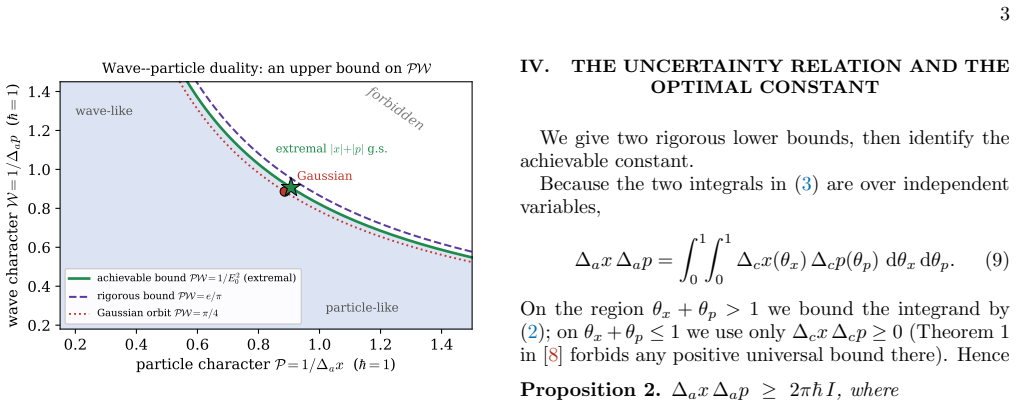
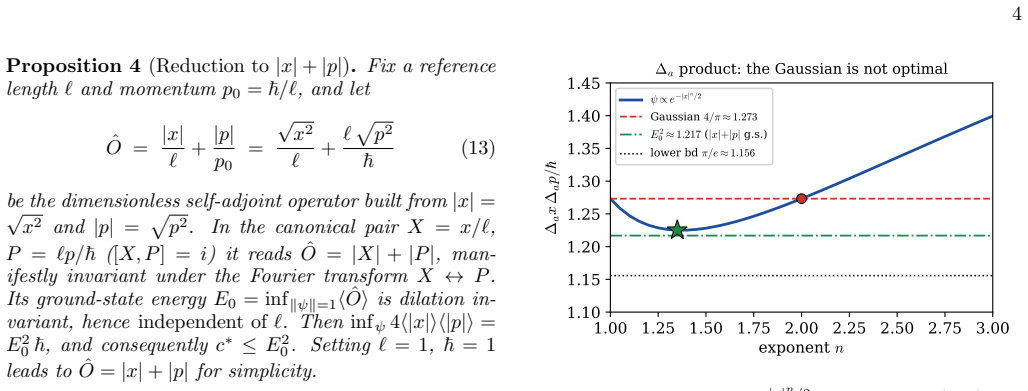
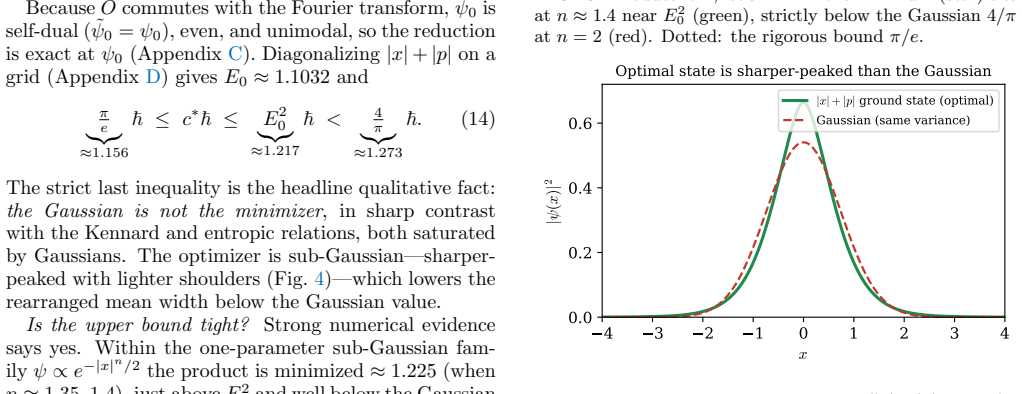
The central claim is that the lower bound on the product Δ_a x Δ_a p is identically an upper bound on combined particle-and-wave character when the reciprocals are so interpreted, making uncertainty and wave-particle duality two faces of one inequality. The constant satisfies π/e ≤ c* ≤ E_0² ≈ 1.217, with the achievable optimum fixed by the ground state of the Fourier-invariant operator |x| + |p| and the optimal state therefore sub-Gaussian rather than Gaussian.
What carries the argument
Average confidence width Δ_a x, the integral of the confidence width over all probability fractions, which equals the first moment of the decreasing rearrangement of |ψ|² and serves as the L1 mean-absolute-deviation localization measure.
If this is right
- The product Δ_a x Δ_a p is bounded below by c ħ with c at least π/e.
- The best possible constant c* cannot exceed the square of the ground-state energy of the operator |x| + |p|.
- Gaussian states are not optimal for the combined duality-uncertainty bound.
- The states that saturate the bound are sub-Gaussian.
Where Pith is reading between the lines
- Numerical diagonalization of |x| + |p| in a suitable basis would yield the exact optimal constant and the corresponding wavefunction.
- The same construction could be applied to other conjugate pairs to produce analogous duality bounds.
- Preparation of sub-Gaussian states in an experiment would allow a direct test of whether the measured product approaches the tighter constant.
Load-bearing premise
That the reciprocals of the average confidence widths can be interpreted as quantifying particle character and wave character respectively.
What would settle it
A quantum state whose product of average confidence widths lies below (π/e) ħ, or an explicit ground-state wavefunction of |x| + |p| whose energy squared lies below the stated upper limit on c*.
Figures

read the original abstract
We introduce the average confidence width $\Delta_a x=\int_0^1 \Delta_c x (\theta_x) d \theta_x$: the confidence width $\Delta_c x(\theta_x)$ -- the smallest position interval carrying a fraction $\theta_x$ of the probability -- averaged over all levels. It is the first moment of the decreasing rearrangement of $|\psi|^2$, an $L^1$ mean-absolute-deviation measure of localization, so the product $\Delta_{a} x\,\Delta_{a} p$ is dilation invariant and obeys $\Delta_{a} x\,\Delta_{a} p\ge c\,\hbar$. Reading $1/\Delta_{a} x$ as a particle character and $1/\Delta_{a} p$ as a wave character, this lower bound on combined spread is identically an upper bound on combined particle-and-wave character: uncertainty and wave-particle duality are two faces of one inequality. A mean-entropy argument with the Bialynicki-Birula-Mycielski relation gives the rigorous $c\ge\pi/e$, while the achievable constant $c^\ast$ is set by the ground state of the Fourier-invariant operator $|x|+|p|$, $c^\ast\le E_0^2\approx 1.217$. Hence $\pi/e\le c^\ast\le E_0^2<4/\pi$: the optimal state is sub-Gaussian, so the Gaussian -- optimal for the Heisenberg and entropic relations -- is not the duality optimum.
Editorial analysis
A structured set of objections, weighed in public.
Referee Report
Summary. The manuscript defines the average confidence width Δ_a x as the integral over θ_x of the smallest interval containing fraction θ_x of the probability mass (the first moment of the decreasing rearrangement of |ψ|²). It shows that the product Δ_a x Δ_a p is dilation-invariant and obeys Δ_a x Δ_a p ≥ c ħ. A mean-entropy argument based on the Bialynicki-Birula-Mycielski relation supplies the rigorous lower bound c ≥ π/e; the achievable constant c* is bounded above by the square of the ground-state energy E_0 of the Fourier-invariant operator |x|+|p|, yielding π/e ≤ c* ≤ E_0² ≈ 1.217 < 4/π. The paper then reads 1/Δ_a x as particle character and 1/Δ_a p as wave character, asserting that the spread lower bound is identically an upper bound on combined character and that uncertainty and wave-particle duality are therefore two faces of one inequality.
Significance. If the interpretive mapping is accepted, the result supplies a concrete, dilation-invariant measure that unifies uncertainty and duality with explicit, non-Gaussian constants and identifies the |x|+|p| ground state as the duality optimum. The derivation re-uses the established BBM relation in a mean-entropy setting and introduces a technically natural upper-bound operator; these are genuine strengths. The sub-Gaussian character of the optimum distinguishes the result from both Heisenberg and entropic cases.
major comments (1)
- [Abstract] Abstract and opening paragraphs: the assertion that the inequality is 'identically' an upper bound on combined particle-and-wave character rests on the direct re-interpretation of 1/Δ_a x and 1/Δ_a p as particle and wave characters. The manuscript states this mapping immediately after the definition but supplies no independent operational definition of wave-particle duality nor a derivation showing that the re-interpretation follows from the mathematics of the spread bound alone; this step is load-bearing for the central duality claim.
minor comments (2)
- [Abstract] The numerical value E_0² ≈ 1.217 should be accompanied by additional digits, an explicit statement of the numerical method used to obtain it, or a reference to a prior computation of the |x|+|p| ground state.
- Notation: the symbol c* is introduced for the achievable constant; its precise definition (supremum over states of 1/(Δ_a x Δ_a p)) should be stated explicitly in the main text.
Simulated Author's Rebuttal
We thank the referee for the careful review and constructive feedback. We respond to the single major comment below.
read point-by-point responses
-
Referee: [Abstract] Abstract and opening paragraphs: the assertion that the inequality is 'identically' an upper bound on combined particle-and-wave character rests on the direct re-interpretation of 1/Δ_a x and 1/Δ_a p as particle and wave characters. The manuscript states this mapping immediately after the definition but supplies no independent operational definition of wave-particle duality nor a derivation showing that the re-interpretation follows from the mathematics of the spread bound alone; this step is load-bearing for the central duality claim.
Authors: We agree that the mapping of 1/Δ_a x to particle character and 1/Δ_a p to wave character is presented as an interpretive step rather than a mathematical derivation internal to the spread bound. The motivation rests on the conventional association, in discussions of wave-particle duality, between position localization (small Δ_a x) and particle-like behavior versus momentum localization (small Δ_a p) and wave-like behavior. This is consistent with prior quantitative approaches to duality in the literature, though the manuscript does not supply an independent operational definition or experimental protocol that would derive the mapping from the inequality alone. To make this load-bearing interpretive step more transparent and better supported, we will expand the introduction with additional context and references to existing operational measures of wave-particle character. revision: yes
Circularity Check
No circularity; derivation relies on independent external relations
full rationale
The paper first defines the average confidence width Δ_a x as the first moment of the decreasing rearrangement of |ψ|^2 and derives the product bound Δ_a x Δ_a p ≥ c ħ via a mean-entropy argument from the established Bialynicki-Birula-Mycielski relation together with the ground-state energy of the separate Fourier-invariant operator |x|+|p|. These inputs are external and not reduced to the target duality statement. The subsequent claim that reading the inverses as particle/wave characters makes the inequality 'identically' a duality bound is an interpretive overlay stated after the mathematical result, not a self-definitional or fitted-input reduction. No self-citations, ansatz smuggling, or renaming of known results occur in the derivation chain. The result is therefore self-contained against external benchmarks.
Axiom & Free-Parameter Ledger
axioms (2)
- standard math Bialynicki-Birula-Mycielski entropic uncertainty relation
- standard math Existence and computability of the ground-state energy of the Fourier-invariant operator |x| + |p|
Reference graph
Works this paper leans on
-
[1]
duality from entropy
Settingℓ= 1,ℏ= 1 leads to ˆO=|x|+|p|for simplicity. Because ˆOcommutes with the Fourier transform,ψ 0 is self-dual ( ˜ψ0 =ψ 0), even, and unimodal, so the reduction is exact atψ 0 (Appendix C). Diagonalizing|x|+|p|on a grid (Appendix D) givesE 0 ≈1.1032 and π e|{z} ≈1.156 ℏ≤c ∗ℏ≤E 2 0|{z} ≈1.217 ℏ< 4 π|{z} ≈1.273 ℏ.(14) The strict last inequality is the h...
-
[2]
The bound is saturated by the mini- mizerψ 0, which is even, nodeless, and—because ˆOcom- mutes withF—self-dual ( ˜ψ0 =ψ 0); when its densi- ties are symmetric unimodal, (5) holds with equality and ∆ ax∆ ap(ψ0) = 4⟨|x|⟩⟨|p|⟩=E 2 0 ℏ, matching the bound. Appendix D: Numerical methods All computations useℏ= 1 on a uniform grid ofN points spanning [−L/2, L/2...
-
[3]
Heisenberg
W. Heisenberg. ¨Uber den anschaulichen Inhalt der quan- tentheoretischen Kinematik und Mechanik.Z. Phys., 43:172–198, 1927
1927
-
[4]
E. H. Kennard. Zur Quantenmechanik einfacher Bewe- gungstypen.Z. Phys., 44:326–352, 1927
1927
-
[5]
W. K. Wootters and W. H. Zurek. Complementarity in the double-slit experiment: quantum nonseparability and a quantitative statement of Bohr’s principle.Phys. Rev. D, 19:473–484, 1979
1979
-
[6]
D. M. Greenberger and A. Yasin. Simultaneous wave and particle knowledge in a neutron interferometer.Phys. Lett. A, 128:391–394, 1988
1988
-
[7]
B.-G. Englert. Fringe visibility and which-way informa- tion: an inequality.Phys. Rev. Lett., 77:2154–2157, 1996
1996
-
[8]
Jaeger, A
G. Jaeger, A. Shimony, and L. Vaidman. Two interfero- metric complementarities.Phys. Rev. A, 51:54–67, 1995
1995
-
[9]
S. D¨ urr. Quantitative wave-particle duality in multibeam interferometers.Phys. Rev. A, 64:042113, 2001
2001
-
[10]
J.-Y. Lin, X.-Y. Li, W. Wang, and S. Wu. Confidence uncertainty: position and momentum can be jointly de- termined with a guaranteed probability.arXiv preprint arXiv:2605.04484, 2026
work page internal anchor Pith review Pith/arXiv arXiv 2026
-
[11]
P. J. Coles, J. Kaniewski, and S. Wehner. Equivalence of wave–particle duality to entropic uncertainty.Nat. Commun., 5:5814, 2014
2014
-
[12]
D. L. Donoho and Philip B. Stark. Uncertainty principles and signal recovery.SIAM J. Appl. Math., 49:906–931, 1989
1989
-
[13]
Bia lynicki-Birula and J
I. Bia lynicki-Birula and J. Mycielski. Uncertainty rela- tions for information entropy in wave mechanics.Com- mun. Math. Phys., 44:129–132, 1975
1975
-
[14]
W. Beckner. Inequalities in Fourier analysis.Ann. of Math., 102:159–182, 1975
1975
-
[15]
I. I. Hirschman. A note on entropy.Amer. J. Math., 79:152–156, 1957
1957
-
[16]
H. P. Robertson. The uncertainty principle.Phys. Rev., 34:163–164, 1929
1929
-
[17]
V. V. Dodonov. Variance-based uncertainty relations: a concise review of inequalities discovered since 1927. Quantum Reports, 7(3):34, 2025
1927
-
[18]
Maassen and J
H. Maassen and J. B. M. Uffink. Generalized entropic uncertainty relations.Phys. Rev. Lett., 60:1103–1106, 1988
1988
-
[19]
S. Wu, S. Yu, and K. Mølmer. Entropic uncertainty relation for mutually unbiased bases.Phys. Rev. A 79:022104, 2009
2009
-
[20]
P. J. Coles, M. Berta, M. Tomamichel, and S. Wehner. Entropic uncertainty relations and their applications. Rev. Mod. Phys., 89:015002, 2017
2017
-
[21]
H. Wang, Z. Ma, S. Wu, W. Zheng, Z. Cao, Z. Chen, Z. Li, S.-M. Fei, X. Peng, V. Vedral, and J. Du. Uncertainty equality with quantum memory and its experimental ver- ification.npj Quantum Information, 5:39, 2019
2019
-
[22]
Huang, Z.-B
S. Huang, Z.-B. Chen, and S. Wu. Entropic uncertainty relations for general symmetric informationally complete positive operator-valued measures and mutually unbiased measurements.Phys. Rev. A, 103:042205, 2021
2021
-
[23]
H. J. Landau and H. O. Pollak. Prolate spheroidal wave functions, Fourier analysis and uncertainty—II.Bell Syst. Tech. J., 40:65–84, 1961
1961
-
[24]
G. B. Folland and A. Sitaram. The uncertainty principle: a mathematical survey.J. Fourier Anal. Appl., 3:207– 7 238, 1997
1997
-
[25]
Benedicks
M. Benedicks. On Fourier transforms of functions sup- ported on sets of finite Lebesgue measure.J. Math. Anal. Appl., 106:180–183, 1985
1985
-
[26]
W. O. Amrein and A. M. Berthier. On support properties ofL p-functions and their Fourier transforms.J. Funct. Anal., 24:258–267, 1977
1977
-
[27]
Hossein Partovi
M. Hossein Partovi. Majorization formulation of uncer- tainty in quantum mechanics.Phys. Rev. A, 84:052117, 2011
2011
-
[28]
Friedland, V
S. Friedland, V. Gheorghiu, and G. Gour. Universal un- certainty relations.Phys. Rev. Lett., 111:230401, 2013. Erratum: Phys. Rev. Lett.112, 119905 (2014)
2013
-
[29]
Pucha la, L
Z. Pucha la, L. Rudnicki, and K. ˙Zyczkowski. Majoriza- tion entropic uncertainty relations.J. Phys. A: Math. Theor., 46:272002, 2013
2013
-
[30]
A. W. Marshall, I. Olkin, and B. C. Arnold.Inequalities: Theory of Majorization and Its Applications. Springer, 2nd edition, 2011
2011
-
[31]
Bagan, J
E. Bagan, J. A. Bergou, S. S. Cottrell, and M. Hillery. Relations between coherence and path information.Phys. Rev. Lett., 116:160406, 2016
2016
-
[32]
D¨ urr and G
S. D¨ urr and G. Rempe. Can wave–particle duality be based on the uncertainty relation?Am. J. Phys., 68:1021–1024, 2000
2000
-
[33]
Spegel-Lexne, S
D. Spegel-Lexne, S. G´ omez, J. Argillander, M. Paw lowski, P. R. Dieguez, A. Alarc´ on, and G. B. Xavier. Experimental demonstration of the equivalence of en- tropic uncertainty with wave–particle duality.Sci. Adv., 10:eadr2007, 2024
2024
-
[34]
T. M. Cover and J. A. Thomas.Elements of Information Theory. Wiley, 2nd edition, 2006
2006
-
[35]
A. N. Kolmogorov and V. M. Tikhomirov.ε-entropy and ε-capacity of sets in function spaces.Uspekhi Mat. Nauk, 14(2):3–86, 1959
1959
-
[36]
J. L. Massey. Guessing and entropy. InProc. 1994 IEEE Int. Symp. Information Theory (ISIT), page 204, 1994
1994
-
[37]
E. Arikan. An inequality on guessing and its application to sequential decoding.IEEE Trans. Inf. Theory, 42:99– 105, 1996
1996
-
[38]
E. H. Lieb and M. Loss.Analysis, volume 14 ofGraduate Studies in Mathematics. American Mathematical Society, 2nd edition, 2001
2001
discussion (0)
Sign in with ORCID, Apple, or X to comment. Anyone can read and Pith papers without signing in.