Designing bistable nanostructures for target behavior
Pith reviewed 2026-07-01 03:01 UTC · model grok-4.3
The pith
A hinge-arm design lets energy barriers and metastable binding-site separations be programmed in bistable nanostructures, while full energy-profile control needs extra freedom.
A machine-rendered reading of the paper's core claim, the machinery that carries it, and where it could break.
Core claim
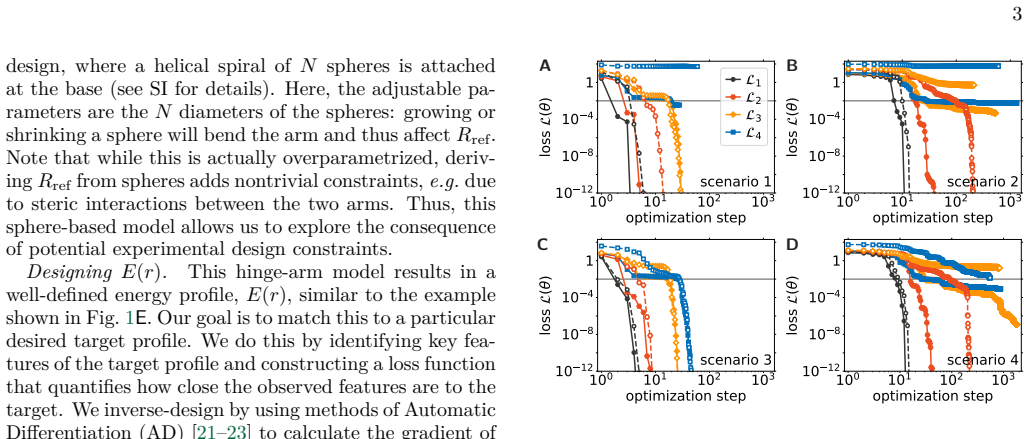
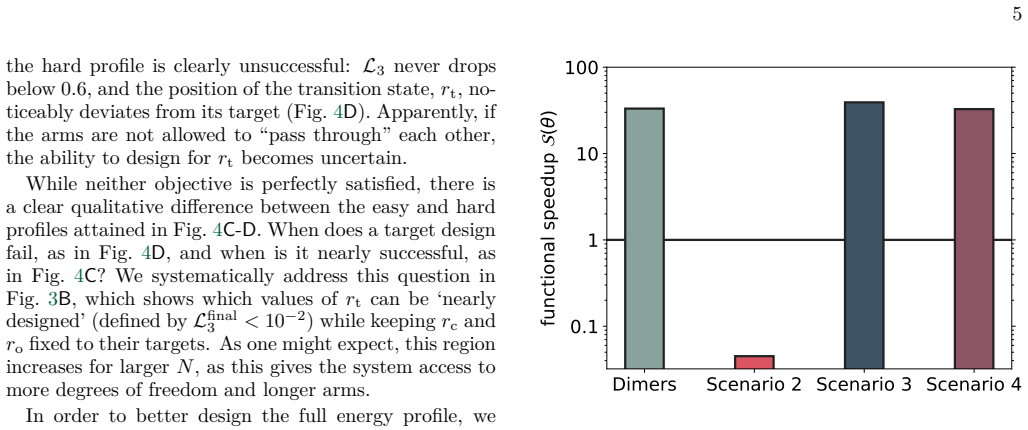
Using the hinge-arm paradigm, energy barriers and the binding-site separations in the two metastable states can be readily designed, while controlling the location of the transition state or the full shape of the energy profile requires additional design freedom. A differentiable optimization framework produces solutions that sometimes deviate numerically from the target profile yet still produce the intended functional behavior, underscoring the value of function-based rather than purely numerical evaluation.
What carries the argument
The hinge-arm paradigm: a small bistable hinge controls the energetics of the conformational transition while rigid arms map that transition onto the separation between external binding sites.
If this is right
- Energy barriers between the two metastable states become a controllable design parameter.
- Binding-site separations at each metastable state can be set independently of the barrier height.
- Some numerically inexact solutions still produce the target functional behavior.
- A practical hierarchy of designability emerges: certain profile features are easy, others require added degrees of freedom.
- The framework supplies a concrete route to synthetic nanomachines that link conformational change to prescribed binding or mechanical output.
Where Pith is reading between the lines
- The same modular split between local hinge energetics and global arm geometry could be tested on multi-state or cyclic machines.
- Function-based acceptance criteria might relax exact matching requirements in other inverse-design problems where small numerical errors do not affect use.
- If the hierarchy holds under fabrication noise, it would guide which biological-machine behaviors are easiest to copy in DNA or protein nanostructures.
Load-bearing premise
The hinge-arm model, with its small hinge controlling energy and rigid arms setting geometry, accurately captures the actual conformational energetics of the nanostructures.
What would settle it
Fabricate a hinge-arm nanostructure whose designed barrier height or metastable separation deviates measurably from the value predicted by the model when the arms are held rigid.
Figures





read the original abstract
Many biological machines function through controlled conformational transitions, yet designing synthetic nanostructures with prescribed dynamical behavior remains a major challenge. Here, we develop a modular inverse-design framework for bistable nanostructures whose function is controlled by an energy profile along a geometric reaction coordinate. Inspired by proteins with rigid domains connected by flexible hinges, we introduce a hinge-arm paradigm in which a small bistable hinge controls the energetics of a conformational transition, while rigid arms map this transition onto the separation between external binding sites. Specifically, we ask which features of a target energy profile can be programmed under different design constraints. We find that the energy barriers and the binding-site separations in the two metastable states can be readily designed, while controlling the location of the transition state or the full shape of the energy profile requires additional design freedom. Using a differentiable design framework, we find that some optimized solutions are numerically inexact but still display the functional behavior for which the target profile was selected, emphasizing the importance of function-based evaluation criteria. These results establish a practical hierarchy of designability for bistable nanostructures and provide a route toward synthetic nanomachines that couple conformational transitions to target behavior.
Editorial analysis
A structured set of objections, weighed in public.
Referee Report
Summary. The manuscript develops a modular inverse-design framework for bistable nanostructures based on the hinge-arm paradigm, in which a small bistable hinge controls the energetics of a conformational transition while rigid arms map the transition onto binding-site separation. The central claim is a hierarchy of designability obtained via differentiable optimization: energy barriers and the binding-site separations in the two metastable states can be readily programmed, whereas the location of the transition state and the full shape of the energy profile require additional design freedom. The authors note that some numerically inexact solutions remain functionally adequate and emphasize function-based evaluation criteria.
Significance. If the reported hierarchy holds under the stated computational model, the work supplies a concrete, practical guide for programming conformational dynamics in synthetic nanostructures. The modular separation of hinge energetics from arm geometry and the explicit distinction between exact numerical match and functional behavior are useful contributions that could accelerate design of nanomachines coupling geometry to target dynamics.
minor comments (2)
- [Abstract] Abstract: the statement that 'some optimized solutions are numerically inexact but still display the functional behavior' would be strengthened by a concrete metric or example (e.g., a tolerance on barrier height or a functional test) that defines 'functionally adequate.'
- [Abstract] Abstract: the phrase 'additional design freedom' is used without quantifying the extra degrees of freedom or parameters involved; a brief clarification would improve readability.
Simulated Author's Rebuttal
We thank the referee for the careful reading, positive assessment of the significance of the modular inverse-design framework, and recommendation for minor revision. No major comments were raised in the report.
Circularity Check
No significant circularity
full rationale
The paper develops a modular inverse-design framework and reports empirical optimization results within a hinge-arm computational model. The hierarchy of designability (barriers and site separations programmable; TS location and full profile requiring extra freedom) is obtained directly from the model's numerical experiments rather than from any self-definitional mapping, fitted-input prediction, or load-bearing self-citation chain. No equations or claims reduce to their inputs by construction, and the work is self-contained against external benchmarks as an observation inside the stated framework.
Axiom & Free-Parameter Ledger
invented entities (1)
-
hinge-arm paradigm
no independent evidence
Reference graph
Works this paper leans on
-
[1]
Phillips, J
R. Phillips, J. Kondev, J. Theriot, and H. Garcia,Phys- ical Biology of the Cell(Garland Science, 2012)
2012
-
[2]
Nelson,Biological Physics: Energy, Information, Life (W
P. Nelson,Biological Physics: Energy, Information, Life (W. H. Freeman and Company, 2013)
2013
-
[3]
Zardecki, S
C. Zardecki, S. Dutta, D. S. Goodsell, R. Lowe, M. Voigt, and S. K. Burley, Protein Science31, 129 (2022)
2022
-
[4]
M. F. Perutz, Scientific American239, 92 (1978)
1978
-
[5]
Fischer, K
S. Fischer, K. W. Olsen, K. Nam, and M. Karplus, Pro- ceedings of the National Academy of Sciences108, 5608 (2011)
2011
-
[6]
Zhang and H
Y. Zhang and H. Hess, ACS Central Science5, 939 (2019)
2019
-
[7]
Y. Lin, J. Ren, and X. Qu, Accounts of Chemical Re- search47, 1097 (2014). 9
2014
-
[8]
Praetorius, P
F. Praetorius, P. J. Y. Leung, M. H. Tessmer, A. Broer- man, C. Demakis, A. F. Dishman, A. Pillai, A. Idris, D. Juergens, J. Dauparas, X. Li, P. M. Levine, M. Lamb, R. K. Ballard, S. R. Gerben, H. Nguyen, A. Kang, B. Sankaran, A. K. Bera, B. F. Volkman, J. Nivala, S. Stoll, and D. Baker, Science381, 754 (2023)
2023
-
[9]
W. B. Rogers, W. M. Shih,and V. N. Manoharan,Nature Reviews Materials1, 16008 (2016)
2016
-
[10]
E. M. King, C. X. Du, Q.-Z. Zhu, S. S. Schoenholz, and M. P. Brenner, Proceedings of the National Academy of Sciences121, e2311891121 (2024)
2024
-
[11]
Q.-Z. Zhu, C. X. Du, E. M. King, and M. P. Brenner, Physical Review Research6, L042057 (2024)
2024
-
[12]
Koehler, P
L. Koehler, P. Ronceray, and M. Lenz, Physical Review X14, 041061 (2024)
2024
-
[13]
M. C. Hübl, T. E. Videbæk, D. Hayakawa, W. B. Rogers, and C. P. Goodrich, Nature Physics22, 294 (2026)
2026
-
[14]
A. Ehrmann and C. P. Goodrich, arXiv:2506.14266 [cond-mat.soft] (2025)
Pith/arXiv arXiv 2025
-
[15]
M. Holmes-Cerfon, S. J. Gortler, and M. P. Brenner, Proceedings of the National Academy of Sciences110, 10.1073/pnas.1211720110 (2013)
-
[16]
C. P. Goodrich, E. M. King, S. S. Schoenholz, E. D. Cubuk, and M. P. Brenner, Proceedings of the National Academy of Sciences118, e2024083118 (2021)
2021
-
[17]
S. A. Trygubenko and D. J. Wales, The Journal of Chem- ical Physics120, 2082 (2004)
2082
-
[18]
C. J. Cerjan and W. H. Miller, The Journal of Chemical Physics75, 2800 (1981)
1981
-
[19]
Wales,Energy Landscapes: Applications to Clusters, Biomolecules and Glasses, Cambridge Molecular Science (Cambridge University Press, 2004)
D. Wales,Energy Landscapes: Applications to Clusters, Biomolecules and Glasses, Cambridge Molecular Science (Cambridge University Press, 2004)
2004
-
[20]
J. C. Mauro, R. J. Loucks, and J. Balakrishnan, The Journal of Physical Chemistry A109, 9578 (2005)
2005
-
[21]
A. G. Baydin, B. A. Pearlmutter, A. A. Radul, and J. M. Siskind, Journal of Machine Learning Research18, 1 (2018)
2018
-
[22]
D. E. Rumelhart, G. E. Hinton, and R. J. Williams, Na- ture323, 533 (1986)
1986
-
[23]
R. E. Wengert, Communications of the ACM7, 463 (1964)
1964
-
[24]
M. Blondel, Q. Berthet, M. Cuturi, R. Frostig, S. Hoyer, F. Llinares-López, F. Pedregosa, and J.-P. Vert, arXiv 10.48550/arXiv.2105.15183 (2022), 2105.15183 [cs]
-
[25]
Melio, M
J. Melio, M. Van Hecke, S. E. Henkes, and D. J. Kraft, Nature651, 632 (2026)
2026
-
[26]
Bradbury, R
J. Bradbury, R. Frostig, P. Hawkins, M. J. Johnson, C. Leary, D. Maclaurin, G. Necula, A. Paszke, J. Van- derPlas, S. Wanderman-Milne, and Q. Zhang, JAX: com- posable transformations of Python+NumPy programs (2023)
2023
-
[27]
S. S. Schoenholz and E. D. Cubuk, Journal of Statis- tical Mechanics: Theory and Experiment2021, 124016 (2021)
2021
-
[28]
Sadoc and N
J. Sadoc and N. Rivier, The European Physical Journal B12, 309 (1999). Appendix A: Model details
1999
-
[29]
hinge”regiontransitioningbetweentwocon- figurations and rigid “arms
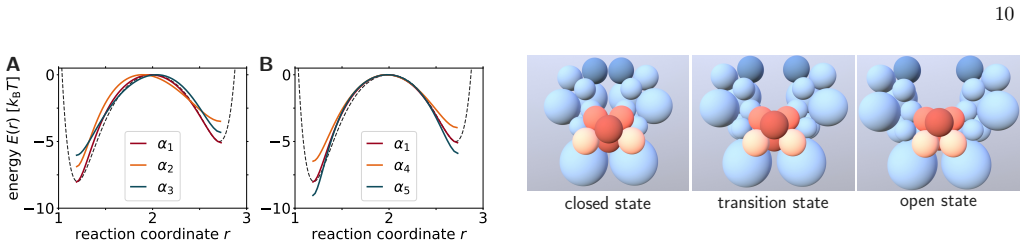
Designing bistable nanostructures The bistable nanostructures used in this work consist ofacentral“hinge”regiontransitioningbetweentwocon- figurations and rigid “arms” that are symmetrically at- tached to the hinge. The hinge is modeled by six spher- ical particles with diameter of 1, which can be arranged in a “closed” polyhedral conformation or an “open...
-
[30]
easy”) and Source (“hard
Target energy profiles We model the target energy profiles of Machine (“easy”) and Source (“hard”) nanostructures through double-well potentials, allowing us to independently tune the positions of the closed, open, and transition states, all barrier heights, and the steepness of the barriers. Each 10 1 2 3 reaction coordinate r 10 5 0 energy E(r) [kBT] 1 ...
-
[31]
This stacking of regular tetrahedra is known as the Boerdijk–Coxeter helix [28]
Designing colloidal nanostructures with sphere-based arms We construct a sphere-based arm as a helical structure by mirroring one point of a tetrahedron with respect to the plane formed by the outermost three points, which is repeated until a desired numberNof colloids in the arm is reached. This stacking of regular tetrahedra is known as the Boerdijk–Cox...
-
[32]
passthrough
Design freedom in the location of the transition state We know from previous work that arbitrary energy barriers can be designed with the hinge [16], but can any combination ofr c,r o, andr t be achieved just by chang- ing the arm design? We test the design freedom in the location of the transition state for a fixed location of the closed state atrc = 1.2...
-
[33]
Comparing the mean first-passage time of the coupled re- actionstotheMachineonitsownresultsinthefunctional speedup presented in the manuscript
Figure 16Bdemonstrates that the energy barriers along the coupled reaction, Mc·Sc→Mo·So, (purple curve) are significantly smaller compared to the energy barriers of the Machine nanostructure transitioning on its own, Mc→Mo, and the Source on its own, Sc→So. Comparing the mean first-passage time of the coupled re- actionstotheMachineonitsownresultsinthefun...
discussion (0)
Sign in with ORCID, Apple, or X to comment. Anyone can read and Pith papers without signing in.