An analog ac voltage amplifier based on a single straintronic magnetic tunnel junction
Pith reviewed 2026-07-02 17:47 UTC · model grok-4.3
The pith
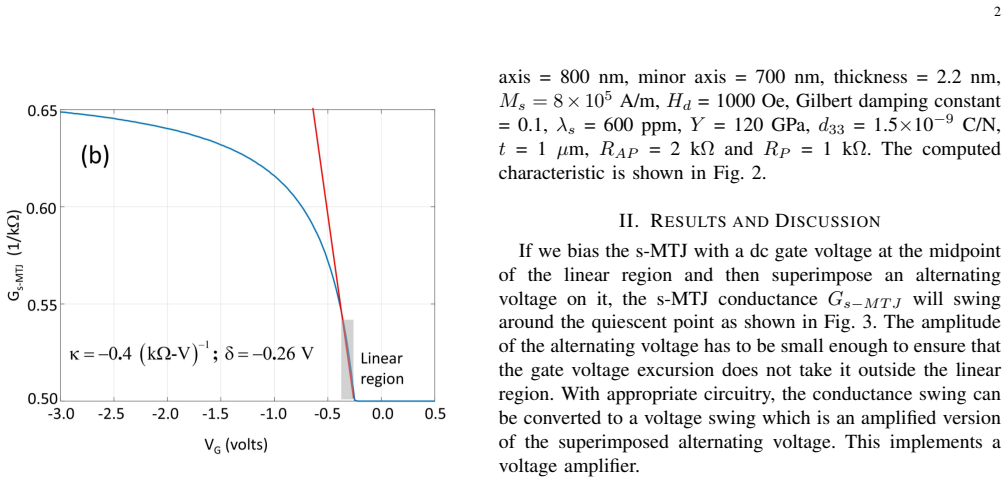
A straintronic magnetic tunnel junction amplifies small AC voltages without distortion when biased in its linear conductance region.
A machine-rendered reading of the paper's core claim, the machinery that carries it, and where it could break.
Core claim
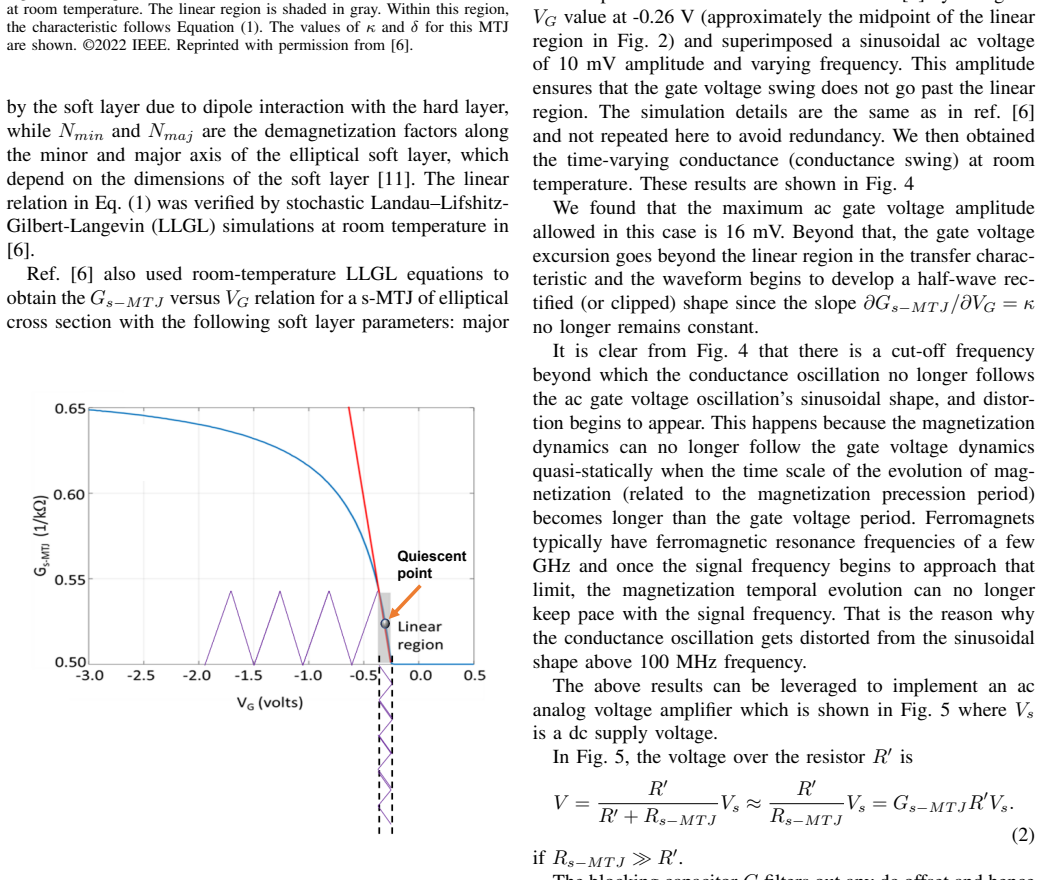
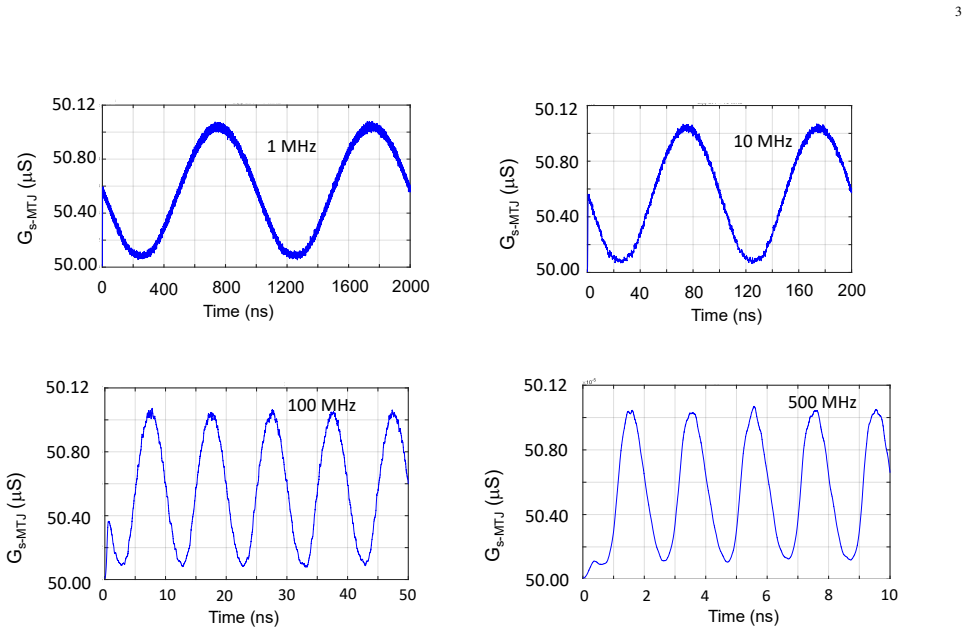
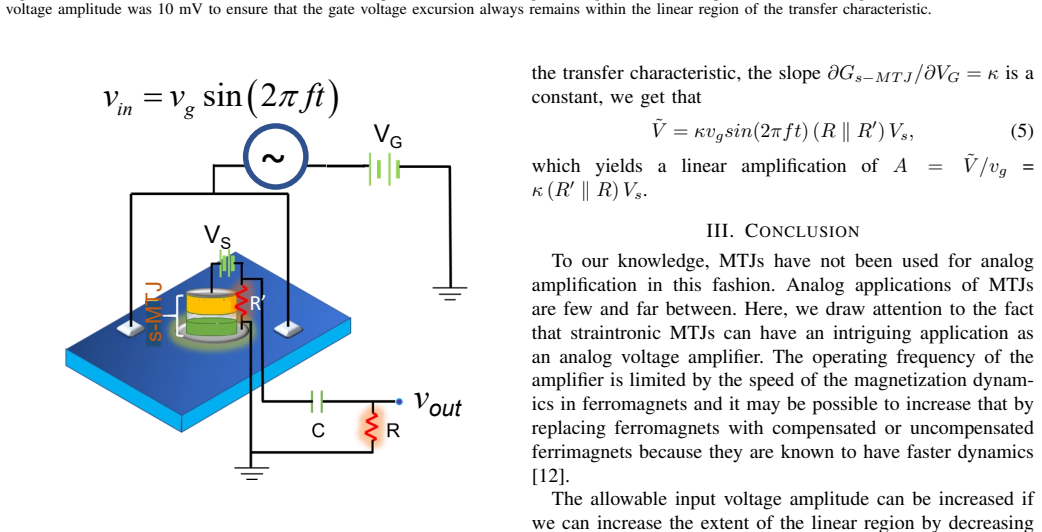
If the s-MTJ's gate voltage is fixed around the midpoint of the linear region and a small AC voltage is superimposed on it, then the AC voltage can be amplified without distortion as long as its amplitude is small enough to avoid gate voltage excursion beyond the linear region. Unlike a transistor-based voltage amplifier whose amplification is determined solely by the transistor's internal parameters, here the amplification can be varied by an external power supply voltage. The maximum allowed amplitude and frequency of the input signal for distortion-free amplification are examined by modeling the magnetization dynamics, and an expression for the amplification is derived.
What carries the argument
The linear region of the conductance versus gate voltage transfer characteristic of the straintronic MTJ, which converts small changes in gate voltage into proportional changes in conductance for linear voltage amplification.
If this is right
- Distortion-free amplification occurs only when the total gate voltage remains inside the linear region of the transfer curve.
- Voltage gain is adjusted directly by changing the external power supply voltage rather than by redesigning the device.
- Magnetization dynamics impose upper bounds on both the amplitude and the frequency of the input AC signal.
- An explicit expression for the voltage gain follows from the linear-region slope and the circuit parameters.
Where Pith is reading between the lines
- The same biasing approach could be reused for other linear analog functions such as voltage-controlled attenuators or mixers within the same MTJ.
- Integration with existing spintronic memory arrays might allow on-chip conversion between digital storage and analog signal processing.
- Material choices that widen the linear region would directly increase the maximum undistorted input amplitude without changing the circuit topology.
Load-bearing premise
The conductance versus gate voltage curve always contains a usable linear region that remains wide enough for the chosen bias point and small AC excursions.
What would settle it
Apply an AC input whose peak-to-peak excursion keeps the total gate voltage inside the identified linear region of the measured transfer curve and check whether the output waveform exhibits the predicted gain with no detectable harmonic distortion; any systematic deviation falsifies the claim.
Figures

read the original abstract
Magnetic tunnel junctions (MTJs) are known for their digital applications (memory and logic). A special class of them called "straintronic" magnetic tunnel junctions (s-MTJ) has lately emerged as a potential platform for analog applications because their conductance can be varied continuously with mechanical strain generated with a gate voltage. The conductance versus gate voltage (transfer) characteristic always has a linear region and that can be leveraged for a variety of analog applications. Here, we discuss one such application, namely analog voltage amplification. If the s-MTJ's gate voltage is fixed around the midpoint of the linear region and a small ac voltage is superimposed on it, then the ac voltage can be amplified without distortion as long as its amplitude is small enough to avoid gate voltage excursion beyond the linear region. Unlike a transistor-based voltage amplifier whose amplification is determined solely by the transistor's internal parameters - namely the transconductance and Early resistance - here the amplification can be varied by an external power supply voltage. We examine the maximum allowed amplitude and frequency of input signal for distortion-free amplification by modeling the magnetization dynamics and derive an expression for the amplification.
Editorial analysis
A structured set of objections, weighed in public.
Referee Report
Summary. The manuscript proposes an analog AC voltage amplifier based on a single straintronic MTJ (s-MTJ). By fixing the gate voltage at the midpoint of the linear region of the conductance vs. gate-voltage transfer curve and superimposing a small AC signal, the device amplifies the AC voltage without distortion provided the excursions remain within the linear window. Unlike transistor amplifiers whose gain is fixed by internal parameters (transconductance and Early resistance), the s-MTJ gain is stated to be tunable by an external bias supply. Magnetization dynamics are modeled to bound the maximum input amplitude and frequency, and an expression for the amplification is derived.
Significance. If the linear-region premise and dynamics bounds hold, the work would demonstrate a tunable analog function in a single s-MTJ, potentially useful for integrated spintronic analog circuits. The explicit use of magnetization dynamics modeling to set operational limits is a constructive element that supplies a concrete, falsifiable framework for the distortion-free regime.
major comments (3)
- [Abstract] Abstract: the assertion that the conductance-gate voltage characteristic 'always has a linear region' is load-bearing for the distortion-free amplification claim yet is stated without the explicit functional form of G(V_g) or a demonstration that the strain-anisotropy coupling (via Stoner-Wohlfarth or LLG) produces a sufficiently wide linear window before higher-order terms appear.
- [Modeling/derivation sections] Modeling and derivation sections: the amplification expression and the amplitude/frequency limits obtained from magnetization dynamics modeling are presented without accompanying numerical validation, error analysis, or comparison to the underlying cos(θ(V_g)) dependence; this leaves the small-signal premise untested and the derived gain expression without demonstrated support.
- [Amplification derivation] Amplification claim: the statement that gain 'can be varied by an external power supply voltage' is central but requires an explicit derivation showing how the external bias enters the gain formula independently of internal s-MTJ parameters; without this, it is unclear whether the expression reduces to a fitted or self-referential quantity.
minor comments (2)
- [Abstract] Abstract: the derived amplification expression is mentioned but not displayed; including the key formula would aid immediate assessment.
- [Throughout] Notation: symbols for conductance, gate voltage, linear-region midpoint, and the external bias should be introduced once and used consistently with the equations.
Simulated Author's Rebuttal
We thank the referee for the constructive feedback on our manuscript. We address each major comment below and will incorporate revisions to strengthen the presentation of the linear-region premise, the supporting derivations, and the numerical validation.
read point-by-point responses
-
Referee: [Abstract] Abstract: the assertion that the conductance-gate voltage characteristic 'always has a linear region' is load-bearing for the distortion-free amplification claim yet is stated without the explicit functional form of G(V_g) or a demonstration that the strain-anisotropy coupling (via Stoner-Wohlfarth or LLG) produces a sufficiently wide linear window before higher-order terms appear.
Authors: The claim originates from the strain dependence of the free-layer anisotropy energy, which for moderate gate voltages produces an approximately linear rotation of the magnetization angle before higher-order terms in the Stoner-Wohlfarth energy become significant. The conductance then follows G(V_g) = G_P + (G_AP - G_P)(1 - cos θ(V_g))/2, yielding a linear window around the midpoint. We agree the abstract is too terse; the revised version will replace 'always has a linear region' with 'exhibits a linear region within the operating range' and will add a short derivation of the linear window from the LLG equation under the small-strain approximation. revision: yes
-
Referee: [Modeling/derivation sections] Modeling and derivation sections: the amplification expression and the amplitude/frequency limits obtained from magnetization dynamics modeling are presented without accompanying numerical validation, error analysis, or comparison to the underlying cos(θ(V_g)) dependence; this leaves the small-signal premise untested and the derived gain expression without demonstrated support.
Authors: The amplitude and frequency bounds are obtained by integrating the LLG equation with a time-varying strain term and requiring that the magnetization angle remains within the linear conductance window. The gain expression follows directly from the small-signal expansion of ΔG around the bias point. We acknowledge that the current manuscript presents only the analytic results. In revision we will include numerical LLG integrations that (i) reproduce the analytic limits within 5 % for the stated parameter range, (ii) quantify the deviation from the cos(θ(V_g)) curve, and (iii) report the maximum error in the small-signal gain as a function of input amplitude. revision: yes
-
Referee: [Amplification derivation] Amplification claim: the statement that gain 'can be varied by an external power supply voltage' is central but requires an explicit derivation showing how the external bias enters the gain formula independently of internal s-MTJ parameters; without this, it is unclear whether the expression reduces to a fitted or self-referential quantity.
Authors: The output voltage swing is ΔV_out = V_supply × (ΔR / R_total), where ΔR is set by the strain-induced conductance change and R_total includes the fixed load. Consequently the voltage gain A_v = ΔV_out / ΔV_in scales linearly with the externally chosen supply voltage V_supply while the internal MTJ parameters (strain coupling coefficient, TMR ratio) remain fixed. We will insert a dedicated paragraph deriving A_v = (V_supply / V_in) × (ΔG/G_0) and will contrast it with the transistor case where both g_m and r_o are device-intrinsic. revision: yes
Circularity Check
No significant circularity; derivation self-contained against external modeling
full rationale
The paper states that the s-MTJ transfer curve possesses a linear region (treated as given) and invokes magnetization dynamics modeling solely to bound amplitude/frequency limits before deriving the amplification expression. No quoted equation reduces the gain to a fitted parameter renamed as prediction, nor does any load-bearing premise collapse to a self-citation chain or self-definitional loop. The central claim remains independent of the present paper's own inputs once the dynamics model is accepted as external.
Axiom & Free-Parameter Ledger
axioms (1)
- domain assumption The conductance versus gate voltage characteristic always has a linear region
Reference graph
Works this paper leans on
-
[1]
Energy-efficient switching of nanomagnets for computing: Straintronics and other methodologies
N. D’Souza, et al., “Energy-efficient switching of nanomagnets for computing: Straintronics and other methodologies”,Nanotechnology, vol. 29, No. 44, 442001 (2018). https://doi.org/10.1088/1361-6528/aad65d
-
[2]
S. Bandyopadhyay, J. Atulasimha and A. Barman, “Magnetic straintron- ics: Manipulating the magnetization of magnetostrictive nanomagnets with strain for energy-efficient applications”,Appl. Phys. Rev., vol. 8, 041323 (2021). https://doi.org/10.1063/5.0062993
-
[3]
S. Bandyopadhyay,Magnetic Straintronics: An Energy-Efficient Hard- ware Paradigm for Digital and Analog Information Processing(Springer- Nature, Cham, Switzerland, 2022). DOI:10.1007/978-3-031-20683-2
-
[4]
Perspective: There is plenty of room for magnetic straintronics in the analog domain
S. Bandyopadhyay, “Perspective: There is plenty of room for magnetic straintronics in the analog domain”,npj Spintronics, vol. 2, 15 (2022). https://doi.org/10.1038/s44306-024-00018-3
-
[5]
Straintronic magnetic tunnel junctions for analog computation: a perspective
S. Bandyopadhyay, “Straintronic magnetic tunnel junctions for analog computation: a perspective”,J. Phys. D: Appl. Phys., vol. 58, 152001 (2025). DOI 10.1088/1361-6463/adb9f7
-
[6]
R. Rahman and S. Bandyopadhyay, “A nonvolatile all-spin nonbi- nary matrix multiplier: An efficient hardware accelerator for machine learning”,IEEE Trans. Elec. Dev., vol. 69, 7120-7127 (2022). DOI: 10.1109/TED.2022.3214167
-
[7]
P. Li, A. Chen, D. Li, Y . Zhao, S. Zhang, L. Yang, Y . Liu, M. Zhu, H. Zhang, and X. Han,Adv. Mater., vol. 26, 4320 (2014). https://doi.org/10.1002/adma.201400617
-
[8]
Z. Zhao, M. Jamali, N. D’Souza, D. Zhang, S. Bandyopadhyay, J. Atulasimha and J-P Wang, “Giant voltage manipulation of MgO-based magnetic tunnel junctions via localized anisotropic strain: a potential pathway to ultra-energy-efficient memory technology”,Appl. Phys. Lett., vol. 109, 092403 (2016). https://doi.org/10.1063/1.4961670
-
[9]
A. Chen, Y . Wen, B. Fang, Y . Zhao, Q. Zhang, Y . Chang, P. Li, H. Wu, H. Huang, Y . Lu, Z. Zeng, J. Cai, X. Han, T. Wu, X. X Zhang and Y . Zhao, “Giant nonvolatile manipulation of magnetoresistance in magnetic tunnel junctions by electric fields via magnetoelectric coupling”,Nat. Commun., vol. 10, 243 (2019). https://doi.org/10.1038/s41467-018-08061-5
-
[10]
Full voltage manipulation of the resistance of a magnetic tunnel junction
A. Chen, Y . Zhao, Y . Wen, L. Pan, P. Li and X. X. Zhang, “Full voltage manipulation of the resistance of a magnetic tunnel junction”,Sci. Adv., vol. 5, eaay5141 (2019). DOI: 10.1126/sciadv.aay5141
-
[11]
Chikazumi,Physics of Magnetism(Wiley, New York, 1964)
S. Chikazumi,Physics of Magnetism(Wiley, New York, 1964)
1964
-
[12]
Spintronics with compensated ferrimagnets
J. Finley and L. Liu, “Spintronics with compensated ferrimagnets”,Appl. Phys. Lett., vol. 116, 110501 (2020). https://doi.org/10.1063/1.5144076
-
[13]
Millman and C
J. Millman and C. C. Halkias,Electronic Devices and Circuits(Tata- McGraw Hill, New Delhi, 1999)
1999
discussion (0)
Sign in with ORCID, Apple, or X to comment. Anyone can read and Pith papers without signing in.