A High-Order Arbitrary Lagrangian-Eulerian Discontinuous Galerkin Method for the Boltzmann Equation in Nearly Incompressible Flows
Pith reviewed 2026-07-02 17:09 UTC · model grok-4.3
The pith
An arbitrary Lagrangian-Eulerian discontinuous Galerkin discretization of the Boltzmann equation satisfies the geometric conservation law for nearly incompressible flows with moving boundaries.
A machine-rendered reading of the paper's core claim, the machinery that carries it, and where it could break.
Core claim
Mapping the continuous Boltzmann equations to a reference state compensates mesh motion via an added advection term. When the resulting system is discretized with high-order discontinuous Galerkin on unstructured meshes and advanced with semi-analytic Runge-Kutta time integration, the scheme satisfies the geometric conservation law. Consistent update of geometric factors ensures this property holds, enabling the method to simulate nearly incompressible flows with moving boundaries on a GPU-accelerated implementation.
What carries the argument
The ALE mapping of the Boltzmann equations to a reference configuration that adds a compensating advection term, discretized by discontinuous Galerkin with consistent geometric-factor updates to enforce the geometric conservation law.
If this is right
- Free-stream preservation holds exactly under mesh motion.
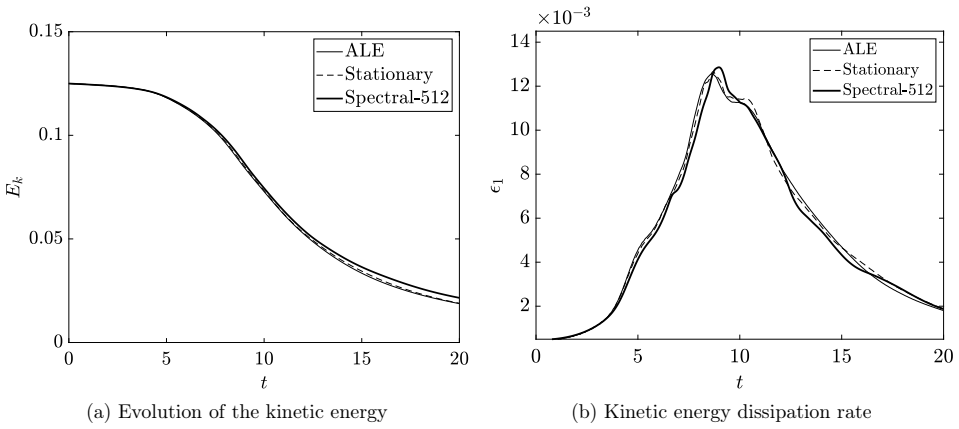
- The moving Taylor-Green vortex test remains accurate.
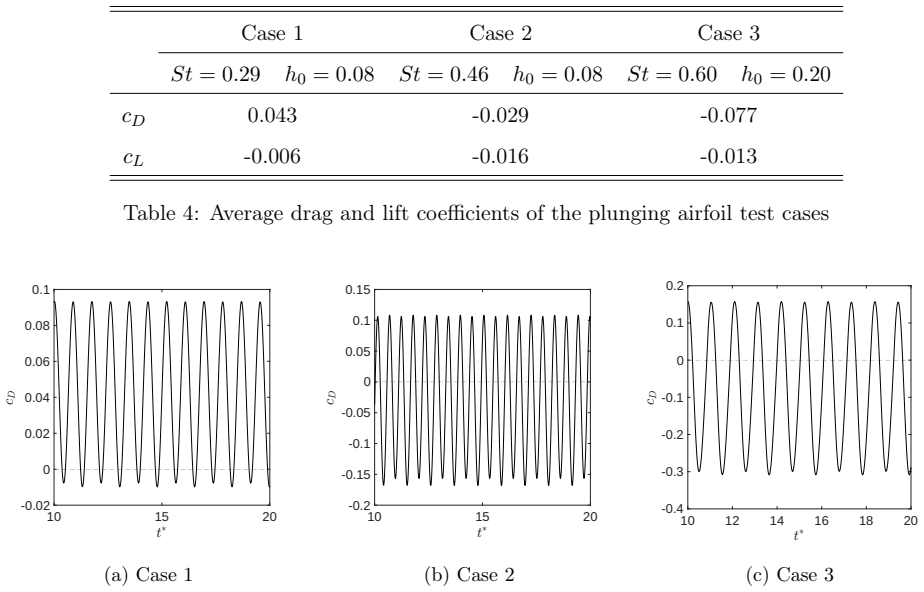
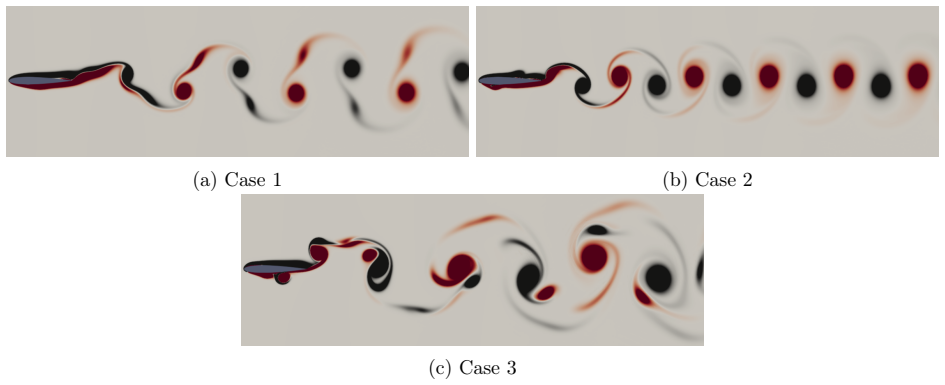
- A plunging symmetric airfoil can be simulated in two dimensions.
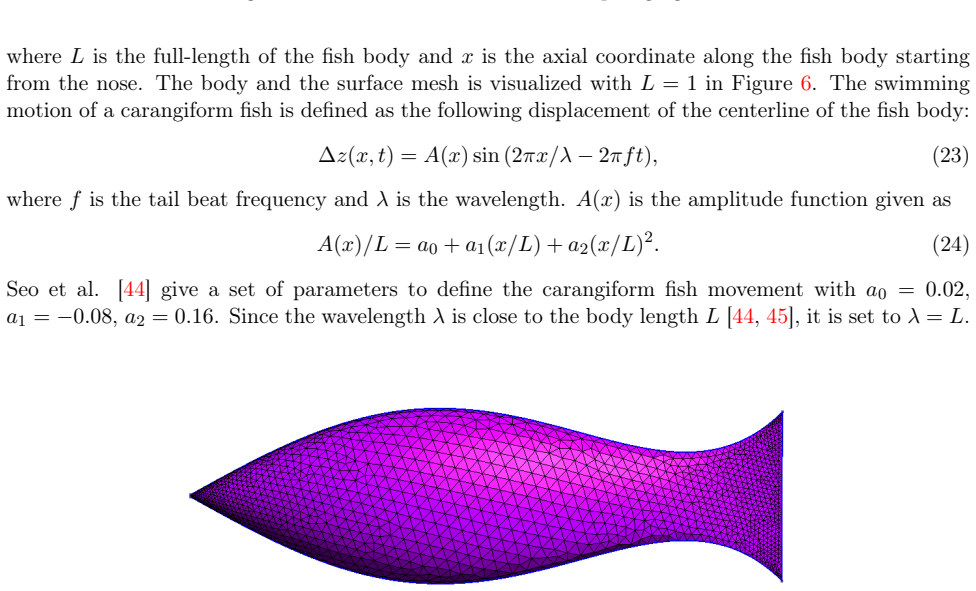
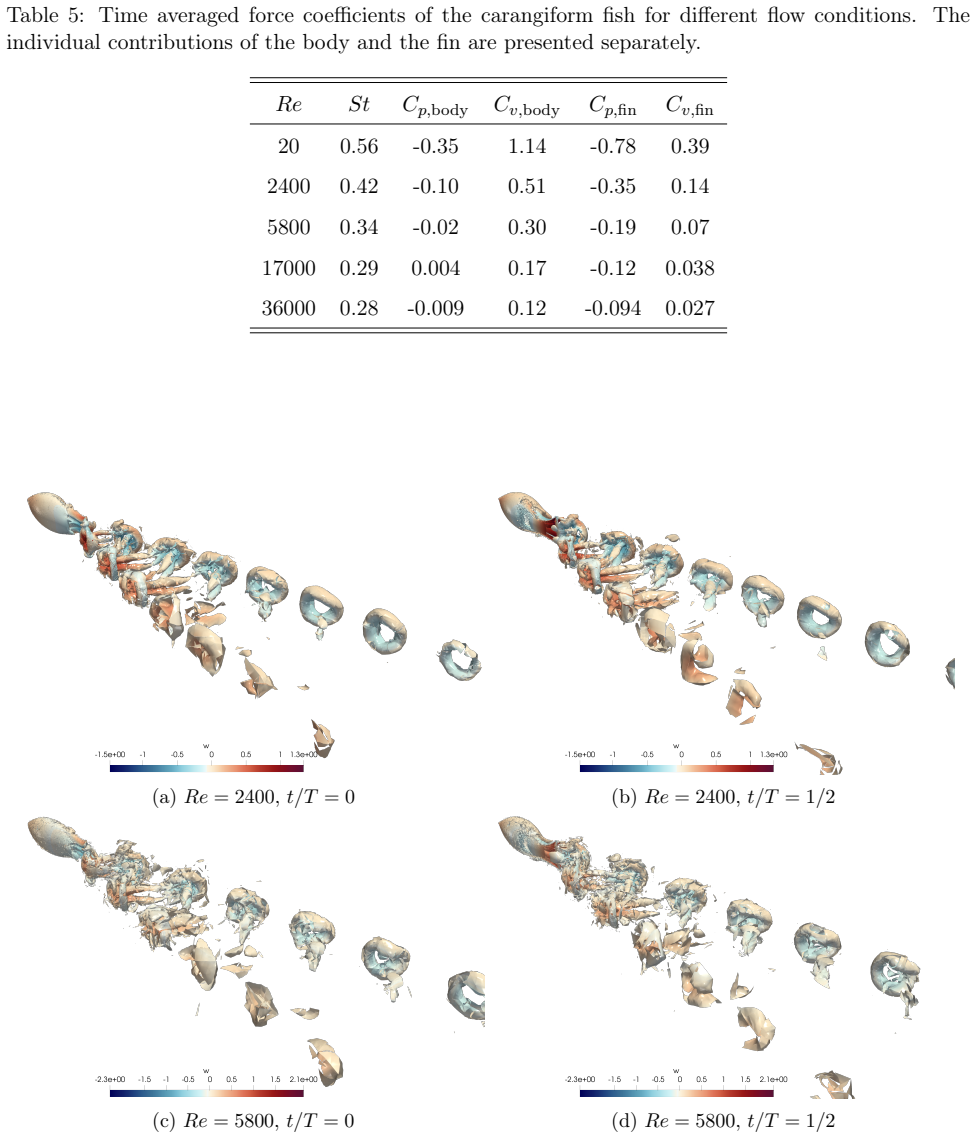
- A moving carangiform fish can be simulated in three dimensions with perfectly matched layers.
Where Pith is reading between the lines
- The same reference-mapping approach could be applied to other kinetic models that share the same continuous structure.
- High-order accuracy on unstructured meshes would support simulations of more complex three-dimensional geometries with arbitrary boundary motion.
- The GPU kernel implementation suggests the method scales to larger problems where mesh motion is driven by external solvers.
- The semi-analytic time integrator may reduce stiffness in other stiff kinetic problems with moving domains.
Load-bearing premise
Mapping the continuous Boltzmann equations to a reference state compensates mesh motion via an added advection term without introducing errors that violate the nearly incompressible assumption or the geometric conservation law on moving unstructured meshes.
What would settle it
A numerical experiment in which free-stream preservation fails to machine precision or the discrete geometric conservation law is violated when the mesh moves.
Figures

read the original abstract
We propose the arbitrary Lagrangian-Eulerian (ALE) form of the Galerkin-Boltzmann formulation for the simulation of nearly incompressible flows with moving boundaries. The continuous Boltzmann equations are mapped to a reference state to compensate the mesh motion with an advection term. The resulting system is discretized in space using the discontinuous Galerkin method on unstructured meshes. A semi-analytic Runge-Kutta time discretization is used to overcome the stiffness introduced by the continuous Boltzmann equations. The well-known geometric conservation law is shown to be satisfied by the time and space discretizations and consistent update of geometric factors of the discretization. The implementation is on the GPU accelerated kernel library libParanumal and validated by a free stream preservation and moving Taylor-Green vortex test cases. Then, the capabilities are shown using a plunging symmetric airfoil in two-dimensions and moving carangiform fish in three-dimensions using perfectly matched layers.
Editorial analysis
A structured set of objections, weighed in public.
Referee Report
Summary. The manuscript develops an arbitrary Lagrangian-Eulerian (ALE) formulation of the Galerkin-Boltzmann equation for nearly incompressible flows on deforming domains. The continuous Boltzmann equation is mapped to a fixed reference element, introducing an additional advection term that accounts for mesh velocity. The resulting system is discretized in space with a high-order discontinuous Galerkin method on unstructured meshes and advanced in time with a semi-analytic Runge-Kutta integrator that treats the collision term exactly. The authors state that the geometric conservation law (GCL) is satisfied exactly when geometric factors are updated consistently with the spatial and temporal discretizations. Numerical evidence is provided via free-stream preservation, a moving Taylor-Green vortex, a plunging airfoil in 2-D, and a 3-D carangiform swimmer, all implemented in the GPU library libParanumal and employing perfectly matched layers at artificial boundaries.
Significance. If the GCL satisfaction and accuracy claims hold under the nearly incompressible regime, the work supplies a high-order, structure-preserving kinetic solver for moving-boundary problems that is directly relevant to low-Mach bio-fluid mechanics and fluid-structure interaction. The combination of ALE mapping, DG discretization, and semi-analytic time integration for the stiff collision operator is a concrete technical contribution, and the GPU implementation addresses a practical barrier to adoption. The test cases (plunging airfoil, swimming fish) are representative of the target applications.
minor comments (3)
- §3.2: the precise definition of the reference-element mapping and the resulting geometric factors (Jacobian, metric terms) should be written explicitly so that the GCL proof can be verified without ambiguity.
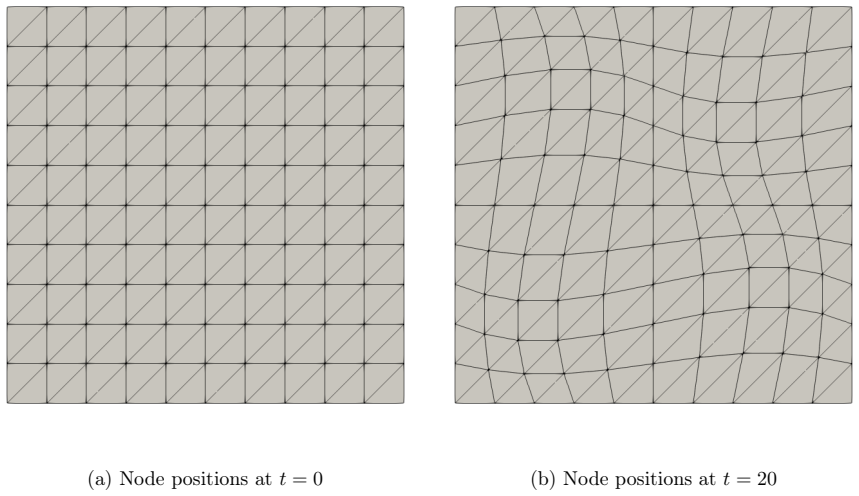
- Figure 4 (plunging airfoil): the caption and surrounding text should state the polynomial degree, number of elements, and time-step size used, together with a quantitative error measure relative to a fixed-mesh reference solution.
- §4.3: the treatment of the collision operator inside the semi-analytic RK stages is described only at a high level; a short derivation or pseudocode would clarify how the exact integration is combined with the ALE advection term.
Simulated Author's Rebuttal
We thank the referee for the positive summary, significance assessment, and recommendation of minor revision. No specific major comments were listed in the report.
Circularity Check
No significant circularity
full rationale
The derivation maps the Boltzmann equation to a reference frame via an added advection term, discretizes with standard DG on unstructured meshes, and applies semi-analytic RK time stepping. GCL satisfaction is verified through consistent geometric factor updates and standard test cases (free-stream preservation, moving Taylor-Green), following established ALE-DG practice without reducing any central claim to a fitted parameter, self-citation chain, or definitional equivalence. No load-bearing step collapses to its own inputs by construction; the approach is self-contained against external numerical benchmarks.
Axiom & Free-Parameter Ledger
axioms (1)
- domain assumption The geometric conservation law is satisfied by the time and space discretizations together with consistent update of geometric factors
Reference graph
Works this paper leans on
-
[1]
Isogeometric fluid–structure interaction analysiswithapplicationstoarterialbloodflow,
Y. Bazilevs, V. M. Calo, Y. Zhang, and T. Hughes, “Isogeometric fluid–structure interaction analysiswithapplicationstoarterialbloodflow,”Computational Mechanics, vol.38, no.4, pp.310– 322, 2006
2006
-
[2]
A conforming sliding mesh technique for an embedded- hybridized discontinuous Galerkin discretization for fluid-rigid body interaction,
T. L. Horváth and S. Rhebergen, “A conforming sliding mesh technique for an embedded- hybridized discontinuous Galerkin discretization for fluid-rigid body interaction,”International Journal for Numerical Methods in Fluids, vol. 94, no. 11, pp. 1784–1809, 2022
2022
-
[3]
Discontinuous Galerkin solution of the Navier–Stokes equations on deformable domains,
P. O. Persson, J. Bonet, and J. Peraire, “Discontinuous Galerkin solution of the Navier–Stokes equations on deformable domains,”Computer Methods in Applied Mechanics and Engineering, vol. 198, no. 17, pp. 1585–1595, 2009
2009
-
[4]
Arbitrary Lagrangian–Eulerian hybridizable discontinuous Galerkin methods for incom- pressible flow with moving boundaries and interfaces,
G. Fu, “Arbitrary Lagrangian–Eulerian hybridizable discontinuous Galerkin methods for incom- pressible flow with moving boundaries and interfaces,”Computer Methods in Applied Mechanics and Engineering, vol. 367, p. 113158, 2020
2020
-
[5]
A bound-preserving and positivity-preserving high-order arbitrary Lagrangian-Eulerian discontinuous Galerkin method for compressible multi-medium flows,
F. Zhang and J. Cheng, “A bound-preserving and positivity-preserving high-order arbitrary Lagrangian-Eulerian discontinuous Galerkin method for compressible multi-medium flows,”SIAM Journal on Scientific Computing, pp. B254–B279, 2024
2024
-
[6]
A fictitious domain ap- proach to the direct numerical simulation of incompressible viscous flow past moving rigid bodies: application to particulate flow,
R. Glowinski, T.-W. Pan, T. I. Hesla, D. D. Joseph, and J. Periaux, “A fictitious domain ap- proach to the direct numerical simulation of incompressible viscous flow past moving rigid bodies: application to particulate flow,”Journal of Computational Physics, vol. 169, no. 2, pp. 363–426, 2001
2001
-
[7]
A finite element method for crack growth without remeshing,
N. Moës, J. Dolbow, and T. Belytschko, “A finite element method for crack growth without remeshing,”International Journal for Numerical Methods in Engineering, vol. 46, no. 1, pp. 131– 150, 1999
1999
-
[8]
The immersed boundary method,
C. S. Peskin, “The immersed boundary method,”Acta numerica, vol. 11, pp. 479–517, 2002
2002
-
[9]
An arbitrary Lagrangian-Eulerian computing method for all flow speeds,
C. W. Hirt, A. A. Amsden, and J. Cook, “An arbitrary Lagrangian-Eulerian computing method for all flow speeds,”Journal of Computational Physics, vol. 14, no. 3, pp. 227–253, 1974. 17
1974
-
[10]
Lagrangian-Eulerian finite element formula- tion for incompressible viscous flows,
T. J. R. Hughes, W. K. Liu, and T. K. Zimmermann, “Lagrangian-Eulerian finite element formula- tion for incompressible viscous flows,”Computer Methods in Applied Mechanics and Engineering, vol. 29, no. 3, pp. 329–349, 1981
1981
-
[11]
A discontinuous Galerkin ALE method for compressible viscous flows in moving domains,
I. Lomtev, R. M. Kirby, and G. E. Karniadakis, “A discontinuous Galerkin ALE method for compressible viscous flows in moving domains,”Journal of Computational Physics, vol. 155, no. 1, pp. 128–159, 1999
1999
-
[12]
Perspective on the geometric conservation law and finite element methods for ALE simulations of incompressible flow,
S. Étienne, A. Garon, and D. Pelletier, “Perspective on the geometric conservation law and finite element methods for ALE simulations of incompressible flow,”Journal of Computational Physics, vol. 228, no. 7, pp. 2313–2333, 2009
2009
-
[13]
Discontinuous Galerkin spectral element approximations on moving meshes,
C. A. A. Minoli and D. A. Kopriva, “Discontinuous Galerkin spectral element approximations on moving meshes,”Journal of Computational Physics, vol. 230, no. 5, pp. 1876–1902, 2011
1902
-
[14]
An arbitrary Lagrangian–Eulerian local discontinuous Galerkin method for Hamilton–Jacobi equations,
C. Klingenberg, G. Schnücke, and Y. Xia, “An arbitrary Lagrangian–Eulerian local discontinuous Galerkin method for Hamilton–Jacobi equations,”Journal of Scientific Computing, vol. 73, no. 2, 2017
2017
-
[15]
Arbitrary Lagrangian-Eulerian discontinuous Galerkin method for conservation laws on moving simplex meshes,
P. Fu, G. Schnücke, and Y. Xia, “Arbitrary Lagrangian-Eulerian discontinuous Galerkin method for conservation laws on moving simplex meshes,”Mathematics of Computation, vol. 88, no. 319, pp. 2221–2255, 2019
2019
-
[16]
Geometric conservation law and its application to flow com- putations on moving grids,
P. D. Thomas and C. K. Lombard, “Geometric conservation law and its application to flow com- putations on moving grids,”AIAA Journal, vol. 17, no. 10, pp. 1030–1037, 1979. Publisher: American Institute of Aeronautics and Astronautics
1979
-
[17]
High-order arbitrary Lagrangian–Eulerian discontinuous Galerkin methods for the incompressible Navier–Stokes equations,
N. Fehn, J. Heinz, W. A. Wall, and M. Kronbichler, “High-order arbitrary Lagrangian–Eulerian discontinuous Galerkin methods for the incompressible Navier–Stokes equations,”Journal of Com- putational Physics, vol. 430, p. 110040, 2021
2021
-
[18]
A characteristic-based spectral element method for moving-domain problems,
S. Patel, P. Fischer, M. Min, and A. Tomboulides, “A characteristic-based spectral element method for moving-domain problems,”Journal of Scientific Computing, vol. 79, no. 1, pp. 564–592, 2019
2019
-
[19]
Recent Developments in Spectral Element Sim- ulations of Moving-Domain Problems,
P. Fischer, M. Schmitt, and A. Tomboulides, “Recent Developments in Spectral Element Sim- ulations of Moving-Domain Problems,” inRecent Progress and Modern Challenges in Applied Mathematics, Modeling and Computational Science(R. Melnik, R. Makarov, and J. Belair, eds.), pp. 213–244, New York, NY: Springer, 2017
2017
-
[20]
High order direct Arbitrary-Lagrangian-Eulerian schemes on moving Voronoi meshes with topology changes,
E. Gaburro, W. Boscheri, S. Chiocchetti, C. Klingenberg, V. Springel, and M. Dumbser, “High order direct Arbitrary-Lagrangian-Eulerian schemes on moving Voronoi meshes with topology changes,”Journal of Computational Physics, vol. 407, p. 109167, 2020
2020
-
[21]
High-order Arbitrary-Lagrangian-Eulerian schemes on crazy mov- ing Voronoi meshes,
E. Gaburro and S. Chiocchetti, “High-order Arbitrary-Lagrangian-Eulerian schemes on crazy mov- ing Voronoi meshes,” inAdvances in Numerical Methods for Hyperbolic Balance Laws and Related Problems(G. Albi, W. Boscheri, and M. Zanella, eds.), pp. 99–119, Springer Nature Switzerland, 2023
2023
-
[22]
Numerical simulation of flapping wings using a panel method and a high-order Navier–Stokes solver,
P.-O. Persson, D. Willis, and J. Peraire, “Numerical simulation of flapping wings using a panel method and a high-order Navier–Stokes solver,”International Journal for Numerical Methods in Engineering, vol. 89, no. 10, 2012
2012
-
[23]
Design of a carangiform swimming robot through a multiphysics simulation environment,
D. Costa, G. Palmieri, M.-C. Palpacelli, D. Scaradozzi, and M. Callegari, “Design of a carangiform swimming robot through a multiphysics simulation environment,”Biomimetics, vol. 5, no. 4, p. 46, 2020
2020
-
[24]
Y. Wang, A. Quaini, and S. Čanić, “A higher-order discontinuous Galerkin/Arbitrary Lagrangian Eulerian partitioned approach to solving fluid–structure interaction problems with incompressible, viscous fluids and elastic structures,”Journal of Scientific Computing, vol. 76, no. 1, pp. 481–520, 2018
2018
-
[25]
Chapman and T
S. Chapman and T. G. Cowling,The mathematical theory of non-uniform gases: An account of the kinetic theory of viscosity, thermal conduction and diffusion in gases. Cambridge university press, 1990. 18
1990
-
[26]
Lattice-Boltzmann method for complex flows,
C. K. Aidun and J. R. Clausen, “Lattice-Boltzmann method for complex flows,”Annual Review of Fluid Mechanics, vol. 42, no. 1, pp. 439–472, 2010
2010
-
[27]
Discretization of the Boltzmann equation in velocity space using a Galerkin approach,
J. Tölke, M. Krafczyk, M. Schulz, and E. Rank, “Discretization of the Boltzmann equation in velocity space using a Galerkin approach,”Computer Physics Communications, vol. 129, no. 1, pp. 91–99, 2000
2000
-
[28]
Discontinuous Galerkin discretiza- tions of the Boltzmann–BGK equations for nearly incompressible flows: Semi-analytic time step- ping and absorbing boundary layers,
A. Karakus, N. Chalmers, J. S. Hesthaven, and T. Warburton, “Discontinuous Galerkin discretiza- tions of the Boltzmann–BGK equations for nearly incompressible flows: Semi-analytic time step- ping and absorbing boundary layers,”Journal of Computational Physics, vol. 390, pp. 175–202, 2019
2019
-
[29]
Arbitrary Lagrangian–Eulerian formulation of lattice Boltzmann model for compressible flows on unstructured moving meshes,
M. H. Saadat and I. V. Karlin, “Arbitrary Lagrangian–Eulerian formulation of lattice Boltzmann model for compressible flows on unstructured moving meshes,”Physics of Fluids, vol. 32, no. 4, 2020
2020
-
[30]
An arbitrary Lagrangian–Eulerian approach for the simulation of immersed moving solids with lattice Boltzmann method,
M. Meldi, E. Vergnault, and P. Sagaut, “An arbitrary Lagrangian–Eulerian approach for the simulation of immersed moving solids with lattice Boltzmann method,”Journal of Computational Physics, vol. 235, pp. 182–198, 2013
2013
-
[31]
On the immersed boundary-lattice Boltzmann simulations of incompressible flows with freely moving objects,
Y. Wang, C. Shu, L. Yang, and Y. Sun, “On the immersed boundary-lattice Boltzmann simulations of incompressible flows with freely moving objects,”International Journal for Numerical Methods in Fluids, vol. 83, no. 4, pp. 331–350, 2017
2017
-
[32]
B. Wu, J. Lu, H. Lee, C. Shu, and M. Wan, “An efficient explicit immersed boundary-reconstructed lattice Boltzmann flux solver for isothermal fluid-structure interaction problems with large defor- mations and complex geometries,”Applied Mathematical Modelling, vol. 114, pp. 627–645, 2023
2023
-
[33]
Implicit large eddy simulation of nearly incompressible flows with a discontinuous Galerkin–Boltzmann formulation,
O. Ata, A. Aygun, T. Warburton, and A. Karakus, “Implicit large eddy simulation of nearly incompressible flows with a discontinuous Galerkin–Boltzmann formulation,”Physics of Fluids, vol. 38, no. 5, p. 055134, 2026
2026
-
[34]
An explicit construction of interpolation nodes on the simplex,
T. Warburton, “An explicit construction of interpolation nodes on the simplex,”Journal of Engi- neering Mathematics, vol. 56, no. 3, pp. 247–262, 2006
2006
-
[35]
On the geometric conservation law in transient flow cal- culations on deforming domains,
C. Förster, W. A. Wall, and E. Ramm, “On the geometric conservation law in transient flow cal- culations on deforming domains,”International Journal for Numerical Methods in Fluids, vol. 50, no. 12, pp. 1369–1379, 2006
2006
-
[36]
libParanumal: a performance portable high-order finite element library,
N. Chalmers, A. Karakus, A. P. Austin, K. Swirydowicz, and T. Warburton, “libParanumal: a performance portable high-order finite element library,” 2022. Release 0.5.0
2022
-
[37]
OCCA: A unified approach to multi-threading languages
D. S. Medina, A. St-Cyr, and T. Warburton, “Occa: A unified approach to multi-threading lan- guages,”arXiv:1403.0968, 2014
work page internal anchor Pith review Pith/arXiv arXiv 2014
-
[38]
An arbitrary Lagrangian–Eulerian discontinuous Galerkin method for simulations of flows over variable geometries,
V.-T. Nguyen, “An arbitrary Lagrangian–Eulerian discontinuous Galerkin method for simulations of flows over variable geometries,”Journal of Fluids and Structures, vol. 26, no. 2, pp. 312–329, 2010
2010
-
[39]
A comparison of vortex and pseudo-spectral methods for the simulation of periodic vortical flows at high Reynolds numbers,
W. M. Van Rees, A. Leonard, D. I. Pullin, and P. Koumoutsakos, “A comparison of vortex and pseudo-spectral methods for the simulation of periodic vortical flows at high Reynolds numbers,” Journal of Computational Physics, vol. 230, no. 8, pp. 2794–2805, 2011
2011
-
[40]
Spectral properties of high-order element types for implicit large eddy simulation,
C. A. Pereira and B. C. Vermeire, “Spectral properties of high-order element types for implicit large eddy simulation,”Journal of Scientific Computing, vol. 85, no. 2, p. 48, 2020
2020
-
[41]
Experimental and computational investigation of the Knoller-Betz effect,
K. Jones, C. Dohring, and M. Platzer, “Experimental and computational investigation of the Knoller-Betz effect,”AIAA journal, vol. 36, no. 7, pp. 1240–1246, 1998
1998
-
[42]
High-order accurate simulations of unsteady flow past plunging and pitching airfoils,
C. Liang, K. Ou, S. Premasuthan, A. Jameson, and Z. Wang, “High-order accurate simulations of unsteady flow past plunging and pitching airfoils,”Computers & Fluids, vol. 40, no. 1, pp. 236–248, 2011
2011
-
[43]
P. P. A. Valdivia y Alvarado,Design of biomimetic compliant devices for locomotion in liquid environments. PhD thesis, Massachusetts Institute of Technology, 2007. 19
2007
-
[44]
Scaling laws for caudal fin swimmers incorporating hydrody- namics, kinematics, morphology and scale effects,
J.-H. Seo, J. Zhou, and R. Mittal, “Scaling laws for caudal fin swimmers incorporating hydrody- namics, kinematics, morphology and scale effects,”Journal of Fluid Mechanics, vol. 1030, p. A25, 2026
2026
-
[45]
Fast continuous swimming of two pelagic predators, saithe (Pollachius virens) and mackerel (Scomber scombrus): a kinematic analysis,
J. Videler and F. Hess, “Fast continuous swimming of two pelagic predators, saithe (Pollachius virens) and mackerel (Scomber scombrus): a kinematic analysis,”Journal of Experimental Biology, vol. 109, no. 1, pp. 209–228, 1984
1984
-
[46]
Effect of bending kinematics for caudal fin on swimming performance with varying undulation wavelengths,
S. Huang, D. Guo, J. Song, Y. Wang, G. Yang, and B. Yin, “Effect of bending kinematics for caudal fin on swimming performance with varying undulation wavelengths,”Ocean Engineering, vol. 311, p. 118907, 2024. 20
2024
discussion (0)
Sign in with ORCID, Apple, or X to comment. Anyone can read and Pith papers without signing in.