REVIEW 3 major objections 5 minor 27 references
A multilevel stochastic-gradient neural solver for boundary integral equations
T0 review · 3 major / 5 minor · reviewed 2026-08-04 · deepseek-v4-flash
Pith's one-line read This paper claims that for well-conditioned second-kind boundary integral equations, a network trained on a ladder of quadrature grids can convert its spectral bias—slow convergence on high-frequency residual modes—into a multigrid-style sm
desk verdict A genuinely useful multilevel neural BIE solver with strong experiments; the main theoretical bridge (Section 3.5) is an acknowledged but unverified regularity postulate. read the letter →
The pith
A machine-rendered reading of the paper's core claim, the machinery that carries it, and where it could break.
The reading
What carries the argument
The central object is the empirical neural tangent kernel T_{θ,N}=J_{θ,N}J*_{θ,N}, the Nyström discretization of the continuum NTK; its eigenmodes with eigenvalues ≥1 define the effective tangent space E_θ. The paper shows how residual-aligned amplitude growth lifts small eigenvalues into E_θ (within-level expansion) and how grid refinement exposes new modes (cross-level expansion), with sinusoidal activations making the lift maximally sharp. The cross-level residual bound uses a uniform C^q regularity postulate on the network output to show each level starts within a constant factor of its tolerance.
What would settle it
Run the solver on a second-kind BIE whose exact density is non-smooth (e.g., a domain with a re-entrant corner, so the exact density has a singularity) and monitor the C^q norm of the network output and the warm-start loss at each level; if the norm grows with refinement or the loss at level ℓ+1 exceeds the predicted O(ε_ℓ + h^{2m}) by a growing factor, the regularity postulate is violated.
Extended reading notes
Core claim
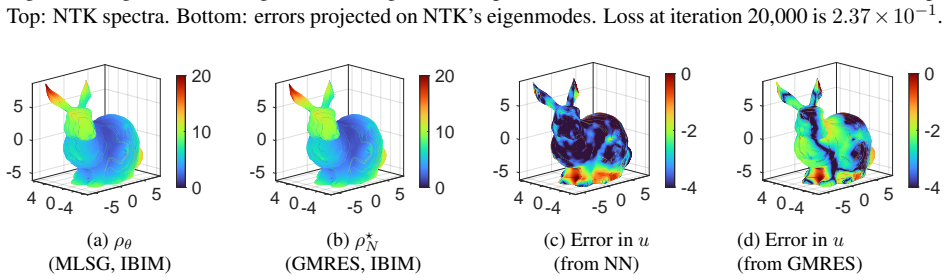
On a fixed grid, gradient training stalls once the residual concentrates in modes where the empirical NTK contracts slowly. The paper establishes, by spectral analysis and experiments, that refining the Nyström quadrature resolves more of the continuum NTK spectrum and returns these slow modes to the optimizer's reach. Warm-starting each level from the previous parameters re-exposes off-grid high-frequency content, so the effective tangent space expands monotonically across levels. The uniform conditioning of A maps the NTK spectrum directly to residual decay rates, making the training residual an a posteriori error bound. The multilevel schedule thus turns spectral bias into a smoother, wit
Load-bearing premise
The load-bearing premise is that the network output stays uniformly smooth—bounded in a uniform C^q norm—for every parameter encountered during training; the cross-level error bound and the tolerance schedule collapse if this constant does not exist.
Editorial extensions
If this is right
- Training residual can be used as a rigorous error certificate: Lemma 2.1 bounds the density error by a constant times the residual, uniformly in N.
- Single-level training plateaus are not a hard accuracy limit; the multilevel schedule reaches tolerances that a fine grid alone cannot.
- The solver applies to dense BIE systems without assembling the matrix, with per-step cost O(bN) on GPU hardware, making million-node systems feasible.
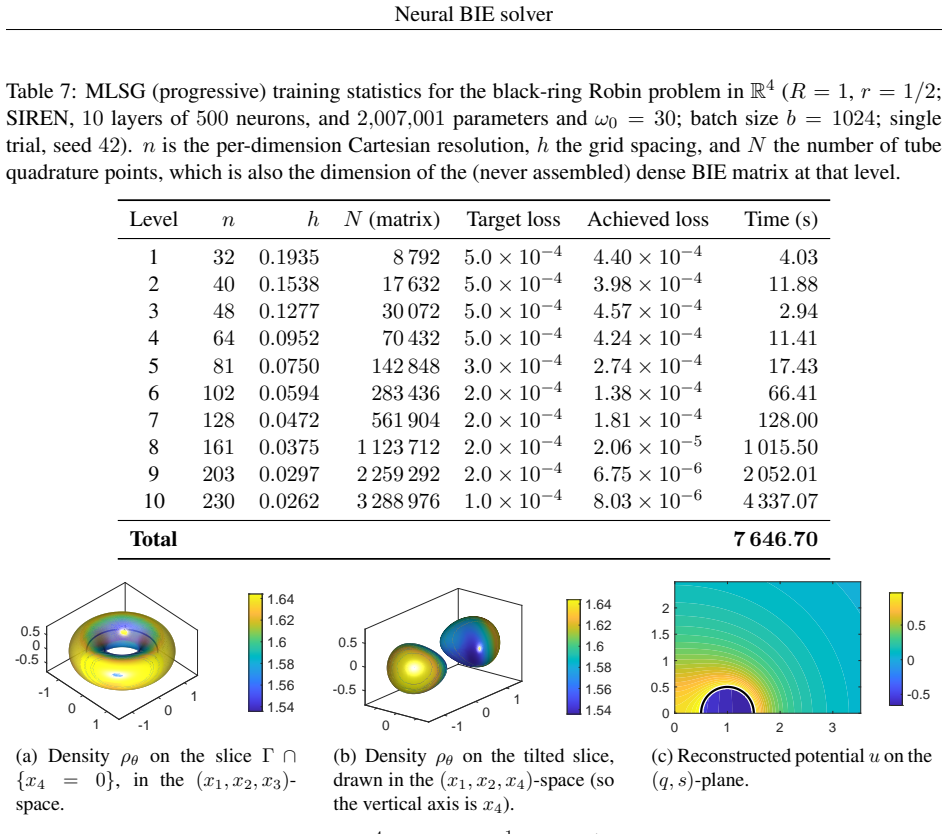
- The mesh-free formulation extends to hypersurfaces in R^4, demonstrated on a black-ring Robin problem.
- At matched tolerances, the solver is faster than a standard Krylov solver on exterior Helmholtz problems, with the speedup growing as the wavenumber rises.
Reading between the lines
- The analysis suggests spectral-bias-based smoothing is not limited to second-kind BIEs; any well-conditioned linear problem with a compact perturbation could inherit the same multilevel treatment, though the NTK would no longer be the only rate-determining factor.
- If the uniform regularity assumption fails—for example on boundaries with corners or non-smooth data—the warm-start loss bound (53) degrades; one testable fix is adaptive refinement of the network architecture or a residual-regularized training objective.
- The trained network is a continuous, smooth approximation built from low-frequency modes; this indicates the solver may double as a denoiser or preconditioner for classical iterative schemes, an extension the paper mentions but does not study.
- The success with sinusoidal activations points to a design principle: choose activations whose derivative stays in the same frequency band, so that amplitude growth lifts exactly the modes carrying residual.
Signed reviews
Editorial analysis
A structured set of objections, weighed in public.
Referee Report
Summary. The paper proposes MLSG, a multilevel stochastic-gradient neural solver for second-kind boundary integral equations. The unknown density is represented by an MLP trained by minimizing the Nyström-discretized residual on a ladder of refining quadrature grids, with each level warm-started from the previous one. The authors develop a spectral picture in which the empirical neural tangent kernel (NTK) is the rate-determining operator: spectral bias suppresses high-frequency residual modes, and quadrature refinement re-exposes those modes, so refinement acts like the coarse-grid correction in multigrid. Rigorous ingredients include Lemma 2.1 (residual controls error via uniform invertibility of A_N), Proposition 2.1 (compactness/self-adjointness of the continuum NTK), and Proposition A.1 (consistency of the empirical-mean IBIM loss). The main theoretical bridge between levels, however, is a cross-level residual transfer bound (Section 3.5, Eq. (53)) that assumes a uniform C^q regularity bound on every network encountered during training. Numerical experiments cover interior Dirichlet Laplace/Poisson problems, exterior Neumann Helmholtz problems in 2D/3D, and a 4D exterior Robin problem on a black-ring hypersurface, with wall-clock comparisons against MATLAB GMRES.
Significance. If the proposed mechanism is correct, the paper offers a genuinely different GPU-oriented solver for dense second-kind BIE systems, avoiding matrix assembly and extending neural PDE solvers to integral equations. It also gives a concrete multigrid-type interpretation of spectral bias, which is an interesting conceptual contribution. The rigorous components (Lemma 2.1, Prop. 2.1, Prop. A.1) are clean, and the experimental scope is substantial, including a high-dimensional demonstration. However, the central multilevel guarantee is conditional on an unverified regularity postulate, and the headline speedups compare a GPU implementation against a CPU MATLAB GMRES without hierarchical acceleration. The paper is honest about several caveats (non-simultaneous diagonalizability, resonance, single-trial 4D example), but those caveats cut against the strength of the claims made in the abstract and conclusions.
major comments (3)
- [Section 3.5, Eq. (53)] The warm-start bound (53) is the only quantitative bridge between levels, and it relies on the postulate that every parameter θ encountered during training satisfies ‖ρ_θ‖_{C^q(Γ)} ≤ C_ρ uniformly. The paper provides no mechanism enforcing this: SIREN weights can grow, and fitting high-wavenumber Helmholtz data at κ=8 plausibly increases the Lipschitz/C^q norm as grids refine. If the C^q norm grows with the level, the constants in (50)–(53) are not uniform in ℓ, the claimed O(ε_ℓ + h^{2m}) transfer fails, and the a posteriori error justification via Lemma 2.1 does not carry across levels. This is acknowledged as a postulate, but it is load-bearing. Please either prove such a bound for the architecture/training, add direct numerical monitoring of the C^q norm across all levels and trials, or explicitly downgrade the theoretical claim to a conditional/empirical statement.
- [Section 3.2, Eq. (35)] The spectral contraction analysis treats A_N T_{θ,N} A*_N as if it were simultaneously diagonalizable with T_{θ,N} in a frozen eigenbasis. The paper itself notes that this is not generally true, that the eigenbasis moves with θ, and that Adam's diagonal preconditioning distorts the per-mode factors. These caveats make 'the NTK is the sole rate-determining spectrum' a heuristic rather than a proven mechanism, even though the numerical spectra in §4.1 support the qualitative picture. Given that the multigrid analogy is the paper's central novelty, the abstract and concluding statements should clearly mark the spectral mechanism as an idealized/empirical explanation, or the authors should provide a rigorous statement for a well-defined regime (e.g., lazy training or a controlled small-parameter limit).
- [Table 4] The reported speedups compare a single NVIDIA H200 GPU MLSG implementation against a multi-core CPU MATLAB GMRES implementation without FMM acceleration. Since the hardware and baseline algorithms differ substantially, the 100–600× speedups conflate algorithmic advantage with hardware and implementation choices. Moreover, the table states 'matched accuracy' without reporting the achieved relative errors or residuals for either solver. Please report the actual errors/tolerances for both methods, and either include a more directly comparable baseline (e.g., a GPU GMRES or a CPU MLSG variant) or explicitly qualify that the speedups are hardware- and implementation-specific. This is necessary for the efficiency claims in the abstract and conclusions.
minor comments (5)
- [Section 3.5] Typo: 'estiamte' should be 'estimate' in the sentence before Eq. (51).
- [Table 4] The row for κ=8 appears garbled ('1 51.1665.74') and the GMRES time is missing; the table should be reformatted and the missing entry explained.
- [Table 7] The 4D black-ring experiment is reported for a single trial (seed 42). A single trial is acceptable for a demonstration, but the caption should explicitly state that no variance information is available and that the timing should be read as one realization.
- [Section 4.1] The experimental setup says the network uses cos activations with Kaiming initialization, while the rest of the paper uses SIREN sinusoidal activations. Please clarify whether the spectral experiments in Figures 1–3 are intended to transfer to the SIREN networks used elsewhere.
- [Figures 1–3] The axis labels in the figure captions contain stray numbers/formatting artifacts (e.g., '128-20 -10 0 10 20 127'). Please regenerate or clean these captions.
Circularity Check
No significant circularity: the NTK spectral analysis and multilevel transfer bounds are derived from the parametrized loss and operator definitions, not refit from the numerical results; the main caveats are an unverified regularity postulate and self-citations used only as tools.
full rationale
This is a non-circular derivation. The residual-flow identities (21), (28), (31) and the loss-decay formula (35) are exact chain-rule consequences of the parametrized residual loss and the definition T_{θ,N}=J_{θ,N}J*_{θ,N}; they are not fitted to the experiments. The multilevel transfer bound (50)-(53) is a genuine estimate under an explicitly stated uniform C^q regularity postulate; the postulate is unverified and load-bearing, but it is an assumption about the training trajectory, not a hidden re-use of the conclusion, and the paper honestly labels it 'We postulate'. The spectral diagnostics of Section 4.1 use the same NTK objects defined in Section 3, so they are consistency checks rather than independent predictions; that weakens the evidence but is not circularity. The IBIM discretization cites the authors' earlier work [20,6], but it is used only as a quadrature tool; the central multilevel/NTK mechanism does not reduce to that citation, and Appendix A.2 even re-derives a corrected regularization constant rather than blindly importing it. The wall-clock comparisons against GMRES are external empirical benchmarks, not outputs of the theory. Therefore no load-bearing step reduces by construction to its input, and no fitted parameter is renamed as a prediction.
Assumptions & free parameters
free parameters (4)
- per-stage tolerance ε_ℓ =
varies per example (e.g., 5e-4 to 1e-4)
- learning-rate schedule =
initial 1e-3 with decay; some levels at 1e-4
- batch size b =
1024 or 8192 rows
- network architecture (depth, width, ω0) =
e.g., 10 layers x 500 neurons, ω0=30 for the black-ring example
assumptions (5)
- standard math Nyström quadrature converges pointwise on C(Γ) with order ν and the discrete operators A_N are uniformly invertible
- domain assumption 0 ∉ σ(A), so the second-kind operator A = 1/2 I + K is invertible with bounded inverse
- ad hoc to paper For every θ encountered during training, ρ_θ ∈ C^q(Γ) with ||ρ_θ||_{C^q} ≤ C_ρ uniformly
- domain assumption The MLP has enough capacity to interpolate the discrete solution at the nodes of each level
- domain assumption Test wavenumbers avoid interior Dirichlet eigenvalues (Helmholtz) and Steklov resonances (Robin)
Cite this review
Pith. "Pith review of A multilevel stochastic-gradient neural solver for boundary integral equations." pith.science (2026). https://pith.science/paper/Q6PQQFFG
@misc{pith2026260700560,
  author       = {Pith},
  title        = {Pith review of: A multilevel stochastic-gradient neural solver for boundary integral equations},
  year         = {2026},
  howpublished = {\url{https://pith.science/paper/Q6PQQFFG}},
  note         = {Machine review of arXiv:2607.00560}
}
abstract
We develop a multilevel stochastic-gradient neural solver for boundary integral equations of the second kind. The unknown density is represented by a multilayer perceptron, trained by minimizing the Nystr\"om-discretized residual on a ladder of refining quadrature grids, each level warm-started from the parameters of the previous one. Each step requires only dense matrix-vector products on mini-batches of collocation rows and network passes, operations that map directly onto GPU hardware. The residual contraction is governed by the empirical neural tangent kernel (NTK), the discrete sample of a single continuum kernel. On a fixed grid, training stalls once the residual concentrates in those modes at which the network contracts slowly. A spectral analysis, confirmed numerically, explains how refining the quadrature resolves more of the continuum kernel's spectrum and returns these modes to the optimizer's reach. Spectral bias, elsewhere an obstruction to neural network solvers, thus serves as the smoother of a multigrid-type iteration, with quadrature refinement in place of coarse-grid correction. The uniform conditioning of the discrete second-kind operator ensures that the NTK is the sole rate-determining spectrum, allowing the training residual to serve as an a posteriori error bound. Experiments on interior Dirichlet Laplace/Poisson problems and exterior Neumann Helmholtz problems {\color{black}{in $\mathbb{R}^d, d = 2 ,3$}}, using both parametric and signed-distance surface representations, demonstrate the effectiveness and efficiency of the proposed method compared with GMRES at comparable tolerances. A final example, an exterior Robin problem for the Laplace equation on a ring-shaped hypersurface in $\R^4$, illustrates that the mesh-free formulation extends to higher-dimensional ambient spaces.
Figures


Figures from the paper (16 more)




Reference graph
Works this paper leans on
-
[1]
P. M. Anselone.Collectively Compact Operator Approximation Theory and Applications to Integral Equations. Prentice-Hall, Englewood Cliffs, NJ, 1971
1971
-
[2]
Atanasov, B
A. Atanasov, B. Bordelon, and C. Pehlevan. Neural networks as kernel learners: The silent alignment effect. InInternational Conference on Learning Representations (ICLR), 2022
2022
-
[3]
K. E. Atkinson.The Numerical Solution of Integral Equations of the Second Kind. Cambridge Uni- versity Press, Cambridge, 1997
1997
-
[4]
F. A. Bornemann and P. Deuflhard. The cascadic multigrid method for elliptic problems.Numerische Mathematik, 75(2):135–152, 1996. 40 Neural BIE solver
1996
-
[5]
A. J. Burton and G. F. Miller. The application of integral equation methods to the numerical solution of some exterior boundary-value problems.Proceedings of the Royal Society of London. Series A, 323(1553):201–210, 1971
1971
-
[6]
Chen and R
C. Chen and R. Tsai. Implicit boundary integral methods for the Helmholtz equation in exterior do- mains.Research in the Mathematical Sciences, 4(19), 2017
2017
-
[7]
Cheng, L
H. Cheng, L. Greengard, and V . Rokhlin. A fast adaptive multipole algorithm in three dimensions. Journal of Computational Physics, 155(2):468–498, 1999
1999
-
[8]
Colton and R
D. Colton and R. Kress.Integral Equation Methods in Scattering Theory. SIAM, Philadelphia, 2013
2013
Show all 27 references
-
[9]
Emparan and H
R. Emparan and H. S. Reall. A rotating black ring solution in five dimensions.Physical Review Letters, 88(10):101101, 2002. arXiv:hep-th/0110260
2002 arXiv
-
[10]
Emparan and H
R. Emparan and H. S. Reall. Black rings.Classical and Quantum Gravity, 23(20):R169–R197, 2006. arXiv:hep-th/0608012
2006 arXiv
-
[11]
Y . Fan, J. An, and L. Ying. Fast algorithms for integral formulations of steady-state radiative transfer equation.Journal of Computational Physics, 380:191–211, 2019
2019
-
[12]
Greengard and V
L. Greengard and V . Rokhlin. A fast algorithm for particle simulations.Journal of Computational Physics, 73(2):325–348, 1987
1987
-
[13]
Hackbusch.Multi-Grid Methods and Applications
W. Hackbusch.Multi-Grid Methods and Applications. Springer, Berlin, 1985
1985
-
[14]
Hackbusch
W. Hackbusch. A sparse matrix arithmetic based onH-matrices. Part I: Introduction toH-matrices. Computing, 62(2):89–108, 1999
1999
-
[15]
Ida and K.-i
D. Ida and K.-i. Nakao. Isoperimetric inequality for higher-dimensional black holes.Physical Review D, 66:064026, 2002. arXiv:gr-qc/0204082
2002 arXiv
-
[16]
F. Izzo, O. Runborg, and R. Tsai. Corrected trapezoidal rules for singular implicit boundary integrals. Journal of Computational Physics, 461:111193, 2022
2022
-
[17]
Jacot, F
A. Jacot, F. Gabriel, and C. Hongler. Neural tangent kernel: Convergence and generalization in neural networks.Advances in neural information processing systems, 31, 2018
2018
-
[18]
D. P. Kingma and J. Ba. Adam: A method for stochastic optimization. InInternational Conference on Learning Representations (ICLR), 2015
2015
-
[19]
Kress.Linear Integral Equations
R. Kress.Linear Integral Equations. Springer, New York, 3rd edition, 2014
2014
-
[20]
Kublik, N
C. Kublik, N. M. Tanushev, and R. Tsai. An implicit interface boundary integral method for Poisson’s equation on arbitrary domains.Journal of Computational Physics, 247:279–311, 2013
2013
-
[21]
D. Maxwell. Solutions of the Einstein constraint equations with apparent horizon boundaries.Com- munications in Mathematical Physics, 253:561–583, 2005
2005
-
[22]
Messner, M
M. Messner, M. Schanz, and J. Tausch. A fast Galerkin method for parabolic space-time boundary integral equations.Journal of Computational Physics, 258:15–30, 2014
2014
-
[23]
Rahaman, A
N. Rahaman, A. Baratin, D. Arpit, F. Draxler, M. Lin, F. Hamprecht, Y . Bengio, and A. Courville. On the spectral bias of neural networks. InProceedings of the 36th International Conference on Machine Learning (ICML), pages 5301–5310, 2019. 41 Neural BIE solver
2019
-
[24]
K. Ren, R. Zhang, and Y . Zhong. A fast algorithm for radiative transport in isotropic media.Journal of Computational Physics, 399:108958, 2019
2019
-
[25]
Saad and M
Y . Saad and M. H. Schultz. GMRES: A generalized minimal residual algorithm for solving nonsym- metric linear systems.SIAM Journal on Scientific and Statistical Computing, 7(3):856–869, 1986
1986
-
[26]
Sitzmann, J
V . Sitzmann, J. N. P. Martel, A. W. Bergman, D. B. Lindell, and G. Wetzstein. Implicit neural repre- sentations with periodic activation functions. InProceedings of the 34th International Conference on Neural Information Processing Systems, NIPS ’20, Red Hook, NY , USA, 2020....
2020
-
[27]
Z.-Q. J. Xu, Y . Zhang, T. Luo, Y . Xiao, and Z. Ma. Frequency principle: Fourier analysis sheds light on implicit regularization of deep neural networks.Communications in Computational Physics, 28(5):1746–1767, 2020. 42
2020
Reviewed August 4, 2026 · model on record in the stance chip above.
Discussion (0). Continue with ORCID to comment.