Quantum machine learning models for graphs
Pith reviewed 2026-07-02 12:10 UTC · model grok-4.3
The pith
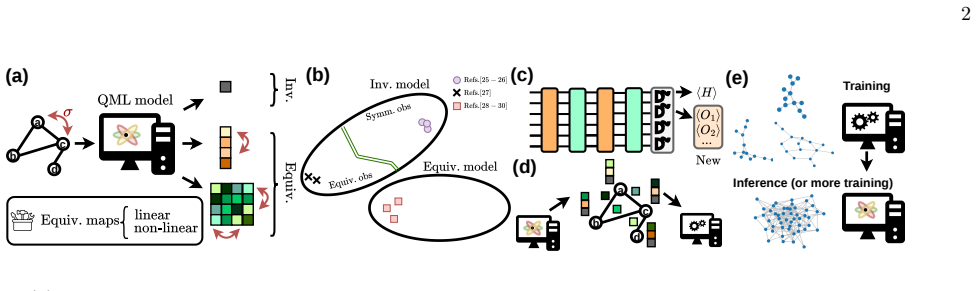
A characterization of the constituents of quantum graph models for n-node graphs encoded in n-qubit states supplies a toolbox for their design.
A machine-rendered reading of the paper's core claim, the machinery that carries it, and where it could break.
Core claim
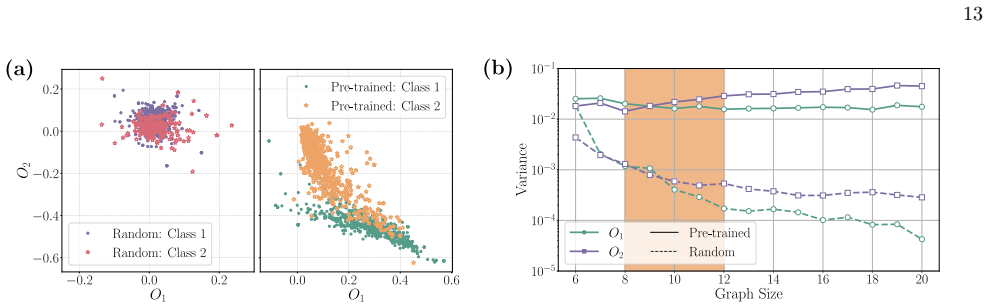
For graphs encoded in n-qubit states, a comprehensive characterization of the model constituents provides a toolbox for designing quantum graph models. This toolbox enables natural integration with classical models, generalization of existing GQML models (sometimes extending expressivity at low cost), and straightforward classical pre-training strategies, with the latter two features shown in numerical experiments.
What carries the argument
The comprehensive characterization of constituents of GQML models when n-node graphs are encoded in n-qubit states, which functions as a design toolbox.
If this is right
- Models can integrate directly with classical networks without architectural mismatch.
- Known GQML models can be recovered as special cases and sometimes extended in expressivity.
- Classical pre-training becomes available as a standard step before quantum training.
- The same characterization applies across multiple graph problems due to the shared encoding.
Where Pith is reading between the lines
- Designers could systematically enumerate valid quantum operations on graphs before choosing a circuit.
- The toolbox may reduce the need for trial-and-error in selecting equivariant quantum layers.
- Pre-training on classical graph networks could initialize parameters that transfer to the quantum case.
Load-bearing premise
That encoding n-node graphs into n-qubit states captures the essential structure needed for a complete characterization of useful model constituents.
What would settle it
A specific graph task where a model built from the characterized constituents fails to match or exceed the performance of an uncharacterized baseline while using the same resources.
Figures
read the original abstract
Geometric Machine Learning (GML) successes have been achieved through the thorough study and design of new equivariant neural networks. In comparison, geometric quantum machine learning (GQML) models lack such a detailed understanding and, despite already several proposals, a unifying perspective on their design remains elusive. In this work, we focus on GQML models for graph problems that showcase a lot of structure and still remain frontier in machine learning. For the case when n-node graphs are encoded in n-qubit states, we provide a comprehensive characterization of their constituents. Taken together, these furnish us with a toolbox for the design of quantum graph models, and we further probe its benefits including the natural integration with classical models, generalization of known GQML models (sometimes extending their expressivity at virtually no cost), and straightforward classical pre-training strategies. The latter two features are demonstrated in dedicated numerical experiments.
Editorial analysis
A structured set of objections, weighed in public.
Referee Report
Summary. The manuscript claims that for n-node graphs encoded into n-qubit states, a comprehensive characterization of the constituents of geometric quantum machine learning (GQML) models can be derived. This characterization supplies a design toolbox whose benefits include natural integration with classical models, generalization of prior GQML models (sometimes extending expressivity at virtually no cost), and straightforward classical pre-training strategies; the latter two are supported by dedicated numerical experiments.
Significance. If the characterization holds under the stated encoding, the work supplies a systematic unifying perspective on GQML for graphs that has been missing relative to classical geometric machine learning. The explicit toolbox construction and the reported generalization/pre-training demonstrations are concrete strengths that could aid model design, provided the encoding preserves the graph features required for the claimed benefits.
major comments (1)
- [Encoding section] The n-node to n-qubit encoding is load-bearing for the entire characterization and all downstream toolbox claims (abstract). The manuscript must include an explicit statement or proposition (in the section defining the encoding) identifying which graph properties—adjacency elements, node features, edge directions/weights, or higher-order motifs—are faithfully represented in the n-qubit Hilbert space and which are not; without this, the generalization of known GQML models and integration with classical GML cannot be substantiated for frontier tasks.
minor comments (1)
- [Abstract] The abstract states that generalization occurs 'sometimes extending their expressivity at virtually no cost'; the main text should quantify this with concrete metrics (e.g., circuit depth or parameter count before/after generalization) drawn from the numerical experiments.
Simulated Author's Rebuttal
We thank the referee for the positive assessment and the constructive major comment. We address it point-by-point below and will incorporate the requested clarification in the revised manuscript.
read point-by-point responses
-
Referee: [Encoding section] The n-node to n-qubit encoding is load-bearing for the entire characterization and all downstream toolbox claims (abstract). The manuscript must include an explicit statement or proposition (in the section defining the encoding) identifying which graph properties—adjacency elements, node features, edge directions/weights, or higher-order motifs—are faithfully represented in the n-qubit Hilbert space and which are not; without this, the generalization of known GQML models and integration with classical GML cannot be substantiated for frontier tasks.
Authors: We agree that an explicit statement is required to substantiate the claims. The current manuscript describes the n-node to n-qubit encoding (via computational-basis amplitudes encoding adjacency and node features) but does not isolate preserved versus non-preserved properties in a single proposition. We will add a dedicated proposition in the encoding section stating that the encoding faithfully represents adjacency-matrix elements and node features (when present) but does not intrinsically encode edge directions, weights, or higher-order motifs unless additional structure (e.g., directed-graph extensions or auxiliary qubits) is introduced. This addition will directly support the generalization and classical-integration arguments. revision: yes
Circularity Check
No circularity: characterization derived from explicit encoding choice without self-referential reduction
full rationale
The paper selects the n-node to n-qubit encoding as its modeling regime and then derives a characterization of model constituents from that choice. No step reduces a claimed prediction or first-principles result to a fitted parameter, self-citation chain, or definitional tautology. The toolbox benefits (integration, generalization, pre-training) are presented as downstream consequences of the derived constituents rather than inputs that are renamed as outputs. The derivation remains self-contained; the encoding assumption is stated explicitly and does not loop back on itself.
Axiom & Free-Parameter Ledger
Reference graph
Works this paper leans on
-
[1]
Among them, we will mostly restrict our attention to the sub- space of observables (i.e
Preliminaries LetH= (C 2)⊗n be the state space ofnqubits and let ˜Bbe the space of linear operators acting onH. Among them, we will mostly restrict our attention to the sub- space of observables (i.e. Hermitian operators)B ⊂ ˜B. For generic vector spacesVandW, let Hom(V, W) de- note the linear maps fromVtoW, and Aff(V, W) the affine maps fromVtoW. Let End...
-
[2]
Let us first focus on linear and affine functions
Symmetric and equivariant maps and observables Equivariance in Definition 1 can take many forms de- pending on the type of functions considered, and the choice of what constitutes their inputs and outputs. Let us first focus on linear and affine functions. Definition 3(Equivariant linear maps).Given a group Gwith representationsR V onVandR W onW, we say t...
-
[3]
These are equivalently identified through their adjacency matrices such that we can take inputs to be matrices, x∈R n×n, with entriesx i,j the weight of the edge from nodeitoj
Graphs and the symmetric group A graphxconsists of a setV(x) ofnvertices and a set of (potentially weighted and directed) edgesE(x). These are equivalently identified through their adjacency matrices such that we can take inputs to be matrices, x∈R n×n, with entriesx i,j the weight of the edge from nodeitoj. WhenFadditional nodes or edgesfea- turesare ava...
-
[4]
More generally, consider an order-k tensorsT∈R nk , with entries in- dexed through a vector of indices ⃗i∈[n] k such as [T] ⃗i or [T] i1,...,ik (we often drop the brackets)
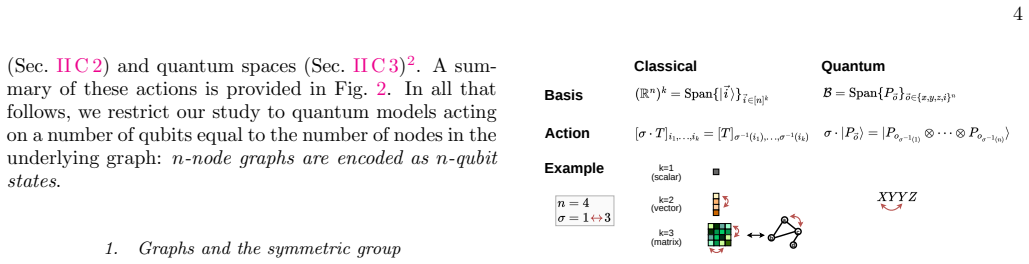
Action on classical vector spaces Permutations acts on a graph by relabeling its vertices, or equivalently, on its adjacency matricexby permuting simultaneouslyits rows and columns. More generally, consider an order-k tensorsT∈R nk , with entries in- dexed through a vector of indices ⃗i∈[n] k such as [T] ⃗i or [T] i1,...,ik (we often drop the brackets). T...
-
[5]
⊗ |ψ n⟩ :=R q(σ) |ψ1⟩ ⊗
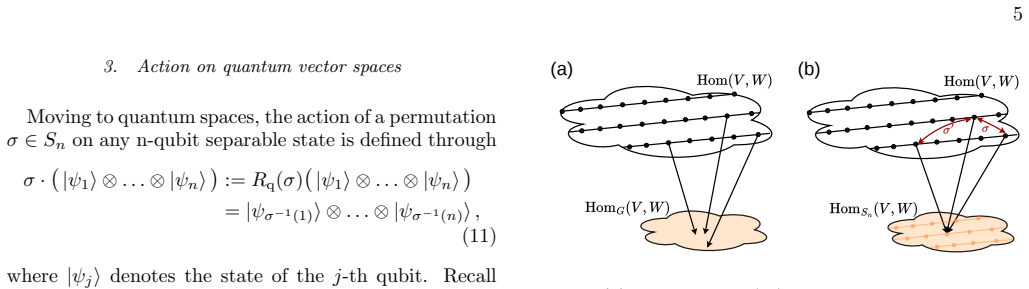
Action on quantum vector spaces Moving to quantum spaces, the action of a permutation σ∈S n on any n-qubit separable state is defined through σ· |ψ1⟩ ⊗. . .⊗ |ψ n⟩ :=R q(σ) |ψ1⟩ ⊗. . .⊗ |ψ n⟩ =|ψ σ−1(1)⟩ ⊗. . .⊗ |ψ σ−1(n)⟩, (11) where|ψ j⟩denotes the state of thej-th qubit. Recall thatR q(σ) is the unitary representation ofσonto the n-qubit state. Eq. (11...
-
[6]
(17) yields a systematic way to characterize HomSn(V, W)
Systematic strategy Eq. (17) yields a systematic way to characterize HomSn(V, W). However, in general, this would incur in- tractable computations, as individual twirls require sum- ming over|S n|=n! terms and need to be performed for all dim(V)×dim(W) basis elements. Furthermore, the resulting symmetrized maps need not be orthogonal (as Tis a projector),...
-
[7]
Before proceeding to concrete instantiations of this strategy, we provide the interpretation and definite properties of the equivariant maps Γ∈Hom Sn(V, W) satisfying Definition
Interpretation The previous approach yields efficient computations such that we can identify all equivariant linear maps of interest. Before proceeding to concrete instantiations of this strategy, we provide the interpretation and definite properties of the equivariant maps Γ∈Hom Sn(V, W) satisfying Definition. 3 for various choices of input spaces Vand o...
-
[8]
Given Eq
Classical spaces Case I(V=R n×n, W=R)-The basis of the linear maps isB V,W ={|0⟩ ⟩⟨ ⟨i1, i2|}with (i 1, i2)∈[n] 2. Given Eq. (10) and the 1-transitivity ofS n, there always ex- istsσthat maps any|0⟩ ⟩⟨ ⟨i 1, i1|to any other|0⟩ ⟩⟨ ⟨i ′ 1, i′ 1|. Resorting the 2-transitivity ofS n, there always existsσ that maps any|0⟩ ⟩⟨ ⟨i1, i2|to any other|0⟩ ⟩⟨ ⟨i ′ 1, ...
-
[9]
However, no permutation can map|0⟩ ⟩⟨ ⟨i1, i1|to|0⟩ ⟩⟨ ⟨i′ 1, i′ 2 ̸=i ′ 1|. The basis of maps thus partitions in 2 equivalence classes denoted as C0 ≡ {{i1, i2}},andC 1 ≡ {{i1},{i 2}}, to signify that the two indices take the same (distinct) values for the first (second) equivalence classes. Corre- spondingly, the equivariant maps are spanned by the two ...
-
[10]
Let us denotek(⃗ o)≡[k x(⃗ o), ky(⃗ o), kz(⃗ o), ki(⃗ o)]∈N 4 the com- position of the corresponding Pauli string: the number of individualX,Y,ZandIappearing in the string
Quantum spaces Case I(V=B, W=R)-The basis of the linear maps isB V,W ={|0⟩ ⟩⟨ ⟨P⃗ o|}with⃗ o∈ {x, y, z, i} n. Let us denotek(⃗ o)≡[k x(⃗ o), ky(⃗ o), kz(⃗ o), ki(⃗ o)]∈N 4 the com- position of the corresponding Pauli string: the number of individualX,Y,ZandIappearing in the string. Any Pauli stringP ⃗ ocan be mapped to any otherP ⃗ o′ provided thatk(⃗ o) ...
-
[11]
However, in QML the cost of implementing a given map may vary signifi- cantly depending on its specificity
Specialization In a classical ML setting, for a fixed choice of input and output domain, all the equivariant maps would have roughly the same implementation cost. However, in QML the cost of implementing a given map may vary signifi- cantly depending on its specificity. As such, it is often desirable to restrict the space of maps to the ones that can be i...
-
[12]
Biamonte, P
J. Biamonte, P. Wittek, N. Pancotti, P. Rebentrost, N. Wiebe, and S. Lloyd, Quantum machine learning, Na- ture549, 195 (2017)
2017
-
[13]
Benedetti, E
M. Benedetti, E. Lloyd, S. Sack, and M. Fiorentini, Pa- rameterized quantum circuits as machine learning mod- els, Quantum science and technology4, 043001 (2019)
2019
-
[14]
Cerezo, G
M. Cerezo, G. Verdon, H.-Y. Huang, L. Cincio, and P. J. Coles, Challenges and opportunities in quantum machine learning, Nature computational science2, 567 (2022)
2022
-
[15]
J. R. McClean, S. Boixo, V. N. Smelyanskiy, R. Bab- bush, and H. Neven, Barren plateaus in quantum neural network training landscapes, Nature communications9, 4812 (2018)
2018
-
[16]
E. R. Anschuetz and B. T. Kiani, Quantum variational algorithms are swamped with traps, Nature Communica- tions13, 7760 (2022)
2022
-
[17]
Larocca, S
M. Larocca, S. Thanasilp, S. Wang, K. Sharma, J. Bia- monte, P. J. Coles, L. Cincio, J. R. McClean, Z. Holmes, and M. Cerezo, Barren plateaus in variational quantum computing, Nature Reviews Physics , 1 (2025)
2025
-
[18]
Larocca, F
M. Larocca, F. Sauvage, F. M. Sbahi, G. Verdon, P. J. Coles, and M. Cerezo, Group-invariant quantum machine learning, PRX quantum3, 030341 (2022)
2022
-
[19]
J. J. Meyer, M. Mularski, E. Gil-Fuster, A. A. Mele, F. Arzani, A. Wilms, and J. Eisert, Exploiting symmetry in variational quantum machine learning, PRX quantum 4, 010328 (2023)
2023
-
[20]
Zheng, Z
H. Zheng, Z. Li, J. Liu, S. Strelchuk, and R. Kon- dor, Speeding up learning quantum states through group equivariant convolutional quantum ans¨ atze, PRX quan- tum4, 020327 (2023)
2023
-
[21]
M. T. West, J. Heredge, M. Sevior, and M. Usman, Prov- ably trainable rotationally equivariant quantum machine learning, PRX Quantum5, 030320 (2024)
2024
-
[22]
I. N. M. Le, O. Kiss, J. Schuhmacher, I. Tavernelli, and F. Tacchino, Symmetry-invariant quantum machine learning force fields, New Journal of Physics27, 023015 (2025)
2025
-
[23]
Cohen and M
T. Cohen and M. Welling, Group equivariant convolu- tional networks, inInternational conference on machine learning(PMLR, 2016) pp. 2990–2999
2016
-
[24]
Kondor and S
R. Kondor and S. Trivedi, On the generalization of equiv- ariance and convolution in neural networks to the action of compact groups, inInternational conference on ma- chine learning(PMLR, 2018) pp. 2747–2755
2018
-
[25]
M. M. Bronstein, J. Bruna, T. Cohen, and P. Veliˇ ckovi´ c, Geometric deep learning: Grids, groups, graphs, geodesics, and gauges, arXiv preprint arXiv:2104.13478 (2021)
work page internal anchor Pith review Pith/arXiv arXiv 2021
-
[26]
Q. T. Nguyen, L. Schatzki, P. Braccia, M. Ragone, P. J. Coles, F. Sauvage, M. Larocca, and M. Cerezo, Theory for equivariant quantum neural networks, PRX Quantum 5, 020328 (2024)
2024
-
[27]
T. S. Cohen and M. Welling, Steerable cnns, inInterna- tional Conference on Learning Representations(2017)
2017
-
[28]
Maron, H
H. Maron, H. Ben-Hamu, N. Shamir, and Y. Lipman, In- variant and equivariant graph networks, inInternational Conference on Learning Representations(2019)
2019
-
[29]
Finzi, M
M. Finzi, M. Welling, and A. G. Wilson, A practical method for constructing equivariant multilayer percep- trons for arbitrary matrix groups, inInternational con- ference on machine learning(PMLR, 2021) pp. 3318– 3328
2021
-
[30]
Bouritsas, F
G. Bouritsas, F. Frasca, S. Zafeiriou, and M. M. Bron- stein, Improving graph neural network expressivity via subgraph isomorphism counting, IEEE Transactions on Pattern Analysis and Machine Intelligence45, 657 (2022)
2022
-
[31]
K. Xu, W. Hu, J. Leskovec, and S. Jegelka, How powerful are graph neural networks?, arXiv preprint arXiv:1810.00826 (2018)
work page internal anchor Pith review Pith/arXiv arXiv 2018
-
[32]
Morris, M
C. Morris, M. Ritzert, M. Fey, W. L. Hamilton, J. E. Lenssen, G. Rattan, and M. Grohe, Weisfeiler and leman go neural: Higher-order graph neural networks, inPro- ceedings of the AAAI conference on artificial intelligence, 01 (2019) pp. 4602–4609
2019
-
[33]
U. Alon and E. Yahav, On the bottleneck of graph neural networks and its practical implications, arXiv preprint arXiv:2006.05205 (2020)
-
[34]
J. Zhu, Y. Yan, L. Zhao, M. Heimann, L. Akoglu, and D. Koutra, Beyond homophily in graph neural networks: Current limitations and effective designs, Advances in neural information processing systems33, 7793 (2020)
2020
-
[35]
O. Puny, D. Lim, B. Kiani, H. Maron, and Y. Lipman, Equivariant polynomials for graph neural networks, in International Conference on Machine Learning(PMLR,
-
[36]
Mills, R
P. Mills, R. Rundle, J. Samson, S. J. Devitt, T. Tilma, V. Dwyer, and M. J. Everitt, Quantum invariants and the graph isomorphism problem, Physical Review A100, 052317 (2019)
2019
-
[37]
Schatzki, M
L. Schatzki, M. Larocca, Q. T. Nguyen, F. Sauvage, and M. Cerezo, Theoretical guarantees for permutation- equivariant quantum neural networks, npj Quantum In- formation10, 12 (2024)
2024
-
[38]
Szegedy, What do qaoa energies reveal about graphs?, arXiv preprint arXiv:1912.12277 (2019)
M. Szegedy, What do qaoa energies reveal about graphs?, arXiv preprint arXiv:1912.12277 (2019)
-
[39]
Mernyei, K
P. Mernyei, K. Meichanetzidis, and I. I. Ceylan, Equivari- ant quantum graph circuits, inInternational Conference on Machine Learning(PMLR, 2022) pp. 15401–15420
2022
-
[40]
Skolik, M
A. Skolik, M. Cattelan, S. Yarkoni, T. B¨ ack, and V. Dunjko, Equivariant quantum circuits for learning on weighted graphs, npj Quantum Information9, 47 (2023)
2023
-
[41]
Albrecht, C
B. Albrecht, C. Dalyac, L. Leclerc, L. Ortiz-Guti´ errez, S. Thabet, M. D’Arcangelo, J. R. Cline, V. E. Elfving, L. Lassabli` ere, H. Silv´ erio,et al., Quantum feature maps for graph machine learning on a neutral atom quantum processor, Physical Review A107, 042615 (2023)
2023
- [42]
-
[43]
Krizhevsky, I
A. Krizhevsky, I. Sutskever, and G. E. Hinton, Imagenet classification with deep convolutional neural networks, Advances in neural information processing systems25 (2012)
2012
-
[44]
Fulton and J
W. Fulton and J. Harris,Representation theory: a first course, Vol. 129 (Springer Science & Business Media, 2013)
2013
-
[45]
The Quantum Schur Transform: I. Efficient Qudit Circuits
D. Bacon, I. L. Chuang, and A. W. Harrow, The quantum schur transform: I. efficient qudit circuits, arXiv preprint quant-ph/0601001 (2005). 16
work page internal anchor Pith review Pith/arXiv arXiv 2005
-
[46]
E. Pearce-Crump, Connecting permutation equivariant neural networks and partition diagrams, arXiv preprint arXiv:2212.08648 (2022)
-
[47]
T´ oth, W
G. T´ oth, W. Wieczorek, D. Gross, R. Krischek, C. Schwemmer, and H. Weinfurter, Permutationally in- variant quantum tomography, Physical review letters 105, 250403 (2010)
2010
-
[48]
E. R. Anschuetz, A. Bauer, B. T. Kiani, and S. Lloyd, Efficient classical algorithms for simulating symmetric quantum systems, Quantum7, 1189 (2023)
2023
-
[49]
F. Sauvage and M. Larocca, Classical shadows with sym- metries, arXiv preprint arXiv:2408.05279 (2024)
-
[50]
A Quantum Approximate Optimization Algorithm
E. Farhi, J. Goldstone, and S. Gutmann, A quan- tum approximate optimization algorithm, arXiv preprint arXiv:1411.4028 (2014)
work page internal anchor Pith review Pith/arXiv arXiv 2014
-
[51]
J. M. Martyn, Z. M. Rossi, A. K. Tan, and I. L. Chuang, Grand unification of quantum algorithms, PRX quantum 2, 040203 (2021)
2021
-
[52]
B¨ artschi and S
A. B¨ artschi and S. Eidenbenz, Deterministic prepara- tion of dicke states, inInternational Symposium on Fun- damentals of Computation Theory(Springer, 2019) pp. 126–139
2019
-
[53]
M. Hein, W. D¨ ur, J. Eisert, R. Raussendorf, M. Nest, and H.-J. Briegel, Entanglement in graph states and its applications, arXiv preprint quant-ph/0602096 (2006)
work page internal anchor Pith review Pith/arXiv arXiv 2006
-
[54]
Streif and M
M. Streif and M. Leib, Training the quantum approxi- mate optimization algorithm without access to a quan- tum processing unit, Quantum Science & Technology5, 034008 (2020)
2020
-
[55]
Wurtz and D
J. Wurtz and D. Lykov, Fixed-angle conjectures for the quantum approximate optimization algorithm on regular maxcut graphs, Physical Review A104, 052419 (2021)
2021
-
[56]
S. H. Sack and M. Serbyn, Quantum annealing initializa- tion of the quantum approximate optimization algorithm, quantum5, 491 (2021)
2021
-
[57]
F. Sauvage, S. Sim, A. A. Kunitsa, W. A. Simon, M. Mauri, and A. Perdomo-Ortiz, Flip: A flexible initial- izer for arbitrarily-sized parametrized quantum circuits, arXiv preprint arXiv:2103.08572 (2021)
-
[58]
Shaydulin, P
R. Shaydulin, P. C. Lotshaw, J. Larson, J. Ostrowski, and T. S. Humble, Parameter transfer for quantum approx- imate optimization of weighted maxcut, ACM Transac- tions on Quantum Computing4, 1 (2023)
2023
-
[59]
M. L. Goh, M. Larocca, L. Cincio, M. Cerezo, and F. Sauvage, Lie-algebraic classical simulations for quan- tum computing, Physical Review Research7, 033266 (2025)
2025
-
[60]
Pelofske, M
E. Pelofske, M. M. Rams, A. B¨ artschi, P. Czarnik, P. Braccia, L. Cincio, and S. Eidenbenz, Evaluating the limits of quantum approximate optimization algorithm parameter transfer at high rounds on sparse ising mod- els with geometrically local cubic terms, Physical Review Research8, 023023 (2026)
2026
-
[61]
Akshay, D
V. Akshay, D. Rabinovich, E. Campos, and J. Biamonte, Parameter concentrations in quantum approximate opti- mization, Physical Review A104, L010401 (2021)
2021
-
[62]
F. G. Brandao, M. Broughton, E. Farhi, S. Gutmann, and H. Neven, For fixed control parameters the quantum approximate optimization algorithm’s objective function value concentrates for typical instances, arXiv preprint arXiv:1812.04170 (2018)
work page internal anchor Pith review Pith/arXiv arXiv 2018
-
[63]
TUDataset: A collection of benchmark datasets for learning with graphs
C. Morris, N. M. Kriege, F. Bause, K. Kersting, P. Mutzel, and M. Neumann, Tudataset: A collection of benchmark datasets for learning with graphs, inICML 2020 Workshop on Graph Representation Learning and Beyond (GRL+ 2020)(2020) arXiv:2007.08663
work page internal anchor Pith review Pith/arXiv arXiv 2020
-
[64]
Aharonov, J
D. Aharonov, J. Cotler, and X.-L. Qi, Quantum algo- rithmic measurement, Nature communications13, 887 (2022)
2022
-
[65]
Huang, M
H.-Y. Huang, M. Broughton, J. Cotler, S. Chen, J. Li, M. Mohseni, H. Neven, R. Babbush, R. Kueng, J. Preskill,et al., Quantum advantage in learning from experiments, Science376, 1182 (2022)
2022
discussion (0)
Sign in with ORCID, Apple, or X to comment. Anyone can read and Pith papers without signing in.