Inelastic electron scattering induced quantum coherence: isotope effect
Pith reviewed 2026-07-02 04:33 UTC · model grok-4.3
The pith
HD behaves as a homonuclear molecule in the Franck-Condon region during electron-impact excitation, producing identical angular asymmetry for H− and D− ions.
A machine-rendered reading of the paper's core claim, the machinery that carries it, and where it could break.
Core claim
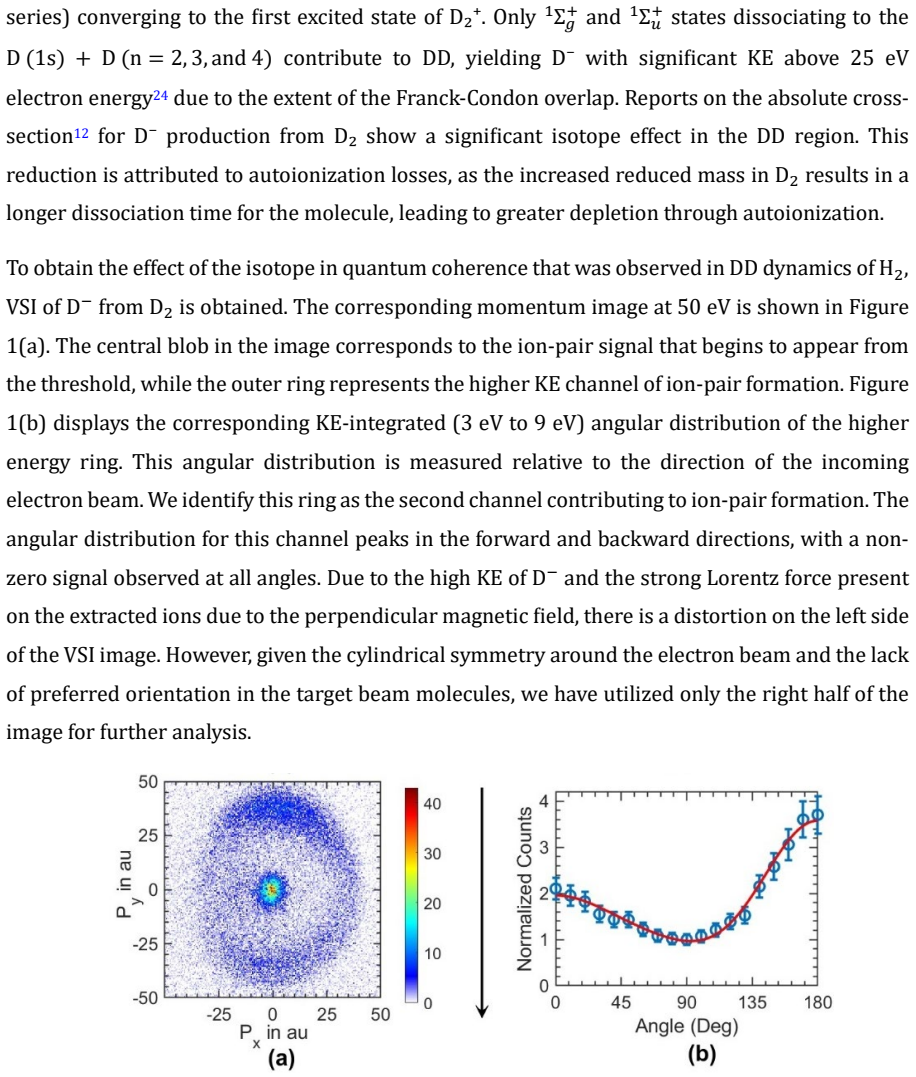
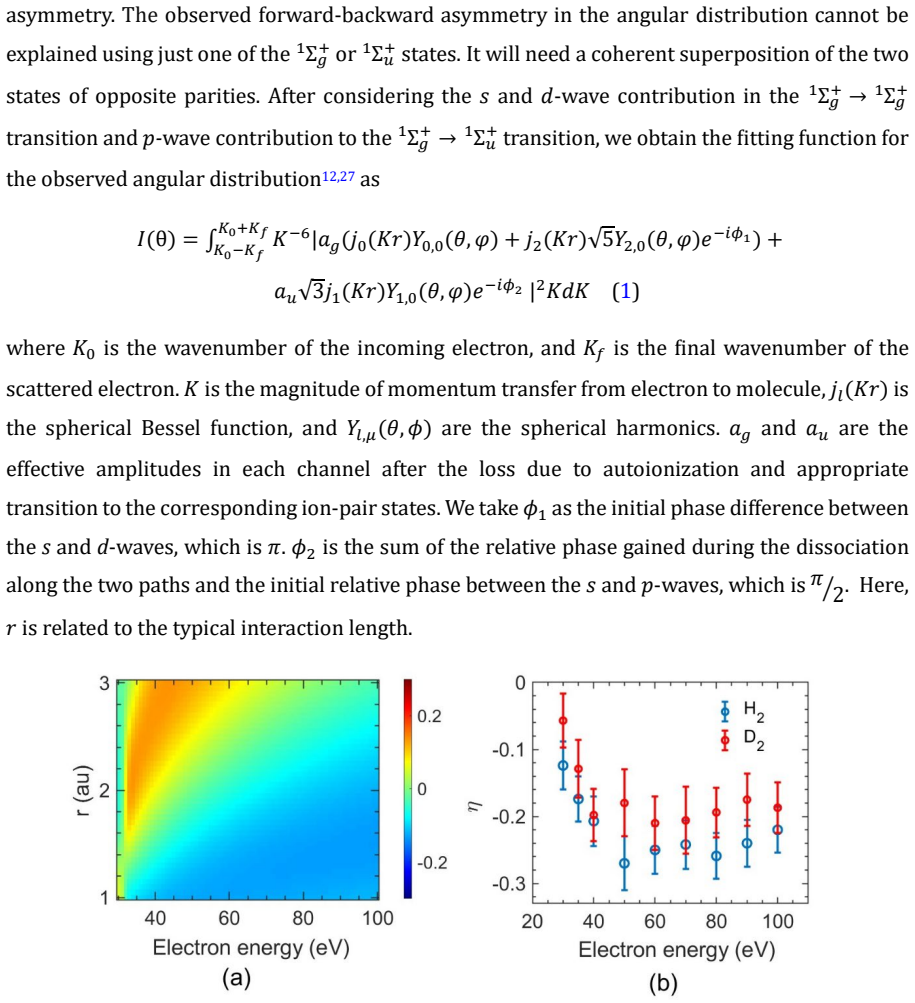
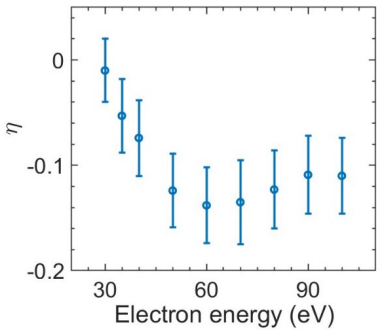
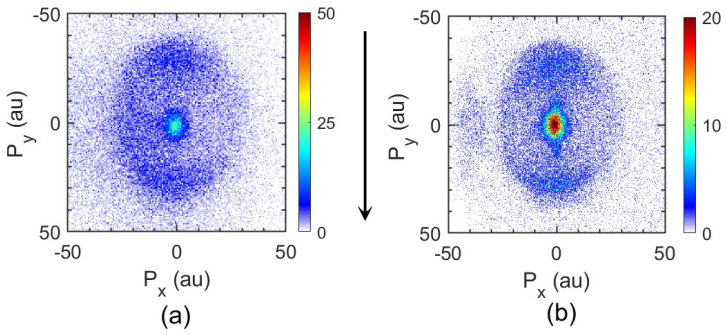
In non-resonant inelastic electron scattering, excitation creates a coherent superposition of opposite-parity states that survives to produce asymmetry in the angle-differential cross sections of dipolar dissociation. Measurements on D2 across electron energies confirm an isotope effect in which heavier isotopes exhibit diminished asymmetry due to longer dissociation times. In HD the asymmetric masses do not alter the excitation outcome, so the angular distributions of H− and D− ions show the same asymmetry; this occurs because HD displays homonuclear-like behavior inside the Franck-Condon region.
What carries the argument
coherent superposition of opposite-parity states created by electron-impact excitation, whose persistence until dissociation determines the observed left-right asymmetry in fragment angular distributions
If this is right
- The isotope effect on asymmetry in D2 holds across a range of electron energies rather than only at 50 eV.
- Coherence established at excitation is independent of the subsequent fragment masses in HD.
- The Franck-Condon region fixes the effective symmetry of the excited HD molecule before dissociation begins.
- Asymmetry magnitude scales inversely with dissociation time set by reduced mass.
- Coherence signatures can be compared directly between homonuclear and heteronuclear isotopologues without mass correction in the initial step.
Where Pith is reading between the lines
- If the Franck-Condon region dominates, similar coherence measurements on other heteronuclear molecules should also erase mass-asymmetry effects at the excitation stage.
- The result suggests that varying the initial internuclear separation (for example via vibrational excitation before scattering) could test whether the homonuclear-like behavior persists outside the equilibrium geometry.
- The same coherence mechanism may appear in other non-resonant scattering channels whose final states also involve opposite-parity mixing.
Load-bearing premise
The measured asymmetry in angular distributions is produced by a coherent superposition whose survival time is set by the dissociation timescale, which in turn is controlled by isotope mass.
What would settle it
Direct measurement of different angular asymmetries for H− versus D− ions from HD at an electron energy where dissociation timescales differ substantially from those already reported would contradict the claim that mass asymmetry has no influence on the excitation step.
Figures
read the original abstract
Recent discoveries of electron-induced coherence in both resonant and non-resonant interactions have introduced new perspectives in the field. In non-resonant processes, coherence has been observed in dipolar dissociation, where electron-induced excitation forms a coherent superposition of states of opposite parities, resulting in asymmetry in the angle-differential cross-section of the process relative to the incident electron beam. Notably, an isotope effect has been observed in $D_2$ at 50 eV, where heavier isotopes exhibit diminished asymmetry due to their longer dissociation times. Here, we report the isotope effect on quantum coherence in $D_2$ across different electron energies. Additionally, we investigate the role of coherence in the isotopologue HD. Our findings reveal that the asymmetric masses in HD do not influence electron-impact excitation, leading to similar asymmetry in the angular distributions of $H^-$ and $D^-$ ions. This observation is explained by the homonuclear-like behavior of HD within the Franck-Condon region.
Editorial analysis
A structured set of objections, weighed in public.
Referee Report
Summary. The manuscript reports experimental observations of an isotope effect in electron-induced quantum coherence during non-resonant dipolar dissociation. In D2, asymmetry in angle-differential cross sections diminishes for heavier isotopes at 50 eV due to longer dissociation timescales. The study extends this to other electron energies and examines the heteronuclear isotopologue HD, finding comparable angular asymmetries for H− and D− ions. This is interpreted as mass asymmetry not influencing the electron-impact excitation step, with HD exhibiting homonuclear-like behavior inside the Franck-Condon region that permits coherent superposition of opposite-parity states.
Significance. If the experimental interpretations are robustly supported, the results would extend prior observations of coherence in electron-molecule scattering and provide a test of how nuclear mass and molecular symmetry influence coherence survival during dissociation. The HD case is particularly notable as a potential probe of whether parity-based coherence mechanisms can persist in systems without inversion symmetry.
major comments (2)
- [Abstract] Abstract (HD results paragraph): The central interpretation that 'asymmetric masses in HD do not influence electron-impact excitation' and that HD behaves 'homonuclear-like' in the Franck-Condon region rests on the assumption that a coherent superposition of opposite-parity states can form. However, HD lacks inversion symmetry, so its electronic states carry no definite g/u parity. The selection rules and coherence mechanism invoked for homonuclear D2 therefore require explicit justification or supporting calculation showing how the asymmetry arises in HD; without this, the claim that mass asymmetry is irrelevant for excitation but relevant for dissociation is not yet load-bearing.
- [Abstract] Abstract (isotope-effect claims): The reported diminution of asymmetry with increasing mass in D2 is attributed to dissociation timescale, but the manuscript provides no quantitative comparison of observed asymmetries against predicted survival probabilities or dissociation times across the studied energies. This leaves the energy-dependent isotope effect vulnerable to alternative explanations (e.g., energy-dependent changes in the excited-state manifold) that are not addressed.
Simulated Author's Rebuttal
We thank the referee for the thorough review and valuable comments, which help clarify the presentation of our results on isotope effects in electron-induced quantum coherence. We address each major comment below and indicate where revisions will be made to strengthen the manuscript.
read point-by-point responses
-
Referee: [Abstract] Abstract (HD results paragraph): The central interpretation that 'asymmetric masses in HD do not influence electron-impact excitation' and that HD behaves 'homonuclear-like' in the Franck-Condon region rests on the assumption that a coherent superposition of opposite-parity states can form. However, HD lacks inversion symmetry, so its electronic states carry no definite g/u parity. The selection rules and coherence mechanism invoked for homonuclear D2 therefore require explicit justification or supporting calculation showing how the asymmetry arises in HD; without this, the claim that mass asymmetry is irrelevant for excitation but relevant for dissociation is not yet load-bearing.
Authors: We acknowledge that HD lacks inversion symmetry and thus does not have strict g/u parity labels. However, in the Franck-Condon region the relevant excited-state potential energy curves of HD closely resemble those of D2, with the nuclear wave packet launched from a geometry where the center-of-mass frame still permits coherent excitation of states with opposite dipole character. The experimental observation that the angular asymmetries for H− and D− fragments are essentially identical directly supports that the excitation step itself is insensitive to the mass asymmetry. We will revise the abstract and add a short explanatory paragraph in the main text that explicitly addresses the coherence mechanism in the absence of inversion symmetry, referencing the similarity of the electronic surfaces near the vertical excitation region. revision: partial
-
Referee: [Abstract] Abstract (isotope-effect claims): The reported diminution of asymmetry with increasing mass in D2 is attributed to dissociation timescale, but the manuscript provides no quantitative comparison of observed asymmetries against predicted survival probabilities or dissociation times across the studied energies. This leaves the energy-dependent isotope effect vulnerable to alternative explanations (e.g., energy-dependent changes in the excited-state manifold) that are not addressed.
Authors: We agree that a quantitative comparison would strengthen the interpretation. While a full time-dependent calculation of coherence survival lies outside the scope of this primarily experimental work, the data show a clear, systematic reduction in asymmetry both with increasing nuclear mass at fixed energy and with increasing electron energy for a given isotope—trends that track the expected lengthening of the dissociation time. Alternative explanations based on energy-dependent changes in the excited-state manifold would affect all isotopologues similarly and cannot account for the observed mass dependence. We will add a brief discussion section that estimates dissociation timescales from the known repulsive curves and places the observed asymmetries in the context of these estimates. revision: yes
Circularity Check
No circularity: experimental observations only
full rationale
The manuscript is a report of measured angular distributions for H-/D- ions from electron-impact dissociation of D2 and HD. No equations, fitted parameters, derivations, or model predictions appear in the provided text. Claims rest on direct experimental results (asymmetry, isotope dependence, HD similarity) interpreted via standard concepts (Franck-Condon region, dissociation timescale) without any reduction to self-defined quantities or self-citation chains. This is self-contained experimental work; the default non-circularity outcome applies.
Axiom & Free-Parameter Ledger
Reference graph
Works this paper leans on
-
[1]
Christophorou L G 1983 Electron-Molecule Interactions and Their Application. V ol. 1 (Academic Press, London) (DOI: 10.1016/B978-0-12-174401-4.X5001-9)
-
[2]
Ingo ́ lfsson O 2019 Low-Energy Electrons Fundamentals and Applications (Jenny Stanford Publishing, New York) (DOI: 10.1201/9780429058820)
-
[3]
Frontiers of Nanoscience 11 115 (Elsevier) (DOI: 10.1016/B978-0-08-100354-1.00003-X)
van Dorp W F 2016 Theory: Electron-Induced Chemistry. Frontiers of Nanoscience 11 115 (Elsevier) (DOI: 10.1016/B978-0-08-100354-1.00003-X)
-
[4]
van Dorp W F 2012 The role of electron scattering in electron-induced surface chemistry Phys. Chem. Chem. Phys. 14 16753 (DOI: 10.1039/C2CP42275A)
-
[5]
Zhong Q, Ihle A, Ahles S, Wegner H A, Schirmeisen A, and Ebeling D 2021 Constructing covalent organic nanoarchitectures molecule by molecule via scanning probe manipulation Nat. Chem. 13 1133 (DOI: 10.1038/s41557-021-00773-4)
-
[6]
Nandi D, Prabhudesai V S, Krishnakumar E, and Chatterjee A 2005 Velocity slice imaging for dissociative electron attachment Rev. Sci. Instrum. 76 053107 (DOI: 10.1063/1.1899404)
-
[7]
Adaniya H, Rudek B, Osipov T, Haxton D J , Weber T, Rescigno T N , McCurdy C W, and Belkacem A 2009 Imaging the Molecular Dynamics of Dissociative Electron Attachment to Water Phys. Rev. Lett. 103, 233201 (DOI: 10.1103/PhysRevLett.103.233201)
-
[8]
Slaughter D S, Adaniya H, Rescigno T N, Haxton D J, Orel A E, McCurdy C W, and Belkacem A 2011 Dissociative electron attachment to carbon dioxide via the 8.2 eV Feshbach resonance J. Phys. B: At. Mol. Opt. Phys. 44 205203 (DOI: 10.1088/0953 - 4075/44/20/205203)
-
[9]
Bingham P S and Gor�inkiel J D 2024 Resonances in electron scattering from H 2 around the H(2l) + H −(1s2) dissociation limit J. Phys. B: At. Mol. Opt. Phys. 57 105202 (DOI: 10.1088/1361-6455/ad38f3)
-
[10]
Ambalampitiya H B, and Fabrikant I I 2026 Dissociative electron attachment to H 2: two resonances of different symmetries Phys. Re. A 113 012811 (DOI: 10.1103/f33t-9lk9)
-
[11]
Krishnakumar E, Prabhudesai V S, and Mason N J 2018 Symmetry breaking by quantum coherence in single electron attachment Nat. Phys. 14 149 (DOI: 10.1038/nphys4289)
-
[12]
Kumar A, Swain S, and Prabhudesai V S 2023 Inelastic electron scattering induced quantum coherence in molecular dynamics Nat . Commun. 14 2769 (DOI: 10.1038/s41467-023-38440-6)
-
[13]
Krishnakumar E, Deni�l S, Cadez I, Markelj S, and Mason N J 2011 Dissociative Electron Attachment Cross Sections for H2 and D2 Phys. Rev. Lett. 106 243201 (DOI: 10.1103/PhysRevLett.106.243201)
-
[14]
Prabhudesai V S, Mason N J, and Krishnakumar E 2020 Electron attachment and quantum coherence in molecular hydrogen J . Phys. Conf. Ser. 1412 052006 (DOI: 10.1088/1742 - 6596/1412/5/052006)
-
[15]
Blinder S M 1960 Dipole moment of HD J. Chem. Phys. 32 105 (DOI: 10.1063/1.1700880)
-
[16]
Herzberg G 1950 Rotation-vibration spectrum of the HD molecule Nature 166 563 (DOI: 10.1038/166563a0)
-
[17]
Biesheuvel J, Karr J-Ph, Hilico L, Eikema K S E, Ubachs W, and Koelemeij J C J 2016 Probing QED and fundamental constants through laser spectroscopy of vi brational transitions in HD+ Nat. Commun. 7 10385 (DOI: 10.1038/ncomms10385)
-
[18]
Fichet S 2018 Quantum Forces from Dark Matter and Where to Find Them Phys. Rev. Lett. 120 131801 (DOI: 10.1103/PhysRevLett.120.131801)
-
[19]
De Lange A, Reinhold E, and Ubachs W 2002 Phenomena of g-u symmetry-breakdown in HD Int. Rev. Phys. Chem. 21 257 (DOI: 10.1080/01442350210124515)
-
[20]
Sheehy B , Walker B , and DiMauro L F 1995 Phase Control in the Two -Color Photodissociation of HD+ Phys. Rev. Lett. 74 4799 (DOI: 10.1103/PhysRevLett.74.4799)
-
[21]
Swain S , Krishnakumar E , and Prabhudesai V S 2021 Structure and dynamics of the negative-ion resonance in H2, D2, and HD at 10 eV Phys. Rev. A 103 062804 (DOI: 10.1103/PhysRevA.103.062804)
-
[22]
Swain S , Kumar A, Krishnakumar E, and Prabhudesai V S 2024 Quantum coherence in dissociative electron attachment: Isotope effect Phys . Rev. A 109 042805 (DOI: 10.1103/PhysRevA.109.042805)
-
[23]
https://webbook.nist.gov/chemistry/
-
[24]
Kumar A , Swain S , Upadhyay J , Upalekar Y , Arya R , and Prabhudesai V S 2023 Predissociation dynamics of negative-ion resonances of H2 near 12 and 14.5 eV using the velocity slice imaging technique Phys. Rev. A 107 062803 (DOI: 10.1103/PhysRevA.107.062803)
-
[25]
Das S, Swain S, Gope K, Tadsare V, and Prabhudesai V S 2024 Effect of static gas background signal on momentum imaging in electron-molecule collision experiment Int. J. Mass. Spectrom. 498 117215 (DOI: 10.1016/j.ijms.2024.117215)
-
[26]
Vogel J S 2015 H− formation by neutral resonant ionization of H(n=2) atoms AIP Conf. Proc. 1655 020015 (DOI: 10.1063/1.4916424)
-
[27]
Van Brunt R J 1974 Breakdown of the dipole-Born approximation for predicting angular distributions of dissociation fragments J. Chem. Phys. 60 3064 (DOI: 10.1063/1.1681491)
-
[28]
1999 Resonant ion pair formation in electron collision with ground state molecular ions Phys
Zong W et al. 1999 Resonant ion pair formation in electron collision with ground state molecular ions Phys. Rev. Lett. 88 951 (DOI: 10.1103/PhysRevLett.83.951)
discussion (0)
Sign in with ORCID, Apple, or X to comment. Anyone can read and Pith papers without signing in.