Modular resurgence of topological string
Pith reviewed 2026-07-02 09:15 UTC · model grok-4.3
The pith
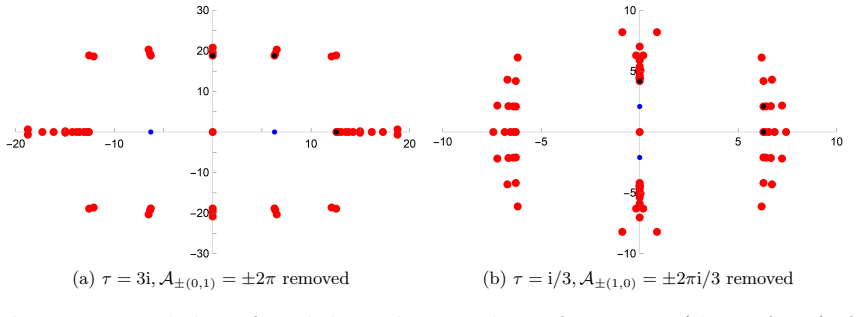
Non-perturbative contributions to topological string free energy form orbits under local monodromy, with equal Stokes constants that reproduce the BPS spectrum.
A machine-rendered reading of the paper's core claim, the machinery that carries it, and where it could break.
Core claim
Using resurgence theory, non-perturbative contributions form orbits of the local monodromy group induced by singular points inside a stability chamber, and the associated Stokes constants must be the same across the orbits. In some examples this allows generation of infinitely many Stokes constants, which reproduce the entire BPS spectrum. Generators of Stokes transformations of the non-holomorphic partition function satisfy Lie brackets of the Kontsevich-Soibelman Lie algebra, making it possible to identify the global Stokes transformation with the Kontsevich-Soibelman wall-crossing invariant.
What carries the argument
Orbits of the local monodromy group induced by singular points inside a stability chamber, which force Stokes constants to coincide and connect to the Kontsevich-Soibelman Lie algebra.
If this is right
- A finite set of Stokes constants determines infinitely many others via the orbits.
- The generated constants match the full BPS spectrum of D-brane multiplicities.
- Stokes transformations satisfy the Lie algebra relations of Kontsevich-Soibelman.
- The global Stokes transformation coincides with the wall-crossing invariant.
Where Pith is reading between the lines
- The orbit structure may organize non-perturbative data in other string or field theories where monodromy acts on instanton sectors.
- It offers a route to compute BPS invariants in Calabi-Yau geometries by propagating a few known values rather than enumerating all charges.
- Stability chambers become the natural domains for grouping the complete non-perturbative spectrum.
Load-bearing premise
Resurgence theory implies that non-perturbative contributions form orbits under the local monodromy group induced by singular points inside a stability chamber.
What would settle it
Explicit computation of two Stokes constants for D-brane charges related by a local monodromy transformation that yields unequal values would falsify the orbit claim.
Figures

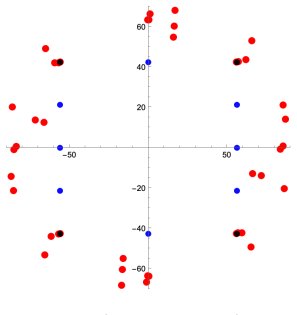
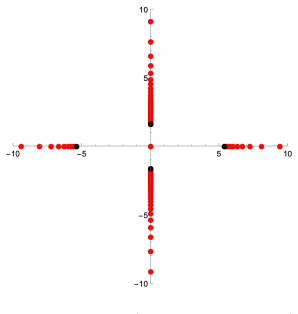
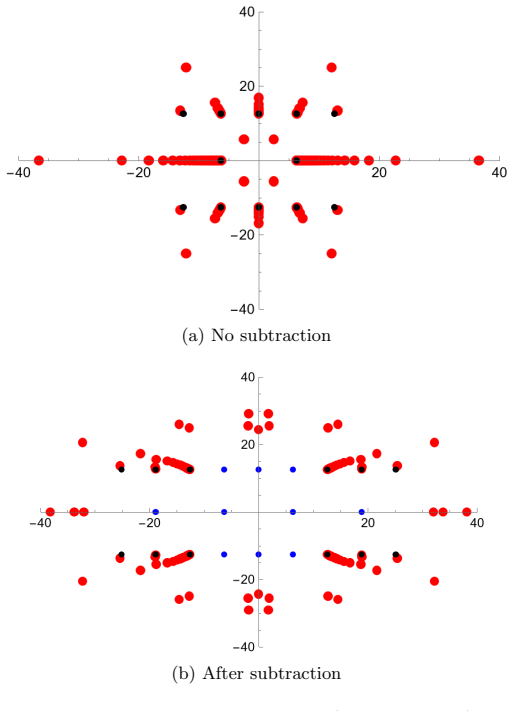
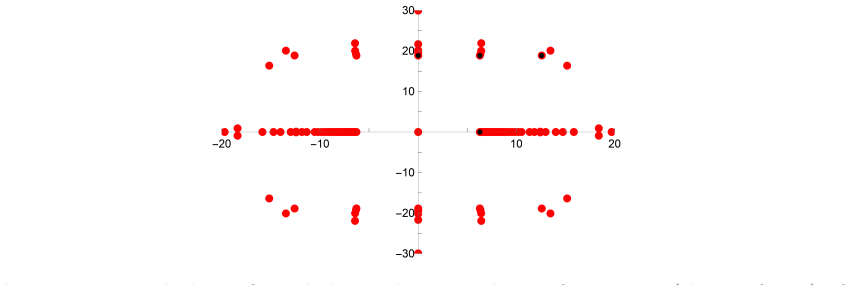
read the original abstract
Topological string free energy has a rich collection of non-perturbative contributions which are labeled by D-brane charge vectors, and the associated Stokes constants are conjectured to coincide with BPS or DT invariants, i.e. D-brane multiplicities. In this paper, we provide additional evidence to this conjecture by studying modular properties of non-perturbative contributions. We argue using resurgence theory that non-perturbative contributions form orbits of local monodromy group induced by singular points inside a stability chamber, and that the associated Stokes constants must be the same across the orbits. In some examples, this allows generation of infinitely many Stokes constants, which reproduce the entire BPS spectrum. In addition, following [DK26], we also show that generators of Stokes transformations of non-holomorphic partition function satisfy Lie brackets of the Kontsevich-Soibelman Lie algebra, making it possible to identify the global Stokes transformation with the Kontsevich-Soibelman wall-crossing invariant.
Editorial analysis
A structured set of objections, weighed in public.
Referee Report
Summary. The paper claims that resurgence theory implies non-perturbative contributions to the topological string free energy form orbits under the local monodromy group induced by singular points inside a stability chamber, with associated Stokes constants invariant across each orbit; this generates infinitely many Stokes constants reproducing the full BPS spectrum in examples. It further shows that generators of Stokes transformations of the non-holomorphic partition function satisfy the Lie brackets of the Kontsevich-Soibelman algebra, allowing identification of the global Stokes transformation with the KS wall-crossing invariant.
Significance. If the central claims hold, the work supplies modular evidence supporting the conjecture that Stokes constants equal BPS/DT invariants and links resurgence directly to wall-crossing phenomena, with the potential to compute entire BPS spectra from a small number of independent Stokes constants. The explicit verification that Stokes generators obey the KS Lie algebra is a concrete strength.
major comments (2)
- [Abstract] Abstract and the resurgence argument: the statement that resurgence theory itself forces non-perturbative sectors to close into orbits under the local monodromy group with invariant Stokes constants lacks an explicit covariance argument showing how the transseries transforms under the monodromy action while preserving the Stokes constants; resurgence equates Borel jumps to individual non-perturbative exponentials but supplies no automatic mechanism for orbit closure or invariance without additional structure on the transseries.
- [Examples] The examples section (where infinitely many Stokes constants are generated to reproduce the BPS spectrum): it must be shown that the orbit construction derives the Stokes constants independently rather than reproducing them by construction from the monodromy action on a finite set of fitted values; otherwise the claim that the method reproduces the entire spectrum rests on the same data used to define the orbits.
minor comments (2)
- Notation for the local monodromy group and stability chamber should be defined at first use with an explicit reference to the relevant singular points.
- The transition from the local Stokes transformations to the global KS identification would benefit from a short diagram or table summarizing which generators map to which KS elements.
Simulated Author's Rebuttal
We thank the referee for the careful reading and insightful comments. We address the two major comments point by point below. We agree that additional explicit discussion of the transseries covariance under monodromy would improve clarity and have revised the manuscript accordingly. On the examples, we maintain that the base Stokes constants are determined independently via resurgence, with orbits providing predictions rather than tautological reproduction, but we have added further clarification.
read point-by-point responses
-
Referee: [Abstract] Abstract and the resurgence argument: the statement that resurgence theory itself forces non-perturbative sectors to close into orbits under the local monodromy group with invariant Stokes constants lacks an explicit covariance argument showing how the transseries transforms under the monodromy action while preserving the Stokes constants; resurgence equates Borel jumps to individual non-perturbative exponentials but supplies no automatic mechanism for orbit closure or invariance without additional structure on the transseries.
Authors: We agree that an explicit covariance argument for the transseries under monodromy would strengthen the presentation. The manuscript invokes the geometric action of monodromy on D-brane charges together with the identification of Stokes constants as invariants, but does not spell out the transformation of the full transseries in detail. We have added a new subsection (now Section 3.2) that derives the covariance explicitly: the Borel plane singularities transform according to the monodromy representation on the charge lattice, while the Stokes constants remain invariant because they are extracted from the jump discontinuities that are preserved by the underlying holomorphic anomaly equations and the modular properties of the topological string. This supplies the missing mechanism without requiring extra structure beyond what is already present in the resurgence setup. revision: yes
-
Referee: [Examples] The examples section (where infinitely many Stokes constants are generated to reproduce the BPS spectrum): it must be shown that the orbit construction derives the Stokes constants independently rather than reproducing them by construction from the monodromy action on a finite set of fitted values; otherwise the claim that the method reproduces the entire spectrum rests on the same data used to define the orbits.
Authors: The base Stokes constants in the examples are obtained independently from the large-order asymptotics of the perturbative coefficients via standard resurgence techniques (numerical Borel summation and matching to the expected exponential growth). These values are not fitted to the full BPS spectrum; only a minimal generating set is extracted. The monodromy orbits then predict the remaining constants, which are compared a posteriori to independently computed BPS/DT invariants. This constitutes a non-trivial consistency check. We have revised the examples section to state explicitly the independent origin of the base values, the predictive step performed by the orbits, and the separate verification against the known spectrum, thereby removing any ambiguity about circularity. revision: partial
Circularity Check
Minor self-citation on KS identification; resurgence orbit claim presented as independent
full rationale
The central argument invokes resurgence theory to conclude that non-perturbative contributions form orbits under the local monodromy group with invariant Stokes constants across orbits, allowing generation of the BPS spectrum. This is stated as following directly from resurgence without any quoted reduction of the orbit or invariance statement to a fitted parameter or self-referential definition within the paper's equations. The reference to [DK26] for the Kontsevich-Soibelman Lie algebra brackets is a self-citation but is isolated to the secondary identification step and does not carry the load of the orbit/Stokes claim. No self-definitional, fitted-input, or ansatz-smuggling patterns appear in the abstract or described derivation chain, so the paper remains self-contained against external benchmarks with only a minor self-citation.
Axiom & Free-Parameter Ledger
axioms (1)
- domain assumption Resurgence theory applies to the non-perturbative contributions of topological string free energy and induces local monodromy orbits.
Reference graph
Works this paper leans on
-
[1]
The non-perturbative topological string: from resurgence to wall-crossing of DT invariants
S. Douaud and A.-K. Kashani-Poor,The non-perturbative topological string: from resurgence to wall-crossing of DT invariants, 4 2026,arXiv:2604.19731 [hep-th]
work page internal anchor Pith review Pith/arXiv arXiv 2026
-
[2]
Combinatorics of Boundaries in String Theory
J. Polchinski,Combinatorics of boundaries in string theory, Phys. Rev. D50(1994) R6041–R6045,arXiv:hep-th/9407031
work page internal anchor Pith review Pith/arXiv arXiv 1994
-
[3]
M-Theory and Topological Strings--I
R. Gopakumar and C. Vafa,M theory and topological strings. 1., 1998, arXiv:hep-th/9809187 [hep-th]
work page internal anchor Pith review Pith/arXiv arXiv 1998
-
[4]
M-Theory and Topological Strings--II
R. Gopakumar and C. Vafa,M theory and topological strings. 2., 1998, arXiv:hep-th/9812127 [hep-th]
work page internal anchor Pith review Pith/arXiv arXiv 1998
-
[5]
Kodaira-Spencer Theory of Gravity and Exact Results for Quantum String Amplitudes
M. Bershadsky, S. Cecotti, H. Ooguri, and C. Vafa,Kodaira-Spencer theory of gravity and exact results for quantum string amplitudes, Commun. Math. Phys.165(1994) 311–428, arXiv:hep-th/9309140 [hep-th]
work page internal anchor Pith review Pith/arXiv arXiv 1994
-
[6]
Holomorphic Anomalies in Topological Field Theories
M. Bershadsky, S. Cecotti, H. Ooguri, and C. Vafa,Holomorphic anomalies in topological field theories, Nucl. Phys.B405(1993) 279–304,arXiv:hep-th/9302103 [hep-th]
work page internal anchor Pith review Pith/arXiv arXiv 1993
-
[7]
Open string amplitudes and large order behavior in topological string theory
M. Marino,Open string amplitudes and large order behavior in topological string theory, JHEP03(2008) 060,arXiv:hep-th/0612127 [hep-th]
work page internal anchor Pith review Pith/arXiv arXiv 2008
-
[8]
Nonperturbative Effects and the Large-Order Behavior of Matrix Models and Topological Strings
M. Marino, R. Schiappa, and M. Weiss,Nonperturbative effects and the large-order behavior of matrix models and topological strings, Commun. Num. Theor. Phys.2(2008) 349–419, arXiv:0711.1954 [hep-th]
work page internal anchor Pith review Pith/arXiv arXiv 2008
-
[9]
Nonperturbative effects and nonperturbative definitions in matrix models and topological strings
M. Marino,Nonperturbative effects and nonperturbative definitions in matrix models and topological strings, JHEP12(2008) 114,arXiv:0805.3033 [hep-th]
work page internal anchor Pith review Pith/arXiv arXiv 2008
-
[10]
´Ecalle,Les fonctions r´ esurgentes
J. ´Ecalle,Les fonctions r´ esurgentes. Vols. I-III, Universit´ e de Paris-Sud, D´ epartement de Math´ ematiques, Bˆ at. 425, 1981
1981
-
[11]
M. Marino,Lectures on non-perturbative effects in largeNgauge theories, matrix models and strings, Fortsch. Phys.62(2014) 455–540,arXiv:1206.6272 [hep-th]. 18It is related to the Stokes transformation of topological string partition function given in [36]. – 40 –
-
[12]
Mitschi and D
C. Mitschi and D. Sauzin,Divergent series, summability and resurgence. I, Lecture Notes in Mathematics, vol. 2153, Springer, [Cham], 2016, Monodromy and resurgence, With a foreword by Jean-Pierre Ramis and a preface by ´Eric Delabaere, Mich` ele Loday-Richaud, Claude Mitschi and David Sauzin
2016
-
[13]
I. Aniceto, G. Basar, and R. Schiappa,A Primer on Resurgent Transseries and Their Asymptotics, Phys. Rept.809(2019) 1–135,arXiv:1802.10441 [hep-th]
-
[14]
G. V. Dunne,Introductory Lectures on Resurgence: CERN Summer School 2024, Eur. Phys. J. ST02(2026) 21,arXiv:2511.15528 [hep-th]
work page internal anchor Pith review Pith/arXiv arXiv 2024
-
[15]
Borel and Stokes Nonperturbative Phenomena in Topological String Theory and c=1 Matrix Models
S. Pasquetti and R. Schiappa,Borel and Stokes nonperturbative phenomena in topological string theory and c=1 matrix models, Annales Henri Poincare11(2010) 351–431, arXiv:0907.4082 [hep-th]
work page internal anchor Pith review Pith/arXiv arXiv 2010
-
[16]
The Resurgence of Instantons in String Theory
I. Aniceto, R. Schiappa, and M. Vonk,The resurgence of instantons in string theory, Commun. Num. Theor. Phys.6(2012) 339–496,arXiv:1106.5922 [hep-th]
work page internal anchor Pith review Pith/arXiv arXiv 2012
-
[17]
M. Marino,Les Houches lectures on non-perturbative topological strings, 11 2024, arXiv:2411.16211 [hep-th]
-
[18]
Resurgence Matches Quantization
R. Couso-Santamar´ ıa, M. Marino, and R. Schiappa,Resurgence Matches Quantization, J. Phys. A50(2017) 145402,arXiv:1610.06782 [hep-th]
work page internal anchor Pith review Pith/arXiv arXiv 2017
- [19]
- [20]
-
[21]
Resurgent Transseries and the Holomorphic Anomaly: Nonperturbative Closed Strings in Local CP2
R. Couso-Santamar´ ıa, J. D. Edelstein, R. Schiappa, and M. Vonk,Resurgent transseries and the holomorphic anomaly: Nonperturbative closed strings in localCP 2, Commun. Math. Phys.338(2015) 285–346,arXiv:1407.4821 [hep-th]
work page internal anchor Pith review Pith/arXiv arXiv 2015
-
[22]
Resurgent Transseries and the Holomorphic Anomaly
R. Couso-Santamar´ ıa, J. D. Edelstein, R. Schiappa, and M. Vonk,Resurgent transseries and the holomorphic anomaly, Annales Henri Poincare17(2016) 331–399,arXiv:1308.1695 [hep-th]
work page internal anchor Pith review Pith/arXiv arXiv 2016
-
[23]
M. Marino and M. Schwick,Large N instantons, BPS states, and the replica limit, 3 2024, arXiv:2403.14462 [hep-th]
-
[24]
Nonperturbative aspects of ABJM theory
N. Drukker, M. Marino, and P. Putrov,Nonperturbative aspects of ABJM theory, JHEP11 (2011) 141,arXiv:1103.4844 [hep-th]
work page internal anchor Pith review Pith/arXiv arXiv 2011
-
[25]
Resurgence of Chern-Simons theory at the trivial flat connection
S. Garoufalidis, J. Gu, M. Marino, and C. Wheeler,Resurgence of Chern-Simons theory at the trivial flat connection, 11 2021,arXiv:2111.04763 [math.GT]
work page internal anchor Pith review Pith/arXiv arXiv 2021
-
[26]
S. Garoufalidis, J. Gu, and M. Marino,Peacock patterns and resurgence in complex Chern-Simons theory, 11 2020,arXiv:2012.00062 [math.GT]
-
[27]
S. Garoufalidis, J. Gu, and M. Marino,The resurgent structure of quantum knot invariants, Communications in Mathematical Physics386(2020) 469–493,arXiv:2007.10190 [hep-th]
-
[28]
Marino,From resurgence to bps states, Strings 2019 (Brussels), 2019
M. Marino,From resurgence to bps states, Strings 2019 (Brussels), 2019
2019
- [29]
- [30]
- [31]
- [32]
-
[33]
S. Douaud and A.-K. Kashani-Poor,Borel singularities and Stokes constants of the topological string free energy on one-parameter Calabi-Yau threefolds, JHEP06(2025) 253, arXiv:2412.16140 [hep-th]
-
[34]
S. Alexandrov, M. Marino, and B. Pioline,Resurgence of refined topological strings and dual partition functions, 11 2023,arXiv:2311.17638 [hep-th]
-
[35]
J. Gu,Relations between Stokes constants of unrefined and Nekrasov-Shatashvili topological strings, JHEP (2023),arXiv:2307.02079 [hep-th]
-
[36]
K. Iwaki and M. Marino,Resurgent Structure of the Topological String and the First Painlev´ e Equation, 7 2023,arXiv:2307.02080 [hep-th]
-
[37]
Non-Perturbative Real Topological Strings
M. Marino and M. Schwick,Non-perturbative real topological strings, 9 2023, arXiv:2309.12046 [hep-th]
work page internal anchor Pith review Pith/arXiv arXiv 2023
- [38]
-
[39]
Bridgeland,Riemann-Hilbert problems from Donaldson-Thomas theory, Invent
T. Bridgeland,Riemann-Hilbert problems from Donaldson-Thomas theory, Invent. Math.216 (2019) 69–124,arXiv:1611.03697 [math.AG]
-
[40]
Bridgeland,Riemann-Hilbert problems for the resolved conifold, 3 2017, arXiv:1703.02776 [math.AG]
T. Bridgeland,Riemann-Hilbert problems for the resolved conifold, 3 2017, arXiv:1703.02776 [math.AG]
-
[41]
T. Bridgeland and I. Tulli,Resurgence and Riemann–Hilbert Problems for Elliptic Calabi–Yau Threefolds, Commun. Math. Phys.406(2025) 132,arXiv:2407.06974 [hep-th]
-
[42]
M. Marino and R. Miravitllas,Large N instantons from topological strings, SciPost Phys.16 (2024) 155,arXiv:2306.01104 [hep-th]
-
[43]
Stability structures, motivic Donaldson-Thomas invariants and cluster transformations
M. Kontsevich and Y. Soibelman,Stability structures, motivic Donaldson-Thomas invariants and cluster transformations, 11 2008,arXiv:0811.2435 [math.AG]
work page internal anchor Pith review Pith/arXiv arXiv 2008
-
[44]
Brandhuber and S
A. Brandhuber and S. Stieberger,Periods, coupling constants and modular functions in N = 2 SU(2) SYM with massive matter, Int. J. Mod. Phys. A13(1998) 1329
1998
-
[45]
Refined stable pair invariants for E-, M- and [p,q]-strings
M.-X. Huang, A. Klemm, and M. Poretschkin,Refined stable pair invariants for E-, M- and [p, q]-strings, JHEP11(2013) 112,arXiv:1308.0619 [hep-th]
work page internal anchor Pith review Pith/arXiv arXiv 2013
-
[46]
Landman,On the picard-lefschetz transformation for algebraic manifolds acquiring general singularities,, Trans
A. Landman,On the picard-lefschetz transformation for algebraic manifolds acquiring general singularities,, Trans. Amer. Math. Soc.181(1973) 89–126
1973
-
[47]
van Straten,Calabi-Yau operators, Adv
D. van Straten,Calabi-Yau operators, Adv. Lect. Math. (ALM) (Somerville, MA, USA), vol. 42, Int. Press, Somerville, MA, USA, 2018, pp. 401–451
2018
-
[48]
The Omega deformed B-model for rigid N=2 theories
M.-x. Huang, A.-K. Kashani-Poor, and A. Klemm,TheΩdeformed B-model for rigidN= 2 theories, Annales Henri Poincare14(2013) 425–497,arXiv:1109.5728 [hep-th]. – 42 –
work page internal anchor Pith review Pith/arXiv arXiv 2013
-
[49]
Strominger,Special geometry, Commun
A. Strominger,Special geometry, Commun. Math. Phys.133(1990) 163–180
1990
-
[50]
Candelas and X
P. Candelas and X. de la Ossa,Moduli Space of Calabi-Yau Manifolds, Nucl. Phys.B355 (1991) 455–481
1991
-
[51]
Holomorphicity and Modularity in Seiberg-Witten Theories with Matter
M.-x. Huang and A. Klemm,Holomorphicity and modularity in Seiberg-Witten theories with matter, JHEP07(2010) 083,arXiv:0902.1325 [hep-th]
work page internal anchor Pith review Pith/arXiv arXiv 2010
-
[52]
Topological String Partition Functions as Polynomials
S. Yamaguchi and S.-T. Yau,Topological string partition functions as polynomials, JHEP07 (2004) 047,arXiv:hep-th/0406078 [hep-th]
work page internal anchor Pith review Pith/arXiv arXiv 2004
-
[53]
Polynomial Structure of the (Open) Topological String Partition Function
M. Alim and J. D. Lange,Polynomial Structure of the (Open) Topological String Partition Function, JHEP10(2007) 045,arXiv:0708.2886 [hep-th]
work page internal anchor Pith review Pith/arXiv arXiv 2007
-
[54]
c=1 String as the Topological Theory of the Conifold
D. Ghoshal and C. Vafa,C = 1 string as the topological theory of the conifold, Nucl. Phys. B 453(1995) 121–128,arXiv:hep-th/9506122
work page internal anchor Pith review Pith/arXiv arXiv 1995
-
[55]
Integrability of the holomorphic anomaly equations
B. Haghighat, A. Klemm, and M. Rauch,Integrability of the holomorphic anomaly equations, JHEP0810(2008) 097,arXiv:0809.1674 [hep-th]
work page internal anchor Pith review Pith/arXiv arXiv 2008
-
[56]
Resurgent functions and splitting problems
D. Sauzin,Resurgent functions and splitting problems, arXiv preprint arXiv:0706.0137 (2007),0706.0137
work page internal anchor Pith review Pith/arXiv arXiv 2007
-
[57]
Joyce and Y
D. Joyce and Y. Song,A theory of generalized donaldson-thomas invariants, Mem. Amer. Math. Soc.217(2012) iv+199
2012
-
[58]
Quantum hypermultiplet moduli spaces in N=2 string vacua: a review
S. Alexandrov, J. Manschot, D. Persson, and B. Pioline,Quantum hypermultiplet moduli spaces in n=2 string vacua: a review, Proc. Symp. Pure. Math90(2015) 181,1304.0766 [hep-th]
work page internal anchor Pith review Pith/arXiv arXiv 2015
-
[59]
T. M. Chiang, A. Klemm, S.-T. Yau, and E. Zaslow,Local mirror symmetry: Calculations and interpretations, Adv. Theor. Math. Phys.3(1999) 495–565,arXiv:hep-th/9903053 [hep-th]
work page internal anchor Pith review Pith/arXiv arXiv 1999
-
[60]
Local Mirror Symmetry at Higher Genus
A. Klemm and E. Zaslow,Local mirror symmetry at higher genus, AMS/IP Stud. Adv. Math.23(2001) 183–207,arXiv:hep-th/9906046
work page internal anchor Pith review Pith/arXiv arXiv 2001
-
[61]
Monopole Condensation, And Confinement In N=2 Supersymmetric Yang-Mills Theory
N. Seiberg and E. Witten,Electric - magnetic duality, monopole condensation, and confinement in N=2 supersymmetric Yang-Mills theory, Nucl. Phys.B426(1994) 19–52, [Erratum: Nucl. Phys.B430,485(1994)],arXiv:hep-th/9407087 [hep-th]
work page internal anchor Pith review Pith/arXiv arXiv 1994
-
[62]
The Strong-Coupling Spectrum of the Seiberg-Witten Theory
F. Ferrari and A. Bilal,The Strong coupling spectrum of the Seiberg-Witten theory, Nucl. Phys. B469(1996) 387–402,arXiv:hep-th/9602082
work page internal anchor Pith review Pith/arXiv arXiv 1996
-
[63]
S. H. Katz, A. Klemm, and C. Vafa,Geometric engineering of quantum field theories, Nucl. Phys.B497(1997) 173–195,arXiv:hep-th/9609239 [hep-th]
work page internal anchor Pith review Pith/arXiv arXiv 1997
-
[64]
Monopoles, Duality and Chiral Symmetry Breaking in N=2 Supersymmetric QCD
N. Seiberg and E. Witten,Monopoles, duality and chiral symmetry breaking in N=2 supersymmetric QCD, Nucl. Phys.B431(1994) 484–550,arXiv:hep-th/9408099 [hep-th]
work page internal anchor Pith review Pith/arXiv arXiv 1994
-
[65]
T. W. Grimm, A. Klemm, M. Marino, and M. Weiss,Direct Integration of the Topological String, JHEP08(2007) 058,arXiv:hep-th/0702187 [HEP-TH]
work page internal anchor Pith review Pith/arXiv arXiv 2007
-
[66]
On N=2 Supersymmetric QCD with 4 Flavors
N. Dorey, V. V. Khoze, and M. P. Mattis,On N=2 supersymmetric QCD with four flavors, Nucl. Phys. B492(1997) 607–622,arXiv:hep-th/9611016
work page internal anchor Pith review Pith/arXiv arXiv 1997
-
[67]
N. A. Nekrasov,Seiberg-Witten prepotential from instanton counting, Adv. Theor. Math. Phys.7(2003) 831–864,arXiv:hep-th/0206161 [hep-th]. – 43 –
work page internal anchor Pith review Pith/arXiv arXiv 2003
-
[68]
The dyon spectra of finite gauge theories
F. Ferrari,The Dyon spectra of finite gauge theories, Nucl. Phys. B501(1997) 53–96, arXiv:hep-th/9702166. – 44 –
work page internal anchor Pith review Pith/arXiv arXiv 1997
discussion (0)
Sign in with ORCID, Apple, or X to comment. Anyone can read and Pith papers without signing in.