Exceptional points in dissipative coupling polaron-polaritons
Pith reviewed 2026-07-02 06:52 UTC · model grok-4.3
The pith
Dissipative coupling and many-body correlations produce tunable exceptional points in polaron-polariton spectra.
A machine-rendered reading of the paper's core claim, the machinery that carries it, and where it could break.
Core claim
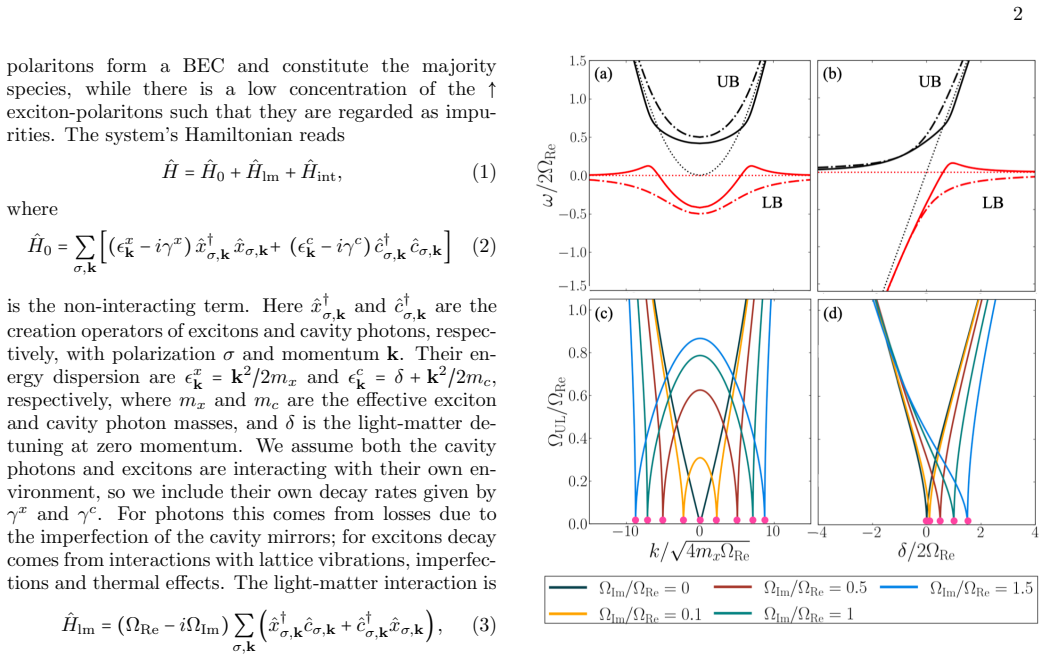
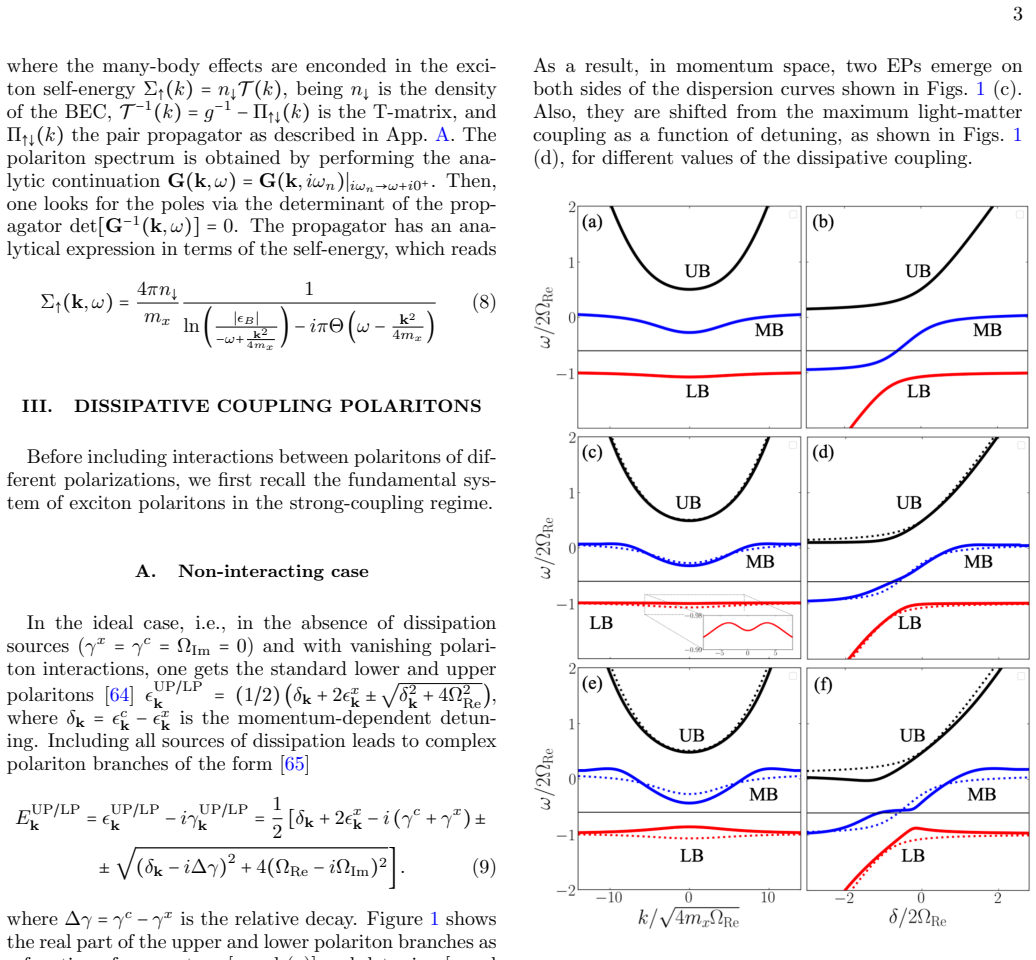
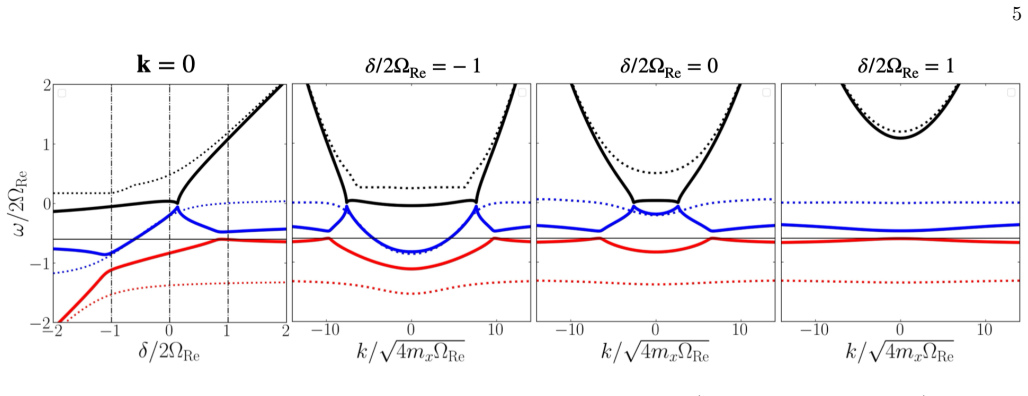
The interplay between many-body correlations and non-Hermitian coupling generates anomalous dispersion relations and exceptional points in the polaron-polariton spectrum. The location and coexistence of exceptional points are controlled by the dissipative coupling and the relative decay rates of the excitonic and photonic constituents, allowing them to emerge across different polaron-polariton branches.
What carries the argument
Polaron-polariton quasiparticles formed by biexciton resonance under dissipative light-matter coupling, which add non-Hermitian terms to the many-body spectrum.
Load-bearing premise
The biexciton resonance produces polaron-polariton quasiparticles when light-matter coupling includes dissipation.
What would settle it
A measured polaron-polariton dispersion relation that remains normal and free of exceptional points despite finite dissipative coupling and a biexciton resonance would contradict the claimed generation mechanism.
Figures
read the original abstract
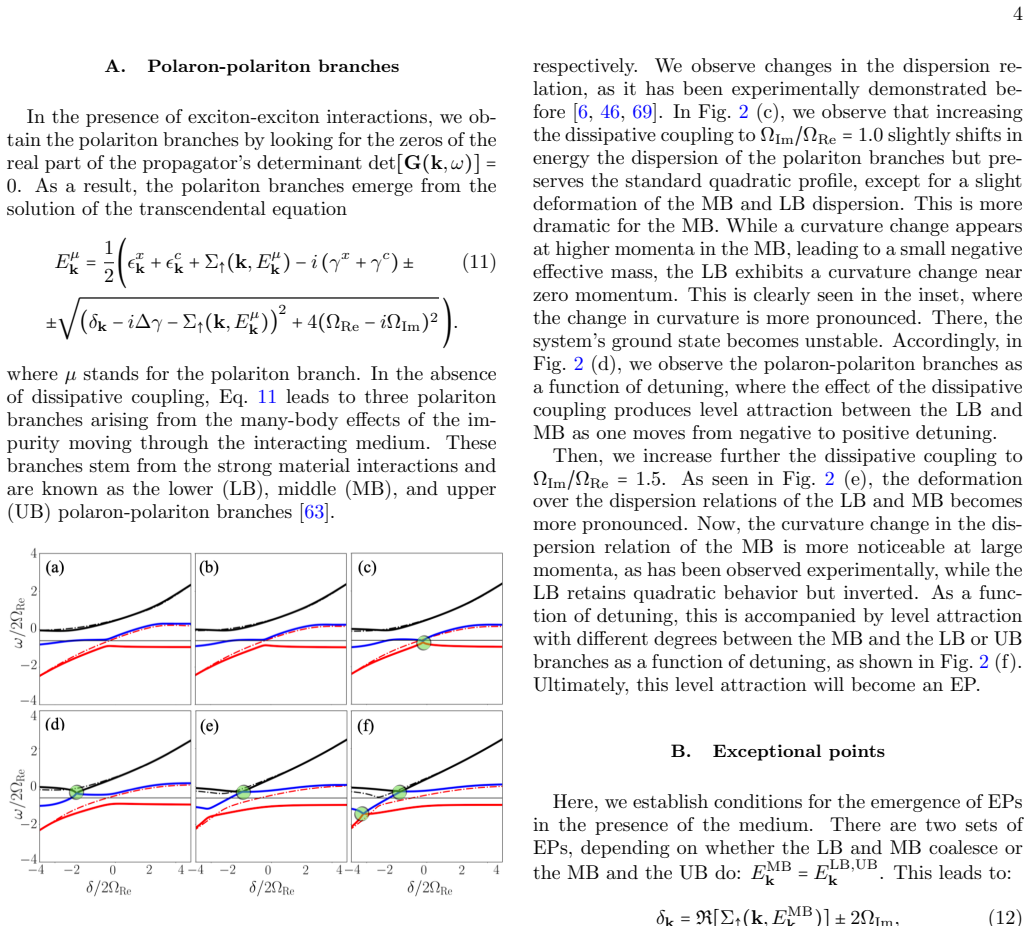
Understanding how strong correlations and dissipation combine to shape collective quantum excitations is a central challenge in many-body physics. We investigate the effect of dissipative light-matter coupling on strongly interacting exciton-polaritons in the presence of a biexciton resonance, which gives rise to polaron-polariton quasiparticles. We show that the interplay between many-body correlations and non-Hermitian coupling generates anomalous dispersion relations and exceptional points in the polaron-polariton spectrum. The location and coexistence of exceptional points are controlled by the dissipative coupling and the relative decay rates of the excitonic and photonic constituents, allowing them to emerge across different polaron-polariton branches. These results identify dissipative polaron-polaritons as a versatile platform for exploring non-Hermitian many-body physics with tunable light-matter quasiparticles.
Editorial analysis
A structured set of objections, weighed in public.
Referee Report
Summary. The paper examines dissipative light-matter coupling in strongly interacting exciton-polaritons with a biexciton resonance, which generates polaron-polariton quasiparticles. It derives an effective non-Hermitian Hamiltonian showing that many-body correlations combined with non-Hermitian terms produce anomalous dispersion relations and exceptional points whose positions and coexistence are tunable via the dissipative coupling strength and the relative decay rates of excitonic and photonic components.
Significance. If the derivations hold, the work supplies a concrete, tunable platform for non-Hermitian many-body physics realized in polariton systems. The explicit construction of the effective non-Hermitian Hamiltonian from the biexciton resonance and the demonstration that exceptional points can appear across multiple branches constitute the main advance.
minor comments (3)
- The abstract and introduction should include a brief statement of the starting Hamiltonian before the effective non-Hermitian reduction is introduced.
- Figure captions for the dispersion plots should explicitly label the branches (e.g., lower/upper polaron-polariton) and mark the exceptional-point locations with arrows or symbols.
- Notation for the decay rates (γ_e, γ_p) and the dissipative coupling parameter should be defined once in the main text and used consistently thereafter.
Simulated Author's Rebuttal
We thank the referee for the positive evaluation of our manuscript on dissipative light-matter coupling in polaron-polaritons and for recognizing the tunable exceptional points as a platform for non-Hermitian many-body physics. The recommendation for minor revision is noted.
Circularity Check
No significant circularity; derivation self-contained from system definition
full rationale
The manuscript defines its physical setup explicitly as exciton-polaritons with a biexciton resonance in the presence of dissipative (non-Hermitian) light-matter coupling, which produces polaron-polariton quasiparticles by construction of the model. From this starting Hamiltonian the authors derive the spectrum, anomalous dispersion, and locations of exceptional points as functions of the dissipative coupling strength and decay rates. No load-bearing step reduces a claimed prediction to a fitted parameter, self-citation chain, or ansatz that is equivalent to the target result; the emergence and tunability of EPs are presented as consequences of the interplay rather than presupposed. The provided abstract and skeptic summary contain no equations or citations that would trigger any of the enumerated circularity patterns.
Axiom & Free-Parameter Ledger
Reference graph
Works this paper leans on
-
[1]
whereµstands for the polariton branch
As a result, the polariton branches emerge from the solution of the transcendental equation Eµ k = 1 2(ϵ x k+ϵ c k+Σ ↑(k, Eµ k)−i(γ x+γ c)±(11) ± √ (δk−i∆γ−Σ↑(k, Eµ k)) 2 +4(Ω Re−iΩIm)2). whereµstands for the polariton branch. In the absence of dissipative coupling, Eq. 11 leads to three polariton branches arising from the many-body effects of the im- pur...
2024
-
[2]
L. D. Landau, Soviet Physics Jetp-Ussr3, 920 (1957)
1957
-
[3]
Abrikosov and I
A. Abrikosov and I. Khalatnikov, Reports on Progress in Physics22, 329 (1959)
1959
-
[4]
Ashida, Z
Y. Ashida, Z. Gong, and M. Ueda, Advances in Physics 69, 249 (2020). 7
2020
-
[5]
Harder, B
M. Harder, B. M. Yao, Y. S. Gui, and C.-M. Hu, Journal of Applied Physics129, 201101 (2021)
2021
-
[6]
Wang and C.-M
Y.-P. Wang and C.-M. Hu, Journal of Applied Physics 127, 130901 (2020)
2020
-
[7]
Wurdack, T
M. Wurdack, T. Yun, M. Katzer, A. G. Truscott, A. Knorr, M. Selig, E. A. Ostrovskaya, and E. Estre- cho, Nature Communications14, 1026 (2023)
2023
-
[8]
O. Bleu, K. Choo, J. Levinsen, and M. M. Parish, Phys. Rev. A109, 023707 (2024)
2024
-
[10]
Miri and A
M.-A. Miri and A. Al` u, Science363, eaar7709 (2019)
2019
-
[11]
Wouters, Phys
M. Wouters, Phys. Rev. B76, 045319 (2007)
2007
-
[12]
Takemura, S
N. Takemura, S. Trebaol, M. Wouters, M. T. Portella- Oberli, and B. Deveaud, Nature Physics10, 500 (2014)
2014
-
[13]
Takemura, M
N. Takemura, M. D. Anderson, M. Navadeh-Toupchi, D. Y. Oberli, M. T. Portella-Oberli, and B. Deveaud, Phys. Rev. B95, 205303 (2017)
2017
-
[15]
S. S. Kumar, B. C. Mulkerin, M. M. Parish, and J. Levin- sen, Phys. Rev. B108, 125416 (2023)
2023
-
[16]
J. Gu, V. Walther, L. Waldecker, D. Rhodes, A. Raja, J. C. Hone, T. F. Heinz, S. K´ ena-Cohen, T. Pohl, and V. M. Menon, Nature communications12, 2269 (2021)
2021
-
[17]
Makhonin, A
M. Makhonin, A. Delphan, K. W. Song, P. Walker, T. Isoniemi, P. Claronino, K. Orfanakis, S. K. Rajen- dran, H. Ohadi, J. Heck¨ otter, et al., Light: Science & Applications13, 47 (2024)
2024
-
[18]
Walther, R
V. Walther, R. Johne, and T. Pohl, Nature communica- tions9, 1309 (2018)
2018
-
[19]
Zhang, F
L. Zhang, F. Wu, S. Hou, Z. Zhang, Y.-H. Chou, K. Watanabe, T. Taniguchi, S. R. Forrest, and H. Deng, Nature591, 61 (2021)
2021
-
[20]
H. Park, J. Zhu, X. Wang, Y. Wang, W. Holtzmann, T. Taniguchi, K. Watanabe, J. Yan, L. Fu, T. Cao, D. Xiao, D. R. Gamelin, H. Yu, W. Yao, and X. Xu, Nature Physics19, 1286 (2023)
2023
-
[21]
Camacho-Guardian and N
A. Camacho-Guardian and N. R. Cooper, Phys. Rev. Lett.128, 207401 (2022)
2022
-
[22]
L. Du, Z. Huang, J. Zhang, F. Ye, Q. Dai, H. Deng, G. Zhang, and Z. Sun, Nature Materials23, 1179 (2024)
2024
-
[23]
S. A. Herrera-Gonz´ alez, H. A. Lara-Garc´ ıa, G. Pirruccio, D. A. Ruiz-Tijerina, and A. Camacho-Guardian, Journal of Physics: Condensed Matter37, 483002 (2025)
2025
-
[24]
Borri, W
P. Borri, W. Langbein, U. Woggon, J. R. Jensen, and J. M. Hvam, Phys. Rev. B62, R7763 (2000)
2000
-
[25]
M. Saba, F. Quochi, C. Ciuti, U. Oesterle, J. L. Staehli, B. Deveaud, G. Bongiovanni, and A. Mura, Phys. Rev. Lett.85, 385 (2000)
2000
-
[26]
Baars, G
T. Baars, G. Dasbach, M. Bayer, and A. Forchel, Phys. Rev. B63, 165311 (2001)
2001
-
[27]
D. K. Efimkin and A. H. MacDonald, Phys. Rev. B95, 035417 (2017)
2017
-
[28]
G. Li, O. Bleu, M. M. Parish, and J. Levinsen, Phys. Rev. Lett.126, 197401 (2021)
2021
-
[29]
Levinsen, F
J. Levinsen, F. M. Marchetti, J. Keeling, and M. M. Parish, Phys. Rev. Lett.123, 266401 (2019)
2019
-
[30]
Sidler, P
M. Sidler, P. Back, O. Cotlet, A. Srivastava, T. Fink, M. Kroner, E. Demler, and A. Imamoglu, Nature Physics 13, 255 (2017)
2017
-
[31]
Cotlet ¸, F
O. Cotlet ¸, F. Pientka, R. Schmidt, G. Zarand, E. Demler, and A. Imamoglu, Phys. Rev. X9, 041019 (2019)
2019
-
[32]
Chervy, P
T. Chervy, P. Kn¨ uppel, H. Abbaspour, M. Lupatini, S. F¨ alt, W. Wegscheider, M. Kroner, and A. Imamoˇ glu, Phys. Rev. X10, 011040 (2020)
2020
-
[33]
D. M. Myers, Q. Yao, H. Alnatah, S. Mukherjee, B. Oz- den, J. Beaumariage, L. N. Pfeiffer, K. West, and D. W. Snoke, Phys. Rev. Lett.135, 146903 (2025)
2025
-
[34]
Emmanuele, M
R. Emmanuele, M. Sich, O. Kyriienko, V. Shahnazaryan, F. Withers, A. Catanzaro, P. Walker, F. Benimetskiy, M. Skolnick, A. Tartakovskii, et al., Nature communica- tions11, 3589 (2020)
2020
-
[35]
L. B. Tan, O. Cotlet, A. Bergschneider, R. Schmidt, P. Back, Y. Shimazaki, M. Kroner, and A. m. c. ˙Imamo˘ glu, Phys. Rev. X10, 021011 (2020)
2020
-
[36]
L. B. Tan, O. K. Diessel, A. Popert, R. Schmidt, A. Imamoglu, and M. Kroner, Phys. Rev. X13, 031036 (2023)
2023
-
[37]
M. A. Bastarrachea-Magnani, A. Camacho-Guardian, and G. M. Bruun, Phys. Rev. Lett.126, 127405 (2021)
2021
-
[38]
Camacho-Guardian, M
A. Camacho-Guardian, M. A. Bastarrachea-Magnani, and G. M. Bruun, Phys. Rev. Lett.126, 017401 (2021)
2021
-
[39]
J. B. Muir, J. Levinsen, S. K. Earl, M. A. Conway, J. H. Cole, M. Wurdack, R. Mishra, D. J. Ing, E. Estrecho, Y. Lu, et al., Nature Communications13, 6164 (2022)
2022
-
[40]
F. P. Laussy, A. V. Kavokin, and I. A. Shelykh, Phys. Rev. Lett.104, 106402 (2010)
2010
-
[41]
Cotlet ¸, S
O. Cotlet ¸, S. Zeytinoˇ glu, M. Sigrist, E. Demler, and A. m. c. Imamoˇ glu, Phys. Rev. B93, 054510 (2016)
2016
- [42]
-
[43]
Julku, J
A. Julku, J. J. Kinnunen, A. Camacho-Guardian, and G. M. Bruun, Phys. Rev. B106, 134510 (2022)
2022
-
[44]
I. A. Shelykh, T. Taylor, and A. V. Kavokin, Phys. Rev. Lett.105, 140402 (2010)
2010
-
[45]
Caldara, O
M. Caldara, O. Bleu, F. M. Marchetti, J. Levinsen, and M. M. Parish, Phys. Rev. Lett.136, 116902 (2026)
2026
-
[46]
Wasak, R
T. Wasak, R. Schmidt, and F. Piazza, Physical Review Research3, 013086 (2021)
2021
-
[47]
Dhara, C
S. Dhara, C. Chakraborty, K. Goodfellow, L. Qiu, T. O’Loughlin, G. Wicks, S. Bhattacharjee, and A. Vamivakas, Nature Physics14, 130 (2018)
2018
-
[48]
W. D. Heiss and H. L. Harney, The European Physi- cal Journal D - Atomic, Molecular, Optical and Plasma Physics17, 149 (2001)
2001
-
[49]
C. A. Downing and V. A. Saroka, American Journal of Physics93, 396 (2025)
2025
-
[50]
W. D. Heiss and R. G. Nazmitdinov, The European Phys- ical Journal D58, 53 (2010)
2010
-
[51]
W. D. Heiss, Journal of Physics A: Mathematical and Theoretical45, 444016 (2012)
2012
-
[52]
Y. Li, X. Ma, Z. Hatzopoulos, P. G. Savvidis, S. Schu- macher, and T. Gao, ACS Photonics9, 2079 (2022)
2079
-
[53]
Wingenbach, S
J. Wingenbach, S. Schumacher, and X. Ma, Phys. Rev. Res.6, 013148 (2024)
2024
-
[54]
Chen, S ¸
W. Chen, S ¸. Kaya ¨Ozdemir, G. Zhao, J. Wiersig, and L. Yang, Nature548, 192 (2017)
2017
-
[55]
T. Gao, E. Estrecho, K. Y. Bliokh, T. C. H. Liew, M. D. Fraser, S. Brodbeck, M. Kamp, C. Schneider, S. H¨ ofling, Y. Yamamoto, F. Nori, Y. S. Kivshar, A. G. Truscott, R. G. Dall, and E. A. Ostrovskaya, Nature526, 554 (2015)
2015
-
[56]
T. Gao, G. Li, E. Estrecho, T. C. H. Liew, D. Comber- Todd, A. Nalitov, M. Steger, K. West, L. Pfeiffer, D. W. 8 Snoke, A. V. Kavokin, A. G. Truscott, and E. A. Ostro- vskaya, Phys. Rev. Lett.120, 065301 (2018)
2018
-
[57]
Hanai, A
R. Hanai, A. Edelman, Y. Ohashi, and P. B. Littlewood, Phys. Rev. Lett.122, 185301 (2019)
2019
-
[58]
Yu, J.-K
Z.-F. Yu, J.-K. Xue, L. Zhuang, J. Zhao, and W.-M. Liu, Phys. Rev. B104, 235408 (2021)
2021
-
[59]
Q. Liao, C. Leblanc, J. Ren, F. Li, Y. Li, D. Solnyshkov, G. Malpuech, J. Yao, and H. Fu, Phys. Rev. Lett.127, 107402 (2021)
2021
-
[60]
Universal topol- ogy of exceptional points in nonlinear non-hermitian sys- tems,
N. H. Kwong, J. Wingenbach, L. Ares, J. Sperling, X. Ma, S. Schumacher, and R. Binder, “Universal topol- ogy of exceptional points in nonlinear non-hermitian sys- tems,” (2026), arXiv:2502.19236 [physics.optics]
-
[61]
Novotny, American Journal of Physics78, 1199 (2010)
L. Novotny, American Journal of Physics78, 1199 (2010)
2010
-
[62]
S. R.-K. Rodriguez, European Journal of Physics37, 025802 (2016)
2016
-
[63]
Carusotto, T
I. Carusotto, T. Volz, and A. Imamo˘ glu, Europhysics Letters90, 37001 (2010)
2010
-
[64]
M. A. Bastarrachea-Magnani, A. Camacho-Guardian, M. Wouters, and G. M. Bruun, Phys. Rev. B100, 195301 (2019)
2019
-
[65]
J. J. Hopfield, Phys. Rev.112, 1555 (1958)
1958
-
[66]
Effec- tive mass in dissipative coupled polaritons,
D. A. Mendoza, A. J. Vega-Carmona, A. Camacho- Guardian, and M. A. Bastarrachea-Magnani, “Effec- tive mass in dissipative coupled polaritons,” (2025), arXiv:2512.17833 [cond-mat.mes-hall]
-
[67]
Harder, Y
M. Harder, Y. Yang, B. M. Yao, C. H. Yu, J. W. Rao, Y. S. Gui, R. L. Stamps, and C.-M. Hu, Phys. Rev. Lett. 121, 137203 (2018)
2018
-
[68]
Persson, I
E. Persson, I. Rotter, H.-J. St¨ ockmann, and M. Barth, Phys. Rev. Lett.85, 2478 (2000)
2000
-
[69]
Massignan, M
P. Massignan, M. Zaccanti, and G. M. Bruun, Reports on Progress in Physics77, 034401 (2014)
2014
-
[70]
Anomalous dispersion via dissipative coupling in a quantum well exciton-polariton microcavity,
D. Bieganska, M. Pieczarka, C. Schneider, S. Hofling, S. Klembt, and M. Syperek, “Anomalous dispersion via dissipative coupling in a quantum well exciton-polariton microcavity,” (2024)
2024
-
[71]
Gianfrate, H
A. Gianfrate, H. Sigurdsson, V. Ardizzone, H. C. Nguyen, F. Riminucci, M. Efthymiou-Tsironi, K. W. Baldwin, L. N. Pfeiffer, D. Trypogeorgos, M. De Giorgi, D. Ballar- ini, H. S. Nguyen, and D. Sanvitto, Nature Physics20, 61 (2024)
2024
-
[72]
Baboux, D
F. Baboux, D. D. Bernardis, V. Goblot, V. N. Glad- ilin, C. Gomez, E. Galopin, L. L. Gratiet, A. Lemaˆ ıtre, I. Sagnes, I. Carusotto, M. Wouters, A. Amo, and J. Bloch, Optica5, 1163 (2018)
2018
-
[73]
Kedziora, M
M. Kedziora, M. Kr´ ol, P. Kapu´ sci´ nski, H. Sigurdsson, R. Mazur, W. Piecek, J. Szczytko, M. Matuszewski, A. Opala, and B. Pietka, Nanophotonics13, 2491 (2024)
2024
-
[74]
C. Xing, X. Zhai, C. Yang, P. Wang, J. Mu, X. Yang, Y. Li, X. He, Y. Zhang, H. Dai, L. Feng, and T. Gao, “Observation of anomalous exciton polariton bands in pepi perovskite based microcavity at room temperature,” (2026), arXiv:2601.07438 [physics.optics]
-
[75]
Genco, C
A. Genco, C. Louca, C. Cruciano, K. W. Song, C. Trovatello, G. Di Blasio, G. Sansone, S. A. Ran- derson, P. Claronino, K. Georgiou, R. Jayaprakash, K. Watanabe, T. Taniguchi, D. G. Lidzey, O. Kyriienko, S. Dal Conte, A. I. Tartakovskii, and G. Cerullo, Nature Communications16, 6490 (2025)
2025
-
[76]
Dutta, N
J. Dutta, N. Yadav, B. Johns, and J. George, Advanced Optical Materials13, e02324 (2025)
2025
discussion (0)
Sign in with ORCID, Apple, or X to comment. Anyone can read and Pith papers without signing in.