Shedding light on the nature of φ(2170) with the parton and hadron cascade model PACIAE
Pith reviewed 2026-07-03 20:21 UTC · model grok-4.3
The pith
φ(2170) interpretations as strangeonium, hybrid or tetraquark states yield different production rates and spectra in e+e- collisions.
A machine-rendered reading of the paper's core claim, the machinery that carries it, and where it could break.
Core claim
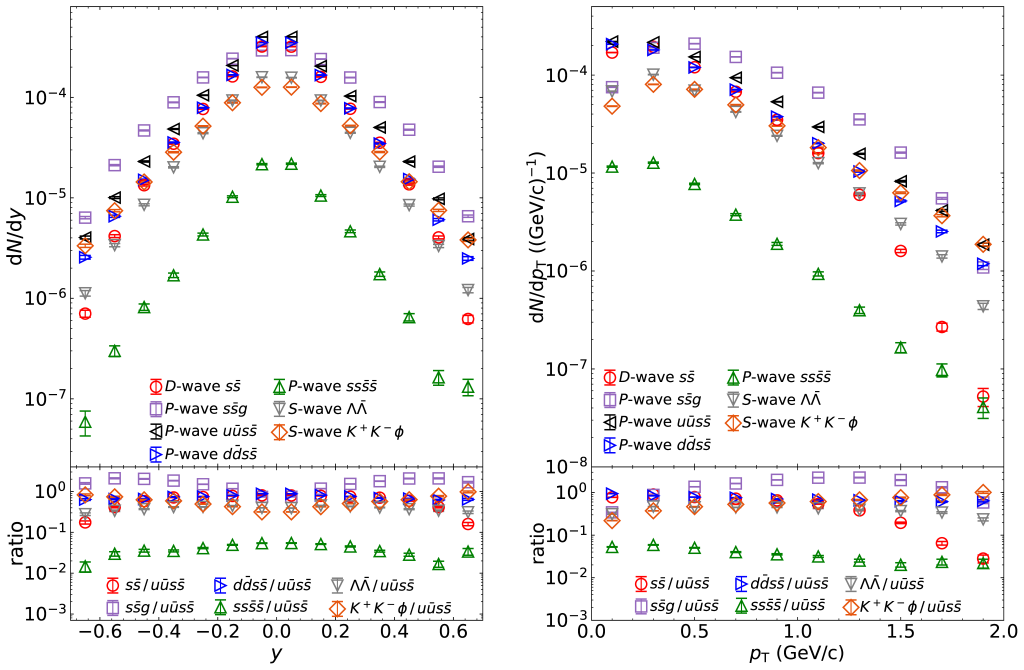
Given J^{PC}=1^{--}, φ(2170) can be interpreted as a D-wave s s-bar, a P-wave s s-bar g, a P-wave u u-bar s s-bar / d d-bar s s-bar / ss s-bar s-bar, an S-wave Lambda-bar Lambda, or an S-wave phi K+ K- state. The yields of the D-wave s s-bar, P-wave s s-bar g, u u-bar s s-bar and d d-bar s s-bar states are of order 10^{-4}; those for the S-wave Lambda-bar Lambda and phi K+ K- states are of order 10^{-5}; while the P-wave ss s-bar s-bar yield is of order 10^{-6}. Moreover, significant discrepancies are observed in the rapidity distributions and the pT spectra among the various candidates. These discrepancies could serve as valuable criteria for unraveling the nature of φ(2170).
What carries the argument
PACIAE 4.0 model generating final partonic state and final hadronic state, with dynamically constrained phase-space coalescence for parton-based candidates and recombination for hadron-based candidates, followed by calculation of orbital angular momentum in the rest frame for spectral classification.
If this is right
- The yield of φ(2170) should be approximately 10^{-4} if it is a D-wave strangeonium or a P-wave tetraquark with two non-strange quarks.
- If φ(2170) is a P-wave tetraquark with four strange quarks, its yield would be about 10^{-6}, an order of magnitude smaller.
- Rapidity distributions of the different candidate states show significant differences that experiments could measure.
- The transverse momentum spectra also differ substantially between interpretations, providing another experimental handle.
- Data at sqrt(s)=4.95 GeV could therefore rule out some interpretations based on measured yields and shapes.
Where Pith is reading between the lines
- Similar simulations could be performed for other vector mesons or exotic states to predict distinguishing features.
- The inclusion of the d d-bar s s-bar configuration is motivated by U(1) anomaly effects, which might have broader implications for production of other mixed-flavor states.
- If one candidate matches data, it would suggest that the formation mechanism in the model is realistic for that structure.
- Extending the model to higher energies or different collision systems could test the robustness of these distinctions.
Load-bearing premise
The dynamically constrained phase-space coalescence and hadron recombination correctly form states with the assigned orbital angular momentum L that satisfy J^{PC}=1^{--} for each candidate.
What would settle it
An experimental measurement of the φ(2170) yield at sqrt(s)=4.95 GeV that falls outside the range of 10^{-6} to 10^{-4}, or rapidity and pT distributions that do not match any of the predicted shapes for the candidates.
Figures
read the original abstract
The nature of $\phi(2170)$ remains open. We simulate its production in $e^+e^-$ collisions at $\sqrt{s}=4.95$ GeV using PACIAE 4.0, which sequentially generates the final partonic state (FPS) and the final hadronic state (FHS). While previous studies have interpreted $\phi(2170)$ as an $ss\bar{s}\bar{s}$ or a $u\bar{u}s\bar{s}$ state, the $U(1)$ anomaly coupling allows non-strange quarks to couple to a vector $s\bar{s}$ component via soft-gluon interactions. This motivates us to also explore the $d\bar{d}s\bar{s}$ tetraquark configuration. In addition, we consider $\phi(2170)$ as an excited strangeonium state, an $s\bar{s}g$ hybrid state, a $\bar{\Lambda}\Lambda$ bound state, and a $\phi K^+K^-$ resonance state. The strangeonium, hybrid, and tetraquark candidates are formed by coalescing their constituent partons in the FPS using the dynamically constrained phase-space coalescence model. The $\bar{\Lambda}\Lambda$ and $\phi K^+K^-$ states are produced via recombination of their constituent hadrons in the FHS. We calculate the orbital angular momentum quantum number of each candidate in its rest frame and perform spectral classification. Given $J^{PC}=1^{--}$, $\phi(2170)$ can be interpreted as a $D$-wave $s\bar{s}$, a $P$-wave $s\bar{s}g$, a $P$-wave $u\bar{u}s\bar{s}/d\bar{d}s\bar{s}/ss\bar{s}\bar{s}$, an $S$-wave $\bar{\Lambda}\Lambda$, or an $S$-wave $\phi K^+K^-$ state. The yields of the $D$-wave $s\bar{s}$, $P$-wave $s\bar{s}g$, $u\bar{u}s\bar{s}$ and $d\bar{d}s\bar{s}$ states are of order $10^{-4}$; those for the $S$-wave $\bar{\Lambda}\Lambda$ and $\phi K^+K^-$ states are of order $10^{-5}$; while the $P$-wave $ss\bar{s}\bar{s}$ yield is of order $10^{-6}$. Moreover, significant discrepancies are observed in the rapidity distributions and the $p_T$ spectra among the various candidates. These discrepancies could serve as valuable criteria for unraveling the nature of $\phi(2170)$.
Editorial analysis
A structured set of objections, weighed in public.
Referee Report
Summary. The manuscript simulates φ(2170) production in e⁺e⁻ collisions at √s=4.95 GeV with PACIAE 4.0, generating final partonic (FPS) and hadronic (FHS) states. It forms candidate states for multiple interpretations (D-wave s s-bar, P-wave s s-bar g hybrid, P-wave u u-bar s s-bar / d d-bar s s-bar / s s s-bar s-bar tetraquarks, S-wave Λ-bar Λ, S-wave φ K⁺ K⁻) via dynamically constrained phase-space coalescence in FPS or hadron recombination in FHS. Orbital angular momentum L is computed in the rest frame for spectral classification to match J^{PC}=1^{--}. Yields are reported as O(10^{-4}) for D-wave s s-bar, P-wave hybrid, and u/d tetraquarks; O(10^{-5}) for Λ-bar Λ and φ K⁺ K⁻; O(10^{-6}) for s s s-bar s-bar. Differences in rapidity distributions and p_T spectra are proposed as experimental discriminants.
Significance. If the coalescence and recombination procedures reliably produce states with the assigned L values consistent with J^{PC}=1^{--}, the order-of-magnitude yield differences and the reported discrepancies in rapidity and p_T spectra would offer a concrete phenomenological handle for distinguishing among the listed interpretations of φ(2170). The systematic exploration of strangeonium, hybrid, tetraquark (including the d d-bar s s-bar case motivated by U(1) anomaly), and molecular configurations is a strength of the approach.
major comments (2)
- [Section on spectral classification and formation in FPS/FHS] Section on spectral classification and formation in FPS/FHS: The assignment of D-wave, P-wave, or S-wave character (and thus the J^{PC}=1^{--} classification) relies on post-formation calculation of orbital angular momentum L from constituent momenta. The dynamically constrained phase-space coalescence model applies position-momentum cuts but contains no explicit projection onto partial-wave content; no validation is provided that the formed clusters possess the intended L wave-function structure.
- [Abstract and results sections] Abstract and results sections: The quoted yields (O(10^{-4})–O(10^{-6})) and the claimed significant discrepancies in rapidity and p_T spectra are presented without statistical or systematic uncertainties, without variation of PACIAE parameters, and without variation of the coalescence phase-space cuts. Because these quantities are direct simulation outputs, the absence of such variations prevents assessment of whether the reported differences are robust enough to serve as distinguishing criteria.
minor comments (1)
- The motivation for including the d d-bar s s-bar tetraquark via U(1) anomaly coupling would be strengthened by citing the relevant literature on soft-gluon interactions.
Simulated Author's Rebuttal
We thank the referee for the positive assessment of our work's significance and for the constructive major comments. We address each point below, indicating planned revisions where appropriate.
read point-by-point responses
-
Referee: Section on spectral classification and formation in FPS/FHS: The assignment of D-wave, P-wave, or S-wave character (and thus the J^{PC}=1^{--} classification) relies on post-formation calculation of orbital angular momentum L from constituent momenta. The dynamically constrained phase-space coalescence model applies position-momentum cuts but contains no explicit projection onto partial-wave content; no validation is provided that the formed clusters possess the intended L wave-function structure.
Authors: We acknowledge that the dynamically constrained phase-space coalescence applies position-momentum cuts without an explicit partial-wave projection operator. The orbital angular momentum L is computed post-formation in the candidate rest frame solely for spectral classification to identify states consistent with J^{PC}=1^{--}. This is the standard procedure in such cascade models, but we agree it constitutes an approximation rather than a full wave-function validation. In the revised manuscript we will add an explicit discussion of this limitation, clarifying that the L assignment provides a necessary consistency check but does not constitute a complete projection onto the desired partial wave. revision: partial
-
Referee: Abstract and results sections: The quoted yields (O(10^{-4})–O(10^{-6})) and the claimed significant discrepancies in rapidity and p_T spectra are presented without statistical or systematic uncertainties, without variation of PACIAE parameters, and without variation of the coalescence phase-space cuts. Because these quantities are direct simulation outputs, the absence of such variations prevents assessment of whether the reported differences are robust enough to serve as distinguishing criteria.
Authors: We agree that the absence of uncertainties and parameter variations limits the ability to judge robustness. The reported yields are direct Monte Carlo outputs from a baseline run with fixed PACIAE and coalescence parameters. In the revised manuscript we will (i) quote statistical uncertainties derived from the simulated event sample and (ii) present results from limited variations of the key coalescence phase-space cuts to demonstrate that the order-of-magnitude yield differences and the qualitative features of the rapidity and p_T spectra remain stable. Full systematic scans of all PACIAE parameters lie beyond the scope of the present exploratory study but can be noted as future work. revision: yes
Circularity Check
Simulation yields and spectra are direct model outputs, not fitted or self-defined
full rationale
The paper runs PACIAE 4.0 to generate FPS and FHS, forms candidate clusters via the dynamically constrained phase-space coalescence model (or hadron recombination), then computes L from rest-frame momenta and classifies states by the resulting L to match J^{PC}=1^{--}. Yields (10^{-4} to 10^{-6}) and rapidity/p_T discrepancies are computed outputs for each candidate; no parameters are adjusted to φ(2170) data, and no equation reduces a claimed prediction to an input fit or self-citation by construction. Model citations are standard prior work and do not carry the distinction claim. This is self-contained against external benchmarks.
Axiom & Free-Parameter Ledger
free parameters (2)
- PACIAE model parameters
- coalescence phase-space cuts
axioms (2)
- domain assumption PACIAE 4.0 accurately generates the final partonic and hadronic states in e+e- collisions at 4.95 GeV
- domain assumption The coalescence model assigns correct orbital angular momentum L to each formed candidate in its rest frame
Reference graph
Works this paper leans on
-
[1]
The con- stituent mesons of each accepted candidate are subse- quently removed from the list
is accepted as a φ(2170) candidate. The con- stituent mesons of each accepted candidate are subse- quently removed from the list. The triple-loop process is repeated on the updated list until no mesons remain or no further valid candidates can be formed. The production of φ(2170) candidates with other configurations is per- formed in a similar manner, usin...
-
[2]
Different theoretical interpretations of φ(2170) lead to distinct P and C formulas
leads to: L = round ( − 1 + √ 1 + 4|l∗|2/ ℏ2 2 ) , (7) where round(X) returns the integer nearest to X. Different theoretical interpretations of φ(2170) lead to distinct P and C formulas. If φ(2170) is interpreted as an excited s¯s state, the parity is P = Ps ·P¯s ·(− 1)L = (− 1)L+1, where L is the total orbital angular momen- tum of the system. For the te...
- [3]
-
[4]
21 × 10− 6, and 3 . 91 × 10− 8, respectively. In contrast, theS-wave ¯ΛΛ and φK +K − states show an opposite ten- dency with respect to the lower bound of R0. When the lower limit is decreased from 1.0 fm to 0.7 fm, their yields increase from 6. 58 × 10− 5 and 6. 43 × 10− 5 to 1. 30 × 10− 4 and 1. 46 × 10− 4, respectively. Moreover, further increas- ing t...
-
[5]
64 times the total width of φ(2170). Furthermore, we examined the sensitivity of the results to the method used for extracting the orbital angular momentum quantum number L in Eq. ( 7). An alternative procedure based 6 on “trunc(X)”, which discards the fractional part of X, was compared with the default “round( X)” method. Re- placing “round” with “trunc”...
work page 2019
-
[6]
C. Amsler and N. A. T¨ ornqvist, Mesons beyond the naive quark model, Phys. Rep. 389, 61 (2004)
work page 2004
-
[7]
E. Klempt and A. Zaitsev, Glueballs, hybrids, multi- quarks: Experimental facts versus QCD inspired con- cepts, Phys. Rep. 454, 1 (2007)
work page 2007
-
[8]
V. Crede and C. Meyer, The experimental status of glue- balls, Prog. Part. Nucl. Phys. 63, 74 (2009)
work page 2009
-
[9]
Brambilla, et al., QCD and strongly coupled gauge theories: challenges and perspectives, Eur
N. Brambilla, et al., QCD and strongly coupled gauge theories: challenges and perspectives, Eur. Phys. J C 74, 2981 (2014)
work page 2014
-
[10]
Gell-Mann, A schematic model of baryons and mesons, Phys
M. Gell-Mann, A schematic model of baryons and mesons, Phys. Lett. 8, 214 (1964)
work page 1964
-
[11]
Zweig, An SU(3) model for strong interaction symme- try and its breaking, CERN Report No
G. Zweig, An SU(3) model for strong interaction symme- try and its breaking, CERN Report No. CERN-TH-401. 7
-
[12]
S.-K. Choi et al. (Belle Collaboration), Observation of a narrow charmoniumlike state in exclusive B± → K ± π +π − J/ψ , Phys. Rev. Lett. 91, 262001 (2003)
work page 2003
-
[13]
H.-X. Chen, W. Chen, X. Liu, and S.-L. Zhu, The hid- dencharm pentaquark and tetraquark states, Phys. Rept. 639, 1 (2016)
work page 2016
-
[14]
A. Esposito, A. Pilloni, and A. D. Polosa, Multiquark resonances, Phys. Rept. 668, 1 (2017)
work page 2017
-
[15]
A. Ali, J. S. Lange, and S. Stone, Exotics: heavy pen- taquarks and tetraquarks, Prog. Part. Nucl. Phys. 97, 123 (2017)
work page 2017
-
[16]
R. F. Lebed, E. S. Mitchell, and E. S. Swanson, Heavy- quark QCD exotica, Prog. Part. Nucl. Phys. 93, 143 (2017)
work page 2017
-
[17]
F.-K. Guo, C. Hanhart, U.-G. Meißner, Q. Wang, Q. Zhao, and B.-S. Zou, Hadronic molecules, Rev. Mod. Phys. 90, 015004 (2018)
work page 2018
-
[18]
S. L. Olsen, T. Skwarnicki, and D. Zieminska, Nonstan- dard heavy mesons and baryons: Experimental evidence, Rev. Mod. Phys. 90, 015003 (2018)
work page 2018
-
[19]
N. Brambilla et al. The XYZ states: experimental and theoretical status and perspectives, Phys. Rept. 873, 1 (2020)
work page 2020
-
[20]
R. Aaij et al. (LHCb Collaboration), A model- independent study of resonant structure in B+ → D+D− K + decays, Phys. Rev. Lett. 125, 242001 (2020)
work page 2020
-
[21]
R. Aaij et al. (LHCb Collaboration), Observation of an exotic narrow doubly charmed tetraquark, Nature Physics 18, 751–754 (2022)
work page 2022
- [22]
-
[23]
R. Aaij et al. (LHCb Collaboration), Observation of structure in the J/ψ -pair mass spectrum, Sci. Bull. 65, 1983 (2020)
work page 1983
-
[24]
A. Hayrapetyan et al. (CMS Collaboration), New struc- tures in the J/ψJ/ψ mass spectrum in proton-proton col- lisions at √ s = 13 TeV, Phys. Rev. Lett. 132, 111901 (2024)
work page 2024
- [25]
-
[26]
S. S. Agaev, K. Azizi, B. Barsbay, and H. Sundu, Fully charmed resonance X(6900) and its beauty counterpart, Nucl. Phys. A 1041, 122768 (2024)
work page 2024
-
[27]
J. Z. Wang, D. Y. Chen, X. Liu, and T. Matsuki, Pro- ducing fully charm structures in the J/ψ -pair invariant mass spectrum, Phys. Rev. D 103, 071503 (2021)
work page 2021
-
[28]
M. A. Bedolla, J. Ferretti, C. D. Roberts, and E. San- topinto, Spectrum of fully-heavy tetraquarks from a di- quark+antidiquark perspective, Eur. Phys. J. C 80, 1004 (2020)
work page 2020
- [29]
-
[30]
J. F. Giron and R. F. Lebed, Simple spectrum of c¯cc¯c states in the dynamical diquark model, Phys. Rev. D 102, 074003 (2020)
work page 2020
-
[31]
M. Ablikim et al. (BESIII Collaboration), Observation of an axial-vector state in the study of the decay ψ (3686) → φηη ′, Phys. Rev. Lett. 134, 191901 (2025)
work page 2025
-
[32]
M. Ablikim et al. (BESIII Collaboration), Observation of a structure in e+e− → φη ′ at √ s from 2.05 to 3.08 GeV, Phys. Rev. D 102, 012008 (2020)
work page 2020
-
[33]
B. Aubert et al. (BaBar Collaboration), Structure at 2175 MeV in e+e− → φf 0(980) observed via initial-state radiation, Phys. Rev. D 74, 091103(R) (2006)
work page 2006
-
[34]
C. P. Shen et al. (Belle Collaboration), Observation of the φ (1680) and the Y (2175) in e+e− → φπ +π − , Phys. Rev. D 80, 031101(R) (2009)
work page 2009
-
[35]
M. Ablikim et al. (BES Collaboration), Observation of Y (2175) in J/ψ → ηφf 0(980), Phys. Rev. Lett. 100, 102003 (2008)
work page 2008
-
[36]
M. Ablikim et al. (BESIII Collaboration), Study of J/ψ → ηφπ +π − at BESIII, Phys. Rev. D 91, 052017 (2015)
work page 2015
-
[37]
M. Ablikim et al. (BESIII Collaboration), Observation of e+e− → ηY (2175) at center-of-mass energies above 3.7 GeV, Phys. Rev. D 99, 012014 (2019)
work page 2019
-
[38]
M. Ablikim et al. (BESIII Collaboration), Study of the process e+e− → φη at center-of-mass energies between 2.00 and 3.08 GeV, Phys. Rev. D 104, 032007 (2021)
work page 2021
-
[39]
M. Ablikim et al. (BESIII Collaboration), Measurement of e+e− → φπ +π − cross sections at center-of-mass ener- gies from 2.00 to 3.08 GeV, Phys. Rev. D 108, 032011 (2023)
work page 2023
-
[40]
B. Aubert et al. (BaBar Collaboration), The e+e− → K +K − π +π − ,K +K − π 0π 0, and K +K − K +K − cross sec- tions measured with initial-state radiation, Phys. Rev. D 76, 012008 (2007)
work page 2007
-
[41]
J. P. Lees et al. (BaBar Collaboration), Cross Sections for the Reactions e+e− → K +K − π +π − , K +K − π 0π 0, andK +K − K +K − measured using initial-state radiation events, Phys. Rev. D 86, 012008 (2012)
work page 2012
-
[42]
Pang, Excited states of φ meson, Phys
C.-Q. Pang, Excited states of φ meson, Phys. Rev. D 99, 074015 (2019)
work page 2019
- [43]
-
[44]
S. S. Afonin and I. V. Pusenkov, Universal description of radially excited heavy and light vector mesons, Phys. Rev. D 90, 094020 (2014)
work page 2014
- [45]
-
[46]
X. Wang, Z.-F. Sun, D.-Y. Chen, X. Liu, and T. Matsuki, Nonstrange partner of strangeonium-like state Y (2175), Phys. Rev. D 85, 074024 (2012)
work page 2012
-
[47]
G.-J. Ding and M.-L. Yan, A candidate for 1 − strangeo- nium hybrid, Phys. Lett. B 650, 390 (2007)
work page 2007
-
[48]
P. R. Page, E. S. Swanson, and A. P. Szczepaniak, Hybrid meson decay phenomenology, Phys. Rev. D 59, 034016 (1999)
work page 1999
- [49]
-
[50]
Wang, Analysis of the Y (2175) as a tetraquark state with QCD sum rules, Nucl
Z.-G. Wang, Analysis of the Y (2175) as a tetraquark state with QCD sum rules, Nucl. Phys. A 791 106 (2007)
work page 2007
-
[51]
H.-X. Chen, X. Liu, A. Hosaka, and S.-L. Zhu, The Y (2175) state in the QCD sum rule, Phys. Rev. D 78, 034012 (2008)
work page 2008
-
[52]
N.V. Drenska, R. Faccini, and A.D. Polosa, Higher tetraquark particles, Phys. Lett. B 669, 160 (2008)
work page 2008
-
[53]
H.-W. Ke and X.-Q. Li, Study of the strong decays of φ (2170) and the future charm-tau factory, Phys. Rev. D 99, 036014 (2019). 8
work page 2019
- [54]
-
[55]
S. S. Agaev, K. Azizi, H. Sundu, Nature of the vector resonance Y (2175), Phys. Rev. D 101, 074012 (2020)
work page 2020
-
[56]
L. Zhao, N. Li, S.-L. Zhu, and B.-S. Zou, Meson-exchange model for the Λ ¯Λ interaction, Phys. Rev. D 87, 054034 (2013)
work page 2013
-
[57]
C. Deng, J. Ping, Y. Yang, and F. Wang, Baryonia and near-threshold enhancements, Phys. Rev. D 88, 074007 (2013)
work page 2013
-
[58]
Y. Dong, A. Faessler, T. Gutsche, Q. L¨ u, and V. E. Lyubovitskij, Selected strong decays of η(2225) and φ (2170) as Λ ¯Λ bound states, Phys. Rev. D 96, 074027 (2017)
work page 2017
-
[59]
A. Martinez Torres, K. P. Khemchandani, L. S. Geng, M. Napsuciale, and E. Oset, X(2175) as a resonant state of the φK ¯K system, Phys. Rev. D 78, 074031 (2008)
work page 2008
-
[60]
S. Gomez-Avila, M. Napsuciale and E. Oset, φK +K − production in electron-positron annihilation, Phys. Rev. D 79, 034018 (2009)
work page 2009
- [61]
-
[62]
Y.-L. Yan, G. Chen, X.-M. Li, D.-M. Zhou, M.-J. Wang, S.-Y. Hu, L. Ye, and B.-H. Sa, Predictions for the pro- duction of light nuclei in pp collisions at √ s = 7 and 14 TeV, Phys. Rev. C 85, 024907 (2012)
work page 2012
-
[63]
B. R. Martin and G. Shaw, Particle Physics (Third edi- tion), (John Wiley and Sons Ltd, West Sussex, 2008)
work page 2008
- [64]
-
[65]
T. Sj¨ ostrand, S. Mrenna, and P. Z. Skands, PYTHIA 6.4 physics and manual, J. High Energy Phys. 05, 026 (2006)
work page 2006
-
[66]
B. L. Combridge, J. Kripfganz, and J. Ranft, Hadron pro- duction at large transverse momentum and QCD, Phys. Lett. B 70, 234 (1977)
work page 1977
-
[67]
R. D. Field, Applications of perturbative QCD (Addison - Wesley Publishing Company, Reading, MA, 1989)
work page 1989
-
[68]
A. Baldini, et al., Total cross section for reactions of high energy particles, (Spring-veslay, Berlin, 1988)
work page 1988
- [69]
- [70]
- [71]
-
[72]
Z.-L. She, A.-K. Lei, Y.-L. Yan, D.-M. Zhou, W.-C. Zhang, H. Zheng, L. Zheng, Y.-L. Xie, G. Chen, and B.-H. Sa, Identifying an X(3872) tetraquark state versus a molecular state by formation time, velocity, and tem- perature in relativistic nuclear collisions, Phys. Rev. C 110, 014910 (2024)
work page 2024
- [73]
- [74]
-
[75]
C.-H. Chen, Y.-L. Xie, H.-G. Xu, Z. Zhang, D.-M. Zhou, Z.-L. She, and G. Chen, Exotic states Pc(4312),Pc(4440), and Pc(4457) in pp collisions at √ s = 7, 13 TeV, Phys. Rev. D 105, 054013 (2022)
work page 2022
-
[76]
H.-G. Xu, G. Chen, Y.-L. Yan, D.-M. Zhou, L. Zheng, Y.-L. Xie, Z.-L. She, and B.-H. Sa, Study on the Ω 0 c states decaying to Ξ + cK − in pp collisions at √ s = 7, 13 TeV, Phys. Rev. C 102, 054319 (2020)
work page 2020
-
[77]
Q. Wang, Z.-L. She, A.-K. Lei, D.-M. Zhou, W.-C. Zhang, H. Zheng, Y.-L. Yan, B.-H. Sa, Investigation of T ∗ cs0(2870)0 in pp collisions at √ s = 7 TeV with the PA- CIAE model, Phys. Lett. B 872, 140068 (2026)
work page 2026
-
[78]
J. Cao, Z.-L. She, J.-P. Zhang, J.-H. Shi, Z.-Y. Qin, W.- C. Zhang, H. Zheng, A.-K. Lei, D.-M. Zhou, Y.-L. Yan, and B.-H. Sa, X(2370) glueball-like particle productions in e+e− collisions at the BESIII energy and in pp colli- sions at the LHC energy with the PACIAE model, Phys. Rev. D 110, 054046 (2024)
work page 2024
-
[79]
Kubo, Statistical mechanics (North-Holland Publis h- ing Company, Amsterdam, 1965)
R. Kubo, Statistical mechanics (North-Holland Publis h- ing Company, Amsterdam, 1965)
work page 1965
-
[80]
K. Stowe, An introduction to thermodynamics and statis - tical mechanics (Cambridge University, Cambridge, Eng- land, 2007)
work page 2007
discussion (0)
Sign in with ORCID, Apple, or X to comment. Anyone can read and Pith papers without signing in.