Efficient Compression of Structured and Unstructured Volumes via Learned 3D Gaussian Representation
Pith reviewed 2026-07-02 15:21 UTC · model grok-4.3
The pith
Collections of 3D Gaussians compress both structured and unstructured volume data by directly encoding scalar fields and domain geometry without separate mesh storage.
A machine-rendered reading of the paper's core claim, the machinery that carries it, and where it could break.
Core claim
An explicit model based on 3D Gaussian primitives can serve as a complete representation for volume scalar fields. The primitives are trained so that scalar values are reconstructed through weighted aggregation of intersecting Gaussians, and the same primitives automatically encode domain geometry. This formulation eliminates the partial-mesh requirement that limits compression of unstructured volumes under implicit neural representations, while optimized CUDA sampling pipelines and sampling-error densification produce competitive quality with faster training on structured volumes and superior results on unstructured volumes.
What carries the argument
3D Gaussian primitives reinterpreted as an explicit scalar-field representation, reconstructed via weighted aggregation of intersecting primitives at query locations.
If this is right
- Unstructured volumes can be stored and queried without any separate mesh data structure.
- Training completes faster than implicit neural representations on structured volumes while matching reconstruction quality.
- All standard quality metrics improve on unstructured volumes relative to implicit baselines.
- Higher overall compression ratios become possible because geometry is carried inside the same primitives that store the field.
- CUDA-accelerated sampling pipelines allow direct querying of the compressed representation.
Where Pith is reading between the lines
- The same explicit primitives could support real-time volume rendering or direct isosurface extraction without an intermediate decompression step.
- Extending the densification criterion to time-varying data might allow compression of dynamic volumes with the same mesh-free property.
- Because geometry and field live in one data structure, the approach could simplify pipelines that combine compression with spatial queries or level-of-detail selection.
Load-bearing premise
Collections of 3D Gaussians trained via weighted aggregation can accurately encode both the scalar field values and the domain geometry for unstructured volumes without requiring any additional mesh storage or post-processing.
What would settle it
A head-to-head storage and quality comparison on multiple unstructured volumes in which the Gaussian model requires more total memory than an implicit network plus its partial mesh while also showing lower PSNR or higher error.
Figures


read the original abstract
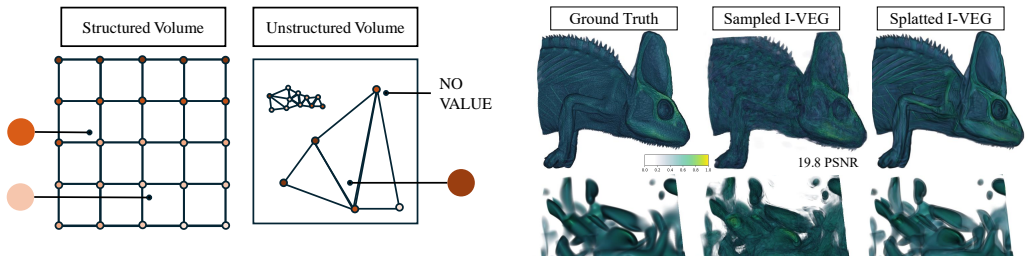
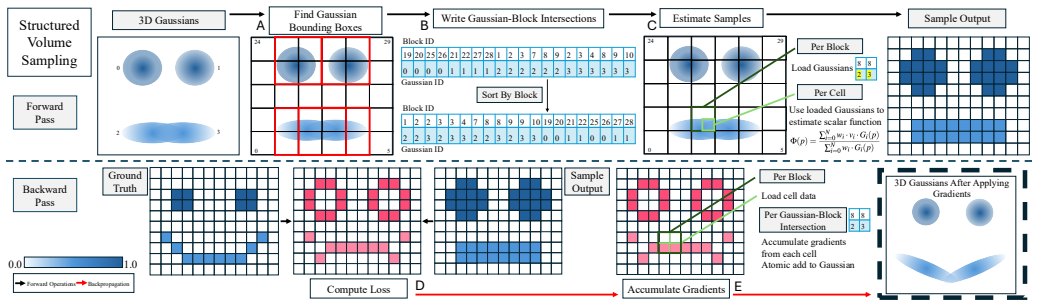
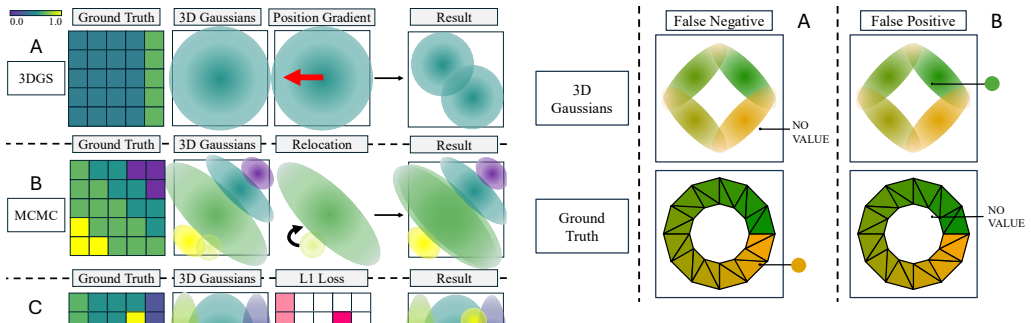
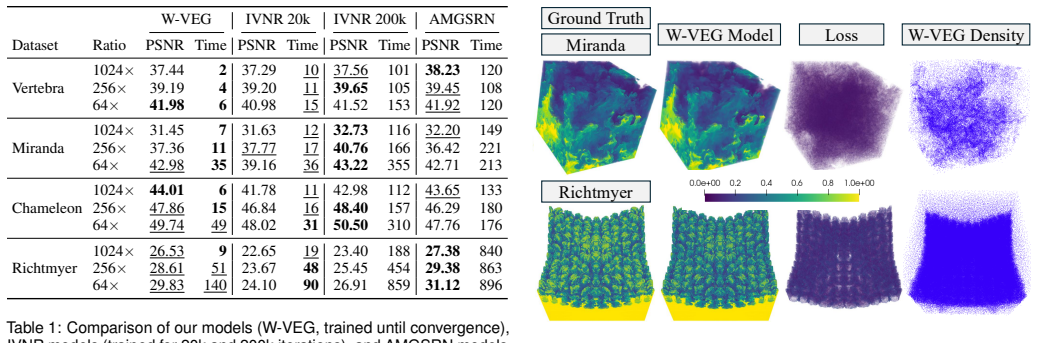
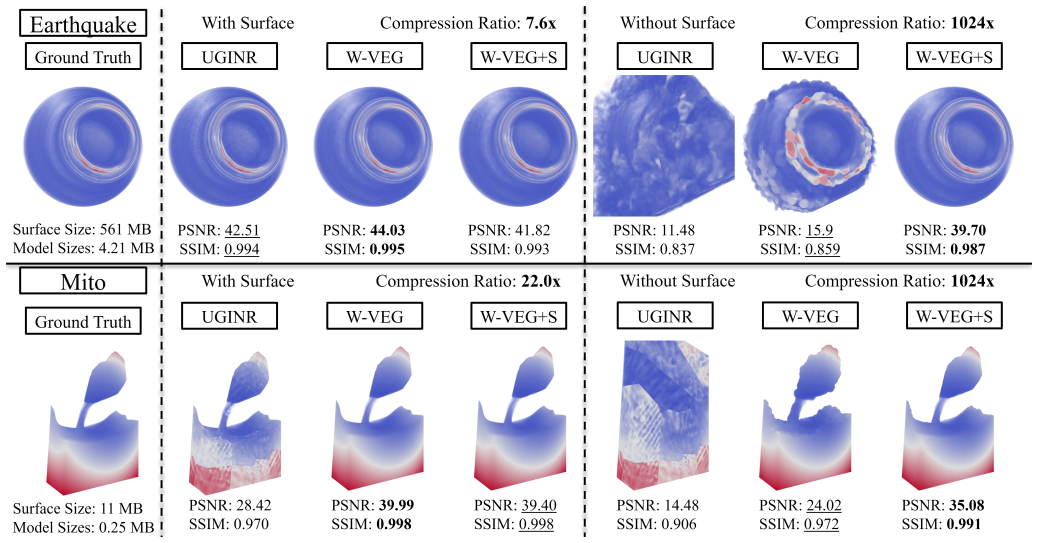
Recent work has shown that implicit neural representations (INRs) can be trained to effectively compress structured and unstructured volume data, allowing for direct data querying with a reduced memory footprint. However, as existing INRs for unstructured volumes do not encode geometry, they require partial mesh storage for later sampling, limiting achievable compression. At the same time, novel view synthesis methods have shown that explicit collections of 3D Gaussians can be used to accurately visualize volume data. In this work, we introduce an explicit model for volume data compression based on 3D Gaussian primitives. We reinterpret collections of 3D Gaussians as an explicit representation of a scalar field and use a sampling strategy that reconstructs scalar values at spatial locations through weighted aggregation of intersecting Gaussians. We develop optimized CUDA-accelerated pipelines for structured and unstructured model sampling, loss functions that encourage accurate domain encoding by our models, and a novel sampling-error based densification strategy. Our explicit formulation naturally encodes domain geometry, eliminating the need for mesh storage in unstructured volumes and introducing significantly higher compression opportunities. Compared to existing INRs, we demonstrate that our explicit model achieves competitive reconstruction quality with significant training speedups on structured volumes, while markedly outperforming in all metrics on unstructured volumes.
Editorial analysis
A structured set of objections, weighed in public.
Referee Report
Summary. The paper proposes an explicit representation for compressing structured and unstructured volume data using collections of 3D Gaussian primitives. Scalar values are reconstructed via weighted aggregation of intersecting Gaussians, supported by CUDA-accelerated sampling pipelines, loss functions that encourage domain encoding, and a sampling-error-based densification strategy. The central claims are that this approach achieves competitive reconstruction quality with faster training on structured volumes and markedly superior performance on unstructured volumes, while naturally encoding domain geometry to eliminate the need for separate mesh storage.
Significance. If the performance claims and geometry-encoding property hold under rigorous verification, the method could advance volume compression by offering an explicit, mesh-free alternative to implicit neural representations, with potential gains in training speed and compression ratios for unstructured data.
major comments (2)
- Abstract: the claim that the model 'naturally encodes domain geometry, eliminating the need for mesh storage' is load-bearing for the unstructured-volume advantage, yet the provided text gives no concrete description of how weighted aggregation assigns background values to points outside the true domain support or how this is validated on irregular geometries; without this, the reported metric gains versus mesh-dependent INRs cannot be directly compared.
- Abstract: the assertion of 'competitive reconstruction quality with significant training speedups' and 'markedly outperforming in all metrics' on unstructured volumes is presented without any experimental setup details, baseline definitions, error bars, or data-exclusion rules, rendering the central performance claims unverifiable from the manuscript text.
Simulated Author's Rebuttal
We thank the referee for the constructive feedback. We address the two major comments point-by-point below. Where the abstract lacks sufficient detail for verifiability, we will revise it and cross-reference the methods and experiments sections.
read point-by-point responses
-
Referee: Abstract: the claim that the model 'naturally encodes domain geometry, eliminating the need for mesh storage' is load-bearing for the unstructured-volume advantage, yet the provided text gives no concrete description of how weighted aggregation assigns background values to points outside the true domain support or how this is validated on irregular geometries; without this, the reported metric gains versus mesh-dependent INRs cannot be directly compared.
Authors: We agree the abstract is too terse on this mechanism. Section 3.2 details the weighted aggregation and the domain-encoding loss terms that drive background values outside the support; Section 4.3 validates this on irregular unstructured geometries by comparing against mesh-dependent baselines. We will expand the abstract with one sentence summarizing the background assignment process and ensure the irregular-geometry validation is explicitly called out, enabling direct metric comparison. revision: yes
-
Referee: Abstract: the assertion of 'competitive reconstruction quality with significant training speedups' and 'markedly outperforming in all metrics' on unstructured volumes is presented without any experimental setup details, baseline definitions, error bars, or data-exclusion rules, rendering the central performance claims unverifiable from the manuscript text.
Authors: The abstract is a high-level summary; full experimental protocols (including INR baselines, multiple-run error bars, and data-exclusion criteria) appear in Section 4 and the supplement. We will revise the abstract to include a brief parenthetical reference to these sections and, if space permits, note that all metrics include standard deviations, thereby improving verifiability without altering the summary nature of the abstract. revision: partial
Circularity Check
No circularity: formulation introduces independent sampling, loss, and densification mechanisms
full rationale
The paper presents an explicit 3D Gaussian model for volume compression that reinterprets Gaussians as a scalar field via weighted aggregation sampling, augmented by custom CUDA pipelines, domain-encoding loss terms, and sampling-error densification. No equations or performance claims in the provided text reduce reported metrics to quantities defined by the same fitted parameters or prior self-citations; the geometry-encoding claim is tied to the newly proposed losses rather than being presupposed by construction. The derivation chain remains self-contained against external benchmarks.
Axiom & Free-Parameter Ledger
free parameters (1)
- Gaussian count and initialization density
axioms (1)
- domain assumption Weighted aggregation of intersecting 3D Gaussians reconstructs accurate scalar values at query points
Reference graph
Works this paper leans on
-
[1]
https://github.com/NVIDIA/cuBQL
cuBQL: A CUDA BVH Build and Query Library. https://github.com/NVIDIA/cuBQL. 6
-
[2]
K. Ai, K. Tang, and C. Wang. NLI4V olVis: Natural language interaction for vol- ume visualization via llm multi-agents and editable 3d gaussian splatting.IEEE Transactions on Visualization and Computer Graphics (IEEE VIS 2025), 32(1), 2026. Preprint available athttps://arxiv.org/abs/2507.12621. 2
-
[3]
W. K. Anderson, R. T. Biedron, J.-R. Carlson, J. M. Derlaga, B. Diskin, C. T. Druyor Jr, P. A. Gnoffo, D. P. Hammond, K. E. Jacobson, W. T. Jones, et al. Fun3d manual: 14.1. 2024. 1
2024
-
[4]
Arndt, W
D. Arndt, W. Bangerth, D. Davydov, T. Heister, L. Heltai, M. Kronbichler, M. Maier, J.-P. Pelteret, B. Turcksin, and D. Wells. The deal.ii finite element library: Design, features, and insights.Computers & Mathematics with Applications, 81:407–422,
-
[5]
doi: 10.1016/j.camwa.2020.02.022 1
Development and Application of Open-source Software for Problems with Numerical PDEs. doi: 10.1016/j.camwa.2020.02.022 1
-
[6]
Ayachit.The ParaView Guide: A Parallel Visualization Application
U. Ayachit.The ParaView Guide: A Parallel Visualization Application. Kitware, Inc., Clifton Park, NY , USA, 2015. 7
2015
-
[7]
Banesh, R
D. Banesh, R. Linn, and J. Patchett. V orticity-driven lateral spread ensemble data set. Dataset documentation (PDF), Oct. 2021. Accessed 2026-03-05. 8
2021
-
[8]
M. Berger and P. Colella. Local adaptive mesh refinement for shock hydrodynamics. Journal of Computational Physics, 82(1):64–84, 1989. doi: 10.1016/0021-9991(89) 90035-1 1
-
[9]
Berger, J
M. Berger, J. Li, and J. A. Levine. A Generative Model for V olume Rendering . IEEE Transactions on Visualization & Computer Graphics, 25(04):1636–1650, Apr
-
[10]
doi: 10.1109/TVCG.2018.2816059 2
-
[11]
C. Burstedde, L. C. Wilcox, and O. Ghattas. p4est: Scalable algorithms for parallel adaptive mesh refinement on forests of octrees.SIAM J. Sci. Comput., 33(3):1103–1133, 31 pages, May 2011. doi: 10.1137/100791634 1
-
[12]
A. Dubey, K. Antypas, A. C. Calder, C. Daley, B. Fryxell, J. B. Gallagher, D. Q. Lamb, D. Lee, K. Olson, L. B. Reid, P. Rich, P. M. Ricker, K. M. Riley, R. Rosner, A. Siegel, N. T. Taylor, K. Weide, F. X. Timmes, N. Vladimirova, and J. ZuHone. Evolution of flash, a multi-physics scientific simulation code for high-performance computing.The International J...
-
[13]
Dyken, S
L. Dyken, S. Andres, W. Usher, N. Debardeleben, S. Petruzza, and S. Kumar. V olume encoding gaussians: Transfer function-agnostic 3d gaussians for volume rendering. IEEE Transactions on Visualization and Computer Graphics, 2026. To appear. 2, 3, 5
2026
-
[14]
T. D. Economon, F. Palacios, S. R. Copeland, T. W. Lukaczyk, and J. J. Alonso. Su2: An open-source suite for multiphysics simulation and design.AIAA Journal, 54(3):828–846, 2016. doi: 10.2514/1.J053813 1
-
[15]
Z. Fan, K. Wang, K. Wen, Z. Zhu, D. Xu, and Z. Wang. Lightgaussian: Unbounded 3d gaussian compression with 15x reduction and 200+ fps. In A. Globerson, L. Mackey, D. Belgrave, A. Fan, U. Paquet, J. Tomczak, and C. Zhang, eds.,Advances in Neural Information Processing Systems, vol. 37, pp. 140138–140158. Curran Associates, Inc., 2024. doi: 10.52202/079017-4447 9
-
[16]
Griffin, A
W. Griffin, A. Godil, J. Bullard, J. Terrill, A. Varshney, and S. Jain. Compressed volume rendering using deep learning. Proceedings of the Large Scale Data Analysis and Visualization (LDA V) Symposium, Phoenix, AZ, 2017-10-02 2017. 2
2017
-
[17]
Hahlbohm, L
F. Hahlbohm, L. Franke, M. Eisemann, and M. Magnor. Faster-gs: Analyzing and improving gaussian splatting optimization, 2026. 5
2026
-
[19]
M. Han, A. Sewell, J. Insley, J. Knowles, V . A. Mateevitsi, M. E. Papka, S. Petruzza, and S. Rizzi. Toward distributed 3d gaussian splatting for high-resolution isosurface visualization. In2025 IEEE International Conference on eScience (eScience), pp. 331–332, 2025. doi: 10.1109/eScience65000.2025.00056 2
-
[20]
B. Kerbl, G. Kopanas, T. Leimkuehler, and G. Drettakis. 3d gaussian splatting for real-time radiance field rendering.ACM Trans. Graph., 42(4), article no. 139, 14 pages, July 2023. doi: 10.1145/3592433 2, 3, 4, 5
-
[21]
S. Kheradmand, D. Rebain, G. Sharma, W. Sun, Y .-C. Tseng, H. Isack, A. Kar, A. Tagliasacchi, and K. M. Yi. 3d gaussian splatting as markov chain monte carlo. In A. Globerson, L. Mackey, D. Belgrave, A. Fan, U. Paquet, J. Tomczak, and C. Zhang, eds.,Advances in Neural Information Processing Systems, vol. 37, pp. 80965–80986. Curran Associates, Inc., 2024....
-
[22]
D. P. Kingma and J. Ba. Adam: A method for stochastic optimization, 2017. 7
2017
-
[23]
C. C. Kiris, J. A. Housman, M. F. Barad, C. Brehm, E. Sozer, and S. Moini-Yekta. Computational framework for launch, ascent, and vehicle aerodynamics (lava). Aerospace Science and Technology, 55:189–219, 2016. doi: 10.1016/j.ast.2016. 05.008 1
-
[24]
Klacansky
P. Klacansky. Open scivis datasets, December 2017. https://klacansky.com/open-scivis-datasets/. 7
2017
- [25]
-
[26]
K. Liu, C. Jiao, X. Gao, and C. Bi. Uginr: large-scale unstructured grid reduction via implicit neural representation.J. Vis., 27(5):983–996, 14 pages, June 2024. doi: 10. 1007/s12650-024-01003-y 1, 2, 6, 8
2024
-
[27]
Y . Lu, K. Jiang, J. A. Levine, and M. Berger. Compressive neural representations of volumetric scalar fields.Computer Graphics Forum, 40(3):135–146, 2021. doi: 10. 1111/cgf.14295 1, 2
2021
-
[28]
S. S. Mallick, R. Goel, B. Kerbl, M. Steinberger, F. V . Carrasco, and F. De La Torre. Taming 3dgs: High-quality radiance fields with limited resources. InSIGGRAPH Asia 2024 Conference Papers, SA ’24, article no. 2, 11 pages. Association for Computing Machinery, New York, NY , USA, 2024. doi: 10.1145/3680528.3687694 5
-
[29]
Moenne-Loccoz, A
N. Moenne-Loccoz, A. Mirzaei, O. Perel, R. de Lutio, J. Martinez Esturo, G. State, S. Fidler, N. Sharp, and Z. Gojcic. 3d gaussian ray tracing: Fast tracing of particle scenes.ACM Trans. Graph., 43(6), article no. 232, 19 pages, Nov. 2024. doi: 10. 1145/3687934 9
2024
-
[30]
N. Morrical, A. Sahistan, U. Güdükbay, I. Wald, and V . Pascucci. Quick clusters: A gpu-parallel partitioning for efficient path tracing of unstructured volumetric grids. IEEE Transactions on Visualization and Computer Graphics, 29(1):537–547, 2023. doi: 10.1109/TVCG.2022.3209418 2, 8
-
[31]
T. Müller. tiny-cuda-nn, 4 2021. 7
2021
-
[32]
T. Müller, A. Evans, C. Schied, and A. Keller. Instant neural graphics primitives with a multiresolution hash encoding.ACM Trans. Graph., 41(4), article no. 102, 15 pages, July 2022. doi: 10.1145/3528223.3530127 2
-
[33]
S. Niedermayr, J. Stumpfegger, and R. Westermann. Compressed 3D Gaussian Splatting for Accelerated Novel View Synthesis . In2024 IEEE/CVF Conference on Computer Vision and Pattern Recognition (CVPR), pp. 10349–10358. IEEE Computer Society, Los Alamitos, CA, USA, June 2024. doi: 10.1109/CVPR52733. 2024.00985 9
-
[34]
N. Offermans, A. Peplinski, O. Marin, and P. Schlatter. Adaptive mesh refinement for steady flows in Nek5000.Computers & Fluids, 2020. doi: 10.1016/j.compfluid. 2019.104352 1
-
[35]
F. Palacios, J. Alonso, K. Duraisamy, M. Colonno, J. Hicken, A. Aranake, A. Campos, S. Copeland, T. Economon, A. Lonkar, T. Lukaczyk, and T. Taylor. Stanford Univer- sity Unstructured (SU^2): An open-source integrated computational environment for multi-physics simulation and design. In51st AIAA Aerospace Sciences Meeting including the New Horizons Forum ...
-
[36]
P. Papantonakis, G. Kopanas, B. Kerbl, A. Lanvin, and G. Drettakis. Reducing the memory footprint of 3d gaussian splatting.Proc. ACM Comput. Graph. Interact. Tech., 7(1), article no. 16, 17 pages, May 2024. doi: 10.1145/3651282 9
-
[37]
J. M. Patchett and G. R. Gisler. Deep water impact ensemble data set, 05 2017. doi: 10.25583/2588620 8
-
[38]
B. Rathke, I. Wald, K. Chiu, and C. Brownlee. SIMD Parallel Ray Tracing of Homogeneous Polyhedral Grids. InEurographics Symposium on Parallel Graphics and Visualization, 2015. doi: 10.2312/pgv.20151153 8
-
[39]
S. Rota Bulò, L. Porzi, and P. Kontschieder. Revising densification in gaussian splatting. InComputer Vision – ECCV 2024: 18th European Conference, Milan, Italy, September 29–October 4, 2024, Proceedings, Part LXIII, 16 pages, p. 347–362. Springer-Verlag, Berlin, Heidelberg, 2024. doi: 10.1007/978-3-031-73036-8_20 5
-
[40]
Sitzmann, J
V . Sitzmann, J. N. P. Martel, A. W. Bergman, D. B. Lindell, and G. Wetzstein. Implicit neural representations with periodic activation functions, 2020. 2
2020
-
[41]
H. Son, J. Noh, S. Jeon, C. Wang, and W.-K. Jeong. Mc-inr: Efficient encoding of multivariate scientific simulation data using meta-learning and clustered implicit neural representations, 2025. 1, 2, 6, 8
2025
-
[42]
SuperSplat.https://github.com/playcanvas/supersplat. 8
-
[43]
T. Takikawa, J. Litalien, K. Yin, K. Kreis, C. Loop, D. Nowrouzezahrai, A. Jacobson, M. McGuire, and S. Fidler. Neural Geometric Level of Detail: Real-time Rendering with Implicit 3D Shapes . In2021 IEEE/CVF Conference on Computer Vision and Pattern Recognition (CVPR), pp. 11353–11362. IEEE Computer Society, Los Alamitos, CA, USA, June 2021. doi: 10.1109/...
-
[44]
K. Tang, S. Yao, and C. Wang. ivr-gs: Inverse volume rendering for explorable visu- alization via editable 3d gaussian splatting.IEEE Transactions on Visualization and Computer Graphics, 31(6):3783–3795, 2025. doi: 10.1109/TVCG.2025.3567121 2
-
[45]
I. Wald, N. Morrical, and S. Zellmann. A memory efficient encoding for ray tracing large unstructured data.IEEE Transactions on Visualization and Computer Graphics, 28(1):583–592, 2022. doi: 10.1109/TVCG.2021.3114869 2
-
[46]
C. Wang and J. Han. Dl4scivis: A state-of-the-art survey on deep learning for scientific visualization.IEEE Transactions on Visualization and Computer Graphics, 29(8):3714–3733, 20 pages, Aug. 2023. doi: 10.1109/TVCG.2022.3167896 2
-
[47]
Weiss, P
S. Weiss, P. Hermüller, and R. Westermann. Fast neural representations for direct volume rendering.Computer Graphics Forum, 41(6):196–211, June 2022. doi: 10. 1111/cgf.14578 1, 2
2022
-
[48]
Q. Wu, D. Bauer, M. J. Doyle, and K.-L. Ma. Interactive V olume Visualization via Multi-Resolution Hash Encoding based Neural Representation.IEEE Transactions on Visualization and Computer Graphics, 2023. doi: 10.1109/TVCG.2023.3293121 1, 2
-
[49]
Q. Wu, D. Bauer, M. J. Doyle, and K.-L. Ma. Interactive volume visualization via multi-resolution hash encoding based neural representation.IEEE Transactions on Visualization and Computer Graphics, 30(8):5404–5418, 2024. doi: 10.1109/TVCG. 2023.3293121 2, 7
-
[50]
S. W. Wurster and H.-W. Shen. Amgsrn++: Improved adaptive srn for scientific visualization. In2025 IEEE 18th Pacific Visualization Conference (PacificVis), pp. 182–191, 2025. doi: 10.1109/PacificVis64226.2025.00024 2, 7, 8
-
[51]
S. W. Wurster, T. Xiong, H.-W. Shen, H. Guo, and T. Peterka. Adaptively placed multi-grid scene representation networks for large-scale data visualization.IEEE Transactions on Visualization and Computer Graphics, 30(1):965–974, 2024. doi: 10.1109/TVCG.2023.3327194 1, 2
-
[52]
S. Yao, Y . Lu, and C. Wang. ViSNeRF: Efficient Multidimensional Neural Ra- diance Field Representation for Visualization Synthesis of Dynamic V olumetric Scenes . In2025 IEEE 18th Pacific Visualization Conference (PacificVis), pp. 235–
- [53]
-
[54]
S. Yao and C. Wang. Revolve: Neural reconstruction of volumes for visualization enhancement of direct volume rendering.Computers & Graphics, 131:104295, 2025. doi: 10.1016/j.cag.2025.104295 2
-
[55]
H. Zhao, H. Weng, D. Lu, A. Li, J. Li, A. Panda, and S. Xie. On scaling up 3d gaussian splatting training, 2024. 2 A DATASETINFORMATION Dataset Dimensions Total Size Vertebra 512×512×512 537 MB Miranda 1024×1024×1024 4.29 GB Chameleon 1024×1024×1080 4.53 GB Richtmyer 2048×2048×1920 32.21 GB Table 4: Structured volume datasets sorted by total size. Points ...
2024
discussion (0)
Sign in with ORCID, Apple, or X to comment. Anyone can read and Pith papers without signing in.