Exploiting Symmetry in Quantum Reservoir Computing
Pith reviewed 2026-07-02 11:31 UTC · model grok-4.3
The pith
A symmetric Hamiltonian is insufficient unless measured observables complete the symmetry orbit of the data.
A machine-rendered reading of the paper's core claim, the machinery that carries it, and where it could break.
Core claim
Observable-orbit completion measures symmetry-related observable channels so that the quantum feature map respects the cyclic symmetry of the forecasting task, allowing the readout to learn rotation-invariant rules that a symmetric Hamiltonian alone cannot guarantee.
What carries the argument
observable-orbit completion, the procedure of measuring the full set of symmetry-rotated observable channels to enforce alignment across encoding, dynamics, measurement and readout.
If this is right
- Large Pauli measurement sets still fail when their channels do not match the data symmetry.
- Strongest performance gains require simultaneous alignment of encoding, dynamics, measurement and readout.
- The same measured-span mechanism improves results on spin-ring models, real weather data and IBM hardware.
- Readout optimization cannot recover information from channels that were never measured.
Where Pith is reading between the lines
- The same orbit-completion logic could be applied to other discrete symmetry groups such as reflections or translations.
- Hardware experiments might benefit from prioritizing orbit measurements to lower the total number of distinct circuits required.
- The finding suggests that symmetry in quantum machine learning generally demands coordinated design across all layers rather than isolated symmetric components.
Load-bearing premise
The cyclic symmetry of the forecasting task can be fully captured by completing the observable set without noise, decoherence or hardware errors breaking the alignment between rotated inputs and rotated predictions.
What would settle it
An experiment on a cyclic forecasting task that shows no accuracy improvement after completing the observable orbit, while keeping all other parameters fixed, would falsify the claim.
Figures


read the original abstract
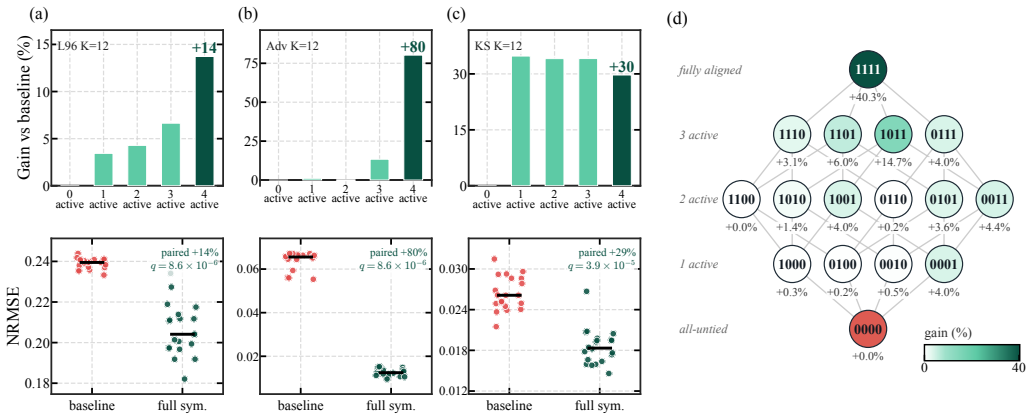
Symmetry is a powerful inductive bias, but in quantum reservoir computing (QRC) it cannot be imposed only by making the reservoir symmetric. QRC maps inputs through fixed quantum dynamics into nonlinear expectation-value features and trains only a classical readout, so the relevant symmetry must be visible in the measured feature map. We study cyclic forecasting tasks, such as sensors around a turbine or weather stations along a latitude circle, where the same local pattern should be forecast by the same rule wherever it appears on the ring. Thus, rotating the input by one site should rotate, not change, the predicted field. We show that a symmetric Hamiltonian is not enough: even large Pauli measurement sets can fail if their channels do not match the data symmetry, since optimization cannot recover channels that were never measured. We address this through observable-orbit completion, which measures symmetry-related observable channels and aligns encoding, dynamics, measurement, and readout. The strongest gains arise from aligning all four interfaces together, with matched spin-ring, real-weather, and IBM hardware checks supporting the same measured-span mechanism.
Editorial analysis
A structured set of objections, weighed in public.
Referee Report
Summary. The manuscript claims that symmetry in quantum reservoir computing for cyclic forecasting tasks (e.g., ring sensors or latitude weather stations) cannot be achieved by a symmetric Hamiltonian alone, because even large Pauli measurement sets fail if their channels do not match the input symmetry; optimization cannot recover unmeasured channels. The proposed solution is observable-orbit completion, which augments the measured set with symmetry-related observables to align encoding, dynamics, measurement, and readout. Supporting evidence consists of checks on spin-ring models, real weather data, and IBM quantum hardware, all said to confirm the measured-span mechanism.
Significance. If validated, the observable-orbit completion approach supplies a structural method for enforcing equivariance in the measured feature map of QRC without post-hoc fitting, which is relevant for periodic or rotationally symmetric forecasting tasks. The multi-domain checks (spin-ring, weather, hardware) provide breadth, though the absence of quantitative error bars and ablations limits immediate impact assessment.
major comments (2)
- [IBM hardware checks] IBM hardware checks section: the manuscript states that hardware experiments support the mechanism, yet reports no quantitative error bars, ablation results on differential readout noise or crosstalk, or explicit test that the completed observable set remains closed under the cyclic group action once device noise is included. This directly bears on the central claim that alignment of the four interfaces works in practice, as the skeptic correctly notes that any orbit-dependent decoherence would break the required equivariance.
- [Observable-orbit completion] Observable-orbit completion description (likely §3 or equivalent): the claim that completing the observable orbit aligns encoding, dynamics, measurement, and readout lacks an explicit derivation or equation showing that the augmented feature map is equivariant (i.e., rotated inputs produce rotated features). Without this, it is unclear whether the method is parameter-free or depends on unstated choices of orbit representatives.
minor comments (1)
- [Abstract] Abstract: the phrase 'matched spin-ring, real-weather, and IBM hardware checks' is used without defining the matching metric or the baseline (symmetric Hamiltonian only) against which gains are measured.
Simulated Author's Rebuttal
We thank the referee for the careful reading and constructive comments on our manuscript. We address the two major comments point by point below and will revise the manuscript to incorporate the requested clarifications and analyses.
read point-by-point responses
-
Referee: [IBM hardware checks] IBM hardware checks section: the manuscript states that hardware experiments support the mechanism, yet reports no quantitative error bars, ablation results on differential readout noise or crosstalk, or explicit test that the completed observable set remains closed under the cyclic group action once device noise is included. This directly bears on the central claim that alignment of the four interfaces works in practice, as the skeptic correctly notes that any orbit-dependent decoherence would break the required equivariance.
Authors: We agree that the hardware section would be strengthened by these quantitative elements. In the revised manuscript we will add (i) error bars obtained from repeated circuit executions on the IBM device, (ii) ablations that isolate the effects of readout noise and crosstalk on the measured features, and (iii) an explicit numerical check confirming that the completed observable orbit remains closed under the cyclic group action when the device noise model is included. These additions will directly test whether orbit-dependent decoherence breaks the required equivariance. revision: yes
-
Referee: [Observable-orbit completion] Observable-orbit completion description (likely §3 or equivalent): the claim that completing the observable orbit aligns encoding, dynamics, measurement, and readout lacks an explicit derivation or equation showing that the augmented feature map is equivariant (i.e., rotated inputs produce rotated features). Without this, it is unclear whether the method is parameter-free or depends on unstated choices of orbit representatives.
Authors: We appreciate the request for an explicit derivation. While the manuscript describes the alignment of the four interfaces, we will insert a new subsection containing the missing mathematical argument. We will prove that, once the measurement set is completed to the full orbit under the cyclic group, the resulting feature map φ satisfies φ(g·x) = g·φ(x) for every group element g. The proof proceeds by showing equivariance at each interface separately: the encoding is invariant under the group action, the Hamiltonian commutes with the symmetry operator, the completed observables transform covariantly, and the linear readout is trained on the full orbit. The construction is parameter-free; the orbit is generated deterministically from any minimal set of representatives by applying the known group action, with no additional choices required. revision: yes
Circularity Check
No circularity; observable-orbit completion is a structural measurement alignment, not a fitted or self-defined result
full rationale
The paper's derivation introduces observable-orbit completion to ensure the measured feature map respects cyclic symmetry by explicitly measuring symmetry-related Pauli channels. No equation or claim reduces a prediction to a fitted parameter by construction, nor does any load-bearing step rely on a self-citation chain whose content is unverified. The central mechanism (aligning encoding, dynamics, measurement, and readout) is presented as an explicit completion of the observable set, with hardware checks cited as external support rather than internal redefinition. The result is therefore self-contained against external benchmarks and receives the default non-circularity finding.
Axiom & Free-Parameter Ledger
axioms (2)
- standard math Quantum dynamics are governed by a fixed Hamiltonian whose symmetry properties are preserved under unitary evolution.
- domain assumption The forecasting task possesses exact cyclic symmetry such that rotating the input must rotate the output prediction.
Reference graph
Works this paper leans on
-
[1]
Quantum computing in the NISQ era and beyond,
J. Preskill, “Quantum computing in the NISQ era and beyond,”Quantum, vol. 2, p. 79, 2018
work page 2018
-
[2]
J. Biamonte, P. Wittek, N. Pancotti, P. Rebentrost, N. Wiebe, and S. Lloyd, “Quantum machine learning,”Nature, vol. 549, pp. 195–202, 2017
work page 2017
-
[3]
Harnessing disordered-ensemble quantum dynamics for machine learning,
K. Fujii and K. Nakajima, “Harnessing disordered-ensemble quantum dynamics for machine learning,”Physical Review Applied, vol. 8, p. 024030, 2017
work page 2017
-
[4]
S. Ghosh, A. Opala, M. Matuszewski, T. Paterek, and T. C. H. Liew, “Quantum reservoir processing,”npj Quantum Information, vol. 5, p. 35, 2019. 1https://github.com/eybmits/qrc-symmetry
work page 2019
-
[5]
Boosting computational power through spatial multiplexing in quantum reservoir computing,
K. Nakajima, K. Fujii, M. Negoro, K. Mitarai, and M. Kitagawa, “Boosting computational power through spatial multiplexing in quantum reservoir computing,”Physical Review Applied, vol. 11, p. 034021, 2019
work page 2019
-
[6]
Exploiting symmetry in variational quantum machine learning,
J. J. Meyer, M. Mularski, E. Gil-Fuster, A. A. Mele, F. Arzani, A. Wilms, and J. Eisert, “Exploiting symmetry in variational quantum machine learning,”PRX Quantum, vol. 4, p. 010328, 2023
work page 2023
-
[7]
Theoretical guarantees for permutation-equivariant quantum neural networks,
L. Schatzki, M. Larocca, Q. T. Nguyen, F. Sauvage, and M. Cerezo, “Theoretical guarantees for permutation-equivariant quantum neural networks,”npj Quantum Information, vol. 10, p. 12, 2024
work page 2024
-
[8]
A theory for equivariant quantum neural networks,
Q. T. Nguyen, L. Schatzki, P. Braccia, M. Ragone, P. J. Coles, F. Sauvage, M. Larocca, and M. Cerezo, “A theory for equivariant quantum neural networks,”PRX Quantum, vol. 5, p. 020328, 2024
work page 2024
-
[9]
WeatherBench 2: A benchmark for the next generation of data-driven global weather models,
S. Raspet al., “WeatherBench 2: A benchmark for the next generation of data-driven global weather models,”Journal of Advances in Modeling Earth Systems, vol. 16, no. 6, p. e2023MS004019, 2024
work page 2024
-
[10]
H. Hersbachet al., “The ERA5 global reanalysis,”Quarterly Journal of the Royal Meteorological Society, vol. 146, no. 730, pp. 1999–2049, 2020
work page 1999
-
[11]
W. Maass, T. Natschlaeger, and H. Markram, “Real-time computing without stable states: A new framework for neural computation based on perturbations,”Neural Computation, vol. 14, no. 11, pp. 2531–2560, 2002
work page 2002
-
[12]
Harnessing nonlinearity: Predicting chaotic systems and saving energy in wireless communication,
H. Jaeger and H. Haas, “Harnessing nonlinearity: Predicting chaotic systems and saving energy in wireless communication,”Science, vol. 304, no. 5667, pp. 78–80, 2004
work page 2004
-
[13]
Reservoir computing approaches to recurrent neural network training,
M. Lukosevicius and H. Jaeger, “Reservoir computing approaches to recurrent neural network training,”Computer Science Review, vol. 3, no. 3, pp. 127–149, 2009
work page 2009
-
[14]
Next generation reservoir computing,
D. J. Gauthier, E. Bollt, A. Griffith, and W. A. S. Barbosa, “Next generation reservoir computing,”Nature Communications, vol. 12, p. 5564, 2021
work page 2021
-
[15]
K. Nakajima and I. Fischer, Eds.,Reservoir Computing: Theory, Physical Implementations, and Applications. Springer, 2021
work page 2021
-
[16]
Time-series quantum reservoir computing with weak and projective measurements,
P. Mujal, R. Martinez-Pena, J. Nokkala, J. Garcia-Beni, G. L. Giorgi, M. C. Soriano, and R. Zambrini, “Time-series quantum reservoir computing with weak and projective measurements,”npj Quantum Information, vol. 9, p. 16, 2023
work page 2023
-
[17]
O. Ahmed, F. Tennie, and L. Magri, “Prediction of chaotic dynamics and extreme events: A recurrence-free quantum reservoir computing approach,”Physical Review Research, vol. 6, p. 043082, 2024
work page 2024
-
[18]
Overcoming the coherence time barrier in quantum machine learning on temporal data,
F. Hu, S. A. Khan, N. T. Bronn, G. Angelatos, G. E. Rowlands, G. J. Ribeill, and H. E. Türeci, “Overcoming the coherence time barrier in quantum machine learning on temporal data,”Nature Communications, vol. 15, p. 7491, 2024
work page 2024
-
[19]
Gradient-based learning applied to document recognition,
Y . LeCun, L. Bottou, Y . Bengio, and P. Haffner, “Gradient-based learning applied to document recognition,”Proceedings of the IEEE, vol. 86, no. 11, pp. 2278–2324, 1998
work page 1998
-
[20]
Group equivariant convolutional networks,
T. Cohen and M. Welling, “Group equivariant convolutional networks,” inInternational Conference on Machine Learning, 2016
work page 2016
-
[21]
Geometric deep learning: Going beyond Euclidean data,
M. M. Bronstein, J. Bruna, Y . LeCun, A. Szlam, and P. Vandergheynst, “Geometric deep learning: Going beyond Euclidean data,”IEEE Signal Processing Magazine, vol. 34, no. 4, pp. 18–42, 2017
work page 2017
-
[22]
Symmetry-aware reservoir computing,
W. A. S. Barbosa, A. Griffith, G. E. Rowlands, L. C. G. Govia, G. J. Ribeill, M.-H. Nguyen, T. A. Ohki, and D. J. Gauthier, “Symmetry-aware reservoir computing,”Physical Review E, vol. 104, p. 045307, 2021
work page 2021
-
[23]
Ridge regression: Biased estimation for nonorthogonal problems,
A. E. Hoerl and R. W. Kennard, “Ridge regression: Biased estimation for nonorthogonal problems,”Technometrics, vol. 12, no. 1, pp. 55–67, 1970
work page 1970
-
[24]
Predictability: A problem partly solved,
E. N. Lorenz, “Predictability: A problem partly solved,” inProceedings of the Seminar on Predictability. ECMWF, 1996
work page 1996
-
[25]
PDEBench: An extensive benchmark for scientific machine learning,
M. Takamoto, T. Praditia, R. Leiteritz, D. MacKinlay, F. Alesiani, D. Pflüger, and M. Niepert, “PDEBench: An extensive benchmark for scientific machine learning,” inAdvances in Neural Information Processing Systems Datasets and Benchmarks Track, 2022
work page 2022
-
[26]
Diffusion-induced chaos in reaction systems,
Y . Kuramoto, “Diffusion-induced chaos in reaction systems,”Progress of Theoretical Physics Supplement, vol. 64, pp. 346–367, 1978
work page 1978
-
[27]
Nonlinear dynamics of hydrodynamic instability in laminar flames,
G. I. Sivashinsky, “Nonlinear dynamics of hydrodynamic instability in laminar flames,”Acta Astronautica, vol. 4, no. 11–12, pp. 1177–1206, 1977
work page 1977
-
[28]
Controlling the false discovery rate: A practical and powerful approach to multiple testing,
Y . Benjamini and Y . Hochberg, “Controlling the false discovery rate: A practical and powerful approach to multiple testing,”Journal of the Royal Statistical Society: Series B, vol. 57, no. 1, pp. 289–300, 1995
work page 1995
discussion (0)
Sign in with ORCID, Apple, or X to comment. Anyone can read and Pith papers without signing in.