Polynomial equivalence of the global transverse-field Ising model and the gate model of quantum computation
Pith reviewed 2026-07-02 11:23 UTC · model grok-4.3
The pith
The transverse-field Ising model with a single global time-dependent field can simulate any quantum circuit using only polynomial overhead.
A machine-rendered reading of the paper's core claim, the machinery that carries it, and where it could break.
Core claim
The authors give an explicit construction that encodes an arbitrary quantum circuit into the time evolution generated by a transverse-field Ising Hamiltonian whose transverse field is global and time-dependent; the encoding incurs only polynomial overhead in the number of qubits, the duration of the evolution, and the required energy scales, thereby proving polynomial equivalence between the global transverse-field Ising model and the gate model.
What carries the argument
A mapping that adapts a prior global-control construction for Rydberg atoms to the transverse-field Ising model while preserving polynomial overhead.
If this is right
- The global transverse-field Ising model is polynomially equivalent in power to the gate model of quantum computation.
- Under the assumption that BQP is not contained in P, the time-dependent global transverse-field Ising model cannot be efficiently simulated classically.
- Analog quantum simulation platforms that realize the global transverse-field Ising model can in principle implement universal quantum computation.
- The result motivates the search for lower-overhead encodings of circuits into global-control Ising dynamics.
Where Pith is reading between the lines
- Similar global-control mappings may exist for other spin models with restricted control, such as the Heisenberg model.
- Numerical checks on small circuits could quantify the concrete size of the polynomial overhead and identify bottlenecks.
- The equivalence suggests that hardness results for classical simulation of time-dependent Ising dynamics could be transferred to other globally driven systems.
Load-bearing premise
The global-control technique developed for Rydberg atoms extends directly to the transverse-field Ising model without introducing superpolynomial costs.
What would settle it
An explicit quantum circuit together with a proof that no global transverse-field Ising evolution can reproduce its output with only polynomial resources in time, qubits, or energy.
Figures
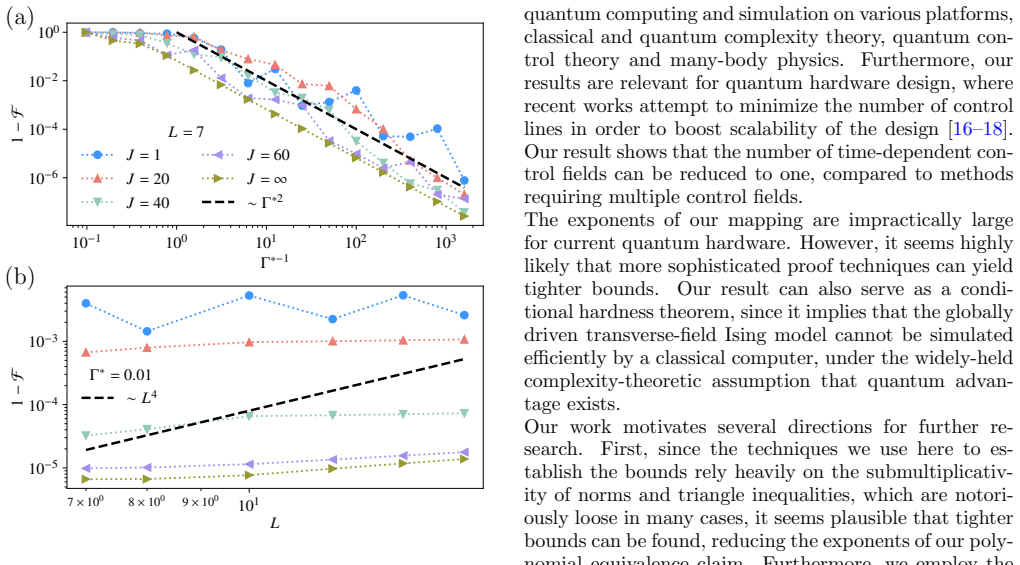
read the original abstract
The transverse-field Ising model has attracted a lot of attention in recent years, especially in the quantum simulation and quantum computation literature. This interest is driven by many platforms for analog quantum computation, which implement the transverse-field Ising model for solving optimization problems, such as quantum annealing. However, it has remained an open question whether the Ising model with a global transverse field is equivalent to the gate model of quantum computation. Here we answer this question affirmatively for the case of a non-monotonic time-dependent transverse field. Building on a recent result by Cesa and Pichler on global control of Rydberg atoms, we provide a construction that allows simulating arbitrary quantum circuits using the Ising model with global transverse field with polynomial overhead in time, qubit number, and energy scale. Although the polynomial overheads we establish here are large relative to what is feasible on real-world quantum hardware, our result motivates the development of more sophisticated methods for simulating quantum circuits using the Ising model with a global transverse field. Additionally, under the assumption that quantum computing is strictly more powerful than classical computing, our result serves as a no-go theorem for efficient classical simulation of the transverse-field Ising model with a time-dependent global transverse field. Therefore, our finding is relevant for multiple communities, from analog quantum simulation and quantum optimization on various platforms to complexity and control theory.
Editorial analysis
A structured set of objections, weighed in public.
Referee Report
Summary. The manuscript claims that the transverse-field Ising model with a non-monotonic, time-dependent global transverse field is polynomially equivalent to the gate model of quantum computation. Building on Cesa and Pichler, it provides a construction simulating arbitrary quantum circuits on this model with polynomial overhead in time, qubit number, and energy scale. It further derives a no-go theorem for efficient classical simulation assuming BQP is not in P.
Significance. If the central construction holds, the result establishes universality for a restricted analog model relevant to quantum annealing and simulation platforms, with implications across quantum simulation, optimization, and complexity theory. Credit is given for the explicit (if large) polynomial overheads and the no-go implication under standard complexity assumptions, which strengthens the result beyond mere existence claims.
major comments (1)
- [Introduction] Introduction (paragraph invoking Cesa and Pichler): the polynomial-overhead claim rests on extending the Rydberg-atom global-control construction to the transverse-field Ising Hamiltonian (ZZ interactions plus single global σ^x). No derivation, pulse-sequence mapping, or overhead analysis is supplied showing that blockade-induced effective interactions translate without auxiliary local fields or exponential blow-up in energy scale or depth; this is load-bearing for the equivalence.
minor comments (1)
- The abstract states the result for a 'non-monotonic' transverse field; the precise functional form and any constraints on the time dependence should be stated explicitly in the construction section for reproducibility.
Simulated Author's Rebuttal
We thank the referee for the detailed reading and for highlighting the need for greater clarity on the mapping from the Cesa-Pichler Rydberg construction. We address the single major comment below and will revise the manuscript accordingly.
read point-by-point responses
-
Referee: [Introduction] Introduction (paragraph invoking Cesa and Pichler): the polynomial-overhead claim rests on extending the Rydberg-atom global-control construction to the transverse-field Ising Hamiltonian (ZZ interactions plus single global σ^x). No derivation, pulse-sequence mapping, or overhead analysis is supplied showing that blockade-induced effective interactions translate without auxiliary local fields or exponential blow-up in energy scale or depth; this is load-bearing for the equivalence.
Authors: We agree that the introduction paragraph is too terse and that an explicit mapping is required to substantiate the claim. The manuscript does contain a high-level construction in Section 3 that adapts the global Rydberg blockade to the Ising (ZZ + global X) setting via a sequence of global pulses and detuning schedules; however, the referee is correct that a self-contained derivation of the effective Hamiltonian, the absence of auxiliary local fields, and the polynomial bounds on depth and energy scale are not presented with sufficient detail. We will add a dedicated subsection (approximately 1.5 pages) that (i) writes the explicit time-dependent pulse sequence, (ii) derives the effective Ising interactions via the blockade approximation with error bounds polynomial in the system size, and (iii) tabulates the overheads in time, qubit number, and energy scale. This addition will make the load-bearing step fully explicit without altering the stated polynomial scaling. revision: yes
Circularity Check
No circularity; central claim rests on external citation to Cesa-Pichler result
full rationale
The paper's derivation chain consists of invoking an external result ('Building on a recent result by Cesa and Pichler on global control of Rydberg atoms') and then providing a construction that maps it to the transverse-field Ising model. No self-citations, self-definitional steps, fitted inputs renamed as predictions, or ansatzes smuggled via prior author work appear in the abstract or described structure. The cited result is treated as independent input, and the polynomial overhead claim is presented as following from that external premise rather than being defined in terms of quantities internal to this paper. This is the normal case of a non-circular extension of prior work.
Axiom & Free-Parameter Ledger
Reference graph
Works this paper leans on
-
[1]
A. D. King, A. Nocera, M. M. Rams, J. Dziarmaga, R. Wiersema, W. Bernoudy, J. Raymond, N. Kaushal, N. Heinsdorf, R. Harris, K. Boothby, F. Altomare, M. Asad, A. J. Berkley, M. Boschnak, K. Chern, H. Christiani, S. Cibere, J. Connor, M. H. Dehn, R. Deshpande, S. Ejtemaee, P. Farre, K. Hamer, E. Hoskinson, S. Huang, M. W. Johnson, S. Kortas, E. Ladizinsky, ...
-
[2]
Albash and D
T. Albash and D. A. Lidar, Adiabatic quantum compu- tation, Rev. Mod. Phys.90, 015002 (2018)
2018
-
[3]
A. J. Daley, Twenty-five years of analogue quantum sim- ulation, Nature Reviews Physics5, 702 (2023)
2023
-
[4]
Arg¨ uello-Luengo, A
J. Arg¨ uello-Luengo, A. Gonz´ alez-Tudela, T. Shi, P. Zoller, and J. I. Cirac, Analogue quantum chemistry simulation, Nature574, 215–218 (2019)
2019
-
[5]
Quantum approximate optimization is computationally universal
S. Lloyd, Quantum approximate optimization is compu- tationally universal (2018), arXiv:1812.11075 [quant-ph]
work page internal anchor Pith review Pith/arXiv arXiv 2018
-
[6]
M. E. S. Morales, J. D. Biamonte, and Z. Zimbor´ as, On the universality of the quantum approximate optimiza- tion algorithm, Quantum Information Processing19, 291 (2020)
2020
- [7]
- [8]
-
[9]
Cesa and H
F. Cesa and H. Pichler, Universal quantum computation in globally driven rydberg atom arrays, Phys. Rev. Lett. 131, 170601 (2023)
2023
-
[10]
Callison, M
A. Callison, M. Festenstein, J. Chen, L. Nita, V. Kendon, and N. Chancellor, Energetic perspective on rapid quenches in quantum annealing, PRX Quantum2, 010338 (2021)
2021
-
[11]
Venturelli and A
D. Venturelli and A. Kondratyev, Reverse quantum an- nealing approach to portfolio optimization problems, Quantum Machine Intelligence1, 17 (2019)
2019
-
[12]
Passarelli, K.-W
G. Passarelli, K.-W. Yip, D. A. Lidar, H. Nishimori, and P. Lucignano, Reverse quantum annealing of thep-spin model with relaxation, Phys. Rev. A101, 022331 (2020)
2020
-
[13]
Pelofske, G
E. Pelofske, G. Hahn, and H. Djidjev, Initial state en- coding via reverse quantum annealing and h-gain fea- tures, IEEE Transactions on Quantum Engineering4, 1–21 (2023)
2023
-
[14]
Kohler, S
T. Kohler, S. Piddock, J. Bausch, and T. Cubitt, Gen- eral conditions for universality of quantum hamiltonians, PRX Quantum3, 010308 (2022)
2022
-
[15]
Harley, I
D. Harley, I. Datta, F. R. Klausen, A. Bluhm, D. S. Fran¸ ca, A. H. Werner, and M. Christandl, Going be- yond gadgets: the importance of scalability for analogue quantum simulators, Nature Communications15, 6527 (2024)
2024
-
[16]
Menta, F
R. Menta, F. Cioni, R. Aiudi, M. Polini, and V. Giovan- netti, Globally driven superconducting quantum comput- ing architecture, Phys. Rev. Res.7, L012065 (2025)
2025
-
[17]
Cioni, R
F. Cioni, R. Menta, R. Aiudi, M. Polini, and V. Gio- vannetti, Conveyor-belt superconducting quantum com- puter, Phys. Rev. A113, 012439 (2026)
2026
-
[18]
Menta, F
R. Menta, F. Cioni, R. Aiudi, F. Caravelli, M. Polini, and V. Giovannetti, Building globally controlled quan- tum processors withzzinteractions, Phys. Rev. A113, 012614 (2026)
2026
-
[19]
Henriet, L
L. Henriet, L. Beguin, A. Signoles, T. Lahaye, A. Browaeys, G.-O. Reymond, and C. Jurczak, Quantum computing with neutral atoms, Quantum4, 327 (2020)
2020
-
[20]
Scholl, M
P. Scholl, M. Schuler, H. J. Williams, A. A. Eberharter, D. Barredo, K.-N. Schymik, V. Lienhard, L.-P. Henry, T. C. Lang, T. Lahaye, A. M. L¨ auchli, and A. Browaeys, Quantum simulation of 2d antiferromagnets with hun- dreds of rydberg atoms, Nature595, 233 (2021)
2021
-
[21]
Scholl, H
P. Scholl, H. J. Williams, G. Bornet, F. Wallner, D. Barredo, L. Henriet, A. Signoles, C. Hainaut, T. Franz, S. Geier, A. Tebben, A. Salzinger, G. Z¨ urn, T. Lahaye, M. Weidem¨ uller, and A. Browaeys, Microwave engineering of programmablexxzhamiltonians in arrays of rydberg atoms, PRX Quantum3, 020303 (2022)
2022
-
[22]
Leclerc, C
L. Leclerc, C. Dalyac, P. Bendotti, R. Griset, J. Mikael, and L. Henriet, Implementing transferable annealing pro- tocols for combinatorial optimization on neutral-atom quantum processors: A case study on smart charging of electric vehicles, Phys. Rev. A111, 032611 (2025)
2025
- [23]
-
[24]
Bombieri, Z
L. Bombieri, Z. Zeng, R. Tricarico, R. Lin, S. Notar- nicola, M. Cain, M. D. Lukin, and H. Pichler, Quantum adiabatic optimization with rydberg arrays: Localization phenomena and encoding strategies, PRX Quantum6, 020306 (2025)
2025
-
[25]
Raussendorf and H
R. Raussendorf and H. J. Briegel, A one-way quantum computer, Phys. Rev. Lett.86, 5188 (2001)
2001
-
[26]
Aharonov, W
D. Aharonov, W. van Dam, J. Kempe, Z. Landau, S. Lloyd, and O. Regev, Adiabatic quantum computation is equivalent to standard quantum computation, SIAM Review50, 755 (2008)
2008
-
[27]
A. M. Childs, Universal computation by quantum walk, Phys. Rev. Lett.102, 180501 (2009)
2009
-
[28]
T. S. Cubitt, A. Montanaro, and S. Piddock, Uni- versal quantum hamiltonians, Proceedings of the National Academy of Sciences115, 9497 (2018), https://www.pnas.org/doi/pdf/10.1073/pnas.1804949115
-
[29]
G. D. las Cuevas and T. S. Cubitt, Sim- ple universal models capture all classi- cal spin physics, Science351, 1180 (2016), https://www.science.org/doi/pdf/10.1126/science.aab3326
-
[30]
Bravyi and M
S. Bravyi and M. Hastings, On complexity of the quantum ising model, Communications in Mathematical Physics349, 1 (2017)
2017
-
[31]
Monte Carlo simulation of stoquastic Hamiltonians
S. Bravyi, Monte carlo simulation of stoquastic hamilto- nians (2015), arXiv:1402.2295 [quant-ph]
work page internal anchor Pith review Pith/arXiv arXiv 2015
-
[32]
Hen, Determining quantum monte carlo simulability with geometric phases, Phys
I. Hen, Determining quantum monte carlo simulability with geometric phases, Phys. Rev. Res.3, 023080 (2021)
2021
- [33]
-
[34]
A Quantum Approximate Optimization Algorithm
E. Farhi, J. Goldstone, and S. Gutmann, A quan- tum approximate optimization algorithm (2014), arXiv:1411.4028 [quant-ph]
work page internal anchor Pith review Pith/arXiv arXiv 2014
-
[35]
Leveraging Landau-Zener-St\"uckelberg interference for accelerating diabatic quantum annealing
M. Werner, M. Jonsson, A. Garc´ ıa-S´ aez, A. Riera, and T. Albash, Leveraging landau-zener-st¨ uckelberg interfer- ence for accelerating diabatic quantum annealing (2026), arXiv:2606.09706 [quant-ph]
work page internal anchor Pith review Pith/arXiv arXiv 2026
-
[36]
Bourgain, F
J. Bourgain, F. Golse, and B. Wennberg, On the distribu- tion of free path lengths for the periodic lorentz gas, Com- munications in Mathematical Physics190, 491 (1998)
1998
-
[37]
Berti, L
M. Berti, L. Biasco, and P. Bolle, Drift in phase space: a new variational mechanism with optimal diffusion time, Journal de Math´ ematiques Pures et Appliqu´ ees82, 613 (2003)
2003
-
[38]
J. R. Schrieffer and P. A. Wolff, Relation between the anderson and kondo hamiltonians, Phys. Rev.149, 491 (1966)
1966
-
[39]
Bravyi, D
S. Bravyi, D. P. DiVincenzo, and D. Loss, Schrieffer–wolff transformation for quantum many-body systems, Annals of Physics326, 2793 (2011)
2011
-
[40]
Lambert, E
N. Lambert, E. Gigu‘ere, P. Menczel, B. Li, P. Hopf, G. Su’arez, M. Gali, J. Lishman, R. Gadhvi, R. Agarwal, A. Galicia, N. Shammah, P. Nation, J. R. Johansson, S. Ahmed, S. Cross, A. Pitchford, and F. Nori, Qutip 5: The quantum toolbox in Python, Physics Reports1153, 1 (2026)
2026
-
[41]
Bombieri and W
E. Bombieri and W. Gubler, The subspace theorem, inHeights in Diophantine Geometry, New Mathemati- cal Monographs (Cambridge University Press, 2006) p. 176–230
2006
-
[42]
H. Dumas and S. Fischler, Filling times for linear flow on the torus with truncated diophantine conditions: a brief review and new proof (2021), arXiv:2112.11786 [math.DS]
-
[43]
A. Bouland and T. Giurgica-Tiron, Efficient universal quantum compilation: An inverse-free solovay-kitaev al- gorithm (2021), arXiv:2112.02040 [quant-ph]
-
[44]
Gershgorin, ¨Uber die abgrenzung der eigenwerte einer matrix, Bulletin de l’Acad´ emie des Sciences de l’URSS
S. Gershgorin, ¨Uber die abgrenzung der eigenwerte einer matrix, Bulletin de l’Acad´ emie des Sciences de l’URSS. Classe des sciences math´ ematiques et naturelles , 749 (1931). Appendix A: Definitions and notation Before we begin with the proof, let us first introduce the relevant concepts and notation. As a general remark, here we consider systems compo...
1931
-
[45]
Here, atoms / qubits can be placed closely together such that the Rydberg blockade energetically prohibits two adjacent qubits to be in the excited state at the same time
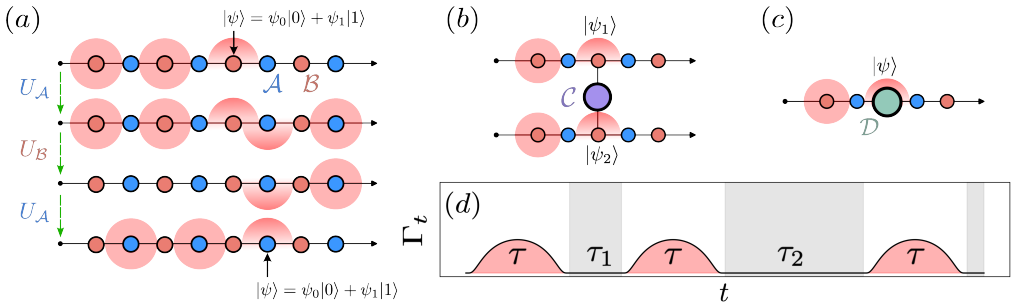
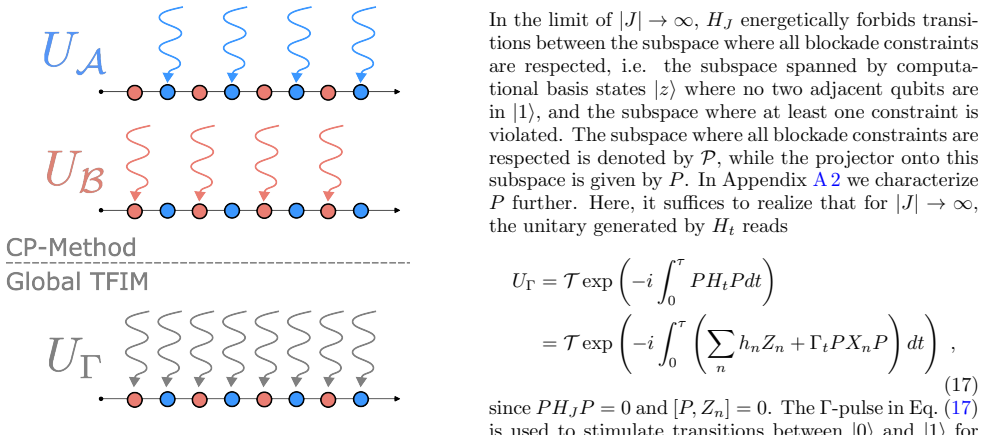
Computational subspace The CP-method was conceived with Rydberg atom systems in mind. Here, atoms / qubits can be placed closely together such that the Rydberg blockade energetically prohibits two adjacent qubits to be in the excited state at the same time. We will make use of the same mechanism. For a given connectivity graphGof qubits, these interaction...
-
[46]
This leads to conditional single-qubit gates, conditioned on the state of their neighboring qubits in the graph
Conditional gates and generators LetV∈SU(2) be a single-qubit quantum gate with a potentially time-dependent generatoriH V,t such that V=Texp −i Z τ 0 HV,tdt .(A5) In this work, we will often consider unitaries generated by Hamiltonians projected onto the computational subspaceP by the projectorP. This leads to conditional single-qubit gates, conditioned ...
-
[47]
To this end, we use Proposition 1 from [35]
Universal SU(2)-gates from pulses and phases We will require universal single-qubit unitaries, which can be constructed from Γ-pulses and phase gates. To this end, we use Proposition 1 from [35]. Here, we restate it as a Lemma and a proof for completeness, while slightly simplifying the assumptions. Consider a single-qubit HamiltonianH t and the respectiv...
-
[48]
Here, we will make this notion more concrete by invoking results from ergodic theory
Quasi-independent phase control Lloyd proposed to gain quasi-independent control over different Hamiltonian terms by choosing fourQ-linearly independent coefficients, such that each Hamiltonian could effectively be singled out up to an errorε phase by evolving the system for a timeO ε−4 phase [5]. Here, we will make this notion more concrete by invoking r...
-
[49]
Recall that if sinλ= 1/ √ 2, i.e.λ=π/4, then a single concatenation step and a proper choice of phases rendersU(ϕ 1, θ1)U(ϕ2, θ2) =V
Efficient compilation of single-qubit gates The proof of Lemma 1 directly implies an efficient classical compilation algorithm for arbitraryV∈SU(2), assuming thatλis sufficiently large, as we argue in the following. Recall that if sinλ= 1/ √ 2, i.e.λ=π/4, then a single concatenation step and a proper choice of phases rendersU(ϕ 1, θ1)U(ϕ2, θ2) =V. In the ...
-
[50]
We present the proof here for complete- ness
Bound on exponential series We will make use of the following standard result of analysis several times. We present the proof here for complete- ness. Lemma 2.Letx∈Rwithx≥0. Then ∞X k=2 xk k! ≤x 2ex .(B18) Proof.It is easy to see that the series converges point-wise, since it is the Taylor series ofe x minus the first two terms. So we can algebraically ma...
-
[51]
To this end, we will use the following standard result
Perturbed time evolution We will require a bound on the error of a time evolution under a perturbed Hamiltonian. To this end, we will use the following standard result. Lemma 3.Consider a time-dependent HamiltonianH ′ t =H t +V t, whereH t is considered the true Hamiltonian andV t is a time-dependent error, both defined on a time intervalt∈[0, τ]almost ev...
-
[52]
For the proof, we refer to the literature
Gershgorin circle theorem We will also use the Gershgorin circle theorem to establish bounds on operator norms. For the proof, we refer to the literature. Theorem 4.(Gershgorin Circle Theorem [44]) LetMbe a complex square matrix with elementsm ij. All eigenvalues λofMlie in the union of the disksD(m ii, Ri)centered onm ii and with radii Ri = X j̸=i |mij|....
-
[53]
that by controlling the schedule Γt, as defined in Section A 4, we can realize the conditional gatesU Ii,i necessary for the CP-method with a controllable error
-
[54]
We arrange the qubits in the universal arrangementG, as depicted in Figure 2, and couple them toH Z as in Eq
that the error can also be controlled when|J|= poly nq, p, ε−1 . We arrange the qubits in the universal arrangementG, as depicted in Figure 2, and couple them toH Z as in Eq. (15), which is a special case ofH Z in Eq. (1). We chooseh K =O(1) to be algebraicQ-linearly independent numbers such that Theorem 2 is satisfied non-trivially, and a Γ t : [0, τ]→R ...
-
[55]
Basic properties of the generated unitary In the limit of infinite|J|, the effective Hamiltonian onPreads HP,t =P H tP=P H ZP+ Γ tP HX P ,(C3) whereH X =P n Xn,H Z =P n hnZn+ J 4 P (m,n)∈E(G)(1−Z m)(1−Z n) andPis the projector onto the computational subspace. Since the interacting terms ofH Z are zero in the computational subspace, as no neighboring qubit...
-
[56]
, (C6) where in the last line we used the Dyson series
In the rotating frame,U Γ transforms to ˜UΓ =Texp −i Z τ 0 ΓtUZ,tP HX P U† Z,tdt =Texp −i Z τ 0 ΓtP UZ,tHX U † Z,tP dt =I−i Z τ 0 ΓtP UZ,tHX U † Z,tP dt+ (−i)2 Z τ 0 Z t 0 ΓtΓt′P UZ,tHX U † Z,tP UZ,t′HX U † Z,t′P dt′dt+... , (C6) where in the last line we used the Dyson series. We will use ˜At to denote the operatorsA t transformed into the rotating frame...
-
[57]
Consider I ∈ {A,B,C,D,B ∪ D}the set of non-adjacent qubits required to be driven by a given gateU Ii,i given by the CP- method, whileI c denotes its complement
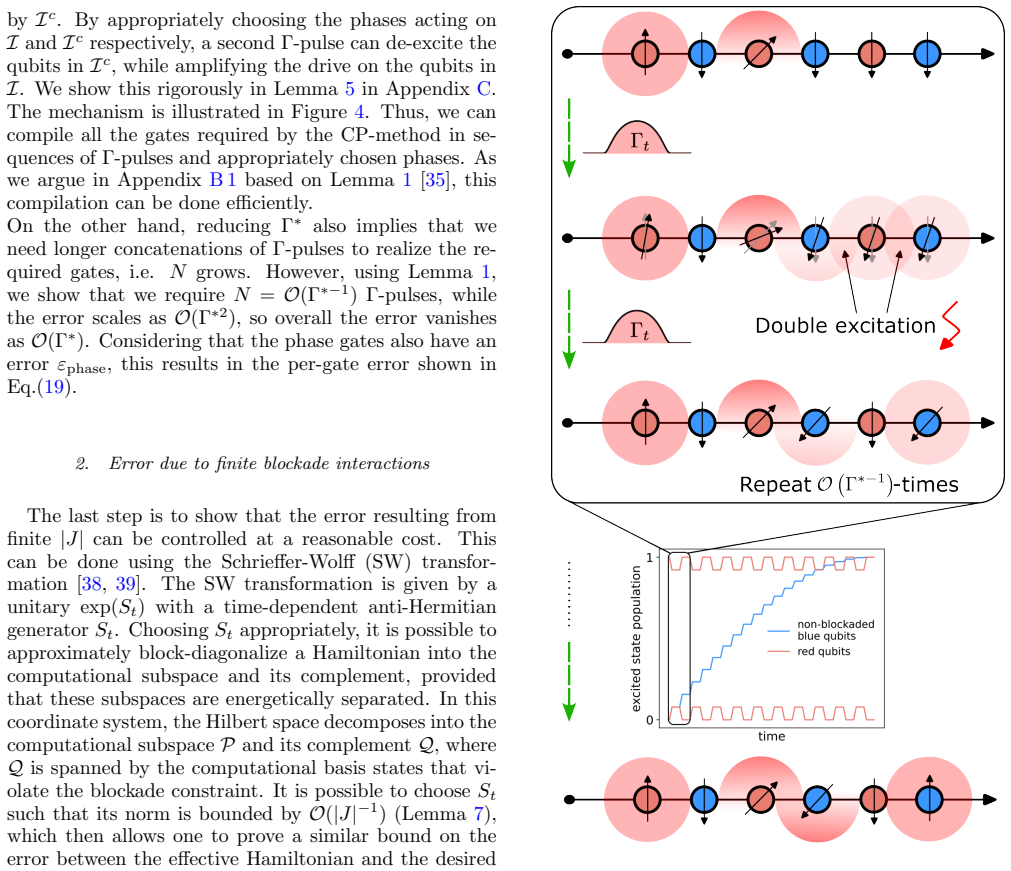
Independent drives on subsets of qubits For the implementation of the CP method, it is required to drive independent sets of non-adjacent qubits. Consider I ∈ {A,B,C,D,B ∪ D}the set of non-adjacent qubits required to be driven by a given gateU Ii,i given by the CP- method, whileI c denotes its complement. Note that|I|+|I c|=n ′ q. The Γ-pulse acting only ...
-
[58]
To this end, we will prove the following lemma using Lemma 1
Universal gates on subsetI Having established how to emulate a targeted drive on a selected subset of qubitsI, we now show how to construct arbitrary conditional gates acting on qubits inI ∈ {A,B,C,D,B ∪ D}. To this end, we will prove the following lemma using Lemma 1. Recall thatIonly contains non-adjacent qubits. Lemma 6.Let ˜UΓ andU Z as above. For any...
-
[59]
St,Γ t X n Xn # (C82) and therefore by using the linearity of the nested commutator [St, Ht]k = [St,−V od,t]k−1 +
Error due to finite|J| Up to now, we considered the effect of the blockade HamiltonianH J only in the limit of|J| → ∞, such that it can be considered to act as the projectorPonto the computational subspace. Considering a large but finiteJ, we introduce an additional source of error. We need to show that for finiteJ, the error can be controlled at a cost p...
-
[60]
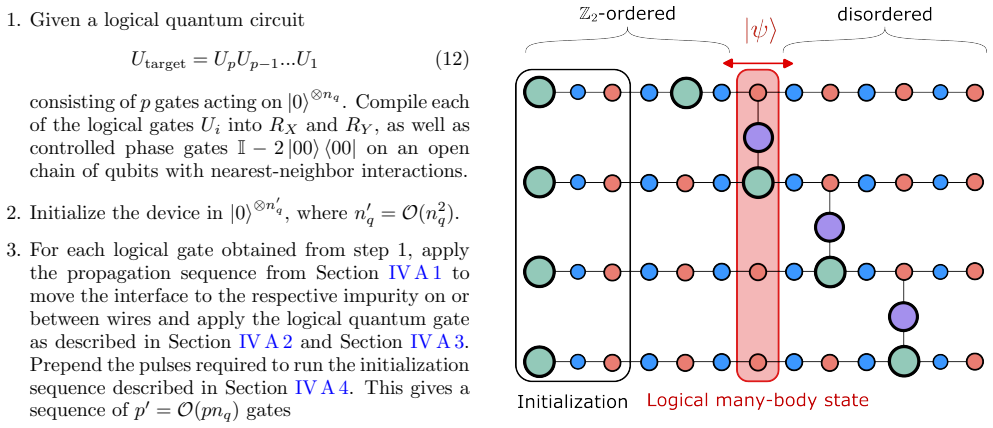
Total error scaling and resources Using the CP-method, a quantum circuit onn q qubits andpgates is mapped to a Hamiltonian ofn ′ q =O(n 2 q) qubits andp ′ =O(n qp) conditional quantum gates{U Ii,i}p′ i=1. Since the CP-method simulates any quantum circuit exactly, we find that if we initialize then ′ q qubits in|0⟩ ⊗n′ q and apply the gates, we obtain UIp′...
discussion (0)
Sign in with ORCID, Apple, or X to comment. Anyone can read and Pith papers without signing in.