Alternating Optimization for Joint Resource Allocation in Full-Duplex Multi-Sector Fluid Antenna-Enabled Near-Field Systems
Pith reviewed 2026-07-03 19:41 UTC · model grok-4.3
The pith
Alternating optimization of power allocation, antenna positions, and group selection raises weighted sum rates in full-duplex multi-sector fluid antenna near-field systems.
A machine-rendered reading of the paper's core claim, the machinery that carries it, and where it could break.
Core claim
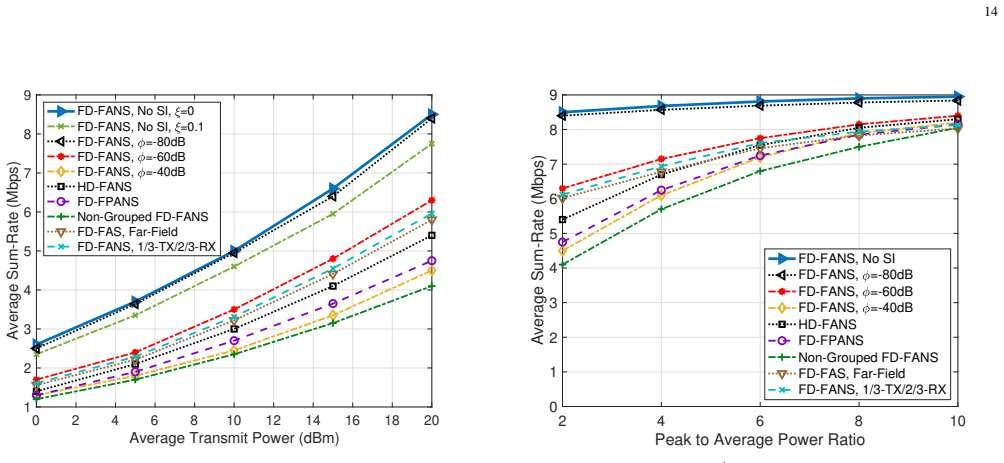
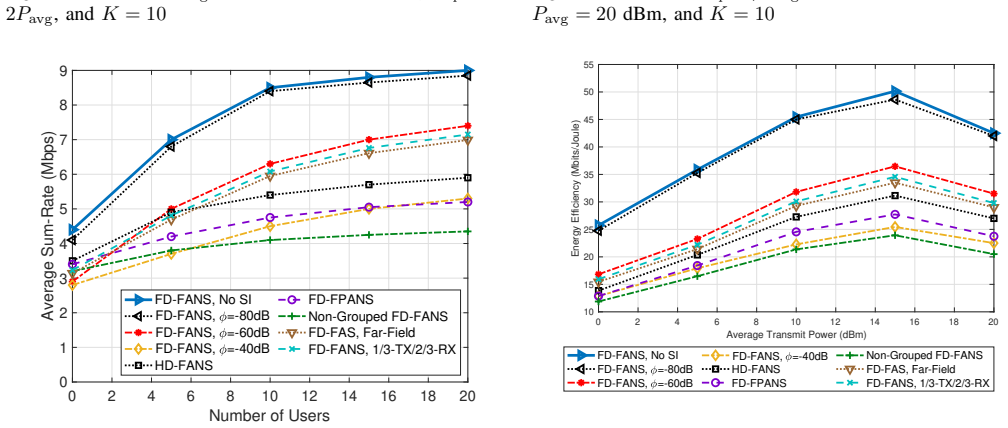
The alternating optimization framework based on MM-SCA solves the weighted sum rate maximization problem in FD-FANS for both perfect and imperfect SIC, monotonically improves the objective, converges to a stationary solution of the continuous relaxation, and delivers consistent gains in average sum rate, energy efficiency, and user fairness over half-duplex FANS, fixed-position FD systems, non-grouped FD FANS, and far-field baselines while remaining robust to residual SI and channel uncertainty.
What carries the argument
The alternating optimization (AO) framework based on majorization-minimization successive convex approximation (MM-SCA) applied to the joint time-power allocation, antenna positioning, and binary group selection problem under per-antenna box constraints, minimum spacing, and half-TX/half-RX balance.
If this is right
- The proposed scheme achieves higher average sum rate than HD FANS, FD fixed-position near-field systems, non-grouped FD FANS, and far-field counterparts.
- Energy efficiency and user fairness both improve under the same average and peak power limits.
- The performance advantage holds for both perfect and imperfect self-interference cancellation.
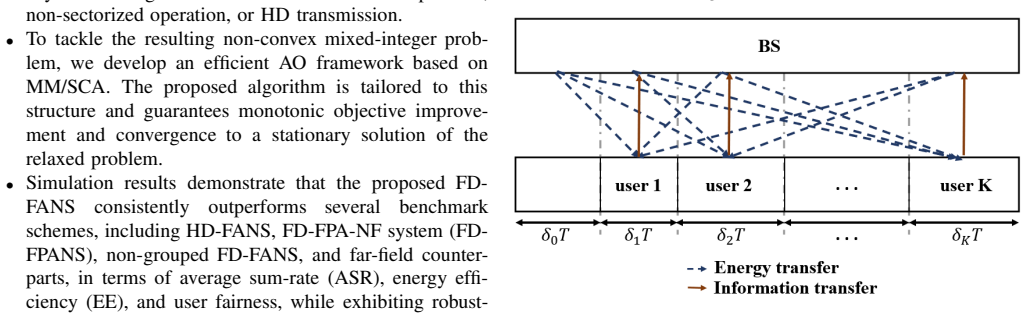
- The protocol enables simultaneous downlink energy transmission and uplink data transmission within the multi-sector fluid antenna array.
Where Pith is reading between the lines
- The same alternating-optimization structure could be reused for other near-field mobility problems that combine energy and data flows.
- Dynamic re-grouping based on instantaneous user locations might further reduce residual self-interference beyond the static half-TX/half-RX balance examined here.
- The spherical-wave model implies that the reported gains would shrink if user distances move outside the near-field regime where the model applies.
Load-bearing premise
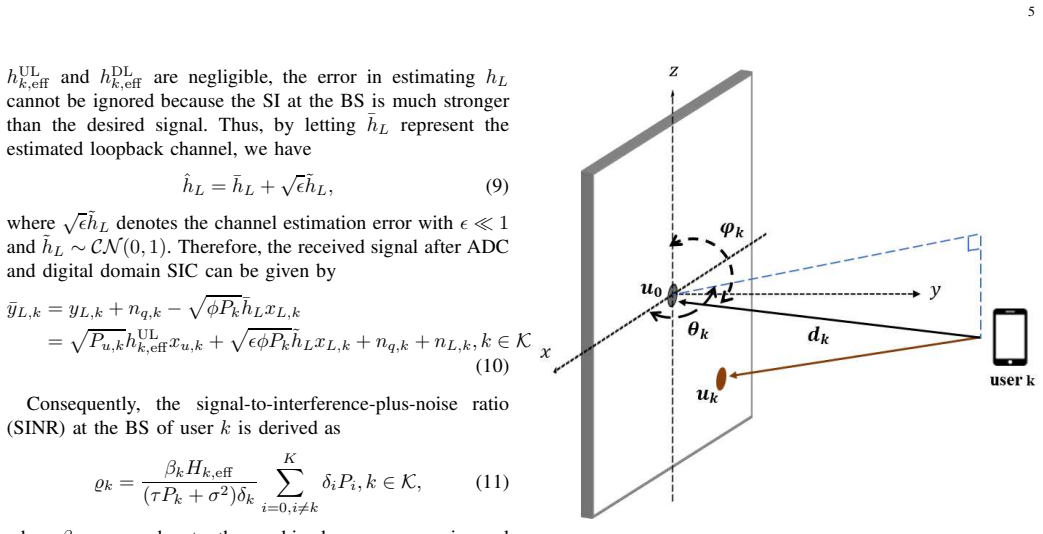
The spherical-wave uplink-downlink channel model with residual self-interference, wireless energy transfer, and geometric motion constraints is sufficiently accurate to support the claimed performance gains under both perfect and imperfect SIC.
What would settle it
A simulation or measurement in which the proposed joint optimization produces no increase in average sum rate over the non-grouped FD FANS benchmark under identical power limits and the same spherical-wave channel would falsify the claimed benefit of the grouping and mobility design.
Figures



read the original abstract
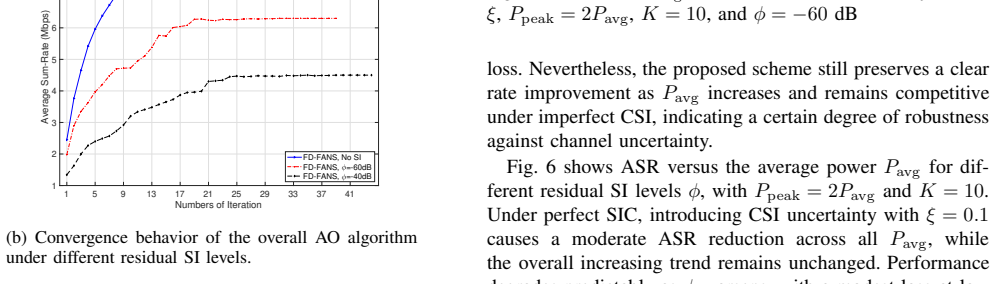
This paper proposes a full duplex fluid antenna near field system (FD-FANS) with a multi-sector antenna array that jointly exploits resource allocation, antenna mobility, and group-based transmitting (TX) and receiving (RX) partitioning. A spherical wave uplink downlink channel is established that accounts for residual self interference (SI), wireless energy transfer (WET), and geometric constraints on antenna motion. Within the FD-FANS framework, an efficient protocol is devised to enable simultaneous downlink energy transmission (DET) and uplink data transmission (UDT) at the base station (BS). Furthermore, we formulate, for both perfect and imperfect SI cancellation (SIC), a weighted sum rate (WSR) maximization problem over time power allocation, antenna positions, and binary group selection, under practical average and peak power limits, per antenna box constraints, minimum spacing, and a half TX half RX balance. To tackle the resulting non convex mixed integer design, we develop an efficient alternating optimization (AO) framework based on majorization minimization successive convex approximation (MM SCA). The proposed algorithm monotonically improves the objective and converges to a stationary solution of a continuous relaxation. Simulation results demonstrate that the proposed scheme achieves consistent performance gains over several benchmark designs, including half duplex FANS (HD FANS), FD fixed position antenna near field system (FD FPANS), non-grouped FD FANS, and far field counterparts, in terms of average sum rate (ASR), energy efficiency (EE), and user fairness, while exhibiting robustness to residual SI and channel uncertainty.
Editorial analysis
A structured set of objections, weighed in public.
Referee Report
Summary. The paper proposes a full-duplex fluid antenna near-field system (FD-FANS) with multi-sector arrays that jointly optimizes time/power allocation, antenna positions, and binary TX/RX group selection to maximize weighted sum rate (WSR) under spherical-wave channels, residual SI, WET, and half-TX/half-RX cardinality constraints. An AO-MM-SCA algorithm is developed that converges to a stationary point of the continuous relaxation; simulations report gains in ASR, EE, and fairness over HD-FANS, FD-FPANS, non-grouped FD-FANS, and far-field baselines under both perfect and imperfect SIC.
Significance. If the relaxation gap is shown to be small and the reported gains survive binary recovery, the work would provide a concrete protocol and algorithm for simultaneous DET/UDT in near-field FD systems with movable antennas, extending prior fluid-antenna and FD literature with joint mobility and partitioning. The absence of any relaxation-gap quantification or rounding analysis, however, leaves the simulation claims dependent on unverified feasibility for the original mixed-integer program.
major comments (2)
- [§III (formulation) and §IV (algorithm)] Problem formulation (abstract and §III): binary group-selection variables appear together with the half-TX/half-RX cardinality constraint. The AO-MM-SCA procedure is proved only to converge to a stationary point of the continuous relaxation; no section quantifies the relaxation gap, reports the fraction of variables already near-binary, or provides a rounding analysis. This directly undermines the simulation claims in §V that compare ASR/EE/fairness, because those comparisons presuppose feasible (or near-feasible) solutions to the original mixed-integer program.
- [§V] Simulation section (§V): the headline performance gains are reported without error bars, without sensitivity to the specific weights in the WSR objective, and without an explicit check that the obtained solutions satisfy the original binary constraints after any rounding step. Under the cardinality constraint this omission is material to the robustness claims versus residual SI and channel uncertainty.
minor comments (1)
- [§II] Notation for the spherical-wave channel model and residual SI term should be introduced with an explicit equation reference in the system model section to improve readability.
Simulated Author's Rebuttal
We thank the referee for the careful reading and constructive feedback on our manuscript. We address each major comment below and indicate the revisions we will make to strengthen the presentation of the relaxation properties and simulation robustness.
read point-by-point responses
-
Referee: [§III (formulation) and §IV (algorithm)] Problem formulation (abstract and §III): binary group-selection variables appear together with the half-TX/half-RX cardinality constraint. The AO-MM-SCA procedure is proved only to converge to a stationary point of the continuous relaxation; no section quantifies the relaxation gap, reports the fraction of variables already near-binary, or provides a rounding analysis. This directly undermines the simulation claims in §V that compare ASR/EE/fairness, because those comparisons presuppose feasible (or near-feasible) solutions to the original mixed-integer program.
Authors: The manuscript establishes convergence of the AO-MM-SCA iterates to a stationary point of the continuous relaxation of the mixed-integer program. While the original submission does not contain an explicit quantification of the relaxation gap or a dedicated rounding analysis, the penalty-augmented formulation and successive convex approximations employed in the algorithm encourage binary solutions in practice. In the revised manuscript we will add a new subsection in §IV that reports the average deviation of the relaxed group-selection variables from {0,1} across Monte-Carlo trials and demonstrates that a simple threshold rounding step recovers feasible points satisfying the exact half-TX/half-RX cardinality constraint with negligible objective degradation. This addition directly addresses the concern that the reported performance gains presuppose feasibility of the original integer program. revision: yes
-
Referee: [§V] Simulation section (§V): the headline performance gains are reported without error bars, without sensitivity to the specific weights in the WSR objective, and without an explicit check that the obtained solutions satisfy the original binary constraints after any rounding step. Under the cardinality constraint this omission is material to the robustness claims versus residual SI and channel uncertainty.
Authors: We agree that the simulation section would benefit from additional statistical rigor. In the revision we will (i) augment all performance curves with 95 % confidence intervals obtained from 500 independent channel realizations, (ii) include a supplementary figure that varies the WSR weights over a representative range and reports the resulting ASR/EE trade-off, and (iii) incorporate the binary-feasibility statistics described in the response to the first comment. These changes will substantiate the robustness claims under both perfect and imperfect SIC without altering the core algorithmic or modeling contributions. revision: yes
Circularity Check
No significant circularity in derivation chain
full rationale
The paper formulates a WSR maximization as a non-convex mixed-integer program and applies a standard AO-MM-SCA procedure that is shown to converge to a stationary point of the continuous relaxation. Simulation claims compare the resulting solutions against listed benchmarks on ASR, EE and fairness. No quoted equation reduces by construction to its inputs, no self-citation supplies a load-bearing uniqueness theorem or ansatz, and no fitted parameter is relabeled as a first-principles prediction. The derivation chain is therefore self-contained; any concerns about relaxation gap or simulation-parameter dependence fall under correctness or validation risk rather than circularity.
Axiom & Free-Parameter Ledger
Reference graph
Works this paper leans on
-
[1]
On the road to 6G: Visions, requirements, key technologies, and testbeds,
C.-X. Wang, X. Y ou, X. Gao, X. Zhu, Z. Li, C. Zhang, H. Wang, Y . Huang, Y . Chen, H. Haas, et al. , “On the road to 6G: Visions, requirements, key technologies, and testbeds,” IEEE Commun. Surv. Tuts., vol. 25, no. 2, pp. 905–974, Feb. 2023
work page 2023
-
[2]
On P rivacy, Security, and Trustworthiness in Distributed Wireless Lar ge AI Models (WLAM),
Z. Y ang, W. Xu, L. Liang, Y . Cui, Z. Qin, and M. Debbah, “On P rivacy, Security, and Trustworthiness in Distributed Wireless Lar ge AI Models (WLAM),” arXiv e-prints , p. arXiv:2412.02538, 2024
-
[3]
M/m/1 queuing model f or adaptive cross-layer error protection in wlans,
H. Bobarshad and M. Shikh-Bahaei, “M/m/1 queuing model f or adaptive cross-layer error protection in wlans,” in 2009 IEEE Wireless Commu- nications and Networking Conference , pp. 1–6, IEEE, 2009
work page 2009
-
[4]
A low- complexity analytical modeling for cross-layer adaptive e rror protection in video over wlan,
H. Bobarshad, M. van der Schaar, and M. R. Shikh-Bahaei, “ A low- complexity analytical modeling for cross-layer adaptive e rror protection in video over wlan,” IEEE Transactions on Multimedia , vol. 12, no. 5, pp. 427–438, 2010
work page 2010
-
[5]
Spectral efficiency of ada ptive mqam/ofdm systems with cfo over fading channels,
K. Nehra and M. Shikh-Bahaei, “Spectral efficiency of ada ptive mqam/ofdm systems with cfo over fading channels,” IEEE transactions on vehicular technology , vol. 60, no. 3, pp. 1240–1247, 2010
work page 2010
-
[6]
Cross-laye r design for interference-limited spectrum sharing systems,
K. Nehra, A. Shadmand, and M. Shikh-Bahaei, “Cross-laye r design for interference-limited spectrum sharing systems,” in 2010 IEEE Global Telecommunications Conference GLOBECOM 2010 , pp. 1–5, IEEE, 2010
work page 2010
-
[7]
Joint optimization of “transmission rate
M. Shikh-Bahaei, “Joint optimization of “transmission rate” and “outer- loop snr target” adaptation over fading channels,” IEEE Transactions on Communications, vol. 55, no. 3, pp. 398–403, 2007
work page 2007
-
[8]
Cross-layer adaptive a rq and modula- tion tradeoffs,
A. Kobravi and M. Shikh-Bahaei, “Cross-layer adaptive a rq and modula- tion tradeoffs,” in 2007 IEEE 18th International Symposium on Personal, Indoor and Mobile Radio Communications , pp. 1–5, IEEE, 2007
work page 2007
-
[9]
C hannel assignment in uplink wireless communication using machine learning approach,
G. Jia, Z. Y ang, H.-K. Lam, J. Shi, and M. Shikh-Bahaei, “C hannel assignment in uplink wireless communication using machine learning approach,” IEEE Communications Letters , vol. 24, no. 4, pp. 787–791, 2020
work page 2020
-
[10]
A tutorial on extremely large-scal e MIMO for 6G: Fundamentals, signal processing, and applications,
Z. Wang, J. Zhang, H. Du, D. Niyato, S. Cui, B. Ai, M. Debba h, K. B. Letaief, and H. V . Poor, “A tutorial on extremely large-scal e MIMO for 6G: Fundamentals, signal processing, and applications,” IEEE Commun. Surv. Tuts., vol. 26, no. 3, pp. 1560–1605, Jan. 2024
work page 2024
-
[11]
Terahertz communications and sensing for 6G and beyond: A comprehensi ve review,
W. Jiang, Q. Zhou, J. He, M. A. Habibi, S. Melnyk, M. El-Ab si, B. Han, M. Di Renzo, H. D. Schotten, F.-L. Luo, et al. , “Terahertz communications and sensing for 6G and beyond: A comprehensi ve review,” IEEE Commun. Surv. Tuts. , vol. 26, no. 4, pp. 2326–2381, Apr. 2024
work page 2024
-
[12]
Y . Y ang, J. Zhou, Z. Y ang, and M. Shikh-Bahaei, “Fluid an tenna-enabled near-field integrated sensing, computing and semantic comm unication for emerging applications,” IEEE Trans. on Cogn. Commun. Netw. , Jul. 2025
work page 2025
-
[13]
Full-duplex wireless for 6G: Pr ogress brings new opportunities and challenges,
B. Smida, A. Sabharwal, G. Fodor, G. C. Alexandropoulos , H. A. Suraweera, and C.-B. Chae, “Full-duplex wireless for 6G: Pr ogress brings new opportunities and challenges,” IEEE J. Sel. Areas Commun. , vol. 41, no. 9, pp. 2729–2750, Jun. 2023
work page 2023
-
[14]
A neural network prediction-based adaptive mode selection scheme i n full-duplex cognitive networks,
Y . Zhang, J. Hou, V . Towhidlou, and M. R. Shikh-Bahaei, “ A neural network prediction-based adaptive mode selection scheme i n full-duplex cognitive networks,” IEEE Transactions on Cognitive Communications and Networking , vol. 5, no. 3, pp. 540–553, 2019
work page 2019
-
[15]
Improved cognitive networking through full duplex cooperative arq and harq,
V . Towhidlou and M. Shikh-Bahaei, “Improved cognitive networking through full duplex cooperative arq and harq,” IEEE Wireless Commu- nications Letters , vol. 7, no. 2, pp. 218–221, 2017
work page 2017
-
[16]
RIS-aided cell-free massive MIMO systems for 6 G: Fundamentals, system design, and applications,
E. Shi, J. Zhang, H. Du, B. Ai, C. Y uen, D. Niyato, K. B. Let aief, and X. Shen, “RIS-aided cell-free massive MIMO systems for 6 G: Fundamentals, system design, and applications,” Proc. of the IEEE , vol. 112, no. 4, pp. 331–364, Jun. 2024
work page 2024
-
[17]
Secure intelligent reflecting surface assisted uav commun ication net- works,
J. Fang, Z. Y ang, N. Anjum, Y . Hu, H. Asgari, and M. Shikh- Bahaei, “Secure intelligent reflecting surface assisted uav commun ication net- works,” in 2021 IEEE International Conference on Communications W orkshops (ICC W orkshops), pp. 1–6, IEEE, 2021
work page 2021
-
[18]
A tutorial on near-field XL-MIMO communications toward 6G,
H. Lu, Y . Zeng, C. Y ou, Y . Han, J. Zhang, Z. Wang, Z. Dong, S . Jin, C.-X. Wang, T. Jiang, et al. , “A tutorial on near-field XL-MIMO communications toward 6G,” IEEE Commun. Surv. Tuts. , vol. 26, no. 4, pp. 2213–2257, Apr. 2024
work page 2024
-
[19]
6G wireless communications: From far-field beam steering to ne ar-field beam focusing,
H. Zhang, N. Shlezinger, F. Guidi, D. Dardari, and Y . C. E ldar, “6G wireless communications: From far-field beam steering to ne ar-field beam focusing,” IEEE Commun. Mag. , vol. 61, no. 4, pp. 72–77, Mar. 2023
work page 2023
-
[20]
Near-fie ld wireless power transfer technology for unmanned aerial vehicles: A s ystematical review,
X. Mou, D. Gladwin, J. Jiang, K. Li, and Z. Y ang, “Near-fie ld wireless power transfer technology for unmanned aerial vehicles: A s ystematical review,” IEEE J. Emerg. Sel. Top. Ind. Electron. , vol. 4, no. 1, pp. 147– 158, Nov. 2022
work page 2022
-
[21]
Near- field extremely large-scale STAR-RIS enabled integrated sensin g and com- munications,
J. Zhou, Y . Y ang, Z. Y ang, and M. R. Shikh-Bahaei, “Near- field extremely large-scale STAR-RIS enabled integrated sensin g and com- munications,” IEEE Trans. Green Commun. Netw., vol. 9, no. 1, pp. 404– 416, Sep. 2024
work page 2024
-
[22]
Utilizing imperfect resolution of near-field beamforming: A hybrid-NOMA perspective,
Z. Ding and H. V . Poor, “Utilizing imperfect resolution of near-field beamforming: A hybrid-NOMA perspective,” IEEE Commun. Lett. , vol. 28, no. 7, pp. 1718–1722, May 2024
work page 2024
-
[23]
Near-field full duplex XL M IMO with reconfigurable holographic surfaces,
C. K. Sheemar, W. U. Khan, S. Solanki, G. C. Alexandropou los, Z. Abdullah, and S. Chatzinotas, “Near-field full duplex XL M IMO with reconfigurable holographic surfaces,” in Proc. IEEE 36th Int. Symp. Pers., Indoor Mobile Radio Commun. (PIMRC) , pp. 1–6, IEEE, 2025
work page 2025
-
[24]
Full-duplex be amforming optimization for near-field ISAC,
A. Nazar, Z. Shaikhanov, and S. Ulukus, “Full-duplex be amforming optimization for near-field ISAC,” in Proc. 2025 IEEE Mil. Commun. Conf. (MILCOM) , pp. 687–692, IEEE, 2025
work page 2025
-
[25]
C. Du, H. Zhang, X. Zhang, Z. Zhao, J. Y ang, X. Zhang, Z. Xi ng, Z. Feng, S. Zuo, C. Xu, et al. , “A full-duplex based integrated sensing and communication survey: Principles, key techniques, and receiver design,” IEEE Commun. Surv. Tuts. , Jun. 2025
work page 2025
-
[26]
Modeling and performance an alysis for movable antenna enabled wireless communications,
L. Zhu, W. Ma, and R. Zhang, “Modeling and performance an alysis for movable antenna enabled wireless communications,” IEEE Trans. Wireless Commun., vol. 23, no. 6, pp. 6234–6250, Nov. 2023
work page 2023
-
[27]
K.-K. Wong, A. Shojaeifard, K.-F. Tong, and Y . Zhang, “F luid antenna systems,” IEEE Trans. Wireless Commun., vol. 20, no. 3, pp. 1950–1962, Nov. 2020
work page 1950
-
[28]
FAS-RIS for V2X: Unlocking realistic perfor mance analysis with finite elements,
T. Wu, X. Lai, K. Zhi, M. Elkashlan, N. Al-Dhahir, M. C. V a lenti, and F. Adachi, “FAS-RIS for V2X: Unlocking realistic perfor mance analysis with finite elements,” IEEE Trans. V eh. Technol. , Dec. 2025. Early Access
work page 2025
-
[29]
Fluid antenna systems enabling 6G: Principles, applications, and research directions,
T. Wu, K. Zhi, J. Y ao, X. Lai, J. Zheng, H. Niu, M. Elkashla n, K.-K. Wong, C.-B. Chae, Z. Ding, et al., “Fluid antenna systems enabling 6G: Principles, applications, and research directions,” IEEE Wirel. Commun., Dec. 2025. Early Access
work page 2025
-
[30]
Scalable Fluid Antenna Systems: A New Paradigm for Array Signal Processing
T. Wu, Y . Tian, J. Tang, K. Zhi, M. Elkashlan, K.-F. Tong, N. Al- Dhahir, C.-B. Chae, M. C. V alenti, G. K. Karagiannidis, et al., “Scalable FAS: A new paradigm for array signal processing,” arXiv preprint , p. arXiv:2508.10831, 2025
work page internal anchor Pith review Pith/arXiv arXiv 2025
-
[31]
T. Wu, K.-M. Luk, J. Tang, K.-K. Wong, J. Zheng, B. Liu, D. Morales- Jimenez, M. Elkashlan, K.-F. Tong, C.-B. Chae, et al. , “V ariable block- correlation modeling and optimization for secrecy analysi s in fluid antenna systems,” arXiv preprint, p. arXiv:2510.03594, 2025
-
[32]
W. K. New, K.-K. Wong, H. Xu, C. Wang, F. R. Ghadi, J. Zhang , J. Rao, R. Murch, P . Ram´ ırez-Espinosa, D. Morales-Jimenez, et al. , “A tutorial on fluid antenna system for 6G networks: Encompassing commun ication theory, optimization methods and hardware designs,” IEEE Commun. Surv. Tuts., vol. 27, no. 4, pp. 2325 – 2377, Nov. 2024
work page 2024
-
[33]
H. Qin, W. Chen, Z. Li, Q. Wu, N. Cheng, and F. Chen, “Anten na positioning and beamforming design for fluid antenna-assis ted multi- user downlink communications,” IEEE Wireless Commun. Lett. , vol. 13, no. 4, pp. 1073–1077, Jan. 2024
work page 2024
-
[34]
Movable-antenna array enha nced beam- forming: Achieving full array gain with null steering,
L. Zhu, W. Ma, and R. Zhang, “Movable-antenna array enha nced beam- forming: Achieving full array gain with null steering,” IEEE Commun. Lett., vol. 27, no. 12, pp. 3340–3344, Dec. 2023
work page 2023
-
[35]
6D movable antenna base d on user distribution: Modeling and optimization,
X. Shao, Q. Jiang, and R. Zhang, “6D movable antenna base d on user distribution: Modeling and optimization,” IEEE Trans. Wireless Commun., Nov. 2024
work page 2024
-
[36]
6D movable a ntenna enhanced wireless network via discrete position and rotati on optimiza- tion,
X. Shao, R. Zhang, Q. Jiang, and R. Schober, “6D movable a ntenna enhanced wireless network via discrete position and rotati on optimiza- tion,” IEEE J. Sel. Areas Commun. , vol. 43, no. 3, pp. 674–687, Jan. 2025
work page 2025
-
[37]
Joint beamforming and antenna design for near-field fluid antenna s ystem,
Y . Chen, M. Chen, H. Xu, Z. Y ang, K.-K. Wong, and Z. Zhang, “Joint beamforming and antenna design for near-field fluid antenna s ystem,” IEEE Wireless Commun. Lett. , vol. 14, no. 2, pp. 415–419, Nov. 2024
work page 2024
-
[38]
Y . Y ang, J. Zhou, Z. Y ang, and M. Shikh-Bahaei, “Enhance d metaverse experiences: Fluid antenna-enabled integrated sensing, c omputing, and 17 semantic communication,” in Proc. IEEE Conf. Comput. Commun. W orkshops(INFOCOM WKSHPS), pp. 1–6, IEEE, 2025
work page 2025
-
[39]
Lo cation optimization for fluid antenna-assisted near-field system,
J. Zhou, Y . Y ang, Z. Y ang, W. Xu, and M. Shikh-Bahaei, “Lo cation optimization for fluid antenna-assisted near-field system, ” in Proc. IEEE Glob. Commun. W orkshops (GC WKSHPS) , pp. 1–6, IEEE, 2024
work page 2024
-
[40]
In-band full-duplex wireless: Challenges and opportuni- ties,
A. Sabharwal, P . Schniter, D. Guo, D. W. Bliss, S. Rangar ajan, and R. Wichman, “In-band full-duplex wireless: Challenges and opportuni- ties,” IEEE J. Sel. Areas Commun. , vol. 32, no. 9, pp. 1637–1652, Jun. 2014
work page 2014
-
[41]
Optimal resource allocation in full -duplex wireless- powered communication network,
H. Ju and R. Zhang, “Optimal resource allocation in full -duplex wireless- powered communication network,” IEEE Trans. Commun. , vol. 62, no. 10, pp. 3528–3540, Sep. 2014
work page 2014
-
[42]
Y . Zhang, Q. Wu, and M. R. Shikh-Bahaei, “On ensemble lea rning- based secure fusion strategy for robust cooperative sensin g in full- duplex cognitive radio networks,” IEEE Trans. Commun., vol. 68, no. 10, pp. 6086–6100, Jun. 2020
work page 2020
-
[43]
Adaptive full-dupl ex communica- tions in cognitive radio networks,
V . Towhidlou and M. Shikh-Bahaei, “Adaptive full-dupl ex communica- tions in cognitive radio networks,” IEEE Trans. V eh. Technol., vol. 67, no. 9, pp. 8386–8395, Jun. 2018
work page 2018
-
[44]
Full- duplex cooperative NOMA relaying systems with I/Q imbalanc e and imperfect SIC,
X. Li, M. Liu, C. Deng, P . T. Mathiopoulos, Z. Ding, and Y . Liu, “Full- duplex cooperative NOMA relaying systems with I/Q imbalanc e and imperfect SIC,” IEEE Wireless Commun. Lett. , vol. 9, no. 1, pp. 17–20, Sep. 2019
work page 2019
-
[45]
5G-advanced toward 6G: Past, present, and future,
W. Chen, X. Lin, J. Lee, A. Toskala, S. Sun, C. F. Chiasser ini, and L. Liu, “5G-advanced toward 6G: Past, present, and future,” IEEE J. Sel. Areas Commun. , vol. 41, no. 6, pp. 1592–1619, Jun. 2023
work page 2023
-
[46]
A. Olfat and M. Shikh-Bahaei, “Optimum power and rate ad aptation for mqam in rayleigh flat fading with imperfect channel estimati on,” IEEE transactions on vehicular technology , vol. 57, no. 4, pp. 2622–2627, 2008
work page 2008
-
[47]
A. Olfat and M. Shikh-Bahaei, “Optimum power and rate ad aptation with imperfect channel estimation for mqam in rayleigh flat f ading channel,” in VTC-2005-Fall. 2005 IEEE 62nd V ehicular Technology Conference, 2005., vol. 4, pp. 2468–2471, IEEE, 2005
work page 2005
-
[48]
Multi-user time-fre quency down- link scheduling and resource allocation for lte cellular sy stems,
A. Shadmand and M. Shikh-Bahaei, “Multi-user time-fre quency down- link scheduling and resource allocation for lte cellular sy stems,” in 2010 IEEE Wireless Communication and Networking Conference , pp. 1–6, IEEE, 2010
work page 2010
-
[49]
J. Y ao, W. Xu, Z. Y ang, X. Y ou, M. Bennis, and H. V . Poor, “W ireless federated learning over resource-constrained networks: D igital versus analog transmissions,” IEEE Trans. Wireless Commun. , vol. 23, no. 10, pp. 14020–14036, Jun. 2024
work page 2024
-
[50]
Exploiting multi-layer refracting RIS-assist ed receiver for HAP-SWIPT networks,
K. An, Y . Sun, Z. Lin, Y . Zhu, W. Ni, N. Al-Dhahir, K.-K. Wo ng, and D. Niyato, “Exploiting multi-layer refracting RIS-assist ed receiver for HAP-SWIPT networks,” IEEE Trans. Wireless Commun., vol. 23, no. 10, pp. 12638–12657, May 2024
work page 2024
-
[51]
MIMO broadcasting for simultaneo us wire- less information and power transfer,
R. Zhang and C. K. Ho, “MIMO broadcasting for simultaneo us wire- less information and power transfer,” IEEE Trans. Wireless Commun. , vol. 12, no. 5, pp. 1989–2001, Mar. 2013
work page 1989
-
[52]
Rela ying protocols for wireless energy harvesting and information p rocessing,
A. A. Nasir, X. Zhou, S. Durrani, and R. A. Kennedy, “Rela ying protocols for wireless energy harvesting and information p rocessing,” IEEE Trans. Wireless Commun. , vol. 12, no. 7, pp. 3622–3636, Jul. 2013
work page 2013
-
[53]
Energy efficiency maximization in RIS-assisted SWIPT netw orks with RSMA: A PPO-based approach,
R. Zhang, K. Xiong, Y . Lu, P . Fan, D. W. K. Ng, and K. B. Leta ief, “Energy efficiency maximization in RIS-assisted SWIPT netw orks with RSMA: A PPO-based approach,” IEEE J. Sel. Areas Commun. , vol. 41, no. 5, pp. 1413–1430, Jan. 2023
work page 2023
-
[54]
N ear- field communications: A tutorial review,
Y . Liu, Z. Wang, J. Xu, C. Ouyang, X. Mu, and R. Schober, “N ear- field communications: A tutorial review,” IEEE Open J. Commun. Soc. , vol. 4, pp. 1999–2049, Aug. 2023
work page 1999
-
[55]
J. Y ao, J. Xu, W. Xu, D. W. K. Ng, C. Y uen, and X. Y ou, “Robus t beam- forming design for RIS-aided cell-free systems with CSI unc ertainties and capacity-limited backhaul,” IEEE Trans. Commun. , vol. 71, no. 8, pp. 4636–4649, May 2023
work page 2023
-
[56]
Energy harvesting broadband communication systems with processing energy cost,
O. Orhan, D. G¨ und¨ uz, and E. Erkip, “Energy harvesting broadband communication systems with processing energy cost,” IEEE Trans. Wireless Commun., vol. 13, no. 11, pp. 6095–6107, Nov. 2014
work page 2014
-
[57]
Optimal Resource Allocation in Full-Duplex Wireless-Powered Communication Network
H. Ju and R. Zhang, “Optimal resource allocation in full -duplex wireless- powered communication network,” arXiv preprint arXiv:1403.2580 , 2014
work page internal anchor Pith review Pith/arXiv arXiv 2014
discussion (0)
Sign in with ORCID, Apple, or X to comment. Anyone can read and Pith papers without signing in.