Lensing-Reconstructed Dark Matter-Intracluster Medium Coherence as a Probe of Cluster Dynamical State: Application to HSTFF, RELICS, and CLASH Clusters
Pith reviewed 2026-07-03 18:47 UTC · model grok-4.3
The pith
Coherence between lensing-reconstructed mass and X-ray gas maps shows only 16 percent of galaxy clusters are dynamically relaxed under a conservative threshold.
A machine-rendered reading of the paper's core claim, the machinery that carries it, and where it could break.
Core claim
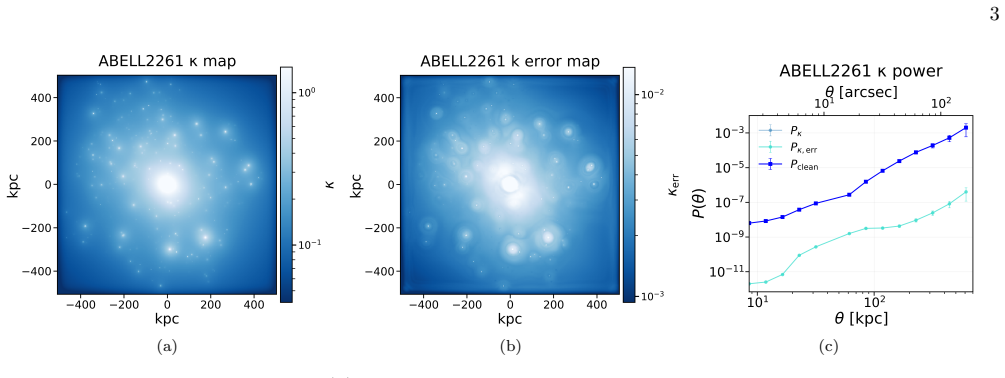
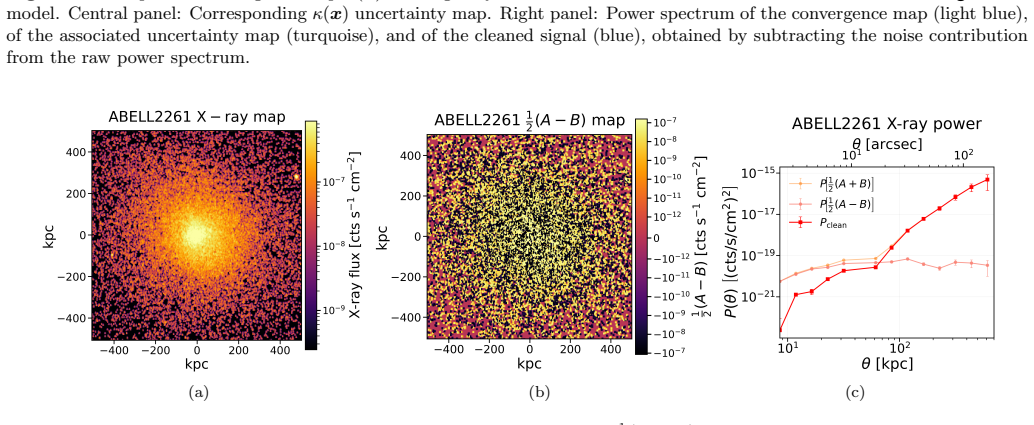
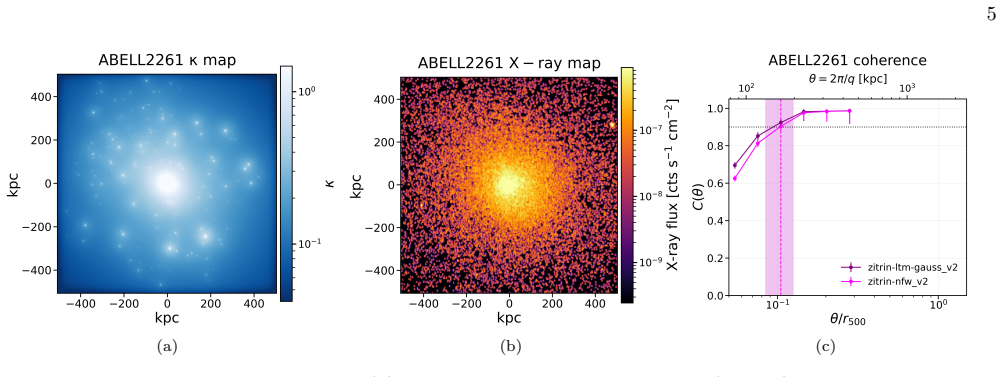
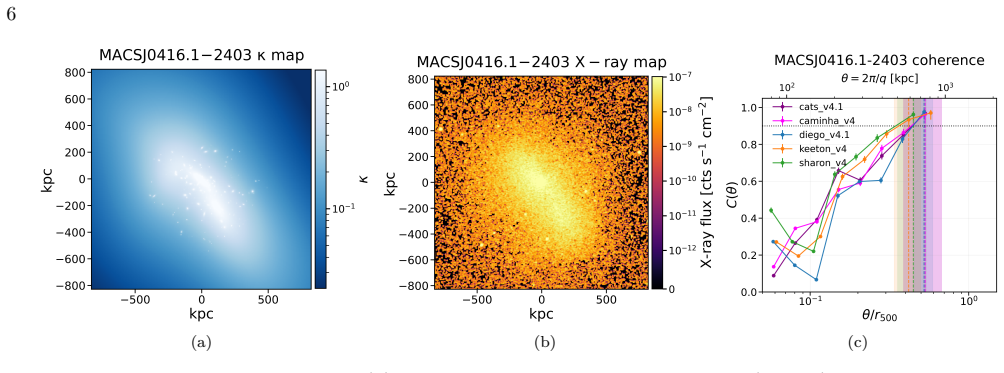
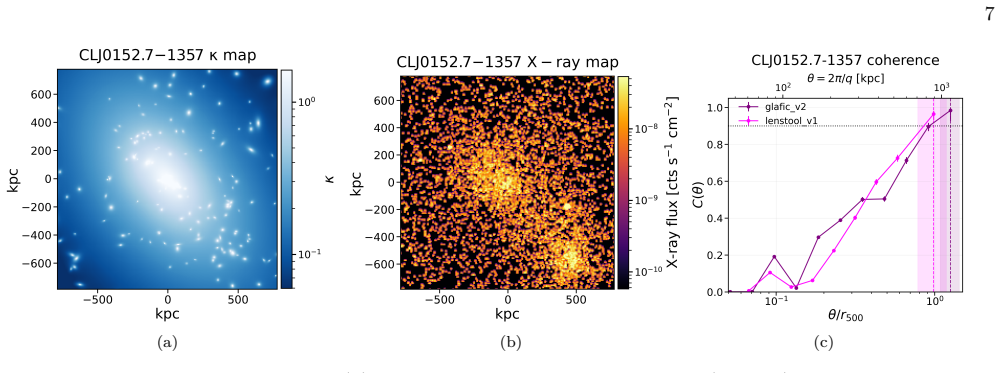
The central claim is that the Fourier-space coherence length l_CR between lensing-reconstructed projected mass and Chandra X-ray surface brightness, defined as the largest scale at which the maps stay at least 90 percent coherent, directly traces dynamical state: small l_CR/r500 marks relaxed clusters with aligned dark matter and gas, while larger values mark disturbed or merging clusters that have lost alignment on smaller scales. Across the 49-cluster sample this diagnostic yields a low relaxed fraction and identifies more disturbed systems than prior methods.
What carries the argument
The coherence length l_CR, the scale above which the lensing mass and X-ray maps remain at least 90 percent coherent in Fourier space.
If this is right
- Relaxed clusters exhibit high coherence across a wide range of scales and correspondingly small l_CR/r500.
- Disturbed and merging clusters lose coherence on intermediate and small scales, producing larger l_CR/r500.
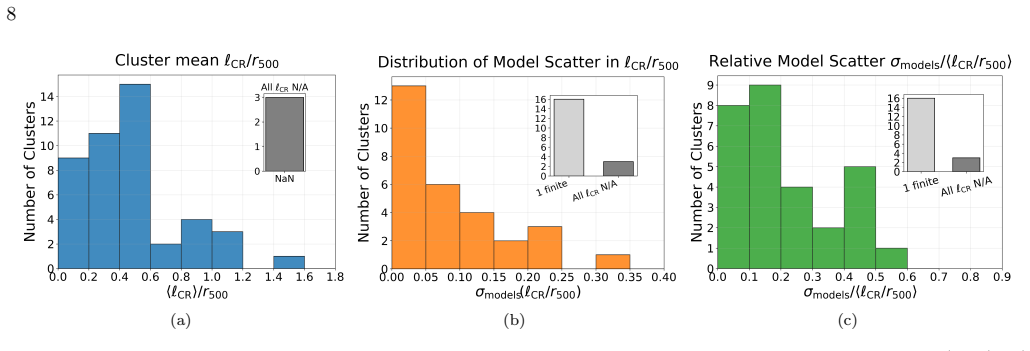
- A threshold l_CR/r500 less than 0.2 classifies 16 percent of the sample as relaxed, while less than 0.4 classifies 41 percent.
- The coherence method disagrees with previous X-ray and morphological classifications on 24 percent of systems and flags more clusters as disturbed.
Where Pith is reading between the lines
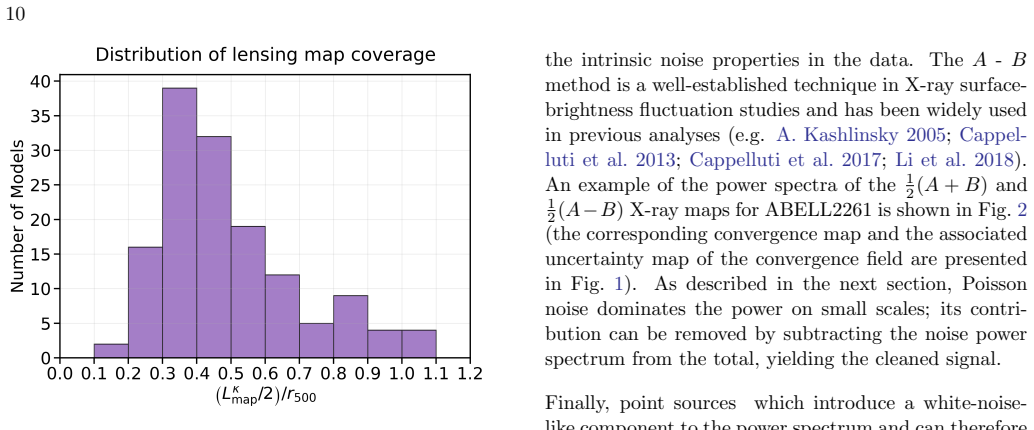
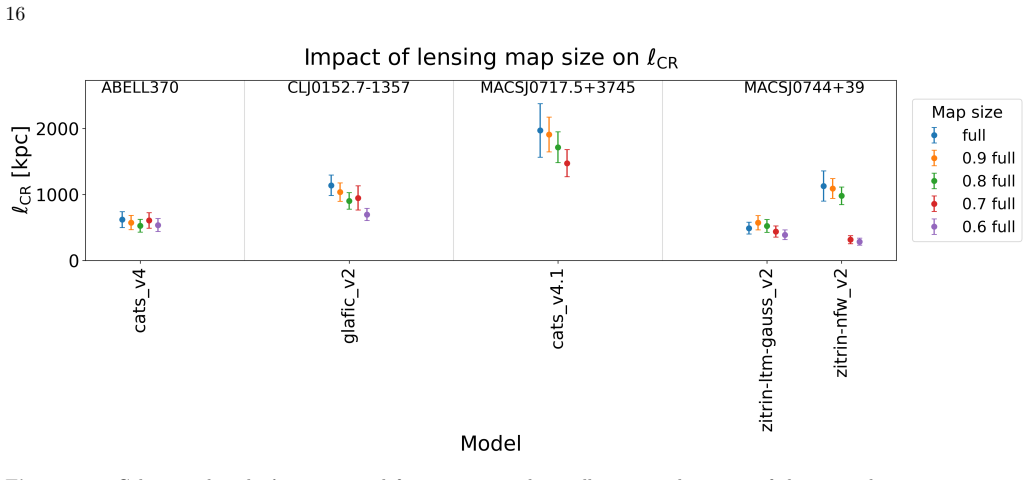
- Homogeneous wide-field weak-lensing maps would reduce the sensitivity to field-of-view and reconstruction systematics noted in the sample.
- The method could be combined with velocity or Sunyaev-Zel'dovich data to test whether the coherence signal tracks merger history more cleanly than single-wavelength proxies.
- Selecting clusters by small l_CR/r500 might improve cosmological samples by reducing contamination from unrelaxed systems whose mass estimates are biased.
Load-bearing premise
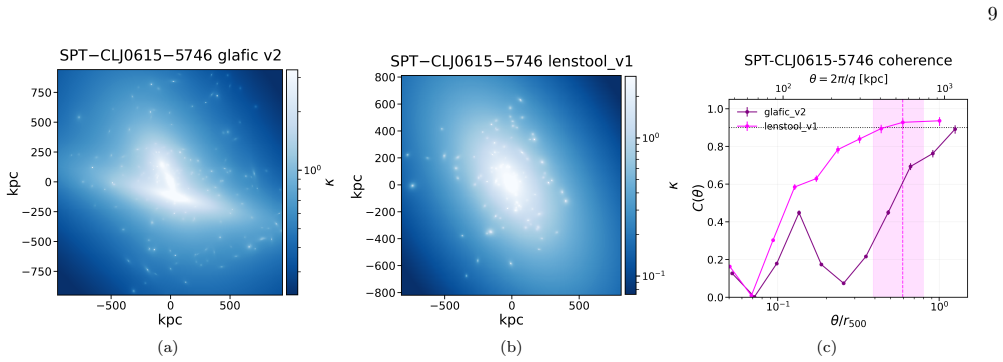
The 90-percent coherence length remains a physically meaningful diagnostic of dynamical state even when the lensing maps have uneven coverage and rest on different lens-model assumptions.
What would settle it
A direct comparison on the same clusters showing that l_CR/r500 fails to correlate with independent dynamical indicators such as line-of-sight velocity dispersion or clear merger signatures in multi-wavelength data would falsify the diagnostic.
Figures

read the original abstract
We present the first application of Fourier-space coherence analysis between the lensing-reconstructed projected mass distribution and the X-ray-emitting intracluster medium to a sample of 49 observed galaxy clusters. Using publicly available HST convergence maps from the Hubble Frontier Fields, CLASH, and RELICS programs, together with Chandra X-ray imaging, we measure the scale-dependent coherence between the dark-matter-dominated surface mass density and the hot baryonic gas. We use the coherence length, l_CR, defined as the scale above which the two maps remain at least 90% coherent, as a diagnostic of cluster dynamical state. Across the sample, dynamically relaxed systems exhibit high coherence over a broad range of scales and small l_CR/r500, while disturbed and merging systems show a loss of coherence on intermediate and small scales, yielding larger l_CR/r500. The inferred coherence lengths show sensitivity to lens-model assumptions and to the heterogeneous extent of the available convergence maps. Nevertheless, the coherence signal remains physically interpretable and provides a stringent measure of dark-matter-gas alignment. Applying a conservative threshold, l_CR/r500 < 0.2, we find that only 16% of the sample is relaxed; this fraction rises to 41% for a more permissive threshold of l_CR/r500 < 0.4. Relative to previous X-ray and morphological classifications, we find a 24% disagreement, with the coherence method identifying more systems as dynamically disturbed. These results demonstrate that lensing-X-ray coherence provides a complementary, scale-resolved probe of cluster dynamical state, while highlighting the need for homogeneous, wide-field weak-lensing maps to control reconstruction and field-of-view systematics.
Editorial analysis
A structured set of objections, weighed in public.
Referee Report
Summary. The manuscript presents the first application of Fourier-space coherence analysis between lensing-reconstructed projected mass (from HST convergence maps in HSTFF, CLASH, RELICS) and X-ray intracluster medium (Chandra) for 49 galaxy clusters. It defines a coherence length l_CR (scale where coherence >=90%) normalized by r500 as a diagnostic of dynamical state, reporting that only 16% (41%) of the sample is relaxed for conservative (permissive) thresholds l_CR/r500 <0.2 (<0.4), with 24% disagreement to previous X-ray/morphological classifications, identifying more disturbed systems.
Significance. If the coherence length remains a reliable indicator despite acknowledged systematics, this work introduces a scale-resolved, physically interpretable probe of dark matter-gas alignment that complements existing morphological and X-ray classifications. The demonstration on a sizable sample and the explicit call for homogeneous wide-field lensing maps are strengths.
major comments (1)
- [Abstract] Abstract, final paragraph: the reported relaxed fractions (16% and 41%) and 24% disagreement rate are presented as evidence that the coherence method identifies more disturbed systems, yet the text explicitly notes sensitivity to lens-model assumptions and heterogeneous map extent without providing any controlled tests (e.g., re-running the pipeline on alternate lens models or truncated common FOV) to demonstrate that these systematics do not drive the classification differences.
minor comments (1)
- [Abstract] Abstract: the 90% coherence threshold used to define l_CR and the specific relaxed cutoffs (l_CR/r500 < 0.2 and < 0.4) are introduced without accompanying justification or sensitivity tests; moving this discussion to the methods section with a brief robustness check would improve clarity.
Simulated Author's Rebuttal
We thank the referee for their constructive review and for highlighting this important point regarding the presentation of our results. We address the major comment below.
read point-by-point responses
-
Referee: [Abstract] Abstract, final paragraph: the reported relaxed fractions (16% and 41%) and 24% disagreement rate are presented as evidence that the coherence method identifies more disturbed systems, yet the text explicitly notes sensitivity to lens-model assumptions and heterogeneous map extent without providing any controlled tests (e.g., re-running the pipeline on alternate lens models or truncated common FOV) to demonstrate that these systematics do not drive the classification differences.
Authors: We agree that the absence of explicit controlled tests leaves open the possibility that the reported 24% disagreement and relaxed fractions could be influenced by the acknowledged systematics. In the revised manuscript we will add a new subsection (likely in Section 4 or 5) that performs two controlled tests on the available data: (1) for the subset of clusters with multiple independent lens models, we recompute l_CR and re-classify dynamical state to quantify model-to-model variation; (2) we truncate all convergence and X-ray maps to a common minimum field of view and repeat the full analysis pipeline, reporting the resulting changes in relaxed fractions and disagreement rate. These tests will be presented with quantitative metrics so readers can assess the robustness. The abstract will be updated to reference the new tests while retaining the existing caveats. We believe these additions directly address the concern without altering the core scientific conclusions. revision: yes
Circularity Check
No significant circularity; coherence length derived independently from maps
full rationale
The paper defines l_CR as the scale at which Fourier coherence between independent lensing mass maps and X-ray gas maps reaches 90%, then applies hand-chosen thresholds (<0.2 or <0.4) to classify dynamical state. This computation uses external data products without fitting to prior labels or reducing the result to self-citations. No self-definitional loops, fitted inputs renamed as predictions, or ansatzes smuggled via citation appear in the derivation. The 24% disagreement with X-ray/morphological classifications is an external comparison, not a forced outcome. The method remains self-contained against the maps themselves.
Axiom & Free-Parameter Ledger
free parameters (2)
- coherence threshold
- relaxed classification thresholds
axioms (2)
- domain assumption Lensing-reconstructed convergence maps accurately represent the projected total mass distribution
- domain assumption X-ray images trace the hot intracluster gas without significant projection or temperature biases affecting coherence
Reference graph
Works this paper leans on
-
[2]
2019, Astronomy & Astrophysics, 628, A86, doi: 10.1051/0004-6361/201935984
Lovisari, L. 2019, Astronomy & Astrophysics, 628, A86, doi: 10.1051/0004-6361/201935984
-
[3]
Bartelmann, M., & Schneider, P. 2001, Phys. Rept., 340, 291, doi: 10.1016/S0370-1573(00)00082-X
-
[4]
Bhattacharya, S., & Kosowsky, A. 2008, Phys. Rev. D, 77, 083004, doi: 10.1103/PhysRevD.77.083004
-
[5]
1994, ApJL, 427, L83, doi: 10.1086/187370 Bradaˇ c, M., Allen, S
Bonnet, H., Mellier, Y., & Fort, B. 1994, ApJL, 427, L83, doi: 10.1086/187370 Bradaˇ c, M., Allen, S. W., Treu, T., et al. 2008, The Astrophysical Journal, 687, 959, doi: 10.1086/591246
-
[6]
2005, The Astrophysical Journal, 621, 5388, doi: 10.1086/426494
Broadhurst, T., Benitez, N., Coe, D., et al. 2005, The Astrophysical Journal, 621, 5388, doi: 10.1086/426494
-
[7]
2020, arXiv e-prints, arXiv:2001.11067, doi: 10.48550/arXiv.2001.11067
Brough, S., Collins, C., Demarco, R., et al. 2020, arXiv e-prints, arXiv:2001.11067, doi: 10.48550/arXiv.2001.11067
-
[8]
Bulbul, E., Chiu, I.-N., Mohr, J. J., et al. 2019, The Astrophysical Journal, 871, 50, doi: 10.3847/1538-4357/aaf230
-
[9]
Buote, D. A., & Tsai, J. C. 1995, The Astrohysical Journal, 452, 522, doi: 10.1086/176326
-
[10]
Cabr, A., Fosalba, P., Gaztaaga, E., & Manera, M. 2007, Monthly Notices of the Royal Astronomical Society, 381, 1347, doi: 10.1111/j.1365-2966.2007.12280.x
-
[11]
G., Ettori, S., Lovisari, L., et al
Campitiello, M. G., Ettori, S., Lovisari, L., et al. 2022, Astronomy & Astrophysics, 665, A117, doi: 10.1051/0004-6361/202243470
-
[12]
2025, Astronomy & Astrophysics, 698, A201, doi: 10.1051/0004-6361/202452649
Capalbo, V., De Petris, M., Ferragamo, A., et al. 2025, Astronomy & Astrophysics, 698, A201, doi: 10.1051/0004-6361/202452649
-
[13]
J., Hilker M., Baumgardt H., C \^o t \'e P., Grebel E
Cappelluti, N., Ranalli, P., Roncarelli, M., et al. 2012, Monthly Notices of the Royal Astronomical Society, 427, 651, doi: 10.1111/j.1365-2966.2012.21867.x
-
[14]
Cappelluti, N., Kashlinsky, A., Arendt, R. G., et al. 2013, The Astrophysical Journal, 769, 68, doi: 10.1088/0004-637x/769/1/68
-
[15]
2017, The Astrophysical Journal, 847, L11, doi: 10.3847/2041-8213/aa8acd
Cappelluti, N., Arendt, R., Kashlinsky, A., et al. 2017, The Astrophysical Journal, 847, L11, doi: 10.3847/2041-8213/aa8acd
-
[16]
2024, The Astrophysical Journal, 967, 14, doi: 10.3847/1538-4357/ad41de
Somboonpanyakul, T. 2024, The Astrophysical Journal, 967, 14, doi: 10.3847/1538-4357/ad41de
-
[17]
2025, The Astrophysical Journal, 991, 56, doi: 10.3847/1538-4357/adf744
Cerini, G., Bellomi, E., Cappelluti, N., et al. 2025, The Astrophysical Journal, 991, 56, doi: 10.3847/1538-4357/adf744
-
[18]
Cerini, G., Cappelluti, N., & Natarajan, P. 2022, New metrics to probe the dynamical state of galaxy clusters, arXiv, doi: 10.48550/ARXIV.2209.06831
-
[19]
2018, The Astrophysical Journal, 859, 159, doi: 10.3847/1538-4357/aabe7b
Cerny, C., Sharon, K., Andrade-Santos, F., et al. 2018, The Astrophysical Journal, 859, 159, doi: 10.3847/1538-4357/aabe7b
-
[20]
Churazov, E., Vikhlinin, A., Zhuravleva, I., et al. 2012, Monthly Notices of the Royal Astronomical Society, 421, 11231135, doi: 10.1111/j.1365-2966.2011.20372.x
-
[21]
2018, Monthly Notices of the Royal Astronomical Society, 477, 139, doi: 10.1093/mnras/sty621
Cialone, G., De Petris, M., Sembolini, F., et al. 2018, Monthly Notices of the Royal Astronomical Society, 477, 139, doi: 10.1093/mnras/sty621
-
[22]
Clowe, D., Brada, M., Gonzalez, A. H., et al. 2006, The Astrophysical Journal, 648, L109L113, doi: 10.1086/508162
-
[23]
2003, The Astrophysical Journal, 584, 585, doi: 10.1086/345714
Coble, K., Dodelson, S., Dragovan, M., et al. 2003, The Astrophysical Journal, 584, 585, doi: 10.1086/345714
-
[24]
Coe, D., Salmon, B., Bradaˇ c, M., et al. 2019, The Astrophysical Journal, 884, 85, doi: 10.3847/1538-4357/ab412b De Luca, F., De Petris, M., Yepes, G., et al. 2021, MNRAS, 504, 5383, doi: 10.1093/mnras/stab1073 Di Valentino, E., Mena, O., Pan, S., et al. 2021, Classical and Quantum Gravity, 38, 153001, doi: 10.1088/1361-6382/ac086d
-
[25]
Diego, J. M., Tegmark, M., Protopapas, P., & Sandvik, H. B. 2007, MNRAS, 375, 958, doi: 10.1111/j.1365-2966.2007.11380.x
-
[26]
2017, The Astrophysical Journal, 843, L29, doi: 10.3847/2041-8213/aa7c1a
Eckert, D., Gaspari, M., Vazza, F., et al. 2017, The Astrophysical Journal, 843, L29, doi: 10.3847/2041-8213/aa7c1a
-
[27]
2021, Monthly Notices of the Royal Astronomical Society, 507, 1746, doi: 10.1093/mnras/stab1762
Eifler, T., Miyatake, H., Krause, E., et al. 2021, Monthly Notices of the Royal Astronomical Society, 507, 1746, doi: 10.1093/mnras/stab1762
-
[28]
Ettori, S., Gastaldello, F., Leccardi, A., et al. 2010, Astronomy & Astrophysics, 524, A68, doi: 10.1051/0004-6361/201015271 Euclid Collaboration, Mellier, Y., Abdurro’uf, et al. 2025, Astronomy & Astrophysics, 697, A1, doi: 10.1051/0004-6361/202450810
-
[29]
Evrard, A. E., Metzler, C. A., & Navarro, J. F. 1996, ApJ, 469, 494, doi: 10.1086/177798 22
-
[30]
Fabjan, D., Borgani, S., Tornatore, L., et al. 2010, Monthly Notices of the Royal Astronomical Society, 401, 1670, doi: 10.1111/j.1365-2966.2009.15794.x
-
[31]
1994, The Astrophysical Journal, 437, 56, doi: 10.1086/174974
Fahlman, G., Kaiser, N., Squires, G., & Woods, D. 1994, The Astrophysical Journal, 437, 56, doi: 10.1086/174974
-
[32]
Finner, K., Faisst, A., Chary, R.-R., & Jee, M. J. 2023, The Astrophysical Journal, 953, 102, doi: 10.3847/1538-4357/ace1e6
-
[33]
Finner, K., Cha, S., Scofield, Z. P., et al. 2025, The Astrophysical Journal Letters, 994, L35, doi: 10.3847/2041-8213/ae1d80
-
[34]
Fisher, R. A. 1915, Biometrika, 10, 507, doi: 10.1093/biomet/10.4.507
-
[35]
C., Allen, G
Fruscione, A., McDowell, J. C., Allen, G. E., & et al. 2006, in Proceedings of the SPIE, Vol. 6270, 62701V
2006
-
[36]
2019, Astronomy & Astrophysics, 621, A41, doi: 10.1051/0004-6361/201833325
Ghirardini, V., Eckert, D., Ettori, S., et al. 2019, Astronomy & Astrophysics, 621, A41, doi: 10.1051/0004-6361/201833325
-
[37]
Ghirardini, V., Bulbul, E., Artis, E., et al. 2024, The SRG/eROSITA All-Sky Survey: Cosmology Constraints from Cluster Abundances in the Western Galactic Hemisphere. https://arxiv.org/abs/2402.08458
-
[38]
Gill, A. S., Benton, S. J., Damaren, C. J., et al. 2024, The Astronomical Journal, 168, 85, doi: 10.3847/1538-3881/ad5840
-
[39]
2015, Science, 347, 1462, doi: 10.1126/science.1261381
Harvey, D., Massey, R., Kitching, T., Taylor, A., & Tittley, E. 2015, Science, 347, 1462, doi: 10.1126/science.1261381
-
[40]
2014, American Astronomical Society, 785, 38, doi: 10.1088/0004-637x/785/1/38
Helgason, K., Cappelluti, N., Hasinger, G., Kashlinsky, A., & Ricotti, M. 2014, American Astronomical Society, 785, 38, doi: 10.1088/0004-637x/785/1/38
-
[41]
2021, Astronomy & Astrophysics, 646, A140, doi: 10.1051/0004-6361/202039063
Heymans, Catherine, Trster, Tilman, Asgari, Marika, et al. 2021, Astronomy & Astrophysics, 646, A140, doi: 10.1051/0004-6361/202039063
-
[42]
Hickox, R. C., & Markevitch, M. 2006, The Astrophysical Journal, 645, 95, doi: 10.1086/504070
-
[43]
Hudson, D. S., Mittal, R., Reiprich, T. H., et al. 2010, Astronomy & Astrophysics, 513, A37, doi: 10.1051/0004-6361/200912377
-
[44]
Hunter, J. D. 2007, Computing in Science & Engineering, 9, 90
2007
-
[45]
2015, The Astrophysical Journal, 799, 12, doi: 10.1088/0004-637x/799/1/12
Ishigaki, M., Kawamata, R., Ouchi, M., et al. 2015, The Astrophysical Journal, 799, 12, doi: 10.1088/0004-637x/799/1/12
-
[46]
2015, MNRAS, 452, 1437, doi: 10.1093/mnras/stv1402
Jauzac, M., Richard, J., Jullo, E., et al. 2015, MNRAS, 452, 1437, doi: 10.1093/mnras/stv1402
-
[47]
Joachimi, B., Taylor, A. N., & Kiessling, A. 2011, Monthly Notices of the Royal Astronomical Society, 418, 145, doi: 10.1111/j.1365-2966.2011.19472.x
-
[48]
1984, The Astrophysical Journal, 276, 38, doi: 10.1086/161591
Jones, C., & Forman, W. 1984, The Astrophysical Journal, 276, 38, doi: 10.1086/161591
-
[49]
Jullo, E., & Kneib, J.-P. 2009, Monthly Notices of the Royal Astronomical Society, 395, 13191332, doi: 10.1111/j.1365-2966.2009.14654.x
-
[50]
2007, New Journal of Physics, 9, 447447, doi: 10.1088/1367-2630/9/12/447
Jullo, E., Kneib, J.-P., Limousin, M., et al. 2007, New Journal of Physics, 9, 447447, doi: 10.1088/1367-2630/9/12/447
-
[51]
1993, The Astrophysical Journal, 404, 441, doi: 10.1086/172297
Kaiser, N., & Squires, G. 1993, The Astrophysical Journal, 404, 441, doi: 10.1086/172297
-
[52]
2018, Reviews of Modern Physics, 90, doi: 10.1103/revmodphys.90.025006
Kashlinsky, A., Arendt, R., Atrio-Barandela, F., et al. 2018, Reviews of Modern Physics, 90, doi: 10.1103/revmodphys.90.025006
-
[53]
Kashlinsky, A., Arendt, R. G., Mather, J., & Moseley, S. H. 2005, Nature, 438, 45, doi: 10.1038/nature04143
-
[54]
2018, The Astrophysical Journal, 855, 4, doi: 10.3847/1538-4357/aaa6cf
Kawamata, R., Ishigaki, M., Shimasaku, K., et al. 2018, The Astrophysical Journal, 855, 4, doi: 10.3847/1538-4357/aaa6cf
-
[55]
2011, A&A Rv, 19, 47, doi: 10.1007/s00159-011-0047-3
Kneib, J.-P., & Natarajan, P. 2011, A&A Rv, 19, 47, doi: 10.1007/s00159-011-0047-3
-
[56]
Kravtsov, A. V., & Borgani, S. 2012, Annual Review of Astronomy and Astrophysics, 50, 353, doi: 10.1146/annurev-astro-081811-125502
-
[57]
Lau, E. T., Kravtsov, A. V., & Nagai, D. 2009, The Astrophysical Journal, 705, 1129, doi: 10.1088/0004-637X/705/2/1129
-
[58]
Lavoie, S., Willis, J. P., D´ emocl` es, J., et al. 2016, Monthly Notices of the Royal Astronomical Society, 462, 4141, doi: 10.1093/mnras/stw1906
-
[59]
Lee, W., Cha, S., Jee, M. J., et al. 2023, ApJ, 945, 71, doi: 10.3847/1538-4357/acb76b
-
[60]
Li, Y., Cappelluti, N., Arendt, R. G., et al. 2018, The Astrophysical Journal, 864, 141, doi: 10.3847/1538-4357/aad55a
-
[61]
Liesenborgs, J., De Rijcke, S., & Dejonghe, H. 2006, MNRAS, 367, 1209, doi: 10.1111/j.1365-2966.2006.10040.x
-
[62]
Lopes, P. A. A., Trevisan, M., Lagan´ a, T. F., et al. 2018, Monthly Notices of the Royal Astronomical Society, 478, 5473, doi: 10.1093/mnras/sty1374
-
[63]
M., Koekemoer, A., Coe, D., et al
Lotz, J. M., Koekemoer, A., Coe, D., et al. 2017, The Astrophysical Journal, 837, 97, doi: 10.3847/1538-4357/837/1/97
-
[64]
Lovisari, L., Forman, W. R., Jones, C., et al. 2017, The Astrophysical Journal, 846, 51, doi: 10.3847/1538-4357/aa855f
-
[65]
B., von der Linden, A., Allen, S
Mantz, A. B., von der Linden, A., Allen, S. W., et al. 2014, Monthly Notices of the Royal Astronomical Society, 446, 2205, doi: 10.1093/mnras/stu2096
-
[66]
Markevitch, M., Gonzalez, A. H., Clowe, D., et al. 2004, The Astrophysical Journal, 606, 819, doi: 10.1086/383178 23
-
[67]
McCarthy, I. G., Schaye, J., Ponman, T. J., et al. 2010, Monthly Notices of the Royal Astronomical Society, 406, 822, doi: 10.1111/j.1365-2966.2010.16750.x
-
[68]
McCleary, J. E., Everett, S. W., Shaaban, M. M., et al. 2023, The Astronomical Journal, 166, 134, doi: 10.3847/1538-3881/ace7ca
-
[69]
2010, in Proceedings of the 9th Python in Science Conference, 51–56
McKinney, W. 2010, in Proceedings of the 9th Python in Science Conference, 51–56
2010
-
[70]
1987, ApJ, 313, 121, doi: 10.1086/164953
Merritt, D. 1987, ApJ, 313, 121, doi: 10.1086/164953
-
[71]
Mohr, J. J., Fabricant, D. G., & Geller, M. J. 1993, The Astrophysical Journal, 413, 492, doi: 10.1086/173019
-
[72]
Munshi, S., Mertens, F. G., Koopmans, L. V. E., et al. 2024, Astropnomy & Astrophysics, 687, C1, doi: 10.1051/0004-6361/202450465e
-
[73]
Nagai, D., Vikhlinin, A., & Kravtsov, A. V. 2007, The Astrophysical Journal, 655, 98, doi: 10.1086/509868 NASA High Energy Astrophysics Science Archive Research Center (HEASARC). 2024, HEASoft: Unified Release of FTOOLS and XANADU, https://heasarc.gsfc.nasa.gov/docs/software/heasoft/
-
[74]
2010, PASJ, 62, 1017, doi: 10.1093/pasj/62.4.1017 pandas development team
Oguri, M. 2010, PASJ, 62, 1017, doi: 10.1093/pasj/62.4.1017 pandas development team. 2020, pandas-dev/pandas:
-
[75]
Pandas, Zenodo, doi: 10.5281/zenodo.3509134
-
[76]
2015, Astronomy & Astrophysics, 575, A127, doi: 10.1051/0004-6361/201424123
Holwerda, B. 2015, Astronomy & Astrophysics, 575, A127, doi: 10.1051/0004-6361/201424123
-
[77]
2012, The Astrophysical Journal Supplement Series, 199, 25, doi: 10.1088/0067-0049/199/2/25
Postman, M., Coe, D., Bentez, N., et al. 2012, The Astrophysical Journal Supplement Series, 199, 25, doi: 10.1088/0067-0049/199/2/25
-
[78]
Rodney, S. A. 2017, MNRAS, 465, 1030, doi: 10.1093/mnras/stw2785
-
[79]
W., Markevitch, M., Clowe, D., Gonzalez, A
Randall, S. W., Markevitch, M., Clowe, D., Gonzalez, A. H., & Bradaˇ c, M. 2008, The Astrophysical Journal, 679, 1173, doi: 10.1086/587859
-
[80]
2013, The Astronomical Review, 8, 40, doi: 10.1080/21672857.2013.11519713
Rasia, E., Meneghetti, M., & Ettori, S. 2013, The Astronomical Review, 8, 40, doi: 10.1080/21672857.2013.11519713
-
[81]
2017, Monthly Notices of the Royal Astronomical Society, 465, 569, doi: 10.1093/mnras/stw2670
Robertson, A., Massey, R., & Eke, V. 2017, Monthly Notices of the Royal Astronomical Society, 465, 569, doi: 10.1093/mnras/stw2670
discussion (0)
Sign in with ORCID, Apple, or X to comment. Anyone can read and Pith papers without signing in.