SINA: A Fully Automated Circuit Schematic Image to Netlist Generator Using Artificial Intelligence
Pith reviewed 2026-07-03 17:29 UTC · model grok-4.3
The pith
SINA converts circuit schematic images to netlists at 96.67% accuracy using an integrated AI pipeline.
A machine-rendered reading of the paper's core claim, the machinery that carries it, and where it could break.
Core claim
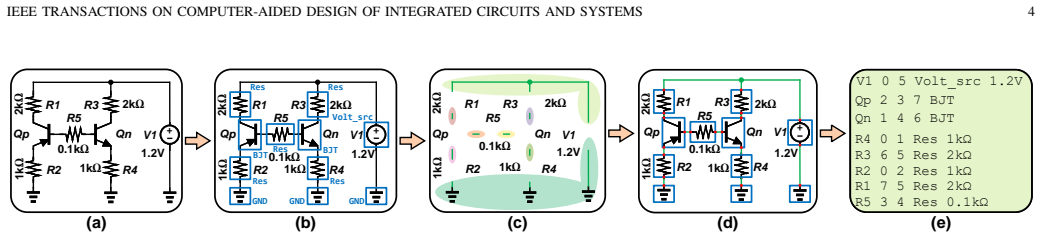
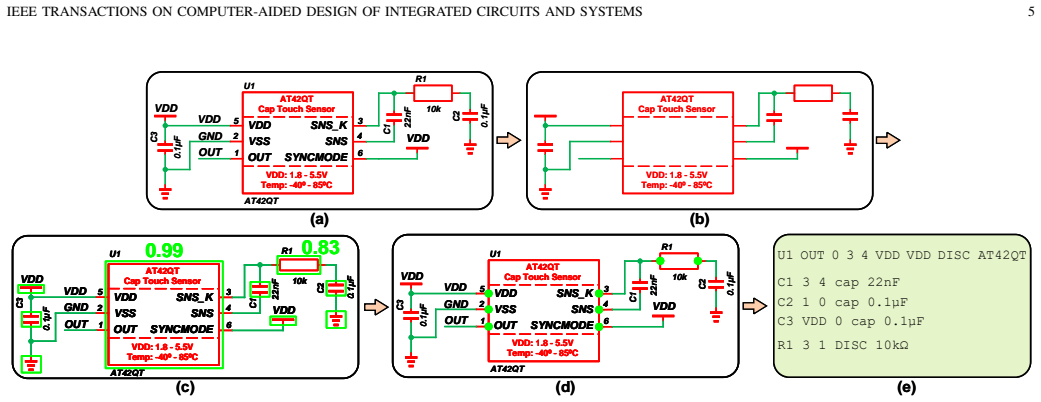
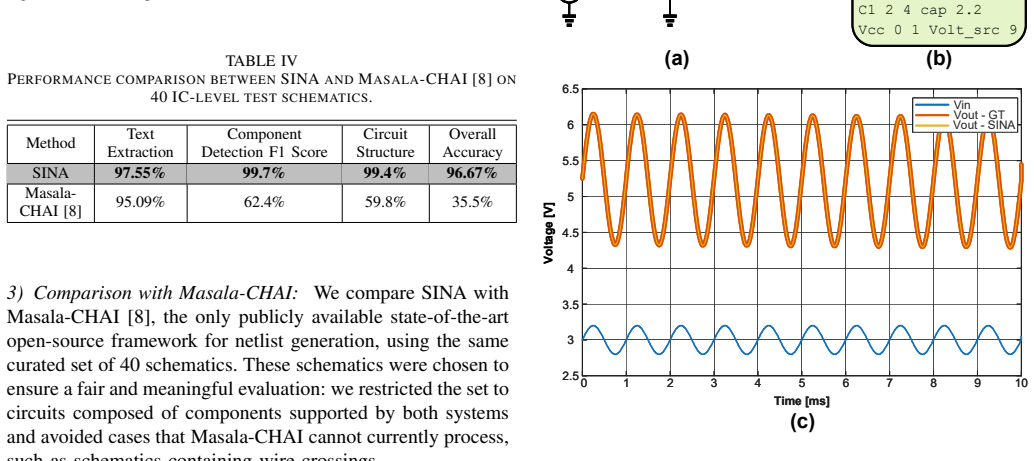
SINA is an open-source pipeline that integrates deep learning for robust component detection, connected-component labeling for accurate connectivity inference, Optical Character Recognition (OCR) for component reference designator extraction, and a Vision-Language Model (VLM) for reliable reference designator assignment. It handles both IC- and PCB-level schematics, incorporates dedicated crossing-wires detection, and validates netlists using graph isomorphism, achieving 96.67% accuracy, 2.72 times higher than state-of-the-art.
What carries the argument
The SINA pipeline combining deep learning component detection, connected-component labeling for connectivity, OCR, VLM for designator assignment, and crossing-wires detection to generate netlists from schematic images.
If this is right
- Netlists can be generated automatically from images in research manuscripts, textbooks, and websites for direct use in simulation and verification.
- Large machine-readable databases of validated circuit designs become feasible to support AI-based models in electronic design automation.
- Generalization is achieved across both integrated circuit and printed circuit board schematics without requiring manual intervention.
- Dedicated crossing-wires detection improves the reliability of connectivity extraction by correctly separating intersections from junctions.
Where Pith is reading between the lines
- The approach could accelerate creation of training datasets for large language models in circuit design by digitizing existing visual references at scale.
- Generated netlists might be fed directly into iterative design tools that combine vision models with language-based optimization.
- It could support reverse-engineering tasks by turning published diagrams into simulatable models for legacy hardware analysis.
Load-bearing premise
Graph isomorphism between generated and reference netlists is a sufficient and complete measure of correctness across all IC- and PCB-level schematics including complex analog connectivity.
What would settle it
A collection of schematic images containing complex analog circuits where the generated netlist is graph-isomorphic to the reference but produces mismatched simulation outputs due to unrepresented component values or behaviors.
Figures




read the original abstract
Recent advances in Artificial Intelligence (AI) have revolutionized Electronic Design Automation (EDA), particularly through Large Language Models (LLMs) for circuit design tasks. However, their application to analog and mixed-signal domains remains limited by the lack of machine-readable representations of existing circuit design knowledge. Circuit schematic images found in research manuscripts, textbooks, and websites constitute a vast repository of validated designs; however, these visual representations cannot be directly processed by EDA tools. Converting them into machine-readable netlists is essential for enabling simulation, verification, and building comprehensive databases for AI-based models. Current conversion methods lack generalization across both Integrated Circuit (IC) and Printed Circuit Board (PCB) level schematics. Moreover, they struggle with component recognition and connectivity inference, and fail to distinguish between connected junctions and crossing wires. In this paper, we propose SINA, an open-source circuit schematic image-to-netlist generator. SINA is a fully automated pipeline that integrates deep learning for robust component detection, connected-component labeling for accurate connectivity inference, Optical Character Recognition (OCR) for component reference designator extraction, and a Vision-Language Model (VLM) for reliable reference designator assignment. SINA handles both IC- and PCB-level schematics and incorporates dedicated crossing-wires detection to differentiate wire intersections from connections. We validate the correctness of the generated netlists using graph isomorphism techniques. Our experiments demonstrate an overall netlist generation accuracy of 96.67%, which is 2.72x higher compared to state-of-the-art approaches.
Editorial analysis
A structured set of objections, weighed in public.
Referee Report
Summary. The manuscript presents SINA, an open-source pipeline that combines deep learning for component detection, connected-component labeling for connectivity, OCR limited to reference designators, and a VLM for assignment, plus dedicated crossing-wire detection, to convert IC- and PCB-level schematic images into netlists. Correctness is assessed via graph isomorphism, with the central claim being an overall accuracy of 96.67% (2.72x higher than SOTA).
Significance. If the accuracy and generalization claims are substantiated with complete validation, the work would provide a practical tool for digitizing existing circuit knowledge from literature and websites, enabling simulation, verification, and dataset construction for AI-driven EDA in analog/mixed-signal domains. The open-source release is a positive factor for reproducibility.
major comments (2)
- [Abstract] Abstract: the central performance claim of 96.67% netlist accuracy (and the 2.72x factor) supplies no information on test-set size, diversity (IC vs. PCB, analog complexity, crossing-wire density), how accuracy was computed beyond isomorphism, or the precise SOTA baselines and their implementations, so the claim cannot be evaluated from the provided text.
- [Abstract] Abstract: validation relies exclusively on graph isomorphism between generated and reference netlists, which confirms topology and reference-designator presence but supplies no check on component-parameter extraction (resistance, capacitance, voltage ratings, etc.); the OCR stage is explicitly limited to reference designators with no parameter-parsing stage described, leaving end-to-end correctness for analog netlists unaddressed.
minor comments (1)
- [Abstract] The abstract would be strengthened by a one-sentence statement of the number and types of schematics used in the reported experiments.
Simulated Author's Rebuttal
We thank the referee for the constructive comments. We address each point below and will revise the manuscript to improve clarity on evaluation details and scope.
read point-by-point responses
-
Referee: [Abstract] Abstract: the central performance claim of 96.67% netlist accuracy (and the 2.72x factor) supplies no information on test-set size, diversity (IC vs. PCB, analog complexity, crossing-wire density), how accuracy was computed beyond isomorphism, or the precise SOTA baselines and their implementations, so the claim cannot be evaluated from the provided text.
Authors: We agree the abstract is insufficiently detailed on these aspects. In the revision we will expand the abstract to report test-set size, breakdown by IC vs. PCB and crossing-wire density, the exact graph-isomorphism procedure used for accuracy, and the specific SOTA implementations and their reported numbers that yield the 2.72x factor. These details appear in the experimental section of the full manuscript and will now be summarized in the abstract. revision: yes
-
Referee: [Abstract] Abstract: validation relies exclusively on graph isomorphism between generated and reference netlists, which confirms topology and reference-designator presence but supplies no check on component-parameter extraction (resistance, capacitance, voltage ratings, etc.); the OCR stage is explicitly limited to reference designators with no parameter-parsing stage described, leaving end-to-end correctness for analog netlists unaddressed.
Authors: The observation is correct. Graph isomorphism verifies topology and reference-designator matching but does not validate extracted component values. The manuscript states that OCR is restricted to reference designators and contains no parameter-parsing stage. The current work therefore targets connectivity and component identification rather than full parameter extraction. We will revise the abstract and scope statement to make this limitation explicit and note that parameter extraction remains future work. revision: yes
Circularity Check
No significant circularity in derivation or validation chain
full rationale
The paper presents an image-to-netlist pipeline whose core outputs (component detections, connectivity graphs, reference designator assignments) are produced by independent ML modules and then validated externally via graph isomorphism against held-out reference netlists. No equations, fitted parameters renamed as predictions, self-definitional loops, or load-bearing self-citations appear in the abstract or described method; the 96.67% accuracy figure is a direct empirical measurement on external test data rather than a quantity forced by construction from the inputs.
Axiom & Free-Parameter Ledger
Reference graph
Works this paper leans on
-
[1]
Autochip: Automating hdl generation using llm feedback.arXiv preprint arXiv:2311.04887, 2023
S. Thakuret al., “AutoChip: Automating HDL Generation Using LLM Feedback,”arXiv preprint arXiv:2311.04887, 2023
-
[2]
ChipGPT: How far are we from natural language hardware design,
K. Changet al., “ChipGPT: How far are we from natural language hardware design,”arXiv preprint arXiv:2305.14019, 2023
-
[3]
P. Abbineniet al., “MuaLLM: A Multimodal Large Language Model Agent for Circuit Design Assistance with Hybrid Contextual Retrieval- Augmented Generation,” in2026 31st Asia and South Pacific Design Automation Conference (ASP-DAC). IEEE, 2026, pp. 646–652
work page 2026
-
[4]
VeriGen: A Large Language Model for Verilog Code Generation,
S. Thakuret al., “VeriGen: A Large Language Model for Verilog Code Generation,”ACM Transactions on Design Automation of Electronic Systems, 2024
work page 2024
-
[5]
RTLLM: An Open-Source Benchmark for Design RTL Generation with Large Language Model,
Y . Lu, S. Liu, Q. Zhang, and Z. Xie, “RTLLM: An Open-Source Benchmark for Design RTL Generation with Large Language Model,” inASP-DAC, 2024, pp. 722–727
work page 2024
-
[6]
Chip-Chat: Challenges and Opportunities in Conversational Hardware Design,
J. Blocklove, S. Garg, R. Karri, and H. Pearce, “Chip-Chat: Challenges and Opportunities in Conversational Hardware Design,” inACM/IEEE 5th Workshop on Machine Learning for CAD (MLCAD), 2023, pp. 1–6
work page 2023
-
[7]
AnalogCoder: Analog Circuit Design via Training-Free Code Generation,
Y . Laiet al., “AnalogCoder: Analog Circuit Design via Training-Free Code Generation,”arXiv preprint arXiv:2405.14918, 2024
-
[8]
Masala-CHAI: A Large-Scale Spice Netlist Dataset for Analog Circuits by Harnessing AI,
J. Bhandariet al., “Masala-CHAI: A Large-Scale Spice Netlist Dataset for Analog Circuits by Harnessing AI,”arXiv preprint arXiv:2411.14299, 2025
-
[9]
M. Fayazi, Z. Colter, E. Afshari, and R. Dreslinski, “Applications of Artificial Intelligence on The Modeling and Optimization for Analog and Mixed-Signal Circuits: A Review,”IEEE TCAS-I, vol. 68, no. 6, 2021
work page 2021
-
[10]
Schemato – An LLM for Netlist-to-Schematic Conversion,
R. Matsuoet al., “Schemato – An LLM for Netlist-to-Schematic Conversion,”arXiv preprint arXiv:2411.13899, 2024
-
[11]
From schemat- ics to netlists–electrical circuit analysis using deep-learning methods,
D. Hemker, J. Maalouly, H. P. Mathis, and E. Ravanan, “From schemat- ics to netlists–electrical circuit analysis using deep-learning methods,” Advances in Radio Science, vol. 22, pp. 61–75, 2024
work page 2024
-
[12]
Hand Drawn Optical Circuit Recognition,
M. Rabbani, R. Khoshkangini, H. S. Nagendraswamy, and M. Conti, “Hand Drawn Optical Circuit Recognition,”Procedia Computer Science, vol. 84, pp. 41–48, 2016
work page 2016
-
[13]
Beyond Schematic Capture: Meaningful Abstractions for Better Electronics Design Tools,
R. Linet al., “Beyond Schematic Capture: Meaningful Abstractions for Better Electronics Design Tools,” inProceedings of the 2019 CHI Conference on Human Factors in Computing Systems, 2019, pp. 1–13
work page 2019
-
[14]
H. Zhang, S. Sun, Y . Lin, R. Wang, and J. Bian, “AnalogXpert: Automating Analog Topology Synthesis by Incorporating Circuit Design Expertise into Large Language Models,” inISEDA. IEEE, pp. 772–777, 2025
work page 2025
-
[15]
AnalogGenie: A Generative Engine for Automatic Discovery of Analog Circuit Topologies,
J. Gao, W. Cao, J. Yang, and X. Zhang, “AnalogGenie: A Generative Engine for Automatic Discovery of Analog Circuit Topologies,” inThe Thirteenth International Conference on Learning Representations, 2025
work page 2025
-
[16]
FASCINET: A Fully Automated Single-Board Com- puter Generator Using Neural Networks,
M. Fayaziet al., “FASCINET: A Fully Automated Single-Board Com- puter Generator Using Neural Networks,”IEEE TCAD, vol. 41, no. 12, pp. 5435–5448, 2022
work page 2022
-
[17]
Tablext: A combined neural network and heuristic based table extractor,
Z. Colteret al., “Tablext: A combined neural network and heuristic based table extractor,”Array, vol. 15, p. 100220, 2022
work page 2022
-
[18]
AMSNet: Netlist Dataset for AMS Circuits,
Z. Taoet al., “AMSNet: Netlist Dataset for AMS Circuits,”arXiv preprint arXiv:2405.09045, 2024
-
[19]
GANA: Graph Convolutional Network Based Auto- mated Netlist Annotation for Analog Circuits,
K. Kunalet al., “GANA: Graph Convolutional Network Based Auto- mated Netlist Annotation for Analog Circuits,” inDATE, 2020, pp. 55– 60
work page 2020
-
[20]
Hand-Drawn Electrical Circuit Recognition using Object Detection and Node Recognition,
R. R. Rachala and M. R. Panicker, “Hand-Drawn Electrical Circuit Recognition using Object Detection and Node Recognition,”SN Com- puter Science, vol. 3, p. 244, 2022
work page 2022
-
[21]
Segmentation and Recognition of Electronic Components in Hand-Drawn Circuit Diagrams,
M. Moetesumet al., “Segmentation and Recognition of Electronic Components in Hand-Drawn Circuit Diagrams,” inEAI Endorsed Trans- actions on Scalable Information Systems, vol. 5, 2018
work page 2018
-
[22]
Digitizing images of electrical-circuit schemat- ics,
J. Kelly and M. Cole, “Digitizing images of electrical-circuit schemat- ics,” inProc. ACM Symposium on Document Engineering, 2023
work page 2023
-
[23]
Img2sim-v2: A CAD Tool for User-Independent Simulation of Circuits in Image Format,
H. B. Gurbuz, M. Gul, I. Savidis, and B. Aksanli, “Img2sim-v2: A CAD Tool for User-Independent Simulation of Circuits in Image Format,” in SMACD, 2023, pp. 1–4
work page 2023
-
[24]
ElectroNet: An Enhanced Model for Small-Scale Object Detection in Electrical Schematic Diagrams,
M. Uzairet al., “ElectroNet: An Enhanced Model for Small-Scale Object Detection in Electrical Schematic Diagrams,” inSpringer LNCS, 2024
work page 2024
-
[25]
You Only Look Once: Unified, Real-Time Object Detection,
J. Redmon, S. Divvala, R. Girshick, and A. Farhadi, “You Only Look Once: Unified, Real-Time Object Detection,” inProc. CVPR, 2016, pp. 779–788
work page 2016
- [26]
-
[27]
A Symbol Recognition System for Single-Line Diagrams Developed Using a Deep- Learning Approach,
H. Bhanbhro, Y . K. Hooi, W. Kusakunniran, and Z. H. Amur, “A Symbol Recognition System for Single-Line Diagrams Developed Using a Deep- Learning Approach,”Applied Sciences, vol. 13, no. 15, p. 8816, 2023
work page 2023
-
[28]
Automated Netlist Generation from Offline Hand-Drawn Circuit Diagrams,
K. V . Reddy and S. Panicker, “Automated Netlist Generation from Offline Hand-Drawn Circuit Diagrams,” inIEEE Intl. Conf. on Image Processing (ICIP), 2021
work page 2021
-
[29]
Parsing Netlists of Integrated Circuits from Images via Graph Attention Network,
Y . Huet al., “Parsing Netlists of Integrated Circuits from Images via Graph Attention Network,”Sensors, vol. 24, no. 2, 2024
work page 2024
-
[30]
Reference Designations for Electrical and Electronics Parts and Equipment,
B. Matisoff, “Reference Designations for Electrical and Electronics Parts and Equipment,” inHandbook of Electronics Manufacturing Engineer- ing. Springer, 1997, pp. 342–365
work page 1997
-
[31]
Deep Learning for Text Detection and Recognition in Complex Engineering Diagrams,
L. Jamieson, C. F. Moreno-Garcia, and E. Elyan, “Deep Learning for Text Detection and Recognition in Complex Engineering Diagrams,” in Proc. IEEE Int. Joint Conf. on Neural Networks (IJCNN), 2020
work page 2020
-
[32]
SINA: A Circuit Schematic Image–to–Netlist Generator Using Artifi- cial Intelligence,
S. Aldowaish, Y . Karumanchi, K. Chiang, S. Noorzad, and M. Fayazi, “SINA: A Circuit Schematic Image–to–Netlist Generator Using Artifi- cial Intelligence,”arXiv preprint arXiv:2601.22114, 2026
-
[33]
Object Detection in Design Diagrams with Machine Learning,
J. K. Nurminen, E. I. J ¨a¨askel¨ainen, M. Hautam ¨aki, and J. H ¨ark¨onen, “Object Detection in Design Diagrams with Machine Learning,” in CORES, vol. 977. Springer, 2019, pp. 27–36
work page 2019
-
[34]
Y ACCLAB - Yet Another Connected Components Labeling Benchmark,
C. Grana, F. Bolelli, L. Baraldi, and R. Vezzani, “Y ACCLAB - Yet Another Connected Components Labeling Benchmark,” inInternational Conference on Pattern Recognition (ICPR), IEEE, pp. 3109–3114, 2016
work page 2016
-
[35]
R. C. Gonzalez and R. E. Woods, “Digital Image Processing,” 4th ed. Pearson, 2017
work page 2017
-
[36]
Recognition of Electrical Symbols in Document Images Using Morphology and Geometric Analysis,
P. De, S. Mandal, and P. Bhowmick, “Recognition of Electrical Symbols in Document Images Using Morphology and Geometric Analysis,” in ICIP, IEEE, pp. 1–6, 2011
work page 2011
-
[37]
Generation of Netlist from a Hand drawn Circuit through Image Processing and Machine Learning,
A. Mohan, A. Mohan, B. Indushree, M. Malavikaa, and C. Narendra, “Generation of Netlist from a Hand drawn Circuit through Image Processing and Machine Learning,” inAISP, IEEE, pp. 1–4, 2022
work page 2022
-
[38]
Research on K nearest neighbor identifica- tion of hand-drawn circuit diagram,
Z. Huoming and S. Lixing, “Research on K nearest neighbor identifica- tion of hand-drawn circuit diagram,” inJournal of Physics: Conference Series, IOP Publishing, p. 012233, 2019
work page 2019
-
[39]
G. Bradski and A. Kaehler,Learning OpenCV 2: Computer Vision with the OpenCV Library. O’Reilly Media, Inc., 2010
work page 2010
-
[40]
An Overview of the Tesseract OCR Engine,
R. Smith, “An Overview of the Tesseract OCR Engine,” inProc. Intl. Conf. on Document Analysis and Recognition (ICDAR), 2007
work page 2007
-
[41]
Offline hand-drawn circuit component recognition using texture and shape-based features,
S. Roy, A. Bhattacharya, N. Sarkar, S. Malakar, and R. Sarkar, “Offline hand-drawn circuit component recognition using texture and shape-based features,”Multimedia Tools and Applications, vol. 79, 2020
work page 2020
-
[42]
P. Veli ˇckovi´cet al., “Graph Attention Networks,”arXiv preprint arXiv:1710.10903, 2017
work page internal anchor Pith review Pith/arXiv arXiv 2017
-
[43]
EasyOCR: Ready-to-use OCR with 80+ Languages Sup- ported,
JaidedAI, “EasyOCR: Ready-to-use OCR with 80+ Languages Sup- ported,” https://github.com/JaidedAI/EasyOCR, 2020
work page 2020
-
[44]
Deep Learning-Based Framework for Power Converter Circuit Identification and Analysis,
R. Bohara and V . Krishnamoorthy, “Deep Learning-Based Framework for Power Converter Circuit Identification and Analysis,”IEEE Trans. Industrial Electronics, 2022
work page 2022
-
[45]
T. Nakura, “Spice Simulation,” inEssential Knowledge for Transistor- Level LSI Circuit Design. Springer, 2016, pp. 19–47
work page 2016
-
[46]
J. Achiamet al., “GPT-4 Technical Report,”arXiv preprint arXiv:2303.08774, 2023
work page internal anchor Pith review Pith/arXiv arXiv 2023
-
[47]
P. R. Gray, P. J. Hurst, S. H. Lewis, and R. G. Meyer,Analysis and Design of Analog Integrated Circuits. John Wiley & Sons, 2009
work page 2009
-
[48]
Ngspice User’s Manual Version 23,
P. Nenzi and H. V ogt, “Ngspice User’s Manual Version 23,” 2011
work page 2011
-
[49]
M. Bertalmio, G. Sapiro, V . Caselles, and C. Ballester, “Image In- painting,” inProceedings of the 27th annual conference on Computer graphics and interactive techniques, pp. 417–424, 2000
work page 2000
-
[50]
Circuit Diagram Retrieval Based on Hierarchical Circuit Graph Representation,
M. Gaoet al., “Circuit Diagram Retrieval Based on Hierarchical Circuit Graph Representation,”arXiv preprint arXiv:2503.11658, 2024
-
[51]
Context Attention Network for skeleton Extraction,
Z. Huanget al., “Context Attention Network for skeleton Extraction,” inProceedings of the IEEE/CVF Conference on Computer Vision and Pattern Recognition Workshops (CVPRW), 2022
work page 2022
-
[52]
A Survey on Image Data Aug- mentation for Deep Learning,
C. Shorten and T. M. Khoshgoftaar, “A Survey on Image Data Aug- mentation for Deep Learning,”Journal of Big Data, vol. 6, pp. 1–48, 2019
work page 2019
-
[53]
YOLOv11: An Overview of the Key Architectural Enhancements
R. Khanam and M. Hussain, “YOLOv11: An Overview of the Key Architectural Enhancements,”arXiv preprint arXiv:2410.17725, 2024
work page internal anchor Pith review Pith/arXiv arXiv 2024
-
[54]
Exploring network structure, dynamics, and function using NetworkX,
A. Hagberg, P. J. Swart, and D. A. Schult, “Exploring network structure, dynamics, and function using NetworkX,” inSciPy2008, pp. 11–15, 2007
work page 2007
-
[55]
RS-YOLO: An efficient object detection algorithm for road scenes,
B. Jiao, Y . Wang, P. Wang, H. Wang, and H. Yue, “RS-YOLO: An efficient object detection algorithm for road scenes,”Digital Signal Processing, vol. 157, p. 104889, 2025
work page 2025
-
[56]
The Hungarian method for the assignment problem,
H. W. Kuhn, “The Hungarian method for the assignment problem,” Naval Research Logistics Quarterly, vol. 2, no. 1-2, pp. 83–97, 1955. IEEE TRANSACTIONS ON COMPUTER-AIDED DESIGN OF INTEGRATED CIRCUITS AND SYSTEMS 10 Saoud Aldowaishis a Research Assistant at the University of Utah, specializing in machine learn- ing, computer vision, and AI-driven automation...
work page 1955
-
[57]
Mohammed Ayman Habibwas born in Bengaluru, India
His academic focus lies in machine learning and software engineering, with a particular interest in applying these technologies to real-world chal- lenges such as autonomous systems and networked devices. Mohammed Ayman Habibwas born in Bengaluru, India. He received the B.E degree major in Electrical and Electronics Engineering from Ramaiah Institute of T...
work page 2021
discussion (0)
Sign in with ORCID, Apple, or X to comment. Anyone can read and Pith papers without signing in.