Particle dynamics and quasi-periodic oscillations of a Reissner--Nordstr\"om-like black hole in Kalb--Ramond gravity under an external magnetic test field
Pith reviewed 2026-07-03 08:51 UTC · model grok-4.3
The pith
A Kalb-Ramond black hole with charge and external magnetic field reproduces observed twin-peak QPO frequencies from three sources via the relativistic precession model.
A machine-rendered reading of the paper's core claim, the machinery that carries it, and where it could break.
Core claim
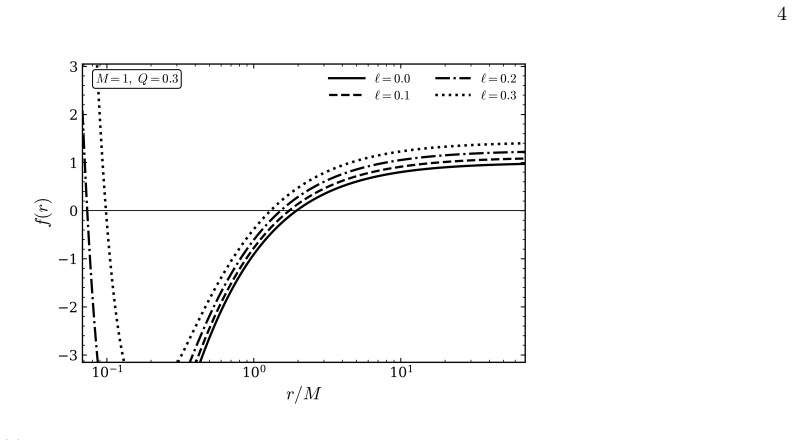
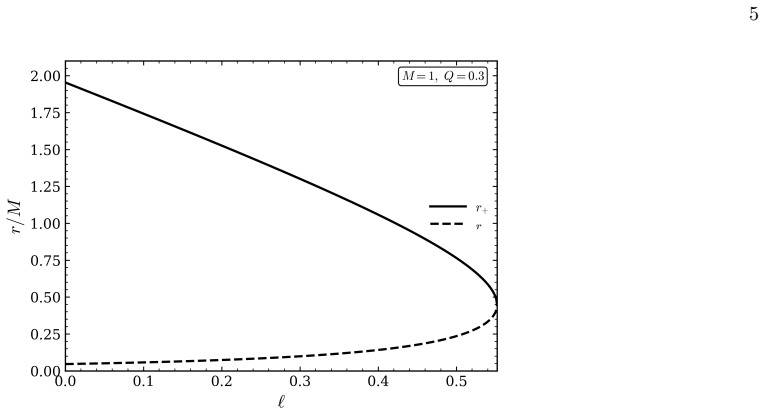
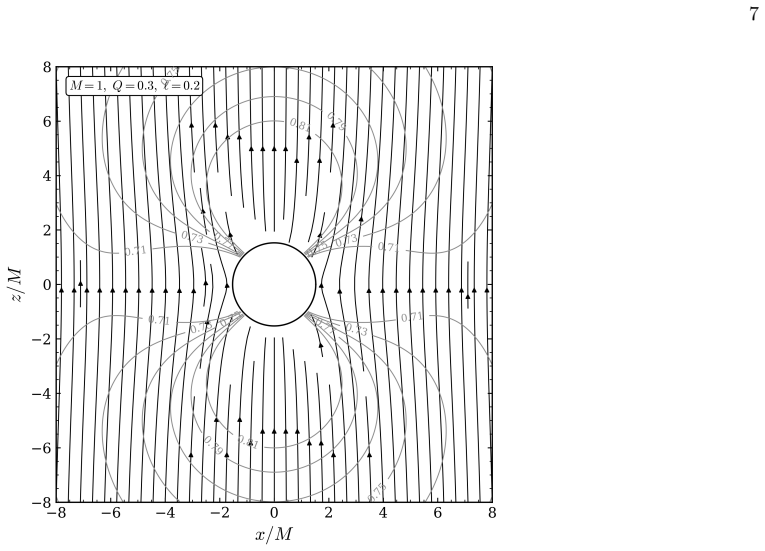
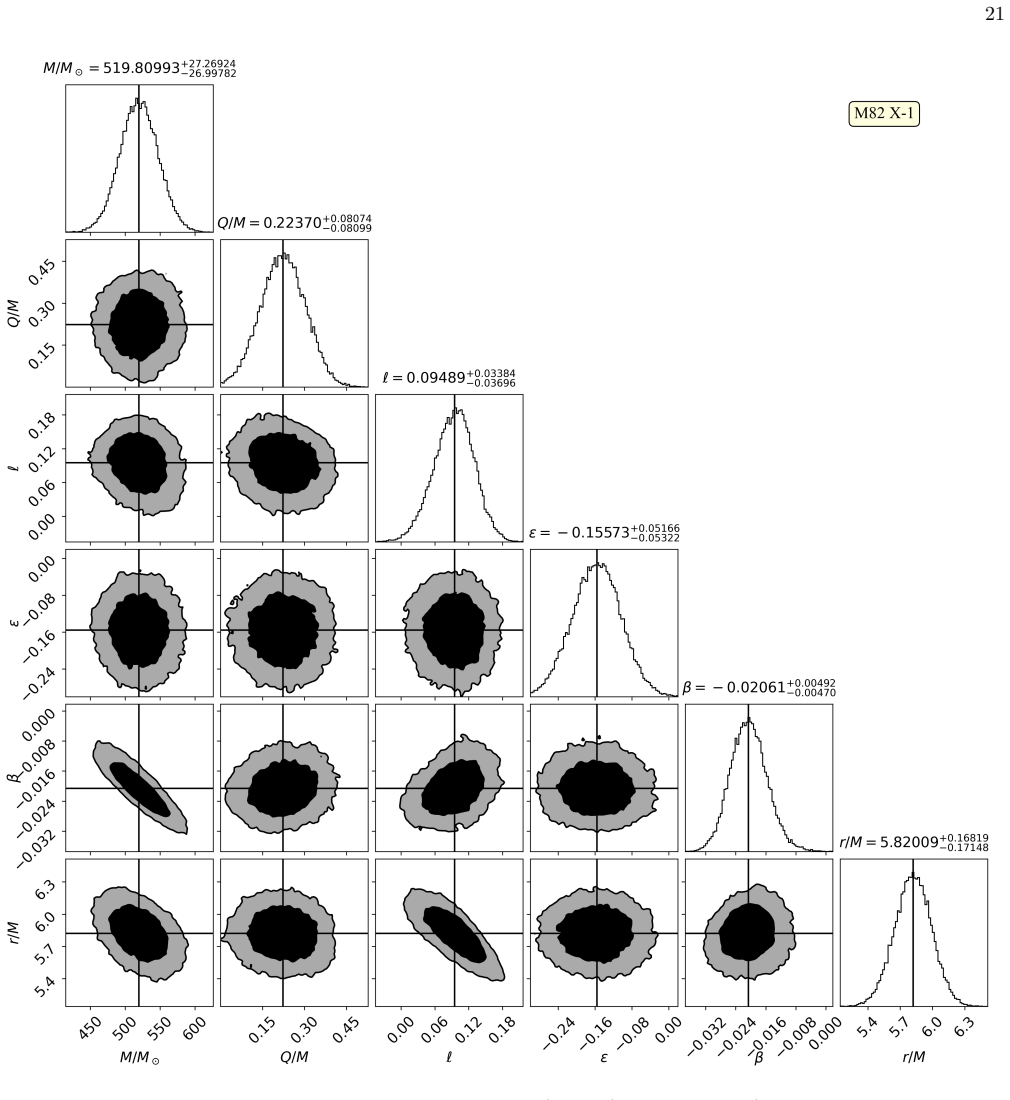
In the charged Kalb-Ramond black-hole spacetime the Lorentz-violating parameter ℓ modifies the line element, horizon radii, and geodesic motion; the magnetic field is obtained by solving the source-free Maxwell equations on this geometry rather than by the standard Wald prescription. The resulting orbital frequency and periastron-precession frequency, when identified with the upper and lower QPO peaks, permit posterior distributions on the four parameters (Q/M, ℓ, ε, β) that are consistent with the measured frequencies of the three named sources.
What carries the argument
The Lorentz-violating parameter ℓ that deforms the Reissner-Nordström-like metric and permits a geometry-adapted magnetic-field profile whose strength enters the Lorentz force on charged particles.
If this is right
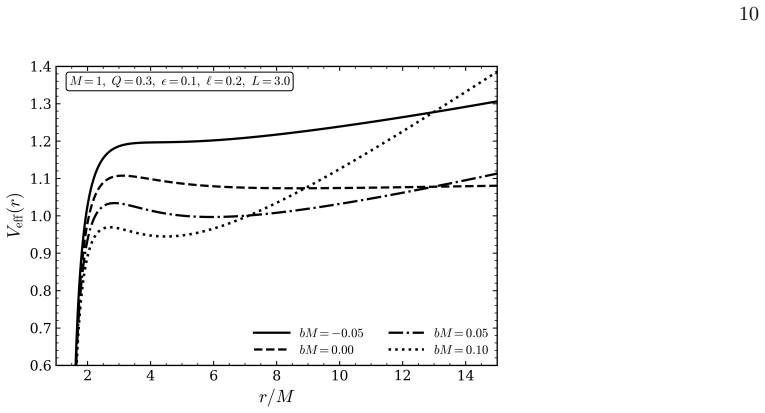
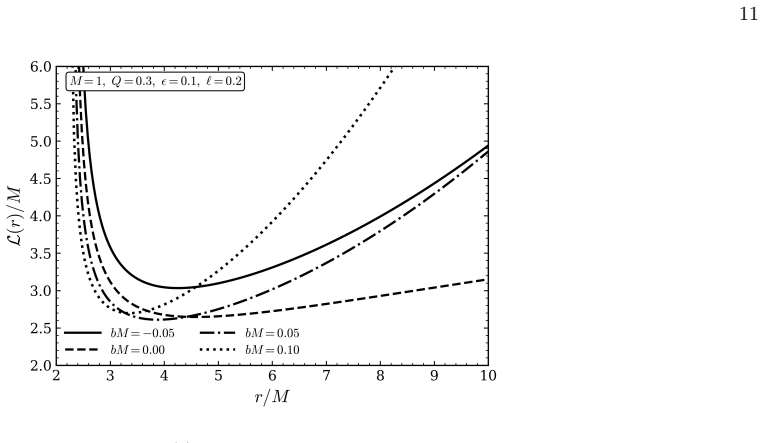
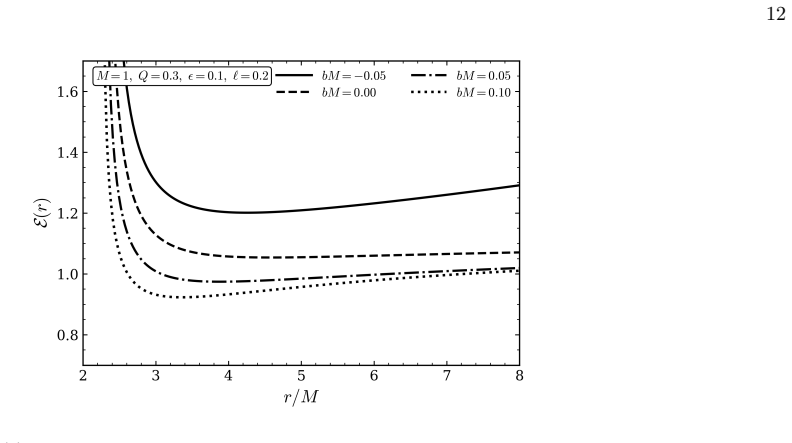
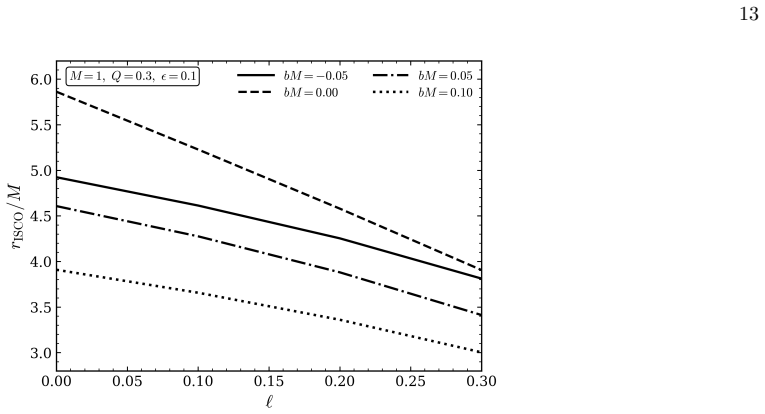
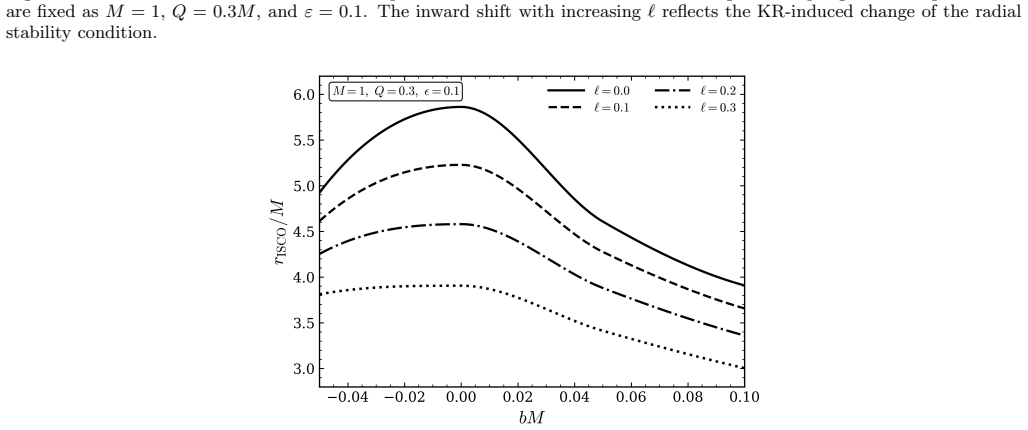
- The location of the innermost stable circular orbit depends jointly on black-hole charge Q/M, KR parameter ℓ, particle charge ε, and magnetic coupling β.
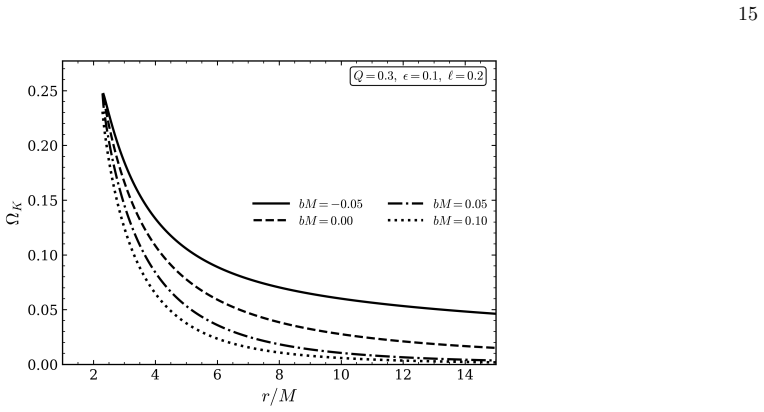
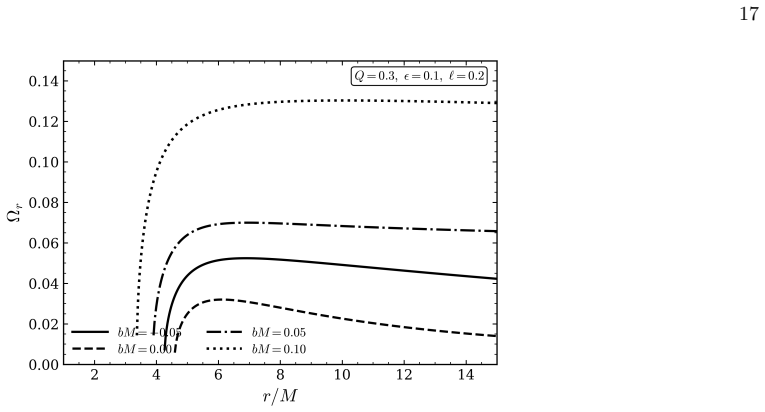
- Both the orbital frequency and the radial epicyclic frequency shift when any of the four parameters is varied.
- Markov chain Monte Carlo sampling produces posterior constraints on all four parameters from the QPO data of the three sources.
- The charged KR model with the adapted magnetic field reproduces the observed QPO pairs inside the sampled ranges.
Where Pith is reading between the lines
- The same frequency expressions could be applied to additional X-ray binaries to test whether the same narrow ranges of ℓ remain viable.
- Higher-precision timing from future missions could tighten bounds on ℓ independently of electromagnetic charge effects.
- The adapted magnetic-field construction may alter accretion-disk stability criteria beyond the test-particle level.
- Comparison with QPO data in other modified-gravity spacetimes would reveal whether the KR deformation is uniquely compatible with the observed pairs.
Load-bearing premise
The relativistic precession model correctly identifies the upper observed QPO frequency with the orbital frequency and the lower one with the periastron-precession frequency computed in the modified spacetime.
What would settle it
A recomputation of the orbital and periastron-precession frequencies at the best-fit MCMC parameter values that yields values lying outside the 1σ error bars of any of the three observed QPO pairs would falsify the reported consistency.
Figures


read the original abstract
We investigate the dynamics of charged test particles and quasi-periodic oscillations around a Reissner--Nordstr\"om-like black hole in Kalb--Ramond (KR) gravity in the presence of an external magnetic test field. The KR background introduces a Lorentz-violating parameter $\ell$, which modifies the spacetime geometry, horizon structure, circular orbits, and characteristic frequencies of particle motion. In contrast to the standard Wald-type prescription, the magnetic-field configuration is constructed from the source-free Maxwell equation on the charged KR background, allowing the magnetic profile to be consistently adapted to the modified geometry. We derive the equations of motion, the effective potential, the conditions for circular orbits, and the orbital and radial epicyclic frequencies of charged particles. The results show that the black-hole charge $Q/M$, the KR parameter $\ell$, the specific particle charge $\epsilon$, and the magnetic coupling $\beta=bM$ jointly affect the innermost stable circular orbit (ISCO) and the quasi-periodic oscillation (QPO) frequencies. We then apply the obtained frequencies to the relativistic precession model, where the upper QPO frequency is identified with the orbital frequency and the lower one with the periastron-precession frequency. Using the observed twin-peak QPO data of GRO J1655--40, XTE J1550--564, and M82 X-1, we perform a Markov chain Monte Carlo analysis to constrain the model parameters. The obtained posterior constraints indicate that the charged KR black-hole model with an external magnetic field can consistently reproduce the observed QPO pairs within the adopted parameter ranges. These findings suggest that QPO observations may serve as a useful phenomenological tool for probing Lorentz-violating black-hole geometries and electromagnetic effects in strong-gravity environments.
Editorial analysis
A structured set of objections, weighed in public.
Referee Report
Summary. The paper derives the equations of motion, effective potential, circular orbit conditions, and orbital/radial epicyclic frequencies for charged test particles around a charged Reissner-Nordström-like black hole in Kalb-Ramond gravity with an external magnetic test field (constructed via source-free Maxwell equations on the modified background). It applies the relativistic precession model (upper QPO = orbital frequency, lower = periastron precession) and performs MCMC fitting of the four parameters (ℓ, Q/M, ε, β) to twin-peak QPO data from GRO J1655-40, XTE J1550-564, and M82 X-1, concluding that the model reproduces the observations within the adopted ranges.
Significance. If the frequency derivations hold, the work provides a concrete phenomenological framework for constraining Lorentz-violating effects and electromagnetic couplings in strong gravity using QPO data. The consistent adaptation of the magnetic field to the KR geometry and the MCMC posteriors are strengths. However, the reproduction is achieved by direct parameter adjustment to the same observations, so the result demonstrates viability rather than independent predictive power.
major comments (1)
- [abstract] The central claim of consistent reproduction rests on MCMC fitting of the four free parameters (ℓ, Q/M, ε, β) directly to the observed frequency pairs. This procedure necessarily yields acceptable posteriors if the model is sufficiently flexible, but the abstract presents it as a test of the spacetime rather than a fit (abstract and MCMC analysis).
minor comments (1)
- [abstract] The mapping from derived frequencies to observed QPOs assumes the standard relativistic precession model without explicit validation or sensitivity checks in the modified metric; this is standard but should be stated as an assumption.
Simulated Author's Rebuttal
We thank the referee for the constructive comments. We address the single major comment below and agree that a revision to the abstract is warranted to avoid any implication of an independent test.
read point-by-point responses
-
Referee: [abstract] The central claim of consistent reproduction rests on MCMC fitting of the four free parameters (ℓ, Q/M, ε, β) directly to the observed frequency pairs. This procedure necessarily yields acceptable posteriors if the model is sufficiently flexible, but the abstract presents it as a test of the spacetime rather than a fit (abstract and MCMC analysis).
Authors: We agree that the abstract wording risks overstating the result as a test of the spacetime geometry rather than a demonstration of viability via direct fitting. The MCMC analysis constrains the four parameters to values that allow the model to match the observed frequency pairs from the three sources; this is a consistency check within the model's flexibility, not an a priori prediction. We will revise the abstract (and the corresponding sentence in the conclusions) to state explicitly that the posteriors show the charged KR model with magnetic field can reproduce the data within the adopted ranges, thereby clarifying the phenomenological nature of the constraint. revision: yes
Circularity Check
No significant circularity: standard parameter fitting to QPO data after independent frequency derivation
full rationale
The paper derives orbital and epicyclic frequencies from the modified KR metric (with parameters ℓ, Q/M, ε, β) using the effective potential and geodesic equations. It then applies the standard relativistic precession model (upper QPO = orbital freq, lower = periastron precession) and performs MCMC to constrain those parameters against observed frequencies from three sources. This is a conventional phenomenological fit to constrain model parameters and demonstrate consistency within ranges; the paper does not present the frequency match as an independent prediction or first-principles result. No self-definitional steps, fitted inputs renamed as predictions, or load-bearing self-citations appear in the abstract or described procedure. The central claim reduces to showing that acceptable posteriors exist, which is tautological only in the trivial sense of any fit but does not meet the criteria for circularity (no quoted reduction of a claimed derivation to its own inputs by construction).
Axiom & Free-Parameter Ledger
free parameters (4)
- ℓ
- Q/M
- ε
- β = bM
axioms (3)
- domain assumption The background is the Reissner-Nordström-like metric of Kalb-Ramond gravity
- domain assumption Magnetic field is obtained from the source-free Maxwell equation on the KR background
- domain assumption Relativistic precession model correctly identifies upper QPO with orbital frequency and lower QPO with periastron precession
invented entities (1)
-
Kalb-Ramond Lorentz-violating parameter ℓ
no independent evidence
Reference graph
Works this paper leans on
-
[1]
V. A. Kosteleck´ y and S. Samuel, Physical Review D39, 683 (1989)
1989
-
[2]
V. A. Kosteleck´ y and S. Samuel, Physical Review D40, 1886 (1989)
1989
-
[3]
Amelino-Camelia, J
G. Amelino-Camelia, J. Ellis, N. E. Mavromatos, D. V. Nanopoulos, and S. Sarkar, Nature393, 763 (1998)
1998
-
[4]
Mattingly, Living Reviews in Relativity8, 5 (2005)
D. Mattingly, Living Reviews in Relativity8, 5 (2005)
2005
-
[5]
Bertolami, J
O. Bertolami, J. G. Rosa, C. M. L. de Arag˜ ao, P. Castorina, and D. Zapall` a, Physical Review D72, 025010 (2005)
2005
-
[6]
Kanno, M
S. Kanno, M. Kimura, J. Soda, and S. Yokoyama, Journal of Cosmology and Astroparticle Physics2008, 034
-
[7]
S. M. Carroll and E. A. Lim, Physical Review D70, 123525 (2004)
2004
-
[8]
Colladay and V
D. Colladay and V. A. Kosteleck´ y, Physical Review D58, 116002 (1998)
1998
-
[9]
V. A. Kosteleck´ y, Physical Review D69, 105009 (2004)
2004
-
[10]
O’Neal-Ault, Q
K. O’Neal-Ault, Q. G. Bailey, and N. A. Nilsson, Physical Review D103, 044010 (2021)
2021
-
[11]
A. A. A. Filho, N. Heidari, and I. P. Lobo, Physics Letters B875, 140350 (2026)
2026
-
[12]
K. Abe, Y. Haga, Y. Hayato, M. Ikeda, K. Iyogi, J. Kameda, Y. Kishimoto, M. Miura, S. Moriyama,et al., Physical Review D91, 052003 (2015)
2015
-
[13]
Bluhm and V
R. Bluhm and V. A. Kosteleck´ y, Physical Review D71, 065008 (2005)
2005
-
[14]
Capelo and J
D. Capelo and J. P´ aramos, Physical Review D91, 104007 (2015)
2015
-
[15]
Casana, A
R. Casana, A. Cavalcante, F. P. Poulis, and E. B. Santos, Physical Review D97, 104001 (2018)
2018
-
[16]
C. F. S. Pereira, M. V. de S. Silva, H. Belich, D. C. Rodrigues, J. C. Fabris, and M. E. Rodrigues, Physical Review D 111, 124005 (2025)
2025
-
[17]
L. A. Lessa, R. B. Magalh˜ aes, and M. M. F. Jr, Physical Review D112, 064031 (2025)
2025
-
[18]
X. Zhu, R. Xu, and D. Xu, Physics of the Dark Universe50, 102127 (2025)
2025
-
[19]
X. Lai, Y. Dong, Y. Fan, and Y. Liu, Physical Review D113, 044003 (2026)
2026
-
[20]
R. V. Maluf and J. C. S. Neves, Physical Review D103, 044002 (2021)
2021
-
[21]
Kalb and P
M. Kalb and P. Ramond, Physical Review D9, 2273 (1974)
1974
-
[22]
K. Yang, Y. Chen, Z. Duan, and J. Zhao, Physical Review D108, 124004 (2023)
2023
-
[23]
Z.-Q. Duan, J.-Y. Zhao, and K. Yang, European Physical Journal C84, 798 (2024), arXiv:2310.13555
-
[24]
E. L. B. Junior, J. T. S. S. Junior, F. S. N. Lobo, M. E. Rodrigues, D. Rubiera-Garcia, L. F. D. da Silva, and H. A. Vieira, European Physical Journal C84, 1257 (2024)
2024
-
[25]
E. L. B. Junior, J. T. S. S. Junior, F. S. N. Lobo, M. E. Rodrigues, D. Rubiera-Garcia, L. F. D. da Silva, and H. A. Vieira, Physical Review D110, 024077 (2024)
2024
-
[26]
E. L. B. Junior, J. T. S. S. Junior, F. S. N. Lobo, M. E. Rodrigues, D. Rubiera-Garcia, L. F. D. da Silva, and H. A. Vieira, European Physical Journal C85, 557 (2025)
2025
-
[27]
D. S. J. Cordeiro, E. L. B. Junior, J. T. S. S. Junior, F. S. N. Lobo, M. E. Rodrigues, D. Rubiera-Garcia, L. F. D. da Silva, and H. A. Vieira, Physical Review D112, 104018 (2025)
2025
-
[28]
D. S. J. Cordeiro, E. L. B. Junior, J. T. S. S. Junior, F. S. N. Lobo, J. A. A. Ramos, M. E. Rodrigues, D. Rubiera-Garcia, L. F. D. da Silva, and H. A. Vieira, European Physical Journal C85, 1141 (2025)
2025
-
[29]
Al-Badawi, F
A. Al-Badawi, F. Ahmed, and I. Sakalli, Phys. Dark Univ.50, 102076 (2025)
2025
-
[30]
Al-Badawi, S
A. Al-Badawi, S. Sanjar, and I. Sakalli, Eur. Phys. J C84, 825 (2024)
2024
-
[31]
Ahmed, A
F. Ahmed, A. Al-Badawi, and I. Sakalli, Mod. Phys. Lett. A41, 2650061 (2026)
2026
-
[32]
Ahmed, A
F. Ahmed, A. Al-Badawi, I. Sakalli, F. Javed, and S. Kanzi, Int. J Geom. Meth. Mod. Phys. , 2650130 (2026), online first
2026
-
[33]
Ahmed, A
F. Ahmed, A. Al-Badawi, and I. Sakalli, Physics of the Dark Universe52, 102315 (2026)
2026
-
[34]
Jumaniyozov, S
S. Jumaniyozov, S. Murodov, J. Rayimbaev, I. Ibragimov, B. Madaminov, S. Urinbaev, and A. Abdujabbarov, European Physical Journal C85(2025), cited by: 27; All Open Access; Gold Open Access; Green Open Access
2025
-
[35]
Rahmatov, I
B. Rahmatov, I. Egamberdiev, S. Murodov, J. Rayimbaev, I. Ibragimov, E. Davletov, and S. Djumanov, Physics of the Dark Universe50(2025), cited by: 8
2025
-
[36]
Jumaniyozov, M
S. Jumaniyozov, M. Zahid, M. Alloqulov, I. Ibragimov, J. Rayimbaev, and S. Murodov, European Physical Journal C85 (2025), cited by: 50; All Open Access; Gold Open Access; Green Open Access
2025
-
[37]
Rahmatov, I
B. Rahmatov, I. Egamberdiev, O. Umarov, M. Vapayev, S. Karshiboev, Y. Turaev, and S. Murodov, Nuclear Physics B 1022(2026), cited by: 8; All Open Access; Gold Open Access; Green Open Access
2026
-
[38]
Rahmatov, S
B. Rahmatov, S. Murodov, J. Rayimbaev, Y. Turaev, I. Egamberdiev, K. Badalov, S. Ahmedov, and S. Usanov, Annals of Physics488(2026), cited by: 7
2026
-
[39]
Saydullayev, I
S. Saydullayev, I. Nishonov, M. Dusaliyev, O. Xoldorov, S. Murodov, S. Karshiboev, S. Urinov, and B. Rahmatov, European Physical Journal C85(2025), cited by: 4; All Open Access; Gold Open Access; Green Open Access
2025
-
[40]
Rahmatov, I
B. Rahmatov, I. Nishonov, S. Murodov, I. Egamberdiev, O. Umarov, S. Karshiboev, M. Vapayev, and M. Matyoqubov, Physics of the Dark Universe52(2026), cited by: 6. 25
2026
-
[41]
Meliyeva, O
L. Meliyeva, O. Xoldorov, O. Tursunboyev, S. Karshiboev, S. Murodov, I. Nishonov, and B. Rahmatov, Chinese Physics C49(2025), cited by: 3
2025
-
[42]
R. M. Zulqarnain, A. Ashraf, A. Bouzenada, E. Demir, E. G¨ udekli, S. Murodov, and F. Atamurotov, International Journal of Geometric Methods in Modern Physics (2026), cited by: 0
2026
-
[43]
Shermatov, J
A. Shermatov, J. Rayimbaev, S. Murodov, B. C. L¨ utf¨ uo˘ glu, B. Ahmedov, M. Zahid, I. Ibragimov, and B. Shermatov, Physics of the Dark Universe50(2025), cited by: 5
2025
-
[44]
S. U. Khan, J. Rayimbaev, H. Hayat, Z.-M. Chen, M. Abdullaev, S. Murodov, and W. Wang, European Physical Journal C86(2026), cited by: 0; All Open Access; Gold Open Access; Green Open Access
2026
-
[45]
Nishonov, S
I. Nishonov, S. Murodov, B. Ahmedov, S. U. Khan, J. Rayimbaev, I. Ibragimov, and S. Sabirov, European Physical Journal C85(2025), cited by: 9; All Open Access; Gold Open Access; Green Open Access
2025
-
[46]
Rahmatov, S
B. Rahmatov, S. Murodov, J. Rayimbaev, S. Muminov, I. Ibragimov, and R. Eshburiev, Physics of the Dark Universe50 (2025), cited by: 7
2025
-
[47]
Murodov, I
S. Murodov, I. Egamberdiev, O. Umarov, J. Rayimbaev, E. Davletov, and I. Davletov, European Physical Journal C86 (2026), cited by: 0; All Open Access; Gold Open Access; Green Open Access
2026
-
[48]
J. Guo, F. Javed, S. Murodov, A. Shermatov, J. Rayimbaev, and M. Matyoqubov, Physics of the Dark Universe52 (2026), cited by: 2
2026
-
[49]
Ditta, G
A. Ditta, G. Mustafa, S. Mehmood, F. Atamurotov, O. D¨ onmez, S. Maurya, and S. Murodov, European Physical Journal Plus141(2026), cited by: 0
2026
-
[50]
Errehymy, S
A. Errehymy, S. Maurya, M. Govender, K. Singh, J. Rayimbaev, B. Myrzakulova, and S. Murodov, Physics Letters, Section B: Nuclear, Elementary Particle and High-Energy Physics878(2026), cited by: 0; All Open Access; Gold Open Access; Green Open Access
2026
-
[51]
J. Guo, A. Eid, A. Waseem, S. Murodov, J. Rayimbaev, N. Mustapha, A. Seytov, and O. Sirajiddin, Nuclear Physics B 1025(2026), cited by: 0; All Open Access; Gold Open Access; Green Open Access
2026
-
[52]
B. C. L¨ utf¨ uo˘ glu, S. Murodov, M. Abdullaev, J. Rayimbaev, M. Akhmedov, and M. Matyoqubov, Nuclear Physics B1029 (2026), cited by: 0; All Open Access; Gold Open Access; Green Open Access
2026
-
[53]
B. C. L¨ utf¨ uo˘ glu, J. Rayimbaev, S. Murodov, J. Kurbanov, and M. Matyoqubov, Annals of Physics491(2026), cited by: 0; All Open Access; Green Open Access
2026
-
[54]
S. Khan, S. Murodov, J. Rayimbaev, I. Davletov, I. Ibragimov, and S. Muminov, Nuclear Physics B1022(2026), cited by: 3; All Open Access; Gold Open Access; Green Open Access
2026
-
[55]
Banerjee, I
A. Banerjee, I. Karar, J. Rayimbaev, I. Ibragimov, S. Murodov, S. Muminov, and S. Jumaniyozov, Chinese Physics C49 (2025), cited by: 1; All Open Access; Hybrid Gold Open Access
2025
-
[56]
Banerjee, B
A. Banerjee, B. Dayanandan, J. Rayimbaev, S. Murodov, I. Ibragimov, S. Muminov, and I. Davletov, European Physical Journal C85(2025), cited by: 1; All Open Access; Gold Open Access; Green Open Access
2025
-
[57]
Rahaman, M
F. Rahaman, M. Kalam, A. DeBenedicts, A. A. Usmani, and S. Ray, Monthly Notices of the Royal Astronomical Society 389, 27 (2008)
2008
-
[58]
C. Liu, H. Siew, T. Zhu, Q. Wu, Y. Sun, Y. Zhao, and H. Xu, Journal of Cosmology and Astroparticle Physics2023, 096
-
[59]
Abdulkhamidov, P
F. Abdulkhamidov, P. Nedkova, J. Rayimbaev, J. Kunz, and B. Ahmedov, Physical Review D109, 104074 (2024)
2024
-
[60]
Ashraf, A
A. Ashraf, A. Ditta, T. Nasser, S. K. Maurya, S. Ray, P. Channuie, and F. Atamurotov, European Physical Journal C 85, 633 (2025)
2025
-
[61]
Nishonov, S
I. Nishonov, S. Murodov, B. Ahmedov, S. U. Khan, J. Rayimbaev, I. Ibragimov, and S. Sabirov, European Physical Journal C85, 1029 (2025)
2025
-
[62]
Z. Ahal, H. E. Moumni, and K. Masmar, Physics of the Dark Universe52, 102311 (2026)
2026
-
[63]
M. Wu, H. Guo, and X. Kuang, European Physical Journal C86, 79 (2026)
2026
-
[64]
Psaltis, Living Reviews in Relativity11, 9 (2008)
D. Psaltis, Living Reviews in Relativity11, 9 (2008)
2008
-
[65]
Bambi, Journal of Cosmology and Astroparticle Physics2012, 014
C. Bambi, Journal of Cosmology and Astroparticle Physics2012, 014
-
[66]
Falanga, T
M. Falanga, T. Belloni, P. Casella, M. Gilfanov, P. Jonker, and A. King,The Physics of Accretion onto Black Holes (Springer New York, New York, 2015)
2015
-
[67]
T. M. Belloni, A. Sanna, and M. M´ endez, Monthly Notices of the Royal Astronomical Society426, 1701 (2012)
2012
-
[68]
Stella and M
L. Stella and M. Vietri, The Astrophysical Journal492, L59 (1998)
1998
-
[69]
M. A. Abramowicz and W. Klu´ zniak, Astronomy and Astrophysics374, L19 (2001)
2001
-
[70]
Stuchl´ ık, A
Z. Stuchl´ ık, A. Kotrlov´ a, and G. T¨ or¨ ok, Acta Astronomica58, 441 (2008)
2008
-
[71]
Stuchl´ ık, A
Z. Stuchl´ ık, A. Kotrlov´ a, and G. T¨ or¨ ok, Astronomy and Astrophysics552, A10 (2013)
2013
-
[72]
Ditta, F
A. Ditta, F. Javed, G. Mustafa, F. Atamurotov, and S. Salimov, Journal of High Energy Astrophysics43, 51 (2024)
2024
-
[73]
R. A. Remillard, E. H. Morgan, J. E. McClintock, C. D. Bailyn, and J. A. Orosz, The Astrophysical Journal522, 397 (1999)
1999
-
[74]
R. A. Remillard, M. P. Muno, J. E. McClintock, and J. A. Orosz, The Astrophysical Journal580, 1030 (2002)
2002
-
[75]
D. R. Pasham, T. E. Strohmayer, and R. F. Mushotzky, Nature513, 74 (2014)
2014
-
[76]
Z. Wang, S. Chen, and J. Jing, European Physical Journal C82, 528 (2022)
2022
-
[77]
Y. Liu, G. Mustafa, S. K. Maurya, G. D. A. Yildiz, and E. G¨ udekli, Physics of the Dark Universe42, 101311 (2023)
2023
-
[78]
Shaymatovet al., The Astrophysical Journal959, 6 (2023)
S. Shaymatovet al., The Astrophysical Journal959, 6 (2023)
2023
-
[79]
Boshkayev, A
K. Boshkayev, A. Idrissov, O. Luongo, and M. Muccino, Physical Review D108, 044063 (2023)
2023
-
[80]
Jumaniyozov, S
S. Jumaniyozov, S. U. Khan, J. Rayimbaev, A. Abdujabbarov, S. Urinbaev, and S. Murodov, European Physical Journal C84, 964 (2024). 26
2024
discussion (0)
Sign in with ORCID, Apple, or X to comment. Anyone can read and Pith papers without signing in.