Finite-Lag Operator Geometry of Recurrent Representations
Pith reviewed 2026-07-03 17:39 UTC · model grok-4.3
The pith
A finite-lag conditional transport law from source-successor pairs decomposes recurrent dynamics into conditional spread and coherent displacement plus directed circulation.
A machine-rendered reading of the paper's core claim, the machinery that carries it, and where it could break.
Core claim
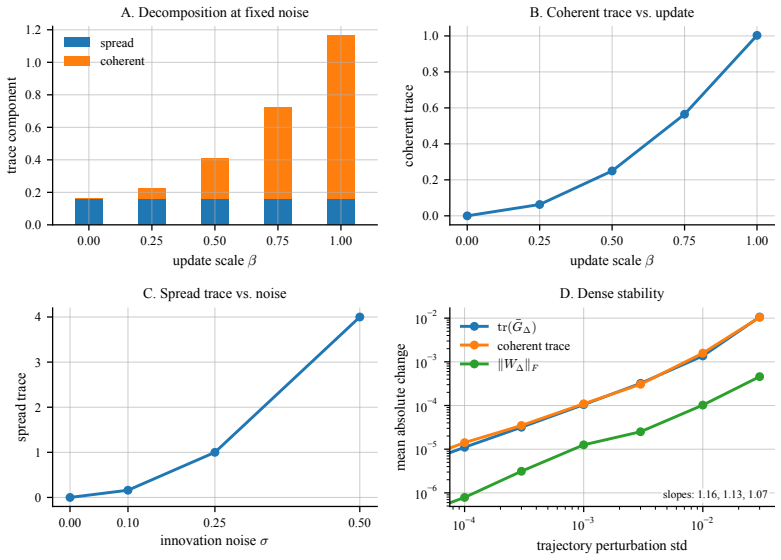
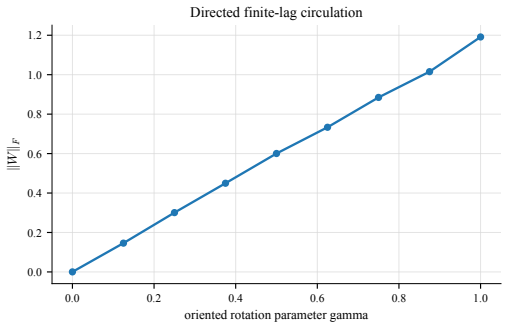
From the directed finite-lag law we derive a source-centered transport tensor G_Δ, which decomposes exactly into conditional spread and coherent displacement, and an antisymmetric coordinate circulation W_Δ^ρ, which summarizes directed lagged flow. We prove affine covariance with explicit metric dependence of scalar summaries, dense estimator stability on bounded trajectory clouds, and a finite-lag separation result showing that source-centered transport detects deterministic recurrent motion not recorded by infinitesimal carre-du-champ geometry.
What carries the argument
The conditional transport law Q_Δ(dy|x) estimated by a dense Gaussian source-smoothing operator, which produces the source-centered transport tensor G_Δ and the antisymmetric circulation W_Δ^ρ.
If this is right
- G_Δ is affine covariant and its scalar summaries depend explicitly on the chosen metric.
- The dense estimator for G_Δ and W_Δ^ρ remains stable whenever trajectories remain inside a bounded cloud.
- Source-centered transport separates deterministic recurrent motion from noise in a way infinitesimal geometry cannot.
- In the linear-Gaussian case the quantities reduce to closed-form expressions involving the update matrix A_Δ, source covariance, and innovation covariance.
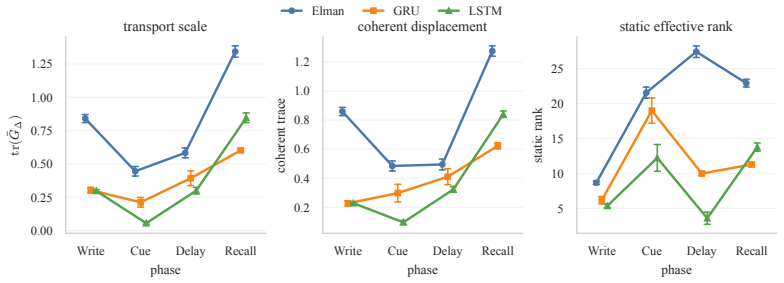
- Architecture-dependent differences appear in total transport scale and coherent displacement trace when the same task is solved by different repeat-copy networks.
Where Pith is reading between the lines
- The decomposition could be used to compare internal flow structure across recurrent architectures even when task performance is matched.
- Because the circulation term is antisymmetric, it may serve as a diagnostic for directed information flow that is invisible to symmetric distance-based measures.
- Metric dependence of the scalar summaries suggests that practitioners should select the embedding distance according to the physical or representational scale they wish to emphasize.
- The finite-lag separation result raises the question of whether similar lag-based operators can be defined for non-Euclidean state spaces common in modern sequence models.
Load-bearing premise
The conditional transport law can be reliably estimated from observed source-successor pairs by a dense Gaussian source-smoothing operator, which requires bounded trajectory clouds.
What would settle it
In a linear-Gaussian recurrent system engineered to contain deterministic periodic orbits, measure whether the coherent-displacement trace of G_Δ is detectably positive while the corresponding carre-du-champ quadratic form remains zero.
Figures
read the original abstract
Recurrent representations are trajectories, but representation geometry is often measured from static snapshots. We develop finite-lag operator geometry for recurrent hidden states from observed source-successor pairs $(X_t,X_{t+\Delta})$. The primitive is the conditional transport law $Q_\Delta(dy\mid x)$, estimated by a dense Gaussian source-smoothing operator. From this directed finite-lag law we derive a source-centered transport tensor $G_\Delta$, which decomposes exactly into conditional spread and coherent displacement, and an antisymmetric coordinate circulation $W_\Delta^\rho$, which summarizes directed lagged flow. We prove affine covariance with explicit metric dependence of scalar summaries, dense estimator stability on bounded trajectory clouds, and a finite-lag separation result showing that source-centered transport detects deterministic recurrent motion not recorded by infinitesimal carre-du-champ geometry. A linear-Gaussian closed form calibrates the quantities in terms of the update $A_\Delta$, source covariance, and innovation covariance. Controlled experiments validate the decomposition, circulation, covariance, and stability predictions. In performance matched repeat-copy networks, the framework reveals architecture dependent differences in total transport scale and coherent displacement trace, while coherent displacement fraction is metric and resolution dependent.
Editorial analysis
A structured set of objections, weighed in public.
Referee Report
Summary. The paper claims to develop finite-lag operator geometry for recurrent hidden states from observed source-successor pairs (X_t, X_{t+Δ}). The primitive is the conditional transport law Q_Δ(dy|x) estimated by a dense Gaussian source-smoothing operator. From this it derives the source-centered transport tensor G_Δ, which decomposes exactly into conditional spread and coherent displacement, and the antisymmetric coordinate circulation W_Δ^ρ summarizing directed lagged flow. It proves affine covariance with explicit metric dependence of scalar summaries, dense estimator stability on bounded trajectory clouds, and a finite-lag separation result showing source-centered transport detects deterministic recurrent motion not recorded by infinitesimal carre-du-champ geometry. A linear-Gaussian closed form calibrates the quantities in terms of the update A_Δ, source covariance, and innovation covariance. Controlled experiments validate the decomposition, circulation, covariance, and stability predictions, and the framework is applied to performance-matched repeat-copy networks.
Significance. If the derivations hold, the work supplies a new geometric framework for analyzing directed lagged flows in recurrent representations, with an explicit decomposition of transport and a proved distinction from existing infinitesimal geometry. The linear-Gaussian closed form and the controlled experiments validating multiple predictions are concrete strengths that support calibration and empirical checks.
minor comments (1)
- The description of the dense Gaussian source-smoothing operator used to estimate Q_Δ(dy|x) would benefit from an explicit statement of the bandwidth selection procedure and its sensitivity, as this directly affects the practical estimator whose stability is claimed.
Simulated Author's Rebuttal
We thank the referee for the detailed and positive assessment of the manuscript, including the recognition of the derivations, the linear-Gaussian closed form, the controlled experiments, and the distinction from infinitesimal geometry. The recommendation for minor revision is appreciated. No specific major comments were listed in the report.
Circularity Check
No significant circularity
full rationale
The derivation begins from the externally estimated conditional transport law Q_Δ(dy|x) obtained from observed source-successor pairs via a dense Gaussian source-smoothing operator. All subsequent objects (G_Δ, W_Δ^ρ, scalar summaries, affine covariance, stability bounds, and the finite-lag separation from carre-du-champ geometry) are obtained by explicit algebraic decomposition or proved consequences of this law under the stated bounded-trajectory-cloud assumption. The linear-Gaussian closed form is a direct specialization of the same transport law rather than a fitted parameter renamed as a prediction. No self-citation chain, self-definitional loop, or ansatz smuggled via prior work is present; the central claims remain independent of the target results and are externally falsifiable on the observed pairs.
Axiom & Free-Parameter Ledger
axioms (2)
- standard math Affine covariance of scalar summaries with explicit metric dependence
- domain assumption Dense estimator stability on bounded trajectory clouds
invented entities (2)
-
source-centered transport tensor G_Δ
no independent evidence
-
antisymmetric coordinate circulation W_Δ^ρ
no independent evidence
Reference graph
Works this paper leans on
-
[1]
SVCCA: Singu- lar vector canonical correlation analysis for deep learning dynamics and interpretability
Maithra Raghu, Justin Gilmer, Jason Yosinski, and Jascha Sohl-Dickstein. SVCCA: Singu- lar vector canonical correlation analysis for deep learning dynamics and interpretability. In Advances in Neural Information Processing Systems, volume 30, pages 6076–6085, 2017
2017
-
[2]
Similarity of neural network representations revisited
Simon Kornblith, Mohammad Norouzi, Honglak Lee, and Geoffrey Hinton. Similarity of neural network representations revisited. InProceedings of the 36th International Conference on Machine Learning, volume 97 ofProceedings of Machine Learning Research, pages 3519–3529. PMLR, 2019
2019
-
[3]
Macke, and Davide Zoccolan
Alessio Ansuini, Alessandro Laio, Jakob H. Macke, and Davide Zoccolan. Intrinsic dimension of data representations in deep neural networks. InAdvances in Neural Information Processing Systems, volume 32, 2019
2019
-
[4]
Uri Cohen, SueYeon Chung, Daniel D. Lee, and Haim Sompolinsky. Separability and geometry of object manifolds in deep neural networks.Nature Communications, 11(1):746, 2020. doi: 10.1038/s41467-020-14578-5
-
[5]
Vardan Papyan, X. Y . Han, and David L. Donoho. Prevalence of neural collapse during the terminal phase of deep learning training.Proceedings of the National Academy of Sciences, 117 (40):24652–24663, 2020. doi: 10.1073/pnas.2015509117
-
[6]
Christensen, Alexander Tong, Guillaume Huguet, Guy Wolf, Maximilian Nickel, Ian Adelstein, and Smita Krishnaswamy
Danqi Liao, Chen Liu, Benjamin W. Christensen, Alexander Tong, Guillaume Huguet, Guy Wolf, Maximilian Nickel, Ian Adelstein, and Smita Krishnaswamy. Assessing neural network representations during training using noise-resilient diffusion spectral entropy, 2023
2023
-
[7]
Steindl, Selma Mazioud, Ellie Schueler, Folu Ogundipe, Ellen Zhang, Yvan Grinspan, Kristof Reimann, Peyton Crevasse, Dhananjay Bhaskar, Siddharth Viswanath, Yanlei Zhang, Tim G
Elliott Abel, Andrew J. Steindl, Selma Mazioud, Ellie Schueler, Folu Ogundipe, Ellen Zhang, Yvan Grinspan, Kristof Reimann, Peyton Crevasse, Dhananjay Bhaskar, Siddharth Viswanath, Yanlei Zhang, Tim G. J. Rudner, Ian Adelstein, and Smita Krishnaswamy. Exploring the manifold of neural networks using diffusion geometry, 2024
2024
-
[8]
Laplacian eigenmaps for dimensionality reduction and data representation.Neural Computation, 15(6):1373–1396, 2003
Mikhail Belkin and Partha Niyogi. Laplacian eigenmaps for dimensionality reduction and data representation.Neural Computation, 15(6):1373–1396, 2003. doi: 10.1162/ 089976603321780317
2003
-
[9]
Ronald R. Coifman and Stéphane Lafon. Diffusion maps.Applied and Computational Harmonic Analysis, 21(1):5–30, 2006. doi: 10.1016/j.acha.2006.04.006
-
[10]
Diffusion operator geometry of feedforward representations, 2026
Kanishka Reddy. Diffusion operator geometry of feedforward representations, 2026
2026
-
[11]
Peter J. Schmid. Dynamic mode decomposition of numerical and experimental data.Journal of Fluid Mechanics, 656:5–28, 2010. doi: 10.1017/S0022112010001217
-
[12]
Matthew O. Williams, Ioannis G. Kevrekidis, and Clarence W. Rowley. A data-driven ap- proximation of the koopman operator: Extending dynamic mode decomposition.Journal of Nonlinear Science, 25(6):1307–1346, 2015. doi: 10.1007/s00332-015-9258-5
-
[13]
Guillermo Pérez-Hernández, Fabian Paul, Toni Giorgino, Gianni De Fabritiis, and Frank Noé. Identification of slow molecular order parameters for markov model construction.The Journal of Chemical Physics, 139(1):015102, 2013. doi: 10.1063/1.4811489
-
[14]
Christian R. Schwantes and Vijay S. Pande. Improvements in markov state model construction reveal many non-native interactions in the folding of ntl9.Journal of Chemical Theory and Computation, 9(4):2000–2009, 2013. doi: 10.1021/ct300878a
-
[15]
Hao Wu and Frank Noé. Variational approach for learning markov processes from time series data.Journal of Nonlinear Science, 30(1):23–66, 2020. doi: 10.1007/s00332-019-09567-y
-
[16]
V AMPnets for deep learning of molecular kinetics.Nature Communications, 9(1):5, 2018
Andreas Mardt, Luca Pasquali, Hao Wu, and Frank Noé. V AMPnets for deep learning of molecular kinetics.Nature Communications, 9(1):5, 2018. doi: 10.1038/s41467-017-02388-1
-
[17]
Diffusions hypercontractives.Séminaire de Probabilités XIX 1983/84, 1123:177–206, 1985
Dominique Bakry and Michel Émery. Diffusions hypercontractives.Séminaire de Probabilités XIX 1983/84, 1123:177–206, 1985. doi: 10.1007/BFb0075847. 10
-
[18]
Dominique Bakry, Ivan Gentil, and Michel Ledoux.Analysis and Geometry of Markov Diffusion Operators, volume 348 ofGrundlehren der mathematischen Wissenschaften. Springer, 2014. doi: 10.1007/978-3-319-00227-9
-
[19]
Boaz Nadler, Stephane Lafon, Ronald R. Coifman, and Ioannis G. Kevrekidis. Diffusion maps, spectral clustering and reaction coordinates of dynamical systems.Applied and Computational Harmonic Analysis, 21(1):113–127, 2006. doi: 10.1016/j.acha.2005.07.004
-
[20]
Diffusion geometry, 2024
Iolo Jones. Diffusion geometry, 2024
2024
-
[21]
Manifold diffusion geometry: Curvature, tangent spaces, and dimension, 2024
Iolo Jones. Manifold diffusion geometry: Curvature, tangent spaces, and dimension, 2024
2024
-
[22]
Computing diffusion geometry, 2026
Iolo Jones and David Lanners. Computing diffusion geometry, 2026
2026
-
[23]
Williams, Clarence W
Matthew O. Williams, Clarence W. Rowley, and Ioannis G. Kevrekidis. A kernel-based method for data-driven koopman spectral analysis.Journal of Computational Dynamics, 2(2):247–265,
-
[24]
doi: 10.3934/jcd.2015005
-
[25]
Stefan Klus, Feliks Nuske, Péter Koltai, Hao Wu, Ioannis Kevrekidis, Christof Schutte, and Frank Noé. Data-driven model reduction and transfer operator approximation.Journal of Nonlinear Science, 28(3):985–1010, 2018. doi: 10.1007/s00332-017-9437-7
-
[26]
Stefan Klus, Ingmar Schuster, and Krikamol Muandet. Eigendecompositions of transfer opera- tors in reproducing kernel hilbert spaces.Journal of Nonlinear Science, 30:283–315, 2020. doi: 10.1007/s00332-019-09574-z
-
[27]
Gary Froyland. An analytic framework for identifying finite-time coherent sets in time- dependent dynamical systems.Physica D: Nonlinear Phenomena, 250:1–19, 2013. doi: 10.1016/j.physd.2013.01.013
-
[28]
Dynamic isoperimetry and the geometry of lagrangian coherent structures
Gary Froyland. Dynamic isoperimetry and the geometry of lagrangian coherent structures. Nonlinearity, 28(10):3587–3622, 2015. doi: 10.1088/0951-7715/28/10/3587
-
[29]
Ronald R. Coifman and Matthew J. Hirn. Diffusion maps for changing data.Applied and Computational Harmonic Analysis, 36(1):79–107, 2014. doi: 10.1016/j.acha.2013.03.001
-
[30]
Nicholas F. Marshall and Matthew J. Hirn. Time coupled diffusion maps.Applied and Computational Harmonic Analysis, 45(3):709–728, 2018. doi: 10.1016/j.acha.2017.08.007
-
[31]
Opening the black box: Low-dimensional dynamics in high- dimensional recurrent neural networks
David Sussillo and Omri Barak. Opening the black box: Low-dimensional dynamics in high- dimensional recurrent neural networks. InAdvances in Neural Information Processing Systems, volume 26, 2013
2013
-
[32]
Neural circuits as computational dynamical systems.Current Opinion in Neurobiology, 25:156–163, 2014
David Sussillo. Neural circuits as computational dynamical systems.Current Opinion in Neurobiology, 25:156–163, 2014. doi: 10.1016/j.conb.2014.01.008
-
[33]
McIntosh, David B
Niru Maheswaranathan, Lane T. McIntosh, David B. Kastner, Josh Melander, L. E. Brezovec, Aran Nayebi, Julia Wang, Surya Ganguli, and Stephen A. Baccus. Reverse engineering recurrent networks for sentiment classification reveals line attractor dynamics, 2019
2019
-
[34]
Williams, Matthew D
Niru Maheswaranathan, Alex H. Williams, Matthew D. Golub, Surya Ganguli, and David Sussillo. Universality and individuality in neural dynamics across large populations of recurrent networks. InAdvances in Neural Information Processing Systems, volume 32, 2019
2019
-
[35]
Rylan Schaeffer, Mikail Khona, Leenoy Meshulam, International Brain Laboratory, and Ila R. Fiete. Reverse-engineering recurrent neural network solutions to a hierarchical inference task for mice. InAdvances in Neural Information Processing Systems, volume 33, pages 4584–4596, 2020
2020
-
[36]
Jimmy T. H. Smith, Scott W. Linderman, and David Sussillo. Reverse engineering recurrent neural networks with jacobian switching linear dynamical systems. InAdvances in Neural Information Processing Systems, volume 34, pages 16700–16713, 2021. 11
2021
-
[37]
Francesca Mastrogiuseppe and Srdjan Ostojic. Linking connectivity, dynamics, and com- putations in low-rank recurrent neural networks.Neuron, 99(3):609–623.e29, 2018. doi: 10.1016/j.neuron.2018.07.003
-
[38]
Manuel Beiran, Alexis Dubreuil, Adrian Valente, Francesca Mastrogiuseppe, and Srdjan Os- tojic. Shaping dynamics with multiple populations in low-rank recurrent networks.Neural Computation, 33(6):1572–1615, 2021. doi: 10.1162/neco_a_01381
-
[39]
Pillow, and Srdjan Ostojic
Adrian Valente, Jonathan W. Pillow, and Srdjan Ostojic. Extracting computational mechanisms from neural data using low-rank RNNs. InAdvances in Neural Information Processing Systems, volume 35, pages 24072–24086, 2022
2022
-
[40]
Matthijs Pals, Jakob H. Macke, and Omri Barak. Trained recurrent neural networks develop phase-locked limit cycles in a working memory task.PLOS Computational Biology, 20(2): e1011852, 2024. doi: 10.1371/journal.pcbi.1011852
-
[41]
Chen Liu et al. Recurrent neural networks with transient trajectory explain working memory en- coding mechanisms.Communications Biology, 8:88, 2025. doi: 10.1038/s42003-024-07282-3
-
[42]
Dynamical phases of short-term memory mechanisms in RNNs
Bariscan Kurtkaya, Fatih Dinc, Mert Yuksekgonul, Marta Blanco-Pozo, Ege Cirakman, Mark Schnitzer, Yucel Yemez, Hidenori Tanaka, Peng Yuan, and Nina Miolane. Dynamical phases of short-term memory mechanisms in RNNs. InProceedings of the 42nd International Conference on Machine Learning, volume 267 ofProceedings of Machine Learning Research, pages 32032–320...
2025
-
[43]
Sejnowski, and Hava T
Arjun Karuvally, Terrence J. Sejnowski, and Hava T. Siegelmann. Hidden traveling waves bind working memory variables in recurrent neural networks. InProceedings of the 41st International Conference on Machine Learning, volume 235 ofProceedings of Machine Learning Research. PMLR, 2024
2024
-
[44]
Driscoll, Krishna V
Laura N. Driscoll, Krishna V . Shenoy, and David Sussillo. Flexible multitask computation in recurrent networks utilizes shared dynamical motifs.Nature Neuroscience, 27(7):1349–1363,
-
[45]
doi: 10.1038/s41593-024-01668-6
-
[46]
Long short-term memory.Neural Computation, 9 (8):1735–1780, 1997
Sepp Hochreiter and Jurgen Schmidhuber. Long short-term memory.Neural Computation, 9 (8):1735–1780, 1997. doi: 10.1162/neco.1997.9.8.1735
-
[47]
Learning phrase representations using RNN encoder– decoder for statistical machine translation
Kyunghyun Cho, Bart van Merrienboer, Caglar Gulcehre, Dzmitry Bahdanau, Fethi Bougares, Holger Schwenk, and Yoshua Bengio. Learning phrase representations using RNN encoder– decoder for statistical machine translation. InProceedings of the 2014 Conference on Empirical Methods in Natural Language Processing, pages 1724–1734, 2014. doi: 10.3115/v1/D14-1179
-
[48]
Jeff Calder, Nicolás García Trillos, and Marta Lewicka. Lipschitz regularity of graph laplacians on random data clouds.SIAM Journal on Mathematical Analysis, 54(1):1169–1222, 2022. doi: 10.1137/20M1356610
-
[49]
the carré du champ on ht
Daniel Ting, Ling Huang, and Michael I. Jordan. An analysis of the convergence of graph laplacians. InProceedings of the 27th International Conference on Machine Learning, pages 1079–1086, 2010. 12 A Empirical operator construction Here we give the operational details of the empirical finite-lag operatorbP∆ used throughout the paper. The dense Gaussian so...
2010
discussion (0)
Sign in with ORCID, Apple, or X to comment. Anyone can read and Pith papers without signing in.