Phase Transitions with Lyapunov Exponents under Einstein and String Frames in Dilatonic Reissner--Nordstr\"om--AdS Black Holes
Pith reviewed 2026-07-03 08:34 UTC · model grok-4.3
The pith
Lyapunov exponents capture identical phase transition features in black holes across Einstein and string frames.
A machine-rendered reading of the paper's core claim, the machinery that carries it, and where it could break.
Core claim
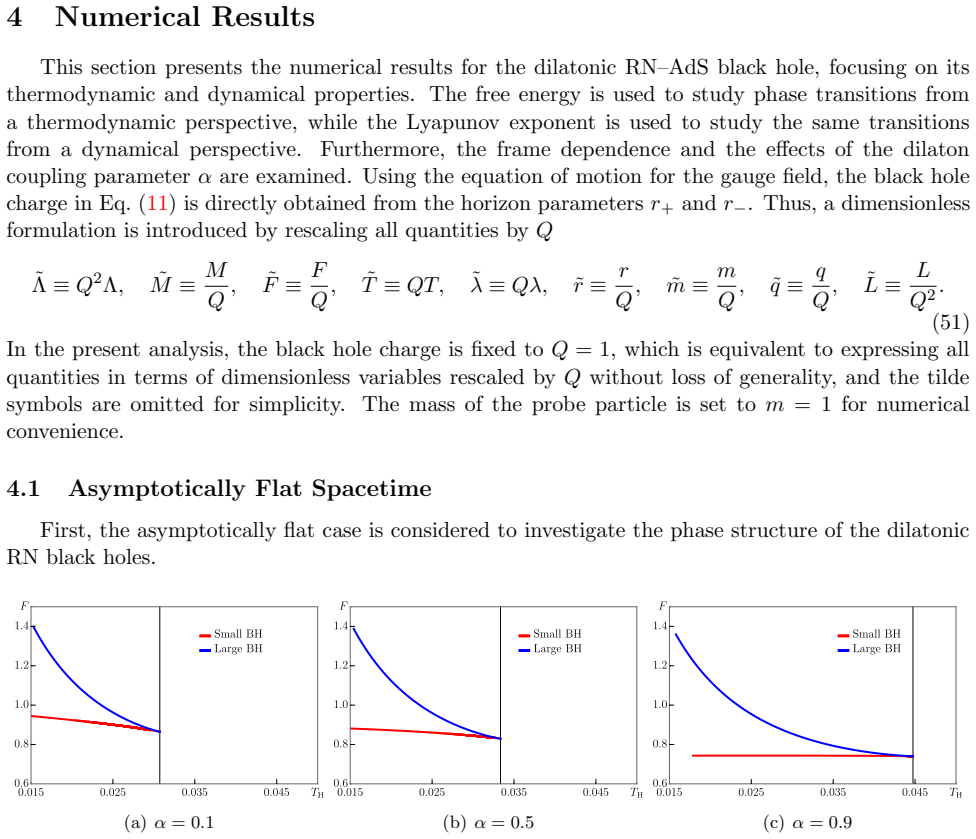
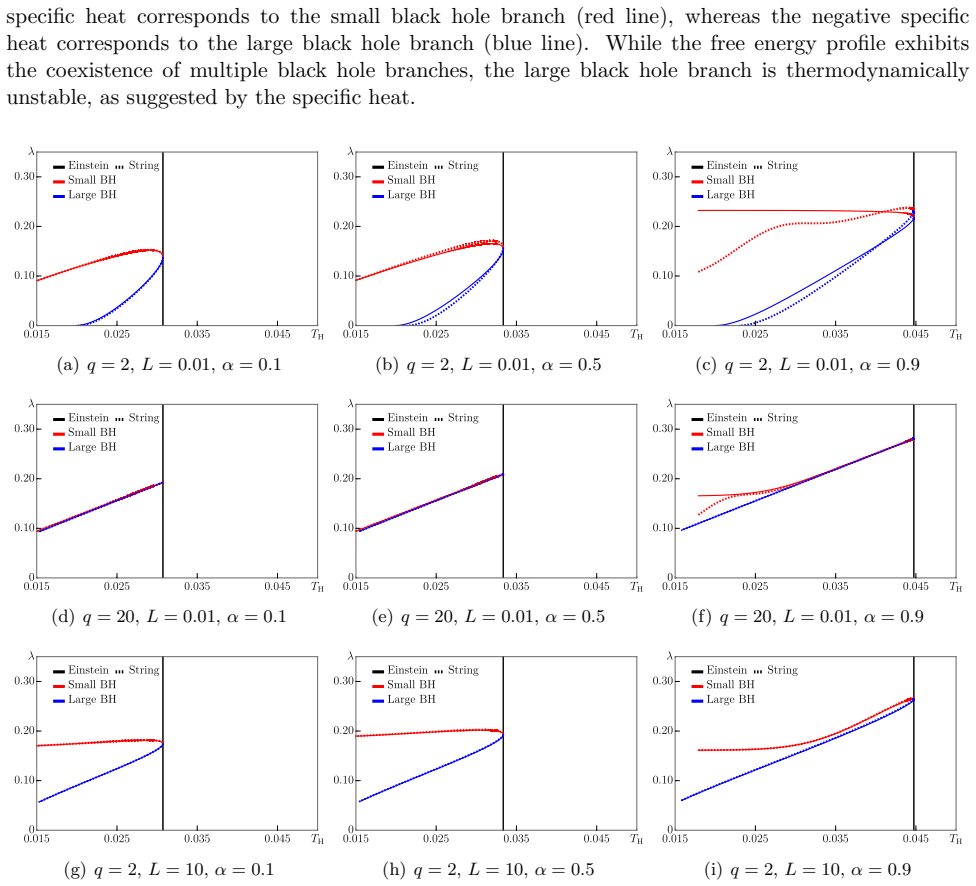
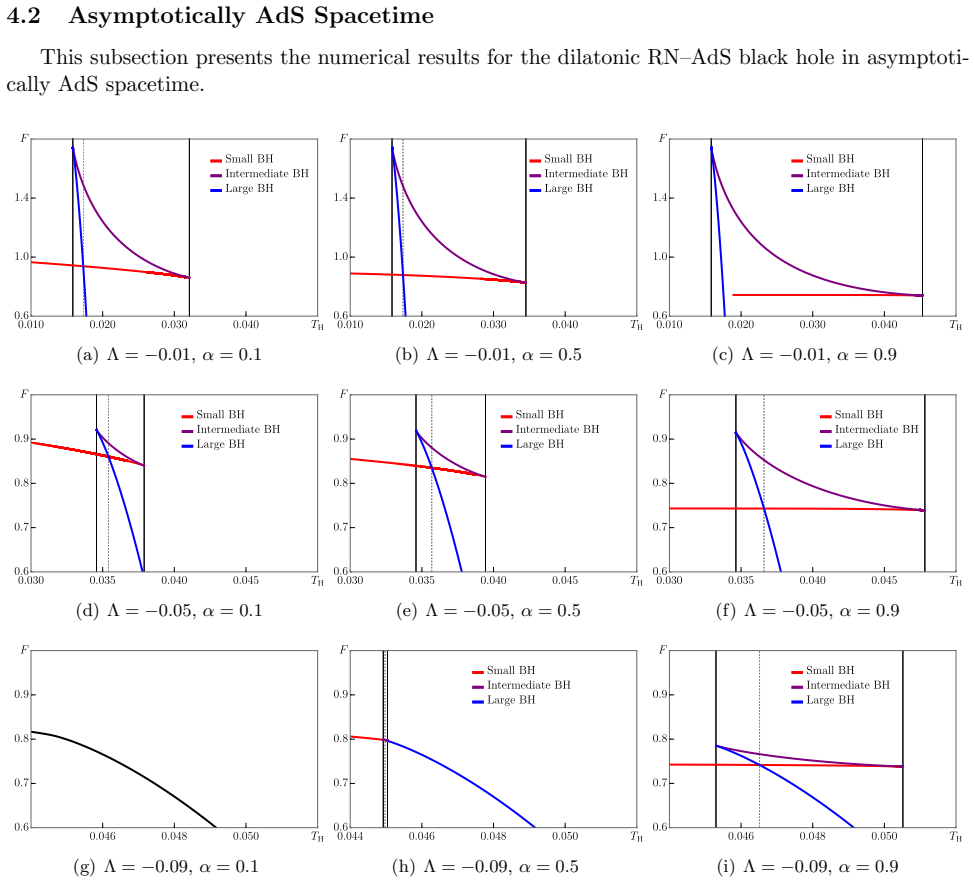
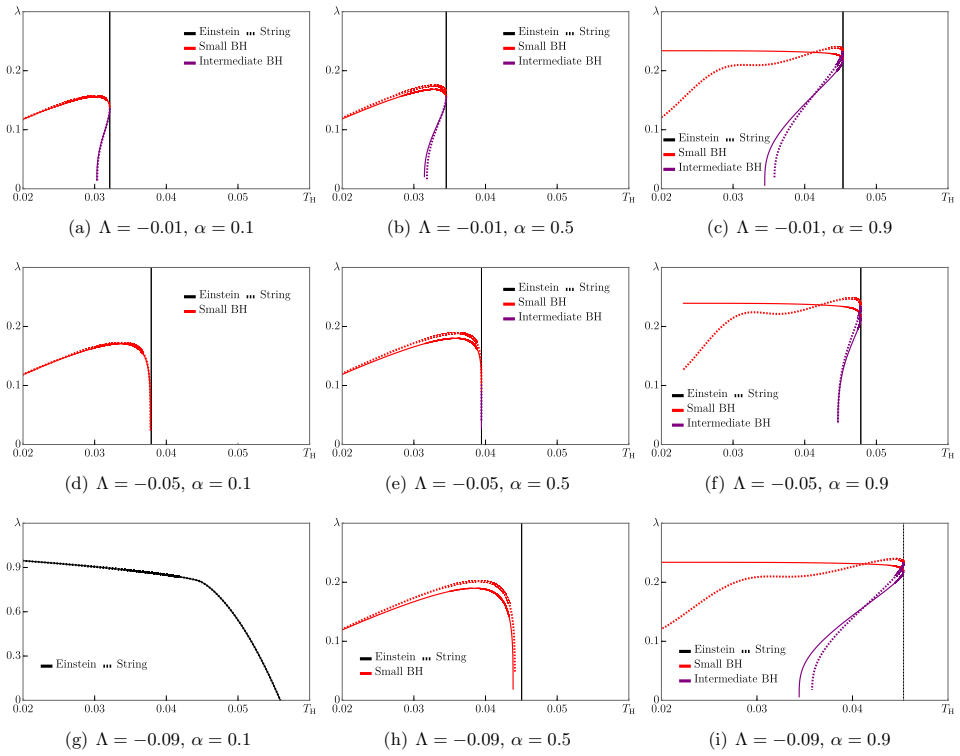
Numerical analysis shows that while the Lyapunov exponent itself is frame-dependent for massive probe particles due to dilaton coupling, the phase structure features it captures, including characteristic cusp behavior and transition points, are independent of the frame choice and match the frame-independent thermodynamic phase structure.
What carries the argument
Lyapunov exponent computed from the geodesic motion of charged probe particles, serving as a dynamical indicator of thermodynamic phase transitions.
If this is right
- The same phase transitions are identified whether using thermodynamic quantities or Lyapunov exponents.
- Frame transformations preserve the critical behavior seen in Lyapunov exponent plots.
- In the massless limit, Lyapunov exponents show no frame dependence.
- This holds specifically for dilatonic Reissner-Nordström-AdS black holes in Einstein-Maxwell-dilaton theory.
Where Pith is reading between the lines
- Similar frame independence might apply to other dynamical probes like quasinormal modes.
- The method could be applied to black holes in other modified gravity theories.
- It suggests that phase transitions have an invariant description beyond specific frames.
- Testing with different particle charges or masses could reveal more about the coupling effects.
Load-bearing premise
The motion of charged probe particles and their Lyapunov exponents faithfully proxy the black hole's own thermodynamic phase transitions.
What would settle it
A calculation in one frame where the Lyapunov exponent plot shows different cusp locations or missing transition points compared to the other frame or to thermodynamics would disprove the frame independence of the captured phase structure.
Figures
read the original abstract
We investigate Lyapunov exponents as dynamical probes of black hole phase transitions in dilatonic Reissner--Nordstr\"om--AdS black holes within Einstein--Maxwell--dilaton theory. The thermodynamic quantities and the Lyapunov exponent of charged probe particles were analyzed in both the Einstein and string frames, thus providing a direct comparison between the thermodynamic phase structure of the black hole and that captured by the Lyapunov exponent. Thermodynamic quantities, including the Hawking temperature and Wald entropy, remained constant under conformal frame transformations, yielding identical phase structures in the two frames. In contrast, the Lyapunov exponent exhibited non-trivial frame dependence for massive probe particles due to dilaton coupling, while no frame dependence was found in the massless limit. Numerical analysis revealed that the phase structure features captured by the Lyapunov exponent, including characteristic cusp behavior and transition points, were independent of the choice of frame, despite the Lyapunov exponent itself being frame-dependent. Therefore, the Lyapunov exponent exhibited frame-dependent values, while the critical structure it captures remained constant across conformal frames.
Editorial analysis
A structured set of objections, weighed in public.
Referee Report
Summary. The manuscript analyzes Lyapunov exponents of charged probe particles as dynamical indicators of thermodynamic phase transitions in dilatonic Reissner-Nordström-AdS black holes within Einstein-Maxwell-dilaton theory. Thermodynamic quantities (Hawking temperature, Wald entropy) are shown to be invariant under conformal transformations between the Einstein and string frames, yielding identical phase structures. The Lyapunov exponent itself depends on the frame for massive probes due to dilaton coupling but is frame-independent in the massless limit. Numerical results indicate that characteristic phase-structure features extracted from the Lyapunov exponent, including cusp behavior and transition points, remain the same across frames despite the frame dependence of the exponent values.
Significance. If the numerical comparison holds, the result establishes that Lyapunov-exponent-derived phase features are robust under frame transformations relevant to string theory, even though the exponent itself transforms. This provides concrete evidence that certain dynamical probes can capture frame-independent thermodynamic structure, which is useful for extending such methods beyond Einstein frame. The explicit side-by-side frame comparison and the massless limit result are positive features.
major comments (2)
- [Abstract and numerical results section] The central claim rests on numerical identification of matching cusps and transition points between frames, yet the abstract (and the supplied text) provides no equations for the Lyapunov exponent computation, no error estimates, no convergence criteria, and no data-exclusion rules. Without these in the methods or results section, the load-bearing numerical evidence for frame-independent transition points cannot be assessed for robustness.
- [Introduction and § on Lyapunov exponent] The manuscript treats the Lyapunov exponent of probe particles as a faithful proxy for thermodynamic phase transitions without deriving this link from first principles; while common in the literature, the absence of even a brief justification or reference to prior derivations makes the interpretation of the observed cusps as phase-transition signatures an assumption rather than a demonstrated result.
minor comments (1)
- [Frame transformation section] Notation for the dilaton coupling and the string-frame metric transformation should be stated explicitly once at the beginning of the frame-comparison section to avoid ambiguity when comparing Lyapunov-exponent expressions.
Simulated Author's Rebuttal
We thank the referee for the constructive comments and the positive evaluation of the work's significance. We address each major comment below and indicate the revisions we will make to improve clarity and robustness.
read point-by-point responses
-
Referee: [Abstract and numerical results section] The central claim rests on numerical identification of matching cusps and transition points between frames, yet the abstract (and the supplied text) provides no equations for the Lyapunov exponent computation, no error estimates, no convergence criteria, and no data-exclusion rules. Without these in the methods or results section, the load-bearing numerical evidence for frame-independent transition points cannot be assessed for robustness.
Authors: We agree that the abstract lacks the explicit Lyapunov exponent formula and that the supplied excerpt does not detail numerical controls. The full manuscript describes the computation via the geodesic deviation equation in the effective potential (Section on Lyapunov exponent), but to address the concern directly we will (i) add the key equation and a sentence on numerical implementation to the abstract, and (ii) expand the numerical results section with error estimates, convergence criteria, and data-exclusion rules. These changes will allow independent assessment of the reported cusp and transition-point matching. revision: yes
-
Referee: [Introduction and § on Lyapunov exponent] The manuscript treats the Lyapunov exponent of probe particles as a faithful proxy for thermodynamic phase transitions without deriving this link from first principles; while common in the literature, the absence of even a brief justification or reference to prior derivations makes the interpretation of the observed cusps as phase-transition signatures an assumption rather than a demonstrated result.
Authors: We accept that an explicit reference to the underlying derivation would strengthen the presentation. Although the connection is standard in the literature on chaotic probes of black-hole thermodynamics, we will insert a concise paragraph in the introduction that briefly recalls the first-principles link (divergence of the Lyapunov exponent at the inflection point of the effective potential signals the onset of thermodynamic instability) and cite the relevant prior derivations. This addition will make the interpretation explicit rather than assumed. revision: yes
Circularity Check
No significant circularity
full rationale
The manuscript performs explicit numerical evaluation of thermodynamic quantities (Hawking temperature, Wald entropy) and Lyapunov exponents for charged probe particles in both Einstein and string frames. Thermodynamic quantities are shown to be invariant under the conformal transformation by direct computation, while the Lyapunov exponent is computed separately in each frame and observed to differ in value but to share the same cusp locations and transition points. No parameter fitting, self-referential definitions, or load-bearing self-citations are present; the reported frame-independence of the extracted phase-structure features is the direct numerical output rather than a quantity defined by construction from the same data.
Axiom & Free-Parameter Ledger
axioms (2)
- domain assumption Lyapunov exponents of charged probe particles serve as dynamical probes of black-hole thermodynamic phase transitions
- standard math Hawking temperature and Wald entropy are invariant under the Einstein-to-string frame transformation
Reference graph
Works this paper leans on
-
[1]
Jacob D. Bekenstein. “Black holes and entropy”. In:Phys. Rev. D7 (1973), pp. 2333–2346.doi: 10.1103/PhysRevD.7.2333
-
[2]
Particle Creation by Black Holes
S. W. Hawking. “Particle Creation by Black Holes”. In:Commun. Math. Phys.43 (1975). Ed. by G. W. Gibbons and S. W. Hawking. [Erratum: Commun.Math.Phys. 46, 206 (1976)], pp. 199– 220.doi:10.1007/BF02345020
-
[3]
Thermodynamics of Black Holes in anti-De Sitter Space
S. W. Hawking and Don N. Page. “Thermodynamics of Black Holes in anti-De Sitter Space”. In:Commun. Math. Phys.87 (1983), p. 577.doi:10.1007/BF01208266
-
[4]
Charged AdS Black Holes and Catastrophic Holography
Andrew Chamblin, Roberto Emparan, Clifford V. Johnson, and Robert C. Myers. “Charged AdS black holes and catastrophic holography”. In:Phys. Rev. D60 (1999), p. 064018.doi: 10.1103/PhysRevD.60.064018. arXiv:hep-th/9902170
work page internal anchor Pith review Pith/arXiv arXiv doi:10.1103/physrevd.60.064018 1999
-
[5]
Black Holes and Membranes in Higher Dimensional The- ories with Dilaton Fields
G. W. Gibbons and Kei-ichi Maeda. “Black Holes and Membranes in Higher Dimensional The- ories with Dilaton Fields”. In:Nucl. Phys. B298 (1988), pp. 741–775.doi:10.1016/0550- 3213(88)90006-5
-
[6]
Charged black holes in string theory
David Garfinkle, Gary T. Horowitz, and Andrew Strominger. “Charged black holes in string theory”. In:Phys. Rev. D43 (1991). [Erratum: Phys. Rev. D 45, 3888 (1992)], p. 3140.doi: 10.1103/PhysRevD.43.3140
-
[7]
On Physical Equivalence between Nonlinear Gravity Theories
Guido Magnano and Leszek M. Sokolowski. “Physical equivalence between nonlinear gravity theories and a general-relativistic self-gravitating scalar field”. In:Phys. Rev. D50 (1994), pp. 5039–5059.doi:10.1103/PhysRevD.50.5039. arXiv:gr-qc/9312008
work page internal anchor Pith review Pith/arXiv arXiv doi:10.1103/physrevd.50.5039 1994
-
[8]
Conformal transformations in classical gravitational theories and in cosmology
Valerio Faraoni, Edgard Gunzig, and Pasquale Nardone. “Conformal transformations in classical gravitational theories and in cosmology”. In:Fund. Cosmic Phys.20 (1999), p. 121. arXiv:gr- qc/9811047
-
[9]
Frame-dependence of the Hamilton–Jacobi formalism for inflation and reheating in non-minimal gravity
Feng-Yi Zhang, Li-Yang Chen, and Rongrong Zhai. “Frame-dependence of the Hamilton–Jacobi formalism for inflation and reheating in non-minimal gravity”. In:Eur. Phys. J. C85.10 (2025), p. 1212.doi:10.1140/epjc/s10052-025-14968-3. arXiv:2502.16262 [gr-qc]
-
[10]
E. C. Valad˜ ao, Felipe Sobrero, and Santiago Esteban Perez Bergliaffa. “Scalar-tensor theories in the Lyra geometry: invariance under local transformations of length units and the Jordan- Einstein frame conundrum”. In:Gen. Rel. Grav.58.1 (2026), p. 6.doi:10.1007/s10714-025- 03509-8. arXiv:2510.08433 [gr-qc]
-
[11]
Dynamics of quadratic f(R) cosmology with a perfect fluid: Jordan and Einstein frames
Artur Alho, Margarida Lima, and Filipe C. Mena. “Dynamics of quadratic f(R) cosmology with a perfect fluid: Jordan and Einstein frames”. In: (Mar. 2026). arXiv:2603.09667 [gr-qc]
-
[12]
Universality in Chaos of Particle Motion near Black Hole Horizon
Koji Hashimoto and Norihiro Tanahashi. “Universality in Chaos of Particle Motion near Black Hole Horizon”. In:Phys. Rev. D95.2 (2017), p. 024007.doi:10.1103/PhysRevD.95.024007. arXiv:1610.06070 [hep-th]
work page internal anchor Pith review Pith/arXiv arXiv doi:10.1103/physrevd.95.024007 2017
-
[13]
Static Equilibria of Charged Particles Around Charged Black Holes: Chaos Bound and Its Violations
Qing-Qing Zhao, Yue-Zhou Li, and H. Lu. “Static Equilibria of Charged Particles Around Charged Black Holes: Chaos Bound and Its Violations”. In:Phys. Rev. D98.12 (2018), p. 124001. doi:10.1103/PhysRevD.98.124001. arXiv:1809.04616 [gr-qc]
work page internal anchor Pith review Pith/arXiv arXiv doi:10.1103/physrevd.98.124001 2018
-
[14]
Chaos of particle motion near a black hole with quasitopological electromagnetism
Yu-Qi Lei, Xian-Hui Ge, and Cheng Ran. “Chaos of particle motion near a black hole with quasitopological electromagnetism”. In:Phys. Rev. D104.4 (2021), p. 046020.doi:10.1103/ PhysRevD.104.046020. arXiv:2008.01384 [hep-th]. 17
-
[15]
Bound on the Lyapunov exponent in Kerr-Newman black holes via a charged particle
Naoto Kan and Bogeun Gwak. “Bound on the Lyapunov exponent in Kerr-Newman black holes via a charged particle”. In:Phys. Rev. D105.2 (2022), p. 026006.doi:10.1103/PhysRevD.105. 026006. arXiv:2109.07341 [gr-qc]
-
[16]
Circular motion of charged particles near a charged black hole
Yu-Qi Lei and Xian-Hui Ge. “Circular motion of charged particles near a charged black hole”. In: Phys. Rev. D105.8 (2022), p. 084011.doi:10.1103/PhysRevD.105.084011. arXiv:2111.06089 [hep-th]
-
[17]
Violation of bound on chaos for charged probe in Kerr-Newman-AdS black hole
Bogeun Gwak, Naoto Kan, Bum-Hoon Lee, and Hocheol Lee. “Violation of bound on chaos for charged probe in Kerr-Newman-AdS black hole”. In:JHEP09 (2022), p. 026.doi:10.1007/ JHEP09(2022)026. arXiv:2203.07298 [gr-qc]
-
[18]
Bound on Lyapunov exponent in Einstein- Maxwell-Dilaton-Axion black holes
Chengye Yu, Deyou Chen, and Chuanhong Gao. “Bound on Lyapunov exponent in Einstein- Maxwell-Dilaton-Axion black holes”. In:Chin. Phys. C46.12 (2022), p. 125106.doi:10.1088/ 1674-1137/ac90af. arXiv:2202.13741 [hep-th]
-
[19]
Chaos bound and its violation in charged Kiselev black hole
Chuanhong Gao, Deyou Chen, Chengye Yu, and Peng Wang. “Chaos bound and its violation in charged Kiselev black hole”. In:Phys. Lett. B833 (2022), p. 137343.doi:10.1016/j.physletb. 2022.137343. arXiv:2204.07983 [gr-qc]
-
[20]
Deyou Chen and Chuanhong Gao. “Angular momentum and chaos bound of charged particles around Einstein–Euler–Heisenberg AdS black holes”. In:New J. Phys.24.12 (2022), p. 123014. doi:10.1088/1367-2630/aca820. arXiv:2205.08337 [hep-th]
-
[21]
Causality bounds chaos in geodesic motion
Koji Hashimoto and Kakeru Sugiura. “Causality bounds chaos in geodesic motion”. In:Phys. Rev. D107.6 (2023), p. 066005.doi:10 . 1103 / PhysRevD . 107 . 066005. arXiv:2205 . 13818 [hep-th]
2023
-
[22]
A holographic study of the characteristics of chaos and correlation in the presence of backreaction
Shankhadeep Chakrabortty, Hironori Hoshino, Sanjay Pant, and Karunava Sil. “A holographic study of the characteristics of chaos and correlation in the presence of backreaction”. In:Phys. Lett. B838 (2023), p. 137749.doi:10.1016/j.physletb.2023.137749. arXiv:2206.12555 [hep-th]
-
[23]
Soyeon Jeong, Bum-Hoon Lee, Hocheol Lee, and Wonwoo Lee. “Homoclinic orbit and the vio- lation of the chaos bound around a black hole with anisotropic matter fields”. In:Phys. Rev. D 107.10 (2023), p. 104037.doi:10.1103/PhysRevD.107.104037. arXiv:2301.12198 [gr-qc]
-
[24]
Chaos bound in Kerr-Newman-Taub-NUT black holes via circular motions
Deyou Chen and Chuanhong Gao. “Chaos bound in Kerr-Newman-Taub-NUT black holes via circular motions”. In:Chin. Phys. C47.1 (2023), p. 015108.doi:10.1088/1674-1137/ac9fb9
-
[25]
Chengye Yu, Deyou Chen, Benrong Mu, and Yucheng He. “Violating the chaos bound in five- dimensional, charged, rotating Einstein-Maxwell-Chern-Simons black holes”. In:Nucl. Phys. B 987 (2023), p. 116093.doi:10.1016/j.nuclphysb.2023.116093
-
[26]
Homoclinic orbits in Kerr-Newman black holes
Yi-Ting Li, Chen-Yu Wang, Da-Shin Lee, and Chi-Yong Lin. “Homoclinic orbits in Kerr-Newman black holes”. In:Phys. Rev. D108.4 (2023), p. 044010.doi:10.1103/PhysRevD.108.044010. arXiv:2302.09471 [gr-qc]
-
[27]
Yu-Qi Lei and Xian-Hui Ge. “Stationary equilibrium of test particles near charged black branes with the hyperscaling violating factor”. In:Phys. Rev. D107.10 (2023), p. 106002.doi:10. 1103/PhysRevD.107.106002. arXiv:2302.12812 [hep-th]
-
[28]
Chaos and fast scrambling delays of a dyonic Kerr-Sen-AdS4 black hole and its ultraspinning version
Hadyan Luthfan Prihadi, Freddy Permana Zen, Donny Dwiputra, and Seramika Ariwahjoedi. “Chaos and fast scrambling delays of a dyonic Kerr-Sen-AdS4 black hole and its ultraspinning version”. In:Phys. Rev. D107.12 (2023), p. 124053.doi:10 . 1103 / PhysRevD . 107 . 124053. arXiv:2304.08751 [hep-th]
-
[29]
Localized chaos due to rotating shock waves in Kerr–AdS black holes and their ultraspinning version
Hadyan Luthfan Prihadi, Freddy Permana Zen, Donny Dwiputra, and Seramika Ariwahjoedi. “Localized chaos due to rotating shock waves in Kerr–AdS black holes and their ultraspinning version”. In:Gen. Rel. Grav.56.8 (2024), p. 90.doi:10.1007/s10714- 024- 03275- z. arXiv: 2310.14535 [hep-th]. 18
-
[30]
Jiayu Xie, Jie Wang, and Bing Tang. “Circular motion and chaos bound of a charged particle near charged 4D Einstein–Gauss–Bonnet-AdS black holes”. In:Phys. Dark Univ.42 (2023), p. 101271.doi:10.1016/j.dark.2023.101271. arXiv:2304.10422 [gr-qc]
-
[31]
Circular string in a black p-brane leading to chaos
Pinaki Dutta, Kamal L. Panigrahi, and Balbeer Singh. “Circular string in a black p-brane leading to chaos”. In:JHEP10 (2023), p. 189.doi:10.1007/JHEP10(2023)189. arXiv:2307.12350 [hep-th]
-
[32]
Entanglement and Chaos near critical point in strongly coupled Gauge theory
Debanjan Karan and Sanjay Pant. “Entanglement and Chaos near critical point in strongly coupled Gauge theory”. In:Eur. Phys. J. C84.2 (2024), p. 113.doi:10.1140/epjc/s10052- 024-12463-9. arXiv:2308.00018 [hep-th]
-
[33]
Bound on Lyapunov exponent in Kerr-Newman-de Sitter black holes by a charged particle
Junsu Park and Bogeun Gwak. “Bound on Lyapunov exponent in Kerr-Newman-de Sitter black holes by a charged particle”. In:JHEP04 (2024), p. 023.doi:10.1007/JHEP04(2024)023. arXiv:2312.13075 [gr-qc]
-
[34]
Lyapunov exponents and phase structure of Lifshitz and hyperscaling violating black holes
A. Naveena Kumara, Shreyas Punacha, and Md Sabir Ali. “Lyapunov exponents and phase structure of Lifshitz and hyperscaling violating black holes”. In:JCAP07 (2024), p. 061.doi: 10.1088/1475-7516/2024/07/061. arXiv:2401.05181 [gr-qc]
-
[35]
Quasinormal modes and universality of the Penrose limit of black hole photon rings
D. Giataganas, A. Kehagias, and A. Riotto. “Quasinormal modes and universality of the Penrose limit of black hole photon rings”. In:JHEP09 (2024), p. 168.doi:10.1007/JHEP09(2024)168. arXiv:2403.10605 [gr-qc]
-
[36]
Yu-Qi Lei, Xian-Hui Ge, and Surojit Dalui. “Thermodynamic stability versus chaos bound vi- olation in D-dimensional RN black holes: Angular momentum effects and phase transitions”. In:Phys. Lett. B856 (2024), p. 138929.doi:10 . 1016 / j . physletb . 2024 . 138929. arXiv: 2404.18193 [hep-th]
-
[37]
Near-horizon chaos beyond Einstein grav- ity
Surajit Das, Surojit Dalui, and Rickmoy Samanta. “Near-horizon chaos beyond Einstein grav- ity”. In:Phys. Rev. D110.12 (2024), p. 124037.doi:10.1103/PhysRevD.110.124037. arXiv: 2405.09945 [gr-qc]
-
[38]
Circular orbits and chaos bound in slow-rotating curved acoustic black holes
Balbeer Singh, Nibedita Padhi, and Rashmi R. Nayak. “Circular orbits and chaos bound in slow-rotating curved acoustic black holes”. In:Eur. Phys. J. C85.5 (2025), p. 570.doi:10. 1140/epjc/s10052-025-14311-w. arXiv:2405.12337 [hep-th]
-
[39]
Chaos bound and its violation in black p-brane
Pinaki Dutta, Kamal L. Panigrahi, and Balbeer Singh. “Chaos bound and its violation in black p-brane”. In:JHEP02 (2025), p. 043.doi:10.1007/JHEP02(2025)043. arXiv:2408.14056 [hep-th]
-
[40]
Bounds for Lyapunov exponent of circular light orbits in black holes
Emanuel Gallo and Thomas M¨ adler. “Bounds for Lyapunov exponent of circular light orbits in black holes”. In:Eur. Phys. J. C85.3 (2025), p. 299.doi:10.1140/epjc/s10052-025-14046-8. arXiv:2412.10328 [gr-qc]
-
[41]
Dynamics of spinning particles in Reissner- Nordstr¨ om black hole exterior
Siang-Yao Ciou, Tien Hsieh, and Da-Shin Lee. “Dynamics of spinning particles in Reissner- Nordstr¨ om black hole exterior”. In:JCAP05 (2025), p. 086.doi:10.1088/1475-7516/2025/ 05/086. arXiv:2503.12911 [gr-qc]
-
[42]
Euclidean thermodynamics and Lyapunov exponents of Einstein–Power–Yang–Mills AdS black holes
Karthik R., Dillirajan D., K. M. Ajith, Kartheek Hegde, Shreyas Punacha, and A. Naveena Kumara. “Euclidean thermodynamics and Lyapunov exponents of Einstein–Power–Yang–Mills AdS black holes”. In:Eur. Phys. J. C85.11 (2025), p. 1364.doi:10.1140/epjc/s10052-025- 15064-2. arXiv:2504.12890 [gr-qc]
-
[43]
Bound on Lyapunov exponent for a charged particle in Kerr- Sen-AdS black hole
Hocheol Lee and Bogeun Gwak. “Bound on Lyapunov exponent for a charged particle in Kerr- Sen-AdS black hole”. In:Phys. Rev. D112.4 (2025), p. 046018.doi:10.1103/tndk-m6jy. arXiv: 2506.00833 [gr-qc]
-
[44]
Probing quantum anomaly corrections on black hole physics through chaos
Yu-Sen An and Wei-Hao Zhang. “Probing quantum anomaly corrections on black hole physics through chaos”. In: (Dec. 2025). arXiv:2512.19163 [gr-qc]. 19
-
[45]
Physical constraints on the Maldacena-Shenker-Stanford chaos-bound in black hole spacetimes
Terkaa Victor Targema, Kazuharu Bamba, Riasat Ali, and Usman Zafar. “Physical constraints on the Maldacena-Shenker-Stanford chaos bound in black hole spacetimes”. In:Phys. Rev. D 113.10 (2026), p. 104056.doi:10.1103/s39h-mlcs. arXiv:2512.22834 [hep-th]
work page internal anchor Pith review Pith/arXiv arXiv doi:10.1103/s39h-mlcs 2026
-
[46]
Chaotic Motion of Strings in a Quantum-Corrected AdS Reissner–Nordstr¨ om Black Hole
Kai Li, Da-Zhu Ma, and Zhen-Meng Xu. “Chaotic Motion of Strings in a Quantum-Corrected AdS Reissner–Nordstr¨ om Black Hole”. In:Universe12.2 (2026), p. 57.doi:10.3390/universe12020057
-
[47]
Motions of spinning particles and chaos bound in Reissner-Nordstr\"om spacetime
Chuang Yang, Deyou Chen, and Yongtao Liu. “Motions of spinning particles and chaos bound in Reissner-Nordstr¨ om spacetime”. In:JHEP04 (2026), p. 205.doi:10.1007/JHEP04(2026)205. arXiv:2601.03751 [gr-qc]
work page internal anchor Pith review Pith/arXiv arXiv doi:10.1007/jhep04(2026)205 2026
-
[48]
Chaotic dynamics in ex- tremal black holes: A challenge to the chaos bound
Surojit Dalui, Chiranjeeb Singha, and Krishnakanta Bhattacharya. “Chaotic dynamics in ex- tremal black holes: A challenge to the chaos bound”. In:Phys. Lett. B874 (2026), p. 140256. doi:10.1016/j.physletb.2026.140256. arXiv:2602.04423 [gr-qc]
-
[49]
Testing the chaos bound in the spinor field of Einstein-Euler-Heisenberg-Anti-de Sitter spacetime
Xiaowei Li, Bingbing Chen, and Guoping Li. “Testing the chaos bound in the spinor field of Einstein-Euler-Heisenberg-Anti-de Sitter spacetime”. In: (Apr. 2026). arXiv:2604 . 03914 [gr-qc]
2026
-
[50]
A universal geometric mechanism for chaos-bound violations in black hole spacetimes
Terkaa Victor Targema, Kazuharu Bamba, and Usman Zafar. “A universal geometric mecha- nism for chaos-bound violations in black hole spacetimes”. In: (May 2026). arXiv:2605.26829 [hep-th]
work page internal anchor Pith review Pith/arXiv arXiv 2026
-
[51]
Probing phase structure of black holes with Lyapunov exponents
Xiaobo Guo, Yuhang Lu, Benrong Mu, and Peng Wang. “Probing phase structure of black holes with Lyapunov exponents”. In:JHEP08 (2022), p. 153.doi:10.1007/JHEP08(2022)153. arXiv: 2205.02122 [gr-qc]
-
[52]
Lyapunov exponents and phase transitions of Born-Infeld AdS black holes
Shaojie Yang, Jun Tao, Benrong Mu, and Aoyun He. “Lyapunov exponents and phase transitions of Born-Infeld AdS black holes”. In:JCAP07 (2023), p. 045.doi:10.1088/1475-7516/2023/ 07/045. arXiv:2304.01877 [gr-qc]
-
[53]
Probing the thermodynamics of charged Gauss Bonnet AdS black holes with the Lyapunov exponent
Xin Lyu, Jun Tao, and Peng Wang. “Probing the thermodynamics of charged Gauss Bonnet AdS black holes with the Lyapunov exponent”. In:Eur. Phys. J. C84.9 (2024), p. 974.doi: 10.1140/epjc/s10052-024-13354-9. arXiv:2312.11912 [gr-qc]
-
[54]
Yun-Zhi Du, Huai-Fan Li, Yu-Bo Ma, and Qiang Gu. “Phase structure and optical properties of the de Sitter Spacetime with KR field based on the Lyapunov exponent”. In:Eur. Phys. J. C 85.1 (2025), p. 78.doi:10.1140/epjc/s10052-025-13809-7. arXiv:2403.20083 [hep-th]
-
[55]
Interplay between the Lyapunov exponents and phase transitions of charged AdS black holes
Bhaskar Shukla, Pranaya Pratik Das, David Dudal, and Subhash Mahapatra. “Interplay between the Lyapunov exponents and phase transitions of charged AdS black holes”. In:Phys. Rev. D 110.2 (2024), p. 024068.doi:10.1103/PhysRevD.110.024068. arXiv:2404.02095 [hep-th]
-
[56]
Lyapunov exponents and phase transition of Hayward AdS black hole
Naba Jyoti Gogoi, Saumen Acharjee, and Prabwal Phukon. “Lyapunov exponents and phase transition of Hayward AdS black hole”. In:Eur. Phys. J. C84.11 (2024), p. 1144.doi:10. 1140/epjc/s10052-024-13520-z. arXiv:2404.03947 [hep-th]
-
[57]
Probing thermodynamic phase transitions of 4D R- charged black holes via lyapunov exponent
Mozib Bin Awal and Prabwal Phukon. “Probing thermodynamic phase transitions of 4D R- charged black holes via lyapunov exponent”. In:Nucl. Phys. B1021 (2025), p. 117176.doi: 10.1016/j.nuclphysb.2025.117176. arXiv:2505.20800 [gr-qc]
-
[58]
Lyapunov exponents, phase transition and chaos bound in Kerr-Newman AdS spacetime
Chuang Yang, Chuanhong Gao, Deyou Chen, and Xiaoxiong Zeng. “Lyapunov exponents, phase transition and chaos bound in Kerr-Newman AdS spacetime”. In:Nucl. Phys. B1023 (2026), p. 117297.doi:10.1016/j.nuclphysb.2026.117297. arXiv:2506.21882 [hep-th]
-
[59]
Arun Kumar, Qiang Wu, Tao Zhu, and Sushant G. Ghosh. “Lyapunov Exponent Approach to Phase Structure of Schwarzschild AdS Black Holes Surrounded by a Cloud of Strings”. In:Chin. J. Phys.103 (2026).doi:10.1016/j.cjph.2026.04.048. arXiv:2508.02768 [gr-qc]
-
[60]
Lyapunov exponents and phase transition of charged Ads black hole in quintessence
Xiaobo Guo, Rui Yang, Yizhi Liang, and Jun Tao. “Lyapunov exponents and phase transition of charged Ads black hole in quintessence”. In: (Aug. 2025). arXiv:2508.03519 [gr-qc]. 20
-
[61]
Lyapunov exponents, phase transi- tions, and Chaos bound of ModMax AdS black holes
Gorima Bezboruah, Mozib Bin Awal, and Prabwal Phukon. “Lyapunov exponents, phase transi- tions, and Chaos bound of ModMax AdS black holes”. In:Eur. Phys. J. C85.10 (2025), p. 1169. doi:10.1140/epjc/s10052-025-14920-5. arXiv:2508.07832 [gr-qc]
-
[62]
Gaussian curvature and Lyapunov exponent as probes of black hole phase transitions
Shi-Hao Zhang, Zi-Qiang Zhao, Zi-Yuan Li, Jing-Fei Zhang, and Xin Zhang. “Gaussian curvature and Lyapunov exponent as probes of black hole phase transitions”. In: (Sept. 2025). arXiv: 2509.05103 [gr-qc]
-
[63]
Probing phase transitions of regular black holes in anti-de Sitter space with Lyapunov exponent
Hao Xie and Si-Jiang Yang. “Probing phase transitions of regular black holes in anti-de Sitter space with Lyapunov exponent”. In:Eur. Phys. J. C85.12 (2025), p. 1374.doi:10.1140/epjc/ s10052-025-15111-y. arXiv:2510.23387 [gr-qc]
work page internal anchor Pith review Pith/arXiv arXiv doi:10.1140/epjc/ 2025
-
[64]
Chuanhong Gao, Chuang Yang, Tetvui Chong, and Deyou Chen. “Interplay of Lyapunov expo- nents, phase transitions, and chaos bound in nonlinear electrodynamics black hole”. In:Chin. Phys. C50.3 (2026), p. 035101.doi:10.1088/1674-1137/ae210d. arXiv:2512.17242 [gr-qc]
-
[65]
Ram´ on B´ ecar, P. A. Gonz´ alez, Felipe Moncada, and Yerko V´ asquez. “Lyapunov exponents and phase transitions in four-dimensional AdS black holes with a nonlinear electrodynamics source”. In:Eur. Phys. J. Plus141.6 (2026), p. 628.doi:10.1140/epjp/s13360-026-07867-3. arXiv: 2601.20919 [gr-qc]
-
[66]
Lyapunov Exponent and Phase Transitions of AdS Black Hole in f(R) Gravity
Long Cheng and Hong-Guang Li. “Lyapunov Exponent and Phase Transitions of AdS Black Hole in f(R) Gravity”. In:Int. J. Theor. Phys.65.2 (2026), p. 52.doi:10.1007/s10773-026-06279-4
-
[67]
Phase transition for a black hole with matter fields and the relation with the Lyapunov exponent
Pakhlavon Yovkochev, Bobomurat J. Ahmedov, Bum-Hoon Lee, Hocheol Lee, and Wonwoo Lee. “Phase transition for a black hole with matter fields and the relation with the Lyapunov exponent”. In: (Apr. 2026). arXiv:2604.00753 [gr-qc]
-
[68]
Phase Transitions and Chaos Bound in Horava Lifshitz Black Holes using Lyapunov Exponents
Mozib Bin Awal and Prabwal Phukon. “Phase Transitions and Chaos Bound in Horava Lifshitz Black Holes using Lyapunov Exponents”. In: (Apr. 2026). arXiv:2604.25495 [hep-th]
work page internal anchor Pith review Pith/arXiv arXiv 2026
-
[69]
Hocheol Lee and Bogeun Gwak. “Frame dependence of bound on Lyapunov exponent in dilatonic Reissner-Nordstr¨ om-AdS and Kerr-Sen-AdS black holes”. In:Phys. Rev. D(2026). Accepted for publication. arXiv:2510.16479 [gr-qc]
-
[70]
Topological black holes in dilaton gravity theory
Chang-Jun Gao and Shuang-Nan Zhang. “Topological black holes in dilaton gravity theory”. In: Phys. Lett. B612 (2005), pp. 127–136.doi:10.1016/j.physletb.2005.03.026
-
[72]
Thermodynamic instability of charged dilaton black holes in AdS spaces
A. Sheykhi, M. H. Dehghani, and S. H. Hendi. “Thermodynamic instability of charged dilaton black holes in AdS spaces”. In:Phys. Rev. D81 (2010), p. 084040.doi:10.1103/PhysRevD. 81.084040. arXiv:0912.4199 [hep-th]
work page internal anchor Pith review Pith/arXiv arXiv doi:10.1103/physrevd 2010
-
[73]
Boundary terms and Brown-York quasilocal parameters for scalar-tensor theory: A study on both timelike and null hypersurfaces
Krishnakanta Bhattacharya and Kazuharu Bamba. “Boundary terms and Brown-York quasilocal parameters for scalar-tensor theory: A study on both timelike and null hypersurfaces”. In:Phys. Rev. D109.6 (2024), p. 064026.doi:10 . 1103 / PhysRevD . 109 . 064026. arXiv:2307 . 06674 [gr-qc]
2024
-
[74]
Black Hole Entropy is Noether Charge
Robert M. Wald. “Black hole entropy is the Noether charge”. In:Phys. Rev. D48.8 (1993), R3427–R3431.doi:10.1103/PhysRevD.48.R3427. arXiv:gr-qc/9307038
work page internal anchor Pith review Pith/arXiv arXiv doi:10.1103/physrevd.48.r3427 1993
-
[75]
Deviations from the Area Law for Supersymmetric Black Holes
Gabriel Lopes Cardoso, Bernard de Wit, and Thomas Mohaupt. “Deviations from the area law for supersymmetric black holes”. In:Fortsch. Phys.48 (2000). Ed. by D. Lust and H. J. Otto, pp. 49–64. arXiv:hep-th/9904005
work page internal anchor Pith review Pith/arXiv arXiv 2000
-
[76]
Generalized Einstein’s Equations fromWald Entropy
Maulik K. Parikh and Sudipta Sarkar. “Generalized Einstein’s Equations fromWald Entropy”. In:Entropy18 (2016), p. 119.doi:10.3390/e18040119. arXiv:0903.1176 [hep-th]. 21
discussion (0)
Sign in with ORCID, Apple, or X to comment. Anyone can read and Pith papers without signing in.