Curvature-driven wall accumulation in chiral active particles
Pith reviewed 2026-07-03 05:10 UTC · model grok-4.3
The pith
Boundary curvature causes non-motile chiral particles to accumulate at walls in curved confinements but not in straight channels.
A machine-rendered reading of the paper's core claim, the machinery that carries it, and where it could break.
Core claim
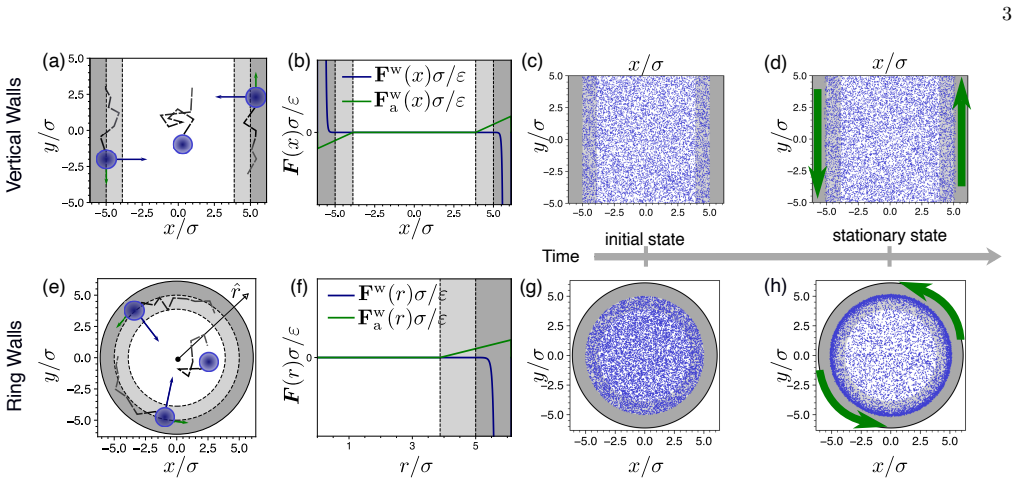
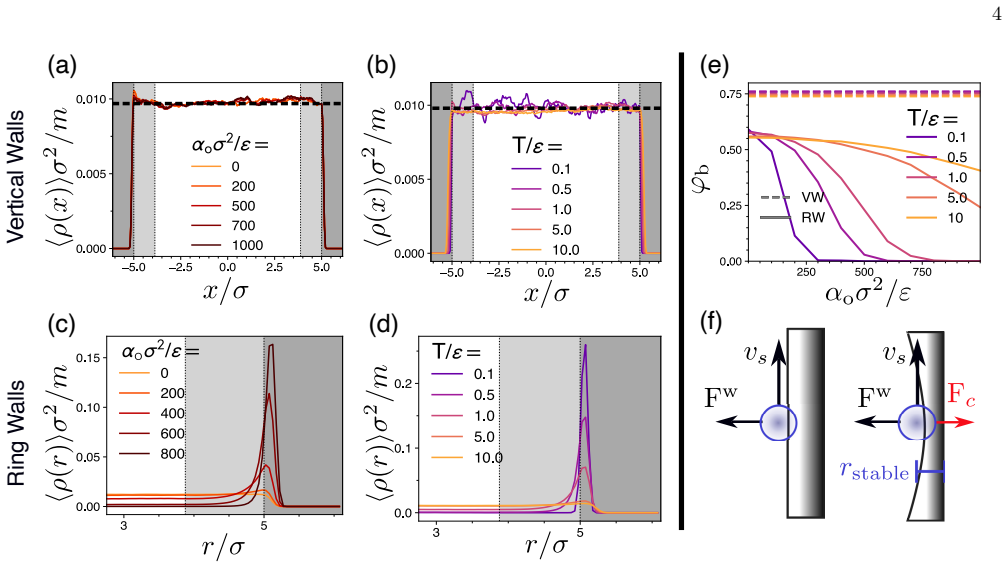
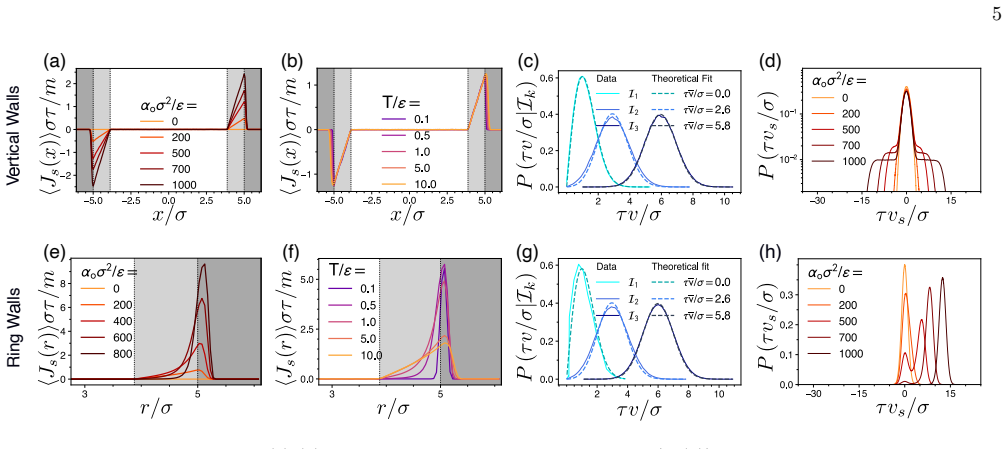
In systems of non-motile chiral active particles, tangential wall forces generate edge currents that produce density inhomogeneities whose strength depends on boundary curvature: particles remain uniformly distributed in straight channels, yet accumulate near the walls of circular enclosures. Numerical simulations and a hydrodynamic theory for the density and momentum fields both recover this curvature-induced wall accumulation.
What carries the argument
Tangential wall forces arising from chiral particle-wall interactions that generate edge currents whose net effect on density is modulated by boundary curvature.
If this is right
- Edge currents alone suffice to create density inhomogeneities when boundaries are curved.
- The accumulation effect vanishes in the zero-curvature limit.
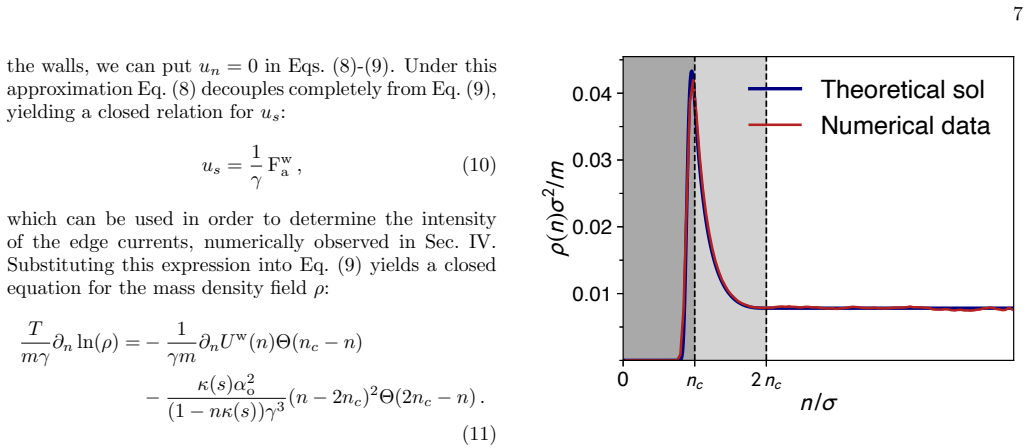
- A hydrodynamic theory coupling density and momentum reproduces the spatial pattern seen in simulations.
- Boundary curvature functions as a tunable parameter for chiral edge transport and confinement organization.
Where Pith is reading between the lines
- Varying the radius of circular enclosures could map how accumulation strength scales with curvature.
- The same tangential-force rule might be tested in microfluidic devices whose walls are shaped to steer particle distributions.
- Granular or colloidal spinners confined by gently curved boundaries offer a direct experimental test bed.
Load-bearing premise
All activity enters the system through chiral tangential forces at the walls, with no particle self-propulsion present.
What would settle it
A measurement of spatially uniform density throughout a circular confinement, or of wall accumulation inside a straight channel, under the same tangential-force rule would falsify the curvature-driven mechanism.
Figures
read the original abstract
We study a dilute system of non-motile chiral active particles confined in geometries ranging from straight channels to circular enclosures. Activity is introduced through chiral particle-wall interactions, modeled as tangential wall forces that generate the edge currents characteristic of chiral active matter. Remarkably, although the particles lack self-propulsion, these boundary currents induce density inhomogeneities. We show that boundary curvature drives a wall accumulation phenomenon: particles remain uniformly distributed in straight channels but accumulate near the boundaries of circular confinements. Numerical simulations and a hydrodynamic theory for the density and momentum fields consistently capture this curvature-induced wall-accumulation. These results identify boundary curvature as a fundamental control parameter for chiral edge transport and confinement-induced organization, with potential experimental relevance to spinning colloids and granular spinners.
Editorial analysis
A structured set of objections, weighed in public.
Referee Report
Summary. The manuscript examines a dilute system of non-motile chiral active particles confined between straight channels and circular enclosures. Activity arises solely from chiral particle-wall interactions modeled as tangential forces that produce edge currents. The central claim is that boundary curvature induces wall accumulation: density remains uniform in zero-curvature (straight) geometries but particles accumulate near the boundaries in finite-curvature (circular) confinements. Both particle-based simulations and a hydrodynamic theory for the density and momentum fields are stated to reproduce this curvature dependence.
Significance. If substantiated, the result isolates boundary curvature as a control parameter for chiral edge currents and confinement-induced density organization in the absence of bulk self-propulsion. The explicit geometric test (straight vs. curved) and the asserted consistency between independent simulation and hydrodynamic outputs constitute a clear strength of the approach.
major comments (2)
- [Numerical simulations and hydrodynamic theory sections (throughout)] The abstract and main text assert that 'numerical simulations and a hydrodynamic theory ... consistently capture' the curvature-induced accumulation, yet no section provides implementation details, parameter values, error bars, convergence checks, or data-exclusion criteria. Because the central claim rests on this consistency, the absence of these elements is load-bearing and prevents independent verification of the reported agreement.
- [Hydrodynamic theory (density/momentum equations)] The model introduces activity exclusively through the tangential wall-force term. While this is explicitly stated, the hydrodynamic closure and its reduction to the observed curvature dependence should be shown explicitly (e.g., via the steady-state density equation) to confirm that the accumulation is not an artifact of the particular force implementation or boundary conditions.
minor comments (2)
- [Figures] Figure captions should explicitly state the curvature values, particle numbers, and run lengths used for the straight-channel and circular cases to allow direct comparison with the text.
- [Model definition] Notation for the tangential force magnitude and the chiral angle should be introduced once and used consistently; currently the symbols appear without prior definition in the abstract and early sections.
Simulated Author's Rebuttal
We thank the referee for their careful reading and constructive comments. We address the concerns regarding reproducibility and explicit derivations below, and have revised the manuscript to incorporate the requested details.
read point-by-point responses
-
Referee: [Numerical simulations and hydrodynamic theory sections (throughout)] The abstract and main text assert that 'numerical simulations and a hydrodynamic theory ... consistently capture' the curvature-induced accumulation, yet no section provides implementation details, parameter values, error bars, convergence checks, or data-exclusion criteria. Because the central claim rests on this consistency, the absence of these elements is load-bearing and prevents independent verification of the reported agreement.
Authors: We agree that the absence of these details limits independent verification. In the revised manuscript we have added a dedicated Methods section that specifies all simulation parameters (particle number, integration timestep, force amplitude and range), the precise implementation of the tangential wall force, statistical error bars obtained from ensemble averages, convergence tests with respect to system size and integration time, and the criteria used for data selection and averaging. revision: yes
-
Referee: [Hydrodynamic theory (density/momentum equations)] The model introduces activity exclusively through the tangential wall-force term. While this is explicitly stated, the hydrodynamic closure and its reduction to the observed curvature dependence should be shown explicitly (e.g., via the steady-state density equation) to confirm that the accumulation is not an artifact of the particular force implementation or boundary conditions.
Authors: We thank the referee for this suggestion. The revised manuscript now contains an explicit derivation of the steady-state density equation. Starting from the continuity and momentum balance with the tangential force term and no-flux boundary conditions, we reduce the system under steady state to obtain a curvature-dependent source term that drives wall accumulation. The derivation is geometry-independent in its origin and confirms the effect is not an artifact of the force implementation. revision: yes
Circularity Check
No significant circularity
full rationale
The paper derives its central claim (curvature-driven wall accumulation via tangential boundary forces in the absence of bulk self-propulsion) from explicit numerical simulations and a hydrodynamic theory for density/momentum fields. These are independent outputs that reproduce uniform density in zero-curvature channels and accumulation in finite-curvature enclosures; the geometric test isolates curvature without reducing any prediction to a fitted parameter or self-citation. The construction is self-contained against the stated model assumptions and external simulation benchmarks.
Axiom & Free-Parameter Ledger
axioms (2)
- domain assumption The system is dilute
- ad hoc to paper Activity is introduced through chiral particle-wall interactions modeled as tangential wall forces generating edge currents
Reference graph
Works this paper leans on
-
[1]
Alfred Gray , title =. 2004 , isbn =. doi:10.1007/978-3-0348-7966-8 , url =
-
[2]
Pressure is not a state function for generic active fluids , author=. Nat. Phys. , volume=. 2015 , publisher=
2015
-
[3]
The mechanics and statistics of active matter , year =
Ramaswamy, Sriram , journal =. The mechanics and statistics of active matter , year =. doi:10.1146/annurev-conmatphys-070909-104101 , eprint =
-
[4]
Hyperuniformity and conservation laws in non-equilibrium systems , author=. J. Chem. Phys. , volume=. 2025 , publisher=
2025
-
[5]
Lecture notes in applied and computational mechanics , volume=
Cosserat continuum mechanics , author=. Lecture notes in applied and computational mechanics , volume=. 2019 , publisher=
2019
-
[6]
Collisional granular flow as a micropolar fluid , author=. Phys. Rev. Lett. , volume=. 2002 , publisher=
2002
-
[7]
Soft Matter , volume=
Coarsening dynamics of binary liquids with active rotation , author=. Soft Matter , volume=. 2015 , publisher=
2015
-
[8]
1990 , publisher=
The mathematical theory of non-uniform gases: an account of the kinetic theory of viscosity, thermal conduction and diffusion in gases , author=. 1990 , publisher=
1990
-
[9]
arXiv preprint arXiv:2603.04273 , year=
Kinetic Theory of Chiral Active Disks: Odd Transport and Torque Density , author=. arXiv preprint arXiv:2603.04273 , year=
-
[10]
Diffusion of active particles driven by odd interactions , author=. Phys. Rev. E , volume=. 2025 , publisher=
2025
-
[11]
Chirality-induced phase separation and collective dynamics in binary mixtures of chiral particles , author=. Phys. Rev. E , volume=. 2025 , publisher=
2025
-
[12]
2012 , publisher=
Large scale dynamics of interacting particles , author=. 2012 , publisher=
2012
-
[13]
Driven low density granular mixtures , author=. Phys. Rev. E , volume=. 2002 , publisher=
2002
-
[14]
Diffuse-interface methods in fluid mechanics , year =
Anderson, Daniel M and McFadden, Geoffrey B and Wheeler, Adam A , journal =. Diffuse-interface methods in fluid mechanics , year =. doi:10.1146/annurev.fluid.30.1.139 , publisher =
-
[15]
Fokker-planck equation , year =
Risken, Hannes , booktitle =. Fokker-planck equation , year =
-
[16]
Bechinger, Clemens and Di Leonardo, Roberto and L. Rev. Mod. Phys. , title =. 2016 , number =. doi:10.1103/revmodphys.88.045006 , publisher =
-
[17]
Marchetti, M Cristina and Joanny, Jean-Fran. Rev. Mod. Phys. , title =. 2013 , number =. doi:10.1103/revmodphys.85.1143 , publisher =
-
[18]
Bubble phase induced by odd interactions in chiral systems , year =
Caprini, Lorenzo and Marini Bettolo Marconi, U , journal =. Bubble phase induced by odd interactions in chiral systems , year =. doi:10.1063/5.0262594 , publisher =
-
[19]
Emergent hydrodynamics of chiral active fluids: vortices, bubbles and odd diffusion , author=. New J. Phys. , volume=. 2026 , publisher=
2026
-
[20]
Singular density correlations in chiral active fluids in three dimensions , author=. Phys. Rev. E , volume=. 2025 , publisher=
2025
-
[21]
Reversal of tracer advection and Hall drift in an interacting chiral fluid , author=. Phys. Rev. E , volume=. 2026 , publisher=
2026
-
[22]
Spontaneous generation of angular momentum in chiral active crystals , year =
Marconi, Umberto Marini Bettolo and Caprini, Lorenzo , journal =. Spontaneous generation of angular momentum in chiral active crystals , year =. doi:10.1039/d4sm01426j , publisher =
-
[23]
Caprini, Lorenzo and L. Soft Matter , title =. 2023 , number =. doi:10.1039/d3sm00793f , publisher =
-
[24]
Phase separation in a chiral active fluid of inertial self-spinning disks , author=. Phys. Rev. Lett. , volume=. 2026 , publisher=
2026
-
[25]
Programmable chiral states in flocks of active magnetic rollers , author=. Lab. Chip. , volume=. 2021 , publisher=
2021
-
[26]
Collective flows drive cavitation in spinner monolayers , year =
Shen, Zaiyi and Lintuvuori, Juho S , journal =. Collective flows drive cavitation in spinner monolayers , year =. doi:10.1103/physrevlett.130.188202 , publisher =
-
[27]
Synchronization and collective dynamics in a carpet of microfluidic rotors , author=. Phys. Rev. Lett. , volume=. 2010 , publisher=
2010
-
[28]
EPL (EPL) , volume=
Synchronization in a carpet of hydrodynamically coupled rotors with random intrinsic frequency , author=. EPL (EPL) , volume=
-
[29]
Micro-flock patterns and macro-clusters in chiral active Brownian disks , author=. J. Phys. Condens. Matter , volume=. 2018 , publisher=
2018
-
[30]
Simultaneous phase separation and pattern formation in chiral active mixtures , author=. Phys. Rev. E , volume=. 2019 , publisher=
2019
-
[31]
Geometry-induced dynamics of confined chiral active matter , author=. Phys. Rev. Res. , volume=. 2023 , publisher=
2023
-
[32]
Phase coexistence and edge currents in the chiral Lennard-Jones fluid , year =
Caporusso, Claudio B and Gonnella, Giuseppe and Levis, Demian , journal =. Phase coexistence and edge currents in the chiral Lennard-Jones fluid , year =. doi:10.1103/physrevlett.132.168201 , publisher =
-
[33]
Dancing volvox: hydrodynamic bound states of swimming algae , author=. Phys. Rev. Lett. , volume=. 2009 , publisher=
2009
-
[34]
Brilliantov, Nikolai V and Spahn, Frank and Hertzsch, Jan-Martin and P. Phys. Rev. E , title =. 1996 , number =. doi:10.1103/physreve.53.5382 , publisher =
-
[35]
Huang, Zhi-Feng and te Vrugt, Michael and Wittkowski, Raphael and L. Proc. Natl. Acad. Sci. U.S.A. , title =. 2025 , number =. doi:10.1073/pnas.2511350122 , eprint =
-
[36]
Tuning nonequilibrium phases with odd forces: From crystalline order to vortex structures in systems with competing interactions , author=. Phys. Rev. E , volume=. 2026 , publisher=
2026
-
[37]
Avron, JE , journal =. Odd viscosity , year =. doi:10.1023/a:1023084404080 , publisher =
-
[38]
Fluctuating hydrodynamics of chiral active fluids , year =
Han, Ming and Fruchart, Michel and Scheibner, Colin and Vaikuntanathan, Suriyanarayanan and De Pablo, Juan J and Vitelli, Vincenzo , journal =. Fluctuating hydrodynamics of chiral active fluids , year =. doi:10.1038/s41567-021-01360-7 , publisher =
-
[39]
Odd viscosity and odd elasticity , year =
Fruchart, Michel and Scheibner, Colin and Vitelli, Vincenzo , journal =. Odd viscosity and odd elasticity , year =. doi:10.1146/annurev-conmatphys-040821-125506 , eprint =
-
[40]
Ma, Zhan and Ni, Ran , journal =. Dynamical clustering interrupts motility-induced phase separation in chiral active Brownian particles , year =. doi:10.1063/5.0077389 , eprint =
-
[41]
Nonreciprocity and odd viscosity in chiral active fluids , year =
Markovich, Tomer and Lubensky, Tom C , journal =. Nonreciprocity and odd viscosity in chiral active fluids , year =. doi:10.1073/pnas.2219385121 , publisher =
-
[42]
Markovich, Tomer and Tjhung, Elsen and Cates, Michael E , journal =. Chiral active matter: microscopic ‘torque dipoles’ have more than one hydrodynamic description , year =. doi:10.1088/1367-2630/ab54af , publisher =
-
[43]
Time-reversal symmetry breaking in two-dimensional nonequilibrium viscous fluids , year =
Epstein, Jeffrey M and Mandadapu, Kranthi K , journal =. Time-reversal symmetry breaking in two-dimensional nonequilibrium viscous fluids , year =. doi:10.1103/physreve.101.052614 , publisher =
-
[44]
2013 , publisher=
Theory of simple liquids: with applications to soft matter , author=. 2013 , publisher=
2013
-
[45]
Ishimoto, Kenta and Moreau, Cl. Phys. Rev. E , title =. 2022 , number =. doi:10.1103/physreve.105.064603 , publisher =
-
[46]
Physics of microswimmers—single particle motion and collective behavior: a review , year =
Elgeti, Jens and Winkler, Roland G and Gompper, Gerhard , journal =. Physics of microswimmers—single particle motion and collective behavior: a review , year =. doi:10.1088/0034-4885/78/5/056601 , publisher =
-
[47]
Mecke, Joscha and Gao, Yongxiang and Ram. Commun. Phys. , title =. 2023 , number =. doi:10.1038/s42005-023-01442-3 , publisher =
-
[48]
A simple equation of state for hard discs , year =
Henderson, Douglas , journal =. A simple equation of state for hard discs , year =. doi:10.1080/00268977500102511 , publisher =
-
[49]
The odd free surface flows of a colloidal chiral fluid , year =
Soni, Vishal and Bililign, Ephraim S and Magkiriadou, Sofia and Sacanna, Stefano and Bartolo, Denis and Shelley, Michael J and Irvine, William TM , journal =. The odd free surface flows of a colloidal chiral fluid , year =. doi:10.1038/s41567-019-0603-8 , publisher =
-
[50]
Classical dynamics with curl forces, and motion driven by time-dependent flux , author=. J. Phys. A: Math. Theor. , volume=. 2012 , publisher=
2012
-
[51]
Splitting probabilities of confined chiral active Brownian particles , author=. New J. Phys. , volume=. 2026 , publisher=
2026
-
[52]
Diffusion of gravitactic chiral active Brownian particles in an asymmetric channel , author=. Phys. Rev. E , volume=. 2026 , publisher=
2026
-
[53]
Fodor,. Annu. Rev. Condens. Matter Phys. , title =. 2022 , number =. doi:10.1146/annurev-conmatphys-031720-032419 , eprint =
-
[54]
Active chiral particles under confinement: Surface currents and bulk accumulation phenomena , year =
Caprini, Lorenzo and Marconi, Umberto Marini Bettolo , journal =. Active chiral particles under confinement: Surface currents and bulk accumulation phenomena , year =. doi:10.1039/c8sm02492h , publisher =
-
[55]
Van Teeffelen, Sven and L. Phys. Rev. E , title =. 2008 , number =. doi:10.1103/physreve.78.020101 , publisher =
-
[56]
Plasma viscosity in a magnetic field , year =
Kaufman, Allan N , journal =. Plasma viscosity in a magnetic field , year =
-
[57]
The form of interfacial surfaces in KortewegÕs theory of phase equilibria , year =
Serrin, James , journal =. The form of interfacial surfaces in KortewegÕs theory of phase equilibria , year =
-
[58]
Benilov, ES , journal =. Dependence of the surface tension and contact angle on the temperature, as described by the diffuse-interface model , year =. doi:10.1103/physreve.101.042803 , publisher =
-
[59]
Non-equilibrium thermodynamics in multiphase flows , year =
Mauri, Roberto , publisher =. Non-equilibrium thermodynamics in multiphase flows , year =
-
[60]
Measuring Hall viscosity of graphene’s electron fluid , year =
Berdyugin, Alexey I and Xu, SG and Pellegrino, FMD and Krishna Kumar, R and Principi, Alessandro and Torre, Iacopo and Ben Shalom, M and Taniguchi, Takashi and Watanabe, K and Grigorieva, IV and others , journal =. Measuring Hall viscosity of graphene’s electron fluid , year =. doi:10.1126/science.aau0685 , eprint =
-
[61]
arXiv preprint arXiv:2510.15419 , year=
Confinement-Induced Delay in Chiral Active Brownian Particles , author=. arXiv preprint arXiv:2510.15419 , year=
-
[62]
Odd viscosity-induced Hall-like transport of an active chiral fluid , year =
Lou, Xin and Yang, Qing and Ding, Yu and Liu, Peng and Chen, Ke and Zhou, Xin and Ye, Fangfu and Podgornik, Rudolf and Yang, Mingcheng , journal =. Odd viscosity-induced Hall-like transport of an active chiral fluid , year =. doi:10.1073/pnas.2201279119 , publisher =
-
[63]
The free surface of a colloidal chiral fluid: waves and instabilities from odd stress and Hall viscosity , author=. arXiv preprint arXiv:1812.09990 , year=
work page internal anchor Pith review Pith/arXiv arXiv
-
[64]
Odd Viscodiffusive Fluids , year =
Deshpande, Alhad and Hargus, Cory and Shekhar, Karthik and Mandadapu, Kranthi K , journal =. Odd Viscodiffusive Fluids , year =
-
[65]
Phase transition dynamics , year =
Onuki, Akira , publisher =. Phase transition dynamics , year =
-
[66]
Swimming at low Reynolds number in fluids with odd, or Hall, viscosity , year =
Lapa, Matthew F and Hughes, Taylor L , journal =. Swimming at low Reynolds number in fluids with odd, or Hall, viscosity , year =. doi:10.1103/physreve.89.043019 , publisher =
-
[67]
A collisional model of odd fluids: from Boltzmann equation to chiral hydrodynamics , year =
Eren, Ege and Fruchart, Michel and Vitelli, Vincenzo , journal =. A collisional model of odd fluids: from Boltzmann equation to chiral hydrodynamics , year =
-
[68]
Clustering and phase separation of circle swimmers dispersed in a monolayer , year =
, Guo-Jun and Klapp, Sabine HL , journal =. Clustering and phase separation of circle swimmers dispersed in a monolayer , year =. doi:10.1039/c8sm01366g , publisher =
-
[69]
Bickmann, Jens and Br. J. Chem. Phys. , title =. 2022 , number =. doi:10.1063/5.0085122 , eprint =
-
[70]
K. Phys. Rev. Lett. , title =. 2013 , number =. doi:10.1103/physrevlett.110.198302 , publisher =
-
[71]
L. Eur. Phys. J. , title =. 2016 , pages =. doi:10.1140/epjst/e2016-60054-6 , publisher =
-
[72]
Motility-induced phase separation , year =
Cates, Michael E and Tailleur, Julien , journal =. Motility-induced phase separation , year =. doi:10.1146/annurev-conmatphys-031214-014710 , eprint =
-
[73]
Long-range translational order and hyperuniformity in two-dimensional chiral active crystal , year =
Kuroda, Yuta and Kawasaki, Takeshi and Miyazaki, Kunimasa , journal =. Long-range translational order and hyperuniformity in two-dimensional chiral active crystal , year =. doi:10.1103/physrevresearch.7.l012048 , publisher =
-
[74]
Shee, Amir and Henkes, Silke and Huepe, Cristi. Soft Matter , title =. 2024 , number =. doi:10.1039/d4sm00958d , publisher =
-
[75]
Collective behavior of chiral active matter: Pattern formation and enhanced flocking , year =
Liebchen, Benno and Levis, Demian , journal =. Collective behavior of chiral active matter: Pattern formation and enhanced flocking , year =. doi:10.1103/physrevlett.119.058002 , publisher =
-
[76]
Pattern formation in chemically interacting active rotors with self-propulsion , year =
Liebchen, Benno and Cates, Michael E and Marenduzzo, Davide , journal =. Pattern formation in chemically interacting active rotors with self-propulsion , year =. doi:10.1039/c6sm01162d , publisher =
-
[77]
Huang, Zhi-Feng and Menzel, Andreas M and L. Phys. Rev. Lett. , title =. 2020 , number =. doi:10.1103/physrevlett.125.218002 , publisher =
-
[78]
Kruk, Nikita and Carrillo, Jos. Phys. Rev. E , title =. 2020 , number =. doi:10.1103/physreve.102.022604 , publisher =
-
[79]
, Guo-Jun and Klapp, Sabine HL , journal =. Emergent vortices and phase separation in systems of chiral active particles with dipolar interactions , year =. doi:10.1039/d1sm00545f , publisher =
-
[80]
Caprini, Lorenzo and Liebchen, Benno and L. Commun. Phys. , title =. 2024 , number =. doi:10.1038/s42005-024-01637-2 , publisher =
discussion (0)
Sign in with ORCID, Apple, or X to comment. Anyone can read and Pith papers without signing in.