False vacuum decay in a two-dimensional quantum spin system
Pith reviewed 2026-07-03 11:56 UTC · model grok-4.3
The pith
Tree tensor network simulations of the 2D quantum Ising model extract decay rate, interface tension and critical bubble size that match semi-classical field theory predictions.
A machine-rendered reading of the paper's core claim, the machinery that carries it, and where it could break.
Core claim
Through tree tensor network simulations of the quantum Ising model in two dimensions, the decay rate, effective interface tension, and critical bubble size are extracted and found to agree with semi-classical field theory calculations, demonstrating that the critical-bubble picture of false vacuum decay survives in an interacting quantum spin system in 2+1 dimensions.
What carries the argument
Tree tensor network simulations of the 2D quantum Ising model that extract the decay rate, interface tension and critical bubble size for comparison with semi-classical field theory.
If this is right
- The extracted decay rate agrees quantitatively with semi-classical expectations.
- An effective interface tension can be defined and measured in the quantum lattice model.
- The critical bubble size extracted from the simulations is consistent with the continuum theory.
- The geometrical nucleation mechanism therefore carries over from classical field theory to this interacting quantum system.
Where Pith is reading between the lines
- The same numerical protocol could be applied to other lattice spin models to test whether the critical-bubble description remains accurate when additional interactions are present.
- If the agreement persists at larger scales, it would support using semi-classical estimates to predict decay times in quantum simulators that realize similar metastable states.
- The work leaves open whether the same matching would hold in three spatial dimensions or in models with different symmetries.
Load-bearing premise
The tree tensor network simulations accurately capture the long-time quantum dynamics and bubble nucleation without significant truncation or finite-size artifacts that would invalidate the extracted decay rate and interface tension.
What would settle it
A clear mismatch between the simulated decay rate and the semi-classical prediction when system size or evolution time is increased substantially beyond the values reported.
Figures

read the original abstract
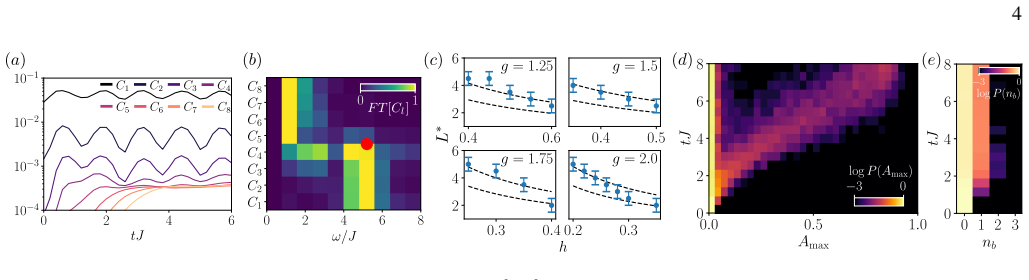
False vacuum decay describes the relaxation of a metastable state through the nucleation and growth of bubbles of the stable phase. Despite describing a broad variety of phenomena across different fields, the quantum version of the nucleation theory has little experimental or numerical support. Testing its predictions is particularly important in two or more spatial dimensions, where bubble nucleation acquires its true geometrical nature. Here, we study false vacuum decay in the quantum Ising model in two dimensions. Through tree tensor network simulations we extract the decay rate, the effective interface tension and the critical bubble size. We compare them to new semi-classical field theory calculations, and find excellent agreement. These results provide numerical evidence that the critical-bubble picture survives in an interacting quantum spin system in 2+1 dimensions.
Editorial analysis
A structured set of objections, weighed in public.
Referee Report
Summary. The manuscript studies false vacuum decay in the two-dimensional quantum Ising model. Using tree tensor network (TTN) simulations, the authors extract the decay rate, effective interface tension, and critical bubble size. These quantities are compared to new semi-classical field-theory calculations, with the abstract reporting excellent agreement. The central claim is that these results supply numerical evidence that the critical-bubble picture survives in an interacting quantum spin system in 2+1 dimensions.
Significance. If the reported agreement is shown to be robust, the work would supply rare quantitative support for quantum nucleation theory in higher dimensions, where geometric effects are essential and analytic control is limited. The combination of TTN numerics with independent semi-classical predictions is a strength when convergence is demonstrated.
major comments (2)
- [Abstract] Abstract: the claim of 'excellent agreement' for decay rate, interface tension, and critical bubble size is stated without any quantitative measures (relative errors, χ^{2} values, or tabulated comparisons), system sizes, bond dimensions, or truncation-error estimates. The central claim therefore rests on an unshown comparison whose robustness cannot be assessed from the given text.
- [Simulation Methods / Results] Simulation section (implicit in methods and results): bubble nucleation is a rare, long-time process with entanglement growth across a 2D interface. Tree tensor networks require bond-dimension truncation; without explicit bond-dimension scaling, finite-size extrapolation, or error bounds on the extracted decay rate and tension, it is unclear whether the reported agreement is free of systematic bias.
minor comments (2)
- [Results] Notation for the effective interface tension and critical radius should be defined explicitly when first introduced and kept consistent between the TTN and semi-classical sections.
- [Figures] Figure captions should state the bond dimension, lattice size, and time window used for each extracted quantity.
Simulated Author's Rebuttal
We thank the referee for the detailed and constructive report. The comments highlight important aspects of presentation and validation that we will address in a revised manuscript. Below we respond point-by-point to the major comments.
read point-by-point responses
-
Referee: [Abstract] Abstract: the claim of 'excellent agreement' for decay rate, interface tension, and critical bubble size is stated without any quantitative measures (relative errors, χ² values, or tabulated comparisons), system sizes, bond dimensions, or truncation-error estimates. The central claim therefore rests on an unshown comparison whose robustness cannot be assessed from the given text.
Authors: We agree that the abstract would be strengthened by quantitative indicators. The detailed comparisons appear in the main text (Figures 3–5 display the decay rates, effective tensions, and critical radii against the semi-classical curves). In the revision we will update the abstract to include explicit relative differences (typically <8 % for the decay rate and <5 % for the tension on the lattices studied) and will mention representative system sizes (up to 20×20) together with the bond dimensions employed (D=16–32). A compact table summarizing the extracted quantities with estimated uncertainties will also be added to the main text or supplementary material. revision: yes
-
Referee: [Simulation Methods / Results] Simulation section (implicit in methods and results): bubble nucleation is a rare, long-time process with entanglement growth across a 2D interface. Tree tensor networks require bond-dimension truncation; without explicit bond-dimension scaling, finite-size extrapolation, or error bounds on the extracted decay rate and tension, it is unclear whether the reported agreement is free of systematic bias.
Authors: We acknowledge that explicit convergence diagnostics are essential for a rare-event process. Our TTN calculations were performed with a sequence of bond dimensions; the extracted decay rates and interface tensions stabilize for D ≳ 16, with changes below 4 % upon further increase. Finite-size effects were assessed by repeating the simulations on lattices from 10×10 to 24×24, confirming that the critical bubble size and nucleation rate become size-independent beyond 16×16 for the parameters considered. In the revised manuscript we will insert a dedicated subsection (or appendix) containing bond-dimension scaling plots, finite-size extrapolation data, and the fitting uncertainties used to obtain the reported quantities, thereby demonstrating that the agreement with the semi-classical predictions is not affected by truncation or finite-size bias at the level of precision shown. revision: yes
Circularity Check
No circularity: simulations and semi-classical calculations are independent
full rationale
The paper extracts decay rates, interface tensions and critical bubble sizes from tree tensor network simulations of the 2D quantum Ising model, then compares these quantities to separate semi-classical field theory calculations. No equations or text indicate that any reported prediction reduces to a fitted input by construction, that a uniqueness theorem is imported from the authors' prior work, or that an ansatz is smuggled via self-citation. The central claim rests on numerical evidence that is not forced by the input data or by self-referential definitions.
Axiom & Free-Parameter Ledger
Reference graph
Works this paper leans on
-
[1]
Higgs mass and vacuum stability in the Standard Model at NNLO
G. Degrassi, S. Di Vita, J. Elias-Miro, J. R. Espinosa, G. F. Giudice, G. Isidori, and A. Strumia, Higgs mass and vacuum stability in the Standard Model at NNLO, JHEP08, 098, arXiv:1205.6497 [hep-ph]
work page internal anchor Pith review Pith/arXiv arXiv
-
[2]
Investigating the near-criticality of the Higgs boson
D. Buttazzo, G. Degrassi, P. P. Giardino, G. F. Giudice, F. Sala, A. Salvio, and A. Strumia, Investigating the near-criticality of the Higgs boson, JHEP12, 089, arXiv:1307.3536 [hep-ph]
work page internal anchor Pith review Pith/arXiv arXiv
-
[3]
Langer, Statistical theory of the decay of metastable states, Annals of Physics54, 258–275 (1969)
J. Langer, Statistical theory of the decay of metastable states, Annals of Physics54, 258–275 (1969)
1969
-
[4]
Binder, Theory of first-order phase transitions, Reports on Progress in Physics50, 783–859 (1987)
K. Binder, Theory of first-order phase transitions, Reports on Progress in Physics50, 783–859 (1987)
1987
-
[5]
Bray, Theory of phase-ordering kinetics, Advances in Physics43, 357–459 (1994)
A. Bray, Theory of phase-ordering kinetics, Advances in Physics43, 357–459 (1994)
1994
-
[6]
C. Yin, F. M. Surace, and A. Lucas, Theory of metastable states in many-body quantum systems, Physical Review X15, 10.1103/physrevx.15.011064 (2025)
-
[7]
B. M. Terhal, Quantum error correction for quantum memories, Reviews of Modern Physics87, 307–346 (2015)
2015
-
[8]
B. J. Brown, D. Loss, J. K. Pachos, C. N. Self, and J. R. Wootton, Quantum memories at finite temperature, Reviews of Modern Physics88, 10.1103/revmodphys.88.045005 (2016)
-
[9]
J. S. Langer, Theory of the condensation point, Annals Phys. 41, 108 (1967)
1967
-
[10]
S. R. Coleman, The Fate of the False Vacuum. 1. Semiclassical Theory, Phys. Rev.D15, 2929 (1977), [Erratum: Phys. Rev.D16,1248(1977)]
1977
-
[11]
C. G. Callan and S. R. Coleman, The Fate of the False Vacuum
-
[12]
Rev.D16, 1762 (1977)
First Quantum Corrections, Phys. Rev.D16, 1762 (1977)
1977
-
[13]
Schiffer and D
P. Schiffer and D. D. Osheroff, Nucleation of the AB transition in superfluid 3He: Surface effects and baked Alaska, Reviews of Modern Physics67, 491 (1995)
1995
-
[14]
Balibar and F
S. Balibar and F. Caupin, Metastable liquids, Journal of Physics: Condensed Matter15, S75–S82 (2002)
2002
-
[15]
Y . Tian, D. Lotnyk, A. Eyal, K. Zhang, N. Zhelev, T. S. Abhilash, A. Chavez, E. N. Smith, M. Hindmarsh, J. Saunders, E. Mueller, and J. M. Parpia, Supercooling of the a phase of 3he, Nature Communications14, 10.1038/s41467-022-35532- 7 (2023)
-
[16]
Hindmarsh, J
M. Hindmarsh, J. A. Sauls, K. Zhang, S. Autti, R. P. Haley, P. J. Heikkinen, S. J. Huber, L. V . Levitin, A. Lopez-Eiguren, A. J. Mayer, K. Rummukainen, J. Saunders, and D. Zmeev, A-b transition in superfluid he3 and cosmological phase transitions, Journal of Low Temperature Physics215, 495–524 (2024)
2024
-
[17]
Zenesini, A
A. Zenesini, A. Berti, R. Cominotti, C. Rogora, I. G. Moss, T. P. Billam, I. Carusotto, G. Lamporesi, A. Recati, and G. Ferrari, False vacuum decay via bubble formation in ferromagnetic superfluids, Nature Physics20, 558–563 (2024)
2024
-
[18]
R. Cominotti, C. Baroni, C. Rogora, D. Andreoni, G. Guarda, G. Lamporesi, G. Ferrari, and A. Zenesini, Observation of temperature effects on false vacuum decay in atomic quantum gases, Physical Review Letters135, 10.1103/l396-yysb (2025). 6
-
[19]
Fialko, B
O. Fialko, B. Opanchuk, A. I. Sidorov, P. D. Drummond, and J. Brand, The universe on a table top: engineering quantum decay of a relativistic scalar field from a metastable vacuum, Journal of Physics B: Atomic, Molecular and Optical Physics 50, 024003 (2017)
2017
- [20]
- [21]
- [22]
-
[23]
G. Lagnese, F. M. Surace, M. Kormos, and P. Calabrese, False vacuum decay in quantum spin chains, Physical Review B104, 10.1103/physrevb.104.l201106 (2021)
-
[24]
S. B. Rutkevich, Decay of the metastable phase ind= 1and d= 2Ising models, Physical Review B60, 14525–14528 (1999)
1999
-
[25]
A. Sinha, T. Chanda, and J. Dziarmaga, Nonadiabatic dynamics across a first-order quantum phase transition: Quantized bubble nucleation, Physical Review B103, 10.1103/physrevb.103.l220302 (2021)
-
[26]
A. Milsted, J. Liu, J. Preskill, and G. Vidal, Collisions of false- vacuum bubble walls in a quantum spin chain, PRX Quantum 3, 10.1103/prxquantum.3.020316 (2022)
-
[28]
O. Pomponio, M. A. Werner, G. Zar ´and, and G. Takacs, Bloch oscillations and the lack of the decay of the false vacuum in a one-dimensional quantum spin chain, SciPost Physics12, 10.21468/scipostphys.12.2.061 (2022)
-
[29]
J. A. Maki, A. Berti, I. Carusotto, and A. Biella, Monte carlo matrix-product-state approach to the false vacuum decay in the monitored quantum ising chain, SciPost Physics15, 10.21468/scipostphys.15.4.152 (2023)
-
[30]
M. Lencs ´es, G. Mussardo, and G. Tak´acs, Variations on vacuum decay: The scaling ising and tricritical ising field theories, Physical Review D106, 10.1103/physrevd.106.105003 (2022)
-
[31]
O. Pomponio, A. Krasznai, and G. Tak ´acs, Confinement and false vacuum decay on the potts quantum spin chain, SciPost Physics18, 10.21468/scipostphys.18.3.082 (2025)
-
[32]
S. Darbha, M. Kornja ˇca, F. Liu, J. Balewski, M. R. Hirsbrunner, P. L. S. Lopes, S.-T. Wang, R. Van Beeumen, D. Camps, and K. Klymko, False vacuum decay and nucleation dynamics in neutral atom systems, Physical Review B110, 10.1103/physrevb.110.155103 (2024)
-
[33]
S. Darbha, M. Kornja ˇca, F. Liu, J. Balewski, M. R. Hirsbrunner, P. L. S. Lopes, S.-T. Wang, R. Van Beeumen, K. Klymko, and D. Camps, Long-lived oscillations of metastable states in neutral atom systems, Physical Review B 110, 10.1103/physrevb.110.155114 (2024)
-
[34]
V odeb, J.-Y
J. V odeb, J.-Y . Desaules, A. Hallam, A. Rava, G. Humar, D. Willsch, F. Jin, M. Willsch, K. Michielsen, and Z. Papi ´c, Stirring the false vacuum via interacting quantized bubbles on a 5, 564-qubit quantum annealer, Nature Physics21, 386–392 (2025)
2025
-
[36]
Y .-X. Chao, P. Ge, Z.-X. Hua, C. Jia, X. Wang, X. Liang, Z. Yue, R. Lu, M. K. Tey, X. Wang, and L. You, Probing false vacuum decay and bubble nucleation in a rydberg atom array, Physical Review Letters136, 10.1103/kqzq-fnr4 (2026)
-
[37]
F. Balducci, A. Gambassi, A. Lerose, A. Scardicchio, and C. Vanoni, Localization and melting of interfaces in the two- dimensional quantum ising model, Physical Review Letters 129, 10.1103/physrevlett.129.120601 (2022)
-
[38]
W. Krinitsin, N. Tausendpfund, M. Rizzi, M. Heyl, and M. Schmitt, Roughening dynamics of interfaces in the two- dimensional quantum ising model, Physical Review Letters 134, 10.1103/9bsk-x9rw (2025)
-
[39]
L. Pave ˇsi´c, D. Jaschke, and S. Montangero, Constrained dynamics and confinement in the two-dimensional quantum ising model, Physical Review B111, 10.1103/physrevb.111.l140305 (2025)
-
[40]
Manovitz, S
T. Manovitz, S. H. Li, S. Ebadi, R. Samajdar, A. A. Geim, S. J. Evered, D. Bluvstein, H. Zhou, N. U. Koyluoglu, J. Feldmeier, P. E. Dolgirev, N. Maskara, M. Kalinowski, S. Sachdev, D. A. Huse, M. Greiner, V . Vuleti ´c, and M. D. Lukin, Quantum coarsening and collective dynamics on a programmable simulator, Nature638, 86–92 (2025)
2025
-
[44]
L. Tagliacozzo, G. Evenbly, and G. Vidal, Simulation of two- dimensional quantum systems using a tree tensor network that exploits the entropic area law, Physical Review B80, 10.1103/physrevb.80.235127 (2009)
-
[45]
V . Murg, F. Verstraete, O. Legeza, and R. M. Noack, Simulating strongly correlated quantum systems with tree tensor networks, Physical Review B82, 10.1103/physrevb.82.205105 (2010). [45]Introduction to Tensor Network Methods: From Many-Body Quantum Systems to Machine Learning(Springer Nature Switzerland, 2026)
-
[46]
Schollw ¨ock, The density-matrix renormalization group in the age of matrix product states, Annals of Physics326, 96–192 (2011)
U. Schollw ¨ock, The density-matrix renormalization group in the age of matrix product states, Annals of Physics326, 96–192 (2011)
2011
-
[47]
J. I. Cirac, D. P ´erez-Garc´ıa, N. Schuch, and F. Verstraete, Matrix product states and projected entangled pair states: Concepts, symmetries, theorems, Reviews of Modern Physics 93, 10.1103/revmodphys.93.045003 (2021)
-
[48]
Pave ˇsi´c, I
L. Pave ˇsi´c, I. Moss, and S. Montangero, Supplementary material for ”False vacuum decay in two dimensions” (2026)
2026
-
[49]
J. Tindall and D. Sels, Confinement in the transverse field ising model on the heavy hex lattice, Physical Review Letters133, 10.1103/physrevlett.133.180402 (2024)
-
[50]
N. J. Guenther, D. A. Nicole, and D. J. Wallace, Goldstone Modes in Vacuum Decay and First Order Phase Transitions, J. Phys. A13, 1755 (1980)
1980
-
[51]
M. J. Lowe and D. J. Wallace, Instantons and the ising model below tc, Journal of Physics A: Mathematical and General13, L381 (1980)
1980
-
[52]
L. Pave ˇsi´c, M. Di Liberto, and S. Montangero, Scattering and 7 induced false vacuum decay in the two-dimensional quantum ising model, Nature Communications 10.1038/s41467-026- 73056-6 (2026)
-
[53]
S. W. Hawking, I. G. Moss, and J. M. Stewart, Bubble collisions in the very early universe, Physical Review D26, 2681–2693 (1982)
1982
-
[54]
M. Lewicki and V . Vaskonen, On bubble collisions in strongly supercooled phase transitions, Phys. Dark Univ.30, 100672 (2020), arXiv:1912.00997 [astro-ph.CO]
-
[55]
S. R. Coleman and F. De Luccia, Gravitational Effects on and of Vacuum Decay, Phys. Rev. D21, 3305 (1980)
1980
-
[56]
A. D. Linde, Eternally existing self-reproducing inflationary universe, Phys. Scripta T15, 169 (1987)
1987
-
[57]
A. H. Guth, Inflation and eternal inflation, Phys. Rept.333, 555 (2000), arXiv:astro-ph/0002156
work page internal anchor Pith review Pith/arXiv arXiv 2000
-
[58]
C. Anastopoulos, Final states in quantum cosmology: Cosmic acceleration as a quantum postselection effect, Phys. Rev. D 111, 064045 (2025), arXiv:2401.07662 [gr-qc]
-
[61]
Baccari, D
F. Baccari, D. Bacilieri, M. Ballarin, F. P. Barone, F. Campaioli, A. G. Catalano, G. Cataldi, M. Colombo, A. Coppi, A. Costantini, A. Datta, A. De Girolamo, D. Jaschke, S. B. Koˇzi´c, G. Magnifico, C. Mordini, S. Montangero, M. Menon, G. Mu ˜noz Men ´es, S. Notarnicola, A. Pagano, L. Pavesic, D. Rattacaso, M. Rigobello, N. Reini ´c, S. Scarlatella, I. Si...
2026
-
[62]
Baccari, M
F. Baccari, M. Ballarin, F. P. Barone, A. Coppi, A. D. Girolamo, D. Jaschke, S. Montangero, C. Mordini, L. Pave ˇsi´c, D. Rattacaso, and N. Reini´c, Quantum tea: qredtea (2025)
2025
-
[64]
M. Suzuki, Relationship between d-Dimensional Quantal Spin Systems and (d+1)-Dimensional Ising Systems: Equivalence, Critical Exponents and Systematic Approximants of the Partition Function and Spin Correlations, Prog. Theor. Phys.56, 1454 (1976)
1976
- [65]
-
[66]
J. E. Avron, H. van Beijeren, L. S. Schulman, and R. K. P. Zia, Roughening transition, surface tension and equilibrium droplet shapes in a two-dimensional ising system, Journal of Physics A: Mathematical and General15, L81 (1982)
1982
-
[67]
R. K. P. Zia and J. E. Avron, Total surface energy and equilibrium shapes: Exact results for thed= 2ising crystal, Phys. Rev. B25, 2042(R) (1982)
2042
-
[68]
L. Kohn, P. Silvi, M. Gerster, M. Keck, R. Fazio, G. E. Santoro, and S. Montangero, Superfluid-to-mott transition in a bose- hubbard ring: Persistent currents and defect formation, Physical Review A101, 10.1103/physreva.101.023617 (2020)
-
[69]
J. Haegeman, C. Lubich, I. Oseledets, B. Vandereycken, and F. Verstraete, Unifying time evolution and optimization with matrix product states, Physical Review B94, 10.1103/physrevb.94.165116 (2016)
-
[70]
D. Bauernfeind and M. Aichhorn, Time dependent variational principle for tree tensor networks, SciPost Physics8, 10.21468/scipostphys.8.2.024 (2020)
-
[71]
Cataldi, A
G. Cataldi, A. Abedi, G. Magnifico, S. Notarnicola, N. D. Pozza, V . Giovannetti, and S. Montangero, Hilbert curve vs hilbert space: exploiting fractal 2d covering to increase tensor network efficiency, Quantum5, 556 (2021)
2021
-
[72]
O. R. Bellwood, H. P. Casagrande, and W. J. Munro, Fractal path strategies for efficient two-dimensional density matrix renormalization group simulations, Physical Review B112, 10.1103/wwjx-kc37 (2025)
-
[73]
arXivabs/1811.12649(2018).https://doi.org/10.48550/arXiv
A. Scardicchio, On the optimal layout of two-dimensional lattices for density matrix renormalization group 10.48550/ARXIV .2601.13762 (2026). 8 SUPPLEMENTARY MA TERIAL FOR: FALSE V ACUUM DECA Y IN A TWO DIMENSIONAL QUANTUM SPIN SYSTEM CRITICAL BUBBLES AND INSTANTONS The application of critical droplet theory to ferromagnetic phase transitions in Ising mod...
work page internal anchor Pith review doi:10.48550/arxiv 2026
discussion (0)
Sign in with ORCID, Apple, or X to comment. Anyone can read and Pith papers without signing in.