Idling error suppression through gate scheduling
Pith reviewed 2026-07-03 12:46 UTC · model grok-4.3
The pith
Rescheduling quantum gate timings suppresses idling errors and improves accuracy without extra gates.
A machine-rendered reading of the paper's core claim, the machinery that carries it, and where it could break.
Core claim
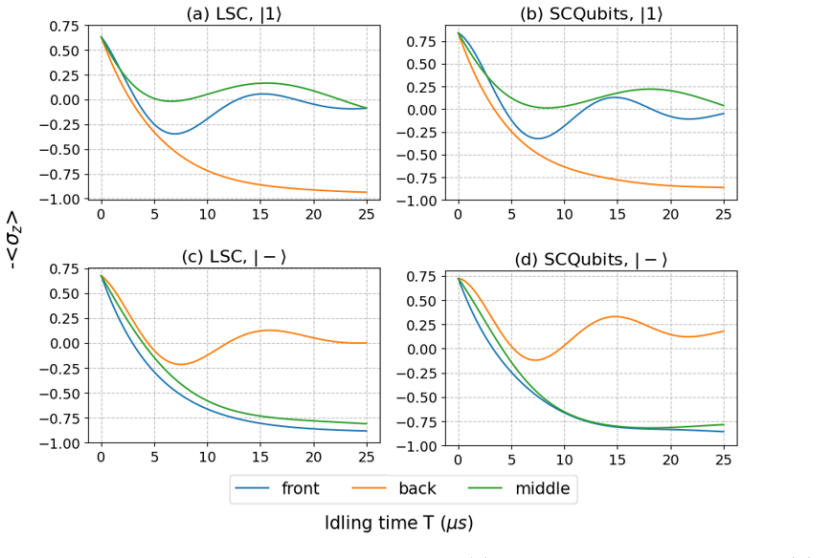
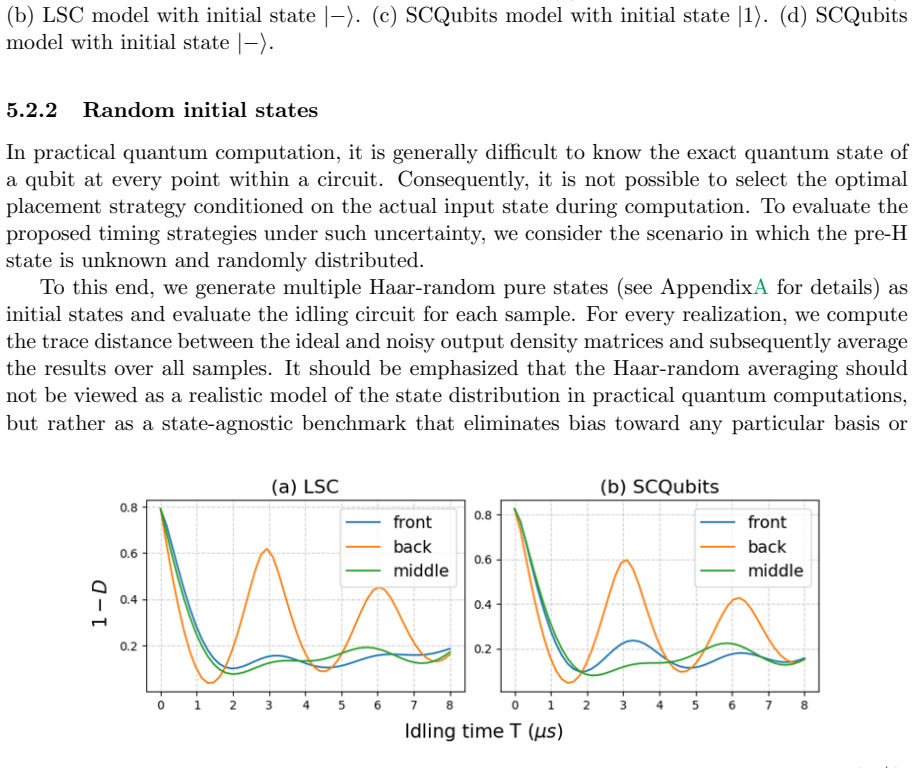
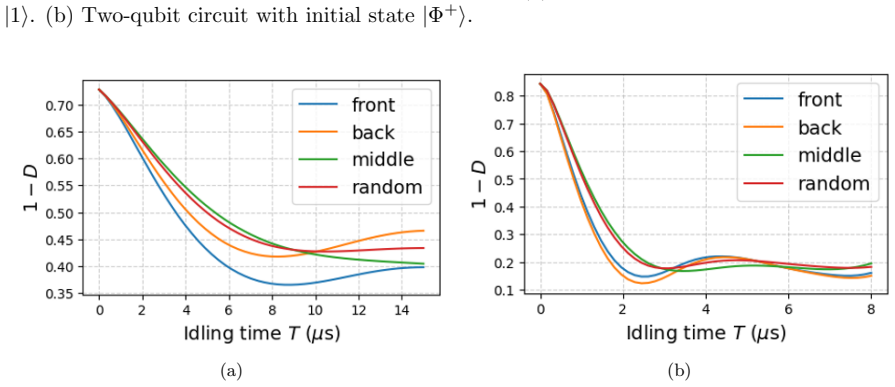
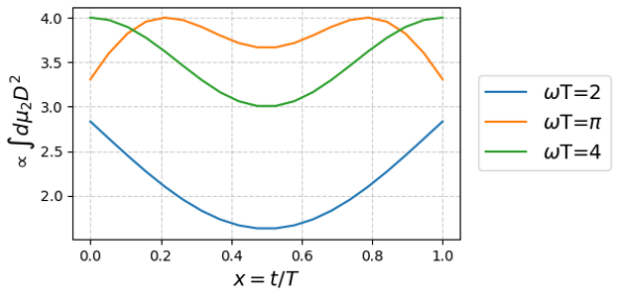
By appropriately adjusting the execution timing of quantum gates with scheduling flexibility, idling errors are suppressed and overall computational accuracy is significantly influenced and in many cases improved, as demonstrated in numerical simulations and hardware experiments; an analytic derivation of the density-matrix evolution under idling noise accounts for the observed behavior.
What carries the argument
Gate scheduling that varies only the start times of existing operations to reduce cumulative idling noise on qubit states.
If this is right
- Quantum circuits can reach higher fidelity by choosing gate start times that minimize idle periods under the prevailing noise.
- Error suppression occurs without increasing circuit depth or inserting additional control operations.
- The density-matrix derivation gives a direct way to predict which schedules will perform better before running the circuit.
- The method applies to any circuit that already possesses scheduling freedom between gates.
Where Pith is reading between the lines
- Compilers could incorporate automatic timing optimization as a low-cost preprocessing step.
- Scheduling adjustments might complement or partially replace dynamical decoupling in noise regimes where idle-time reordering is sufficient.
- The same timing principle could be tested on circuits dominated by other time-dependent noise sources beyond pure idling.
- Larger-scale validation would compare output distributions across systematically varied schedules on devices with known idle-noise profiles.
Load-bearing premise
Idling noise has enough time structure that its total effect on the final state shrinks when gate start times are reordered, without needing to know the noise spectrum or to add compensating pulses.
What would settle it
Execute the identical circuit on the same hardware under two schedules that differ solely in gate start times and measure no statistically significant change in output fidelity.
Figures




read the original abstract
Achieving high-precision quantum computation requires effective suppression of idling errors that occur when qubits remain inactive during waiting periods within a quantum circuit. Conventional mitigation techniques, such as dynamical decoupling, suppress decoherence by periodically refreshing quantum states through the insertion of additional control gates. In this paper, we propose an alternative approach that suppresses idling errors through quantum circuit scheduling without introducing any additional gate operations. By appropriately adjusting the execution timing of quantum gates with scheduling flexibility, we demonstrate through both numerical simulations and hardware experiments that the overall computational accuracy can be significantly influenced and, in many cases, improved. In addition, we analytically derive the density-matrix evolution under idling noise and provide a theoretical framework that explains the observed behavior.
Editorial analysis
A structured set of objections, weighed in public.
Referee Report
Summary. The manuscript proposes suppressing idling errors in quantum circuits by adjusting gate execution timings via scheduling flexibility, without inserting additional gates. It supports the claim with numerical simulations, hardware experiments on quantum processors, and an analytical derivation of the density-matrix evolution under idling noise, asserting that such adjustments can significantly influence and often improve computational accuracy.
Significance. If the central claim holds under the paper's noise model, the approach would provide a low-overhead alternative to dynamical decoupling by exploiting existing scheduling degrees of freedom. The combination of an explicit analytical framework with both simulation and hardware validation is a strength, as is the absence of extra gate overhead. The result would be of practical interest for near-term devices if the timing effect is robust and not limited to specially engineered noise.
major comments (3)
- [analytical derivation] Abstract and analytical derivation section: the density-matrix evolution is presented as explaining the observed scheduling benefit, yet the noise Hamiltonian or correlation function is not specified. Under a stationary Markovian model the integrated decoherence depends only on each qubit's total idle time (fixed by topology and gate durations), so the derivation must explicitly demonstrate a non-stationary or time-correlated structure for reordering start times to reduce cumulative error.
- [hardware experiments] Hardware experiments section: improvements are attributed to gate scheduling, but no control experiments are described that hold total idle time fixed while varying only start-time ordering, or that isolate idling timing from schedule-dependent effects such as crosstalk, calibration drift, or pulse overlap. Without such controls the attribution to the proposed mechanism remains unverified.
- [numerical simulations] Numerical simulations section: the manuscript asserts accuracy improvement via simulations, but provides no quantitative metrics (e.g., fidelity deltas, error rates with/without scheduling), noise-model parameters, or statistical controls (error bars, number of shots). This prevents assessment of effect size and reproducibility.
minor comments (2)
- [abstract] The abstract states that accuracy is 'significantly influenced and, in many cases, improved' but does not report any numerical values or confidence intervals; adding at least one concrete metric would improve clarity.
- [throughout] Notation for the idling noise operator and the scheduling variables should be defined consistently between the analytical derivation and the simulation/hardware sections.
Simulated Author's Rebuttal
We thank the referee for the constructive and detailed comments. We address each major comment point by point below, indicating where revisions have been made to strengthen the manuscript.
read point-by-point responses
-
Referee: [analytical derivation] Abstract and analytical derivation section: the density-matrix evolution is presented as explaining the observed scheduling benefit, yet the noise Hamiltonian or correlation function is not specified. Under a stationary Markovian model the integrated decoherence depends only on each qubit's total idle time (fixed by topology and gate durations), so the derivation must explicitly demonstrate a non-stationary or time-correlated structure for reordering start times to reduce cumulative error.
Authors: We agree that the noise model assumptions require explicit clarification. Our analytical derivation employs a non-Markovian noise model with a time-dependent correlation function that depends on the relative timing of idle intervals; this structure is what permits reordering to reduce cumulative error. In the revised manuscript we will add the explicit form of the noise Hamiltonian and correlation function, together with a short derivation step showing how the integrated decoherence term changes with start-time ordering under this model. revision: yes
-
Referee: [hardware experiments] Hardware experiments section: improvements are attributed to gate scheduling, but no control experiments are described that hold total idle time fixed while varying only start-time ordering, or that isolate idling timing from schedule-dependent effects such as crosstalk, calibration drift, or pulse overlap. Without such controls the attribution to the proposed mechanism remains unverified.
Authors: The referee correctly notes the absence of explicit control experiments that isolate ordering while holding total idle time constant. The original hardware section reports end-to-end circuit fidelity improvements but does not include those controls. We will revise the section to describe additional control runs (or, where hardware constraints prevented them, to discuss the remaining confounding factors and the steps taken to minimize them). revision: yes
-
Referee: [numerical simulations] Numerical simulations section: the manuscript asserts accuracy improvement via simulations, but provides no quantitative metrics (e.g., fidelity deltas, error rates with/without scheduling), noise-model parameters, or statistical controls (error bars, number of shots). This prevents assessment of effect size and reproducibility.
Authors: We accept that quantitative metrics and statistical details were omitted. The revised numerical simulations section now reports fidelity deltas, per-qubit error rates for scheduled versus unscheduled circuits, the precise noise-model parameters, error bars obtained from 100 independent runs, and the number of shots used in each simulation. revision: yes
Circularity Check
No circularity: analytic derivation presented as independent of empirical results
full rationale
The paper states that it analytically derives the density-matrix evolution under idling noise as a separate theoretical framework that explains the numerical and hardware observations. No equations, parameters, or predictions are shown to reduce by construction to fitted inputs, self-citations, or ansatzes imported from prior work by the same authors. The central claim rests on the assumption of exploitable time dependence in the noise, but this is not smuggled in via definition or renaming; it is an explicit modeling choice whose validity is tested externally via simulation and experiment. The derivation chain is therefore self-contained against external benchmarks.
Axiom & Free-Parameter Ledger
Reference graph
Works this paper leans on
-
[1]
P. Krantz, M. Kjaergaard, F. Yan, T. P. Orlando, S. Gustavsson, and W. D. Oliver. A quantum engineer’s guide to superconducting qubits.Appl. Phys. Rev., 6(2):021318, 2019. doi: 10.1063/1.5089550. 20
-
[2]
Barbara M. Terhal. Quantum error correction for quantum memories.Rev. Mod. Phys., 87(2):307, 2015. doi: 10.1103/RevModPhys.87.307
-
[3]
Exponential suppression of bit or phase flip errors with repetitive error correction
Zijun Chen et al. Exponential suppression of bit or phase flip errors with repetitive error correction. 2 2021. doi: 10.1038/s41586-021-03588-y
-
[4]
Demonstration of quantum volume 64 on a superconducting quantum computing system.Quantum Sci
Petar Jurcevic et al. Demonstration of quantum volume 64 on a superconducting quantum computing system.Quantum Sci. Technol., 6:025020, 2021. doi: 10.1088/2058-9565/ abe519
-
[5]
Bibek Pokharel, Namit Anand, Benjamin Fortman, and Daniel A. Lidar. Demonstration of fidelity improvement using dynamical decoupling with superconducting qubits.Phys. Rev. Lett., 121:220502, Nov 2018. doi: 10.1103/PhysRevLett.121.220502. URLhttps: //link.aps.org/doi/10.1103/PhysRevLett.121.220502
-
[6]
Bravyi and Alexei Yu
Sergey B. Bravyi and Alexei Yu. Kitaev. Quantum codes on a lattice with boundary. 11 1998
1998
-
[7]
Eric Dennis, Alexei Kitaev, Andrew Landahl, and John Preskill. Topological quantum memory.J. Math. Phys., 43:4452–4505, 2002. doi: 10.1063/1.1499754
-
[8]
Michael H. Freedman and David A. Meyer. Projective Plane and Planar Quantum Codes. Found. Comput. Math., 1(3):325–332, 2001. doi: 10.1007/s102080010013
-
[9]
Fowler, Matteo Mariantoni, John M
Austin G. Fowler, Matteo Mariantoni, John M. Martinis, and Andrew N. Cleland. Surface codes: Towards practical large-scale quantum computation.Phys. Rev. A, 86(3):032324,
-
[10]
doi: 10.1103/physreva.86.032324
-
[11]
Schwartz, Jochen Braum¨ uller, Philip Krantz, Joel I-Jan Wang, Simon Gustavsson, and William D
Morten Kjaergaard, Mollie E. Schwartz, Jochen Braum¨ uller, Philip Krantz, Joel I-Jan Wang, Simon Gustavsson, and William D. Oliver. Superconducting Qubits: Current State of Play.Physics, 11:369–395, 2020. doi: 10.1146/annurev-conmatphys-031119-050605
-
[12]
PhD thesis, KIT, Karlsruhe, 2019
Alexander Bilmes.Resolving locations of defects in superconducting transmon qubits. PhD thesis, KIT, Karlsruhe, 2019
2019
-
[13]
Martinis, and Alexey V
J¨ urgen Lisenfeld, Alexander Bilmes, Anthony Megrant, Rami Barends, Julian Kelly, Paul Klimov, Georg Weiss, John M. Martinis, and Alexey V. Ustinov. Electric field spectroscopy of material defects in transmon qubits.npj Quantum Inf., 5:105, 2019. doi: 10.1038/ s41534-019-0224-1
2019
-
[14]
Reichardt
Ben W. Reichardt. Fault-tolerant quantum error correction for Steane’s seven-qubit color code with few or no extra qubits.Quantum Sci. Technol., 6(1):015007, 2020. doi: 10.1088/ 2058-9565/abc6f4
2020
-
[15]
Routing-based technique for defect mitigation in quantum error correction.Phys
Runshi Zhou, Fang Zhang, Linghang Kong, Feng Wu, Hui-Hai Zhao, and Jianxin Chen. Routing-based technique for defect mitigation in quantum error correction.Phys. Rev. A, 113(3):032401, 2026. doi: 10.1103/c31l-qjv2
-
[16]
Adaptive Deformation of Color Code in Square Lattices with Defects
Tian-Hao Wei, Jia-Xuan Zhang, Jia-Ning Li, Wei-Cheng Kong, Yu-Chun Wu, and Guo- Ping Guo. Adaptive Deformation of Color Code in Square Lattices with Defects. 4 2026
2026
-
[17]
Fowler, Dominic Horsman, Simon J
Shota Nagayama, Austin G. Fowler, Dominic Horsman, Simon J. Devitt, and Rodney Van Meter. Surface code error correction on a defective lattice.New J. Phys., 19(2): 023050, 2017. doi: 10.1088/1367-2630/aa5918. 21
-
[18]
Cory, Yasunobu Nakamura, Jaw-Shen Tsai, and William D
Jonas Bylander, Simon Gustavsson, Fei Yan, Fumiki Yoshihara, Khalil Harrabi, George Fitch, David G. Cory, Yasunobu Nakamura, Jaw-Shen Tsai, and William D. Oliver. Noise spectroscopy through dynamical decoupling with a superconducting flux qubit.Nature Phys., 7(7):565–570, 2011. doi: 10.1038/nphys1994
-
[19]
K. Khodjasteh and D. A. Lidar. Fault-Tolerant Quantum Dynamical Decoupling.Phys. Rev. Lett., 95(18):180501, 2005. doi: 10.1103/PhysRevLett.95.180501
-
[20]
Kaveh Khodjasteh and Daniel A. Lidar. Performance of deterministic dynamical decoupling schemes: Concatenated and periodic pulse sequences.Phys. Rev. A, 75(6):062310, 2007. doi: 10.1103/PhysRevA.75.062310
-
[21]
G. A. Paz-Silva and D. A. Lidar. Optimally combining dynamical decoupling and quantum error correction.Sci. Rep., 3:1530, 2013. doi: 10.1038/srep01530
-
[22]
Alexandre M. Souza, Gonzalo A. ´Alvarez, and Dieter Suter. Robust Dynamical Decoupling for Quantum Computing and Quantum Memory.Phys. Rev. Lett., 106(24):240501, 2011. doi: 10.1103/PhysRevLett.106.240501
-
[23]
Dynamical decoupling of open quantum systems.Phys
Lorenza Viola, Emanuel Knill, and Seth Lloyd. Dynamical decoupling of open quantum systems.Phys. Rev. Lett., 82:2417–2421, 1999. doi: 10.1103/PhysRevLett.82.2417
work page internal anchor Pith review doi:10.1103/physrevlett.82.2417 1999
-
[24]
ADAPT: Mitigating Idling Errors in Qubits via Adaptive Dynamical Decoupling
Poulami Das, Swamit Tannu, Siddharth Dangwal, and Moinuddin Qureshi. ADAPT: Mitigating Idling Errors in Qubits via Adaptive Dynamical Decoupling. In54th Annual IEEE/ACM International Symposium on Microarchitecture, 9 2021. doi: 10.1145/3466752. 3480059
-
[25]
Devitt, and Jaw-Shen Tsai
Sangil Kwon, Akiyoshi Tomonaga, Gopika Lakshmi Bhai, Simon J. Devitt, and Jaw-Shen Tsai. Gate-based superconducting quantum computing.J. Appl. Phys., 129(4):041102,
-
[26]
doi: 10.1063/5.0029735
-
[27]
Jerry M. Chow et al. Simple All-Microwave Entangling Gate for Fixed-Frequency Super- conducting Qubits.Phys. Rev. Lett., 107(8):080502, 2011. doi: 10.1103/PhysRevLett.107. 080502
-
[28]
Chad Rigetti and Michel Devoret. Fully microwave-tunable universal gates in supercon- ducting qubits with linear couplings and fixed transition frequencies.Phys. Rev. B, 81: 134507, Apr 2010. doi: 10.1103/PhysRevB.81.134507. URLhttps://link.aps.org/doi/ 10.1103/PhysRevB.81.134507
-
[29]
Neill Lambert, Eric Gigu‘ere, Paul Menczel, Boxi Li, Patrick Hopf, Gerardo Su’arez, Marc Gali, Jake Lishman, Rushiraj Gadhvi, Rochisha Agarwal, Asier Galicia, Nathan Shammah, Paul Nation, J. R. Johansson, Shahnawaz Ahmed, Simon Cross, Alexander Pitchford, and Franco Nori. Qutip 5: The quantum toolbox in Python.Physics Reports, 1153:1–62, 2026. ISSN 0370-1...
-
[30]
Pulse-level noisy quantum circuits with QuTiP.Quan- tum, 6:630, January 2022
Boxi Li, Shahnawaz Ahmed, Sidhant Saraogi, Neill Lambert, Franco Nori, Alexander Pitch- ford, and Nathan Shammah. Pulse-level noisy quantum circuits with QuTiP.Quan- tum, 6:630, January 2022. ISSN 2521-327X. doi: 10.22331/q-2022-01-24-630. URL https://doi.org/10.22331/q-2022-01-24-630
-
[31]
Nielsen and Isaac L
Michael A. Nielsen and Isaac L. Chuang.Quantum Computation and Quantum Infor- mation. Cambridge University Press, 6 2012. ISBN 978-0-521-63503-5. doi: 10.1017/ cbo9780511976667. 22
2012
discussion (0)
Sign in with ORCID, Apple, or X to comment. Anyone can read and Pith papers without signing in.