Coherent two-dimensional electronic spectroscopy integrated with confocal back focal plane microscopy
Pith reviewed 2026-07-03 09:37 UTC · model grok-4.3
The pith
An integrated setup combines coherent two-dimensional electronic spectroscopy with confocal back focal plane microscopy for 2D materials.
A machine-rendered reading of the paper's core claim, the machinery that carries it, and where it could break.
Core claim
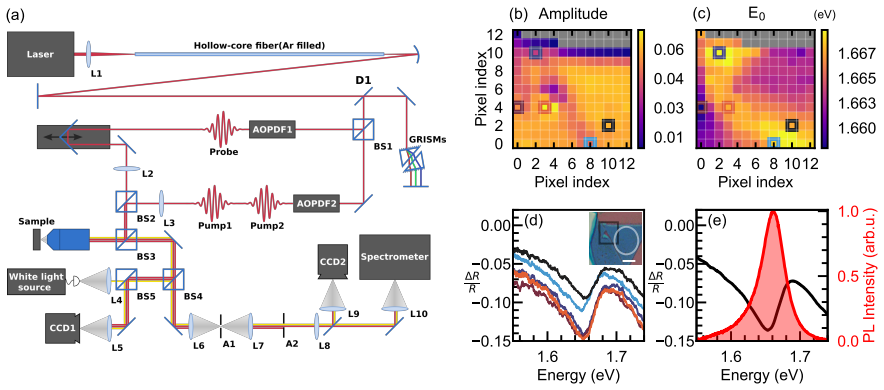
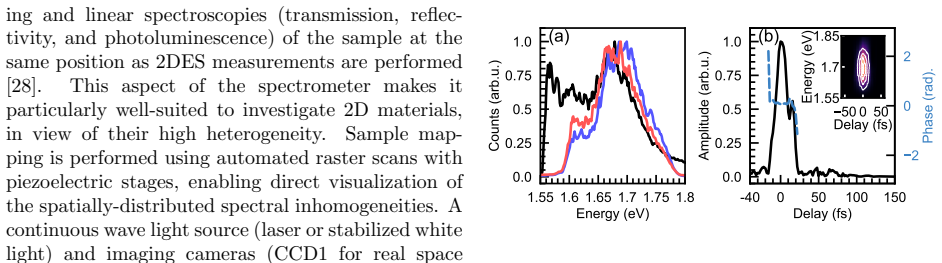
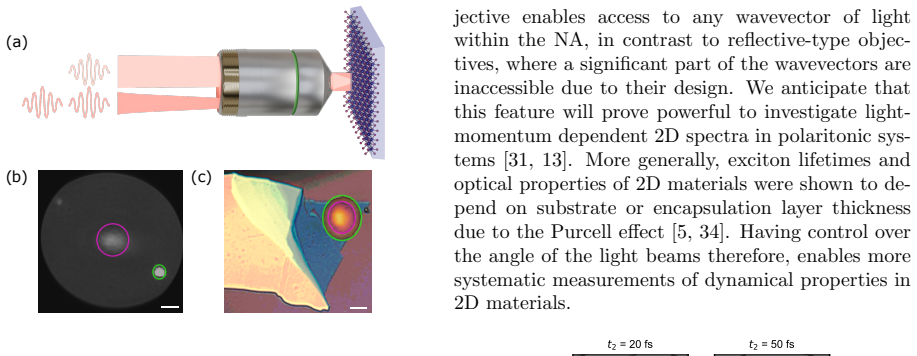
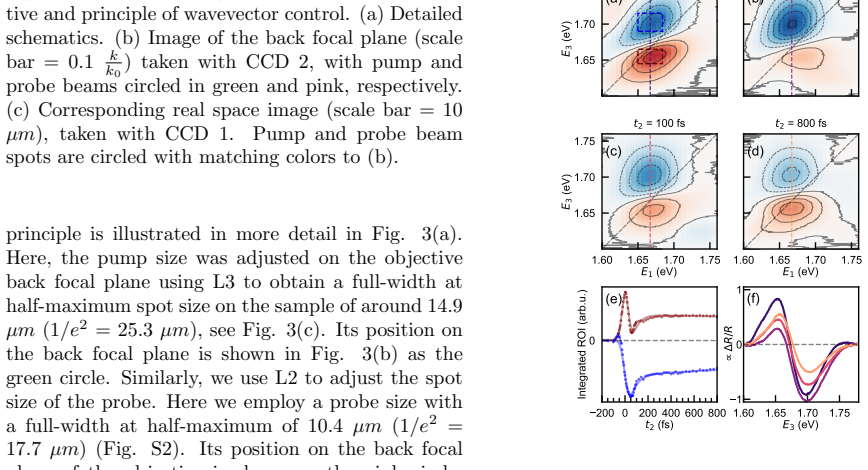
We introduce a setup for coherent two-dimensional electronic spectroscopy in the pump-probe reflection geometry that is integrated with a confocal back focal plane imaging microscope. The angle-resolved capability is utilized to control pump and probe wavevectors, while real space imaging enables co-localization of the collection spots for linear and ultrafast experiments. Compression of pulses down to 20 fs is achieved. We demonstrate the capabilities of this approach on an exfoliated WSe2 monolayer on Si/SiO2. The setup is suited to investigate excitons and exciton-polaritons in 2D Materials and their heterostructures.
What carries the argument
The confocal back focal plane imaging microscope integrated into the pump-probe reflection geometry 2D electronic spectroscopy system, providing simultaneous angle-resolved wavevector control and real-space spot co-localization.
If this is right
- Angle-resolved control enables momentum-selective studies of exciton dynamics in 2D layers.
- Real-space co-localization allows direct comparison of linear absorption and ultrafast 2D spectra on identical sample regions.
- 20 fs pulse compression supports time-resolved measurements of fast exciton relaxation processes.
- The reflection geometry setup extends coherent spectroscopy to opaque or substrate-supported 2D samples without transmission requirements.
Where Pith is reading between the lines
- Spatial mapping of exciton properties across a flake could become feasible by scanning the confocal spot while acquiring 2D spectra.
- The wavevector control may allow direct measurement of exciton-polariton dispersion in integrated cavity structures.
- The method could be tested on other transition metal dichalcogenide monolayers to check whether the integration preserves coherence across different material systems.
Load-bearing premise
Real-space imaging and back-focal-plane angle control can be combined without introducing significant optical aberrations, timing jitter, or loss of coherence that would prevent reliable 2D spectra on exfoliated monolayers.
What would settle it
If the measured 2D spectra on the WSe2 monolayer exhibit unexpected broadening, missing cross-peaks, or failure to resolve known exciton features compared to prior non-integrated measurements, or if the compressed pulses exceed 20 fs while losing coherence, the integration would be shown to introduce prohibitive distortions.
Figures
read the original abstract
We introduce a setup for coherent two-dimensional electronic spectroscopy in the pump-probe reflection geometry that is integrated with a confocal back focal plane imaging microscope. The angle-resolved capability is utilized to control pump and probe wavevectors, while real space imaging enables co-localization of the collection spots for linear and ultrafast experiments. Compression of pulses down to 20 fs is achieved. We demonstrate the capabilities of this approach on an exfoliated WSe$_2$ monolayer on Si/SiO$_2$. The setup is suited to investigate excitons and exciton-polaritons in 2D Materials and their heterostructures.
Editorial analysis
A structured set of objections, weighed in public.
Referee Report
Summary. The manuscript introduces an experimental setup integrating coherent two-dimensional electronic spectroscopy (2DES) in the pump-probe reflection geometry with a confocal back focal plane imaging microscope. It reports pulse compression to 20 fs and demonstrates the combined capabilities on an exfoliated WSe2 monolayer on Si/SiO2, with the angle-resolved mode used to control pump and probe wavevectors and real-space imaging for co-localization of spots in linear and ultrafast measurements. The setup is positioned for studies of excitons and exciton-polaritons in 2D materials and heterostructures.
Significance. If the integration is shown to preserve interferometric stability and avoid measurable degradation, the approach would enable simultaneous real-space localization and momentum-resolved coherent spectroscopy on atomically thin samples, providing a useful capability for 2D materials research where both spatial and wavevector control are relevant.
major comments (2)
- [Methods / Results] The central claim that the combined confocal back-focal-plane and real-space imaging elements can be integrated without compromising coherence or introducing significant aberrations is load-bearing, yet no quantitative validation (e.g., timing jitter, coherence time, or point-spread function comparison between integrated and standalone configurations) is provided to support it.
- [Results] The demonstration on WSe2 is presented without reported error analysis, baseline comparisons to conventional 2DES, or metrics confirming that the added optical paths do not degrade the phase stability required for reliable 2D spectra.
minor comments (1)
- [Abstract] The abstract states pulse compression to 20 fs but does not indicate the diagnostic used or the spectral bandwidth achieved.
Simulated Author's Rebuttal
We thank the referee for their thoughtful review and constructive comments on our manuscript. We address each of the major comments below and outline the revisions we will make.
read point-by-point responses
-
Referee: [Methods / Results] The central claim that the combined confocal back-focal-plane and real-space imaging elements can be integrated without compromising coherence or introducing significant aberrations is load-bearing, yet no quantitative validation (e.g., timing jitter, coherence time, or point-spread function comparison between integrated and standalone configurations) is provided to support it.
Authors: We agree that quantitative validation of the integration's impact on coherence and aberrations is important. Although the demonstration on WSe2 indicates successful operation, we will add in the revised manuscript explicit measurements including timing jitter, coherence time, and point-spread function comparisons between the integrated and standalone setups to support the claim. revision: yes
-
Referee: [Results] The demonstration on WSe2 is presented without reported error analysis, baseline comparisons to conventional 2DES, or metrics confirming that the added optical paths do not degrade the phase stability required for reliable 2D spectra.
Authors: We acknowledge that the current presentation lacks explicit error analysis, baseline comparisons, and phase stability metrics. In the revision, we will include error analysis for the 2D spectra, provide baseline comparisons to conventional 2DES where feasible, and report metrics on phase stability to demonstrate that the added optical paths do not degrade performance. revision: yes
Circularity Check
No circularity: experimental instrumentation paper with no derivations or fitted predictions
full rationale
The paper introduces an optical setup for coherent 2D electronic spectroscopy integrated with confocal back-focal-plane microscopy and demonstrates it on WSe2. No equations, parameters fitted to data, predictions, or uniqueness theorems appear in the provided text. The central claim is the feasibility of the combined instrument, supported by experimental description rather than any self-referential derivation. No load-bearing step reduces to a definition, fit, or self-citation chain. This matches the default case of a self-contained experimental report.
Axiom & Free-Parameter Ledger
Reference graph
Works this paper leans on
-
[1]
A. Al Haddad et al. In:Optics Letters40.3 (Jan. 2015), p. 312.issn: 1539-4794.doi:10. 1364/ol.40.000312.url:http://dx.doi. org/10.1364/OL.40.000312
- [2]
-
[4]
Jan Philipp Bange et al. In:2D Materials10.3 (2023).issn: 2053-1583.doi:10.1088/2053- 1583 / ace067.url:https : / / iopscience . iop . org / article / 10 . 1088 / 2053 - 1583 / ace067/meta
-
[5]
H. H. Fang et al. In:Physical Review Letters 123.6 (Aug. 2019).issn: 1079-7114.doi:10 . 1103/physrevlett.123.067401.url:http: //dx.doi.org/10.1103/PhysRevLett.123. 067401
-
[6]
Geib et al
Nils C. Geib et al. In:Optica6.4 (2019).issn: 495-505.doi:10 . 1364 / OPTICA . 6 . 000495. url:https : / / doi . org / 10 . 1364 / OPTICA . 6.000495. 6
2019
-
[7]
Sebastian Goetz et al. In:Optics Express26.4 (Feb. 2018), p. 3915.issn: 1094-4087.doi:10. 1364/oe.26.003915.url:http://dx.doi. org/10.1364/OE.26.003915
-
[8]
In:The Journal of Physical Chemistry C127.30 (July 2023), pp
Niklas Gross et al. In:The Journal of Physical Chemistry C127.30 (July 2023), pp. 14557– 14586.issn: 1932-7455.doi:10 . 1021 / acs . jpcc.3c02091.url:http://dx.doi.org/10. 1021/acs.jpcc.3c02091
2023
-
[9]
Liang Guo et al. In:Nature Physics15.3 (Dec. 2018), pp. 228–232.issn: 1745-2481.doi:10. 1038/s41567-018-0362-y.url:http://dx. doi.org/10.1038/s41567-018-0362-y
-
[10]
Cambridge University Press, 2012.isbn: 9780511675935
Peter Hamm and Martin Zanni. Cambridge University Press, 2012.isbn: 9780511675935. url:https : / / doi . org / 10 . 1017 / CBO9780511675935
2012
-
[11]
Kai Hao et al. In:Nature Physics12.7 (Feb. 2016), pp. 677–682.issn: 1745-2481.doi:10. 1038/nphys3674.url:http://dx.doi.org/ 10.1038/nphys3674
-
[12]
Andrew C. Jones et al. In:The Journal of Physical Chemistry A123.50 (Nov. 2019), pp. 10824–10836.issn: 1520-5215.doi:10 . 1021/acs.jpca.9b09099.url:http://dx. doi.org/10.1021/acs.jpca.9b09099
-
[13]
In:Physical Review Letters 128.8 (Feb
Donghai Li et al. In:Physical Review Letters 128.8 (Feb. 2022).issn: 1079-7114.doi:10 . 1103/physrevlett.128.087401.url:http: //dx.doi.org/10.1103/PhysRevLett.128. 087401
-
[14]
Lawson T. Lloyd et al. In:ACS Nano15.6 (June 2021), pp. 10253–10263.issn: 1936-086X. doi:10.1021/acsnano.1c02381.url:http: //dx.doi.org/10.1021/acsnano.1c02381
-
[16]
Optics Express19(10), 9315–9329 (2011).https://doi.org/10.1364/OE
Xiaonan Ma, Jakub Dost´ al, and Tobias Brixner. In:Optics Express24.18 (Aug. 2016), p. 20781.issn: 1094-4087.doi:10.1364/oe. 24 . 020781.url:http : / / dx . doi . org / 10 . 1364/OE.24.020781
work page doi:10.1364/oe 2016
-
[17]
In:Nature Communica- tions6.1 (Sept
Galan Moody et al. In:Nature Communica- tions6.1 (Sept. 2015).issn: 2041-1723.doi: 10.1038/ncomms9315.url:http://dx.doi. org/10.1038/ncomms9315
-
[18]
Jeffrey A. Myers et al. In:Optics Express16.22 (Oct. 2008), p. 17420.issn: 1094-4087.doi:10. 1364/oe.16.017420.url:http://dx.doi. org/10.1364/oe.16.017420
-
[19]
K. S. Novoselov et al. In:Science353.6298 (2016).issn: 1095-9203.doi:10 . 1126 / science.aac9439.url:http://dx.doi.org/ 10.1126/science.aac9439
-
[20]
Joshua S. Ostrander et al. In:ACS Photon- ics3.7 (June 2016), pp. 1315–1323.issn: 2330- 4022.doi:10.1021/acsphotonics.6b00297. url:http : / / dx . doi . org / 10 . 1021 / acsphotonics.6b00297
-
[21]
Monika Paw lowska et al. In:Optics Express 22.25 (Dec. 2014), p. 31496.issn: 1094-4087. doi:10 . 1364 / oe . 22 . 031496.url:http : //dx.doi.org/10.1364/OE.22.031496
-
[22]
Veronica R. Policht et al. In:Nano Letters 21.11 (May 2021), pp. 4738–4743.issn: 1530- 6992.doi:10.1021/acs.nanolett.1c01098. url:http : / / dx . doi . org / 10 . 1021 / acs . nanolett.1c01098
-
[23]
Purz et al
Torben L. Purz et al. In:Physical Review B 104.24 (Dec. 2021).issn: 2469-9969.doi:10. 1103 / physrevb . 104 . l241302.url:http : / / dx . doi . org / 10 . 1103 / PhysRevB . 104 . L241302
2021
-
[24]
Torben L. Purz et al. In:The Journal of Chem- ical Physics156.21 (June 2022).issn: 1089- 7690.doi:10 . 1063 / 5 . 0087544.url:http : //dx.doi.org/10.1063/5.0087544. 7
-
[25]
In:Optics Letters42.3 (Feb
H´ el` ene Seiler et al. In:Optics Letters42.3 (Feb. 2017), p. 643.issn: 1539-4794.doi:10.1364/ ol.42.000643.url:http://dx.doi.org/10. 1364/OL.42.000643
2017
-
[26]
Sang-Hee Shim and Martin T. Zanni. In:Phys. Chem. Chem. Phys.11.5 (2009), pp. 748–761. issn: 1463-9084.doi:10.1039/b813817f.url: http://dx.doi.org/10.1039/B813817F
-
[27]
Colin Sonnichsen et al. In:Optics Express29.18 (Aug. 2021), p. 28352.issn: 1094-4087.doi: 10.1364/oe.431988.url:http://dx.doi. org/10.1364/OE.431988
-
[28]
Steves, Hongjun Zheng, and Ken- neth L
Megan A. Steves, Hongjun Zheng, and Ken- neth L. Knappenberger. In:Optics Letters44.8 (Apr. 2019), p. 2117.issn: 1539-4794.doi:10. 1364/ol.44.002117.url:http://dx.doi. org/10.1364/OL.44.002117
-
[29]
Daniel Timmer et al. In:Optics Express32.1 (Dec. 2023), p. 835.issn: 1094-4087.doi:10. 1364/oe.511906.url:http://dx.doi.org/ 10.1364/OE.511906
-
[30]
In:Nano Letters24.26 (June 2024), pp
Daniel Timmer et al. In:Nano Letters24.26 (June 2024), pp. 8117–8125.issn: 1530-6992. doi:10.1021/acs.nanolett.4c01991.url: http : / / dx . doi . org / 10 . 1021 / acs . nanolett.4c01991
-
[31]
In:Nature Nanotechnol- ogy(Jan
Daniel Timmer et al. In:Nature Nanotechnol- ogy(Jan. 2026).issn: 1748-3395.doi:10 . 1038 / s41565 - 025 - 02054 - 4.url:http : / / dx.doi.org/10.1038/s41565-025-02054-4
-
[32]
In:Nature Communications 9.1 (Oct
Vivek Tiwari et al. In:Nature Communications 9.1 (Oct. 2018).issn: 2041-1723.doi:10.1038/ s41467-018-06619-x.url:http://dx.doi. org/10.1038/s41467-018-06619-x
-
[33]
In:Review of Scientific In- struments68.9 (1997), pp
Rick Trebino et al. In:Review of Scientific In- struments68.9 (1997), pp. 3277–3295.issn: 1089-7623.doi:10 . 1063 / 1 . 1148286.url: http://dx.doi.org/10.1063/1.1148286
-
[34]
P. Trofimov et al. In:The Journal of Chemi- cal Physics163.8 (Aug. 2025).issn: 1089-7690. doi:10.1063/5.0279864.url:http://dx. doi.org/10.1063/5.0279864
-
[35]
Verluise et al
F. Verluise et al. In:Optics Letters25.8 (Apr. 2000), p. 575.issn: 1539-4794.doi:10.1364/ ol.25.000575.url:http://dx.doi.org/10. 1364/OL.25.000575
2000
-
[36]
In:Nature Communications 14.1 (2023).issn: 2041-1723.doi:10
Ding Xu et al. In:Nature Communications 14.1 (2023).issn: 2041-1723.doi:10 . 1038 / s41467-023-39550-x.url:http://dx.doi. org/10.1038/s41467-023-39550-x. 8
discussion (0)
Sign in with ORCID, Apple, or X to comment. Anyone can read and Pith papers without signing in.