Heavy-Flavor Electron Classification Using Hadronic Environment as Point Cloud
Pith reviewed 2026-07-03 02:47 UTC · model grok-4.3
The pith
Representing the hadronic environment as a point cloud lets set-based networks classify charm-origin versus bottom-origin electrons at roughly 80 percent purity for 40 percent efficiency.
A machine-rendered reading of the paper's core claim, the machinery that carries it, and where it could break.
Core claim
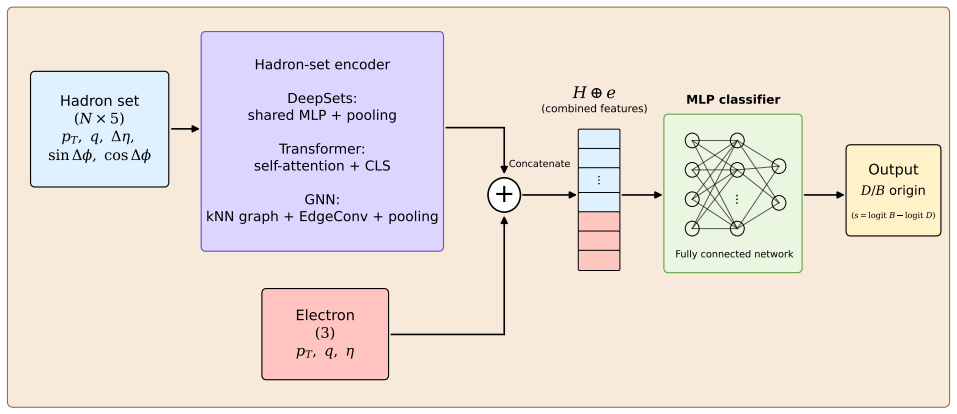
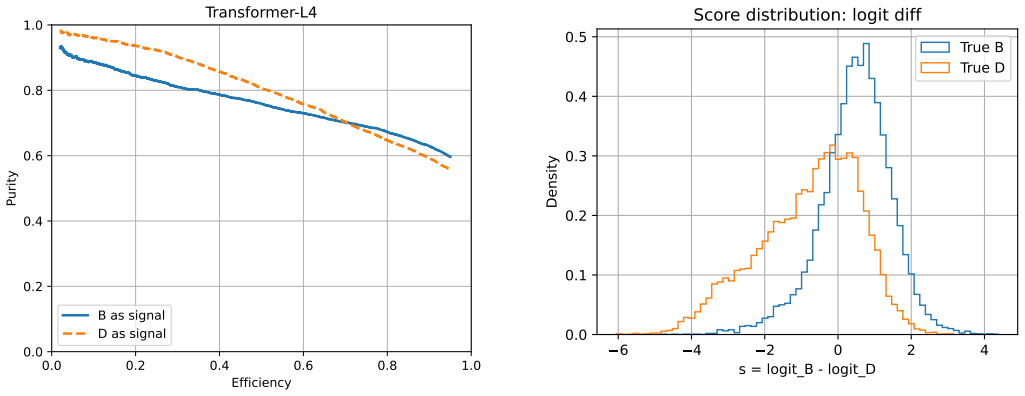
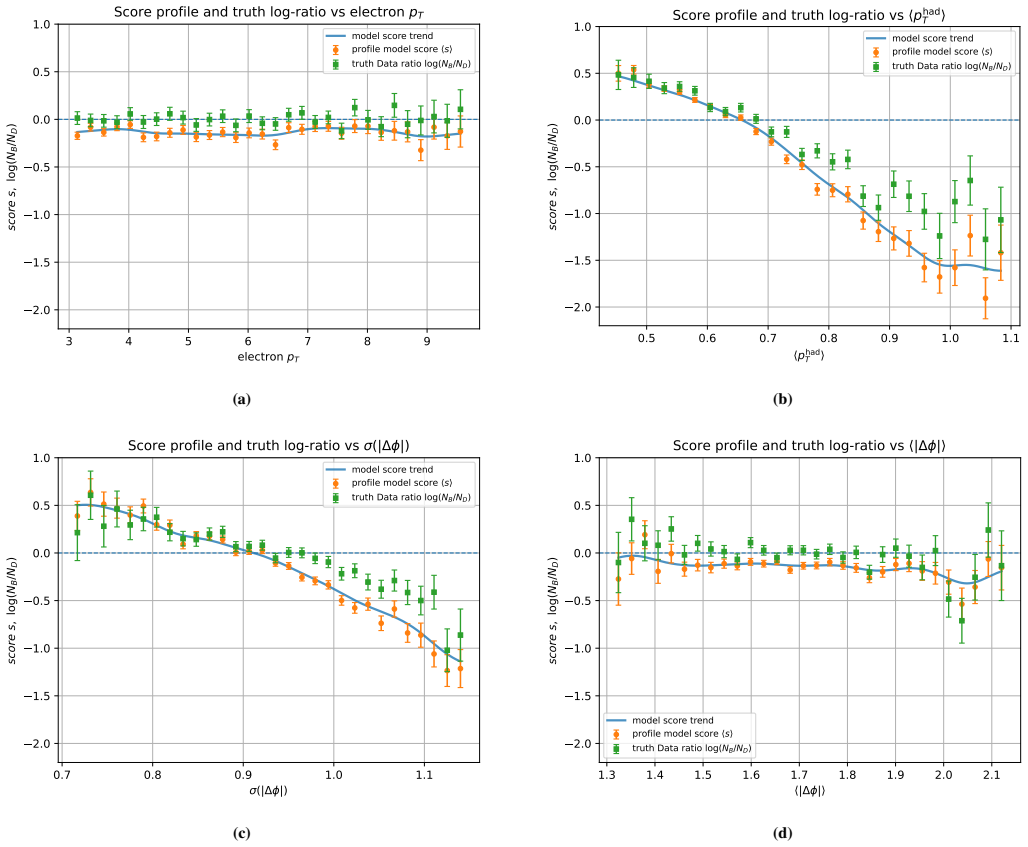
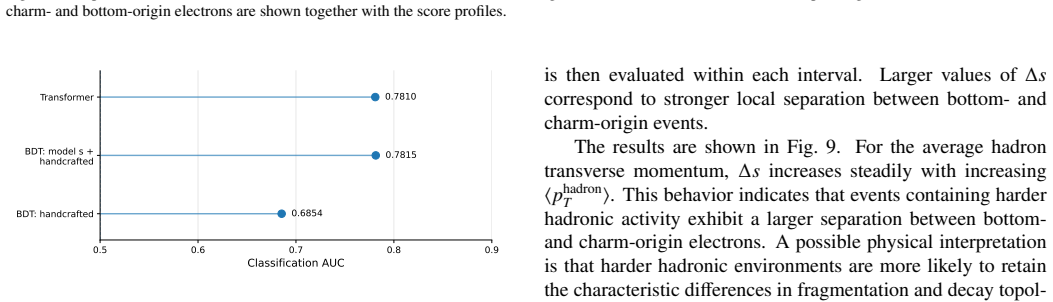
We represent the hadronic environment as a point cloud and apply set-based machine learning architectures including Transformer models to distinguish electrons originating from charm versus bottom hadron decays. Comparable performance across architectures indicates that the dominant limitation is the intrinsic similarity between charm- and bottom-related hadronic structures rather than model expressivity. At an experimentally relevant working point of approximately 40 percent efficiency the classifier achieves a purity close to 80 percent on the test dataset and significantly improves upon a hand-crafted observable BDT baseline. Relation of model response to physics observables together with
What carries the argument
Hadronic environment represented as a point cloud and processed by set-based neural network architectures such as Transformers.
If this is right
- The classifier improves separation of charm-origin and bottom-origin electrons relative to boosted decision trees that rely on hand-crafted observables.
- The learned representation responds primarily to geometric and topological properties of the hadronic environment.
- Comparable results across different set-based architectures imply that physical similarity of the structures sets the performance limit.
- The representation extracts discriminating information that is not captured by a small set of manually constructed high-level observables.
Where Pith is reading between the lines
- If the simulation matches data, the method could be deployed in LHC analyses to refine heavy-flavor cross-section and decay measurements.
- The point-cloud approach might be tested on other particle classification tasks where surrounding environment topology supplies useful discrimination.
- Results from feature perturbation tests could suggest new hand-crafted variables that combine geometric information with existing observables.
- Adding tracking or vertex information to the point cloud input might raise purity without requiring larger models.
Load-bearing premise
The simulated hadronic environments used for training and testing accurately capture the geometric and topological differences between charm- and bottom-origin electrons that would be present in real detector data.
What would settle it
Direct application of the trained classifier to real collision data and measurement of whether purity at 40 percent efficiency remains near 80 percent or falls substantially below that value.
Figures



read the original abstract
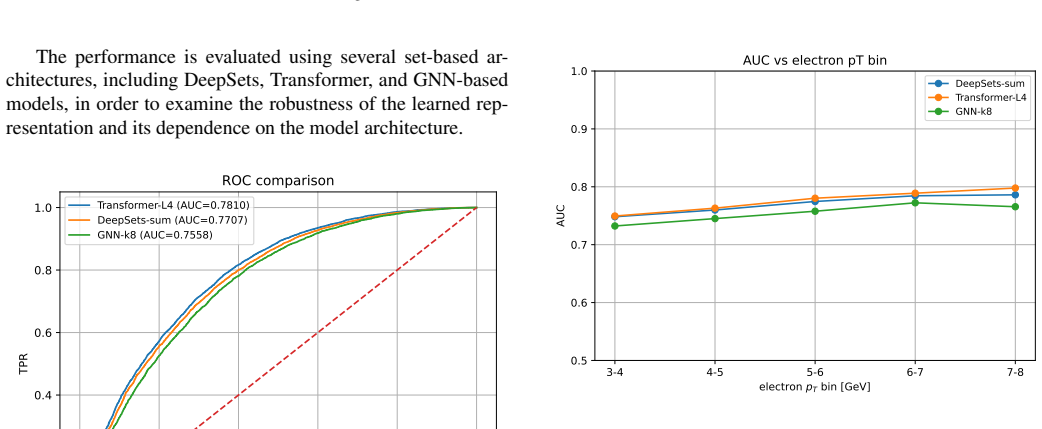
Electrons from semi-leptonic decays of charm (D) and bottom (B) hadrons are important probes in high-energy collisions, while their separation remains challenging due to the similarity of the underlying decay topologies. In this work, we represent the hadronic environment as a point cloud and investigate a hadron-based approach for distinguishing charm- and bottom-origin electrons using several set-based machine learning architectures, including Transformer models. Comparable performance is observed across different architectures, indicating that the dominant limitation originates from the intrinsic similarity between charm- and bottom-related hadronic structures rather than model expressivity. At an experimentally relevant working point corresponding to approximately 40% efficiency, the classifier achieves a purity close to 80% on the test dataset and significantly improves the classification performance relative to a hand-crafted observable BDT baseline. By studying the relation between the model response and physics-motivated observables, together with feature perturbation tests, we find that the learned representation is primarily sensitive to geometric and topological properties of the hadronic environment. Comparisons with high-level observables further suggest that the learned representation captures nontrivial discriminating information beyond a small set of manually constructed variables.
Editorial analysis
A structured set of objections, weighed in public.
Referee Report
Summary. The manuscript proposes representing the hadronic environment around electrons as a point cloud and applies set-based ML architectures (including Transformers) to classify electrons from charm versus bottom hadron decays. It reports that multiple architectures yield comparable performance, with an operating point at ~40% efficiency achieving ~80% purity on a simulated test set, outperforming a BDT baseline using hand-crafted observables; the model is shown to be sensitive primarily to geometric and topological features via response studies and perturbation tests.
Significance. If the simulation-to-data fidelity holds, the approach could offer a data-driven alternative for heavy-flavor electron tagging that captures information beyond a small set of high-level variables. The observation that performance saturates across architectures and is limited by intrinsic charm-bottom similarity rather than model capacity is a useful physics insight. The work demonstrates the viability of point-cloud methods in this context but currently lacks the validation steps needed for direct experimental application.
major comments (2)
- [Abstract] Abstract and results: the headline performance numbers (~40% efficiency, ~80% purity, improvement over BDT) are obtained exclusively on a simulated test dataset with no reported real-data validation, closure tests, or unfolding; given that the learned features are geometric/topological and the claim is framed as 'experimentally relevant,' this is load-bearing for the central claim.
- [Abstract] Abstract: no information is provided on dataset size, training/validation/test splits, or systematic uncertainties arising from simulation modeling (detector response, material budget, underlying event); these details are required to assess whether the reported purity is robust.
minor comments (1)
- The manuscript would benefit from explicit statements on how the point-cloud representation handles variable multiplicity and detector acceptance effects.
Simulated Author's Rebuttal
We thank the referee for the constructive comments on the scope and reporting of our simulation-based study. We address each point below, clarifying the methodological focus while proposing targeted revisions to improve transparency.
read point-by-point responses
-
Referee: [Abstract] Abstract and results: the headline performance numbers (~40% efficiency, ~80% purity, improvement over BDT) are obtained exclusively on a simulated test dataset with no reported real-data validation, closure tests, or unfolding; given that the learned features are geometric/topological and the claim is framed as 'experimentally relevant,' this is load-bearing for the central claim.
Authors: We agree that all reported metrics are obtained on a simulated test set, as ground-truth labels from the generator are required for supervised training and evaluation. The study is framed as a proof-of-concept demonstration of point-cloud methods rather than a ready-to-deploy experimental tool. We will revise the abstract to explicitly state that results are from Monte Carlo simulation and add a new paragraph in the discussion section outlining the additional validation steps (closure tests, data-driven calibration) needed before experimental application. revision: yes
-
Referee: [Abstract] Abstract: no information is provided on dataset size, training/validation/test splits, or systematic uncertainties arising from simulation modeling (detector response, material budget, underlying event); these details are required to assess whether the reported purity is robust.
Authors: The full manuscript provides dataset sizes, split ratios, and training details in the Methods section, but we acknowledge the abstract should be self-contained. We will update the abstract with concise statements on dataset scale and splits. For simulation systematics, we will add a short subsection discussing sensitivity to variations in detector response and underlying event modeling, while noting that a complete systematic evaluation requires experimental data and is beyond the current scope. revision: partial
Circularity Check
No circularity: empirical ML performance on held-out simulation with no derivation chain
full rationale
The paper reports classification metrics (efficiency, purity, improvement over BDT) obtained by training set-based models on simulated point-cloud data and evaluating on a held-out test set. No equations, functional forms, or uniqueness theorems are claimed; the headline numbers are direct empirical outputs of standard supervised training rather than quantities derived from or fitted to the reported results themselves. No self-citation load-bearing steps, ansatz smuggling, or renaming of known results appear in the provided text. The result is therefore self-contained as a simulation-based benchmark.
Axiom & Free-Parameter Ledger
Reference graph
Works this paper leans on
-
[1]
Extraction of Heavy-Flavor Transport Coefficients in QCD Matter
A. Beraudo, et al., Extraction of Heavy-Flavor Transport Coefficients in QCD Matter, Nucl. Phys. A 979 (2018) 21–86. arXiv:1803.03824, doi:10.1016/j.nuclphysa.2018.09.002
work page internal anchor Pith review Pith/arXiv arXiv doi:10.1016/j.nuclphysa.2018.09.002 2018
-
[2]
X. Dong, V . Greco, Heavy quark production and proper- ties of Quark–Gluon Plasma, Prog. Part. Nucl. Phys. 104 (2019) 97–141. doi:10.1016/j.ppnp.2018.08.001
-
[3]
M. He, H. van Hees, R. Rapp, Heavy-quark dif- fusion in the quark–gluon plasma, Prog. Part. Nucl. Phys. 130 (2023) 104020. arXiv:2204.09299, doi:10.1016/j.ppnp.2023.104020
-
[4]
J. Y . Zhang, Y . J. Song, L. Ma, W. H. Ma, H. Z. Huang, Effect of initial geometry fluctuations on the heavy fla- vor flow using a multiphase transport model, Phys. Rev. C 112 (4) (2025) 044901. doi:10.1103/2xt8-bh6x
-
[5]
J. Zhao, K. Zhou, S. Chen, P. Zhuang, Heavy fla- vors under extreme conditions in high energy nuclear collisions, Prog. Part. Nucl. Phys. 114 (2020) 103801. arXiv:2005.08277, doi:10.1016/j.ppnp.2020.103801
-
[6]
S. Acharya, et al., Azimuthal Anisotropy of Heavy-Flavor Decay Electrons inp-Pb Colli- sions at √sNN =5.02 TeV, Phys. Rev. Lett. 122 (7) (2019) 072301. arXiv:1805.04367, doi:10.1103/PhysRevLett.122.072301
work page internal anchor Pith review Pith/arXiv arXiv doi:10.1103/physrevlett.122.072301 2019
-
[7]
S. Masciocchi, Investigation of charm and beauty pro- duction via semileptonic decays of heavy-flavour hadrons in pp at 7 TeV and Pb–Pb at 2.76 TeV with AL- ICE, J. Phys. G 38 (2011) 124069. arXiv:1109.6436, doi:10.1088/0954-3899/38/12/124069
-
[8]
B. B. Abelev, et al., Measurement of electrons from semileptonic heavy-flavor hadron decays inppcollisions at √s=2.76 TeV, Phys. Rev. D 91 (1) (2015) 012001. arXiv:1405.4117, doi:10.1103/PhysRevD.91.012001
work page internal anchor Pith review Pith/arXiv arXiv doi:10.1103/physrevd.91.012001 2015
-
[9]
Measurement of electrons from beauty hadron decays in pp collisions at $\sqrt{s} = 7$ TeV
B. Abelev, et al., Measurement of electrons from beauty hadron decays inppcollisions at √s= 7 TeV, Phys. Lett. B 721 (2013) 13–23, [Erratum: Phys.Lett.B 763, 507–509 (2016)]. arXiv:1208.1902, doi:10.1016/j.physletb.2013.01.069
work page internal anchor Pith review Pith/arXiv arXiv doi:10.1016/j.physletb.2013.01.069 2013
-
[10]
Averbeck, Open heavy flavor measurements with the PHENIX experiment at RHIC, J
R. Averbeck, Open heavy flavor measurements with the PHENIX experiment at RHIC, J. Phys. G 31 (2005) S259–S266. arXiv:nucl-ex/0410007, doi:10.1088/0954- 3899/31/4/032
-
[11]
A. Adare, et al., Heavy Quark Production inp+p and Energy Loss and Flow of Heavy Quarks in Au+Au Collisions at √sNN =200 GeV, Phys. Rev. C 84 (2011) 044905. arXiv:1005.1627, doi:10.1103/PhysRevC.84.044905
work page internal anchor Pith review Pith/arXiv arXiv doi:10.1103/physrevc.84.044905 2011
-
[12]
A. Adare, et al., Single electron yields from semileptonic charm and bottom hadron decays in Au+Au collisions at√sNN =200 GeV, Phys. Rev. C 93 (3) (2016) 034904. arXiv:1509.04662, doi:10.1103/PhysRevC.93.034904
-
[13]
S. Acharya, et al., Measurement of electrons from semileptonic heavy-flavour hadron decays at midrapid- ity in pp and Pb-Pb collisions at √sNN =5.02 TeV, Phys. Lett. B 804 (2020) 135377. arXiv:1910.09110, doi:10.1016/j.physletb.2020.135377
-
[14]
S. Acharya, et al., Measurement of beauty and charm production in pp collisions at √s=5.02 TeV via non- prompt and prompt D mesons, JHEP 05 (2021) 220. arXiv:2102.13601, doi:10.1007/JHEP05(2021)220
-
[15]
M. S. Abdallah, et al., Evidence of Mass Ordering of Charm and Bottom Quark Energy Loss in Au+Au Col- lisions at RHIC, Eur. Phys. J. C 82 (12) (2022) 1150, [Er- ratum: Eur.Phys.J.C 83, 455 (2023)]. arXiv:2111.14615, doi:10.1140/epjc/s10052-022-11003-7
-
[16]
S. Acharya, et al., Measurement of electrons from heavy- flavour hadron decays as a function of multiplicity in p- Pb collisions at √sNN =5.02 TeV, JHEP 02 (2020) 077. arXiv:1910.14399, doi:10.1007/JHEP02(2020)077
-
[17]
Entanglement and Chaos near critical point in strongly coupled Gauge theory
S. Acharya, et al., Azimuthal correlations of heavy-flavor hadron decay electrons with charged particles in pp and p–Pb collisions at √sNN √sNN √sNN =5.02 TeV, Eur. Phys. J. C 83 (8) (2023) 741. arXiv:2303.00591, doi:10.1140/epjc/s10052- 023-11835-x
-
[18]
D. Thomas, F. Colamaria, Recent Findings from Heavy-Flavor Angular Correlation Measurements in Hadronic Collisions, Universe 10 (3) (2024) 109. arXiv:2403.01035, doi:10.3390/universe10030109
-
[19]
Heavy-flavour and quarkonium production in the LHC era: from proton-proton to heavy-ion collisions
A. Andronic, et al., Heavy-flavour and quarkonium pro- duction in the LHC era: from proton–proton to heavy- ion collisions, Eur. Phys. J. C 76 (3) (2016) 107. arXiv:1506.03981, doi:10.1140/epjc/s10052-015-3819-5
work page internal anchor Pith review Pith/arXiv arXiv doi:10.1140/epjc/s10052-015-3819-5 2016
-
[20]
A. Adare, et al., Measurement of Bottom versus Charm as a Function of Transverse Momentum with Electron- Hadron Correlations inp +pCollisions at √s=200 GeV, Phys. Rev. Lett. 103 (2009) 082002. arXiv:0903.4851, doi:10.1103/PhysRevLett.103.082002
work page internal anchor Pith review Pith/arXiv arXiv doi:10.1103/physrevlett.103.082002 2009
-
[21]
P. T. Komiske, E. M. Metodiev, J. Thaler, Energy Flow Networks: Deep Sets for Particle Jets, JHEP 01 (2019)
2019
-
[22]
arXiv:1810.05165, doi:10.1007/JHEP01(2019)121. 7
-
[23]
L. Liu, X. Liu, J. Gao, W. Chen, J. Han, Understanding the difficulty of training transformers, in: Proceedings of the 2020 Conference on Empirical Methods in Natural Lan- guage Processing (EMNLP), 2020, pp. 5747–5763
2020
-
[24]
Machine Learning in High Energy Physics Community White Paper
K. Albertsson, et al., Machine Learning in High En- ergy Physics Community White Paper, J. Phys. Conf. Ser. 1085 (2) (2018) 022008. arXiv:1807.02876, doi:10.1088/1742-6596/1085/2/022008
work page internal anchor Pith review Pith/arXiv arXiv doi:10.1088/1742-6596/1085/2/022008 2018
-
[25]
G. Karagiorgi, G. Kasieczka, S. Kravitz, B. Nachman, D. Shih, Machine Learning in the Search for New Fun- damental Physics (12 2021). arXiv:2112.03769
-
[26]
Mondal, L
S. Mondal, L. Mastrolorenzo, Machine learning in high energy physics: a review of heavy-flavor jet tagging at the LHC, Eur. Phys. J. ST 233 (15-16) (2024) 2657–
2024
-
[27]
arXiv:2404.01071, doi:10.1140/epjs/s11734-024- 01234-y
-
[28]
M. Zaheer, S. Kottur, S. Ravanbakhsh, B. Poczos, R. Salakhutdinov, A. Smola, Deep Sets (3 2017). arXiv:1703.06114
work page internal anchor Pith review Pith/arXiv arXiv 2017
-
[29]
Y . Wang, Y . Sun, Z. Liu, S. E. Sarma, M. M. Bronstein, J. M. Solomon, Dynamic Graph CNN for Learning on Point Clouds (1 2018). arXiv:1801.07829
work page internal anchor Pith review Pith/arXiv arXiv 2018
-
[30]
J. Lee, Y . Lee, J. Kim, A. Kosiorek, S. Choi, Y . W. Teh, Set transformer: A framework for attention-based permutation-invariant neural networks, in: International conference on machine learning, PMLR, 2019, pp. 3744– 3753
2019
-
[31]
G. Carleo, I. Cirac, K. Cranmer, L. Daudet, M. Schuld, N. Tishby, L. V ogt-Maranto, L. Zdeborová, Ma- chine learning and the physical sciences, Rev. Mod. Phys. 91 (4) (2019) 045002. arXiv:1903.10563, doi:10.1103/RevModPhys.91.045002
-
[32]
G. Kasieczka, et al., The LHC Olympics 2020 a com- munity challenge for anomaly detection in high en- ergy physics, Rept. Prog. Phys. 84 (12) (2021) 124201. arXiv:2101.08320, doi:10.1088/1361-6633/ac36b9
-
[33]
Deep Learning and its Application to LHC Physics
D. Guest, K. Cranmer, D. Whiteson, Deep Learn- ing and its Application to LHC Physics, Ann. Rev. Nucl. Part. Sci. 68 (2018) 161–181. arXiv:1806.11484, doi:10.1146/annurev-nucl-101917-021019
work page internal anchor Pith review Pith/arXiv arXiv doi:10.1146/annurev-nucl-101917-021019 2018
-
[34]
A. Radovic, M. Williams, D. Rousseau, M. Kagan, D. Bonacorsi, A. Himmel, A. Aurisano, K. Terao, T. Wongjirad, Machine learning at the energy and inten- sity frontiers of particle physics, Nature 560 (7716) (2018) 41–48. doi:10.1038/s41586-018-0361-2
-
[35]
G. Louppe, K. Cho, C. Becot, K. Cranmer, QCD-Aware Recursive Neural Networks for Jet Physics, JHEP 01 (2019) 057. arXiv:1702.00748, doi:10.1007/JHEP01(2019)057
-
[36]
H. Qu, L. Gouskos, ParticleNet: Jet Tagging via Par- ticle Clouds, Phys. Rev. D 101 (5) (2020) 056019. arXiv:1902.08570, doi:10.1103/PhysRevD.101.056019
- [37]
-
[38]
Y . Zhu, H. Liang, Y . Wang, H. Qu, C. Zhou, M. Ruan, Par- ticleNet and its application on CEPC jet flavor tagging, Eur. Phys. J. C 84 (2) (2024) 152. arXiv:2309.13231, doi:10.1140/epjc/s10052-024-12475-5. 8
discussion (0)
Sign in with ORCID, Apple, or X to comment. Anyone can read and Pith papers without signing in.