REVIEW 4 major objections 5 minor 56 references
ArcAD: Anomaly-Rectified Calibration for Cold-Start Supervised Anomaly Detection
T0 review · 4 major / 5 minor · reviewed 2026-08-04 · deepseek-v4-flash
Pith's one-line read The paper claims that a plug-and-play calibration layer built from balanced hyperspherical clustering and defect-guided pseudo-anomaly synthesis makes reconstruction-based anomaly detectors substantially more accurate in cold-start settings
desk verdict ArcAD's core calibration idea is new and the additive gains over reconstruction baselines largely hold, but the SOTA claim is undermined by single-run, under-tuned supervised baselines and small deltas on the easy datasets. read the letter →
The pith
A machine-rendered reading of the paper's core claim, the machinery that carries it, and where it could break.
The reading
What carries the argument
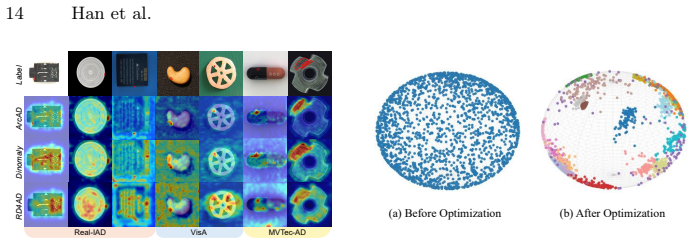
The load-bearing object is a unit hypersphere latent space together with a balanced assignment matrix. SPM computes a soft feature-to-prototype assignment by solving an entropically regularized optimal transport problem with Sinkhorn–Knopp iterations, enforcing that each of K prototypes receives equal total mass; this yields compact, uniformly spread normal clusters even when normal data are scarce. DGC then generates candidate perturbations of normal features on the sphere, filters them by their maximum similarity to the learned prototypes to keep the hardest pseudo-anomalies, and applies a contrastive calibration loss that repels real and synthetic anomalies from the normal prototypes whil
What would settle it
Re-run the authors' cold-start protocol on Real-IAD with every baseline tuned by a neutral party, training anomalies drawn from a split held out of the test set, no pixel masks given to ArcAD (image-level labels only), and 95% confidence intervals over several seeds; if ArcAD's margin over the strongest reconstruction baseline collapses below about 1 I-AUROC or reverses, the central claim is false.
Extended reading notes
Core claim
On the paper's own terms, the discovery is that data scarcity in cold-start anomaly detection should be treated as a geometry problem rather than a data-augmentation problem. Normal patch features live on the unit hypersphere and are organized into K clusters with an equipartition constraint (SPM), so no single dense region absorbs all normal mass; then a prototype-restricted synthesis step generates pseudo-anomalies near the boundary, and a contrastive loss (DGC) pushes real and synthetic anomalies away from the nearest normal prototypes. The combined push–pull calibration makes the reconstruction-based latent space compact and discriminative, and the ablation attributes +3.7 I-AUROC on Rea
Load-bearing premise
The argument stands or falls on whether the cold-start benchmark is a fair instrument: if the reimplemented baselines are under-tuned, or ArcAD's extra pixel-mask supervision explains its edge, the headline claim is a protocol artifact.
Editorial extensions
If this is right
- If the claim holds, a factory can add ArcAD to an existing reconstruction detector and use the few defects logged during ramp-up to sharpen detection, with no extra inference cost.
- Reported gains are largest on broad multi-class datasets: +3.7 I-AUROC on Real-IAD and +3.0 on MANTA over the strongest unsupervised baseline, and up to +11.2 for a weaker reconstruction baseline.
- The improvements persist across three different reconstruction backbones, suggesting the calibration is not tied to one architecture.
- ArcAD still helps when only 3% of training data are anomalies, so the method tolerates even more extreme scarcity.
- Single-class performance also improves, reaching 100.0 I-AUROC on MVTec-AD and gaining +3.4 on Real-IAD.
Reading between the lines
- Editorial inference: because ArcAD only regularizes the training latent space, its push–pull mechanics should transfer to other one-class or reconstruction pipelines beyond the three tested — but that transfer is untested in the paper.
- Editorial inference: the cold-start protocol draws the few training anomalies from the original test set, meaning the model has seen some test anomalies in training; a stricter held-out anomaly split would test whether the reported gains survive on truly unseen defects.
- Editorial inference: DGC uses pixel-level ground-truth masks to select anomaly patches, supervision that image-level-labeled baselines do not receive; if ArcAD is restricted to image-level labels, its margin over those baselines may shrink.
- Editorial inference: the Sinkhorn equipartition idea could be reused for partial-label or noisy-label anomaly settings, where the balanced assignment would resist majority-class domination.
Editorial analysis
A structured set of objections, weighed in public.
Referee Report
Summary. The paper proposes ArcAD, a plug-and-play training-time calibration layer for reconstruction-based industrial anomaly detectors under a cold-start regime with few normal samples and rare anomalies. It maps bottleneck patch features to the unit hypersphere and organizes them into compact, uniformly distributed clusters via Sinkhorn-based prototype modeling (SPM). A defect-guided calibration module (DGC) synthesizes pseudo-anomalies by perturbing normal features and filtering them with prototype similarity (Eqs. 5–6), then uses a contrastive loss (Eq. 8) plus a focal-loss discriminator (Eq. 9) to push real and synthetic anomalies away from normal prototypes. Inference uses the unchanged reconstruction score. The authors report consistent gains over unsupervised and supervised baselines on MVTec-AD, VisA, Real-IAD, and MANTA, with the largest improvements on Real-IAD (+3.7 I-AUROC over Dinomaly) and MANTA (+11.2 for RD4AD).
Significance. If the results are reproducible, ArcAD is a practically useful contribution: it improves several diverse reconstruction baselines without changing inference-time scoring, and the ablation in Table 4 gives a plausible role for each component. The manuscript is clearly written, and the internal arithmetic is consistent: the +3.7 Real-IAD delta and the Fig. 4 gains agree with Tables 1 and 3. The main value is the demonstration that a light clustering-plus-synthesis regularizer can alleviate cold-start data scarcity. However, the claimed 'significantly outperforms state-of-the-art' result is not yet supported by the evidence: the evaluation is single-run, the baselines are reimplemented without released configs, and some baseline results are close to chance. These issues are load-bearing for the headline claim, so the manuscript requires major revision.
major comments (4)
- [§4.1, Tables 1–2] All results are reported as single numbers with no seeds or error bars. The headline improvements on MVTec-AD and VisA are small (multi-class I-AUROC +0.1 and +0.5; single-class +0.5 and +0.2), well within typical rerun variance for such benchmarks. The abstract's 'significantly outperforms' is therefore unsupported on these datasets. Please report mean and standard deviation over at least 3–5 seeds, and where possible a paired test for the ArcAD-vs-baseline delta. At minimum, state the number of runs and the observed run-to-run variability.
- [§4.1, Table 1] The supervised baselines are all reimplemented by the authors under the cold-start protocol, but no configurations or training details are released. Several results are red flags: DevNet scores 50.0 I-AUROC on Real-IAD multi-class (chance), SDNet P-F1-max is 0.9–4.2 across datasets, and SDNet degrades from 70.1 to 59.7 I-AUROC on MVTec-AD when its backbone is upgraded to Dinov2, contrary to the expected feature-quality trend. If these baselines are under-tuned, the reported +14.5 to +19.6 point gains over supervised methods are protocol artifacts. Please release the reimplementation configs, use official code where available, and verify that DevNet and SDNet are not broken under the cold-start protocol.
- [Eq. (7), Table 1] ArcAD is trained with pixel-level ground-truth masks to isolate anomalous patches, whereas DRA and DevNet use image-level labels. This gives ArcAD an extra source of supervision that is not controlled in the comparison. Please compare against an image-level-label variant of ArcAD (e.g., using the whole anomaly image or only image-level labels), or include mask-supervised supervised baselines under the same protocol, so that the comparison is equitable.
- [§4.3, Fig. 5] The number of prototypes K=500 is selected based on I-AUROC on the Real-IAD test set, and the same test set is then used for the final reported numbers. This is test-set selection and can inflate the reported gain on Real-IAD. Use a validation split for K and report the model at the selected K, or show that the results are stable across K. In addition, the noise scale σ, temperatures ε and τ, and the three loss weights λ1–λ3 are fixed (λ1=λ2=λ3=0.1) without sensitivity analysis; please provide a small sensitivity study for the most influential of these hyperparameters.
minor comments (5)
- [Fig. 4] The gain labels for small deltas (e.g., +0.1, +0.2) are very hard to read. Consider using a table or larger fonts, or only annotating deltas above a threshold.
- [Table 3] The header 'Official' vs 'Cold Start' is confusing: 'Official' appears to be the standard-setting result quoted from prior work, not a result of this paper. Please clarify the column definitions and the subscript convention.
- [Eq. (9)] The binary label y is described as 0 for normal and 1 for abnormal, but the loss expression does not make explicit how the focal loss weights positives versus negatives. A short clarification would help.
- [§4.1] State explicitly whether the anomaly images sampled from the original test set for training are excluded from the cold-start test set. The description 'test set ... contains reduced anomalies' is ambiguous; the per-dataset counts in Fig. 3 help but the exact split rule should be stated in one sentence.
- [§4.3, Table 6] Minor wording issues: 'utilizes all candidate anomalies is sub-optimal' should read 'utilizing all candidate anomalies is sub-optimal.' Also, the sentence beginning 'Notably, compared to the strategy without filter' is missing a subject.
Circularity Check
Real-IAD headline gain is the K-selection optimum on the same test set; ArcAD's inference-time score is otherwise independent of the fitted prototypes.
-
fitted input called prediction
[Sec. 4.3, Fig. 5 (K ablation); Table 1; Intro '+3.7%' Real-IAD claim]
"The model reaches its highest I-AUROC (92.5%) at K= 500, with P-AUROC staying relatively stable above 99.0%. Although the highest P-F1-max (50.2%) occurs at K= 800, we ultimately select K= 500 as it provides the best balance between image-level and pixel-level detection performance."
The prototype count K is chosen by running ArcAD on the Real-IAD multi-class test set and reading the I-AUROC curve (Fig. 5). Table 1 then reports ArcAD on that same Real-IAD multi-class test set as 92.5 I-AUROC, exactly the value used to select K; the abstract/introduction summarizes the same number as the +3.7% gain over Dinomaly. Thus the headline Real-IAD result is not an independent hold-out evaluation: it is the optimum of the tuning curve used to set K. Other datasets are evaluated with the same K but were not used in the sweep, so the circularity is partial.
full rationale
The proposed framework itself is not definitionally circular: at inference the anomaly score is the unmodified reconstruction discrepancy, and SPM/DGC only shape the training-time latent space. No theoretical prediction reduces to a fitted value by construction. The concrete circular step is experimental: K is tuned on the Real-IAD test set and the same test set yields the flagship 92.5 I-AUROC / +3.7 result. The paper also uses self-cited anchors (Dinomaly [14], standard-setting reference [12], MANTA [8]) and states all baselines were reimplemented by the authors, but these are reproducibility/comparison-validity concerns rather than load-bearing self-citation circularity, so they do not independently raise the score. Absence of error bars and implausible baseline numbers (DevNet 50.0 chance, SDNet Dinov2 regression) are correctness risks, not circularity. Because the central SOTA claim has independent support on other datasets (e.g., MANTA +3.0) and the training objectives do not enter inference scoring, the circularity burden is moderate (5/10) rather than severe.
Assumptions & free parameters
free parameters (6)
- Prototype count K =
500
- Noise scale σ for pseudo-anomaly synthesis (Eq. 5)
- Sinkhorn temperature ε (Eq. 3)
- vMF temperature τ = 1/κ (Eq. 4)
- Loss weights λ1=λ2=λ3 =
0.1
- Batch size (N_batch)
assumptions (6)
- domain assumption Normalized patch features follow a von Mises-Fisher distribution with a single concentration parameter per prototype
- domain assumption Balanced equipartition of features across prototypes yields better normal-manifold coverage than unconstrained clustering
- ad hoc to paper Isotropic Gaussian perturbation followed by ℓ2 renormalization of a normal feature produces viable pseudo-anomalies near the normal boundary
- domain assumption The min-max candidate (Eq. 6) is the right pseudo-anomaly: the candidate farthest from normal prototypes is the hardest and most useful
- domain assumption Training-time boundary calibration transfers to reconstruction-error scoring at inference
- standard math Sinkhorn-Knopp iteration converges to the entropically regularized OT solution
Cite this review
Pith. "Pith review of ArcAD: Anomaly-Rectified Calibration for Cold-Start Supervised Anomaly Detection." pith.science (2026). https://pith.science/paper/NUMGXKOW
@misc{pith2026260702252,
  author       = {Pith},
  title        = {Pith review of: ArcAD: Anomaly-Rectified Calibration for Cold-Start Supervised Anomaly Detection},
  year         = {2026},
  howpublished = {\url{https://pith.science/paper/NUMGXKOW}},
  note         = {Machine review of arXiv:2607.02252}
}
read the original abstract
The deployment of Industrial Anomaly Detection (IAD) in real-world manufacturing frequently encounters a challenging cold-start bottleneck, in which limited normal samples fail to represent the full normal distribution and only a few anomalies are available. Under such a regime, existing methods struggle to form compact normal boundaries and fail to effectively exploit supervised signals from rare defects. To address this challenge, we propose Anomaly-Rectified Cold-start AD (ArcAD), a plug-and-play calibration framework for reconstruction-based IAD baselines. ArcAD follows a push-pull learning paradigm to construct a compact and discriminative normal boundary under data scarcity. On the one hand, ArcAD projects limited normal samples onto a hypersphere and pulls them into multiple compact clusters to maximize coverage of the normal manifold. On the other hand, it synthesizes pseudo-anomalies on the hypersphere and leverages real anomalies to push the boundary inward and sharpen anomaly discrimination. Extensive experiments on MVTec-AD, VisA, Real-IAD, and MANTA demonstrate that ArcAD significantly outperforms state-of-the-art supervised and unsupervised methods in both single-class and multi-class settings under cold-start conditions. Code is available at: https://github.com/LGC-AD/ArcAD.
Figures


Figures from the paper (3 more)


Reference graph
Works this paper leans on
-
[1]
In: Proceedings of the IEEE/CVF conference on Computer Vision and Pattern Recognition
Bergmann, P., Fauser, M., Sattlegger, D., Steger, C.: Mvtec ad–a comprehen- sive real-world dataset for unsupervised anomaly detection. In: Proceedings of the IEEE/CVF conference on Computer Vision and Pattern Recognition. pp. 9592– 9600 (2019)
2019
-
[2]
Ad- vances in neural information processing systems26(2013)
Cuturi, M.: Sinkhorn distances: Lightspeed computation of optimal transport. Ad- vances in neural information processing systems26(2013)
2013
-
[3]
In: 34th Conference on Uncertainty in Artificial Intelligence 2018, UAI 2018
Davidson, T.R., Falorsi, L., et al.: Hyperspherical variational auto-encoders. In: 34th Conference on Uncertainty in Artificial Intelligence 2018, UAI 2018. pp. 856–
2018
-
[4]
In: International conference on pattern recognition
Defard,T.,Setkov,A.,Loesch,A.,Audigier,R.:Padim:apatchdistributionmodel- ing framework for anomaly detection and localization. In: International conference on pattern recognition. pp. 475–489. Springer (2021)
2021
-
[5]
In: Proceedings of the IEEE/CVF conference on Computer Vision and Pattern Recognition
Deng, H., Li, X.: Anomaly detection via reverse distillation from one-class em- bedding. In: Proceedings of the IEEE/CVF conference on Computer Vision and Pattern Recognition. pp. 9737–9746 (2022)
2022
-
[6]
In: Proceedings of the IEEE/CVF conference on Com- puter Vision and Pattern Recognition
Ding, C., Pang, G., Shen, C.: Catching both gray and black swans: Open-set super- vised anomaly detection. In: Proceedings of the IEEE/CVF conference on Com- puter Vision and Pattern Recognition. pp. 7388–7398 (2022) 16 Han et al
2022
-
[7]
IEEE Trans- actions on Industrial Informatics21(5), 3627–3635 (2025)
Fan, L., Fan, D., Ding, Y., Wu, Y., Di, D., Pagnucco, M., Song, Y.: Grainbrain: Multiview identification and stratification of defective grain kernels. IEEE Trans- actions on Industrial Informatics21(5), 3627–3635 (2025)
2025
-
[8]
In: Proceedings of the Computer Vision and Pattern Recognition Conference
Fan, L., Fan, D., Hu, Z., Ding, Y., Di, D., Yi, K., Pagnucco, M., Song, Y.: Manta: A large-scale multi-view and visual-text anomaly detection dataset for tiny objects. In: Proceedings of the Computer Vision and Pattern Recognition Conference. pp. 25518–25527 (2025)
2025
Show all 56 references
-
[9]
In: Proceedings of the IEEE/CVF International Conference on Computer Vision
Fan, L., Huang, J., Di, D., Su, A., Song, T., Pagnucco, M., Song, Y.: Salvaging the overlooked: Leveraging class-aware contrastive learning for multi-class anomaly de- tection. In: Proceedings of the IEEE/CVF International Conference on Computer Vision. pp. 21419–21428 (2025)
2025
-
[10]
In: Proceedings of the AAAI Conference on Artificial Intelligence
Fu, L., Huang, S., Lai, Y., Liao, T., Zhang, C., Chen, C.: Beyond federated proto- typelearning:Learnablesemanticanchorswithhypersphericalcontrastfordomain- skewed data. In: Proceedings of the AAAI Conference on Artificial Intelligence. vol. 39, pp. 16648–16656 (2025)
2025
-
[11]
In: International Confer- ence on Machine Learning
Gopal, S., Yang, Y.: Von mises-fisher clustering models. In: International Confer- ence on Machine Learning. pp. 154–162. PMLR (2014)
2014
-
[12]
arXiv preprint arXiv:2510.17611 (2025)
Guo,J.,Lu,S.,Fan,L.,Li,Z.,Di,D.,Song,Y.,Zhang,W.,Zhu,W.,Yan,H.,Chen, F., et al.: One dinomaly2 detect them all: A unified framework for full-spectrum unsupervised anomaly detection. arXiv preprint arXiv:2510.17611 (2025)
2025
-
[13]
Advances in Neural Information Processing Systems36, 10721–10740 (2023)
Guo, J., Lu, S., Jia, L., Zhang, W., Li, H.: Recontrast: Domain-specific anomaly de- tection via contrastive reconstruction. Advances in Neural Information Processing Systems36, 10721–10740 (2023)
2023
-
[14]
In: Proceedings of the Computer Vision and Pattern Recognition Conference
Guo, J., Lu, S., Zhang, W., Chen, F., Li, H., Liao, H.: Dinomaly: The less is more philosophy in multi-class unsupervised anomaly detection. In: Proceedings of the Computer Vision and Pattern Recognition Conference. pp. 20405–20415 (2025)
2025
-
[15]
Advances in Neural Information Processing Systems37, 71162– 71187 (2024)
He, H., Bai, Y., Zhang, J., He, Q., Chen, H., Gan, Z., Wang, C., Li, X., Tian, G., Xie, L.: Mambaad: Exploring state space models for multi-class unsupervised anomaly detection. Advances in Neural Information Processing Systems37, 71162– 71187 (2024)
2024
-
[16]
In: Proceedings of the IEEE/CVF conference on Computer Vision and Pattern Recognition
He, K., Fan, H., Wu, Y., Xie, S., Girshick, R.: Momentum contrast for unsupervised visual representation learning. In: Proceedings of the IEEE/CVF conference on Computer Vision and Pattern Recognition. pp. 9729–9738 (2020)
2020
-
[17]
In: Proceedings of the IEEE/CVF International Conference on Com- puter Vision
Hwang, J.J., Yu, S.X., et al.: Segsort: Segmentation by discriminative sorting of segments. In: Proceedings of the IEEE/CVF International Conference on Com- puter Vision. pp. 7334–7344 (2019)
2019
-
[18]
In: Proceedings of the IEEE/CVF Conference on Computer Vision and Pattern Recognition
Jeong, J., Zou, Y., Kim, T., Zhang, D., Ravichandran, A., Dabeer, O.: Winclip: Zero-/few-shot anomaly classification and segmentation. In: Proceedings of the IEEE/CVF Conference on Computer Vision and Pattern Recognition. pp. 19606– 19616 (2023)
2023
-
[19]
arXiv preprint arXiv:2509.24335 (2025)
Ke, G., Xue, H.: Hyperspherical latents improve continuous-token autoregressive generation. arXiv preprint arXiv:2509.24335 (2025)
2025
-
[20]
In: Computer Vision and Pattern Recognition
Kobayashi, T.: T-vmf similarity for regularizing intra-class feature distribution. In: Computer Vision and Pattern Recognition. pp. 6616–6625 (2021)
2021
-
[21]
In: Proceedings of the IEEE/CVF conference on Computer Vision and Pattern Recognition
Li, C.L., Sohn, K., Yoon, J., Pfister, T.: Cutpaste: Self-supervised learning for anomaly detection and localization. In: Proceedings of the IEEE/CVF conference on Computer Vision and Pattern Recognition. pp. 9664–9674 (2021)
2021
-
[22]
In: The Thirteenth International Conference on Learning Representations ArcAD 17
Li, C., Shi, Y., Hu, J., Zhu, X.X., Mou, L.: Scale-aware contrastive reverse distilla- tion for unsupervised medical anomaly detection. In: The Thirteenth International Conference on Learning Representations ArcAD 17
-
[23]
In: European Conference on Computer Vision
Li, J.L., Chang, M.C., Chen, W.C.: Learning multi-manifold embedding for out-of- distribution detection. In: European Conference on Computer Vision. pp. 417–433. Springer (2024)
2024
-
[24]
In: Proceedings of the IEEE International Conference on Computer Vision
Lin, T.Y., Goyal, P., Girshick, R., He, K., Dollár, P.: Focal loss for dense object de- tection. In: Proceedings of the IEEE International Conference on Computer Vision. pp. 2980–2988 (2017)
2017
-
[25]
arXiv preprint arXiv:2511.20169 (2025)
Ling, H., Guo, J., Tao, Z., Cao, Y., Di, D., Xu, H., Su, X., Song, Y., Fan, L.: Adnet: A large-scale and extensible multi-domain benchmark for anomaly detection across 380 real-world categories. arXiv preprint arXiv:2511.20169 (2025)
2025
-
[26]
In: Proceedings of the IEEE/CVF conference on Computer Vision and Pattern Recognition
Liu, Z., Zhou, Y., Xu, Y., Wang, Z.: Simplenet: A simple network for image anomaly detection and localization. In: Proceedings of the IEEE/CVF conference on Computer Vision and Pattern Recognition. pp. 20402–20411 (2023)
2023
-
[27]
In: The Thirteenth International Conference on Learning Representations
Loshchilov, I., Hsieh, C.P., Sun, S., Ginsburg, B.: ngpt: Normalized transformer with representation learning on the hypersphere. In: The Thirteenth International Conference on Learning Representations
-
[28]
arXiv preprint arXiv:2402.02653 (2024)
Lu, H., Gong, D., et al.: Learning with mixture of prototypes for out-of-distribution detection. arXiv preprint arXiv:2402.02653 (2024)
2024 arXiv
-
[29]
John Wiley & Sons (2009)
Mardia, K.V., Jupp, P.E.: Directional statistics. John Wiley & Sons (2009)
2009
-
[30]
In: Proceedings of the IEEE/CVF Interna- tional Conference on Computer Vision
McIntosh, D., Albu, A.B.: Inter-realization channels: Unsupervised anomaly de- tection beyond one-class classification. In: Proceedings of the IEEE/CVF Interna- tional Conference on Computer Vision. pp. 6285–6295 (2023)
2023
-
[31]
Ming, Y., Sun, Y., et al.: How to exploit hyperspherical embeddings for out-of- distribution detection? arXiv preprint arXiv:2203.04450 (2022)
2022 arXiv
-
[32]
IEEE Signal processing magazine13(6), 47–60 (1996)
Moon, T.K.: The expectation-maximization algorithm. IEEE Signal processing magazine13(6), 47–60 (1996)
1996
-
[33]
Transactions on Machine Learning Research Journal (2024)
Oquab, M., Darcet, T., Moutakanni, T., Vo, H., Szafraniec, M., Khalidov, V., Fernandez, P., Haziza, D., Massa, F., El-Nouby, A., et al.: Dinov2: Learning robust visual features without supervision. Transactions on Machine Learning Research Journal (2024)
2024
-
[34]
arXiv preprint arXiv:2108.00462 (2021)
Pang, G., Ding, C., Shen, C., Hengel, A.v.d.: Explainable deep few-shot anomaly detection with deviation networks. arXiv preprint arXiv:2108.00462 (2021)
2021 arXiv
-
[35]
In: Proceedings of the 25th ACM SIGKDD international conference on knowledge discovery & data mining
Pang, G., Shen, C., Van Den Hengel, A.: Deep anomaly detection with deviation networks. In: Proceedings of the 25th ACM SIGKDD international conference on knowledge discovery & data mining. pp. 353–362 (2019)
2019
-
[36]
In: Proceedings of the IEEE/CVF conference on Computer Vision and Pattern Recognition
Park, H., Noh, J., Ham, B.: Learning memory-guided normality for anomaly de- tection. In: Proceedings of the IEEE/CVF conference on Computer Vision and Pattern Recognition. pp. 14372–14381 (2020)
2020
-
[37]
Journal of Machine Learning Research17(200), 1–51 (2016)
Qin, X., Cunningham, P., et al.: Online trans-dimensional von mises-fisher mix- ture models for user profiles. Journal of Machine Learning Research17(200), 1–51 (2016)
2016
-
[38]
IEEE Trans- actions on Instrumentation and Measurement70, 1–13 (2021)
Rippel, O., Mertens, P., König, E., Merhof, D.: Gaussian anomaly detection by modeling the distribution of normal data in pretrained deep features. IEEE Trans- actions on Instrumentation and Measurement70, 1–13 (2021)
2021
-
[39]
In: Proceedings of the IEEE/CVF conference on Computer Vision and Pattern Recognition
Roth, K., Pemula, L., Zepeda, J., Schölkopf, B., Brox, T., Gehler, P.: Towards total recall in industrial anomaly detection. In: Proceedings of the IEEE/CVF conference on Computer Vision and Pattern Recognition. pp. 14318–14328 (2022)
2022
-
[40]
In: Proceedings of the IEEE/CVF winter conference on applications of computer vision
Rudolph, M., Wandt, B., Rosenhahn, B.: Same same but differnet: Semi-supervised defect detection with normalizing flows. In: Proceedings of the IEEE/CVF winter conference on applications of computer vision. pp. 1907–1916 (2021) 18 Han et al
1907
-
[41]
Proceedings of the IEEE109(5), 756–795 (2021)
Ruff, L., Kauffmann, J.R., Vandermeulen, R.A., Montavon, G., Samek, W., Kloft, M., Dietterich, T.G., Müller, K.R.: A unifying review of deep and shallow anomaly detection. Proceedings of the IEEE109(5), 756–795 (2021)
2021
-
[42]
Journal of Intelligent Manufacturing31(3), 759–776 (2020)
Tabernik, D., Šela, S., Skvarč, J., Skočaj, D.: Segmentation-based deep-learning approach for surface-defect detection. Journal of Intelligent Manufacturing31(3), 759–776 (2020)
2020
-
[43]
In: Proceedings of the IEEE/CVF Conference on Computer Vision and Pattern Recognition
Wang, C., Zhu, W., Gao, B.B., Gan, Z., Zhang, J., Gu, Z., Qian, S., Chen, M., Ma, L.: Real-iad: A real-world multi-view dataset for benchmarking versatile industrial anomaly detection. In: Proceedings of the IEEE/CVF Conference on Computer Vision and Pattern Recognition. pp. 2...
2024
-
[44]
In: Proceed- ings of the IEEE/CVF conference on Computer Vision and Pattern Recognition
Wang, F., Zhang, T., Wang, Y., Qiu, Y., Liu, X., Guo, X., Cui, Z.: Distribution pro- totype diffusion learning for open-set supervised anomaly detection. In: Proceed- ings of the IEEE/CVF conference on Computer Vision and Pattern Recognition. pp. 20416–20426 (2025)
2025
-
[45]
In: International conference on ma- chine learning
Wang, T., Isola, P.: Understanding contrastive representation learning through alignment and uniformity on the hypersphere. In: International conference on ma- chine learning. pp. 9929–9939. PMLR (2020)
2020
-
[46]
In: Proceedings of the Computer Vision and Pattern Recognition Conference
Wei, S., Jiang, J., Xu, X.: Uninet: A contrastive learning-guided unified framework with feature selection for anomaly detection. In: Proceedings of the Computer Vision and Pattern Recognition Conference. pp. 9994–10003 (2025)
2025
-
[47]
In: Computer Vision and Pattern Recognition
Xu,J.,Li,S.,Deng,A.,etal.:Probabilisticknowledgedistillationoffaceensembles. In: Computer Vision and Pattern Recognition. pp. 3489–3498 (2023)
2023
-
[48]
In: European Conference on Computer Vision
Yao, X., Li, R., Qian, Z., Wang, L., Zhang, C.: Hierarchical gaussian mixture normalizing flow modeling for unified anomaly detection. In: European Conference on Computer Vision. pp. 92–108. Springer (2024)
2024
-
[49]
In: Proceedings of the IEEE/CVF Conference on Computer Vision and Pattern Recognition
Yao, X., Li, R., Zhang, J., Sun, J., Zhang, C.: Explicit boundary guided semi- push-pull contrastive learning for supervised anomaly detection. In: Proceedings of the IEEE/CVF Conference on Computer Vision and Pattern Recognition. pp. 24490–24499 (2023)
2023
-
[50]
Advances in Neural Information Processing Systems 35, 4571–4584 (2022)
You, Z., Cui, L., Shen, Y., Yang, K., Lu, X., Zheng, Y., Le, X.: A unified model for multi-class anomaly detection. Advances in Neural Information Processing Systems 35, 4571–4584 (2022)
2022
-
[51]
In: Proceedings of the IEEE/CVF International Conference on Computer Vision
Zavrtanik, V., Kristan, M., Skočaj, D.: Draem-a discriminatively trained re- construction embedding for surface anomaly detection. In: Proceedings of the IEEE/CVF International Conference on Computer Vision. pp. 8330–8339 (2021)
2021
-
[52]
arXiv preprint arXiv:2312.07495 (2023)
Zhang, J., Chen, X., Wang, Y., Wang, C., Liu, Y., Li, X., Yang, M.H., Tao, D.: Exploring plain vit reconstruction for multi-class unsupervised anomaly detection. arXiv preprint arXiv:2312.07495 (2023)
2023 arXiv
-
[53]
In: Proceedings of the IEEE/CVF conference on Computer Vision and Pattern Recognition
Zhang, X., Li, S., Li, X., Huang, P., Shan, J., Chen, T.: Destseg: Segmentation guided denoising student-teacher for anomaly detection. In: Proceedings of the IEEE/CVF conference on Computer Vision and Pattern Recognition. pp. 3914– 3923 (2023)
2023
-
[54]
In: Proceedings of the IEEE/CVF conference on Computer Vision and Pattern Recognition
Zhu, J., Ding, C., Tian, Y., Pang, G.: Anomaly heterogeneity learning for open-set supervised anomaly detection. In: Proceedings of the IEEE/CVF conference on Computer Vision and Pattern Recognition. pp. 17616–17626 (2024)
2024
-
[55]
In: European Conference on Computer Vision
Zou, Y., Jeong, J., Pemula, L., Zhang, D., Dabeer, O.: Spot-the-difference self- supervised pre-training for anomaly detection and segmentation. In: European Conference on Computer Vision. pp. 392–408. Springer (2022)
2022
-
[865]
Association For Uncertainty in Artificial Intelligence (AUAI) (2018)
2018
Reviewed August 4, 2026 · model on record in the stance chip above.
Discussion (0). Sign in to comment.