An Inner-Scaled Linear Contribution to Wall-Pressure Variance at High Reynolds Number
Pith reviewed 2026-07-03 04:44 UTC · model grok-4.3
The pith
The linear contribution to wall-pressure variance stays O(1) under inner scaling as Reynolds number grows large.
A machine-rendered reading of the paper's core claim, the machinery that carries it, and where it could break.
Core claim
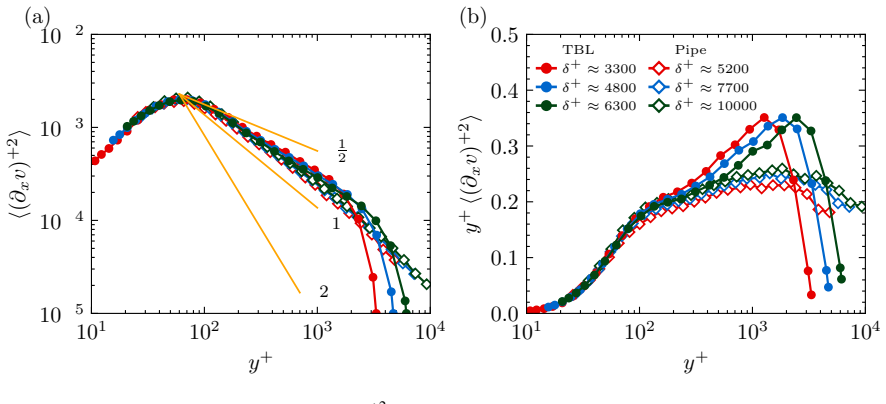
The inner-scaled linear source for wall pressure remains Reynolds-number invariant up to δ+ of order 10^4 because its constituent factors (mean shear and fluctuating velocity gradient) each obey inner scaling, with the gradient variance decaying inversely with wall distance; this leaves the observed logarithmic growth to the nonlinear source, both contributions arising from the same near-wall depletion of mean spanwise vorticity.
What carries the argument
the linear source term (mean shear coupled to fluctuating velocity gradient) isolated by elimination from the Poisson equation for pressure
If this is right
- The nonlinear source term must carry the entire logarithmic growth of inner-scaled wall-pressure variance.
- Both the saturation of the linear source and the growth of the nonlinear source originate from the near-wall depletion of mean spanwise vorticity.
- Vortex stretching sustained by that depletion produces the inertial-layer fissures responsible for the nonlinear contribution.
Where Pith is reading between the lines
- A single vorticity-based structural picture could unify predictions of both linear and nonlinear pressure statistics across the inner and inertial layers.
- The same depletion mechanism may set the scaling of other near-wall quantities whose sources also involve mean shear.
- Extending the eight-sensor probe technique to still higher Reynolds numbers would directly test whether the linear invariance continues without bound.
Load-bearing premise
The fluctuating pressure is predominantly a Poisson response to only the linear source from mean shear and the nonlinear source from velocity fluctuations.
What would settle it
A measurement or direct numerical simulation at friction Reynolds numbers well above 10^4 in which the inner-scaled linear source term increases instead of remaining constant.
Figures

read the original abstract
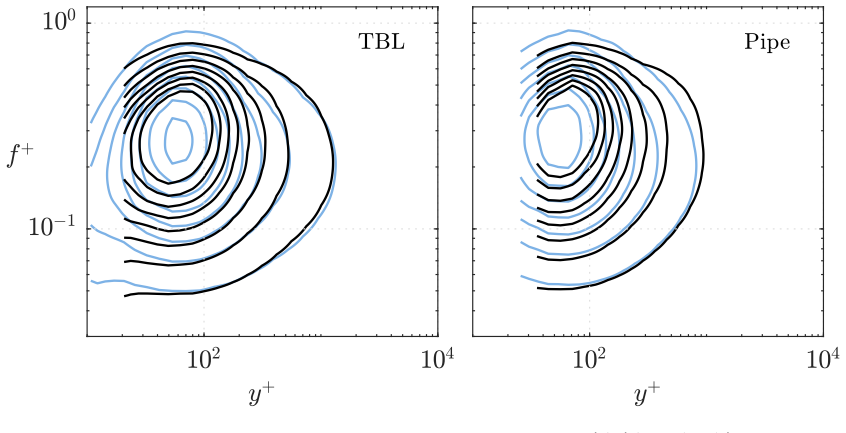
In canonical turbulent wall-bounded flows, the inner-scaled wall-pressure variance is empirically well described by a constant offset plus a slope logarithmic in the friction Reynolds number ($\delta^+$). Because the fluctuating pressure is predominantly a Poisson response to only two source terms -- a linear contribution from the mean shear coupled to a fluctuating velocity gradient, and a nonlinear contribution from the fluctuating velocity field -- the origin of this growth can be pinned down by elimination: if the linear source saturates at a Reynolds-number-independent value, the nonlinear source must carry the logarithmic growth. Here we supply the complementary evidence for inner-scaled invariance of the linear source at $\delta^+$ up to $O(10^4)$, using the simultaneous velocity and velocity-gradient hot-wire measurements of Zimmermann \textit{et al.} (2019 \textit{JFM} vol. 869 pp. 182--213) acquired with a single eight-sensor probe in both a zero-pressure-gradient turbulent boundary layer and a high-Reynolds-number pipe flow. The inner-scaled factors entering the linear source collapse across Reynolds number, and the inertial-layer variance of the relevant fluctuating velocity gradient decays inversely with wall distance. Together with the established inner scaling of the mean shear, this is consistent with a linear wall-pressure contribution that, under inner normalisation, remains $O(1)$ as $\delta^+\to\infty$. Both source terms then trace to one structural mechanism: the near-wall depletion of mean spanwise vorticity that caps the linear source also feeds, through vortex stretching, the inertial-layer fissures that carry the growing nonlinear contribution.
Editorial analysis
A structured set of objections, weighed in public.
Referee Report
Summary. The manuscript claims that the linear source term in the Poisson equation for fluctuating pressure (mean shear coupled to fluctuating velocity gradients) contributes a Reynolds-number-independent O(1) amount to inner-scaled wall-pressure variance at high δ⁺. This is inferred by elimination from the observed inner-scaled collapse of the mean shear and relevant velocity-gradient statistics (drawn from Zimmermann et al. 2019 hot-wire data in boundary layers and pipe flow), together with the inverse wall-distance decay of the gradient variance in the inertial layer; both source terms are then traced to near-wall spanwise vorticity depletion.
Significance. If the central claim holds, the work partitions the empirically observed logarithmic growth in inner-scaled wall-pressure variance to the nonlinear source term and supplies a unified structural mechanism linking the linear and nonlinear contributions. The direct use of simultaneous eight-sensor hot-wire measurements of velocity and velocity gradients, without additional parameter fitting, is a clear strength that allows the source-term factors to be examined independently.
major comments (2)
- [Abstract] Abstract: the assertion that the reported local scalings are 'consistent with a linear wall-pressure contribution that, under inner normalisation, remains O(1) as δ⁺→∞' is not accompanied by an explicit Poisson integration, Green's-function weighting, or bounding argument that converts the observed collapse of S⁺ and the relevant fluctuating-gradient variance into a bounded wall value. Because wall pressure is recovered by integrating the source over the half-space (or pipe radius), local inner scaling alone does not automatically guarantee that the integrated linear term remains O(1); a slow residual Re dependence could persist.
- [Abstract] The assumption that fluctuating pressure is 'predominantly a Poisson response to only two source terms' is used to isolate the linear contribution by elimination, yet the manuscript provides no quantitative assessment of the relative magnitude of any additional source terms (e.g., viscous or compressible contributions) at the Reynolds numbers examined; this isolation step is load-bearing for the claim that saturation of the linear term forces the logarithmic growth onto the nonlinear term.
minor comments (1)
- Notation for the linear source term (mean shear times fluctuating velocity gradient) should be defined explicitly with an equation number at first use to avoid ambiguity when the factors are later discussed separately.
Simulated Author's Rebuttal
We thank the referee for the careful reading, the positive assessment of the experimental approach, and the constructive comments on the abstract. We respond to each major comment below.
read point-by-point responses
-
Referee: [Abstract] Abstract: the assertion that the reported local scalings are 'consistent with a linear wall-pressure contribution that, under inner normalisation, remains O(1) as δ⁺→∞' is not accompanied by an explicit Poisson integration, Green's-function weighting, or bounding argument that converts the observed collapse of S⁺ and the relevant fluctuating-gradient variance into a bounded wall value. Because wall pressure is recovered by integrating the source over the half-space (or pipe radius), local inner scaling alone does not automatically guarantee that the integrated linear term remains O(1); a slow residual Re dependence could persist.
Authors: We agree that a formal Poisson integration or explicit Green's-function bounding argument is not supplied and would strengthen the presentation. The manuscript instead relies on the observed inner-scaled collapse of S⁺ together with the inverse (∼1/y) decay of the relevant gradient variance in the inertial layer. Because the wall-pressure Green's function decays with distance, this combination implies that any contribution from the inertial layer integrates without introducing additional Re dependence beyond the collapse already demonstrated in the data up to δ⁺∼10⁴. A slow residual Re dependence would require a systematic departure from the observed collapse, which is not present. We will add a short clarifying paragraph in the revised manuscript that makes this implicit bounding explicit while retaining the 'consistent with' phrasing. revision: partial
-
Referee: [Abstract] The assumption that fluctuating pressure is 'predominantly a Poisson response to only two source terms' is used to isolate the linear contribution by elimination, yet the manuscript provides no quantitative assessment of the relative magnitude of any additional source terms (e.g., viscous or compressible contributions) at the Reynolds numbers examined; this isolation step is load-bearing for the claim that saturation of the linear term forces the logarithmic growth onto the nonlinear term.
Authors: The two-source-term model is the standard incompressible approximation used throughout the wall-pressure literature. Viscous source terms are confined to the viscous sublayer (y⁺≲10) while the inertial-layer statistics examined here lie well outside this region; compressible contributions are negligible at the low Mach numbers of the Zimmermann et al. air-flow experiments. We will insert a brief order-of-magnitude discussion (drawing on established estimates from the literature) in the revised introduction to quantify why these additional terms do not affect the scaling conclusions at the Reynolds numbers considered. revision: partial
Circularity Check
No significant circularity; evidence from external measurements supports local collapse without reducing claim to input by construction.
full rationale
The paper presents observational evidence from Zimmermann et al. (2019) measurements showing collapse of inner-scaled mean shear and fluctuating velocity-gradient factors, plus inverse decay of gradient variance. This is described as 'consistent with' an O(1) linear contribution rather than derived via explicit Poisson integration or self-referential definition. The citation supplies independent hot-wire data (externally falsifiable measurements), not a uniqueness theorem or ansatz from overlapping authors. No fitted parameter is relabeled as prediction, and no equation reduces the wall-pressure variance claim to the observed local scalings by construction. The absence of integration is a completeness issue, not circularity.
Axiom & Free-Parameter Ledger
axioms (1)
- domain assumption fluctuating pressure is predominantly a Poisson response to only two source terms
Reference graph
Works this paper leans on
-
[1]
Efficient representation of exact coherent states of the. Fluid Dyn. Res. , author =. 2019 , pages =. doi:10.1088/1873-7005/aab1ab , number =
-
[3]
On the space-time characteristics of wall-pressure fluctuations , volume =. Phys. Fluids A , author =. 1990 , pages =. doi:10.1063/1.857593 , language =
-
[4]
Scaling of the velocity fluctuations in turbulent channels up to. Phys. Fluids , author =. 2006 , pages =. doi:10.1063/1.2162185 , language =
-
[5]
Statistical structure of the fluctuating wall pressure and its in-plane gradients at high. J. Fluid Mech. , author =. 2008 , pages =. doi:10.1017/S0022112008002541 , language =
-
[6]
Spectral features of wall pressure fluctuations beneath turbulent boundary layers , volume =. Phys. Fluids A , author =. 1991 , pages =. doi:10.1063/1.858179 , language =
-
[7]
Direct numerical simulation of turbulent channel flow up to , volume =. J. Fluid Mech. , author =. 2015 , pages =. doi:10.1017/jfm.2015.268 , language =
-
[8]
Coupled dynamics of wall pressure and transpiration, with implications for drag reduction , volume =. J. Fluid Mech. , author =. 2025 , pages =
2025
-
[9]
On the structure of pressure fluctuations in simulated turbulent channel flow , volume =. J. Fluid Mech. , author =. 1989 , pages =. doi:10.1017/S0022112089002090 , language =
-
[10]
Wall pressure and shear stress spectra from direct simulations of channel flow , volume =. AIAA J. , author =. 2006 , pages =. doi:10.2514/1.17638 , language =
-
[11]
Active and inactive contributions to the wall pressure and wall-shear stress in turbulent boundary layers , volume =. J. Fluid Mech. , author =. 2025 , pages =. doi:10.1017/jfm.2024.1218 , language =
-
[12]
Correlation of pressure fluctuations in turbulent wall layers , volume =. Phys. Rev. Fluids , author =. 2017 , pages =. doi:10.1103/PhysRevFluids.2.094604 , language =
-
[13]
Analysis of wall-pressure fluctuation sources from direct numerical simulation of turbulent channel flow , volume =. J. Fluid Mech. , author =. 2020 , pages =. doi:10.1017/jfm.2020.412 , language =
-
[14]
Reynolds-stress and dissipation-rate budgets in a turbulent channel flow , volume =. J. Fluid Mech. , author =. 1988 , pages =. doi:10.1017/S0022112088002885 , language =
-
[15]
A critical-layer framework for turbulent pipe flow , volume =. J. Fluid Mech. , author =. 2010 , pages =. doi:10.1017/S002211201000176X , language =
-
[16]
Low- and mid-frequency wall-pressure sources in a turbulent boundary layer , volume =. J. Fluid Mech. , author =. 2021 , pages =. doi:10.1017/jfm.2021.339 , language =
-
[17]
`. J. Fluid Mech. , author =. 1967 , pages =. doi:10.1017/S0022112067001417 , language =
-
[18]
Fluctuating pressure beneath smooth wall boundary layers in nonequilibrium pressure gradients , volume =. AIAA J. , author =. 2022 , pages =. doi:10.2514/1.J061431 , language =
-
[19]
On pressure fluctuations in the near-wall region of turbulent flows , volume =. J. Fluid Mech. , author =. 2025 , pages =. doi:10.1017/jfm.2025.264 , language =
-
[20]
Relationship between wall pressure and velocity-field sources , volume =. Phys. Fluids , author =. 1999 , pages =. doi:10.1063/1.870202 , language =
-
[21]
Assessment of direct numerical simulation data of turbulent boundary layers , volume =. J. Fluid Mech. , author =. 2010 , pages =. doi:10.1017/S0022112010003113 , language =
-
[22]
Fritsch, Danny and Vishwanathan, Vidya and Duetsch-Patel, Julie and Gargiulo, Aldo and Lowe, Kevin T. and Devenport, William J. , month = jun, year =. The pressure signature of high. doi:10.2514/6.2020-3066 , language =
-
[23]
A description of turbulent wall-flow vorticity consistent with mean dynamics , volume =. J. Fluid Mech. , author =. 2013 , pages =. doi:10.1017/jfm.2013.565 , language =
-
[24]
Statistical structure of turbulent-boundary-layer velocity-vorticity products at high and low. J. Fluid Mech. , author =. 2007 , pages =. doi:10.1017/S0022112006002771 , language =
-
[25]
Linear and nonlinear receptivity mechanisms in boundary layers subject to free-stream turbulence , volume =
Blanco, Diego CP and Hanifi, Ardeshir and Henningson, Dan S and Cavalieri, André VG , year =. Linear and nonlinear receptivity mechanisms in boundary layers subject to free-stream turbulence , volume =. J. Fluid Mech. , publisher =
-
[26]
Influences of boundary layer scale separation on the vorticity transport contribution to turbulent inertia , volume =. Phys. Fluids , author =. 2013 , pages =. doi:10.1063/1.4775361 , language =
-
[27]
A uniform momentum zone-vortical fissure model of the turbulent boundary layer , volume =. J. Fluid Mech. , author =. 2019 , pages =. doi:10.1017/jfm.2018.769 , language =
-
[28]
Scaling of wall-pressure-velocity correlations in high-. J. Fluid Mech. , author =. 2025 , pages =. doi:10.1017/jfm.2025.400 , language =
-
[29]
Massey, Jonathan M.O. and Smits, Alexander J. and McKeon, Beverley J. , year=. Two-component inner–outer scaling model for the wall-pressure spectrum at high. doi:10.1017/jfm.2026.11550 , journal=
-
[30]
Effect of wall-boundary disturbances on turbulent channel flows , volume =. J. Fluid Mech. , author =. 2006 , pages =. doi:10.1017/S0022112006001534 , language =
-
[31]
Huang, Yuting and Toedtli, Simon S. and Chini, Gregory P. and McKeon, Beverley J. , month = mar, year =. Spatio-temporal characterization of nonlinear forcing and response in turbulent channel flow , url =. doi:10.48550/arXiv.2503.06915 , language =
-
[32]
Wall effects on pressure fluctuations in turbulent channel flow , volume =. J. Fluid Mech. , author =. 2013 , pages =. doi:10.1017/jfm.2012.633 , language =
-
[33]
Deshpande, Rahul and Hassanein, Abdelrahman and Baars, Woutijn J. , month = aug, year =. Source locations and convection velocities of outer-scaled wall-pressure fluctuations in canonical turbulent boundary layers , url =. doi:10.48550/arXiv.2508.19940 , language =
work page internal anchor Pith review Pith/arXiv arXiv doi:10.48550/arxiv.2508.19940
-
[34]
On the existence of uniform momentum zones in a turbulent boundary layer , volume =. Phys. Fluids , author =. 1995 , pages =. doi:10.1063/1.868594 , language =
-
[35]
Interfaces of uniform momentum zones in turbulent boundary layers , volume =. J. Fluid Mech. , author =. 2017 , pages =. doi:10.1017/jfm.2017.197 , language =
-
[36]
Self-similar geometries within the inertial subrange of scales in boundary layer turbulence , volume =. J. Fluid Mech. , author =. 2022 , pages =. doi:10.1017/jfm.2022.409 , language =
-
[37]
Geometry of large-scale uniform momentum zone interfaces , volume =. J. Fluid Mech. , author =. 2025 , pages =. doi:10.1017/jfm.2025.10929 , language =
-
[38]
The structure of the turbulent boundary layer , volume =. Math. Proc. Camb. Phil. Soc. , author =. 1951 , pages =. doi:10.1017/S0305004100026724 , language =
-
[39]
Properties of turbulent channel flow similarity solutions , volume =. J. Fluid Mech. , author =. 2021 , pages =. doi:10.1017/jfm.2021.132 , language =
-
[40]
Properties of the mean momentum balance in turbulent boundary layer, pipe and channel flows , volume =. J. Fluid Mech. , author =. 2005 , pages =. doi:10.1017/S0022112004001958 , language =
-
[41]
The Physics of Fluids , author =
Comment on ‘‘. The Physics of Fluids , author =. 1982 , pages =. doi:10.1063/1.863774 , language =
-
[42]
The Physics of Fluids , author =
A note on. The Physics of Fluids , author =. 1981 , pages =. doi:10.1063/1.863442 , language =
-
[43]
On the mixing length eddies and logarithmic mean velocity profile in wall turbulence , volume =. J. Fluid Mech. , author =. 2020 , pages =. doi:10.1017/jfm.2020.23 , language =
-
[44]
Taylor's frozen hypothesis of the pressure fluctuations in turbulent channel flow at high. J. Fluid Mech. , author =. 2023 , pages =. doi:10.1017/jfm.2023.692 , abstract =
-
[45]
On the wavenumber–frequency spectrum of the wall pressure fluctuations in turbulent channel flow , volume =. J. Fluid Mech. , author =. 2022 , pages =. doi:10.1017/jfm.2022.137 , language =
-
[46]
Review of. AIAA Journal , author =. 2024 , pages =. doi:10.2514/1.J064561 , language =
-
[47]
On the convection velocity in high-. J. Fluid Mech. , author =. 2025 , pages =. doi:10.1017/jfm.2025.10962 , language =
-
[48]
Experimental investigation of velocity and vorticity in turbulent wall flows , language =
Zimmerman, Spencer James , year =. Experimental investigation of velocity and vorticity in turbulent wall flows , language =
-
[49]
Massey, Jonathan M. O. and Klewicki, Joseph C. and McKeon, Beverley J. , month = dec, year =. On the Poisson-Source Basis of Logarithmic Wall-Pressure-Variance Growth , url =. doi:10.48550/arXiv.2511.16776 , urldate =
work page internal anchor Pith review Pith/arXiv arXiv doi:10.48550/arxiv.2511.16776
-
[50]
Catlett, Matthew R. and Bryan, Benjamin S. and Chang, Natasha and Hemingway, Hugh and Anderson, Jason M. , month = jan, year =. Modeling. doi:10.2514/6.2022-2559 , language =
-
[51]
The Journal of the Acoustical Society of America , author =
Measurement of the low-wavenumber component within a turbulent wall pressure by an inverse problem of vibration , volume =. The Journal of the Acoustical Society of America , author =. 2016 , pages =. doi:10.1121/1.4962986 , language =
-
[52]
Journal of Sound and Vibration , author =
Low-wavenumber turbulent boundary layer wall-pressure measurements from vibration data on a cylinder in pipe flow , volume =. Journal of Sound and Vibration , author =. 2010 , pages =. doi:10.1016/j.jsv.2010.04.010 , language =
-
[53]
and Forest, Jonathan and Catlett, Matthew R
Anderson, Jason M. and Forest, Jonathan and Catlett, Matthew R. and Parker, Colin and Chesnakas, Christopher , month = jul, year =. Surface. doi:10.2514/6.2025-3494 , language =
-
[54]
On the structure and origin of pressure fluctuations in wall turbulence: predictions based on the resolvent analysis , volume =. J. Fluid Mech. , author =. 2014 , pages =. doi:10.1017/jfm.2014.283 , language =
-
[55]
A generalized model for the convection velocity associated with turbulent boundary layer wall pressure fluctuations in both air and water , volume =. Physics of Fluids , author =. 2026 , pages =. doi:10.1063/5.0313916 , abstract =
-
[56]
A framework for studying the effect of compliant surfaces on wall turbulence , volume =. J. Fluid Mech. , author =. 2015 , pages =. doi:10.1017/jfm.2015.85 , language =
-
[57]
Empirical. AIAA Journal , author =. 2004 , pages =. doi:10.2514/1.9433 , language =
-
[58]
Numerical investigation of turbulent channel flow , volume =. J. Fluid Mech. , author =. 1982 , pages =. doi:10.1017/S0022112082001116 , language =
-
[59]
Journal of Sound and Vibration , author =
Modeling the wavevector-frequency spectrum of turbulent boundary layer wall pressure , volume =. Journal of Sound and Vibration , author =. 1980 , pages =. doi:10.1016/0022-460X(80)90553-2 , language =
-
[60]
Journal of Sound and Vibration , author =
The character of the turbulent wall pressure spectrum at subconvective wavenumbers and a suggested comprehensive model , volume =. Journal of Sound and Vibration , author =. 1987 , pages =. doi:10.1016/S0022-460X(87)80098-6 , language =
-
[61]
Kwon, Y. S. and Philip, J. and de Silva, C. M. and Hutchins, N. and Monty, J. P. , year =. The quiescent core of turbulent channel flow , volume =. doi:10.1017/jfm.2014.295 , journal =
-
[62]
Turbulence statistics in fully developed channel flow at low. J. Fluid Mech. , author =. 1987 , pages =. doi:10.1017/S0022112087000892 , language =
-
[63]
The structure of turbulent boundary layers at low. J. Fluid Mech. , author =. 1982 , pages =. doi:10.1017/S0022112082002080 , language =
-
[64]
The turbulence structure of equilibrium boundary layers , volume =. J. Fluid Mech. , author =. 1967 , pages =. doi:10.1017/S0022112067001089 , language =
-
[65]
Bradshaw, P. , month = jun, year =. Review—. doi:https://doi.org/10.1115/1.3447237 , language =
-
[66]
Simultaneous skin friction and velocity measurements in high. J. Fluid Mech. , author =. 2019 , pages =. doi:10.1017/jfm.2019.303 , abstract =
-
[67]
A comparative study of the velocity and vorticity structure in pipes and boundary layers at friction. J. Fluid Mech. , author =. 2019 , pages =. doi:10.1017/jfm.2019.182 , language =
-
[68]
Fluid Dyn
Criteria for assessing experiments in zero pressure gradient boundary layers , author=. Fluid Dyn. Res. , volume=
-
[69]
Design and implementation of a hot-wire probe for simultaneous velocity and vorticity vector measurements in boundary layers , author=. Exp. Fluids , volume=. 2017 , publisher=
2017
-
[70]
Nickels, T. B. and Marusic, I. and Hafez, S. and Chong, M. S. , journal=. Evidence of the k_1^. 2005 , publisher=
2005
-
[71]
and Talamelli, A
Bellani, G. and Talamelli, A. , booktitle=. The final design of the long pipe in. 2016 , organization=
2016
-
[72]
Sillero, J. A. and Jim. One-point statistics for turbulent wall-bounded flows at. Phys. Fluids , volume=. 2013 , publisher=
2013
-
[73]
Pope, S. B. , year=. Turbulent Flows , publisher=
-
[74]
and Antonia, R
Zhu, Y. and Antonia, R. A. , journal=. The spatial resolution of two
-
[75]
Turbulent fluctuations above the buffer layer of wall-bounded flows , journal =
Jim. Turbulent fluctuations above the buffer layer of wall-bounded flows , journal =
-
[76]
On velocity correlations and the solutions of the equations of turbulent fluctuation , author =. Q. Appl. Math. , volume =
-
[77]
Hoyas, S. and Jim. Phys. Fluids , volume =
discussion (0)
Sign in with ORCID, Apple, or X to comment. Anyone can read and Pith papers without signing in.