Optimal stellar rank approximation of squeezed cat states with photon catalysis
Pith reviewed 2026-07-03 11:33 UTC · model grok-4.3
The pith
Photon catalysis between Fock states and squeezed states achieves provably optimal fidelity to squeezed cat states in identified regimes.
A machine-rendered reading of the paper's core claim, the machinery that carries it, and where it could break.
Core claim
The catalysis protocols considered here are provably optimal in identified instances because their output fidelity matches the maximum attainable by any protocol that consumes inputs of identical stellar rank. Parameter regimes exist in which high-fidelity approximations of the target squeezed cat states are obtained with minimal non-Gaussian resources. The same framework extends to related states such as squeezed Fock states, and loss effects are quantified through Hilbert-space truncation.
What carries the argument
Stellar rank, a numerical measure of non-Gaussian complexity for states and measurements that enables direct comparison of achieved fidelity to the theoretical maximum possible with given input resources.
If this is right
- Certain catalysis protocols reach the highest fidelity allowed by their input stellar ranks.
- High-fidelity squeezed cat states become accessible with low non-Gaussian resource overhead in specific parameter windows.
- Photon catalysis using deterministic Fock sources shows higher success probability and state quality than selected Gaussian boson sampling-inspired alternatives.
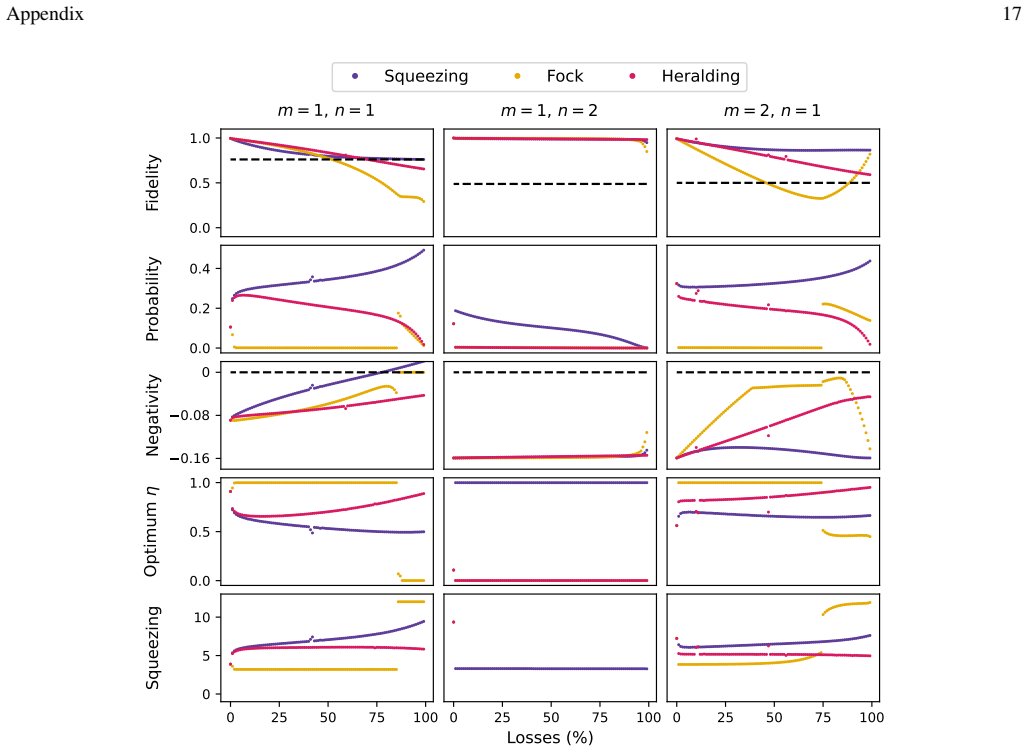
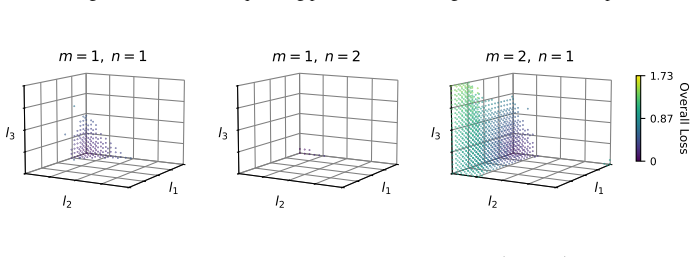
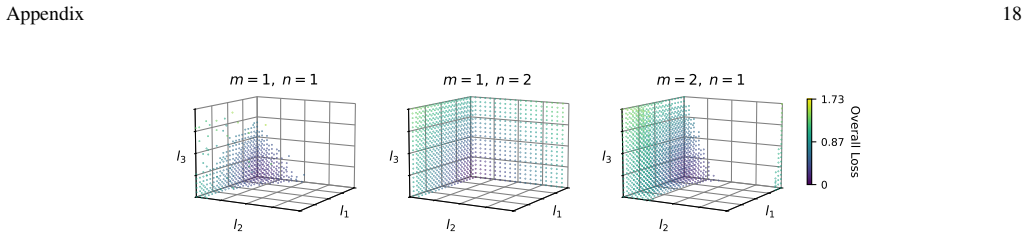
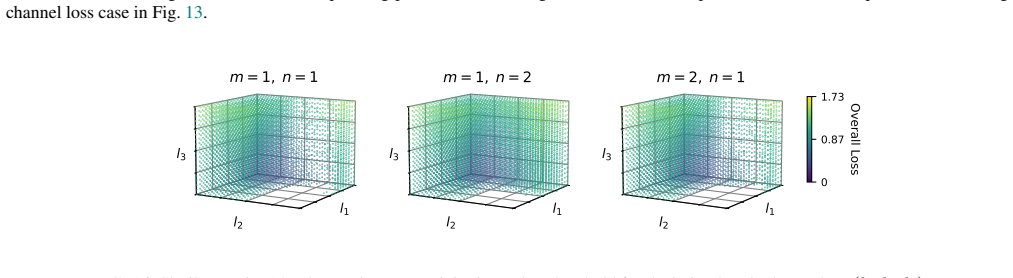
- Modeled optical losses reduce fidelity in a quantifiable way that still leaves usable states in the identified regimes.
- The same stellar-rank comparison applies to the generation of squeezed Fock states needed for quantum error correction.
Where Pith is reading between the lines
- Stellar rank offers a practical benchmark that future non-Gaussian generation schemes in optics could adopt for optimality checks.
- The loss-robustness results indicate concrete fidelity thresholds experimenters can target when designing heralded sources.
- Extending the same resource-counting method to other heralded operations could clarify trade-offs across a wider set of bosonic protocols.
Load-bearing premise
The stellar rank formalism provides a complete and faithful characterization of non-Gaussian complexity that permits direct comparison of achieved fidelity to the maximum fidelity attainable by any protocol using the same input resources.
What would settle it
An alternative protocol that produces higher fidelity to the same target squeezed cat state while consuming inputs of equal or lower stellar rank would falsify the optimality claims.
Figures
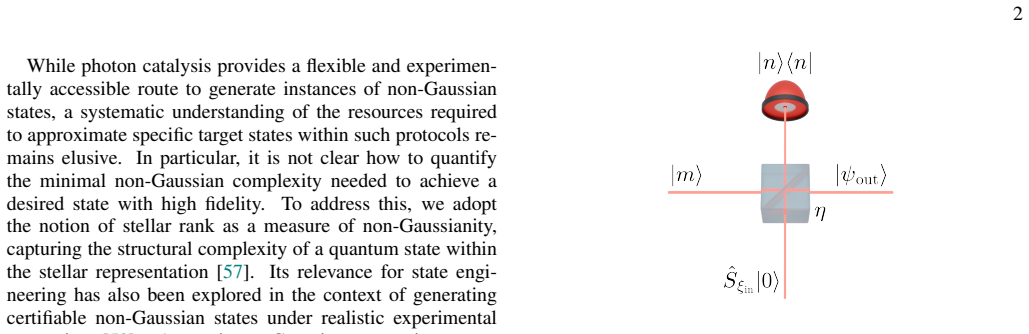




read the original abstract
Non-Gaussian quantum states and operations constitute essential resources for achieving quantum computational advantage and enabling quantum error correction in bosonic platforms. However, their generation in optical settings remains a challenging experimental task, often relying on probabilistic heralded protocols. Here, we present an in-depth analysis of the suitability of photon catalysis between low number Fock states and squeezed states for the generation of squeezed coherent state superpositions. We employ the stellar rank formalism to characterize the non-Gaussian complexity of input resources (including both states and measurements) and the generated states. This enables a systematic comparison of the fidelity between the catalyzed output and the target states to the maximum fidelity achievable by any protocol with the same non-Gaussian input resources. In this sense, we identify instances where the catalysis protocols considered here are provably optimal. We identify parameter regimes in which high-fidelity approximations of the target states can be achieved with minimal resources. Furthermore, we benchmark the performance of photon catalysis against Gaussian boson sampling-inspired protocols in terms of success probability and state quality, highlighting the advantages of deterministic Fock state sources. We also investigate the generation of related non-Gaussian resources including squeezed Fock states relevant for quantum error correction. To account for experimental imperfections, we model losses across all optical modes using a Hilbert space truncation approach in the Fock basis and analyze the robustness of the generated states under realistic conditions. Our results quantify the trade-offs between non-Gaussian resource complexity, achievable fidelity, and losses in photon catalysis protocols, providing practical guidelines for near-term photonic implementations.
Editorial analysis
A structured set of objections, weighed in public.
Referee Report
Summary. The manuscript analyzes photon catalysis between low-number Fock states and squeezed states for generating squeezed cat states (squeezed coherent-state superpositions). It employs the stellar-rank formalism to quantify non-Gaussian complexity of inputs and outputs, enabling direct comparison of achieved fidelity against the maximum fidelity attainable by any protocol using identical stellar-rank resources. The work identifies parameter regimes of provable optimality, benchmarks catalysis against Gaussian-boson-sampling-inspired protocols, examines generation of squeezed Fock states, models uniform losses via Fock-basis truncation, and extracts practical guidelines for near-term photonic implementations.
Significance. If the optimality claims are rigorously established, the results supply concrete resource-fidelity-loss trade-offs and identify high-fidelity, low-resource regimes for non-Gaussian state preparation, directly relevant to bosonic quantum error correction and photonic advantage experiments. Explicit credit is due for the systematic stellar-rank comparison framework and the Hilbert-space truncation loss model, both of which strengthen the practical utility of the findings.
major comments (1)
- [Abstract] Abstract (and the corresponding results section on stellar-rank comparisons): the central claim that 'instances where the catalysis protocols considered here are provably optimal' are identified requires an explicit, general upper bound on fidelity that depends only on the stellar ranks of the input states and measurements (independent of squeezing parameter values). The manuscript must derive or cite such a bound; otherwise the optimality statements rest on numerical matching rather than a rank-based completeness argument.
minor comments (1)
- The loss-modeling section should report the specific truncation dimension N_trunc used in all fidelity calculations together with a convergence check (e.g., fidelity change when N_trunc is increased by 2).
Simulated Author's Rebuttal
We thank the referee for the thorough review and constructive feedback. Below we respond point-by-point to the major comment.
read point-by-point responses
-
Referee: [Abstract] Abstract (and the corresponding results section on stellar-rank comparisons): the central claim that 'instances where the catalysis protocols considered here are provably optimal' are identified requires an explicit, general upper bound on fidelity that depends only on the stellar ranks of the input states and measurements (independent of squeezing parameter values). The manuscript must derive or cite such a bound; otherwise the optimality statements rest on numerical matching rather than a rank-based completeness argument.
Authors: We agree that the presentation of optimality would benefit from greater clarity on how the upper bound is obtained. The stellar-rank measure is independent of Gaussian parameters, and for each fixed combination of input stellar ranks we compute the maximum fidelity to the target by numerically optimizing over all states and measurements possessing exactly those ranks (with arbitrary Gaussian operations permitted). When the catalysis protocol achieves this numerically determined maximum, the result is optimal with respect to the given non-Gaussian resources. This procedure constitutes a rank-based completeness argument for the low-rank cases examined, although the numerical value of the bound necessarily depends on the target squeezing. We will revise the abstract and the stellar-rank comparison section to (i) explicitly describe the optimization used to establish the rank-constrained fidelity upper bound and (ii) replace the phrase “provably optimal” with “optimal with respect to the numerically computed maximum fidelity attainable at the same stellar ranks.” No general closed-form analytical bound independent of all parameters appears to be available in the literature; the numerical approach is rigorous for the regimes considered. revision: yes
Circularity Check
No circularity: stellar-rank fidelity bound treated as external benchmark
full rationale
The paper's central claim rests on comparing catalyzed-state fidelity against a maximum fidelity attainable with identical stellar-rank resources. No quoted step reduces this maximum to a fitted parameter, self-defined quantity, or self-citation chain; the formalism is invoked to supply an independent upper bound rather than to rename or reconstruct the protocol output. Self-citations, if present, are not load-bearing for the optimality statements. The derivation therefore remains self-contained against the stated external benchmark.
Axiom & Free-Parameter Ledger
axioms (1)
- domain assumption Stellar rank formalism fully characterizes non-Gaussian complexity of states and measurements for fidelity comparisons
Reference graph
Works this paper leans on
-
[1]
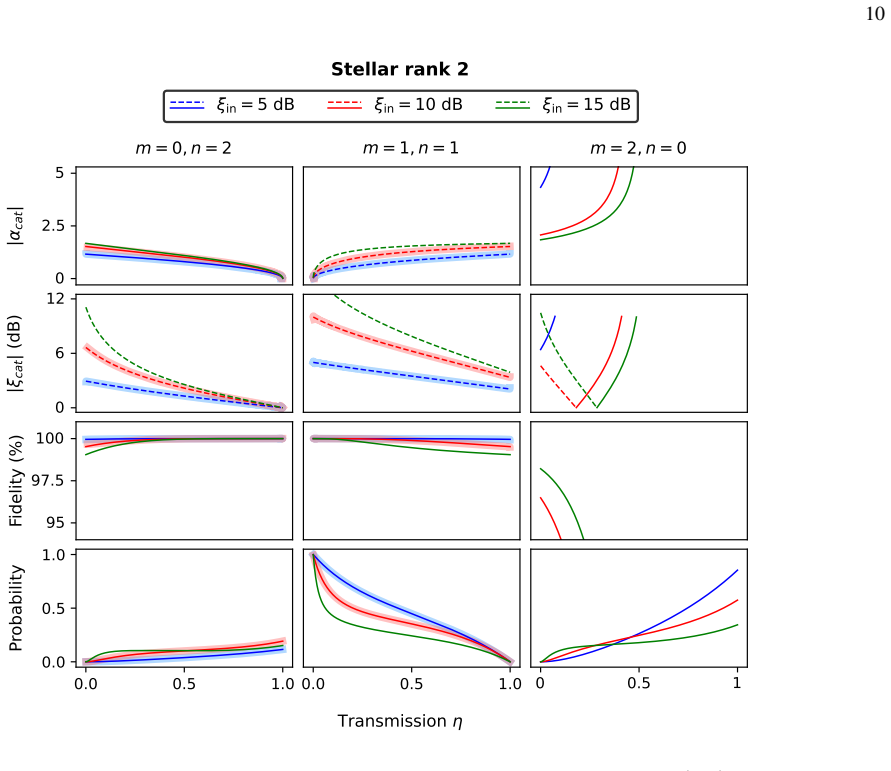
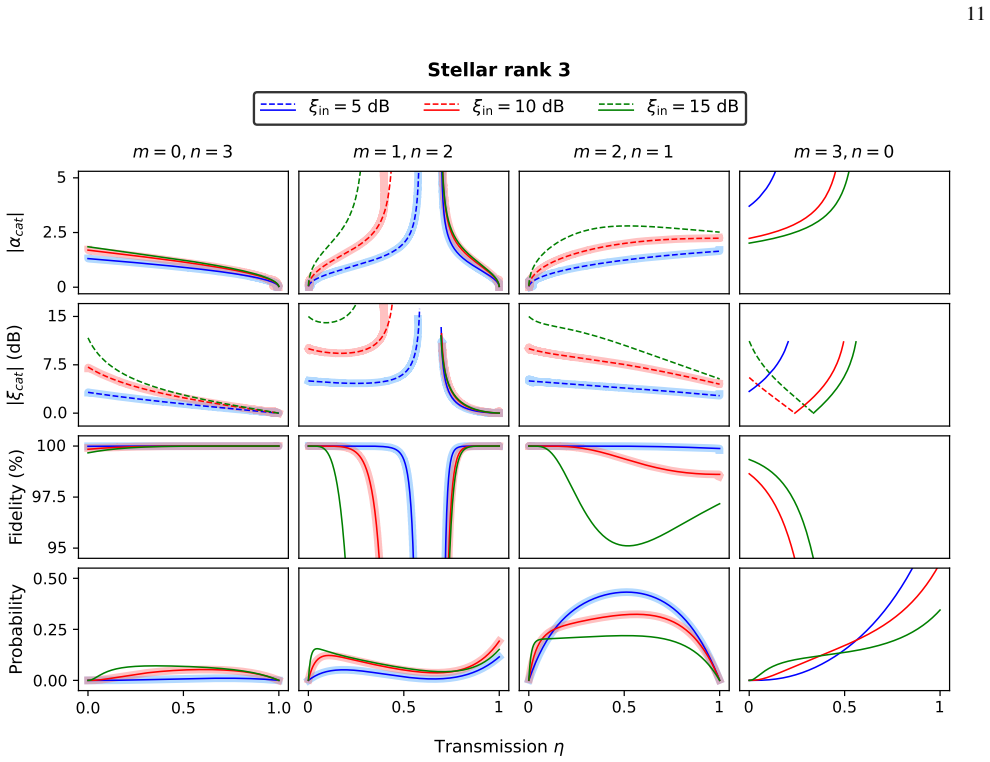
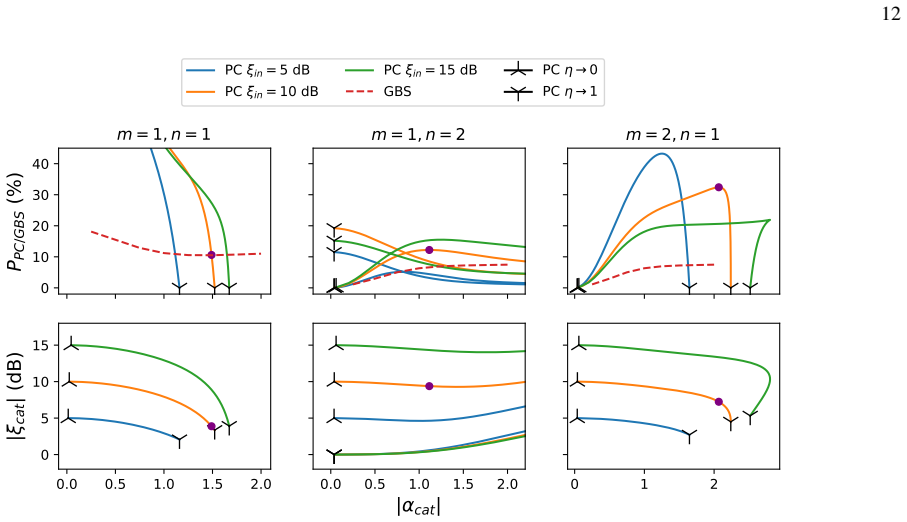
Since PC and the GBS-like scheme both provide optimal stellar rank approximations, only the success probability re- mains for comparison. As suggested in Eq. (33), we investi- gate(m, n) =(1,1), (1,2), (2,1) and compare them to GBS- like scheme with the same stellar rank, i.e.,n= 2andn= 3, respectively. In particular, this covers examples for even and odd...
-
[2]
Efficient computation ofP PC is provided in Appendix B. For PC, the values(α cat, PPC)are displayed as curves that are obtained from varying the transmissivityη. As input squeez- ing, we considerξ in = 5,10,15dB, where the latter is the largest squeezing that has been experimentally measured so far [71]. The case ofm= 1, n= 2gives rise to two branches, wh...
-
[3]
9 that PC outperforms the GBS-like scheme for a broad range ofα cat
We infer from Fig. 9 that PC outperforms the GBS-like scheme for a broad range ofα cat. Let us start with some special cases: Form= 1, n= 1, the limitα cat →0yieldsP PC → | ⟨1|1⟩ |2 = 100%in contrast to PGBS → | ⟨2| ˆSξin |0⟩ |2. Form= 1, n= 2, the limit ofα cat → 0yieldsP GBS → | ⟨3| ˆSξin |0⟩ |2 = 0%since squeezed states have even Fock occupation. In co...
-
[4]
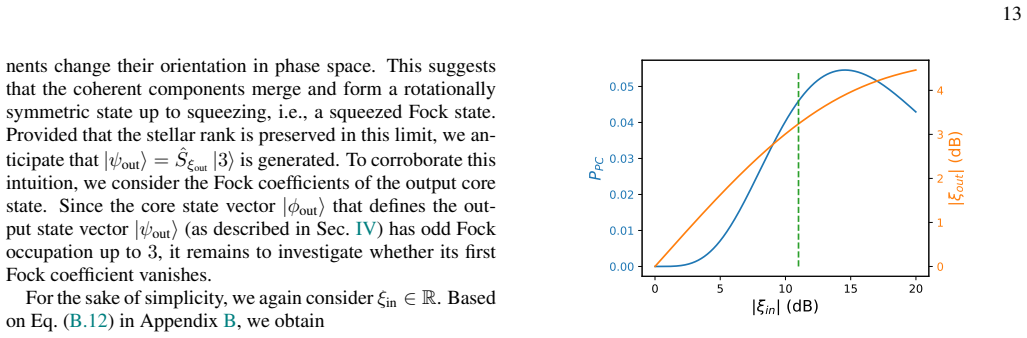
In partic- ular, Eq. (37) allows any value fort in. This reveals that the generation of squeezed Fock states is possible for any input squeezingξ in. The output squeezingξ out, i.e.,t out = tanhξ out, is determined by tout = (1−η)t in = 3 4tin 1− r 1− 8 9 t2 in ,(38) using Eq. (37). Hence, it is limited by|t out|< 1 2, i.e.,|ξ out|< 4.77dB. Based on Eq. (...
work page 2019
-
[5]
PsiQuantum team, A manufacturable platform for photonic quantum computing, Nature641, 876 (2025)
work page 2025
-
[6]
H. A. Radet al., Scaling and networking a modular photonic quantum computer, Nature638, 912 (2025)
work page 2025
-
[7]
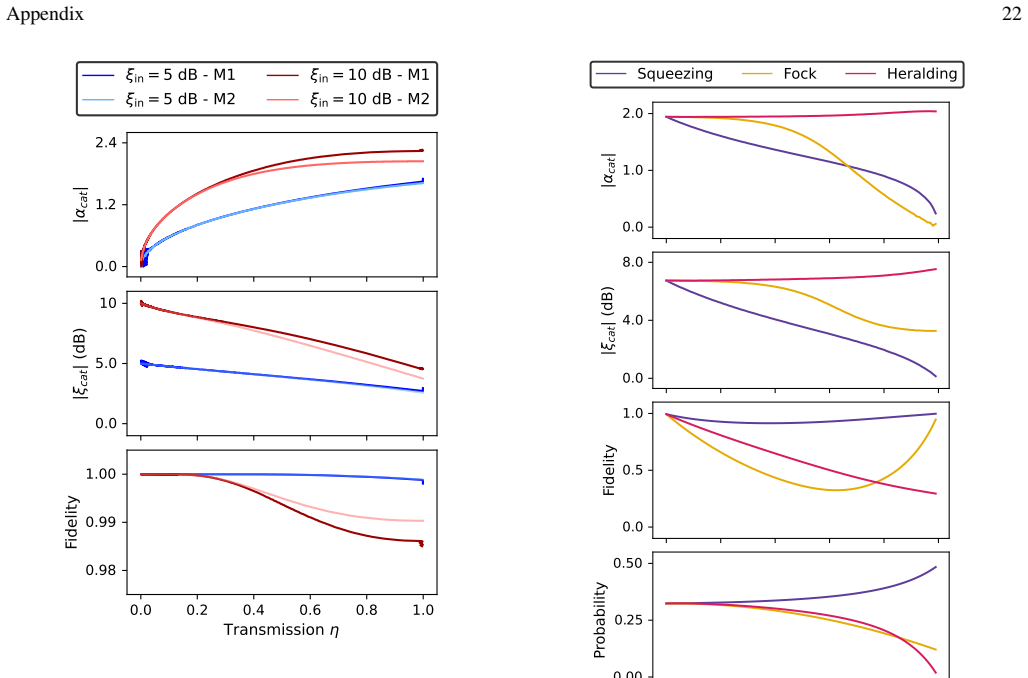
S. Bartolucci, P. Birchall, H. Bombin, H. Cable, C. Dawson, M. Gimeno-Segovia, E. Johnston, K. Kieling, N. Nickerson, M. Pant, F. Pastawski, T. Rudolph, and C. Sparrow, Fusion- based quantum computation, Nature Comm.14, 912 (2023). Appendix 22 0.0 1.2 2.4 | cat| 0.0 5.0 10 | cat| (dB) 0.0 0.2 0.4 0.6 0.8 1.0 Transmission 0.98 0.99 1.00 Fidelity in = 5 dB ...
work page 2023
-
[8]
A. Mari and J. Eisert, Positive Wigner functions render classical simulation of quantum computation efficient, Phys. Rev. Lett. 109, 230503 (2012)
work page 2012
-
[9]
D. Gottesman, A. Kitaev, and J. Preskill, Encoding a qubit in an oscillator, Phys. Rev. A64, 012310 (2001)
work page 2001
- [10]
-
[11]
A. J. Brady, A. Eickbusch, S. Singh, J. Wu, and Q. Zhuang, Ad- vances in bosonic quantum error correction with Gottesman- Kitaev-Preskill codes: Theory, engineering and applications, Prog. Quant. Elect.93, 100496 (2024)
work page 2024
-
[12]
B. Yurke and D. Stoler, Generating quantum mechanical super- positions of macroscopically distinguishable states via ampli- tude dispersion, Phys. Rev. Lett.57, 13 (1986)
work page 1986
-
[13]
H. Jeong and M. Kim, Efficient quantum computation using coherent states, Physical Review A65, 042305 (2002), quant- ph/0109077
- [14]
-
[15]
W. Cai, Y . Ma, W. Wang, C.-L. Zou, and L. Sun, Bosonic quan- tum error correction codes in superconducting quantum cir- cuits, Fundamental Res.1, 50 (2021)
work page 2021
-
[16]
H. Putterman, K. Noh, C. T. Hann,et al., Hardware-efficient quantum error correction via concatenated bosonic qubits, Na- ture638, 927 (2025)
work page 2025
-
[17]
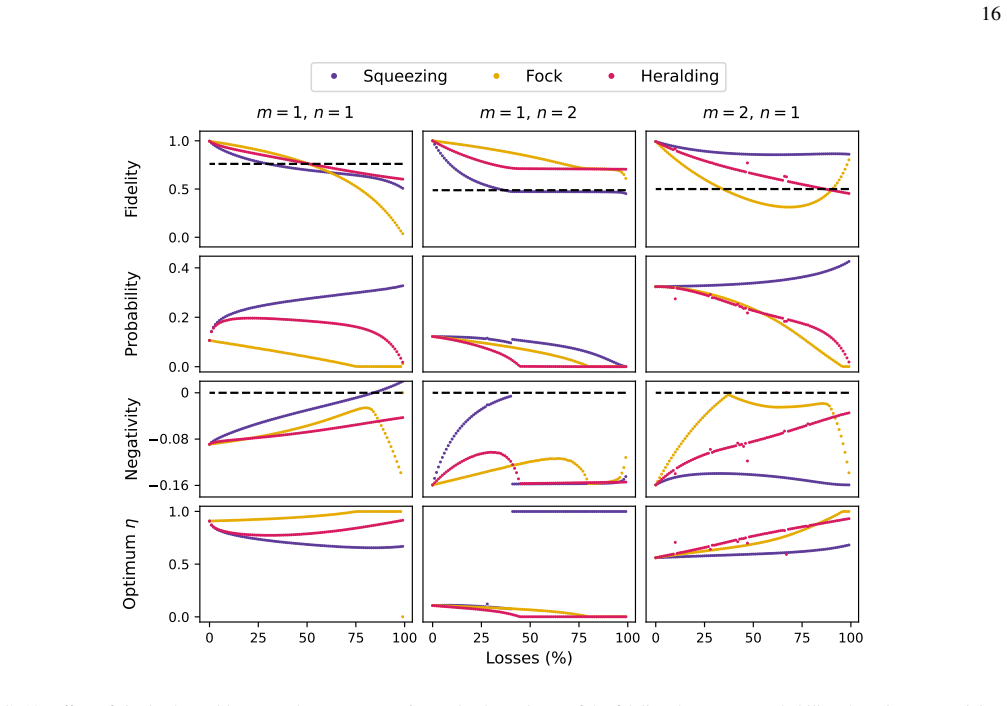
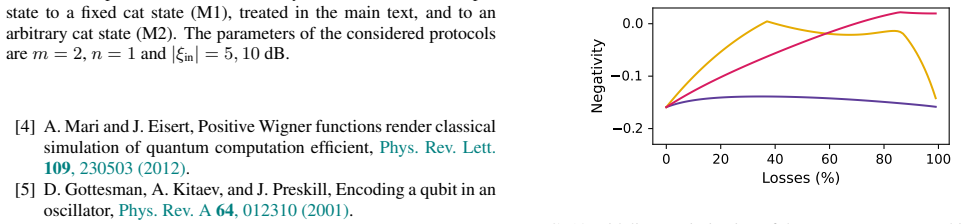
B. L. Brock, S. Singh, A. Eickbusch, V . V . Sivak, A. Z. Ding, L. Frunzio, S. M. Girvin, and M. H. Devoret, Quantum er- 0.0 1.0 2.0 | cat| 0.0 4.0 8.0 | cat| (dB) 0.0 0.5 1.0 Fidelity 0.00 0.25 0.50 Probability 0 20 40 60 80 100 Losses (%) 0.2 0.1 0.0 Negativity Squeezing Fock Heralding FIG. 19. Fidelity maximization of the output state to an arbitrary c...
work page 2025
-
[18]
Serafini,Quantum continuous variables: a primer of theo- retical methods(CRC press, 2023)
A. Serafini,Quantum continuous variables: a primer of theo- retical methods(CRC press, 2023)
work page 2023
-
[19]
Walschaers, Non-Gaussian quantum states and where to find them, PRX Quantum2, 030204 (2021)
M. Walschaers, Non-Gaussian quantum states and where to find them, PRX Quantum2, 030204 (2021)
work page 2021
-
[20]
Zhang, High-fidelity photon-subtraction operation for large- photon-number fock states, Phys
S. Zhang, High-fidelity photon-subtraction operation for large- photon-number fock states, Phys. Rev. A101, 023835 (2020)
work page 2020
- [21]
-
[22]
Furusawa, Quantum states of light, inQuantum states of light(Springer, 2015) pp
A. Furusawa, Quantum states of light, inQuantum states of light(Springer, 2015) pp. 1–67
work page 2015
-
[23]
A. P. Lund, A. Laing, S. Rahimi-Keshari, T. Rudolph, J. L. Appendix 23 O’Brien, and T. C. h, Boson sampling from a Gaussian state, Phys. Rev. Lett.113, 100502 (2014)
work page 2014
-
[24]
C. S. Hamilton, R. Kruse, L. Sansoni, S. Barkhofen, C. Silber- horn, and I. Jex, Gaussian boson sampling, Phys. Rev. Lett.119, 170501 (2017)
work page 2017
-
[25]
D. Hangleiter and J. Eisert, Computational advantage of quan- tum random sampling, Rev. Mod. Phys.95, 035001 (2023)
work page 2023
- [26]
- [27]
-
[28]
A. Ourjoumtsev, R. Tualle-Brouri, J. Laurat, and P. Grangier, Generating optical Schrodinger kittens for quantum informa- tion processing, Science312, 83 (2006)
work page 2006
- [29]
- [30]
-
[31]
A. Zavatta, V . Parigi, M. Kim, and M. Bellini, Subtracting pho- tons from arbitrary light fields: experimental test of coherent state invariance by single-photon annihilation, New J. Phys.10, 123006 (2008)
work page 2008
-
[32]
T. Gerrits, S. Glancy, T. S. Clement, B. Calkins, A. E. Lita, A. J. Miller, A. L. Migdall, S. W. Nam, R. P. Mirin, and E. Knill, Generation of optical coherent-state superpositions by number- resolved photon subtraction from the squeezed vacuum, Phys. Rev. A82, 031802 (2010)
work page 2010
-
[33]
E. Bimbard, N. Jain, A. MacRae, and A. Lvovsky, Quantum- optical state engineering up to the two-photon level, Nature Phot.4, 243 (2010)
work page 2010
-
[34]
J. S. Neergaard-Nielsen, M. Takeuchi, K. Wakui, H. Taka- hashi, K. Hayasaka, . f. M. Takeoka, and M. Sasaki, Optical continuous-variable qubit, Phys. Rev. Lett.105, 053602 (2010)
work page 2010
-
[35]
N. Namekata, Y . Takahashi, G. Fujii, D. Fukuda, S. Kurimura, and S. Inoue, Non-Gaussian operation based on photon subtrac- tion using a photon-number-resolving detector at a telecommu- nications wavelength, Nature Phot.4, 655 (2010)
work page 2010
- [36]
-
[37]
R. Dong, A. Tipsmark, A. Laghaout, L. A. Krivitsky, M. Jeˇzek, and U. L. Andersen, Generation of picosecond pulsed coherent state superpositions, J. Opt. Soc. Am. B31, 1192 (2014)
work page 2014
-
[38]
K. Takase, J.-i. Yoshikawa, W. Asavanant, M. Endo, and A. Fu- rusawa, Generation of optical Schr ¨odinger cat states by gener- alized photon subtraction, Phys. Rev. A103, 013710 (2021)
work page 2021
-
[39]
V . Gorshenin, Preparation of the Schr¨odinger cat quantum state using parametric down-conversion interaction, J. Opt. Soc. Am. B42, 425 (2025)
work page 2025
- [40]
-
[41]
A. Lvovsky and S. Babichev, Synthesis and tomographic char- acterization of the displaced Fock state of light, Phys. Rev. A 66, 011801 (2002)
work page 2002
-
[42]
J. Fiur ´aˇsek, R. Garc´ıa-Patr´on, and N. J. Cerf, Conditional gen- eration of arbitrary single-mode quantum states of light by re- peated photon subtractions, Phys. Rev. A72, 033822 (2005)
work page 2005
-
[43]
A. E. Nielsen and K. Mølmer, Transforming squeezed light into a large-amplitude coherent-state superposition, Phys. Rev. A 76, 043840 (2007)
work page 2007
-
[44]
Y . Miwa, J.-i. Yoshikawa, N. Iwata, M. Endo, P. Marek, R. Filip, P. van Loock, and A. Furusawa, Exploring a new regime for processing optical qubits: Squeezing and unsqueez- ing single photons, Phys. Rev. Lett.113, 013601 (2014)
work page 2014
-
[45]
A. Ourjoumtsev, H. Jeong, R. Tualle-Brouri, and P. Grangier, Generation of optical Schr ¨odinger cats from photon number states, Nature448, 784 (2007)
work page 2007
- [46]
-
[47]
A. Lvovsky and J. Mlynek, Quantum-optical catalysis: generat- ing nonclassical states of light by means of linear optics, Phys. Rev. Lett.88, 250401 (2002)
work page 2002
-
[48]
A. M. Lance, H. Jeong, N. B. Grosse, T. Symul, T. C. h, and P. K. Lam, Quantum-state engineering with continuous-variable postselection, Phys. Rev. A73, 041801 (2006)
work page 2006
-
[49]
T. J. Bartley, G. Donati, J. B. Spring, X.-M. Jin, M. Barbieri, A. Datta, B. J. Smith, and I. A. Walmsley, Multiphoton state engineering by heralded interference between single photons and coherent states, Phys. Rev. A86, 043820 (2012)
work page 2012
- [50]
-
[51]
R. J. Birrittella, M. El Baz, and C. C. Gerry, Photon catalysis and quantum state engineering, J. Opt. Soc. Am. B35, 1514 (2018)
work page 2018
- [52]
-
[53]
D. A. Kuts, M. S. Podoshvedov, B. A. Nguyen, and S. A. Podoshvedov, Realistic conversion of single-mode squeezed vacuum state to large-amplitude high-fidelity Schr ¨odinger cat states by inefficient photon number resolving detection, Phys- ica Scripta97, 115002 (2022)
work page 2022
-
[54]
S. Zhang, High-probability photon catalysis with non-linear photon beam splitter, Optik276, 170638 (2023)
work page 2023
-
[55]
M. S. Winnel, J. J. Guanzon, D. Singh, and T. C. Ralph, De- terministic preparation of optical squeezed cat and Gottesman- Kitaev-Preskill states, Phys. Rev. Lett.132, 230602 (2024)
work page 2024
-
[56]
L. Hu, Z. Liao, and M. S. Zubairy, Continuous-variable entan- glement via multiphoton catalysis, Phys. Rev. A95, 012310 (2017)
work page 2017
-
[57]
V . Crescimanna, S. Yu, K. Heshami, and R. B. Patel, Adap- tive non-Gaussian quantum state engineering, Phys. Rev. A112, 053705 (2025)
work page 2025
-
[58]
V . Crescimanna, A. Z. Goldberg, and K. Heshami, Seeding gaussian boson samplers with single photons for enhanced state generation, Phys. Rev. A109, 023717 (2024)
work page 2024
- [59]
-
[60]
Rigorous no-go theorems for heralded linear-optical state generation tasks
D. Singh, R. J. Marshman, L. Villegas-Aguilar, J. Eisert, and N. Tischler, Rigorous no-go theorems for heralded linear- optical state generation tasks, (2026), arXiv:2602.09495
work page internal anchor Pith review Pith/arXiv arXiv 2026
-
[61]
U. Chabaud, D. Markham, and F. Grosshans, Stellar represen- tation of non-Gaussian quantum states, Phys. Rev. Lett.124, 063605 (2020)
work page 2020
-
[62]
J. Provaznik, O. Solodovnikova, R. Filip, and P. Marek, Optical states with higher stellar rank, Opt. Expr.33, 50761 (2025). Appendix 24
work page 2025
-
[63]
O. Hahn, M. Garnier, G. Ferrini, A. Ferraro, and U. Chabaud, Assessing non-Gaussian quantum state conversion with the stel- lar rank, Quantum10, 2095 (2026)
work page 2095
-
[64]
D. S. Schlegel, F. Minganti, and V . Savona, Quantum error cor- rection using squeezed Schr ¨odinger cat states, Phys. Rev. A 106, 022431 (2022)
work page 2022
-
[65]
M. Bani ´c, V . Crescimanna, J. E. Bourassa, C. Gonz ´alez- Arciniegas, R. N. Alexander, and K. Heshami, Exact simulation of realistic Gottesman-Kitaev-Preskill cluster states, Phys. Rev. A112, 052425 (2025)
work page 2025
-
[66]
U. Chabaud, G. Roeland, M. Walschaers, F. Grosshans, V . Pa- rigi, D. Markham, and N. Treps, Certification of non-gaussian states with operational measurements, PRX Quantum2, 020333 (2021)
work page 2021
-
[67]
D. Su, C. R. Myers, and K. K. Sabapathy, Conversion of Gaussian states to non-Gaussian states using photon-number- resolving detectors, Phys. Rev. A100, 052301 (2019)
work page 2019
-
[68]
E. N. Bashmakova, S. B. Korolev, and T. Y . Golubeva, Bosonic quantum error correction using squeezed Fock states, Phys. Rev. A112, 032434 (2025)
work page 2025
-
[69]
C. C. Gerry and P. L. Knight,Introductory quantum optics (Cambridge University, 2005)
work page 2005
- [70]
-
[71]
J. Anaya-Contreras, A. Z ´u˜niga-Segundo, A. Perez-Leija, R. de J Le ´on-Montiel, and H. M. Moya-Cessa, Multiphoton processes via conditional measurements in the two-field inter- action, J. Opt.23, 095201 (2021)
work page 2021
-
[72]
W. P. Schleich,Quantum optics in phase space(John Wiley & Sons, 2015)
work page 2015
-
[73]
L. Lami, B. Regula, R. Takagi, and G. Ferrari, Framework for resource quantification in infinite-dimensional general proba- bilistic theories, Phys. Rev. A103, 032424 (2021)
work page 2021
-
[74]
O. Hahn, R. Takagi, G. Ferrini, and H. Yamasaki, Classical sim- ulation and quantum resource theory of non-Gaussian optics, Quantum9, 1881 (2025)
work page 2025
-
[75]
H. Vahlbruch, M. Mehmet, K. Danzmann, and R. Schnabel, De- tection of 15 db squeezed states of light and their application for the absolute calibration of photoelectric quantum efficiency, Phys. Rev. Lett.117, 110801 (2016)
work page 2016
-
[76]
J. Yang, Z. Rao, C. Song, M. Rao, Z. Zheng, L. Liu, X. Peng, Y . Yu, and S. Yu, Filter-free high-performance single-photon emission from a quantum dot in a Fabry-Perot microcavity, Photon. Res.12, 2130 (2024)
work page 2024
-
[77]
L. Gin ´es, M. Moczała-Dusanowska, D. Dlaka, R. Hoˇs´ak, J. R. Gonzales-Ureta, J. Lee, M. Je ˇzek, E. Harbord, R. Oulton, S. H¨ofling, A. B. Young, C. Schneider, and A. Predojevi´c, High extraction efficiency source of photon pairs based on a quan- tum dot embedded in a broadband micropillar cavity, Phys. Rev. Lett.129, 033601 (2022)
work page 2022
-
[78]
S. V . Polyakov, A. Muller, E. B. Flagg, A. Ling, N. Borjem- scaia, E. Van Keuren, A. Migdall, and G. S. Solomon, Coa- lescence of single photons emitted by disparate single-photon sources: The example of InAs quantum dots and parametric down-conversion sources, Phys. Rev. Lett.107, 157402 (2011)
work page 2011
- [79]
- [80]
discussion (0)
Sign in with ORCID, Apple, or X to comment. Anyone can read and Pith papers without signing in.