REVIEW 2 major objections 7 minor 72 references
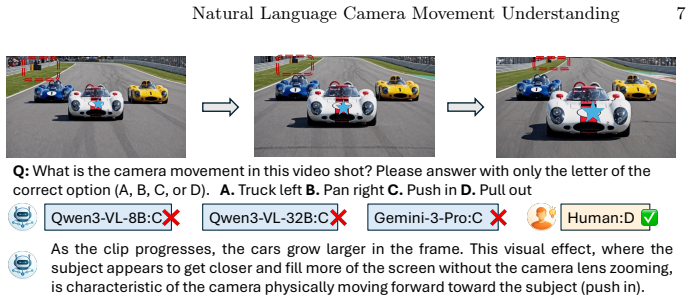
Existing VLMs systematically confuse camera translation with rotation, left with right, and object motion with camera motion; a 17-class taxonomy, atomic real-plus-synthetic benchmark, and augmented training let an 8B model beat Gemini 3.1
Reviewed by Pith at T0; open to challenge. T0 means a machine referee read the full paper against a public rubric. the ladder, T0–T4 →
T0 review · grok-4.5
2026-07-12 05:14 UTC pith:TV32J3E4
load-bearing objection Clean empirical paper that diagnoses VLM camera-motion failures, ships a usable atomic benchmark, and shows modest SFT beats Gemini-3.1-Pro by ~10 points while still trailing humans badly. the 2 major comments →
Natural Language Camera Movement Understanding
The pith
A machine-rendered reading of the paper's core claim, the machinery that carries it, and where it could break.
Core claim
Vision-language models do not yet understand camera movement in natural language; they systematically mis-map the same visual cues that humans read as dolly, pan, truck, zoom, or tracking. By grounding evaluation in a 17-class cinematographic taxonomy and an atomic real-and-synthetic benchmark, and by fine-tuning on a carefully re-balanced multi-source set, an 8B VLM can surpass the strongest proprietary baseline by 10–11% absolute accuracy while remaining far below human performance.
What carries the argument
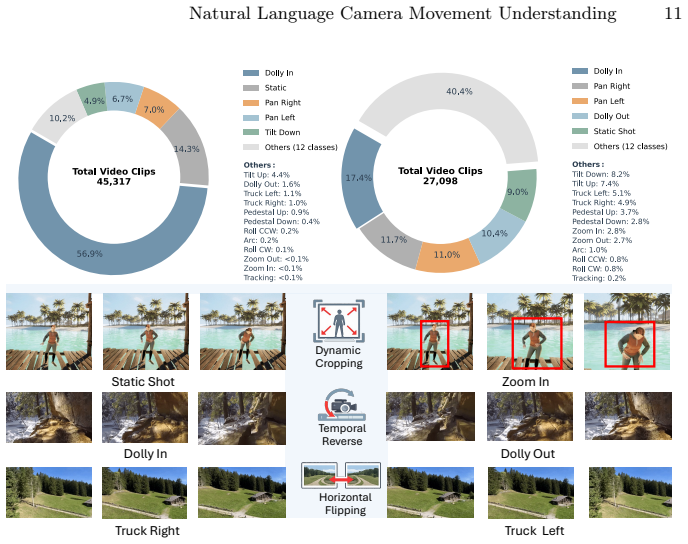
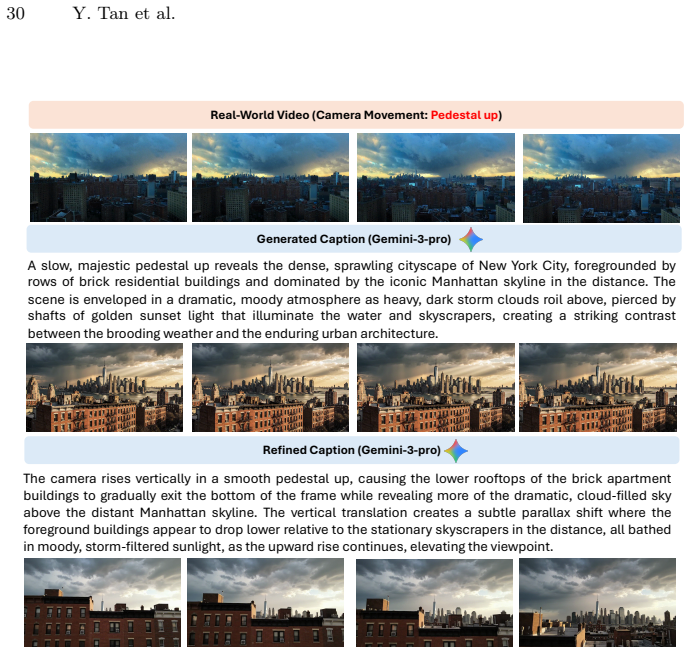
The ACaM (Atomic Camera Movement) benchmark, built on a two-level cinematographic taxonomy of 17 classes that cleanly separates translations, rotations, focal-length changes, static shots, and object-centric moves (tracking, arc). Real clips are filtered and re-verified from prior motion datasets; synthetic clips are generated via caption-then-Veo with manual reclassification and regeneration. The same taxonomy structures the 27 K instruction-tuning set whose targeted augmentations supply the supervision that produces the reported gains.
Load-bearing premise
The synthetic half of the benchmark, produced by prompting a commercial video generator and then manually accepting, reclassifying or discarding clips, is a faithful, unbiased proxy for the 17 intended atomic classes.
What would settle it
An independent multi-annotator re-label of the entire synthetic evaluation set that finds a large fraction of accepted clips still mismatched to their assigned class (especially roll direction and zoom-versus-dolly), which would invalidate both the 11% synthetic gain and the claim that ACaM cleanly isolates atomic movements.
If this is right
- Automatic filtering and captioning of large unannotated video collections for camera-aware training data becomes practical at higher reliability.
- Video-generation leaderboards can score whether models obey specific cinematographic prompts without exhaustive manual review for atomic cases.
- Object-centric and subtle-intensity movements remain the clearest remaining targets for closing the human–machine gap.
- Once atomic recognition is reliable, compound multi-move and long-form camera sequences become the natural next evaluation target.
Where Pith is reading between the lines
- Geometry-based pose estimators and language models remain complementary; feeding estimated trajectories into VLM heads may specifically reduce the translation–rotation and left–right confusions documented here.
- The same five failure modes are likely to degrade any VLM that must reason about viewpoint change, including robotics scene description and AR/VR spatial grounding.
- The paper’s motion-specific augmentations (affine rolls, temporal reverse, progressive crops) form a reusable recipe for other long-tail spatial perception tasks beyond camera motion.
Editorial analysis
A structured set of objections, weighed in public.
Referee Report
Summary. The paper establishes natural language camera-movement understanding as a standalone VLM task. It documents five failure modes of current VLMs (insensitivity to small motion, translation–rotation confusion, left–right errors, zoom vs. dolly, and object vs. camera motion), introduces a 17-class cinematographic taxonomy, and releases ACaM—an atomic MCQ benchmark with real-world clips (1,423 videos / 1,464 QA from CameraBench, ShotBench, MotionBench, FavorBench, CineTechBench, and curated YouTube) plus synthetic clips generated via Gemini-3-Pro captioning and Veo 3.1 with manual reclassification. A multi-source 27K instruction set with targeted augmentations (progressive crop, temporal reverse, horizontal flip, affine roll) is used to SFT Qwen3-VL-4B/8B. The 8B model reports relative gains of ~10% and ~11% over Gemini-3.1-Pro on real and synthetic class-average accuracy (Tables 5–6), with ablations (Table 7), binary-QA F1 (supplement), geometry and specialized-VLM controls, and a human baseline (≈93–98%, IAA 0.953). A large gap to humans remains.
Significance. If the reported numbers hold, the work supplies a clean task definition, a reusable atomic benchmark with human ceiling, and a strong open 8B baseline that already exceeds a leading proprietary model on both real and synthetic splits. That combination is directly useful for (i) automatic filtering/captioning of cinematographic video–text data and (ii) automatic verification of camera prompts in text-to-video systems—both bottlenecks the introduction correctly identifies. Strengths include multi-source training with explicit balancing augmentations, dual Overall/Avg reporting, geometry and prior specialized-VLM controls, intensity and LoRA ablations, and a documented human study. The residual human–model gap is framed as an open research problem rather than oversold.
major comments (2)
- Abstract and §1 headline the result as outperforming Gemini-3.1-Pro by “10% and 11%,” while §1 later says “relative improvements.” Tables 5–6 show absolute Overall gaps of ~4.3 / ~5.2 points and class-average (Avg) gaps of ~6.6 / ~7.9 points; the ~10% / ~11% figures match relative improvement on the Avg column only. Because this is the paper’s central quantitative claim, the abstract, intro, and table captions should state explicitly: (a) relative vs. absolute, (b) Overall vs. Avg, and (c) which column is primary. Without that, readers comparing Overall columns will understate the result, and readers taking “10%” as absolute points will overstate it.
- §3.3 and Fig. 8: synthetic evaluation clips are produced by Gemini-3-Pro prompt generation + Veo 3.1, with manual reclassification and a second generation pass. The paper correctly notes Veo biases (roll direction inversion; zoom collapsing to static/dolly) and heavy filtering. Because Gemini models are also evaluated on this split (Tables 5–6), the manuscript should add a short quantitative check that ranking and relative gains are not driven by residual Gemini-friendly artifacts—e.g., report Gemini vs. SFT accuracy restricted to the “accepted without reclassification” subset, or confirm that the real-world-only ranking already matches the joint ranking (which it appears to). The real-world half is independently curated and already supports the claim; making that independence explicit would remove residual doubt about the synthetic half.
minor comments (7)
- §2.1 / Table 2 and supplement Table 8: intensity bins (low/medium/high) for “push in” are human-labeled; a one-sentence definition of the intensity criteria (e.g., approximate FOV change or pixel shift) would aid reproducibility.
- Fig. 7 class distributions: “roll” remains underrepresented even after YouTube enrichment. A brief note on whether Avg accuracy is macro-averaged over the 17 classes (and how empty/near-empty cells are handled) would clarify the Avg column.
- §4.2 / Fig. 9: augmentation volumes (~1K zoom crop, ~2K temporal reverse, ~1.7K flip, affine roll) are stated; reporting the final per-class counts in the 27K set (or a small table) would make the balancing claim fully checkable.
- §5: geometry models (Mega-SaM, ViPE) cannot predict zoom/tracking/arc by design; the “–” cells are appropriate, but a footnote that their Overall/Avg are computed only over applicable classes would avoid unfair comparison.
- Abstract: “Gemini 3.1 Pro” vs. body “Gemini-3.1-Pro” / “Gemini-3-Pro”—normalize model naming throughout.
- Project page URL is given; if code, ACaM splits, and the 27K training list will be released, state that explicitly in the conclusion or reproducibility statement.
- Supplement Figs. 10–11 (full confusion matrices) are valuable; a one-sentence pointer in §2.2–2.3 of the main text would help readers find them.
Circularity Check
No significant circularity: empirical SFT gains and ACaM scores are measured against held-out human-verified labels, not derived from self-defined quantities or load-bearing self-citations.
full rationale
This is an empirical vision-language paper whose central claims (failure modes of existing VLMs, introduction of a 17-class cinematographic taxonomy and ACaM benchmark with real+synthetic atomic clips, construction of a multi-source 27K training set with geometric augmentations, and SFT Qwen3-VL-8B outperforming Gemini-3.1-Pro by ~10–11% overall accuracy on the held-out real and synthetic MCQ splits while remaining far below human ~93–98%) rest on direct measurement against human-verified ground-truth labels (Tables 5–6, ablation Table 7, binary F1 in supplement). Training clips are drawn from external sources (CameraBench, ShotBench, SpatialVID, MultiCamVideo, GenDoP) plus standard geometric operators (crop/resize for zoom, temporal reverse for dolly, flip for truck, affine roll); none of the reported accuracies is obtained by fitting a parameter to a subset and then “predicting” a quantity that is definitionally identical. Synthetic evaluation clips are generated via Gemini captioning + Veo 3.1 with subsequent manual reclassification/filtering, but the final labels used for scoring are human-assigned, so model rankings (including Gemini itself) are not circular with respect to the generator. The taxonomy is taken from standard cinematography literature rather than self-defined uniqueness theorems. There are no self-definitional equations, no fitted-input-called-prediction steps, no load-bearing self-citation chains, and no renaming of known results presented as first-principles derivation. The work is therefore self-contained against its external benchmarks; circularity score is zero.
Axiom & Free-Parameter Ledger
free parameters (3)
- LoRA rank =
256
- learning rate / batch size / epochs / max frames =
1e-4 / 128 / 5 / 16
- augmentation volumes (zoom crop, temporal reverse, horizontal flip, affine roll) =
~1k / 2k / 1.7k
axioms (4)
- domain assumption The 17-class two-level taxonomy (translations, rotations, zoom, static, tracking, arc) drawn from cinematography literature is an adequate and unambiguous label space for atomic camera movement.
- domain assumption Manual verification by graduate students with cinematography training, plus GPT/Gemini parsing of captions, yields sufficiently clean ground-truth labels for both training and evaluation.
- domain assumption Geometric heuristics that map estimated or synthetic camera poses to semantic movement labels are accurate enough for training data construction.
- ad hoc to paper Atomic (single-movement) clips are the correct first step toward understanding compound camera motion.
invented entities (2)
-
ACaM benchmark (Atomic Camera Movement)
no independent evidence
-
Targeted camera-movement augmentation operators (progressive crop for zoom, temporal reverse for dolly, horizontal flip for truck, continuous affine roll)
no independent evidence
read the original abstract
Understanding camera movement in natural language is critical for training and evaluating video generation models, among other applications. However, we demonstrate that existing vision-language models (VLMs) fail this task in surprising ways, frequently confusing translation with rotation, left with right, and object movement with camera movement. To address these limitations, we establish natural language camera movement understanding as a standalone research task. We introduce a two-level cinematographic taxonomy and an extensive, atomic benchmark featuring both real and synthetic videos. Furthermore, we curate a large-scale, multi-source training set enhanced by targeted camera movement augmentation. Our fine-tuned VLM-8B outperforms Gemini 3.1 Pro by 10% and 11% on our benchmark's real and synthetic videos, respectively. Despite these gains, a significant gap remains relative to human performance, underscoring the need to promote and facilitate future research on natural language camera movement understanding.
Figures








Reference graph
Works this paper leans on
-
[1]
In: Proceedings of the IEEE/CVF International Conference on Computer Vision
Bai,J., Xia, M., Fu, X.,Wang, X.,Mu, L., Cao, J.,Liu, Z., Hu, H.,Bai, X., Wan, P., et al.: Recammaster: Camera-controlled generative rendering from a single video. In: Proceedings of the IEEE/CVF International Conference on Computer Vision. pp. 14834–14844 (2025)
2025
-
[2]
arXiv preprint arXiv:2511.21631 (2025)
Bai, S., Cai, Y., Chen, R., Chen, K., Chen, X., Cheng, Z., Deng, L., Ding, W., Gao, C., Ge, C., et al.: Qwen3-vl technical report. arXiv preprint arXiv:2511.21631 (2025)
Pith/arXiv arXiv 2025
-
[3]
Bai, S., Chen, K., Liu, X., Wang, J., Ge, W., Song, S., Dang, K., Wang, P., Wang, S., Tang, J., et al.: Qwen2. 5-vl technical report. arXiv preprint arXiv:2502.13923 (2025)
Pith/arXiv arXiv 2025
-
[4]
Bordwell, D., Thompson, K., Smith, J.: Film art: An introduction, vol. 7. McGraw- Hill New York (2008) 16 Y. Tan et al
2008
-
[5]
Brooks, T., Peebles, B., Holmes, C., DePue, W., Guo, Y., Jing, L., Schnurr, D., Taylor, J., Luhman, T., Luhman, E., Ng, C., Wang, R., Ramesh, A.: Video gener- ation models as world simulators (2024),https://openai.com/research/video- generation-models-as-world-simulators, last accessed 2026/06/29
2024
-
[6]
Routledge (2016)
Brown, B.: Cinematography: theory and practice: image making for cinematogra- phers and directors. Routledge (2016)
2016
-
[7]
arXiv preprint arXiv:2506.01674 (2025)
Du, Y., Fan, T., Nan, K., Xie, R., Zhou, P., Li, X., Yang, J., Yang, Z., Tai, Y.: Mo- tionsight: Boosting fine-grained motion understanding in multimodal llms. arXiv preprint arXiv:2506.01674 (2025)
arXiv 2025
-
[8]
arXiv preprint arXiv:2505.20279 (2025)
Fan, Z., Zhang, J., Li, R., Zhang, J., Chen, R., Hu, H., Wang, K., Qu, H., Wang, D., Yan, Z., et al.: Vlm-3r: Vision-language models augmented with instruction-aligned 3d reconstruction. arXiv preprint arXiv:2505.20279 (2025)
Pith/arXiv arXiv 2025
-
[9]
google / models / veo/(2024), last accessed 2026/06/29
Google: Veo.https : / / deepmind . google / models / veo/(2024), last accessed 2026/06/29
2024
-
[10]
In: Proceedings of the Computer Vision and Pattern Recognition Conference
Hong, W., Cheng, Y., Yang, Z., Wang, W., Wang, L., Gu, X., Huang, S., Dong, Y., Tang, J.: Motionbench: Benchmarking and improving fine-grained video motion understanding for vision language models. In: Proceedings of the Computer Vision and Pattern Recognition Conference. pp. 8450–8460 (2025)
2025
-
[11]
arXiv preprint arXiv:2511.21688 (2025)
Hu, W., Lin, J., Long, Y., Ran, Y., Jiang, L., Wang, Y., Zhu, C., Xu, R., Wang, T., Pang, J.: G2 vlm: Geometry grounded vision language model with unified 3d reconstruction and spatial reasoning. arXiv preprint arXiv:2511.21688 (2025)
arXiv 2025
-
[12]
arXiv preprint arXiv:2508.10934 (2025)
Huang, J., Zhou, Q., Rabeti, H., Korovko, A., Ling, H., Ren, X., Shen, T., Gao, J., Slepichev,D.,Lin,C.H.,etal.:Vipe:Videoposeenginefor3dgeometricperception. arXiv preprint arXiv:2508.10934 (2025)
Pith/arXiv arXiv 2025
-
[13]
In: European conference on computer vision
Huang, Q., Xiong, Y., Rao, A., Wang, J., Lin, D.: Movienet: A holistic dataset for movie understanding. In: European conference on computer vision. pp. 709–727. Springer (2020)
2020
-
[14]
In: Proceedings of the 33rd ACM International Conference on Multimedia
Jia, Z., Zhang, Z., Qian, J., Wu, H., Sun, W., Li, C., Liu, X., Lin, W., Zhai, G., Min, X.: Vqa2: visual question answering for video quality assessment. In: Proceedings of the 33rd ACM International Conference on Multimedia. pp. 6751–6760 (2025)
2025
-
[15]
Columbia University Press (2019)
Keating, P.: The dynamic frame: camera movement in classical hollywood. Columbia University Press (2019)
2019
-
[16]
arXiv preprint arXiv:2412.03603 (2024)
Kong, W., Tian, Q., Zhang, Z., Min, R., Dai, Z., Zhou, J., Xiong, J., Li, X., Wu, B., Zhang, J., et al.: Hunyuanvideo: A systematic framework for large video generative models. arXiv preprint arXiv:2412.03603 (2024)
Pith/arXiv arXiv 2024
-
[17]
Kuaishou: Kling.https://kling.ai/(2024), last accessed 2026/06/29
2024
-
[18]
Li, B., Zhang, Y., Guo, D., Zhang, R., Li, F., Zhang, H., Zhang, K., Zhang, P., Li, Y.,Liu,Z.,Li,C.:LLaVA-onevision:Easyvisualtasktransfer.TransactionsonMa- chine Learning Research (2025),https://openreview.net/forum?id=zKv8qULV6n
2025
-
[19]
arXiv preprint arXiv:2412.12223 (2024)
Li, X., Wu, K., Yang, S., Qu, Y., Zhang, G., Chen, Z., Li, J., Mu, J., Hu, X., Fang, W., et al.: Can video generation replace cinematographers? research on the cinematic language of generated video. arXiv preprint arXiv:2412.12223 (2024)
Pith/arXiv arXiv 2024
-
[20]
In: Proceedings of the Computer Vision and Pattern Recognition Conference
Li, Z., Tucker, R., Cole, F., Wang, Q., Jin, L., Ye, V., Kanazawa, A., Holynski, A., Snavely, N.: Megasam: Accurate, fast and robust structure and motion from casual dynamic videos. In: Proceedings of the Computer Vision and Pattern Recognition Conference. pp. 10486–10496 (2025)
2025
-
[21]
arXiv preprint arXiv:2504.15376 (2025) Natural Language Camera Movement Understanding 17
Lin, Z., Cen, S., Jiang, D., Karhade, J., Wang, H., Mitra, C., Ling, T., Huang, Y., Liu, S., Chen, M., et al.: Towards understanding camera motions in any video. arXiv preprint arXiv:2504.15376 (2025) Natural Language Camera Movement Understanding 17
Pith/arXiv arXiv 2025
-
[22]
arXiv preprint arXiv:2506.21356 (2025)
Liu, H., He, J., Jin, Y., Zheng, D., Dong, Y., Zhang, F., Huang, Z., He, Y., Li, Y., Chen, W., et al.: Shotbench: Expert-level cinematic understanding in vision- language models. arXiv preprint arXiv:2506.21356 (2025)
arXiv 2025
-
[23]
MiniMax: Hailuo.https://hailuoai.video/(2024), last accessed 2026/06/29
2024
-
[24]
arXiv preprint arXiv:2503.02341 (2025)
Mou, Z., Xia, B., Huang, Z., Yang, W., Jia, J.: Gradeo: Towards human-like evaluation for text-to-video generation via multi-step reasoning. arXiv preprint arXiv:2503.02341 (2025)
arXiv 2025
-
[25]
Department of Inf
Nielsen, J.I., Kau, E., Raskin, R.: Camera movement in narrative cinema: towards a taxonomy of functions. Department of Inf. & Media Studies, University of Aarhus (2007)
2007
-
[26]
arXiv preprint arXiv:2410.21276 (2024)
OpenAI: Gpt-4o system card. arXiv preprint arXiv:2410.21276 (2024)
Pith/arXiv arXiv 2024
-
[27]
In: European Conference on Computer Vision
Pan, L., Baráth, D., Pollefeys, M., Schönberger, J.L.: Global structure-from-motion revisited. In: European Conference on Computer Vision. pp. 58–77. Springer (2024)
2024
-
[28]
In: European Conference on Computer Vision
Rao, A., Wang, J., Xu, L., Jiang, X., Huang, Q., Zhou, B., Lin, D.: A unified framework for shot type classification based on subject centric lens. In: European Conference on Computer Vision. pp. 17–34. Springer (2020)
2020
-
[29]
Data in Brief51, 109627 (2023)
Savardi, M., Kovács, A.B., Signoroni, A., Benini, S.: Cinescale2: a dataset of cine- matic camera features in movies. Data in Brief51, 109627 (2023)
2023
-
[30]
In: Proceedings of the IEEE conference on computer vision and pattern recognition
Schonberger, J.L., Frahm, J.M.: Structure-from-motion revisited. In: Proceedings of the IEEE conference on computer vision and pattern recognition. pp. 4104–4113 (2016)
2016
-
[31]
arXiv preprint arXiv:2601.03267 (2025)
Singh, A., Fry, A., Perelman, A., Tart, A., Ganesh, A., El-Kishky, A., McLaughlin, A., Low, A., Ostrow, A., Ananthram, A., et al.: Openai gpt-5 system card. arXiv preprint arXiv:2601.03267 (2025)
Pith/arXiv arXiv 2025
-
[32]
Univ of California Press (1969)
Spottiswoode, R.: A grammar of the film: An analysis of film technique. Univ of California Press (1969)
1969
-
[33]
In: Proceed- ings of the Computer Vision and Pattern Recognition Conference
Sun, K., Huang, K., Liu, X., Wu, Y., Xu, Z., Li, Z., Liu, X.: T2v-compbench: A comprehensive benchmark for compositional text-to-video generation. In: Proceed- ings of the Computer Vision and Pattern Recognition Conference. pp. 8406–8416 (2025)
2025
-
[34]
Tang, Y., Guo, J., Hua, H., Liang, S., Feng, M., Li, X., Mao, R., Huang, C., Bi, J., Zhang, Z., et al.: Vidcomposition: Can mllms analyze compositions in compiled videos? In: Proceedings of the IEEE/CVF Conference on Computer Vision and Pattern Recognition. pp. 8490–8500 (2025)
2025
-
[35]
arXiv preprint arXiv:2312.11805 (2023)
Team, G., Anil, R., Borgeaud, S., Alayrac, J.B., Yu, J., Soricut, R., Schalkwyk, J., Dai, A.M., Hauth, A., Millican, K., et al.: Gemini: a family of highly capable multimodal models. arXiv preprint arXiv:2312.11805 (2023)
Pith/arXiv arXiv 2023
-
[36]
arXiv preprint arXiv:2503.14935 (2025)
Tu, C., Zhang, L., Chen, P., Ye, P., Zeng, X., Cheng, W., Yu, G., Chen, T.: Favor- bench: A comprehensive benchmark for fine-grained video motion understanding. arXiv preprint arXiv:2503.14935 (2025)
Pith/arXiv arXiv 2025
-
[37]
arXiv preprint arXiv:2503.20314 (2025)
Wan, T., Wang, A., Ai, B., Wen, B., Mao, C., Xie, C.W., Chen, D., Yu, F., Zhao, H., Yang, J., et al.: Wan: Open and advanced large-scale video generative models. arXiv preprint arXiv:2503.20314 (2025)
Pith/arXiv arXiv 2025
-
[38]
arXiv preprint arXiv:2509.09676 (2025)
Wang, J., Yuan, Y., Zheng, R., Lin, Y., Gao, J., Chen, L.Z., Bao, Y., Zhang, Y., Zeng, C., Zhou, Y., et al.: Spatialvid: A large-scale video dataset with spatial annotations. arXiv preprint arXiv:2509.09676 (2025)
arXiv 2025
-
[39]
In: Proceedings of the Computer Vision and Pattern Recognition Conference
Wang, J., Chen, M., Karaev, N., Vedaldi, A., Rupprecht, C., Novotny, D.: Vggt: Visual geometry grounded transformer. In: Proceedings of the Computer Vision and Pattern Recognition Conference. pp. 5294–5306 (2025) 18 Y. Tan et al
2025
-
[40]
arXiv preprint arXiv:2505.12098 (2025)
Wang, J., Duan, H., Jia, Z., Zhao, Y., Yang, W.Y., Zhang, Z., Chen, Z., Wang, J., Xing, Y., Zhai, G., et al.: Love: Benchmarking and evaluating text-to-video gener- ation and video-to-text interpretation. arXiv preprint arXiv:2505.12098 (2025)
Pith/arXiv arXiv 2025
-
[41]
In: Proceedings of the Computer Vision and Pattern Recognition Conference
Wang, Q., Zhang, Y., Holynski, A., Efros, A.A., Kanazawa, A.: Continuous 3d perception model with persistent state. In: Proceedings of the Computer Vision and Pattern Recognition Conference. pp. 10510–10522 (2025)
2025
-
[42]
5: Advancing open-source multimodal models in versatility, reasoning, and efficiency
Wang, W., Gao, Z., Gu, L., Pu, H., Cui, L., Wei, X., Liu, Z., Jing, L., Ye, S., Shao, J., et al.: Internvl3. 5: Advancing open-source multimodal models in versatility, reasoning, and efficiency. arXiv preprint arXiv:2508.18265 (2025)
Pith/arXiv arXiv 2025
-
[43]
arXiv preprint arXiv:2505.15145 (2025)
Wang, X., Xu, S., Shan, X., Zhang, Y., Diao, M., Duan, X., Huang, Y., Liang, K., Ma, Z.: Cinetechbench: A benchmark for cinematographic technique understanding and generation. arXiv preprint arXiv:2505.15145 (2025)
Pith/arXiv arXiv 2025
-
[44]
5: Empowering video mllms with long and rich context modeling
Wang, Y., Li, X., Yan, Z., He, Y., Yu, J., Zeng, X., Wang, C., Ma, C., Huang, H., Gao, J., et al.: Internvideo2. 5: Empowering video mllms with long and rich context modeling. arXiv preprint arXiv:2501.12386 (2025)
Pith/arXiv arXiv 2025
-
[45]
arXiv preprint arXiv:2505.23747 (2025)
Wu, D., Liu, F., Hung, Y.H., Duan, Y.: Spatial-mllm: Boosting mllm capabilities in visual-based spatial intelligence. arXiv preprint arXiv:2505.23747 (2025)
Pith/arXiv arXiv 2025
-
[46]
arXiv preprint arXiv:2510.02423 (2025)
Wu, H., Cai, Y., Ge, H., Chen, H., Yang, M.H., Wang, Y.: Refineshot: Rethinking cinematography understanding with foundational skill evaluation. arXiv preprint arXiv:2510.02423 (2025)
arXiv 2025
-
[47]
arXiv preprint arXiv:2602.00181 (2026)
Wu, H., Cai, Y., Li, Z., Ge, H., Sun, B., Yuan, J., Wang, Y.: Camreasoner: Re- inforcing camera movement understanding via structured spatial reasoning. arXiv preprint arXiv:2602.00181 (2026)
Pith/arXiv arXiv 2026
-
[48]
arXiv preprint arXiv:2408.06072 (2024)
Yang, Z., Teng, J., Zheng, W., Ding, M., Huang, S., Xu, J., Yang, Y., Hong, W., Zhang, X., Feng, G., et al.: Cogvideox: Text-to-video diffusion models with an expert transformer. arXiv preprint arXiv:2408.06072 (2024)
Pith/arXiv arXiv 2024
-
[49]
In: Proceedings of the IEEE/CVF International Conference on Computer Vision
Zhang,M.,Wu,T.,Tan,J.,Liu,Z.,Wetzstein,G.,Lin,D.:Gendop:Auto-regressive camera trajectory generation as a director of photography. In: Proceedings of the IEEE/CVF International Conference on Computer Vision. pp. 18229–18239 (2025)
2025
-
[50]
Zhu, J., Wang, W., Chen, Z., Liu, Z., Ye, S., Gu, L., Tian, H., Duan, Y., Su, W., Shao, J., et al.: Internvl3: Exploring advanced training and test-time recipes for open-source multimodal models. arXiv preprint arXiv:2504.10479 (2025) Natural Language Camera Movement Understanding 19 T able 8:VLM accuracy on ‘push in’vs.three levels of camera movement int...
Pith/arXiv arXiv 2025
-
[51]
Slowly dolly in,
[Cinematography]: Start with the provided camera motion. You MUST observe the video to describe the speed and rhythm of the movement (e.g., "Slowly dolly in," "A fast sweeping pan to the left," "A gradual tracking shot")
-
[52]
[Subject]: Identify and describe the main focal point
-
[53]
[Action]: Detail the specific movements or behaviors of the subject
-
[54]
[Context]: Describe the environment, background, and spatial setting
-
[55]
Subject:
[Style & Ambiance]: Define the lighting, aesthetic style, and mood. Constraints: - OUTPUT MUST BE A SINGLE CONTINUOUS SENTENCE OR PARA- GRAPH. - DO NOT use labels like "Subject:". Output one continuous, cinematic paragraph. - The camera motion MUST be the very first part of the sentence. - Be descriptive but concise; provide enough detail for generation w...
-
[56]
Pan left,
A camera motion type (e.g., "Pan left," "Dolly in")
-
[57]
following
A prompt that may have physics errors OUTPUT: A corrected prompt that follows motion physics rules EXACTLY. CRITICAL MOTION PHYSICS RULES: PAN/TILT (Rotation from fixed position): - Camera DOES NOT MOVE through space - Camera ROTATES HORIZONTALLY on a fixed point - Background SWEEPS across frame - Pan left -> scene enters from LEFT, exits RIGHT - Pan righ...
-
[58]
Identify the specified camera motion type
-
[59]
Check if opening syntax matches EXACTLY -> if not, replace with correct opening
-
[60]
Scan the middle content for physics violations
-
[61]
Preserve ALL specific visual content: objects, colors, lighting, subjects, actions
-
[62]
Check if ending syntax matches EXACTLY -> if not, replace with correct ending
-
[63]
"" Fig. 15:System prompt used to prompt Gemini-3-Pro to refine the generated captions for improved clarity. 28 Y. Tan et al
Ensure 60-80 words total CONSTRAINTS: - Output ONLY the corrected prompt, no preamble - One paragraph, 60-80 words - Use exact opening and ending syntax for the motion type - Preserve all visual details from the original prompt - Fix ONLY physics violations """ Fig. 15:System prompt used to prompt Gemini-3-Pro to refine the generated captions for improved...
-
[64]
Zoom", "Arc
A camera motion type ("Zoom", "Arc", or "Roll")
-
[65]
The camera zooms in optically without moving through space,
The number of unique prompts to generate Each prompt must be 60-80 words and: - Start with the exact motion syntax - Describe how the camera motion affects what appears in the frame - End with the exact motion reinforcement - Depict a UNIQUE scene REQUIRED MOTION SYNTAX: Opening: - Zoom in: "The camera zooms in optically without moving through space," - Z...
-
[66]
ALWAYS start with exact opening syntax
-
[67]
Describe how the motion affects the frame
-
[68]
Use motion-specific vocabulary
-
[69]
Subjects are passive scene elements
-
[70]
ALWAYS end with exact ending syntax
-
[71]
Never mix motion types
-
[72]
subject":
Generate UNIQUE scenes OUTPUT FORMAT: Return ONLY the prompts in this exact JSON format: [ "subject": "brief scene descriptor", "prompt": "full generated prompt" ] Do NOT include any additional text or formatting. """ Fig. 16:System prompt used to prompt Gemini-3-Pro to generate additional prompts for underrepresented camera movements based solely on the ...
discussion (0)
Sign in with ORCID, Apple, or X to comment. Anyone can read and Pith papers without signing in.