REVIEW 4 major objections 43 references
Data-Driven Discovery of Multiscale Power System Oscillation Governing Equations Using SINDy-SENDAI
T0 review · 4 major / 0 minor · reviewed 2026-07-12 · grok-4.5
Pith's one-line read A hierarchical deep model separates power-grid sensor frequencies and recovers explicit equations for the dominant electromechanical oscillations, beating Hankel-DMD on both synthetic and real European data.
desk verdict Solid engineering of SINDy inside SENDAI for PMU streams that beats Hankel-DMD on reconstruction and modal recovery; the multi-minute autonomous forecast claim is overstated by the paper’s own figures. read the letter →
The pith
A machine-rendered reading of the paper's core claim, the machinery that carries it, and where it could break.
The reading
What carries the argument
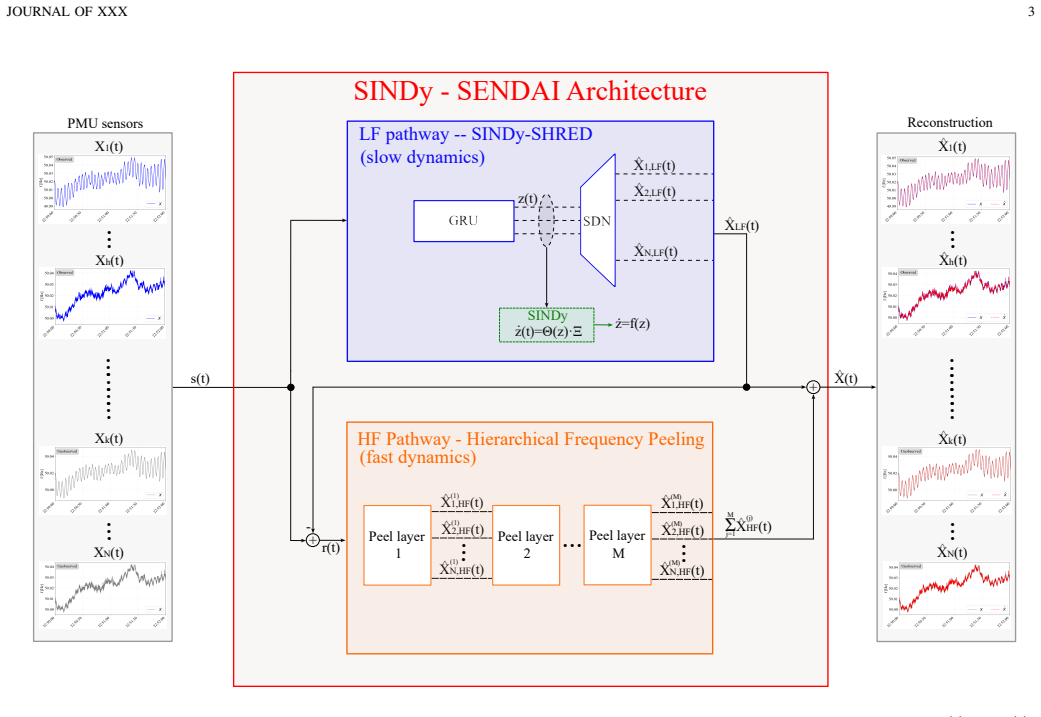
SINDy-SENDAI: a hierarchical architecture whose low-frequency pathway (GRU encoder + shallow decoder + SINDy regularization) isolates a sparse latent ODE while successive high-frequency peel layers correct residuals under a temporal-frequency sparsity penalty.
What would settle it
On a fresh multi-hour PMU archive that includes a known change of operating point or a forced oscillation, retrain once and then compare autonomous multi-minute forecasts against measured frequencies; systematic growth of error or loss of the known inter-area mode would falsify the claim that the latent ODE remains predictive without re-initialization.
Extended reading notes
Core claim
SINDy-SENDAI consistently outperforms Hankel-DMD at recovering electromechanical modal frequency and damping, and the four-dimensional linear ODE identified in its low-frequency latent space is already rich enough to reconstruct full-state PMU trajectories and to produce usable one-minute forecasts on both simulated and real European events.
Load-bearing premise
That a single four-dimensional linear ODE fitted to one short training window continues to describe the grid's dominant modes for multi-minute autonomous forecasts even when operating conditions slowly change.
Editorial analysis
A structured set of objections, weighed in public.
Referee Report
Summary. The manuscript proposes SINDy-SENDAI, a hierarchical multiscale architecture that combines SENDAI-style low/high-frequency residual peeling with a SINDy-regularized latent dynamical model (primarily linear) on the low-frequency pathway. The LF pathway (GRU encoder + shallow decoder + SINDy) is intended to isolate electromechanical oscillations, recover parsimonious latent ODEs, and support modal analysis, mode-shape reconstruction, and short-horizon autonomous forecasting; sequential HF peel layers refine residual high-frequency content. Validation is performed on the two-area Kundur system against classical modal analysis, and on two European PMU datasets (2016 Iberian inter-area event; 2021 southern Italian ambient operation), with Hankel-DMD as the main industrial baseline. The authors report improved modal-parameter accuracy on Kundur, competitive frequency estimates and interpretable mode shapes on real events, and improved reconstruction when HF peels are included.
Significance. If the claims hold under realistic TSO operating conditions, the work would be a meaningful step beyond black-box ML and purely signal-processing modal estimators: it couples multiscale reconstruction from sparse PMUs with explicit latent ODEs that operators can eigendecompose for frequency, damping, and mode shapes. Strengths include a clear Kundur comparison against modal analysis with quantitative relative errors (Table I), real-event reconstructions and mode shapes consistent with known European geography, open code, and an explicit limitations section on forced oscillations and hyperparameter tuning. The combination of hierarchical spectral peeling with latent SINDy is a concrete, deployable-oriented contribution for WAMS oscillation monitoring, provided the forecasting and robustness claims are scoped to the evidence.
major comments (4)
- Abstract and §II.A.3 / §III.B–C (Figs. 6, 11; Eqs. 3, 13, 18–19): The central claim that the learned latent dynamics are “sufficiently informative to accurately … predict the behavior of the full system” is not supported at the multi-minute horizon suggested for practical use. Only the LF pathway is integrated open-loop; HF peels cannot be forecasted; the mean-frequency component is omitted by design; and the paper’s own forecasts diverge after roughly 30 s, with the authors stating that re-initialization or full retraining is required when conditions drift. Please either (i) restrict the abstract/conclusions to short-horizon LF forecasting with a quantified valid horizon and error growth metrics, or (ii) add experiments that demonstrate stable multi-minute prediction under re-initialization/online update protocols that a control room could actually run.
- §III opening configuration paragraph and the deployment claim of “stable performance under diverse operating conditions” (Abstract, §I, §V): All free parameters (d_z=4, M=10 peels, lag L=40 s, λ_SINDy, sparsity thresholds, λ_sp/λ_mag/β, linear library only) are fixed by “engineering judgment,” with no sensitivity study, ablation on d_z/M/L, or cross-event transfer of the same hyperparameters. Because robustness is listed as a design requirement for TSO deployment, at least a limited sensitivity or leave-one-event-out check is load-bearing; otherwise the claim should be narrowed to the three reported operating regimes.
- Tables II–III and the “consistently outperforms Hankel-DMD” claim (Abstract, §I.B, §III): On Kundur (Table I) the comparison is fair and favorable. On the real events there is no ground-truth damping, and the Iberian damping estimates differ substantially (hDMD −0.528% vs SINDy-SENDAI −1.920%) while frequencies agree. Reconstruction RMSE gains (Figs. 5, 10) do not by themselves establish superior modal identification. Please separate reconstruction metrics from modal-parameter claims, state clearly what “outperforms” means on real data, and, if possible, add an independent check (e.g., Prony/ESPRIT on the same windows, or consistency across sliding windows) for damping.
- §II.A.1 and Eqs. (14), (18), (19): The latent SINDy model is constrained a priori to be linear and four-dimensional, then used for classical eigendecomposition. The manuscript does not show that a nonlinear library is unnecessary, nor that d_z=4 is minimal/sufficient across events (ambient Italian data may involve weaker excitation and different modal content). A brief comparison—linear vs sparse nonlinear library, or d_z∈{2,4,6}—would substantiate that the recovered modes are not an artifact of the linear 4-D ansatz.
Circularity Check
Minor self-citations supply architectural building blocks (SENDAI/SHRED/SINDy-SHRED) from overlapping authors, but the load-bearing empirical claims rest on independent external benchmarks (classical modal analysis and Hankel-DMD) and are not forced by construction.
-
self citation load bearing
[§I (Bibliography Review) and §II (SINDy-SENDAI Algorithm), citations [9], [33], [34], [36]]
"The Sparse-measurement, EfficieNt Data AssImilation (SENDAI) model [9] is specifically designed to address the robust, multiscale reconstruction problem. ... The LF backbone of SENDAI builds upon the SHallow REcurrent Decoder (SHRED) architecture [33], [34] ... we augment the LF pathway by embedding a SINDy module [10], [36] directly within the latent space."
SENDAI, SHRED and SINDy-SHRED are prior works whose author lists overlap with the present paper (Kutz, Gao, Pomarico). They supply the hierarchical peeling and latent-SINDy machinery that the method is built upon. The circularity is only mild: these citations justify the architectural choice, not the numerical performance claims, which are independently checked against classical modal analysis and Hankel-DMD.
full rationale
The paper's derivation chain is a standard data-driven pipeline: sparse PMU windows are encoded by a GRU into a 4-D latent trajectory, a linear SINDy model is identified post-hoc by sequential thresholding on that trajectory (Eqs. 3, 6–8, 14, 18, 19), the LF decoder reconstructs the full state, and HF peel layers correct residuals. Modal frequencies/damping are then read off by eigendecomposition of the discovered A matrix and compared to classical modal analysis (Kundur ground truth, Table I) and to Hankel-DMD run in the original measurement space (Tables II–III). Reconstruction RMSE and open-loop forecasts are likewise evaluated on held-out real PMU windows. None of these numerical claims reduce by definition or by fit to their own inputs; the latent ODEs are discovered from data rather than imposed, and the architecture citations ([9], [33], [34], [36]) merely supply reusable components. The only mild circularity is ordinary co-author self-citation of those components; it is not load-bearing for the strongest claim of outperforming hDMD or matching MA. Forecasting drift (Figs. 6, 11) is an honesty issue, not a circularity issue. Score 2 reflects the presence of those self-citations without elevating them to a forced result.
Assumptions & free parameters
free parameters (5)
- latent dimension d_z =
4
- number of HF peel layers M =
10
- lag length L =
40 s
- SINDy regularization weight λ_SINDy and sparsity threshold
- HF sparsity and magnitude weights λ_sp, λ_mag, β
assumptions (3)
- standard math Takens’ embedding theorem guarantees that a sufficiently long lag of a few sensors reconstructs the attractor of the full state.
- domain assumption Dominant electromechanical modes lie in a low-dimensional linear subspace that can be recovered by sparse regression on latent trajectories.
- ad hoc to paper Hierarchical residual peeling cleanly separates spectral bands without destructive mode interference.
invented entities (1)
-
SINDy-SENDAI architecture
Cite this review
Pith. "Pith review of Data-Driven Discovery of Multiscale Power System Oscillation Governing Equations Using SINDy-SENDAI." pith.science (2026). https://pith.science/paper/75LCT7DA
@misc{pith2026260703485,
  author       = {Pith},
  title        = {Pith review of: Data-Driven Discovery of Multiscale Power System Oscillation Governing Equations Using SINDy-SENDAI},
  year         = {2026},
  howpublished = {\url{https://pith.science/paper/75LCT7DA}},
  note         = {Machine review of arXiv:2607.03485}
}
read the original abstract
Monitoring electromechanical oscillations is crucial for maintaining the stability of modern power systems, particularly in the presence of increasing penetrations of inverter-based resources (IBRs), which introduce new dynamic behaviors. In this work, we propose a hierarchical multiscale framework based on the SINDy-SENDAI algorithm to characterize the transient dynamics captured by wide-area measurements. The proposed deep learning architecture robustly separates low- and high-frequency components embedded in sensor data and incorporates a Sparse Identification of Nonlinear Dynamical Systems (SINDy) module in the latent space to identify parsimonious governing equations. In contrast to conventional deep learning approaches that often produce black-box models with limited interpretability, the proposed framework learns an explicit dynamical representation, enabling physical interpretation, stability assessment, and forecasting of electromechanical oscillations. Given the societal importance of modern power systems, the proposed approach is specifically designed to satisfy key requirements for practical deployment, namely robustness, interpretability, and stable performance under diverse operating conditions. The framework is first validated on the two-area Kundur test system using conventional modal analysis as ground truth and subsequently demonstrated on two real-world datasets: the 2016 Iberian oscillatory event and the 2021 ambient measurements from the southern Italian power grid. The results show that SINDy-SENDAI consistently outperforms the state-of-the-art Hankel-DMD method and that the learned latent dynamics are sufficiently informative to accurately reconstruct and predict the behavior of the full system in the original state space.
Figures


Figures from the paper (7 more)


Reference graph
Works this paper leans on
-
[1]
The renewable energy role in the global energy transformations,
Q. Hassanet al., “The renewable energy role in the global energy transformations,”Renewable Energy Focus, vol. 48, p. 100545, 2024
2024
-
[2]
Eremia and M
M. Eremia and M. Shahidehpour, Eds.,Handbook of Electrical Power System Dynamics: Modeling, Stability, and Control. Wiley, 2013
2013
-
[3]
Final report on the grid incident in spain and portugal on 28 april 2025,
ENTSO-E, “Final report on the grid incident in spain and portugal on 28 april 2025,” European Network of Transmission System Operators for Electricity (ENTSO-E), Tech. Rep., Nov. 2025
2025
-
[4]
J. N. Kutz,Data-driven modeling & scientific computation: methods for complex systems & big data. Oxford University Press, 2026
2026
-
[5]
Definition and classification of power system stability–revisited & extended,
N. Hatziargyriouet al., “Definition and classification of power system stability–revisited & extended,”IEEE Transactions on Power Systems, vol. 36, no. 4, pp. 3271–3281, 2020
2020
-
[6]
Kundur,Power System Stability and Control
P. Kundur,Power System Stability and Control. New York: CRC Press, 2007, vol. 10
2007
-
[7]
Countdown to Collapse: Stability Dynamics Ob- served Before the 2025 Iberian Power System Blackout,
A. Pomaricoet al., “Countdown to Collapse: Stability Dynamics Ob- served Before the 2025 Iberian Power System Blackout,” in2025 AEIT International Annual Conference (AEIT), 2025, pp. 1–6. JOURNAL OF XXX 10 /uni00000015/uni00000015/uni0000001d/uni00000018/uni00000013/uni0000001d/uni00000016/uni00000013/uni00000015/uni00000015/uni0000001d/uni00000018/uni000...
2025
-
[8]
Marconato,Electric Power Systems - Vol
R. Marconato,Electric Power Systems - Vol. 2. CEI, 2008
2008
Show all 43 references
-
[9]
Sendai: A hierarchical sparse-measurement, efficient data assimilation framework,
X. Zhanget al., “Sendai: A hierarchical sparse-measurement, efficient data assimilation framework,”arXiv preprint arXiv:2601.21664, 2026
2026
-
[10]
Discovering governing equations from data by sparse identification of nonlinear dynamical systems,
S. L. Brunton, J. L. Proctor, and J. N. Kutz, “Discovering governing equations from data by sparse identification of nonlinear dynamical systems,”Proceedings of the national academy of sciences, vol. 113, no. 15, pp. 3932–3937, 2016
2016
-
[11]
Parsimony as the ultimate regularizer for physics-informed machine learning,
J. N. Kutz and S. L. Brunton, “Parsimony as the ultimate regularizer for physics-informed machine learning,”Nonlinear Dynamics, vol. 107, no. 3, pp. 1801–1817, 2022
2022
-
[12]
Estimation of inter-area modes during ambient operation using the Eigen-system realization algorithm,
H. Zhang, P. Zhang, and X. Wang, “Estimation of inter-area modes during ambient operation using the Eigen-system realization algorithm,” in2014 International Conference on Power System Technology, 2014, pp. 569–574
2014
-
[13]
New signal subspace approach to estimate the inter-area oscillatory modes in power system using TLS-ESPRIT algorithm,
S. K. Samal and B. Subudhi, “New signal subspace approach to estimate the inter-area oscillatory modes in power system using TLS-ESPRIT algorithm,”IET Generation, Transmission & Distribution, vol. 13, no. 18, pp. 4123–4140, 2019
2019
-
[14]
An adaptive tls-esprit algorithm based on an s-g filter for analysis of low frequency oscillation in wide area measurement systems,
J. Chenet al., “An adaptive tls-esprit algorithm based on an s-g filter for analysis of low frequency oscillation in wide area measurement systems,”IEEE Access, vol. 7, pp. 47 644–47 654, 2019
2019
-
[15]
Real-time tracking of electromechanical oscilla- tions in ENTSO-e continental european synchronous area,
G. Giannuzziet al., “Real-time tracking of electromechanical oscilla- tions in ENTSO-e continental european synchronous area,”International Journal of Electrical Power & Energy Systems, vol. 64, pp. 1147–1158, 2015
2015
-
[16]
Use of ARMA block processing for estimating stationary low-frequency electromechanical modes of power systems,
R. Wies, J. Pierre, and D. Trudnowski, “Use of ARMA block processing for estimating stationary low-frequency electromechanical modes of power systems,” in2003 IEEE Power Engineering Society General Meeting (IEEE Cat. No.03CH37491), vol. 4, 2003, pp. 2096–2096
2003
-
[17]
J. N. Kutz, S. L. Brunton, B. W. Brunton, and J. L. Proctor,Dynamic mode decomposition: data-driven modeling of complex systems. SIAM, 2016
2016
-
[18]
A dynamic mode decomposition framework for global power system oscillation analysis,
E. Barocioet al., “A dynamic mode decomposition framework for global power system oscillation analysis,”IEEE Transactions on Power Systems, vol. 30, no. 6, pp. 2902–2912, 2014
2014
-
[19]
Practical implementation and operational experience of dynamic mode decomposition in wide-area monitoring systems of italian power system,
A. Vicarioet al., “Practical implementation and operational experience of dynamic mode decomposition in wide-area monitoring systems of italian power system,”Journal of Modern Power Systems and Clean Energy, vol. 11, no. 3, pp. 793–802, 2022
2022
-
[20]
A review of machine learning approaches to power system security and stability,
O. A. Alimi, K. Ouahada, and A. M. Abu-Mahfouz, “A review of machine learning approaches to power system security and stability,” IEEE access, vol. 8, pp. 113 512–113 531, 2020
2020
-
[21]
A unified online deep learning prediction model for small signal and transient stability,
S. K. a. Azman, “A unified online deep learning prediction model for small signal and transient stability,”IEEE transactions on power systems, vol. 35, no. 6, pp. 4585–4598, 2020
2020
-
[22]
Identification of oscillatory modes in power system using deep learning approach,
R. Satheesh, N. Chakkungal, S. Rajan, M. Madhavan, and H. H. Alhelou, “Identification of oscillatory modes in power system using deep learning approach,”Ieee Access, vol. 10, pp. 16 556–16 565, 2022
2022
-
[23]
Deep learning-based models for predicting poorly damped low-frequency modes of oscillations,
A. O. Muhammed, Y . J. Isbeih, M. S. El Moursi, and K. H. Al Hosani, “Deep learning-based models for predicting poorly damped low-frequency modes of oscillations,”IEEE Transactions on Power Systems, vol. 39, no. 2, pp. 3257–3270, 2023
2023
-
[24]
A data-driven method for fast and accurate identifica- tion of the wideband oscillations in renewable power systems,
L. Gaoet al., “A data-driven method for fast and accurate identifica- tion of the wideband oscillations in renewable power systems,”IEEE Transactions on Power Systems, 2025
2025
-
[25]
A machine learning-based framework for fast prediction of wide-area remedial control actions in interconnected power systems,
S. Naderiet al., “A machine learning-based framework for fast prediction of wide-area remedial control actions in interconnected power systems,” IEEE Transactions on Power Systems, vol. 38, no. 1, pp. 242–255, 2022
2022
-
[26]
An online data-driven method to locate forced oscillation sources from power plants based on sparse identification of nonlinear dynamics (SINDy),
Y . Caiet al., “An online data-driven method to locate forced oscillation sources from power plants based on sparse identification of nonlinear dynamics (SINDy),”IEEE Transactions on Power Systems, vol. 38, no. 3, pp. 2085–2099, 2022
-
[27]
Deep reinforcement learning-based approach for proportional resonance power system stabilizer to prevent ultra-low-frequency oscillations,
G. Zhang, W. Hu, D. Cao, Q. Huang, J. Yi, Z. Chen, and F. Blaabjerg, “Deep reinforcement learning-based approach for proportional resonance power system stabilizer to prevent ultra-low-frequency oscillations,” IEEE Transactions on Smart Grid, vol. 11, no. 6, pp. 5260–5272, 2020
2020
-
[28]
Measurement-driven damping control based on the deep transfer reinforcement learning to suppress sub-synchronous oscillations in a large-scale renewable power system,
Y . He, W. Du, Q. Fu, and H. Wang, “Measurement-driven damping control based on the deep transfer reinforcement learning to suppress sub-synchronous oscillations in a large-scale renewable power system,” IEEE Transactions on Power Systems, vol. 39, no. 5, pp. 6649–6661, 2024
2024
-
[29]
Fractional order pid-pss design using hybrid deep learning approach for damping power system oscillations,
D. U. Sarkar, T. Prakash, and S. N. Singh, “Fractional order pid-pss design using hybrid deep learning approach for damping power system oscillations,”IEEE Transactions on Power Systems, vol. 40, no. 1, pp. 543–555, 2024
2024
-
[30]
Frequency-adaptive power system modeling for multiscale simulation of transients,
F. Gao and K. Strunz, “Frequency-adaptive power system modeling for multiscale simulation of transients,”IEEE Transactions on Power Systems, vol. 24, no. 2, pp. 561–571, 2009
2009
-
[31]
Multi-resolution dynamic mode decomposition for foreground/background separation and object tracking,
J. N. Kutz, X. Fu, S. L. Brunton, and N. B. Erichson, “Multi-resolution dynamic mode decomposition for foreground/background separation and object tracking,” in2015 IEEE international conference on computer vision workshop (ICCVW). IEEE, 2015, pp. 921–929
2015
-
[32]
Discovering time-varying aerodynamics of a prototype bridge by sparse identification of nonlinear dynamical systems,
S. Li, E. Kaiser, S. Laima, H. Li, S. L. Brunton, and J. N. Kutz, “Discovering time-varying aerodynamics of a prototype bridge by sparse identification of nonlinear dynamical systems,”Physical Review E, vol. 100, no. 2, p. 022220, 2019
2019
-
[33]
Sensing with shallow recurrent decoder networks,
J. P. Williams, O. Zahn, and J. N. Kutz, “Sensing with shallow recurrent decoder networks,”Proceedings of the Royal Society A, vol. 480, no. 2298, p. 20240054, 2024
2024
-
[34]
A shallow recurrent decoder for dynamic state estimation with a limited number of PMUs in power systems,
A. Pomarico, A. Berizzi, and J. N. Kutz, “A shallow recurrent decoder for dynamic state estimation with a limited number of PMUs in power systems,”arXiv preprint arXiv:2607.00116, 2026
2026 arXiv
-
[35]
Detecting strange attractors in turbulence,
F. Takens, “Detecting strange attractors in turbulence,” inDynamical Systems and Turbulence, Warwick 1980: proceedings of a symposium held at the University of Warwick 1979/80. Springer, 2006, pp. 366– 381
1980
-
[36]
Sparse identification of nonlinear dynamics and koopman operators with shallow recurrent decoder networks,
M. L. Gao, J. P. Williams, and J. N. Kutz, “Sparse identification of nonlinear dynamics and koopman operators with shallow recurrent decoder networks,”Proceedings of the National Academy of Sciences, vol. 123, no. 16, p. e2508144123, 2026
2026
-
[37]
Gate-variants of gated recurrent unit (gru) neural networks,
R. Dey and F. M. Salem, “Gate-variants of gated recurrent unit (gru) neural networks,” in2017 IEEE 60th international midwest symposium on circuits and systems (MWSCAS). IEEE, 2017, pp. 1597–1600
2017
-
[38]
Learning phrase representations using rnn encoder– decoder for statistical machine translation,
K. Choet al., “Learning phrase representations using rnn encoder– decoder for statistical machine translation,” inProceedings of the 2014 conference on empirical methods in natural language processing (EMNLP), 2014, pp. 1724–1734
2014
-
[39]
Data-driven discovery of coordinates and governing equations,
K. Championet al., “Data-driven discovery of coordinates and governing equations,”Proceedings of the National Academy of Sciences, vol. 116, no. 45, pp. 22 445–22 451, 2019
2019
-
[40]
Bayesian autoencoders for data- driven discovery of coordinates, governing equations and fundamental constants,
L. Mars Gao and J. Nathan Kutz, “Bayesian autoencoders for data- driven discovery of coordinates, governing equations and fundamental constants,”Proceedings of the Royal Society A: Mathematical, Physical and Engineering Sciences, vol. 480, no. 2286, 2024
2024
-
[41]
Passive mode-locking by use of waveguide arrays,
J. L. Proctor and J. N. Kutz, “Passive mode-locking by use of waveguide arrays,”Optics letters, vol. 30, no. 15, pp. 2013–2015, 2005
2013
-
[42]
A survey of convolutional neural networks: analysis, applications, and prospects,
Z. Liet al., “A survey of convolutional neural networks: analysis, applications, and prospects,”IEEE transactions on neural networks and learning systems, vol. 33, no. 12, pp. 6999–7019, 2021
2021
-
[43]
Analysis of CE inter-area oscillation of 1st December 2016,
ENTSO-E, “Analysis of CE inter-area oscillation of 1st December 2016,” Jul. 2017
2016
Reviewed July 12, 2026 · model on record in the stance chip above.
Discussion (0). Continue with ORCID to comment.