REVIEW 3 major objections 5 minor 300 references
Multimodal models reason better about space when they draw and re-render their own intermediate SVG sketches.
Reviewed by Pith at T0; open to challenge. T0 means a machine referee read the full paper against a public rubric. the ladder, T0–T4 →
T0 review · grok-4.5
2026-07-12 01:50 UTC pith:WJMEVWMN
load-bearing objection SVG as a revisable intermediate medium is a clean, useful idea with large gains; the main soft spot is RL on the same benchmark families, not a collapse of the claim. the 3 major comments →
MentalThink: Shaping Thoughts in Mental SVG World
The pith
A machine-rendered reading of the paper's core claim, the machinery that carries it, and where it could break.
Core claim
Executable SVG code functions as a structured intermediate representation that lets multimodal models externalize spatial hypotheses, render them deterministically, and refine them multi-turn, producing large gains on geometry-heavy spatial benchmarks and eliciting dynamic perspective taking, visual reflection, and compositional scene construction that language-only or bounding-box intermediates do not match.
What carries the argument
The think-with-SVG pipeline: an SVG-augmented reasoning state that interleaves linguistic steps with optional SVG code, a deterministic renderer that turns code into an image observation, and a multi-turn RL loop (format reward plus answer reward) that rewards the model for generating, inspecting, and revising those mental sketches.
Load-bearing premise
That teacher-synthesized multi-turn SVG traces plus a simple format-and-answer reward are enough to produce genuine geometric self-correction rather than style-matching or benchmark-prompt memorization.
What would settle it
Train an identical backbone with matched multi-turn text or bounding-box trajectories (same teacher, same tasks, same RL budget) and check whether the SVG version still shows the reported 40-point MindCube and 24-point VSIBench gains and the same adaptive multi-turn revision patterns on held-out spatial problems.
Editorial analysis
A structured set of objections, weighed in public.
Referee Report
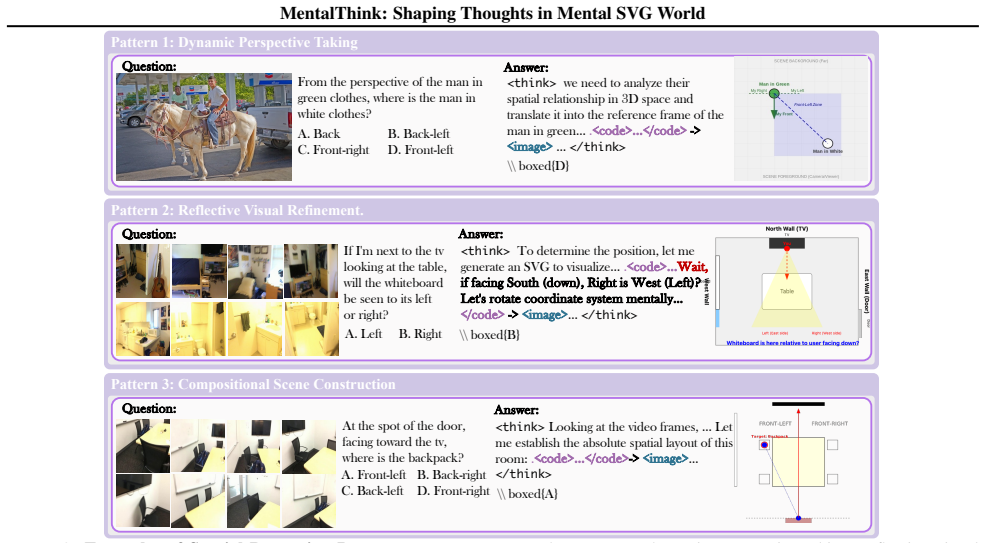
Summary. MentalThink proposes a think-with-SVG pipeline that lets multimodal LLMs externalize spatial hypotheses as executable SVG code, render them deterministically, and condition subsequent reasoning on the rendered images. The method is realized by a two-stage recipe: SFT for syntactic alignment and SVG-mediated thought externalization, followed by multi-turn GRPO (Eq. 10) that rewards format validity and final-answer correctness. On a Qwen2.5-VL-7B backbone the approach reports large gains on spatial benchmarks (55.1% VSIBench, 76.0% MindCube-Tiny; Table 1), with ablations isolating SVG data, general spatial data, and RL (Table 2), a controlled paradigm comparison against text- and bbox-based intermediates (Table 3), and qualitative traces of perspective taking, visual refinement, and scene construction (Figure 3).
Significance. If the gains reflect a transferable geometric workspace rather than benchmark-specific pattern matching, the work supplies a clean, tool-free intermediate representation that is both linguistically native to LLMs and deterministically visualizable. The formalization of SVG-augmented states (Definitions 3.4–3.6), the closed render–inspect loop, and the controlled paradigm comparison (Table 3) are concrete contributions that other multimodal reasoning systems can build on. The adaptive System-1/System-2 statistics (Table 4) further suggest that the model can allocate visual computation according to task difficulty, which is a useful empirical finding for test-time scaling of spatial reasoning.
major comments (3)
- Section 4.1 and Appendix A.1 state that the RL corpus is drawn from the training splits of VSIBench and MindCube—the same two benchmarks that dominate the headline numbers in Table 1. The reward (Eq. 10) contains only format validity and final-answer match; there is no geometric-consistency, multi-view-consistency, or intermediate-SVG quality term. Consequently the large RL increments (especially MindCube 36%→76%) and the multi-turn revision patterns in Figure 3 remain compatible with the policy learning to emit teacher-style SVG sketches that co-occur with correct answers on these particular prompt distributions, rather than acquiring a general inspect-and-revise geometric capability. A held-out spatial suite never seen in RL (or an ablation that freezes the SVG generator after SFT and only optimizes answer selection) is needed to separate these explanations.
- Table 3’s paradigm comparison (Text / BBox / SVG) is the cleanest evidence that the intermediate representation itself matters, yet it is reported only for a single teacher-generated SFT setting and without error bars or multiple seeds. Because the subsequent RL stage re-uses the same benchmark families, it is unclear whether the SVG advantage survives once the policy is optimized under the format+answer reward. Reporting the same three-way comparison after RL (or at least variance across seeds) would make the central claim load-bearing rather than suggestive.
- The qualitative claim of “iterative inspection, revision, and refinement” (Abstract, §3.3, Figure 3) is supported only by selected traces. Table 4 shows that average turns rise only from 1.19 to 1.64 and that SVG is invoked on 63.7% of compositional items; there is no quantitative measure of how often an intermediate SVG is actually revised after rendering (as opposed to a single successful sketch followed by an answer). Without such a revision-rate or self-correction statistic, the multi-turn RL narrative remains under-supported relative to the performance claims.
minor comments (5)
- Table 1 reports MindCube* (MindCube-Tiny) without stating the exact subset size or selection criterion; a one-sentence clarification would aid reproducibility.
- The reward coefficients λ_fmt=0.25 / λ_ans=0.75 and T_max=5 are given without sensitivity analysis; a short appendix note on robustness would strengthen confidence in the free parameters.
- Figure 2’s example trajectory is helpful, but the rendered <image1–3> thumbnails are too small to verify that the SVG actually encodes the claimed egocentric axes; larger insets or an appendix figure would help.
- Several related-work citations (e.g., Visual Sketchpad, cognitive-map methods) are discussed at a high level; a short paragraph contrasting the executable, code-native nature of SVG against non-executable sketch or map tokens would sharpen the novelty claim.
- Typographical inconsistencies appear in model names (LLaV A vs LLaVA) and in the arXiv header date; a light copy-edit pass is warranted.
Circularity Check
Empirical SFT+RL pipeline on public benchmarks; only minor train-split reuse for RL prompts, not a by-construction tautology.
full rationale
MentalThink is an empirical methods paper: it defines a think-with-SVG state (Defs. 3.4–3.6), trains via SFT likelihood (Eq. 7) then GRPO with hybrid reward (Eq. 10: format validity + final-answer match), and reports measured accuracies on held-out splits of VSIBench, MindCube, etc. (Table 1). No first-principles derivation, uniqueness theorem, or fitted parameter is re-labeled as a “prediction.” The reward does not encode geometric self-consistency of intermediate SVGs, so the claim that RL “encourages iterative inspection” is interpretive rather than forced by construction; that is a causal-strength issue, not circularity. RL prompts are drawn from the training splits of the same two benchmarks that dominate the headline numbers (Sec. 4.1, A.1), which is a standard (if imperfect) practice and creates a mild contamination risk, but the evaluation remains against external baselines and official test splits. Data synthesis uses an external teacher (Gemini 3) and is filtered for renderability; this is ordinary distillation, not self-definitional. No load-bearing self-citation of an unverified uniqueness result appears. Hence only minor circularity risk (score 2); the central performance claims are externally falsifiable measurements, not tautologies.
Axiom & Free-Parameter Ledger
free parameters (4)
- format/answer reward weights (λ_fmt=0.25, λ_ans=0.75)
- maximum reasoning horizon T_max=5
- SFT and RL learning rates / batch sizes
- volume and mix of synthetic SVG data (50k+50k+100k)
axioms (3)
- domain assumption SVG code that is grammatically valid and renderable constitutes a complete and compositional representation of the spatial layouts needed for the target benchmarks.
- domain assumption A deterministic SVG renderer can be inserted into the model’s context without breaking end-to-end differentiability of the policy or introducing non-stationary visual noise.
- domain assumption Group Relative Policy Optimization with the hybrid reward yields stable multi-turn visual self-correction.
invented entities (2)
-
think-with-SVG pipeline / SVG-augmented reasoning state
no independent evidence
-
MentalThink two-stage training recipe
no independent evidence
read the original abstract
We introduce MentalThink, a visual-symbolic reasoning paradigm that equips Multimodal LLMs (MLLMs) with an executable mechanism for "mental" visualization. The core of MentalThink is a think-with-SVG pipeline, where the model learns to generate, render, and interpret scalable vector graphics (SVG) code as an intermediate visual representation for multi-turn reasoning. By creating structured vector sketches, the model can externalize spatial hypotheses, inspect them through deterministic rendering, and reason within a constrained geometric space, effectively mimicking the human process of mental imagery. We instantiate this paradigm through a two-stage training framework, combining Supervised Fine-Tuning (SFT) for SVG syntactic alignment with multi-turn Reinforcement Learning (RL) to encourage iterative inspection, revision, and refinement of intermediate visual hypotheses. Extensive evaluations demonstrate that MentalThink achieves superior performance on spatial understanding and reasoning benchmarks (e.g., 55.1% on VSIBench, 76.0% on MindCube), showing that executable vector graphics provide a verifiable visual workspace for dynamic perspective taking, visual reflection, and compositional scene construction.
Figures




Reference graph
Works this paper leans on
-
[1]
Scaling Learning Algorithms Towards
Bengio, Yoshua and LeCun, Yann , booktitle =. Scaling Learning Algorithms Towards
-
[2]
and Osindero, Simon and Teh, Yee Whye , journal =
Hinton, Geoffrey E. and Osindero, Simon and Teh, Yee Whye , journal =. A Fast Learning Algorithm for Deep Belief Nets , volume =
-
[3]
2016 , publisher=
Deep learning , author=. 2016 , publisher=
2016
-
[4]
International Conference on Machine Learning , pages=
Zero-shot text-to-image generation , author=. International Conference on Machine Learning , pages=. 2021 , organization=
2021
-
[5]
arXiv preprint arXiv:2206.10789 , volume=
Scaling autoregressive models for content-rich text-to-image generation , author=. arXiv preprint arXiv:2206.10789 , volume=. 2022 , publisher=
Pith/arXiv arXiv 2022
-
[6]
arXiv preprint arXiv:2110.04627 , year=
Vector-quantized image modeling with improved vqgan , author=. arXiv preprint arXiv:2110.04627 , year=
-
[7]
Proceedings of the IEEE/CVF conference on computer vision and pattern recognition , pages=
Taming transformers for high-resolution image synthesis , author=. Proceedings of the IEEE/CVF conference on computer vision and pattern recognition , pages=
-
[8]
Proceedings of the IEEE/CVF Conference on Computer Vision and Pattern Recognition , pages=
Autoregressive image generation using residual quantization , author=. Proceedings of the IEEE/CVF Conference on Computer Vision and Pattern Recognition , pages=
-
[9]
Advances in neural information processing systems , volume=
Neural discrete representation learning , author=. Advances in neural information processing systems , volume=
-
[10]
Advances in neural information processing systems , volume=
Generating diverse high-fidelity images with vq-vae-2 , author=. Advances in neural information processing systems , volume=
-
[11]
arXiv preprint arXiv:1308.3432 , year=
Estimating or propagating gradients through stochastic neurons for conditional computation , author=. arXiv preprint arXiv:1308.3432 , year=
-
[12]
arXiv preprint arXiv:1312.6114 , year=
Auto-encoding variational bayes , author=. arXiv preprint arXiv:1312.6114 , year=
-
[13]
Advances in neural information processing systems , volume=
Denoising diffusion probabilistic models , author=. Advances in neural information processing systems , volume=
-
[14]
Advances in neural information processing systems , volume=
Generative modeling by estimating gradients of the data distribution , author=. Advances in neural information processing systems , volume=
-
[15]
arXiv preprint arXiv:2010.02502 , year=
Denoising diffusion implicit models , author=. arXiv preprint arXiv:2010.02502 , year=
Pith/arXiv arXiv 2010
-
[16]
Advances in neural information processing systems , volume=
Diffusion models beat gans on image synthesis , author=. Advances in neural information processing systems , volume=
-
[17]
Advances in Neural Information Processing Systems , volume=
Dpm-solver: A fast ode solver for diffusion probabilistic model sampling in around 10 steps , author=. Advances in Neural Information Processing Systems , volume=
-
[18]
arXiv preprint arXiv:2207.12598 , year=
Classifier-free diffusion guidance , author=. arXiv preprint arXiv:2207.12598 , year=
-
[19]
The Journal of Machine Learning Research , volume=
Cascaded diffusion models for high fidelity image generation , author=. The Journal of Machine Learning Research , volume=. 2022 , publisher=
2022
-
[20]
arXiv preprint arXiv:2204.06125 , volume=
Hierarchical text-conditional image generation with clip latents , author=. arXiv preprint arXiv:2204.06125 , volume=
-
[21]
Proceedings of the IEEE/CVF conference on computer vision and pattern recognition , pages=
High-resolution image synthesis with latent diffusion models , author=. Proceedings of the IEEE/CVF conference on computer vision and pattern recognition , pages=
-
[22]
Proceedings of the IEEE/CVF International Conference on Computer Vision , pages=
Scalable diffusion models with transformers , author=. Proceedings of the IEEE/CVF International Conference on Computer Vision , pages=
-
[23]
Advances in Neural Information Processing Systems , volume=
Photorealistic text-to-image diffusion models with deep language understanding , author=. Advances in Neural Information Processing Systems , volume=
-
[24]
arXiv preprint arXiv:2305.18295 , year=
Raphael: Text-to-image generation via large mixture of diffusion paths , author=. arXiv preprint arXiv:2305.18295 , year=
-
[25]
arXiv preprint arXiv:2112.10741 , year=
Glide: Towards photorealistic image generation and editing with text-guided diffusion models , author=. arXiv preprint arXiv:2112.10741 , year=
-
[26]
arXiv preprint arXiv:2307.01952 , year=
Sdxl: Improving latent diffusion models for high-resolution image synthesis , author=. arXiv preprint arXiv:2307.01952 , year=
-
[27]
arXiv preprint arXiv:2310.00426 , year=
PixArt: Fast Training of Diffusion Transformer for Photorealistic Text-to-Image Synthesis , author=. arXiv preprint arXiv:2310.00426 , year=
-
[28]
arXiv preprint arXiv:2312.04557 , year=
GenTron: Delving Deep into Diffusion Transformers for Image and Video Generation , author=. arXiv preprint arXiv:2312.04557 , year=
-
[29]
2024 , eprint=
Scaling Rectified Flow Transformers for High-Resolution Image Synthesis , author=. 2024 , eprint=
2024
-
[30]
arXiv preprint arXiv:2303.01469 , year=
Consistency models , author=. arXiv preprint arXiv:2303.01469 , year=
-
[31]
Computer Science
Improving image generation with better captions , author=. Computer Science. https://cdn. openai. com/papers/dall-e-3. pdf , volume=
-
[32]
5: Three Insights towards Enhancing Aesthetic Quality in Text-to-Image Generation , author=
Playground v2. 5: Three Insights towards Enhancing Aesthetic Quality in Text-to-Image Generation , author=. arXiv preprint arXiv:2402.17245 , year=
-
[33]
Proceedings of the IEEE/CVF Conference on Computer Vision and Pattern Recognition , pages=
Maskgit: Masked generative image transformer , author=. Proceedings of the IEEE/CVF Conference on Computer Vision and Pattern Recognition , pages=
-
[34]
Proceedings of the IEEE/CVF Conference on Computer Vision and Pattern Recognition , pages=
Mage: Masked generative encoder to unify representation learning and image synthesis , author=. Proceedings of the IEEE/CVF Conference on Computer Vision and Pattern Recognition , pages=
-
[35]
Proceedings of the IEEE/CVF Conference on Computer Vision and Pattern Recognition , pages=
Magvit: Masked generative video transformer , author=. Proceedings of the IEEE/CVF Conference on Computer Vision and Pattern Recognition , pages=
-
[36]
Advances in Neural Information Processing Systems , volume=
Movq: Modulating quantized vectors for high-fidelity image generation , author=. Advances in Neural Information Processing Systems , volume=
-
[37]
arXiv preprint arXiv:2309.15505 , year=
Finite scalar quantization: Vq-vae made simple , author=. arXiv preprint arXiv:2309.15505 , year=
-
[38]
arXiv preprint arXiv:2310.05737 , year=
Language Model Beats Diffusion--Tokenizer is Key to Visual Generation , author=. arXiv preprint arXiv:2310.05737 , year=
-
[39]
International Conference on Learning Representations , year=
Phenaki: Variable length video generation from open domain textual descriptions , author=. International Conference on Learning Representations , year=
-
[40]
arXiv preprint arXiv:2301.00704 , year=
Muse: Text-to-image generation via masked generative transformers , author=. arXiv preprint arXiv:2301.00704 , year=
-
[41]
arXiv preprint arXiv:2404.02905 , year=
Visual Autoregressive Modeling: Scalable Image Generation via Next-Scale Prediction , author=. arXiv preprint arXiv:2404.02905 , year=
-
[42]
Advances in neural information processing systems , volume=
Generative adversarial nets , author=. Advances in neural information processing systems , volume=
-
[43]
Proceedings of the IEEE conference on computer vision and pattern recognition , pages=
Image-to-image translation with conditional adversarial networks , author=. Proceedings of the IEEE conference on computer vision and pattern recognition , pages=
-
[44]
Proceedings of the IEEE/CVF conference on computer vision and pattern recognition , pages=
A style-based generator architecture for generative adversarial networks , author=. Proceedings of the IEEE/CVF conference on computer vision and pattern recognition , pages=
-
[45]
Proceedings of the IEEE/CVF conference on computer vision and pattern recognition , pages=
Analyzing and improving the image quality of stylegan , author=. Proceedings of the IEEE/CVF conference on computer vision and pattern recognition , pages=
-
[46]
Advances in Neural Information Processing Systems , volume=
Alias-free generative adversarial networks , author=. Advances in Neural Information Processing Systems , volume=
-
[47]
ACM SIGGRAPH 2022 conference proceedings , pages=
Stylegan-xl: Scaling stylegan to large diverse datasets , author=. ACM SIGGRAPH 2022 conference proceedings , pages=
2022
-
[48]
arXiv preprint arXiv:2301.09515 , year=
Stylegan-t: Unlocking the power of gans for fast large-scale text-to-image synthesis , author=. arXiv preprint arXiv:2301.09515 , year=
-
[49]
Proceedings of the IEEE/CVF Conference on Computer Vision and Pattern Recognition , pages=
Scaling up gans for text-to-image synthesis , author=. Proceedings of the IEEE/CVF Conference on Computer Vision and Pattern Recognition , pages=
-
[50]
Proceedings of the IEEE international conference on computer vision , pages=
Unpaired image-to-image translation using cycle-consistent adversarial networks , author=. Proceedings of the IEEE international conference on computer vision , pages=
-
[51]
arXiv preprint arXiv:1809.11096 , year=
Large scale GAN training for high fidelity natural image synthesis , author=. arXiv preprint arXiv:1809.11096 , year=
-
[52]
Proceedings of the IEEE conference on computer vision and pattern recognition , pages=
The unreasonable effectiveness of deep features as a perceptual metric , author=. Proceedings of the IEEE conference on computer vision and pattern recognition , pages=
-
[53]
Advances in neural information processing systems , volume=
Gans trained by a two time-scale update rule converge to a local nash equilibrium , author=. Advances in neural information processing systems , volume=
-
[54]
Advances in neural information processing systems , volume=
Improved techniques for training gans , author=. Advances in neural information processing systems , volume=
-
[55]
arXiv preprint arXiv:2103.03841 , year=
Generating images with sparse representations , author=. arXiv preprint arXiv:2103.03841 , year=
-
[56]
Advances in neural information processing systems , volume=
Improved precision and recall metric for assessing generative models , author=. Advances in neural information processing systems , volume=
-
[57]
Advances in neural information processing systems , volume=
Attention is all you need , author=. Advances in neural information processing systems , volume=
-
[58]
arXiv preprint arXiv:1810.04805 , year=
Bert: Pre-training of deep bidirectional transformers for language understanding , author=. arXiv preprint arXiv:1810.04805 , year=
-
[59]
The Journal of Machine Learning Research , volume=
Exploring the limits of transfer learning with a unified text-to-text transformer , author=. The Journal of Machine Learning Research , volume=. 2020 , publisher=
2020
-
[60]
article , year=
Improving language understanding by generative pre-training , author=. article , year=
-
[61]
OpenAI blog , volume=
Language models are unsupervised multitask learners , author=. OpenAI blog , volume=
-
[62]
Advances in neural information processing systems , volume=
Language models are few-shot learners , author=. Advances in neural information processing systems , volume=
-
[63]
Advances in Neural Information Processing Systems , volume=
Training language models to follow instructions with human feedback , author=. Advances in Neural Information Processing Systems , volume=
-
[64]
arXiv preprint arXiv:2303.08774 , year=
Gpt-4 technical report , author=. arXiv preprint arXiv:2303.08774 , year=
-
[65]
GPT-4V(ision) system card , author =
-
[66]
International conference on machine learning , pages=
Generative pretraining from pixels , author=. International conference on machine learning , pages=. 2020 , organization=
2020
-
[67]
2022 , howpublished =
OpenAI , title =. 2022 , howpublished =
2022
-
[68]
2023 , howpublished =
Google , title =. 2023 , howpublished =
2023
-
[69]
2023 , howpublished =
Anthropic , title =. 2023 , howpublished =
2023
-
[70]
arXiv preprint arXiv:2302.13971 , year=
Llama: Open and efficient foundation language models , author=. arXiv preprint arXiv:2302.13971 , year=
-
[71]
arXiv preprint arXiv:2307.09288 , year=
Llama 2: Open foundation and fine-tuned chat models , author=. arXiv preprint arXiv:2307.09288 , year=
-
[72]
arXiv preprint arXiv:2203.15556 , year=
Training compute-optimal large language models , author=. arXiv preprint arXiv:2203.15556 , year=
-
[73]
Journal of Machine Learning Research , volume=
Palm: Scaling language modeling with pathways , author=. Journal of Machine Learning Research , volume=
-
[74]
arXiv preprint arXiv:2305.10403 , year=
Palm 2 technical report , author=. arXiv preprint arXiv:2305.10403 , year=
-
[75]
arXiv preprint arXiv:2211.05100 , year=
Bloom: A 176b-parameter open-access multilingual language model , author=. arXiv preprint arXiv:2211.05100 , year=
-
[76]
arXiv preprint arXiv:2205.01068 , year=
Opt: Open pre-trained transformer language models , author=. arXiv preprint arXiv:2205.01068 , year=
-
[77]
arXiv preprint arXiv:2309.16609 , year=
Qwen technical report , author=. arXiv preprint arXiv:2309.16609 , year=
-
[78]
arXiv preprint arXiv:2309.10305 , year=
Baichuan 2: Open large-scale language models , author=. arXiv preprint arXiv:2309.10305 , year=
-
[79]
2023-01-06)[2023-09-27]
Internlm: A multilingual language model with progressively enhanced capabilities , author=. 2023-01-06)[2023-09-27]. https://github. com/InternLM/InternLM , year=
2023
-
[80]
arXiv preprint arXiv:2401.02954 , year=
Deepseek llm: Scaling open-source language models with longtermism , author=. arXiv preprint arXiv:2401.02954 , year=
discussion (0)
Sign in with ORCID, Apple, or X to comment. Anyone can read and Pith papers without signing in.