REVIEW 2 major objections 4 minor 27 references
A training-free post-processing pipeline turns mask-query road polygons and CLIP checks into anomaly maps that beat Maskomaly and set the highest AP on Fishyscapes LostAndFound.
Reviewed by Pith at T0; open to challenge. T0 means a machine referee read the full paper against a public rubric. the ladder, T0–T4 →
T0 review · grok-4.5
2026-07-11 20:12 UTC pith:3RH2EWLB
load-bearing objection Solid training-free engineering that really lifts Maskomaly on road anomalies, but the fixed 20th-query road prior is an unablated single point of failure. the 2 major comments →
Road-Aware Anomaly Segmentation with Query-Guided Polygons and CLIP in Autonomous Driving
The pith
A machine-rendered reading of the paper's core claim, the machinery that carries it, and where it could break.
Core claim
A road polygon derived from one empirically road-attending Mask2Former query, whose complementary gaps serve as anomaly proposals and are then verified or suppressed by CLIP zero-shot classification against in-distribution (and optional OOD) text prompts, produces competitive pixel-level anomaly maps entirely at inference time and without any out-of-distribution supervision.
What carries the argument
Road-aware anomaly proposal: threshold and polygon-fill the 20th query mask to obtain a road prior, take its interior gaps as candidates, then score each connected patch with CLIP against Cityscapes class prompts (threshold 0.8) before fusing high-confidence anomalies into the soft Maskomaly map.
Load-bearing premise
One fixed query index in the frozen Mask2Former model always yields a usable road outline whose interior gaps are reliable anomaly candidates across urban scenes.
What would settle it
Collect a diverse set of urban images (including night, snow, heavy occlusion) and measure whether the chosen query still produces coherent filled road polygons whose gaps contain the true anomalies at rates that preserve the reported AP gains over Maskomaly; systematic failure of the polygon or of the subsequent CLIP filter would collapse the claim.
If this is right
- Existing Mask2Former deployments can add road-focused anomaly detection by pure post-processing with no model changes or extra training data.
- False positives from known objects that happen to sit on the road surface can be suppressed using only natural-language class prompts.
- Small, physically realistic road hazards become more reliably localized without synthetic outlier exposure.
- The same spatial-plus-semantic recipe generalizes across three public benchmarks, supporting plug-and-play use in open-world driving stacks.
Where Pith is reading between the lines
- Stable specialization of individual queries to the road surface may be a general property of mask transformers, inviting systematic query-to-class mapping studies.
- The same road-polygon-plus-CLIP pattern could transfer to other structured surfaces such as factory floors or airport aprons.
- Hybrid soft-query scores fused with hard vision-language decisions may become a reusable template for open-set segmentation beyond driving.
Editorial analysis
A structured set of objections, weighed in public.
Referee Report
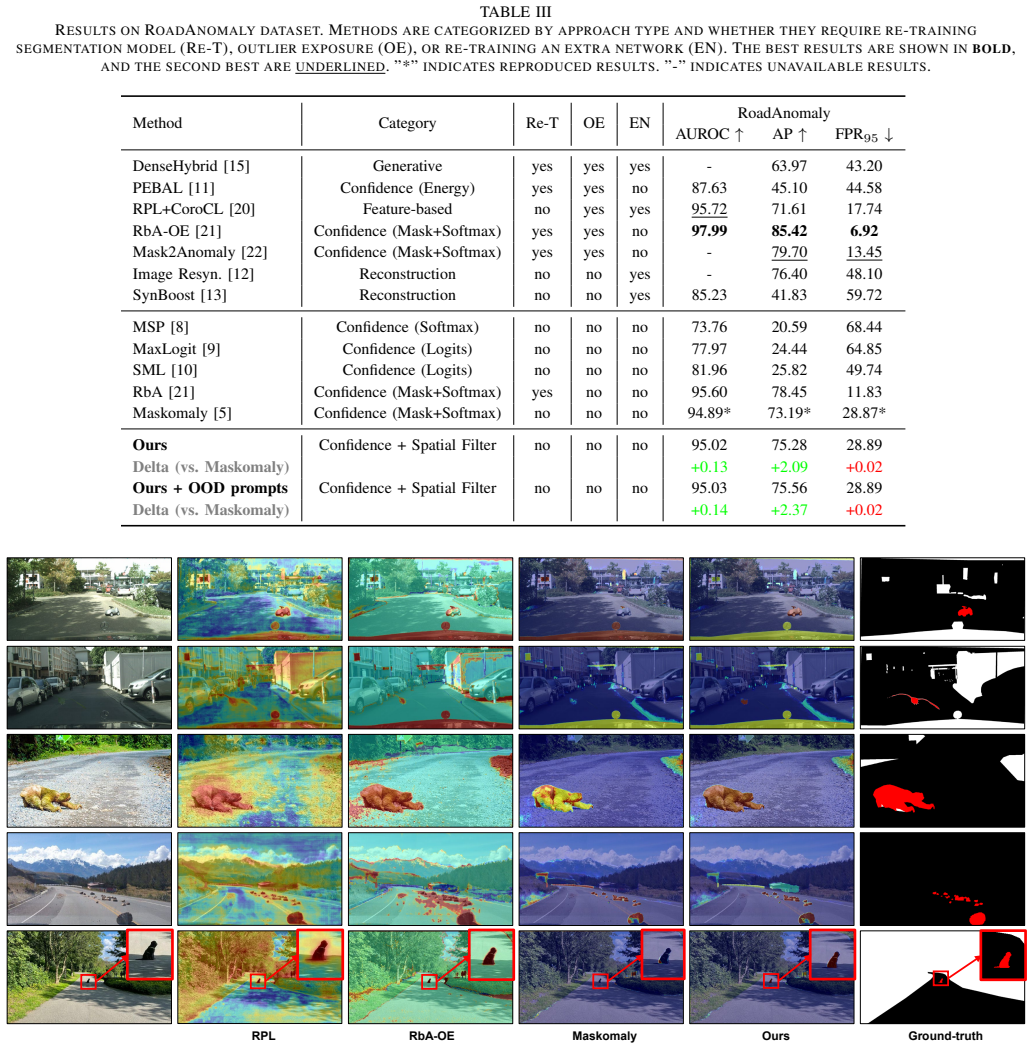
Summary. The paper proposes a training-free, post-processing anomaly segmentation pipeline for autonomous driving that builds on Mask2Former/Maskomaly. It constructs an initial soft anomaly map from rejection- and acceptance-based query masks (Eqs. 1–3), derives a polygonal road prior from a single empirically chosen road query (the 20th), treats gaps inside that polygon as candidate anomalies (Eq. 4), and refines those candidates with CLIP zero-shot classification against Cityscapes ID prompts (optionally plus generic OOD prompts). The CLIP-validated road anomalies are then fused into the soft map (Eq. 5). Experiments on Fishyscapes (LaF/Static), SMIYC (Anomaly/Obstacle) and RoadAnomaly report consistent gains over the reproduced Maskomaly baseline—most notably the highest AP on FS-LaF—and competitive standing against several OE/retraining methods, without requiring OOD data or model updates.
Significance. If the gains hold under broader conditions, the work supplies a practical, immediately deployable plug-in for existing mask-transformer segmentation stacks. The combination of a spatial road prior with zero-shot CLIP filtering is a clean, interpretable way to reduce false positives on the drivable surface while remaining free of outlier exposure and retraining. Strongest empirical support is the large AP lift on the realistic FS-LaF set and the improved small-obstacle results on SMIYC-Obstacle. Code release further aids reproducibility. The contribution is incremental rather than foundational, but it is useful for safety-critical open-world perception where retraining is infeasible.
major comments (2)
- Section III-B and Eq. (4): the entire road-aware prior rests on the unablated claim that “the 20th query mask is found to correspond to the road.” R_init is defined solely as the complement of this fixed query inside the filled polygon. No multi-query aggregation, stability analysis across weather/occlusion/domain shift, or ablation of the query index is provided. Because CLIP only filters candidates already proposed by this prior, a failed or drifted road mask collapses the spatial component that drives the reported AP gains (especially the +50 AP on FS-LaF). A minimal ablation (alternative query indices, automatic road-query selection, or multi-query union) is required to establish that the gains are attributable to a general method rather than a Cityscapes-specific coincidence.
- Tables I–III and free-parameter list: several thresholds (τ_c, λ, τ_ID, the fixed anomaly-sensitive set A = {49,31,83,32}, overwrite score 0.99) are stated without sensitivity analysis or cross-dataset validation. While the method is training-free, these choices still constitute free parameters that can be tuned to the evaluation sets. Reporting performance under modest perturbations of these values (or a simple leave-one-dataset-out protocol) would strengthen the claim of robustness and deployability.
minor comments (4)
- Fig. 2 caption and pipeline diagram: the fusion weight λ and the optional OOD-prompt branch are shown but never quantified in the main text beyond the single λ = 0.6 value; a short paragraph clarifying default versus optional paths would improve reproducibility.
- Section III-A: the acceptance-query set A is taken verbatim from Maskomaly without justification that the same indices remain anomaly-sensitive under the Swin-L Cityscapes checkpoint used here.
- Qualitative Fig. 3: several overlays are hard to interpret at print resolution; adding a binary anomaly mask column or zoomed insets for small obstacles would help readers verify the claimed FP/FN reductions.
- Related-work taxonomy (Section II) is comprehensive but occasionally blurs the distinction between methods that retrain the segmentation backbone versus those that train only an auxiliary head; a clearer column in the tables already helps, yet a one-sentence clarification would avoid confusion.
Circularity Check
No significant circularity: empirical post-processing pipeline evaluated against external ground-truth labels on held-out public benchmarks.
full rationale
The paper presents a training-free inference-time pipeline (Maskomaly soft masks + fixed road-query polygon gaps + CLIP zero-shot filtering) whose outputs are scored by standard pixel metrics (AUROC/AP/FPR95) against independent anomaly ground truth on Fishyscapes, SMIYC and RoadAnomaly. No equation equates the final anomaly map S_final to a quantity that was fitted from the same labels; the sole empirical choices (road query index 20, acceptance set A={49,31,83,32}, thresholds) are fixed a priori from the Mask2Former Cityscapes model and Maskomaly, then applied unchanged. There are no self-definitional identities, no parameters fitted to the evaluation sets and re-presented as predictions, no load-bearing uniqueness theorems imported via self-citation, and no renaming of known results. The method is therefore self-contained against external benchmarks.
Axiom & Free-Parameter Ledger
free parameters (6)
- road query index =
20
- anomaly-sensitive query set A =
{49,31,83,32}
- rejection confidence threshold τ_c =
0.7
- soft-mask fusion weight λ =
0.6
- CLIP ID confidence threshold τ_ID =
0.8
- anomaly overwrite score =
0.99
axioms (3)
- ad hoc to paper A single fixed Mask2Former query reliably produces a road mask whose filled polygon gaps correspond to potential anomalies on the drivable surface.
- domain assumption CLIP cosine similarity to Cityscapes class prompts (plus optional generic OOD prompts) is a reliable zero-shot verifier that suppresses false-positive road objects while retaining true anomalies.
- domain assumption Mask2Former query-level class probabilities and mask logits already encode useful anomaly evidence that can be post-processed without retraining.
read the original abstract
Traditional semantic segmentation models operate under a closed-set assumption and struggle to recognize unknown or unexpected objects-an essential capability for autonomous driving. As a result, such models often misclassify or overlook out-of-distribution (OOD) road anomalies, posing safety risks in open-world environments. We present a lightweight, postprocessing, road-aware anomaly segmentation framework that requires no retraining, no OOD data, and no auxiliary supervision. Our approach builds on a mask transformer-based segmentation network by exploiting query-level mask confidence and deriving a polygonal road prior to detect gap regions that may correspond to anomalies. To further suppress false positives, we introduce a CLIP-based zero-shot semantic filtering module using in-distribution prompts, with optional generalized OOD prompts. By jointly leveraging spatial priors and semantic verification, our framework produces robust and interpretable anomaly predictions. Evaluation on three public benchmarks-Fishyscapes, SMIYC, and RoadAnomaly-shows consistently strong performance. In particular, our method outperforms the training-free baseline Maskomaly on most metrics and achieves the highest AP on Fishyscapes LostAndFound. These results demonstrate the practicality and deployability of our approach for real-world autonomous driving systems.
Figures


Reference graph
Works this paper leans on
-
[1]
Anovox: A benchmark for multimodal anomaly detection in autonomous driving,
D. Bogdoll, I. Hamdard, L. N. R ¨oßler, F. Geisler, M. Bayram, F. Wang, J. Imhof, M. de Campos, A. Tabarov, Y . Yanget al., “Anovox: A benchmark for multimodal anomaly detection in autonomous driving,” arXiv preprint arXiv:2405.07865, 2024
Pith/arXiv arXiv 2024
-
[2]
Comments of the german insurance association (gdv) on,
M. Dzaack, “Comments of the german insurance association (gdv) on,” 2016
2016
-
[3]
Masked-attention mask transformer for universal image segmentation,
B. Cheng, I. Misra, A. G. Schwing, A. Kirillov, and R. Girdhar, “Masked-attention mask transformer for universal image segmentation,” 2022
2022
-
[4]
Entropy maximization and meta classification for out-of-distribution detection in semantic segmentation,
R. Chan, M. Rottmann, and H. Gottschalk, “Entropy maximization and meta classification for out-of-distribution detection in semantic segmentation,” inProceedings of the ieee/cvf international conference on computer vision, 2021, pp. 5128–5137
2021
-
[5]
Maskomaly: Zero-shot mask anomaly segmentation,
J. Ackermann, C. Sakaridis, and F. Yu, “Maskomaly: Zero-shot mask anomaly segmentation,”arXiv preprint arXiv:2305.16972, 2023
Pith/arXiv arXiv 2023
-
[6]
The cityscapes dataset for semantic urban scene understanding,
M. Cordts, M. Omran, S. Ramos, T. Rehfeld, M. Enzweiler, R. Be- nenson, U. Franke, S. Roth, and B. Schiele, “The cityscapes dataset for semantic urban scene understanding,” inProceedings of the IEEE conference on computer vision and pattern recognition, 2016, pp. 3213– 3223
2016
-
[7]
Anomaly detection in autonomous driving: A survey,
D. Bogdoll, M. Nitsche, and J. M. Z ¨ollner, “Anomaly detection in autonomous driving: A survey,” inProceedings of the IEEE/CVF confer- ence on computer vision and pattern recognition, 2022, pp. 4488–4499
2022
-
[8]
A baseline for detecting misclassified and out-of-distribution examples in neural networks,
D. Hendrycks and K. Gimpel, “A baseline for detecting misclassified and out-of-distribution examples in neural networks,”arXiv preprint arXiv:1610.02136, 2016
Pith/arXiv arXiv 2016
-
[9]
Scaling out-of-distribution detection for real-world settings,
D. Hendrycks, S. Basart, M. Mazeika, A. Zou, J. Kwon, M. Mostajabi, J. Steinhardt, and D. Song, “Scaling out-of-distribution detection for real-world settings,”arXiv preprint arXiv:1911.11132, 2019
Pith/arXiv arXiv 1911
-
[10]
Standardized max logits: A simple yet effective approach for identifying unexpected road obstacles in urban-scene segmentation,
S. Jung, J. Lee, D. Gwak, S. Choi, and J. Choo, “Standardized max logits: A simple yet effective approach for identifying unexpected road obstacles in urban-scene segmentation,” inProceedings of the IEEE/CVF International Conference on Computer Vision, 2021, pp. 15 425–15 434
2021
-
[11]
Pixel- wise energy-biased abstention learning for anomaly segmentation on complex urban driving scenes,
Y . Tian, Y . Liu, G. Pang, F. Liu, Y . Chen, and G. Carneiro, “Pixel- wise energy-biased abstention learning for anomaly segmentation on complex urban driving scenes,” inEuropean Conference on Computer Vision. Springer, 2022, pp. 246–263
2022
-
[12]
Detecting the unexpected via image resynthesis,
K. Lis, K. Nakka, P. Fua, and M. Salzmann, “Detecting the unexpected via image resynthesis,” inProceedings of the IEEE/CVF International Conference on Computer Vision, 2019, pp. 2152–2161
2019
-
[13]
Pixel-wise anomaly detection in complex driving scenes,
G. Di Biase, H. Blum, R. Siegwart, and C. Cadena, “Pixel-wise anomaly detection in complex driving scenes,” inProceedings of the IEEE/CVF conference on computer vision and pattern recognition, 2021, pp. 16 918–16 927
2021
-
[14]
Road anomaly detection by partial image reconstruction with segmenta- tion coupling,
T. V ojir, T. ˇSipka, R. Aljundi, N. Chumerin, D. O. Reino, and J. Matas, “Road anomaly detection by partial image reconstruction with segmenta- tion coupling,” inProceedings of the IEEE/CVF international conference on computer vision, 2021, pp. 15 651–15 660. TABLE I RESULTS ONFS-LAFANDFS-STATIC VALIDATION DATASETS. METHODS ARE CATEGORIZED BY APPROACH TY...
arXiv 2021
-
[15]
Densehybrid: Hybrid anomaly detection for dense open-set recognition,
M. Grci ´c, P. Bevandi ´c, and S. ˇSegvi´c, “Densehybrid: Hybrid anomaly detection for dense open-set recognition,” inEuropean Conference on Computer Vision. Springer, 2022, pp. 500–517
2022
-
[16]
Diffusion for out- of-distribution detection on road scenes and beyond,
S. Galesso, P. Schr ¨oppel, H. Driss, and T. Brox, “Diffusion for out- of-distribution detection on road scenes and beyond,” inEuropean Conference on Computer Vision. Springer, 2024, pp. 110–126
2024
-
[17]
A simple unified framework for detecting out-of-distribution samples and adversarial attacks,
K. Lee, K. Lee, H. Lee, and J. Shin, “A simple unified framework for detecting out-of-distribution samples and adversarial attacks,”Advances in neural information processing systems, vol. 31, 2018
2018
-
[18]
Unsupervised holistic segmen- tation of unknown objects,
F. Cermelli, B. Caputo, and C. Masone, “Unsupervised holistic segmen- tation of unknown objects,” inNeurIPS, 2023
2023
-
[19]
Latency-aware road anomaly segmentation in videos: A photorealistic dataset and new metrics,
B. Tian, H.-a. Gao, L. Cui, Y . Zheng, L. Luo, B. Wang, R. Zhi, G. Zhou, and H. Zhao, “Latency-aware road anomaly segmentation in videos: A photorealistic dataset and new metrics,”arXiv preprint arXiv:2401.04942, 2024
Pith/arXiv arXiv 2024
-
[20]
Residual pattern learning for pixel-wise out-of-distribution detection in semantic segmentation,
Y . Liu, C. Ding, Y . Tian, G. Pang, V . Belagiannis, I. Reid, and G. Carneiro, “Residual pattern learning for pixel-wise out-of-distribution detection in semantic segmentation,” inProceedings of the IEEE/CVF International Conference on Computer Vision, 2023, pp. 1151–1161
2023
-
[21]
Rba: Segmenting unknown regions rejected by all,
N. Nayal, M. Yavuz, J. F. Henriques, and F. G ¨uney, “Rba: Segmenting unknown regions rejected by all,” inProceedings of the IEEE/CVF International Conference on Computer Vision, 2023, pp. 711–722
2023
-
[22]
Mask2anomaly: Mask transformer for universal open-set segmentation,
S. N. Rai, F. Cermelli, B. Caputo, and C. Masone, “Mask2anomaly: Mask transformer for universal open-set segmentation,” inCVPR, 2023
2023
-
[23]
Learning transferable visual models from natural language supervision,
A. Radford, J. W. Kim, C. Hallacy, A. Ramesh, G. Goh, S. Agarwal, G. Sastry, A. Askell, P. Mishkin, J. Clarket al., “Learning transferable visual models from natural language supervision,” inInternational conference on machine learning. PmLR, 2021, pp. 8748–8763
2021
-
[24]
Z. Liu, Y . Lin, Y . Cao, H. Hu, Y . Wei, Z. Zhang, S. Lin, and B. Guo, “Swin transformer: Hierarchical vision transformer using shifted TABLE III RESULTS ONROADANOMALY DATASET. METHODS ARE CATEGORIZED BY APPROACH TYPE AND WHETHER THEY REQUIRE RE-TRAINING SEGMENTATION MODEL(RE-T),OUTLIER EXPOSURE(OE),OR RE-TRAINING AN EXTRA NETWORK(EN). THE BEST RESULTS A...
2021
-
[25]
Fishyscapes: A benchmark for safe semantic segmentation in au- tonomous driving,
H. Blum, P.-E. Sarlin, J. Nieto, R. Siegwart, and C. Cadena, “Fishyscapes: A benchmark for safe semantic segmentation in au- tonomous driving,” inproceedings of the IEEE/CVF international con- ference on computer vision workshops, 2019, pp. 0–0
2019
-
[26]
The pascal visual object classes challenge: A retrospective,
M. Everingham, S. A. Eslami, L. Van Gool, C. K. Williams, J. Winn, and A. Zisserman, “The pascal visual object classes challenge: A retrospective,”International journal of computer vision, vol. 111, pp. 98–136, 2015
2015
-
[27]
Segmentmeifyoucan: A benchmark for anomaly segmentation,
R. Chan, K. Lis, S. Uhlemeyer, H. Blum, S. Honari, R. Siegwart, P. Fua, M. Salzmann, and M. Rottmann, “Segmentmeifyoucan: A benchmark for anomaly segmentation,”arXiv preprint arXiv:2104.14812, 2021
Pith/arXiv arXiv 2021
discussion (0)
Sign in with ORCID, Apple, or X to comment. Anyone can read and Pith papers without signing in.