REVIEW 2 major objections 4 minor 40 references
Particle dynamics in nonlinear electromagnetic waves: chaos onset, diffusive heating, and wave surfing
T0 review · 2 major / 4 minor · reviewed 2026-07-11 · grok-4.5
Pith's one-line read Charged particles in intense magnetized EM waves turn chaotic well below field reversal, at relative intensity about 0.25, and then split into slowly heating majority and rare surfing minority.
desk verdict Solid single-particle chaos analysis for magnetized X-modes with a real threshold discrepancy and thin PIC; still worth engaging. read the letter →
The pith
A machine-rendered reading of the paper's core claim, the machinery that carries it, and where it could break.
The reading
What carries the argument
Chirikov resonance-overlap criterion applied to the relativistic cyclotron resonances of the guide field: the island width scales as the square root of wave amplitude while the spacing between adjacent harmonics is fixed by the cyclotron frequency, so global chaos sets in once the overlap parameter K exceeds unity, which occurs at δ ≳ 0.25.
What would settle it
A multi-dimensional particle-in-cell campaign that resolves many rare surfing trajectories over times long enough for asymptotic energy partitioning, and that measures a dissipation fraction approaching unity once δ exceeds 0.25, would falsify the claim of only mild absorption.
Extended reading notes
Core claim
Particle orbits in a nonlinear electromagnetic X-mode become chaotic for relative wave intensity δ = Bw/B0 ≳ 0.25, well below the field-reversal value δ ≥ 1. The transition is produced by Chirikov overlap of cyclotron resonances that destroy the last Kolmogorov–Arnold–Moser tori; the maximal Lyapunov exponent then rises only logarithmically with δ. At still larger δ the phase space incompletely re-laminarizes, so a majority of particles continue to diffuse stochastically while a minority becomes phase-locked and executes macroscopic surfing trajectories (Lévy flights). One-dimensional EPOCH simulations in the high-σ under-dense regime are consistent with this single-particle picture and exhi
Load-bearing premise
That a small suite of one-dimensional cold-start particle-in-cell runs with periodic two-wavelength domains already captures the rare surfing events and the true long-term energy exchange between wave and plasma.
Editorial analysis
A structured set of objections, weighed in public.
Referee Report
Summary. The manuscript analyzes single-particle Hamiltonian dynamics of charged particles in a nonlinear electromagnetic X-mode propagating perpendicular to a guide magnetic field. Using the light-cone variable and a reduced three-dimensional system, it shows that the motion is integrable at both δ = 0 and δ o ∞, but becomes chaotic at intermediate relative wave amplitudes via Chirikov resonance overlap and KAM-torus destruction. Analytic island-width estimates and a complementary strong-wave expansion both recover a local-overlap scale δcrit ≈ 1/16; Poincaré maps and Benettin Lyapunov spectra are presented as evidence that global chaos appears near δ ≳ 0.25. At large δ the phase space incompletely re-laminarizes, producing a majority population that undergoes stochastic diffusion and a minority that experiences intermittent surfing (Lévy flights). Limited 1D EPOCH PIC runs in the high-σ, under-dense regime are reported to be consistent with the single-particle picture and to exhibit only mild dissipation of the initial electromagnetic energy, in contrast to “monster-shock” claims of efficient absorption above field reversal.
Significance. If the quantitative location of the chaos boundary and the mild-dissipation conclusion hold, the work supplies a concrete kinetic counter-argument to MHD-based field-reversal criteria for wave absorption in magnetar magnetospheres and FRB escape models. The Hamiltonian reduction, light-cone formulation, dual weak- and strong-wave Chirikov analyses, and explicit Lyapunov scaling are technically clean and recover the same local-overlap scale; the Poincaré and Lyapunov diagnostics are standard and falsifiable. The identification of coexisting diffusive and surfing populations at large δ is a useful conceptual distinction for non-thermal tails. These strengths make the paper a potentially valuable contribution to relativistic plasma kinetics, provided the factor-of-four discrepancy between analytic and numerical thresholds is resolved and the PIC evidence is strengthened.
major comments (2)
- [Chirikov Threshold and Lyapunov Exponents; Figs. 1–2] The analytic Chirikov threshold and the headline numerical claim disagree by a factor of four. From the weak-wave analysis (Eqs. 20–22) one obtains acrit0 ≈ 1/(16 γn ω̃^{3}) and therefore δcrit = 1/16 = 0.0625 for the fiducial parameters γn = ω̃ = 1; the complementary strong-wave expansion recovers exactly the same value (Eq. S37). Yet the abstract, Fig. 1, Fig. 2 and the PIC discussion all assert that chaos onsets only for δ ≳ 0.25. The text itself notes that the surfing threshold is four times the chaos threshold (asurf0/acrit0 ≈ 4) and then re-labels that surfing value as the chaos-onset value. Until this discrepancy is reconciled—by clarifying whether δ ≳ 0.25 marks global destruction of the last KAM barrier rather than local island overlap, or by showing that the Lyapunov jump is an artifact of sampling—the quantitative claim that chaos appears well below field reversal remains inse
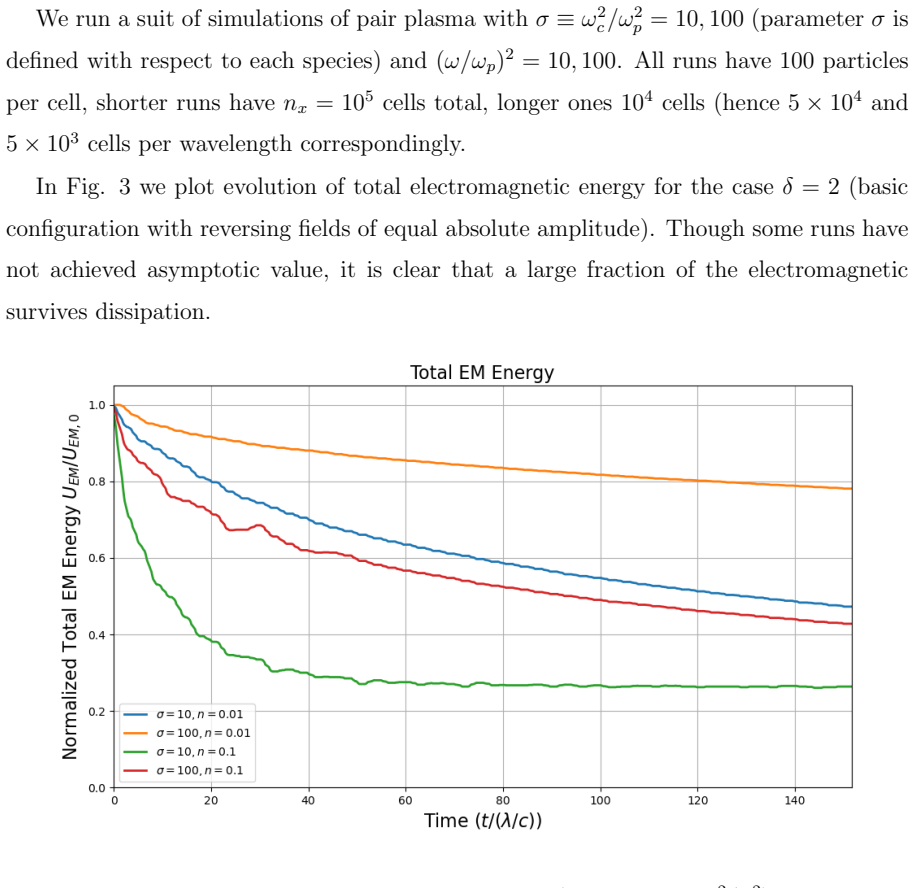
- [PIC SIMULATIONS; Discussion] The PIC suite is too limited to support the claim that dissipation remains mild and thereby contradicts efficient-absorption models. The runs use cold initial particles, a periodic domain of only two wavelengths, σ = 10–100, (ω/ωp)^{2} = 10–100, 100 particles per cell, and some trajectories have not reached asymptotic energy. Rare surfing events that dominate the high-energy tail are statistically under-sampled in 1D. A more systematic scan (or at least a clear statement of the resolution and domain limitations) is required before the mild-dissipation conclusion can be used against the monster-shock literature.
minor comments (4)
- [Eq. (24)] The proportionality constant c1 that appears in the Lyapunov scaling (Eq. 24) is left unspecified; a numerical fit or an order-of-magnitude estimate would make the comparison with Fig. 2 quantitative.
- [FIELD CONFIGURATION; Eq. (9)] Notation for the refractive index n and the normalized frequency ω̃ is introduced late and occasionally overloaded; a short glossary or consistent early definition would help.
- [Fig. 3] Figure 3 captions use n ≡ ωp^{2}/ω^{2} while the text uses the inverse; the inversion should be made consistent.
- [INTRODUCTION] Several self-citations supply the FRB/escape motivation; a brief independent summary of the monster-shock claim being tested would improve accessibility for readers outside that literature.
Circularity Check
No significant circularity: chaos threshold and Lyapunov scaling follow from the relativistic Hamiltonian plus standard Chirikov/KAM analysis; self-citations supply only FRB motivation and the monster-shock foil.
full rationale
The load-bearing derivation begins from the Hamilton-Jacobi equation (Eq. 7) and the closed proper-time system (Eqs. 16-18) for a particle in a guide field plus X-mode. The Chirikov overlap parameter is obtained by the textbook pendulum approximation around cyclotron resonances (island width Δγ_island = 4√(a0 γn ω̃), separation 1/ω̃), yielding the explicit analytic threshold a_crit0 ≈ 1/(16 γn ω̃^{3}) or δ_crit = 1/16 for the fiducial γn = ω̃ = 1 (Eqs. 20-22 and the identical strong-wave result Eq. S37). The maximal Lyapunov exponent is likewise obtained from the standard-map estimate λ_max ≈ (Ωc/(2πω)) ln(c1 a0 ω̃^{3}) (Eq. 24). These expressions contain no free parameters fitted to the paper's own Poincaré maps, Lyapunov spectra, or PIC runs; the numerical diagnostics (Figs. 1-2) and EPOCH simulations are independent consistency checks, not inputs. Self-citations to the author's earlier FRB/escape papers appear only in the introduction and discussion to motivate the astrophysical setting and to identify the 'monster-shock' claims being contradicted; they do not enter the dynamical calculation or the dissipation-fraction statement. The mild numerical-analytic discrepancy between δ ≈ 0.0625 (Chirikov) and the δ ≳ 0.25 quoted in the abstract is a correctness issue, not a circular reduction. Consequently the central claims do not collapse to their inputs by construction.
Assumptions & free parameters
free parameters (3)
- c1 (standard-map proportionality in λ_max) =
order unity
- PIC suite parameters (σ, (ω/ωp)², nx, ppc, domain) =
σ=10–100; (ω/ωp)²=10–100; 100 ppc
- Initial cold plasma / non-self-consistent nonlinear wave =
cold initial particles
assumptions (5)
- standard math Kolmogorov–Arnold–Moser theorem: sufficiently weak perturbations preserve invariant tori that act as absolute barriers in 1.5-dof systems.
- standard math Chirikov resonance-overlap criterion: global stochasticity when island width exceeds resonance separation (K ≥ 1).
- domain assumption Single-particle relativistic Hamiltonian in a prescribed X-mode plus uniform guide field captures the essential particle kinetics of high-σ under-dense plasma.
- domain assumption Coulomb gauge for the wave and Landau gauge for the guide field; Py = Pz = 0 without loss of generality for motion in the x–z plane.
- domain assumption Monster-shock / Beloborodov-type models claim efficient dissipation for δ ≥ 1 via |E| > |B| drift logic.
Cite this review
Pith. "Pith review of Particle dynamics in nonlinear electromagnetic waves: chaos onset, diffusive heating, and wave surfing." pith.science (2026). https://pith.science/paper/HKNQBEK2
@misc{pith2026260704359,
  author       = {Pith},
  title        = {Pith review of: Particle dynamics in nonlinear electromagnetic waves: chaos onset, diffusive heating, and wave surfing},
  year         = {2026},
  howpublished = {\url{https://pith.science/paper/HKNQBEK2}},
  note         = {Machine review of arXiv:2607.04359}
}
abstract
We investigate the dynamics of charged particles interacting with ultra-intense electromagnetic X-modes in strongly magnetized plasmas. We demonstrate that particle motion becomes chaotic for relative wave intensities $\delta = B_w/B_0 \gtrsim 0.25$ (not above the field reversal threshold $\delta \geq 1$). The transition to chaos occurs via the Chirikov resonance overlap mechanism and the related destruction of Kolmogorov-Arnold-Moser (KAM) tori. The maximum Lyapunov exponent increases logarithmically with $\delta$, even though the unmagnetized $\delta \to \infty$ limit is strictly integrable. In the $\delta \gg 1$ regime, incomplete re-laminarization of the phase space flow leads to two distinct populations: (i) the majority of particles undergoing stochastic diffusion, and (ii) a fraction of particles that become phase-locked with the wave, experiencing macroscopic intermittent surfing (L\'evy flights). The 1D Particle-In-Cell simulations using the EPOCH code in the highly magnetized ($\sigma \gg 1$) and under-dense regime are generally consistent with the Hamiltonian single-particle theory. The dissipation fraction of the initial EM energy remains mild.
Figures


Figures from the paper (3 more)


Reference graph
Works this paper leans on
-
[1]
No chaotic dynamics are present, and the particle exhibits strictly periodic, regular cyclotron gyration
Unperturbed Integrable System (δ= 0.0): The phase space is perfectly foliated by smooth, continuous invariant curves. No chaotic dynamics are present, and the particle exhibits strictly periodic, regular cyclotron gyration
-
[2]
The wave creates very thin resonance islands at integer values of Λ (for ˜ω= 1)
Weak Perturbation (δ= 0.05): The Kolmogorov-Arnold-Moser (KAM) tori strictly dominate the phase space. The wave creates very thin resonance islands at integer values of Λ (for ˜ω= 1). The Chirikov resonance overlap parameter isK≪1, meaning particles cannot wander between resonances. The phase space is highly structured and regular
-
[3]
The separatrix layers begin to overlap (K∼1)
Transition to Chaos (δ= 0.2): The resonance islands widen significantly (island half-width ∆I∝ √ δ). The separatrix layers begin to overlap (K∼1). A ”chaotic sea” forms between the primary islands, constituting structural phase noise. 10
-
[4]
The chaotic sea permeates the majority of the phase space, leading to global stochasticity and chaotic diffusion in momentum space
Strong Chaos (δ= 0.5): The primary KAM tori separating the integer resonances are almost destroyed. The chaotic sea permeates the majority of the phase space, leading to global stochasticity and chaotic diffusion in momentum space
-
[5]
Macroscopic diffusion is unhindered, permitting particles to rapidly undergo large stochastic energy excursions across the entire phase space
Fully Developed Chaos (δ= 1.0): The chaotic sea has overwhelmed almost all surviving island chains. Macroscopic diffusion is unhindered, permitting particles to rapidly undergo large stochastic energy excursions across the entire phase space
-
[6]
to the right
Intermittent Surfing (δ= 2.0): Sinceδ≫δ th ≈0.25 (for Λ 0 ∼1), the intense wave field dominates over the background magnetic field. Particles are violently accelerated to ultra-relativistic energies, driving Λ→0. The particle escapes the resonance grid and becomes ponderomotively phase-locked into the macroscopically smooth parabolic pathway, resulting in...
-
[7]
D. R. Lorimer, M. Bailes, M. A. McLaughlin, D. J. Narkevic, and F. Crawford, Science 318, 777 (2007)
2007
-
[8]
Lyutikov, L
M. Lyutikov, L. Burzawa, and S. B. Popov, Mon. Not. Roy. Astron. Soc.462, 941 (2016)
2016
Show all 40 references
-
[9]
Petroff, J
E. Petroff, J. W. T. Hessels, and D. R. Lorimer, Astron. Astrophys. Rev.30, 2 (2022)
2022
-
[10]
J. M. Cordes and S. Chatterjee, Annu. Rev. Astron. Astrophys.57, 417 (2019)
2019
-
[11]
L. G. Spitler, P. Scholz, J. W. T. Hessels, S. Bogdanov, A. Brazier, F. Camilo, S. Chat- terjee, J. M. Cordes, F. Crawford, J. Deneva, R. D. Ferdman, P. C. C. Freire, V. M. Kaspi, P. Lazarus, R. Lynch, E. C. Madsen, M. A. McLaughlin, C. Patel, S. M. Ransom, A. Seymour, I. G. S...
2016
-
[12]
CHIME/FRB Collaboration, B. C. Andersen, K. Bandura, M. Bhardwaj, P. Boubel, M. M. Boyce, P. J. Boyle, C. Brar, T. Cassanelli, P. Chawla, T. Chen, J. F. Cliche, A. Cook, D. Cubranic, A. Z. Cui, M. Deng, M. Dobbs, W. Dobie, F. Dong, G. Eadie, M. Fandino, E. Fonseca, B. M. Gaens...
2020
-
[13]
Ridnaia, D
A. Ridnaia, D. Svinkin, D. Frederiks, A. Bykov, S. Popov, R. Aptekar, S. Golenetskii, A. Lysenko, A. Tsvetkova, M. Ulanov, and M. Klinov, Nature Astronomy5, 372 (2021)
2021
-
[14]
C. D. Bochenek, V. Ravi, K. V. Belov, G. Hallinan, J. Kocz, S. R. Kulkarni, and D. Lebovitz, Nature587, 59 (2020)
2020
-
[15]
Mereghetti, V
S. Mereghetti, V. Savchenko, C. Ferrigno, D. G¨ otz, A. Borghese, A. Bazzano, J. Chenevez, E. Kuulkers, P. Laurent, A. Lioure, A. Lutovinov, A. Martin-Carrillo, P. Minaev, L. Na- talucci, F. Panessa, J. Rodriguez, P. Soffitta, M. Tuerler, and P. Ubertini, Astrophys. J. Lett.89...
2020
-
[16]
C. K. Li, L. Lin, S. L. Xiong, M. Y. Ge, X. B. Li, T. P. Li, F. J. Lu, S. N. Zhang, Y. L. Tuo, Y. Nang, B. Zhang, S. Xiao, Y. Chen, L. M. Song, Y. P. Xu, C. Z. Liu, S. M. Jia, X. L. 11 Cao, J. L. Qu, S. Zhang, Y. D. Gu, J. Y. Liao, X. F. Zhao, Y. Tan, J. Y. Nie, H. S. Zhao, S....
2021
-
[17]
Kwan and J
T. Kwan and J. M. Dawson, The Physics of Fluids22, 1089 (1979)
1979
-
[18]
Gulliford, A
C. Gulliford, A. Bartnik, and I. Bazarov, Phys. Rev. ST Accel. Beams16, 073401 (2013)
2013
-
[19]
Lyutikov, V
M. Lyutikov, V. I. Pariev, and R. D. Blandford, Astrophys. J. Lett.580, L65 (2002)
2002
-
[20]
Lyutikov, Mon
M. Lyutikov, Mon. Not. Roy. Astron. Soc.346, 540 (2003), arXiv:astro-ph/0303384 [astro- ph]
2003 arXiv
-
[21]
Lyutikov, inAPS April Meeting Abstracts, APS Meeting Abstracts (2006) p
M. Lyutikov, inAPS April Meeting Abstracts, APS Meeting Abstracts (2006) p. X3.003
2006
-
[22]
Lyutikov and S
M. Lyutikov and S. Popov, arXiv e-prints , arXiv:2005.05093 (2020), arXiv:2005.05093 [astro-ph.HE]
2005 arXiv
-
[23]
A. M. Beloborodov, Astrophys. J.959, 34 (2023)
2023
-
[25]
Lyutikov, Mon
M. Lyutikov, Mon. Not. Roy. Astron. Soc.529, 2180 (2024), arXiv:2308.13651 [astro- ph.HE]
2024 arXiv
-
[26]
Lyutikov, arXiv e-prints , arXiv:2606.09417 (2026), arXiv:2606.09417 [astro-ph.HE]
M. Lyutikov, arXiv e-prints , arXiv:2606.09417 (2026), arXiv:2606.09417 [astro-ph.HE]
2026 arXiv
-
[27]
Vanthieghem and A
A. Vanthieghem and A. Levinson, Phys. Rev. Lett.134, 035201 (2025)
2025
-
[28]
B. V. Chirikov, Physics Reports52, 263 (1979)
1979
-
[29]
C. F. F. Karney, The Physics of Fluids21, 1584 (1978)
1978
-
[30]
Alternatively, one could start with the covariant Hamilton-Jacobi equation for a charged particle in an electromagnetic field [34] gµν (∂µS+A µ) (∂νS+A ν) + 1 = 0 (S49)
-
[31]
A. N. Kolmogorov, Doklady Akademii Nauk SSSR98, 527 (1954)
1954
-
[32]
V. I. Arnold and B. A. Khesin, Annual Review of Fluid Mechanics24, 145 (1992)
1992
-
[33]
T. D. Arber, K. Bennett, C. S. Brady, A. Lawrence-Douglas, M. G. Ramsay, N. J. Sir- combe, P. Gillies, R. G. Evans, H. Schmitz, A. R. Bell, and C. P. Ridgers, Plasma Physics and Controlled Fusion57, 113001 (2015). 12
2015
-
[34]
Lyutikov, arXiv preprint arXiv:2605.01445 (2026)
M. Lyutikov, arXiv preprint arXiv:2605.01445 (2026)
2026 arXiv
-
[35]
C. S. Roberts and S. J. Buchsbaum, Physical Review135, 381 (1964)
1964
-
[36]
A. M. Beloborodov, arXiv e-prints , arXiv:2606.10189 (2026), arXiv:2606.10189
2026 arXiv
-
[37]
G. M. Zaslavsky, R. Z. Sagdeev, D. A. Usikov, and A. A. Chernikov, Soviet Physics Uspekhi 30, 555 (1987)
1987
-
[38]
Katsouleas and J
T. Katsouleas and J. M. Dawson, Phys. Rev. Lett.51, 392 (1983)
1983
-
[39]
Vanthieghem and A
A. Vanthieghem and A. Levinson, Phys. Rev. E111, 045209 (2025), arXiv:2411.16484 [astro-ph.HE]
2025 arXiv
-
[40]
L. D. Landau and E. M. Lifshitz,The Classical Theory of Fields, Course of Theoretical Physics, Volume 2 (Pergamon Press, 1975)
1975
-
[41]
P. C. Clemmow, Journal of Plasma Physics12, 297 (1974). 13
1974
Reviewed July 11, 2026 · model on record in the stance chip above.
Discussion (0). Continue with ORCID to comment.