REVIEW 5 minor 10 references
Complete Asymptotic Expansion of the Additive Mertens Sum $S_k(x)$
T0 review · 0 major / 5 minor · reviewed 2026-07-13 · grok-4.5
Pith's one-line read The additive sum of reciprocal prime sums admits a complete asymptotic expansion whose coefficients are multiple logarithmic integrals over the unit cube.
desk verdict Solid, carefully executed complete asymptotic expansion for a new additive Mertens sum; the math holds and the limitations are stated honestly. read the letter →
The pith
A machine-rendered reading of the paper's core claim, the machinery that carries it, and where it could break.
The reading
What carries the argument
The coefficient integrals Ek,n themselves: after the prime-number theorem converts the original Stieltjes integral into a smooth main term, a linear rescaling uj=xtj and a multivariate Taylor expansion of the product of (1+wj)^{-1} factors produce exactly these integrals as the successive coefficients.
What would settle it
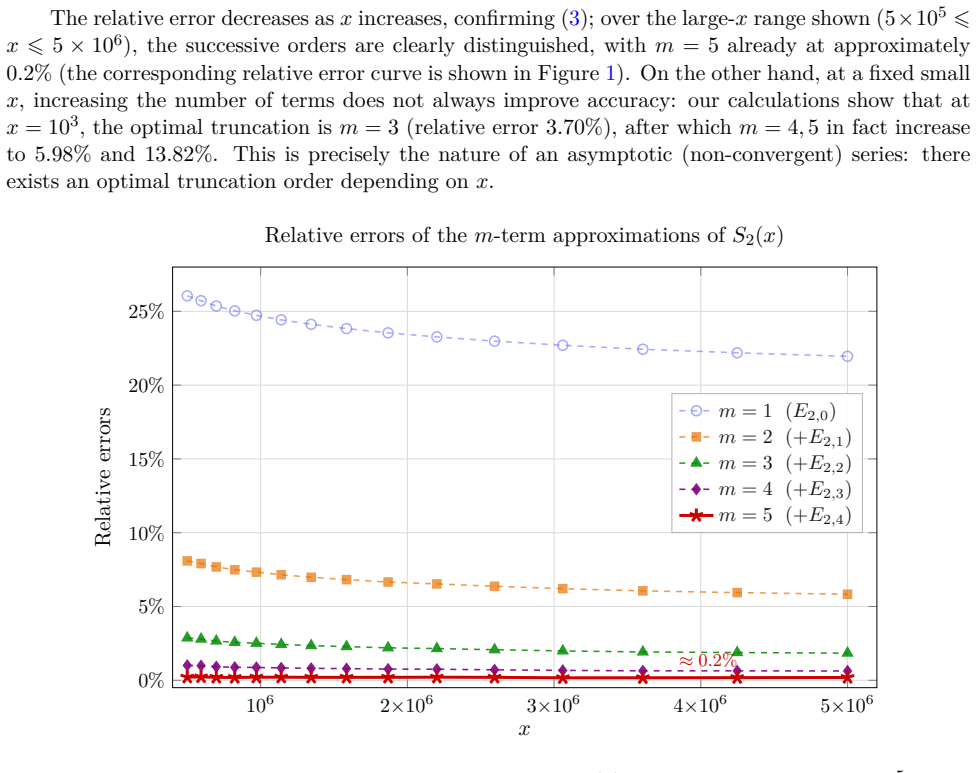
Compute the exact double or triple sum Sk(x) by prime convolution for several large x (e.g., 10^6–10^7) and check whether the successive partial sums of the claimed series reduce the relative error by roughly a factor of three each time, matching the explicit numerical tables already given for k=2 and k=3.
Extended reading notes
Core claim
For every fixed k≥2 and every N≥0 the additive Mertens sum admits the complete expansion Sk(x)=(x^{k-1}/log^k x)∑_{n=0}^N Ek,n/log^n x + O(x^{k-1}/log^{k+N+1}x), where the coefficients are the absolutely convergent integrals Ek,n=(-1)^n ∫_{(0,1]^k} hn(log t1,…,log tk)/(t1+…+tk) dt and hn is the complete homogeneous symmetric polynomial of degree n.
Load-bearing premise
The classical prime-number theorem error is small enough that every term containing at least one residual factor is smaller than any negative power of log x; a weaker error would stop the expansion at finite order.
Editorial analysis
A structured set of objections, weighed in public.
Referee Report
Summary. The paper introduces the additive Mertens sum Sk(x)=∑_{p1,...,pk≤x} 1/(p1+⋯+pk) for fixed k≥2 and proves a complete asymptotic expansion Sk(x)=(x^{k-1}/log^k x)∑_{n=0}^N Ek,n/log^n x + O(x^{k-1}/log^{k+N+1}x) for every N≥0. The coefficients are the absolutely convergent integrals Ek,n=(-1)^n ∫_{(0,1]^k} hn(log t)/(∑t) dt with hn the complete homogeneous symmetric polynomial of degree n. Closed forms are obtained for Ek,0 and Ek,1 for all k, for the diagonal part of Ek,2 for all k (and fully for Ek,2 when k≤4), and for the entire sequence {E2,n} as explicit Q-linear combinations of log 2 and zeta values. The argument proceeds from the Stieltjes representation of Sk, the classical PNT error, isolation of the pure main term Mk, rescaling, and multivariate Taylor expansion with controlled remainder; numerical checks for k=2,3 corroborate the first few terms.
Significance. The additive Mertens sum appears not to have been studied previously; the paper supplies a complete asymptotic expansion of arbitrary order together with explicit arithmetic expressions for the first coefficients and a closed formula for the full sequence when k=2. The derivation is elementary (real-variable PNT, Laplace transforms, finite differences, Taylor remainder) and free of fitted parameters. The numerical tables for S2 and S3 provide independent verification of the closed forms. The work therefore fills a natural gap left by the multiplicative theory of Tenenbaum, Popa, Qi–Hu and supplies concrete, computable expansions that can be used in further analytic-number-theoretic estimates.
minor comments (5)
- In the abstract and Theorem 1 the O-term is written without the subscript k,N that appears later; a uniform notation would avoid any ambiguity about dependence of the implied constant.
- Section 4.3 and the proof of Theorem 2(ii) invoke symbolic verification for k=2….7; a short remark on the computer-algebra system used (or a reference to a supplementary notebook) would strengthen reproducibility.
- Proposition 2 for B4 lists a lengthy expression inside the Q-algebra generated by L3; a brief note that the representation is not unique (already mentioned in a footnote) could be moved into the main text for clarity.
- Table 1 and the numerical Tables 2–3 are clear, but the caption of Figure 1 could explicitly state that the curves are relative errors |approx-exact|/exact rather than absolute errors.
- A few minor typographical inconsistencies appear (e.g., “coeüients” vs. “coefficients”, occasional missing spaces around “=”); a light copy-edit would remove them.
Circularity Check
No circularity: asymptotic expansion derived from PNT + Taylor remainder; coefficients defined by independent integrals later evaluated in closed form.
full rationale
The central claim (Theorem 1) is obtained by writing Sk as a Stieltjes integral, expanding dπ = du/log u + dR via the classical PNT error, isolating the pure main term Mk, proving every term containing at least one dR is O(x^{k-1} exp(-c'√ log x)) (Lemma 2), rescaling uj = x tj, and expanding the product of 1/(L + log tj) by the multivariate Taylor formula with integral remainder whose remainder is controlled by the absolute convergence of the coefficient integrals (Lemmas 1 and 3). The coefficients Ek,n are defined by those integrals (Definition 1) and are subsequently evaluated by Laplace transforms, generating functions satisfying higher-order ODEs, and finite-difference extraction (Propositions 1–2, Lemmas 4–5, Theorem 3); none of these evaluations is fitted to Sk data or presupposes the expansion. Numerical checks use independent exact convolutions of the prime indicator and are not used to derive any coefficient. There is no self-definitional loop, no fitted parameter renamed as prediction, and no load-bearing self-citation of an unverified uniqueness claim. The derivation is self-contained against the classical PNT error term.
Assumptions & free parameters
assumptions (4)
- standard math Prime-number theorem with classical error: π(u)-Li(u)≪ u exp(-c√ log u) for some c>0.
- standard math Frullani integral and the vanishing of the Stirling-number sum that cancels the singularity at zero.
- standard math Integral representation of forward differences and the Laplace transforms of U and w that produce G0 and G1.
- domain assumption Absolute convergence of the multiple integrals defining Ek,n for all k≥2, n≥0.
Cite this review
Pith. "Pith review of Complete Asymptotic Expansion of the Additive Mertens Sum $S_k(x)$." pith.science (2026). https://pith.science/paper/Z444PZL4
@misc{pith2026260704366,
  author       = {Pith},
  title        = {Pith review of: Complete Asymptotic Expansion of the Additive Mertens Sum $S_k(x)$},
  year         = {2026},
  howpublished = {\url{https://pith.science/paper/Z444PZL4}},
  note         = {Machine review of arXiv:2607.04366}
}
abstract
Let $p_1, \dotsc, p_k$ be primes not exceeding $x$ ($k \geqslant 2$), and define the additive Mertens sum \[ S_k(x) = \sum_{p_1 \leqslant x} \cdots \sum_{p_k \leqslant x} \frac{1}{p_1 + \dotsm + p_k}. \] In contrast to Tenenbaum's generalized (multiplicative) Mertens sum, whose leading term has order $(\log \log x)^k$, the sum $S_k(x)$ has leading term of order $x^{k-1}/\log^k x$. We establish the complete asymptotic expansion \[ S_k(x) = \frac{x^{k-1}}{\log^k x} \sum_{n=0}^{N} \frac{E_{k,n}}{\log^n x} + O\left(\frac{x^{k-1}}{\log^{k+N+1} x}\right) \quad (\forall\, N \geqslant 0), \] where the coefficients are given by absolutely convergent multiple logarithmic integrals \[ E_{k,n} = (-1)^n \int_{(0,1]^k} \frac{h_n(\log t_1, \dotsc, \log t_k)}{t_1 + \dotsm + t_k}\, \mathrm{d}\mathbf{t}, \] with $h_n$ the complete homogeneous symmetric polynomial of degree $n$. We give closed-form expressions for the first two coefficients $E_{k,0}$ and $E_{k,1}$ for all $k$, and obtain the closed form for the diagonal part of the third coefficient $E_{k,2}$ (with $E_{k,2}$ fully explicit for $k \leqslant 4$); consequently, the first three terms of the expansions of $S_2(x)$ and $S_3(x)$ are fully explicit. For $k = 2$, we further obtain a closed-form expression for the entire sequence $\{E_{2,n}\}_{n \geqslant 0}$, whose values are explicit $\mathbb{Q}$-linear combinations of $\log 2$ and zeta values $\zeta(j)$. The proofs rely on the real-variable form of the prime number theorem, variable rescaling, and multivariate Taylor remainder estimates.
Figures

Reference graph
Works this paper leans on
-
[1]
Popa, A double Mertens type evaluation , J
D. Popa, A double Mertens type evaluation , J. Math. Anal. Appl. 409 (2014), no. 2, 1159–1163
2014
-
[2]
Popa, A triple Mertens evaluation , J
D. Popa, A triple Mertens evaluation , J. Math. Anal. Appl. 444 (2016), no. 1, 464–474
2016
-
[3]
Tenenbaum, Generalized Mertens sums , in: Analytic Number Theory, Modular Forms and q-Hypergeometric Series, Springer Proc
G. Tenenbaum, Generalized Mertens sums , in: Analytic Number Theory, Modular Forms and q-Hypergeometric Series, Springer Proc. Math. Stat. 221, Springer, Cham, 2017, 733–736
2017
-
[4]
Tenenbaum, Introduction to Analytic and Probabilistic Number Theory , 3rd ed., Grad
G. Tenenbaum, Introduction to Analytic and Probabilistic Number Theory , 3rd ed., Grad. Stud. Math. 163, Amer. Math. Soc., 2015
2015
-
[5]
T. Qi, S. Hu, Multiple Mertens evaluations , arXiv:1909.10930 (2021)
arXiv 1909
-
[6]
R. P. Stanley, Enumerative Combinatorics, Volume 1 , 2nd ed., Cambridge Stud. Adv. Math. 49, Cambridge Univ. Press, 2012
2012
-
[7]
Arias-de-Reyna, On the Theorem of Frullani , Proc
J. Arias-de-Reyna, On the Theorem of Frullani , Proc. Amer. Math. Soc. 109 (1990), no. 1, 165–175
1990
-
[8]
D. Y. Peng, M. H. Ma, H. Liu, Estimate of a class of multiple fractional part sums , College Math. 35 (2019), no. 1, 7–13. (in Chinese)
2019
Show all 10 references
-
[9]
Zagier, Values of zeta functions and their applications , in: First European Congress of Math- ematics, Vol
D. Zagier, Values of zeta functions and their applications , in: First European Congress of Math- ematics, Vol. II (Paris, 1992), Progr. Math. 120, Birkhäuser, Basel, 1994, 497–512
1992
-
[10]
Waldschmidt, Multiple polylogarithms: an introduction , in: Number Theory and Discrete Mathematics (A
M. Waldschmidt, Multiple polylogarithms: an introduction , in: Number Theory and Discrete Mathematics (A. K. Agarwal, B. C. Berndt, C. F. Krattenthaler, G. L. Mullen, K. Ramachandra, M. Waldschmidt, eds.), Hindustan Book Agency, Gurgaon, 2002, pp. 1–12. 16
2002
Reviewed July 13, 2026 · model on record in the stance chip above.
Discussion (0). Continue with ORCID to comment.