REVIEW 4 major objections 6 minor 47 references
Outdoor 3D scenes can be generated from coarse or fine geometry alone by automatically building a directed view graph and conditioning each object with an identity image and a geometry-adherence strength.
Reviewed by Pith at T0; open to challenge. T0 means a machine referee read the full paper against a public rubric. the ladder, T0–T4 →
T0 review · grok-4.5
2026-07-11 17:41 UTC pith:Z35UUPAR
load-bearing objection Solid systems paper that actually removes the outdoor camera-path bottleneck with a usable visibility graph; SOTA claim is overstated relative to the custom 9-layout eval and residual multi-view inconsistency. the 4 major comments →
SceneFrom3D: Geometry-Conditioned Outdoor 3D Scene Generation via View Scheduling with Object-Level Control
The pith
A machine-rendered reading of the paper's core claim, the machinery that carries it, and where it could break.
Core claim
A directed generation graph constructed automatically from outdoor input geometry—nodes as visibility-optimized anchor views, edges as collision-free interpolation trajectories—plus per-object identity images and geometry-adherence parameters, is sufficient to drive a three-stage pipeline that produces high-quality, controllable outdoor 3D Gaussian scenes without requiring explicit camera trajectories as input.
What carries the argument
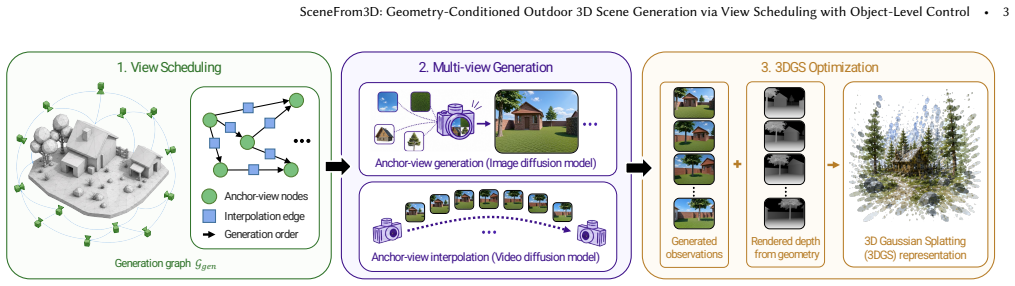
The directed generation graph G_gen = (V, E→): nodes V are a compact set of anchor views obtained by visibility-guided densification and pose optimization; directed edges E→ are interpolation trajectories that also encode generation order. This graph, together with object-level conditioning (identity image + α-adherence), organizes both multi-view synthesis and subsequent 3DGS optimization.
Load-bearing premise
That a sparse set of automatically chosen anchor views, once densified by video diffusion along graph edges, will yield multi-view observations consistent and complete enough for stable 3D Gaussian reconstruction of large unstructured outdoor scenes.
What would settle it
On a held-out outdoor mesh with known ground-truth appearance, run the full pipeline and measure whether novel-view renders remain free of floaters, missing regions, and shadow-direction flips while matching the input layout; systematic failure on scenes with more than eight distinct object identities or with strong global illumination variation would refute the claim.
Editorial analysis
A structured set of objections, weighed in public.
Referee Report
Summary. SceneFrom3D proposes a three-stage geometry-conditioned outdoor 3D scene generation pipeline that removes the need for user-provided camera trajectories. From object meshes with per-object identity images and geometry-adherence parameters α_o, it builds a directed generation graph G_gen whose nodes are visibility-optimized anchor views and whose edges are interpolation trajectories with a generation order. Multi-view images are then synthesized by fine-tuned image diffusion (FLUX.2) at anchors and video diffusion (VACE) along edges, and a 3DGS is optimized with RGB, DSSIM, LPIPS, and mesh-depth losses. The paper claims this is the first trajectory-free outdoor geometry-conditioned generator and reports state-of-the-art quality and object-level controllability on custom outdoor layouts versus UrbanArchitect, YoNoSplat, and a drone path-planning scheduler.
Significance. If the results hold, the main contribution is practical and timely: outdoor geometry is large, unstructured, and unbounded, so automatic view scheduling is a real bottleneck that prior indoor heuristics and trajectory-assuming outdoor methods do not solve. Formulating scheduling as construction of a DAG of anchors and interpolation edges is a clean systems idea, and the object-level identity plus α_o adherence controls go beyond global layout conditioning. The paper supplies detailed algorithms (node init/refinement, soft visibility, pose losses), ablations of tilt/repulsion/interpolation, and qualitative control of α, which are genuine engineering strengths. Residual multi-view failures (shadows, identity overflow) are acknowledged. The work is significant for graphics/VR content creation if evaluation breadth and consistency claims are tightened.
major comments (4)
- Abstract and §1 claim SOTA outdoor geometry-conditioned generation, but §4.2 evaluates only 9 custom layouts (9–16 objects each) with 10 scenes per baseline and no public outdoor benchmark. Table 1 gains are therefore on an author-defined distribution that also supplies the scheduled cameras used by UrbanArchitect and the multi-views used by YoNoSplat. The SOTA claim should be tempered to this setting, or the evaluation expanded (more layouts, larger/unbounded scenes, or an external proxy mesh suite) so the claim is not over-indexed on a small private set.
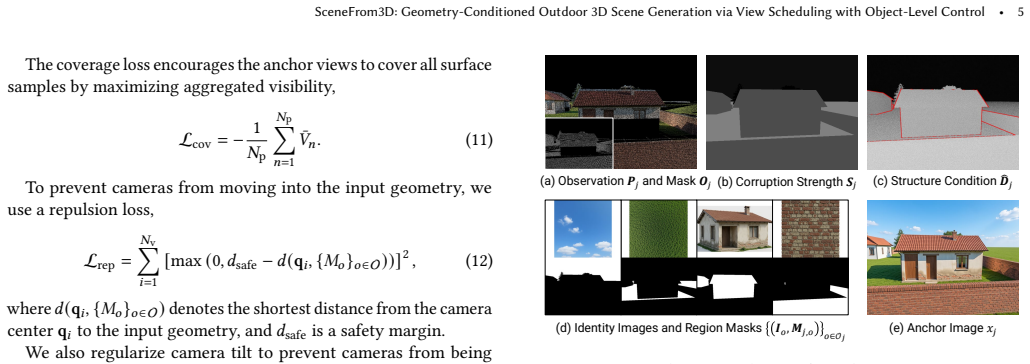
- The central practical claim—that a compact visibility-optimized anchor set plus video interpolation yields observations stable enough for 3DGS—rests on soft visibility (Eq. 5) and shared-visibility edges (§3.2.2), which measure geometric coverage, not photometric or illumination consistency. §5 and Fig. 12 already show residual shadow-direction flips across anchors, and the >8-identity overflow limit. Table 1 reports CLIP Aesthetic, MUSIQ, PSNR-D, Chamfer, and F-score on Bézier paths built from the same anchors, but no multi-view consistency metric (e.g., cross-view warping error, identity/appearance agreement, or shadow/lighting consistency). Without such measures, it is hard to know when the pipeline fails as geometry grows more unstructured.
- §4.2 baseline design is only partially fair. Zhang et al. (2021) is an aerial reconstruction planner and produces top-down-biased paths (Fig. 9), so poor eye-level quality is expected and does not fully stress alternative outdoor scheduling objectives. UrbanArchitect receives the authors’ scheduled poses; YoNoSplat receives the authors’ generated images and is known to be limited in view count and domain. The paper should either add a stronger outdoor geometry-conditioned baseline with its own trajectory policy (or a simple heuristic outdoor scheduler) or clearly reframe comparisons as stage-wise ablations rather than end-to-end SOTA.
- View scheduling depends on many free thresholds (Table S1: d0, δ_vis, δ_shared, δ_remove, δ_merge, d_safe, etc.) and preferred distance d0=35. §4.3 ablations cover L_tilt, L_rep, and interpolation, but not sensitivity of coverage/quality to these thresholds or to surface-sample spacing h. Because compactness of V and edge reliability are load-bearing for both cost and reconstruction completeness, a short sensitivity study (or failure cases when thresholds are misspecified) is needed to support the claim of automatic scheduling for arbitrary outdoor geometry.
minor comments (6)
- Fig. 5 is dense; camera labels A–D and colored identity outlines are hard to parse at print scale. Consider a cleaner layout or larger insets for one scenario in the main paper.
- Notation for the generation graph switches between G_gen, script G, and Ggen; unify early in §3.2.
- §3.3.1 states fine-tuning of FLUX.2-klein-9B on a synthetic multi-reference dataset (~17K pairs in the supplement). A one-sentence main-text note on domain of identity categories (22 categories, architecture grid bias fix) would help readers assess generalization without opening the supplement.
- Table 1: the “W/o interpolation” row has the best MUSIQ but worse structural metrics; the text attributes this to high-frequency artifacts. Adding a short note or a perceptual failure example would make that interpretation less hand-wavy.
- Related work on NBV and aerial path planning is appropriately distinguished; a brief pointer to any concurrent outdoor layout-to-3D systems (if any) would strengthen the “first trajectory-free” claim.
- Minor typography: occasional double-struck or duplicated characters in figure captions (e.g., αα, L script variants) should be cleaned for production.
Circularity Check
Empirical systems paper with no derivation that reduces to its inputs; minor self-citation of VideoFrom3D supplies a generation component but does not force the novel scheduling claim or SOTA metrics.
specific steps
-
self citation load bearing
[§3.1 Overview / §3.3 Multi-view generation]
"We follow the generation strategy of VideoFrom3D [Kim et al. 2025], which combines image-based anchor-view synthesis with video-based view interpolation for geometry-conditioned scene generation. Unlike VideoFrom3D, which relies on given camera trajectories, SceneFrom3D uses the generation graph to organize the same generation process."
The multi-view synthesis stage is taken wholesale from the authors’ prior work rather than re-derived; however this is not load-bearing for the paper’s primary claim (automatic outdoor view scheduling without trajectories). The citation supplies a reusable component, not a uniqueness proof or fitted parameter that forces the SOTA numbers, so circularity is minor.
full rationale
SceneFrom3D is a three-stage engineering pipeline (automatic directed generation-graph view scheduling from soft visibility + pose optimization, FLUX.2/VACE multi-view synthesis with object identity/α conditioning, then 3DGS optimization). There is no mathematical derivation, uniqueness theorem, or fitted constant that is later re-labeled a prediction. Soft visibility (Eq. 5), node/edge construction, and L_node (Eq. 10) are design choices whose outputs are evaluated externally (CLIP Aesthetic, MUSIQ, scale-invariant PSNR-D, Chamfer/F-score vs. input mesh) on held-out Bézier trajectories and against independent baselines (UrbanArchitect, YoNoSplat, Zhang et al. drone planning). The sole self-citation of note is VideoFrom3D (shared authors), which is openly adopted only as the anchor-image + video-interpolation strategy; the paper’s central novelty—the trajectory-free outdoor scheduler and object-level controls—is independent of that citation and is ablated/compared on its own. Residual failures (shadow inconsistency, >8-object limit) are acknowledged rather than defined away. Score 1 reflects only the minor, non-load-bearing self-citation; the evaluation chain does not collapse by construction.
Axiom & Free-Parameter Ledger
free parameters (5)
- Preferred camera distance d0 =
35.0
- Visibility thresholds (δvis, δdense, δremove, δshared, δcand, δmerge) =
0.001 / 0.1 / 80 / 0.007 / 32 / 0.1
- Geometry-adherence α_o per object
- 3DGS loss weights (λr, λs, λd, λp) =
0.8 / 0.2 / 5.0 / 0.10
- Surface-sample spacing h and safety margin dsafe =
1.0 / 6.0
axioms (4)
- domain assumption Pretrained image (FLUX.2-klein) and video (Wan2.1-VACE) diffusion models supply sufficiently multi-view-consistent appearance when conditioned on partial observations, corrupted depth, and identity-region pairs.
- ad hoc to paper Soft visibility (FOV × distance × front-facing × occlusion) is an adequate proxy for both geometric coverage and generation-friendly viewpoints.
- ad hoc to paper A directed acyclic generation graph whose edges are video-interpolation trajectories yields a valid sequential generation order that improves consistency over independent sampling.
- domain assumption Metric depth rendered from the input meshes is a reliable geometric supervisory signal for 3DGS even when appearance is generated stochastically.
invented entities (2)
-
Directed generation graph Ggen = (V, E→)
no independent evidence
-
Per-object geometry-adherence parameter α_o
no independent evidence
read the original abstract
Geometry-conditioned 3D scene generation enables the creation of 3D environments from user-provided geometry, offering direct control over scene structure and object layout. To generate such 3D scenes, current methods commonly adopt a three-stage design that first defines a view schedule, then synthesizes multi-view observations along the scheduled views, and finally reconstructs a 3D representation from the generated images. However, defining the view schedule becomes a major bottleneck for outdoor scenes, where large, unstructured, and unbounded geometry makes it difficult to obtain views that provide sufficient coverage while supporting stable generation. To address this bottleneck, we present SceneFrom3D, a framework that automatically schedules views from outdoor input geometries. SceneFrom3D constructs a directed generation graph whose nodes represent anchor views and whose edges represent interpolation trajectories, defining which views to synthesize, which view pairs to interpolate, and in which order generation should proceed. Beyond automatic view scheduling, SceneFrom3D further improves controllability through object-level conditioning, assigning each object an identity image for appearance guidance and a geometry-adherence parameter for region-wise control over the input geometry. Experiments demonstrate that SceneFrom3D achieves state-of-the-art geometry-conditioned outdoor 3D scene generation, producing high-quality scenes with controllable object appearance and geometry adherence.
Figures




Reference graph
Works this paper leans on
-
[1]
completely blind
Making a “completely blind” image quality analyzer , author=. IEEE Signal processing letters , volume=. 2012 , publisher=
2012
-
[2]
Proceedings of the IEEE/CVF international conference on computer vision , pages=
Musiq: Multi-scale image quality transformer , author=. Proceedings of the IEEE/CVF international conference on computer vision , pages=
-
[3]
2023 , howpublished =
LAION-AI , title =. 2023 , howpublished =
2023
-
[4]
ACM Transactions on Graphics (TOG) , volume=
Stochastic sampling in computer graphics , author=. ACM Transactions on Graphics (TOG) , volume=. 1986 , publisher=
1986
-
[5]
arXiv preprint arXiv:2511.07321 , year=
YoNoSplat: You Only Need One Model for Feedforward 3D Gaussian Splatting , author=. arXiv preprint arXiv:2511.07321 , year=
-
[6]
arXiv preprint arXiv:2405.10314 , year=
Cat3d: Create anything in 3d with multi-view diffusion models , author=. arXiv preprint arXiv:2405.10314 , year=
-
[7]
Proceedings of the IEEE/CVF International Conference on Computer Vision , pages=
Controllable 3D outdoor scene generation via scene graphs , author=. Proceedings of the IEEE/CVF International Conference on Computer Vision , pages=
-
[8]
Proceedings of the IEEE/CVF International Conference on Computer Vision , pages=
Text2room: Extracting textured 3d meshes from 2d text-to-image models , author=. Proceedings of the IEEE/CVF International Conference on Computer Vision , pages=
-
[9]
arXiv preprint arXiv:2404.07199 , year=
Realmdreamer: Text-driven 3d scene generation with inpainting and depth diffusion , author=. arXiv preprint arXiv:2404.07199 , year=
-
[10]
Proceedings of the IEEE/CVF conference on computer vision and pattern recognition , pages=
High-resolution image synthesis with latent diffusion models , author=. Proceedings of the IEEE/CVF conference on computer vision and pattern recognition , pages=
-
[11]
Proceedings of the IEEE/CVF international conference on computer vision , pages=
Adding conditional control to text-to-image diffusion models , author=. Proceedings of the IEEE/CVF international conference on computer vision , pages=
-
[12]
Proceedings of the IEEE/CVF Conference on Computer Vision and Pattern Recognition , pages=
Reco: Region-controlled text-to-image generation , author=. Proceedings of the IEEE/CVF Conference on Computer Vision and Pattern Recognition , pages=
-
[13]
Computer vision and image understanding , volume=
Active object recognition integrating attention and viewpoint control , author=. Computer vision and image understanding , volume=. 1997 , publisher=
1997
-
[14]
IEEE Transactions on Systems, Man, and Cybernetics-Part A: Systems and Humans , volume=
Isolated 3D object recognition through next view planning , author=. IEEE Transactions on Systems, Man, and Cybernetics-Part A: Systems and Humans , volume=. 2000 , publisher=
2000
-
[15]
Computer vision and image understanding , volume=
Planning for complete sensor coverage in inspection , author=. Computer vision and image understanding , volume=. 1995 , publisher=
1995
-
[16]
IEEE Transactions on Robotics and Automation , volume=
Model-based planning of optimal sensor placements for inspection , author=. IEEE Transactions on Robotics and Automation , volume=. 2002 , publisher=
2002
-
[17]
Proceedings
The determination of next best views , author=. Proceedings. 1985 IEEE international conference on robotics and automation , volume=. 1985 , organization=
1985
-
[18]
IEEE Transactions on pattern analysis and machine intelligence , volume=
A solution to the next best view problem for automated surface acquisition , author=. IEEE Transactions on pattern analysis and machine intelligence , volume=. 2002 , publisher=
2002
-
[19]
Proceedings of the IEEE/CVF International Conference on Computer Vision , pages =
Set-the-scene: Global-local training for generating controllable nerf scenes , author =. Proceedings of the IEEE/CVF International Conference on Computer Vision , pages =
-
[20]
arXiv preprint arXiv:2603.22972 , year=
WorldMesh: Generating Navigable Multi-Room 3D Scenes via Mesh-Conditioned Image Diffusion , author=. arXiv preprint arXiv:2603.22972 , year=
-
[21]
Advances in neural information processing systems , volume=
Emergent correspondence from image diffusion , author=. Advances in neural information processing systems , volume=
-
[22]
arXiv preprint arXiv:2209.14988 , year=
Dreamfusion: Text-to-3d using 2d diffusion , author=. arXiv preprint arXiv:2209.14988 , year=
-
[23]
ACM SIGGRAPH 2024 Conference Papers , pages =
Coin3d: Controllable and interactive 3d assets generation with proxy-guided conditioning , author =. ACM SIGGRAPH 2024 Conference Papers , pages =
2024
-
[24]
arXiv preprint arXiv:2310.15110 , year =
Zero123++: a single image to consistent multi-view diffusion base model , author =. arXiv preprint arXiv:2310.15110 , year =
-
[25]
arXiv preprint arXiv:2409.11406 , year =
Phidias: A generative model for creating 3d content from text, image, and 3d conditions with reference-augmented diffusion , author =. arXiv preprint arXiv:2409.11406 , year =
-
[26]
arXiv preprint arXiv:2403.12032 , year =
Generic 3d diffusion adapter using controlled multi-view editing , author =. arXiv preprint arXiv:2403.12032 , year =
-
[27]
Proceedings of the IEEE/CVF conference on computer vision and pattern recognition , pages =
Latent-nerf for shape-guided generation of 3d shapes and textures , author =. Proceedings of the IEEE/CVF conference on computer vision and pattern recognition , pages =
-
[28]
Proceedings of the IEEE/CVF international conference on computer vision , pages =
Fantasia3d: Disentangling geometry and appearance for high-quality text-to-3d content creation , author =. Proceedings of the IEEE/CVF international conference on computer vision , pages =
-
[29]
Kim, Geonung and Han, Janghyeok and Cho, Sunghyun , title =. 2025 , isbn =. doi:10.1145/3757377.3763871 , booktitle =
-
[30]
Communications of the ACM , volume=
Nerf: Representing scenes as neural radiance fields for view synthesis , author=. Communications of the ACM , volume=. 2021 , publisher=
2021
-
[31]
, author=
3d gaussian splatting for real-time radiance field rendering. , author=. ACM Trans. Graph. , volume=
-
[32]
arXiv preprint arXiv:2404.06780 , year=
Urban architect: Steerable 3d urban scene generation with layout prior , author=. arXiv preprint arXiv:2404.06780 , year=
-
[33]
Proceedings of the AAAI Conference on Artificial Intelligence , volume=
SceneGenesis: 3D Scene Synthesis via Semantic Structural Priors and Mesh-Guided Video-Geometry Fusion , author=. Proceedings of the AAAI Conference on Artificial Intelligence , volume=
-
[34]
European Conference on Computer Vision , pages=
Roomtex: Texturing compositional indoor scenes via iterative inpainting , author=. European Conference on Computer Vision , pages=. 2024 , organization=
2024
-
[35]
arXiv preprint arXiv:2509.14981 , volume=
Spatialgen: Layout-guided 3d indoor scene generation , author=. arXiv preprint arXiv:2509.14981 , volume=
-
[36]
Proceedings of the IEEE/CVF Conference on Computer Vision and Pattern Recognition , pages=
Controlroom3d: Room generation using semantic proxy rooms , author=. Proceedings of the IEEE/CVF Conference on Computer Vision and Pattern Recognition , pages=
-
[37]
Advances in Neural Information Processing Systems , volume=
SceneCraft: Layout-guided 3D scene generation , author=. Advances in Neural Information Processing Systems , volume=
-
[38]
SIGGRAPH Asia 2024 Conference Papers , pages=
InstanceTex: Instance-level controllable texture synthesis for 3D scenes via diffusion priors , author=. SIGGRAPH Asia 2024 Conference Papers , pages=
2024
-
[39]
, author=
Continuous aerial path planning for 3D urban scene reconstruction. , author=. ACM Trans. Graph. , volume=
-
[40]
Proceedings of the IEEE International Conference on Computer Vision , pages=
Submodular trajectory optimization for aerial 3d scanning , author=. Proceedings of the IEEE International Conference on Computer Vision , pages=
-
[41]
2018 , publisher=
Aerial path planning for urban scene reconstruction: A continuous optimization method and benchmark , author=. 2018 , publisher=
2018
-
[42]
ACM Transactions on Graphics (TOG) , volume=
Offsite aerial path planning for efficient urban scene reconstruction , author=. ACM Transactions on Graphics (TOG) , volume=. 2020 , publisher=
2020
-
[43]
ACM Transactions on Graphics (TOG) , volume=
Learning reconstructability for drone aerial path planning , author=. ACM Transactions on Graphics (TOG) , volume=. 2022 , publisher=
2022
-
[44]
Proceedings of the Special Interest Group on Computer Graphics and Interactive Techniques Conference Conference Papers , pages=
Aerial Path Online Planning for Urban Scene Updation , author=. Proceedings of the Special Interest Group on Computer Graphics and Interactive Techniques Conference Conference Papers , pages=
-
[45]
ACM Transactions on Graphics (TOG) , volume=
Aerial Path Planning for Urban Geometry and Texture Co-Capture , author=. ACM Transactions on Graphics (TOG) , volume=. 2025 , publisher=
2025
-
[46]
Ryu, Nuri and Gong, Minsu and Kim, Geonung and Lee, Joo-Haeng and Cho, Sunghyun , title =. 2023 , isbn =. doi:10.1145/3610548.3618240 , booktitle =
-
[47]
2025 , eprint=
WorldGen: From Text to Traversable and Interactive 3D Worlds , author=. 2025 , eprint=
2025
discussion (0)
Sign in with ORCID, Apple, or X to comment. Anyone can read and Pith papers without signing in.