REVIEW 2 major objections 5 minor 89 references
QSVideo finds a few query-relevant, diverse frames so compact vision-language models understand long and streaming videos much better under tight frame budgets.
Reviewed by Pith at T0; open to challenge. T0 means a machine referee read the full paper against a public rubric. the ladder, T0–T4 →
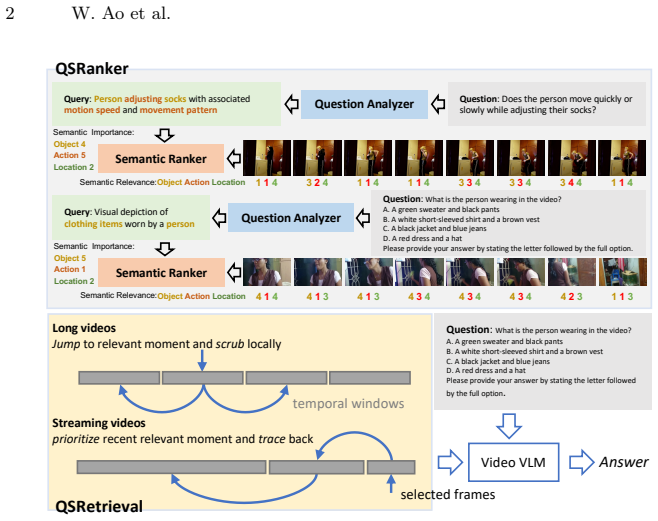
QSVideo reformulates questions into structured queries, ranks frames by object-action-location relevance plus diversity, and applies temporal strategies to boost VLM accuracy under tight frame budgets.
T0 review reviewed 2026-07-11 challenge →
load-bearing objection Solid systems paper: query rewrite + three-axis scoring + dual temporal policies lifts 8B VLMs by ~7 pp on LVBench and hits SoTA on StreamingBench under tight frame budgets; auto-label noise is real but not load-bearing. the 2 major comments →
QSVideo: Query-Conditioned Semantic Temporal Retrieval for Video Understanding
The pith
A machine-rendered reading of the paper's core claim, the machinery that carries it, and where it could break.
The reading
Core claim
Existing multimodal retrieval for video QA is limited by biased relevance scores, near-duplicate frames, and collapse onto narrow time intervals. QSVideo shows that a query-conditioned semantic ranker (QSRanker) that reformulates questions and scores object/action/location relevance, combined with a retrieval procedure (QSRetrieval) that jointly maximises relevance, visual diversity and temporal coverage, supplies far more informative frames. The resulting selections let modest 8B video VLMs match or beat much larger systems under the same tight frame budgets on both long-video and streaming benchmarks.
What carries the argument
QSRanker plus QSRetrieval: an LLM first rewrites the raw question into a retrieval-friendly query and assigns importance weights to object, action and location; a fine-tuned 4B VLM then scores each frame on those three axes; a greedy selector next chooses frames that trade off high weighted relevance against visual L2 distance while enforcing temporal-window coverage (global-anchor-then-local for long videos, recency-first for streams).
Load-bearing premise
The automatic object/action/location scores produced by a large off-the-shelf VLM on only eight uniformly sampled frames per video are assumed to be reliable enough to supervise the smaller semantic ranker.
What would settle it
Retrain the semantic ranker on the same videos but with human-annotated object/action/location scores (or with labels from a different large VLM) and re-evaluate end-to-end accuracy on LVBench and StreamingBench; a large drop would falsify the claim that the current auto-labels are sufficient.
If this is right
- Under a fixed frame budget, simply replacing uniform sampling with QSVideo raises accuracy of existing 7–8B video VLMs by several points without any change to the VLM weights.
- The same retrieval module can be dropped in front of multiple different video VLMs and still yields consistent gains, so model scaling is not required for the improvement.
- Temporal strategies specialised for long versus streaming video measurably improve evidence recall, showing that coverage policy matters as much as relevance scoring.
- Because the ranker is lightweight and batchable, the extra compute stays modest relative to the accuracy gain, making the pipeline practical for real-time or memory-constrained settings.
Where Pith is reading between the lines
- The structured three-axis scoring may transfer to other multimodal tasks (image-document retrieval, long-context audio) where relevance is multi-faceted rather than scalar.
- If the auto-annotation step can be replaced by cheaper self-consistency or contrastive signals, the whole pipeline could become fully unsupervised and easier to scale to web video.
- The recency-first rule for streams suggests a natural interface for always-on AR glasses or robotics, where the system continually re-ranks only the most recent window.
Editorial analysis
A structured set of objections, weighed in public.
Referee Report
Summary. The paper introduces QSVideo, a modular retrieval framework that improves video VLM performance under strict frame budgets by addressing biased relevance, limited diversity, and temporal collapse. QSRanker uses an LLM question analyzer to rewrite arbitrary questions into retrieval-friendly queries and to produce Object/Action/Location importance weights, then a fine-tuned 4B VLM semantic ranker scores frames along the same three dimensions (Eqs. 2–4). QSRetrieval greedily balances relevance and visual diversity (L2 distance on mean-pooled embeddings) inside temporal windows, with distinct traversal policies for long videos (global-anchor then local expansion) and streaming videos (recency-first). The semantic ranker is SFT-ed on the authors’ Video-Ranker-35K set whose labels are produced by Qwen-VL-30B. Under 8/16/32-frame budgets the pipeline lifts MiniCPM-o 2.6 by 6.9–7.1 pp on LVBench, reaches SoTA on StreamingBench, and yields consistent gains when plugged into three other 7–8B VLMs; latency and λ ablations are also reported.
Significance. If the reported gains hold, the work supplies a practical, model-agnostic way to raise long- and streaming-video accuracy without enlarging the VLM or the frame budget—an immediately useful engineering contribution for memory-constrained deployment. Strengths include released code, explicit plug-and-play results across backbones (Table 3), a clear relevance–diversity–coverage formulation (Eq. 1), and tailored temporal policies that match human search heuristics. The empirical claims rest on standard external benchmarks independent of the training set, so the performance numbers are falsifiable and reproducible.
major comments (2)
- §3.2 and the Recall@K paragraph in §5.2: the only supervision for the semantic ranker consists of discrete O/A/L scores auto-generated by Qwen-VL-30B on eight uniformly sampled frames. No human agreement study, inter-annotator reliability, or even a small held-out human-labeled subset is provided. While the end-to-end gains remain valid even under noisy labels, the claim that the ranker “explicitly enforces the correct ranking” rests on unvalidated automatic labels; a modest human validation or comparison against alternative labelers would strengthen the modular contribution of QSRanker itself.
- §3.3 and Tables 1–2: the temporal strategies (anchor-and-expand radius r for long video; recency-first for streaming) are presented as essential, yet no ablation isolates them from plain windowed relevance–diversity selection (Eq. 8). Without that control it is impossible to quantify how much of the 6.9–7.1 pp LVBench lift or the StreamingBench SoTA is attributable to the temporal policies versus the ranker scores alone.
minor comments (5)
- Table 6 (λ ablation) and §5.1: only five discrete λ values are shown; a continuous sweep or variance across random seeds would better support the claim that performance is “relatively insensitive.”
- §4.3 latency tables: candidate-frame count is fixed at 2048; the scaling of QSRanker cost with video length or sampling density is not characterized.
- Fig. 2 and the prompt appendix: the qualitative examples are helpful, but the exact prompt templates for the question analyzer and semantic ranker appear only in the appendix; a short reference in the main text would aid reproducibility.
- Notation: the temporal coverage term Γ in Eq. 1 is never given a concrete value or measurement procedure in the experiments.
- Related-work §2: a few concurrent frame-selection methods (e.g., BOLT, FlexSelect) are cited but not compared under identical frame budgets; a short discussion of why they are omitted would be useful.
Circularity Check
No significant circularity: empirical retrieval pipeline evaluated on independent external benchmarks with no self-definitional equations or fitted-as-prediction steps.
full rationale
QSVideo is an empirical systems paper whose central claims are measured accuracy lifts (e.g., +6.9–7.1 pp on LVBench, SoTA on StreamingBench under fixed 8/16/32-frame budgets) obtained by plugging a fine-tuned ranker + diversity/temporal selector into existing VLMs. The only training data is Video-Ranker-35K (sampled from LLaVA-Video-178K and auto-labeled by an off-the-shelf Qwen-VL-30B); the evaluation sets LVBench and StreamingBench are disjoint external benchmarks. No equation equates a reported quantity to a fitted parameter by construction, no uniqueness theorem is imported from the authors’ prior work, and the sole overlapping-author citation (SEAL) appears only as a baseline, not as a load-bearing premise. The derivation chain therefore reduces to ordinary supervised fine-tuning followed by independent test-set measurement; circularity score is zero.
Axiom & Free-Parameter Ledger
free parameters (4)
- lambda (relevance-diversity trade-off) =
0.9
- temporal radius r
- number of temporal windows K =
equal to selected frames (8/16/32)
- discrete score range {1,2,3,4,5} =
1-5
axioms (4)
- domain assumption Human video understanding balances relevance, diversity and temporal coverage; therefore an algorithmic retrieval system should do the same.
- ad hoc to paper Object, Action and Location dimensions are sufficient to capture query-frame semantic relevance for video QA.
- domain assumption L2 distance on mean-pooled vision-encoder embeddings is a better diversity metric than cosine similarity.
- domain assumption Off-the-shelf large VLMs (Qwen-VL-30B) produce sufficiently accurate frame-level Object/Action/Location labels for supervised fine-tuning.
invented entities (3)
-
QSRanker (question analyzer + semantic ranker)
no independent evidence
-
QSRetrieval (relevance-diversity temporal selection)
no independent evidence
-
Video-Ranker-35K
no independent evidence
Cite this review
Pith. "Pith review of QSVideo: Query-Conditioned Semantic Temporal Retrieval for Video Understanding." pith.science (2026). https://pith.science/paper/6EXQOVKH
@misc{pith2026260704559,
  author       = {Pith},
  title        = {Pith review of: QSVideo: Query-Conditioned Semantic Temporal Retrieval for Video Understanding},
  year         = {2026},
  howpublished = {\url{https://pith.science/paper/6EXQOVKH}},
  note         = {Machine review of arXiv:2607.04559}
}
read the original abstract
The performance of vision-language models (VLMs) in video understanding declines with increasing video duration, as video moments unrelated to the query confuse their language components. Multimodal retrieval has emerged as a critical component of video understanding, addressing this challenge by localizing key visual evidence. However, existing multimodal retrieval methods suffer from biased relevance estimation, limited diversity, and temporal collapse. In this paper, we propose QSVideo, a unified framework that systematically addresses relevance, diversity, and temporal modeling in video retrieval. We first introduce a query-conditioned semantic ranker, QSRanker, which reformulates arbitrary questions into retrieval-friendly queries and estimates structured relevance along object, action, and location dimensions. Building upon this, we design QSRetrieval to jointly optimize relevance and diversity for more informative frame selection. Moreover, we propose temporal alignment strategies tailored for both long and streaming videos to improve evidence recall. Extensive experiments on long and streaming video benchmarks demonstrate that QSVideo greatly enhances video VLM performance under strict frame limit constraints. The code is available at https://github.com/human-analysis/QSVideo.
Figures


Reference graph
Works this paper leans on
-
[1]
Anthropic: Claude 3.5 sonnet (2024)
2024
-
[2]
In: Annual Conference on Neural Information Processing Systems (NeurIPS) (2025)
Arnab, A., Iscen, A., Caron, M., Fathi, A., Schmid, C.: Temporal chain of thought: Long-video understanding by thinking in frames. In: Annual Conference on Neural Information Processing Systems (NeurIPS) (2025)
2025
-
[3]
arXiv preprint arXiv:2308.12966 (2023)
Bai, J., Bai, S., Yang, S., Wang, S., Tan, S., Wang, P., Lin, J., Zhou, C., Zhou, J.: Qwen-VL: A versatile vision-language model for understanding, localization, text reading, and beyond. arXiv preprint arXiv:2308.12966 (2023)
Pith/arXiv arXiv 2023
-
[4]
arXiv preprint arXiv:2511.21631 (2025)
Bai, S., Cai, Y., Chen, R., Chen, K., Chen, X., Cheng, Z., Deng, L., Ding, W., Gao, C., Ge, C., et al.: Qwen3-VL technical report. arXiv preprint arXiv:2511.21631 (2025)
Pith/arXiv arXiv 2025
-
[5]
In: International Conference on Computer Vision (ICCV) (2025)
Bao, X., Xie, C., Tang, H., Weng, T., Wang, X., Zheng, Y., Wang, X.: DynImg: Key frames with visual prompts are good representation for multi-modal video understanding. In: International Conference on Computer Vision (ICCV) (2025)
2025
-
[6]
In: IEEE/CVF Conference on Computer Vision and Pattern Recognition (CVPR)
Buch, S., Nagrani, A., Arnab, A., Schmid, C.: Flexible frame selection for effi- cient video reasoning. In: IEEE/CVF Conference on Computer Vision and Pattern Recognition (CVPR). pp. 29071–29082 (2025)
2025
-
[7]
In: International Conference on Computer Vision (ICCV) (2025)
Chatterjee, D., Remelli, E., Song, Y., Tekin, B., Mittal, A., Bhatnagar, et al.: Memory-efficient streaming VideoLLMs for real-time procedural video understand- ing. In: International Conference on Computer Vision (ICCV) (2025)
2025
-
[8]
In: International Conference on Computer Vision (ICCV) (2025)
Chen, B., Yue, Z., Chen, S., Wang, Z., Liu, Y., Li, P., Wang, Y.: LVAgent: Long video understanding by multi-round dynamical collaboration of MLLM agents. In: International Conference on Computer Vision (ICCV) (2025)
2025
-
[9]
In: IEEE/CVF Conference on Computer Vision and Pattern Recognition (CVPR)
Chen, J., Lv, Z., Wu, S., Lin, K.Q., Song, C., Gao, D., Liu, J.W., Gao, Z., Mao, D., Shou, M.Z.: VideoLLM-online: Online video large language model for streaming video. In: IEEE/CVF Conference on Computer Vision and Pattern Recognition (CVPR). pp. 18407–18418 (2024)
2024
-
[10]
arXiv preprint arXiv:2411.18211 (2024)
Chen, S., Lan, X., Yuan, Y., Jie, Z., Ma, L.: TimeMarker: A versatile video-LLM for long and short video understanding with superior temporal localization ability. arXiv preprint arXiv:2411.18211 (2024)
Pith/arXiv arXiv 2024
-
[12]
arXiv preprint arXiv:2412.05271 (2024)
Chen, Z., Wang, W., Cao, Y., Liu, Y., Gao, Z., Cui, E., Zhu, J., Ye, S., Tian, H., Liu, Z., et al.: Expanding performance boundaries of open-source multimodal models with model, data, and test-time scaling. arXiv preprint arXiv:2412.05271 (2024)
Pith/arXiv arXiv 2024
-
[13]
arXiv preprint arXiv:2404.16821 (2024)
Chen, Z., Wang, W., Tian, H., Ye, S., Gao, Z., Cui, E., Tong, W., Hu, K., Luo, J., Ma, Z., et al.: How far are we to GPT-4V? closing the gap to commercial multi- modal models with open-source suites. arXiv preprint arXiv:2404.16821 (2024)
Pith/arXiv arXiv 2024
-
[14]
In: IEEE/CVF Conference on Computer Vision and Pattern Recognition (CVPR)
Chen, Z., Wu, J., Wang, W., Su, W., Chen, G., Xing, S., Zhong, M., Zhang, Q., Zhu, X., Lu, L., et al.: InternVL: Scaling up vision foundation models and aligning for generic visual-linguistic tasks. In: IEEE/CVF Conference on Computer Vision and Pattern Recognition (CVPR). pp. 24185–24198 (2024)
2024
-
[15]
In: IEEE/CVF Conference on Computer Vision and Pattern Recognition (CVPR) (2025) QSVideo 17
Diko, A., Wang, T., Swaileh, W., Sun, S., Patras, I.: ReWind: Understanding long videos with instructed learnable memory. In: IEEE/CVF Conference on Computer Vision and Pattern Recognition (CVPR) (2025) QSVideo 17
2025
-
[16]
In: IEEE/CVF Conference on Computer Vision and Pattern Recognition (CVPR) (2025)
Dong, Y., Liu, Z., Sun, H.L., Yang, J., Hu, W., Rao, Y., Liu, Z.: Insight-V: Ex- ploring long-chain visual reasoning with multimodal large language models. In: IEEE/CVF Conference on Computer Vision and Pattern Recognition (CVPR) (2025)
2025
-
[17]
In: IEEE/CVF Confer- ence on Computer Vision and Pattern Recognition (CVPR)
Fabian Caba Heilbron, Victor Escorcia, B.G., Niebles, J.C.: ActivityNet: a large- scale video benchmark for human activity understanding. In: IEEE/CVF Confer- ence on Computer Vision and Pattern Recognition (CVPR). pp. 961–970 (2015)
2015
-
[18]
arXiv preprint arXiv:2501.01957 (2025)
Fu, C., Lin, H., Wang, X., Zhang, Y.F., Shen, Y., Liu, X., Li, Y., Long, Z., Gao, H., Li, K., et al.: VITA-1.5: Towards GPT-4o level real-time vision and speech interaction. arXiv preprint arXiv:2501.01957 (2025)
Pith/arXiv arXiv 2025
-
[19]
Gemini 3 pro model (2025)
2025
-
[20]
In: IEEE/CVF Conference on Computer Vision and Pattern Recognition (CVPR)
Grauman, K., Westbury, A., Byrne, E., Chavis, Z., Furnari, A., Girdhar, R., Ham- burger, J., Jiang, H., Liu, M., Liu, X., et al.: Ego4D: Around the world in 3,000 hours of egocentric video. In: IEEE/CVF Conference on Computer Vision and Pattern Recognition (CVPR). pp. 18995–19012 (2022)
2022
-
[21]
arXiv preprint arXiv:2505.07062 (2025)
Guo, D., Wu, F., Zhu, F., Leng, F., Shi, G., Chen, H., Fan, H., Wang, J., Jiang, J., Wang, J., et al.: Seed1.5-VL technical report. arXiv preprint arXiv:2505.07062 (2025)
Pith/arXiv arXiv 2025
-
[22]
In: Annual Conference on Neural Information Processing Systems (NeurIPS) (2025)
Guo, W., Chen, Z., Wang, S., He, J., Xu, Y., Ye, J., Sun, Y., Xiong, H.: Logic-in- Frames: Dynamic keyframe search via visual semantic-logical verification for long video understanding. In: Annual Conference on Neural Information Processing Systems (NeurIPS) (2025)
2025
-
[23]
International Conference on Learning Representations (ICLR)1(2), 3 (2022)
Hu, E.J., Shen, Y., Wallis, P., Allen-Zhu, Z., Li, Y., Wang, S., Wang, L., Chen, W., et al.: LoRA: Low-rank adaptation of large language models. International Conference on Learning Representations (ICLR)1(2), 3 (2022)
2022
-
[24]
Hu, K., Gao, F., Nie, X., Zhou, P., Tran, S., Neiman, T., Wang, L., Shah, M., Hamid, R., Yin, B., et al.: M-LLM based video frame selection for efficient video understanding.In:IEEE/CVFConferenceonComputerVisionandPatternRecog- nition (CVPR). pp. 13702–13712 (2025)
2025
-
[25]
arXiv preprint arXiv:2504.17447 (2025)
Huang, D.A., Radhakrishnan, S., Yu, Z., Kautz, J.: FRAG: Frame selection aug- mented generation for long video and long document understanding. arXiv preprint arXiv:2504.17447 (2025)
Pith/arXiv arXiv 2025
-
[26]
In: IEEE/CVF Conference on Computer Vision and Pattern Recognition (CVPR)
Huang, Z., Li, X., Li, J., Wang, J., Zeng, X., Liang, C., Wu, T., Chen, X., Li, L., Wang, L.: Online video understanding: OVBench and VideoChat-Online. In: IEEE/CVF Conference on Computer Vision and Pattern Recognition (CVPR). pp. 3328–3338 (June 2025)
2025
-
[27]
arXiv preprint arXiv:2410.21276 (2024)
Hurst, A., Lerer, A., Goucher, A.P., Perelman, A., Ramesh, A., Clark, A., Ostrow, A., Welihinda, A., Hayes, A., Radford, A., et al.: GPT-4o system card. arXiv preprint arXiv:2410.21276 (2024)
Pith/arXiv arXiv 2024
-
[28]
In: International Conference on Computer Vision (ICCV) (2025)
Kang, H., Park, Y., Yoo, Y., Choi, Y., Kim, S.J.: Open-ended hierarchical stream- ing video understanding with vision language models. In: International Conference on Computer Vision (ICCV) (2025)
2025
-
[29]
In: Annual Conference on Neural Information Processing Systems (NeurIPS) (2025)
Kim,M.,Shim,K.,Choi,J.,Chang,S.:InfiniPot-V:Memory-constrainedKVcache compression for streaming video. In: Annual Conference on Neural Information Processing Systems (NeurIPS) (2025)
2025
-
[30]
Li, B., Zhang, K., Zhang, H., Guo, D., Zhang, R., Li, F., Zhang, Y., Liu, Z., Li, C.: LLaVA-NeXT: Stronger LLMs supercharge multimodal capabilities in the wild (May 2024)
2024
-
[31]
arXiv preprint arXiv:2408.03326 (2024) 18 W
Li, B., Zhang, Y., Guo, D., Zhang, R., Li, F., Zhang, H., Zhang, K., Zhang, P., Li, Y., Liu, Z., et al.: LLaVA-OneVision: Easy visual task transfer. arXiv preprint arXiv:2408.03326 (2024) 18 W. Ao et al
Pith/arXiv arXiv 2024
-
[32]
Science China Information Sciences 68(10), 200102 (2025)
Li, K., He, Y., Wang, Y., Li, Y., Wang, W., Luo, P., Wang, Y., Wang, L., Qiao, Y.: VideoChat: Chat-centric video understanding. Science China Information Sciences 68(10), 200102 (2025)
2025
-
[33]
arXiv preprint arXiv:2601.04720 (2026)
Li, M., Zhang, Y., Long, D., Keqin, C., Song, S., Bai, S., Yang, Z., Xie, P., Yang, A., Liu, D., Zhou, J., Lin, J.: Qwen3-VL-Embedding and Qwen3-VL-Reranker: A unified framework for state-of-the-art multimodal retrieval and ranking. arXiv preprint arXiv:2601.04720 (2026)
Pith/arXiv arXiv 2026
-
[34]
arXiv preprint arXiv:2311.17043 (2023)
Li, Y., Wang, C., Ji, J.: LLaMA-VID: An image is worth multiple tokens in large language models. arXiv preprint arXiv:2311.17043 (2023)
Pith/arXiv arXiv 2023
-
[35]
arXiv preprint arXiv:2311.10122 (2023)
Lin, B., Zhu, B., Ye, Y., Cui, J., Ning, M., Jin, P., Li, L.Y.: Video-LLaVA: Learn- ing united visual representation by alignment before projection. arXiv preprint arXiv:2311.10122 (2023)
Pith/arXiv arXiv 2023
-
[36]
arXiv preprint arXiv:2411.03628 (2024)
Lin, J., Fang, Z., Chen, C., Wan, Z., Luo, F., Li, P., Liu, Y., Sun, M.: Streaming- Bench: Assessing the gap for MLLMs to achieve streaming video understanding. arXiv preprint arXiv:2411.03628 (2024)
Pith/arXiv arXiv 2024
-
[37]
In: IEEE/CVF Conference on Computer Vision and Pattern Recognition (CVPR) (2024)
Liu, H., Li, C., Li, Y., Lee, Y.J.: Improved baselines with visual instruction tuning. In: IEEE/CVF Conference on Computer Vision and Pattern Recognition (CVPR) (2024)
2024
-
[38]
Liu, H., Li, C., Li, Y., Li, B., Zhang, Y., Shen, S., Lee, Y.J.: LLaVA-NeXT: im- proved reasoning, ocr, and world knowledge (January 2024)
2024
-
[39]
Annual Conference on Neural Information Processing Systems (NeurIPS)36, 34892–34916 (2023)
Liu, H., Li, C., Wu, Q., Lee, Y.J.: Visual instruction tuning. Annual Conference on Neural Information Processing Systems (NeurIPS)36, 34892–34916 (2023)
2023
-
[40]
In: International Conference on Computer Vision (ICCV) (2025)
Liu, R., Sun, S., Tang, H., Gao, W., Li, G.: Flow4Agent: Long-form video un- derstanding via motion prior from optical flow. In: International Conference on Computer Vision (ICCV) (2025)
2025
-
[41]
In: IEEE/CVF Conference on Computer Vision and Pattern Recognition (CVPR) (2025)
Liu, S., Zhao, C., Xu, T., Ghanem, B.: BOLT: Boost large vision-language model without training for long-form video. In: IEEE/CVF Conference on Computer Vision and Pattern Recognition (CVPR) (2025)
2025
-
[42]
arXiv preprint arXiv:2412.04468 (2024)
Liu, Z., Zhu, L., Shi, B., Zhang, Z., Lou, Y., Yang, S., Xi, H., Cao, S., Gu, Y., Li, D., Li, X., Fang, Y., Chen, Y., Hsieh, C.Y., Huang, D.A., Cheng, A.C., Nath, V., Hu, J., Liu, S., Krishna, R., Xu, D., Wang, X., Molchanov, P., Kautz, J., Yin, H., Han, S., Lu, Y.: NVILA: Efficient frontier visual language models. arXiv preprint arXiv:2412.04468 (2024)
Pith/arXiv arXiv 2024
-
[43]
In: IEEE/CVF Conference on Computer Vision and Pattern Recognition (CVPR) (2025)
Ma, Z., Gou, C., Shi, H., Sun, B., Li, S., Rezatofighi, H., Cai, J.: DrVideo: Doc- ument retrieval based long video understanding. In: IEEE/CVF Conference on Computer Vision and Pattern Recognition (CVPR) (2025)
2025
-
[44]
In: Annual Meeting of the Association for Computational Linguistics (ACL) (2024)
Maaz, M., Rasheed, H., Khan, S., Khan, F.S.: Video-ChatGPT: Towards detailed video understanding via large language and vision models. In: Annual Meeting of the Association for Computational Linguistics (ACL) (2024)
2024
-
[45]
Annual Conference on Neural Information Pro- cessing Systems (NeurIPS)35, 27730–27744 (2022)
Ouyang, L., Wu, J., Jiang, X., Almeida, D., Wainwright, C., Mishkin, P., Zhang, C., Agarwal, S., Slama, K., Ray, A., et al.: Training language models to follow instructions with human feedback. Annual Conference on Neural Information Pro- cessing Systems (NeurIPS)35, 27730–27744 (2022)
2022
-
[46]
In: International Conference on Learning Representations (ICLR) (2026)
Pan, J., Zhang, Q., Zhang, R., Lu, M., Wan, X., Zhang, Y., Liu, C., She, Q.: TimeSearch-R: Adaptive temporal search for long-form video understanding. In: International Conference on Learning Representations (ICLR) (2026)
2026
-
[47]
MapReduce
Pang, Z., Wang, Y.X.: Mr. Video: "MapReduce" is the principle for long video understanding. In: Annual Conference on Neural Information Processing Systems (NeurIPS) (2025) QSVideo 19
2025
-
[48]
In: Annual Conference on Neural Information Processing Systems (NeurIPS)
Qian, R.,Dong,X.,Zhang,P., Zang,Y.,Ding,S.,Lin,D., Wang,J.:Streaminglong video understanding with large language models. In: Annual Conference on Neural Information Processing Systems (NeurIPS). vol. 37, pp. 119336–119360 (2024)
2024
-
[49]
In: International Conference for High Per- formance Computing, Networking, Storage and Analysis
Rajbhandari, S., Rasley, J., Ruwase, O., He, Y.: Zero: Memory optimizations to- ward training trillion parameter models. In: International Conference for High Per- formance Computing, Networking, Storage and Analysis. pp. 1–16. IEEE (2020)
2020
-
[50]
Annual Conference on Neural Information Processing Systems (NeurIPS) (2025)
Shen, X., Zhang, W., Chen, J., Elhoseiny, M.: Vgent: Graph-based retrieval- reasoning-augmented generation for long video understanding. Annual Conference on Neural Information Processing Systems (NeurIPS) (2025)
2025
-
[51]
In: IEEE/CVF Conference on Computer Vision and Pattern Recognition (CVPR) (2025)
Shu, Y., Liu, Z., Zhang, P., Qin, M., Zhou, J., Liang, Z., Huang, T., Zhao, B.: Video-XL: Extra-long vision language model for hour-scale video understanding. In: IEEE/CVF Conference on Computer Vision and Pattern Recognition (CVPR) (2025)
2025
-
[52]
In: European Conference on Computer Vision (ECCV)
Sigurdsson, G.A., Varol, G., Wang, X., Farhadi, A., Laptev, I., Gupta, A.: Hol- lywood in homes: Crowdsourcing data collection for activity understanding. In: European Conference on Computer Vision (ECCV). pp. 510–526. Springer (2016)
2016
-
[53]
arXiv preprint arXiv:2601.03267 (2025)
Singh, A., Fry, A., Perelman, A., Tart, A., Ganesh, A., El-Kishky, A., McLaughlin, A., Low, A., Ostrow, A., Ananthram, A., et al.: Openai GPT-5 system card. arXiv preprint arXiv:2601.03267 (2025)
Pith/arXiv arXiv 2025
-
[54]
In: International Conference on Computer Vision (ICCV) (2025)
Suo, Y., Ma, F., Zhu, L., Wang, T., Rao, F., Yang, Y.: From trial to triumph: Advancing long video understanding via visual context sample scaling and self- reward alignment. In: International Conference on Computer Vision (ICCV) (2025)
2025
-
[55]
In: IEEE/CVF Conference on Computer Vision and Pattern Recognition (CVPR) (2025)
Tang, X., Qiu, J., Xie, L., Tian, Y., Jiao, J., Ye, Q.: Adaptive keyframe sampling for long video understanding. In: IEEE/CVF Conference on Computer Vision and Pattern Recognition (CVPR) (2025)
2025
-
[56]
arXiv preprint arXiv:2505.09388 (2025)
Team, Q.: Qwen3 technical report. arXiv preprint arXiv:2505.09388 (2025)
Pith/arXiv arXiv 2025
-
[57]
In: IEEE/CVF Conference on Computer Vision and Pattern Recognition (CVPR) (2025)
Wang,L.,Chen,Y.,Tran,D.,Boddeti,V.N.,Chu,W.S.:SEAL:Semanticattention learning for long video representation. In: IEEE/CVF Conference on Computer Vision and Pattern Recognition (CVPR) (2025)
2025
-
[58]
arXiv preprint arXiv:2409.12191 (2024)
Wang, P., Bai, S., Tan, S., Wang, S., Fan, Z., Bai, J., Chen, K., Liu, X., Wang, J., Ge, W., et al.: Qwen2-VL: Enhancing vision-language model’s perception of the world at any resolution. arXiv preprint arXiv:2409.12191 (2024)
Pith/arXiv arXiv 2024
-
[59]
arXiv preprint arXiv:2406.08035 (2024)
Wang, W., He, Z., Hong, W., Cheng, Y., Zhang, X., Qi, J., Gu, X., Huang, S., Xu, B., Dong, Y., et al.: LVBench: An extreme long video understanding benchmark. arXiv preprint arXiv:2406.08035 (2024)
Pith/arXiv arXiv 2024
-
[60]
In: Findings of the Association for Computational Linguistics: ACL 2025
Wang, X., Si, Q., Zhu, S., Wu, J., Cao, L., Nie, L.: AdaReTaKe: Adaptive redun- dancy reduction to perceive longer for video-language understanding. In: Findings of the Association for Computational Linguistics: ACL 2025. pp. 5417–5432 (2025)
2025
-
[61]
In: International Conference on Learning Representations (ICLR) (2023)
Wang, Y., He, Y., Li, Y., Li, K., Yu, J., Ma, X., Li, X., Chen, G., Chen, X., Wang, Y., et al.: InternVid: A large-scale video-text dataset for multimodal understanding and generation. In: International Conference on Learning Representations (ICLR) (2023)
2023
-
[62]
In: International Conference on Computer Vision (ICCV) (2025)
Wang, Y., Song, Y., Xie, C., Liu, Y., Zheng, Z.: VideoLLaMB: Long-form video understanding with recurrent memory bridges. In: International Conference on Computer Vision (ICCV) (2025)
2025
-
[63]
In: Annual Conference on Neural Information Process- ing Systems (NeurIPS)
Wu, S., Chen, J., Lin, K.Q., Wang, Q., Gao, Y., Xu, Q., Xu, T., Hu, Y., Chen, E., Shou, M.Z.: VideoLLM-MoD: Efficient video-language streaming with mixture-of- depths vision computation. In: Annual Conference on Neural Information Process- ing Systems (NeurIPS). vol. 37, pp. 109922–109947 (2024) 20 W. Ao et al
2024
-
[64]
In: International Confer- ence on Learning Representations (ICLR) (2026)
Wu, Z., Wang, X., Huang, L., Xu, T., Peng, P.: A training-free framework for long video understanding via video-query-options similarity. In: International Confer- ence on Learning Representations (ICLR) (2026)
2026
-
[65]
In: IEEE/CVF Conference on Computer Vision and Pattern Recognition (CVPR)
Xiao, J., Shang, X., Yao, A., Chua, T.S.: NExT-QA: Next phase of question- answering to explaining temporal actions. In: IEEE/CVF Conference on Computer Vision and Pattern Recognition (CVPR). pp. 9777–9786 (June 2021)
2021
-
[66]
In: IEEE/CVF Conference on Computer Vision and Pattern Recognition (CVPR)
Xue, H., Hang, T., Zeng, Y., Sun, Y., Liu, B., Yang, H., Fu, J., Guo, B.: Advancing high-resolution video-language representation with large-scale video transcriptions. In: IEEE/CVF Conference on Computer Vision and Pattern Recognition (CVPR). pp. 5036–5045 (2022)
2022
-
[67]
In: An- nual Conference on Neural Information Processing Systems (NeurIPS) (2025)
Xue, Z., Zhang, J., Xie, X., Cai, Y., Liu, Y., Li, X., Tao, D.: AdaVideoRAG: Omni- contextual adaptive retrieval-augmented efficient long video understanding. In: An- nual Conference on Neural Information Processing Systems (NeurIPS) (2025)
2025
-
[68]
In: International Conference on Computer Vision (ICCV) (2024)
Yang, Z., Chen, D., Yu, X., Shen, M., Gan, C.: VCA: Video curious agent for long video understanding. In: International Conference on Computer Vision (ICCV) (2024)
2024
-
[69]
In: International Conference on Learning Representations (ICLR) (2025)
Yang, Z., Hu, Y., Du, Z., Xue, D., Qian, S., Wu, J., Yang, F., Dong, W., Xu, C.: SVBench: A benchmark with temporal multi-turn dialogues for streaming video understanding. In: International Conference on Learning Representations (ICLR) (2025)
2025
-
[70]
In: Annual Conference on Neural Information Processing Systems (NeurIPS) (2025)
Yang, Z., Zhang, K., Hu, Y., Wang, B., Qian, S., Wen, B., Yang, F., Gao, T., Dong, W., Xu, C.: LiveStar: Live streaming assistant for real-world online video understanding. In: Annual Conference on Neural Information Processing Systems (NeurIPS) (2025)
2025
-
[71]
arXiv preprint arXiv:2408.01800 (2024)
Yao, Y., Yu, T., Zhang, A., Wang, C., Cui, J., Zhu, H., Cai, T., Li, H., Zhao, W., He, Z., et al.: MiniCPM-V: A GPT-4V level MLLM on your phone. arXiv preprint arXiv:2408.01800 (2024)
Pith/arXiv arXiv 2024
-
[72]
In: IEEE/CVF Conference on Computer Vision and Pattern Recognition (CVPR) (2025)
Ye, J., Wang, Z., Sun, H., Chandrasegaran, K., Durante, Z., Eyzaguirre, C., Bisk, Y., Niebles, J.C., Adeli, E., Fei-Fei, L., et al.: Re-thinking temporal search for long-form video understanding. In: IEEE/CVF Conference on Computer Vision and Pattern Recognition (CVPR) (2025)
2025
-
[73]
In: IEEE/CVF Conference on Computer Vision and Pattern Recognition (CVPR) (2025)
Ye, X., Gan, Y., Ge, Y., Zhang, X.P., Tang, Y.: ATP-LLaVA: Adaptive token pruning for large vision language models. In: IEEE/CVF Conference on Computer Vision and Pattern Recognition (CVPR) (2025)
2025
-
[74]
Annual Conference on Neural Information Processing Systems (NeurIPS) pp
Yu, S., Cho, J., Yadav, P., Bansal, M.: Self-chained image-language model for video localization and question answering. Annual Conference on Neural Information Processing Systems (NeurIPS) pp. 76749–76771 (2023)
2023
-
[75]
In: Annual Conference on Neural Information Processing Systems (NeurIPS) (2025)
Zeng, X., Qiu, K., Zhang, Q., Li, X., Wang, J., Li, J., Yan, Z., Tian, K., Tian, M., Zhao, X., et al.: StreamForest: Efficient online video understanding with persistent event memory. In: Annual Conference on Neural Information Processing Systems (NeurIPS) (2025)
2025
-
[76]
arXiv preprint arXiv:2306.02858 (2023)
Zhang, H., Li, X., Bing, L.: Video-LLaMA: An instruction-tuned audio-visual lan- guage model for video understanding. arXiv preprint arXiv:2306.02858 (2023)
Pith/arXiv arXiv 2023
-
[77]
In: International Conference on Computer Vision (ICCV) (2025)
Zhang, H., Wang, Y., Tang, Y., Liu, Y., Feng, J., Jin, X.: Flash-VStream: Efficient real-time understanding for long video streams. In: International Conference on Computer Vision (ICCV) (2025)
2025
-
[78]
In: International Conference on Learning Representations (ICLR) (2026) QSVideo 21
Zhang, K., Yang, Z., Wang, B., Qian, S., Xu, C.: QueryStream: Advancing stream- ing video understanding with query-aware pruning and proactive response. In: International Conference on Learning Representations (ICLR) (2026) QSVideo 21
2026
-
[79]
In: Annual Conference on Neural Information Processing Systems (NeurIPS) (2025)
Zhang, X., Jia, Z., Guo, Z., Li, J., Li, B., Li, H., Lu, Y.: Deep video discovery: Agen- tic search with tool use for long-form video understanding. In: Annual Conference on Neural Information Processing Systems (NeurIPS) (2025)
2025
-
[80]
Zhang, Y., Wu, J., Li, W., Li, B., Ma, Z., Liu, Z., Li, C.: LLaVA-Video: Video instructiontuningwithsyntheticdata.TransactionsonMachineLearningResearch (June 2025)
2025
-
[81]
In: Annual Conference on Neural Information Processing Systems (NeurIPS) (2025)
Zhang, Y., Lu, Y., Wang, T., Rao, F., Yang, Y., Zhu, L.: FlexSelect: Flexible token selection for efficient long video understanding. In: Annual Conference on Neural Information Processing Systems (NeurIPS) (2025)
2025
This paper was first reviewed by grok-4.5 on July 11, 2026.
discussion (0)
Sign in with ORCID, Apple, or X to comment. Anyone can read and Pith papers without signing in.