REVIEW 3 major objections 7 minor 70 references
Deterministic CPU simulation, not hardware meters, trains code models to cut energy nearly three times more than fine-tuning alone and beat human expert references on most valid outputs.
Reviewed by Pith at T0; open to challenge. T0 means a machine referee read the full paper against a public rubric. the ladder, T0–T4 →
T0 review · grok-4.5
2026-07-11 16:59 UTC pith:CDHQAFGF
load-bearing objection Solid empirical recipe: energy-contrastive SFT + simulation-in-the-loop GRPO on a released 3.5M-eval corpus, with a real IPC-trap result and CARET that actually gates correctness. the 3 major comments →
Beyond the Need for Speed: Energy-Aware Code Generation via Simulation-Guided Reinforcement Learning
The pith
A machine-rendered reading of the paper's core claim, the machinery that carries it, and where it could break.
Core claim
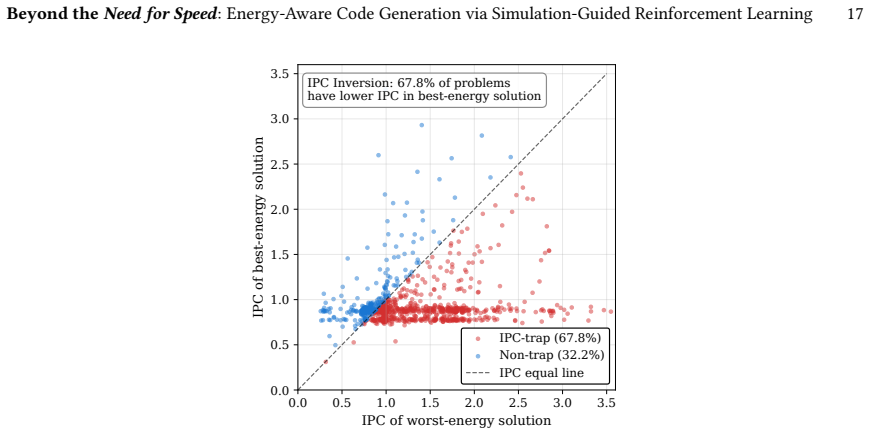
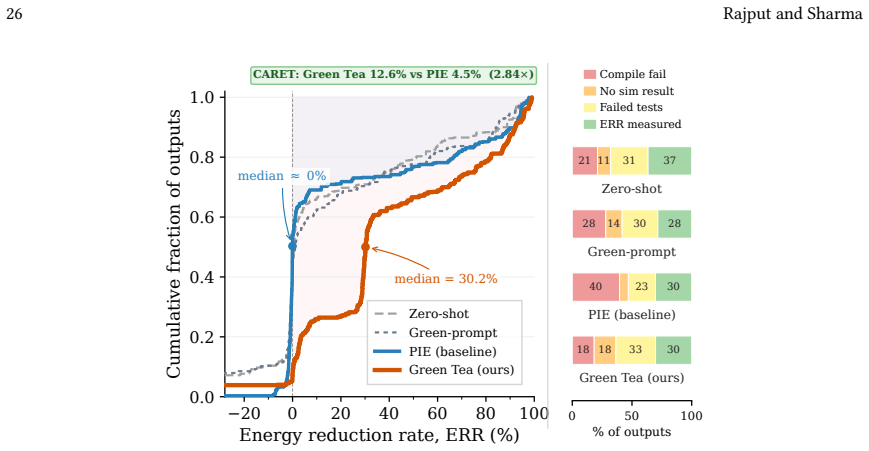
On 143 held-out C++ problems, supervised fine-tuning on energy-contrastive pairs followed by group-relative policy optimization with a simulation-in-the-loop energy or energy-delay reward reaches 12.63% CARET—nearly three times fine-tuning alone—compiles 81.7% of outputs, and beats the human-expert energy reference on 58.4% of valid outputs. Instructions-per-cycle misranks true energy efficiency on 67.8% of problems, so throughput proxies cannot safely substitute for direct energy simulation.
What carries the argument
The simulation-in-the-loop cycle: Sniper/McPAT produces deterministic per-program energy, cycles, and power that score every model rollout during reinforcement learning, together with the CARET metric that multiplies each output’s energy reduction by the fraction of tests it passes and zeros non-compiling code.
Load-bearing premise
Energy rankings from a CPU simulator on short single-threaded competitive-programming C++ programs remain a faithful training target for the energy real deployed code will draw.
What would settle it
On a held-out set of longer multi-threaded or memory-bound production kernels, programs the simulator ranks as lower-energy systematically consume more wall energy than their baselines under careful RAPL or power-meter measurement after identical -O3 compilation.
If this is right
- Energy, not runtime or instructions-per-cycle, must be the direct training signal if models are to optimize software energy rather than a proxy that often inverts it.
- Releasing the precomputed Green Tea labels removes the roughly 263,000 CPU-hour barrier to training energy-aware code models.
- Deployment-facing energy metrics must gate on correctness the way CARET does; reduction rates computed only on valid outputs overstate gains.
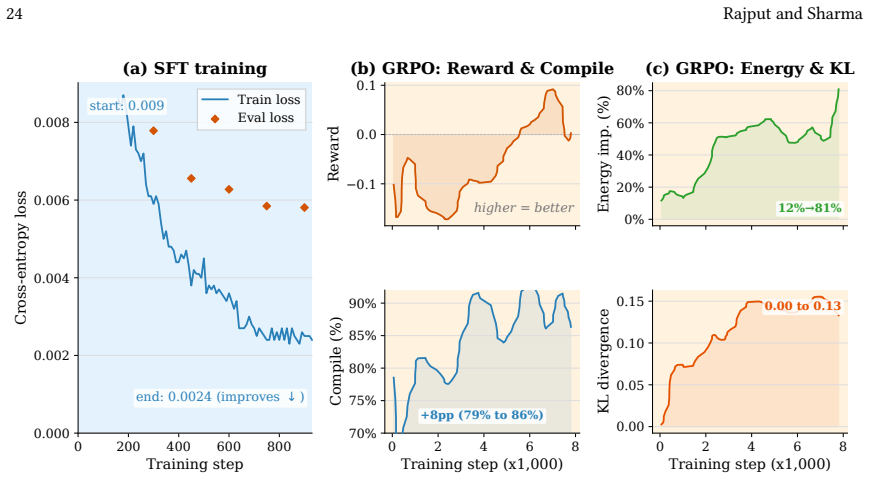
- Closed-loop simulation feedback, not parameter scale alone, is what recovers compilation and deepens optimization on valid programs.
- A compound energy-delay reward roughly doubles the rate at which models beat human expert energy references relative to single-axis rewards.
Where Pith is reading between the lines
- Because the simulator is retargetable by configuration file, the same loop could train models for microarchitectures that do not yet exist before silicon arrives.
- Memory-bound production servers and mobile/GPU settings, where power varies more than on short compute-bound tasks, may show larger gaps between runtime proxies and true energy and therefore larger benefits from direct simulation.
- If AI-generated code becomes the bulk of enterprise software, training models to emit lower-energy implementations by default would cut operational electricity without relying on brittle inference-time prompts.
Editorial analysis
A structured set of objections, weighed in public.
Referee Report
Summary. The paper argues that code LLMs can be trained to optimize program energy, not merely correctness or runtime, by replacing noisy hardware energy measurement with deterministic Sniper/McPAT architectural simulation. From 1,474 PIE C++ problems the authors build Green Tea (3.5M simulations, energy-contrastive pairs), fine-tune with score-conditioned SFT, then run GRPO with a compile–test–simulate reward (energy, runtime, or EDP). They introduce CARET, which multiplies energy reduction by test-pass fraction and zeros non-compiling outputs. On 143 held-out problems the energy-first closed-loop pipeline (Energy-SFT + EDP) reaches 12.63% CARET (2.84× over Energy-SFT alone), 81.7% compile rate, and beats the human reference energy on 58.4% of valid outputs. A corpus analysis shows IPC inverts true energy ranking on 67.8% of problems (the “IPC trap”). Dataset, harness, and models are released.
Significance. Energy of AI-generated code is a timely and under-served objective. The work’s main technical contribution is a reproducible, rank-oriented simulation-in-the-loop training recipe at a scale physical RAPL/power-meter measurement cannot support, plus the Green Tea corpus that amortizes ~263k CPU-hours. CARET is a useful deployment-oriented metric that avoids the binary-correctness gate common in efficiency benchmarks. The within-problem IPC-trap and cycle-vs-power decomposition are concrete, falsifiable findings that justify direct energy simulation over throughput proxies. Strengths include multi-model SFT transfer, five RL init/reward cells in a tight CARET band, paired Wilcoxon tests with Holm–Bonferroni correction, CARET sensitivity conventions, a DeepSeek-Coder-6.7B replication, and a public replication package. If the held-out results hold under the stated scope, the paper is a solid empirical systems/ML contribution for green code generation.
major comments (3)
- §5.3 and Table 5: The abstract and contributions headline Energy-SFT + EDP at 12.63% CARET, yet Runtime-SFT + EDP reaches 16.41% CARET under the same closed loop, and E-SFT + runtime reaches 14.44%. The text treats the five cells as a “4.22 pp band” and attributes aggregate CARET to the loop rather than reward/init, but still markets a single “energy-first” number. Please either (i) justify why 12.63% is the primary deployment-relevant figure (e.g., correctness/Beat-GT tradeoffs, safety of energy ranking from RQ2) with that comparison made explicit in the abstract, or (ii) report the best closed-loop CARET as primary and demote energy-first to an ablation. As written, the headline understates the best result of the method the paper actually proposes.
- §4.2 (Empirical validation of the simulation pipeline): Rank-correctness of Sniper/McPAT is load-bearing for both Green Tea labels and the RL reward. The manuscript reports “avoiding contradiction on 93% of resolvable program pairs and strictly agreeing on 80%” via CodeGreen RAPL, plus <0.1% determinism, but does not state the number of pairs N, how “resolvable” is defined (e.g., RAPL resolution floor, energy-gap threshold), confidence intervals, or whether the spot-check set overlaps training problems. Without N and selection criteria, the 93%/80% figures cannot be assessed. Please report N, selection protocol, and CIs (or a full ranking-agreement table) so readers can judge whether the training signal is adequately validated for the energy gaps used in pair construction (≥10%).
- §5.1 / RQ1 and §7–8: The central necessity claim for direct energy simulation rests on within-problem power-driven cases (12.3% of problems with >5% power contribution; 41.2% of cycle-matched pairs with energy gaps). These fractions are measured on short, single-threaded competitive-programming binaries under one Sniper config (EPYC Zen4 @ 1.5 GHz). The implications section (§7) and abstract language (“structurally empowering… inherently energy-efficient code generation models”) extrapolate to production and sustainability impact. The threats section acknowledges the domain limit, but the abstract and implications do not. Please temper abstract/implications claims to the evaluated distribution, or add at least one non-PIE / longer-running / multi-input production-style case study so the transfer claim is evidence-backed rather than promissory.
minor comments (7)
- Eq. (2) CARET decomposition: The product is correctly labeled an approximation; still, Figure 7 and §5.3.1 would be clearer if the under/over-estimation factors (1.30× SFT, 1.22× GRPO) appeared in the figure caption, not only in prose.
- §4.4 reward constants (ρ_fail=−1.0, ρ_0=−0.8, λ=1.1, ρ_pass=+0.5): Analytical gap reasoning under group normalization is reasonable; a one-sentence note that no sweep was performed (and that results are therefore conditional on these gaps) would help reproducibility claims.
- Table 2 / DeepSeek-Coder-6.7B SFT: Compile collapse 95.4%→8.0% is striking; the later GRPO recovery to 5.99% CARET is important—cross-reference that recovery earlier so readers do not dismiss the model family.
- Figure 2 (IPC trap) and Figure 3 (power vs runtime): Axis units and the 190 W power floor (Table 1) should be defined in the captions; “190 W floor” appears only in prose.
- Listing 1 / score-conditioned prompt: Confirm whether inference always requests score 10/10 (as stated) and whether any ablation of requested score appears in the replication package; §6 mentions score targets as a lever but gives no numbers.
- Typos / polish: Title line break “Beyond theNeed for Speed”; abstract “1{,}474” formatting is fine in LaTeX but check PDF spacing; “ghost execution” is defined late—move the definition next to first use in §4.4.
- Related work: Afterburner [17] and PIE [58] are correctly positioned; a brief note on how CARET differs from EffiBench/Mercury binary-gated scores (already partly in §2.4) would help metric adoption.
Circularity Check
No significant circularity: training signal, held-out evaluation, and CARET/Beat-GT are independent of the claimed gains by construction.
full rationale
The paper’s load-bearing chain is empirical and externally anchored, not definitional. Energy labels and GRPO rewards come from Sniper/McPAT (established third-party simulators), not from quantities defined in terms of the model’s later CARET or Beat-GT. Training uses problem-level 80/10/10 splits so the 143 held-out PIE problems never appear in SFT pairs or RL prompts. CARET weights simulated energy reduction by independent unit-test pass fractions and zeros non-compiling outputs; Beat-GT compares to human-expert PIE references—neither is a tautology of the training objective or a re-label of a fitted parameter. The IPC-trap claim is a corpus statistic (best-energy vs worst-energy IPC per problem), not a prediction forced by a fit. Self-citations (CodeGreen, energy smells, etc.) support infrastructure/context only and do not underwrite uniqueness of the main result. Ablations (five reward/init cells, Runtime-SFT/Afterburner-style baselines, zero-shot/green-prompt) further separate the claimed 12.63% CARET from circular self-reference. No step reduces Eq. X to Eq. Y by construction or renames a fit as a prediction.
Axiom & Free-Parameter Ledger
free parameters (6)
- Reward constants (ρ_fail, ρ_0, λ, ρ_pass) =
−1.0, −0.8, 1.1, +0.5
- GRPO group size K =
16
- Energy-contrastive pair thresholds =
≤6 / ≥7 / 10% floor
- LoRA rank and alpha =
r=64, α=128
- SFT and GRPO learning rates / KL β =
3e-5 / 1e-6 / β=0.04
- Sniper core model (AMD EPYC 9554P @ 1.5 GHz) =
Zen4-like 1.5 GHz config
axioms (6)
- domain assumption Deterministic interval simulation (Sniper) plus McPAT activity-to-energy mapping preserves within-problem energy rankings sufficiently for training and evaluation.
- domain assumption McPAT energy is linear in activity counts so global calibration does not invert solution orderings.
- domain assumption Competitive-programming C++ solutions (PIE/CodeNet) are a valid testbed for learning energy-relevant source transformations.
- standard math Energy E = P × t and within-problem power can diverge from cycle count via instruction mix.
- domain assumption GRPO group-normalized advantages without a learned critic are appropriate when energy spans orders of magnitude across problems.
- ad hoc to paper Reward constants need only relative ordering under group normalization, so analytical gaps suffice without hyperparameter search.
invented entities (3)
-
CARET (Correctness-Adjusted Reduction in Energy Total)
independent evidence
-
Green Tea corpus
independent evidence
-
IPC trap
independent evidence
read the original abstract
Code models strictly prioritize functional correctness, leaving software energy efficiency as an unoptimized byproduct. Training models to generate energy-efficient code requires reproducible feedback at scale, which physical hardware measurement cannot reliably provide due to variance. In this paper, we replace hardware profiling with a deterministic architectural simulation harness to build Green Tea, a corpus of $3.5$ million evaluations across $1{,}474$ C++ problems. We train an energy-aware code model via supervised fine-tuning on energy-contrastive pairs, followed by closed-loop reinforcement learning (GRPO) using simulation-in-the-loop feedback. To rigorously evaluate deployment readiness, we introduce the Correctness-Adjusted Reduction in Energy Total (CARET), a metric that explicitly penalizes code that sacrifices functionality for efficiency. On $143$ held-out problems, our simulation-in-the-loop pipeline achieves $12.63\%$ CARET, nearly tripling the gain of fine-tuning alone, and successfully beats the energy efficiency of human-expert references on $58.4\%$ of its valid outputs. Furthermore, our analysis exposes the IPC trap: standard throughput proxies like Instructions-Per-Cycle (IPC) actively misrank true energy efficiency on $67.8\%$ of problems, proving the absolute necessity of direct energy simulation. By releasing our dataset and infrastructure, we bypass the $263{,}000$ CPU-hours required for reproduction, structurally empowering the community to deploy inherently energy-efficient code generation models.
Figures




Reference graph
Works this paper leans on
-
[1]
Aho, Monica S
Alfred V. Aho, Monica S. Lam, Ravi Sethi, and Jeffrey D. Ullman. 2007.Compilers: Principles, Techniques, and Tools (2nd Edition). Addison-Wesley Longman Publishing Co., Inc
2007
-
[2]
Ayaz Akram and Lina Sawalha. 2016. A Comparison of x86 Computer Architecture Simulators. Poster, SC16 (Int. Conf. for High Performance Computing, Networking, Storage and Analysis). https://sc16.supercomputing.org/sc-archive/tech_poster/poster_files/post233s2-file3.pdf
2016
-
[3]
BW Ang and Na Liu. 2007. Energy decomposition analysis: IEA model versus other methods.Energy policy35, 3 (2007), 1426–1432
2007
-
[4]
Beng Wah Ang. 2004. Decomposition analysis for policymaking in energy:: which is the preferred method?Energy policy32, 9 (2004), 1131–1139
2004
-
[5]
Humza Ashraf, Syed Muhammad Danish, Aris Leivadeas, Yazan Otoum, and Zeeshan Sattar. 2025. Energy-Aware Code Generation with LLMs: Benchmarking Small vs. Large Language Models for Sustainable AI Programming. arXiv:2508.08332 [cs.AI]
Pith/arXiv arXiv 2025
-
[6]
1982.Writing efficient programs
Jon Louis Bentley. 1982.Writing efficient programs. Prentice-Hall, Inc
1982
-
[7]
Reinhardt, Ali Saidi, Arkaprava Basu, Joel Hestness, Derek R
Nathan Binkert, Bradford Beckmann, Gabriel Black, Steven K. Reinhardt, Ali Saidi, Arkaprava Basu, Joel Hestness, Derek R. Hower, Tushar Krishna, Somayeh Sardashti, Rathijit Sen, Korey Sewell, Muhammad Shoaib, Nilay Vaish, Mark D. Hill, and David A. Wood. 2011. The gem5 Simulator.ACM SIGARCH Computer Architecture News39, 2 (2011), 1–7
2011
-
[8]
Carlson, Wim Heirman, and Lieven Eeckhout
Trevor E. Carlson, Wim Heirman, and Lieven Eeckhout. 2011. Sniper: Exploring the Level of Abstraction for Scalable and Accurate Parallel Multi-Core Simulation. InProceedings of 2011 International Conference for High Performance Computing, Networking, Storage and Analysis (SC ’11). ACM/IEEE
2011
-
[9]
Lili Chen, Kevin Lu, Aravind Rajeswaran, Kimin Lee, Aditya Grover, Misha Laskin, Pieter Abbeel, Aravind Srinivas, and Igor Mordatch. 2021. Decision transformer: Reinforcement learning via sequence modeling.Advances in neural information processing systems34 (2021), 15084–15097
2021
-
[10]
Cummings, Matthias Plappert, Fotios Chantzis, Elizabeth Barnes, Ariel Herbert-Voss, William H
Mark Chen, Jerry Tworek, Heewoo Jun, Qiming Yuan, Henrique Pondé de Oliveira Pinto, Jared Kaplan, Harrison Edwards, Yuri Burda, Nicholas Joseph, Greg Brockman, Alex Ray, Raul Puri, Gretchen Krueger, Michael Petrov, Heidy Khlaaf, Girish Sastry, Pamela Mishkin, Brooke Chan, Scott Gray, Nick Ryder, Mikhail Pavlov, Alethea Power, Lukasz Kaiser, Mohammad Bavar...
Pith/arXiv arXiv 2021
-
[11]
Zimin Chen, Sen Fang, and Martin Monperrus. 2024. Supersonic: Learning to Generate Source Code Optimizations in C/C++.IEEE Transactions on Software Engineering50, 11 (Nov. 2024), 2849–2864. doi:10.1109/tse.2024.3423769
-
[12]
Benoit Courty, Victor Schmidt, Goyal-Kamal, MarionCoutarel, Boris Feld, Jérémy Lecourt, LiamConnell, SabAmine, inimaz, supatomic, Mathilde Léval, Luis Blanche, Alexis Cruveiller, ouminasara, Franklin Zhao, Aditya Joshi, Alexis Bogroff, Amine Saboni, Hugues de Lavoreille, Niko Laskaris, Edoardo Abati, Douglas Blank, Ziyao Wang, Armin Catovic, alencon, Mich...
-
[13]
Kevin Zheyuan Cui, Mert Demirer, Sonia Jaffe, Leon Musolff, Sida Peng, and Tobias Salz. 2026. The effects of generative AI on high-skilled work: Evidence from three field experiments with software developers.Management Science(2026)
2026
-
[14]
Vlad-Andrei Cursaru, Laura Duits, Joel Milligan, Damla Ural, Berta Rodriguez Sanchez, Vincenzo Stoico, and Ivano Malavolta. 2024. A controlled experiment on the energy efficiency of the source code generated by code llama. InInternational Conference on the Quality of Information and Communications Technology. Springer, 161–176
2024
-
[15]
Shihan Dou, Yan Liu, Haoxiang Jia, Enyu Zhou, Limao Xiong, Junjie Shan, Caishuang Huang, Xiao Wang, Xiaoran Fan, Zhiheng Xi, Yuhao Zhou, Tao Ji, Rui Zheng, Qi Zhang, Tao Gui, and Xuanjing Huang. 2024. StepCoder: Improving Code Generation with Reinforcement Learning from Compiler Feedback. InProceedings of the 62nd Annual Meeting of the Association for Com...
2024
-
[16]
Mingzhe Du, Luu A Tuan, Bin Ji, Qian Liu, and See-Kiong Ng. 2024. Mercury: A code efficiency benchmark for code large language models.Advances in Neural Information Processing Systems37 (2024), 16601–16622
2024
-
[17]
Mingzhe Du, Luu Anh Tuan, Yue Liu, Yuhao Qing, Dong Huang, Xinyi He, Qian Liu, Zejun Ma, and See-kiong Ng. 2025. Afterburner: Reinforcement Learning Facilitates Self-Improving Code Efficiency Optimization. InThirty-ninth Conference on Neural Information Processing Systems
2025
-
[18]
Joe A Garcia. 2019. Exploration of energy consumption using the intel running average power limit interface. In2019 IEEE Space Computing Conference (SCC). IEEE, 1–10
2019
-
[19]
Gartner. 2024. Gartner Says 75% of Enterprise Software Engineers Will Use AI Code Assistants by 2028. Press Release. https://www.gartner.com/en/ newsroom/press-releases/2024-04-11-gartner-says-75-percent-of-enterprise-software-engineers-will-use-ai-code-assistants-by-2028 Accessed: 2026-02-05
2024
-
[20]
Jonas Gehring, Kunhao Zheng, Jade Copet, Vegard Mella, Quentin Carbonneaux, Taco Cohen, and Gabriel Synnaeve. 2025. RLEF: Grounding Code LLMs in Execution Feedback with Reinforcement Learning. arXiv:2410.02089 [cs.AI]
Pith/arXiv arXiv 2025
-
[21]
Aiden Grossman, Ludger Paehler, Konstantinos Parasyris, Tal Ben-Nun, Jacob Hegna, William Moses, Jose M Monsalve Diaz, Mircea Trofin, and Johannes Doerfert. 2024. ComPile: A Large IR Dataset from Production Sources. arXiv:2309.15432 [cs.PL] https://arxiv.org/abs/2309.15432
Pith/arXiv arXiv 2024
-
[22]
Daya Guo, Qihao Zhu, Dejian Yang, Zhenda Xie, Kai Dong, Wentao Zhang, Guanting Chen, Xiao Bi, Y. Wu, Y. K. Li, Fuli Luo, Yingfei Xiong, and Wenfeng Liang. 2024. DeepSeek-Coder: When the Large Language Model Meets Programming – The Rise of Code Intelligence.arXiv preprint arXiv:2401.14196(2024)
Pith/arXiv arXiv 2024
-
[23]
Marcus Hähnel, Björn Döbel, Marcus Völp, and Hermann Härtig. 2012. Measuring Energy Consumption for Short Code Paths Using RAPL. In Proceedings of the GreenMetrics Workshop, in conjunction with ACM SIGMETRICS. Also published in ACM SIGMETRICS Performance Evaluation Review, 40(3):13–17
2012
-
[24]
2011.Computer architecture: a quantitative approach
John L Hennessy and David A Patterson. 2011.Computer architecture: a quantitative approach. Elsevier
2011
-
[25]
Mark Horowitz. 2014. 1.1 computing’s energy problem (and what we can do about it). In2014 IEEE international solid-state circuits conference digest of technical papers (ISSCC). IEEE, 10–14
2014
-
[26]
Hu, Yelong Shen, Phillip Wallis, Zeyuan Allen-Zhu, Yuanzhi Li, Shean Wang, Lu Wang, and Weizhu Chen
Edward J. Hu, Yelong Shen, Phillip Wallis, Zeyuan Allen-Zhu, Yuanzhi Li, Shean Wang, Lu Wang, and Weizhu Chen. 2022. LoRA: Low-Rank Adaptation of Large Language Models. InProceedings of the International Conference on Learning Representations (ICLR)
2022
-
[27]
Dong Huang, Yuhao Qing, Weiyi Shang, Heming Cui, and Jie Zhang. 2024. Effibench: Benchmarking the efficiency of automatically generated code. Advances in Neural Information Processing Systems37 (2024), 11506–11544
2024
-
[28]
Binyuan Hui, Jian Yang, Zeyu Cui, Jiaxi Yang, Dayiheng Liu, Lei Zhang, Tianyu Liu, Jiajun Zhang, Bowen Yu, Keming Lu, Kai Dang, Yang Fan, Yichang Zhang, An Yang, Rui Men, Fei Huang, Bo Zheng, Yibo Miao, Shanghaoran Quan, Yunlong Feng, Xingzhang Ren, Xuancheng Ren, Jingren Zhou, and Junyang Lin. 2024. Qwen2.5-Coder Technical Report.arXiv preprint arXiv:240...
Pith/arXiv arXiv 2024
-
[29]
2025.Energy and AI
International Energy Agency. 2025.Energy and AI. Technical Report. International Energy Agency (IEA), Paris. https://www.iea.org/reports/energy- and-ai
2025
-
[30]
Gonzalez, Hao Zhang, and Ion Stoica
Woosuk Kwon, Zhuohan Li, Siyuan Zhuang, Ying Sheng, Lianmin Zheng, Cody Hao Yu, Joseph E. Gonzalez, Hao Zhang, and Ion Stoica. 2023. Efficient Memory Management for Large Language Model Serving with PagedAttention. InProceedings of the ACM SIGOPS 29th Symposium on Operating Systems Principles (SOSP). ACM
2023
-
[31]
Alexandre Lacoste, Alexandra Luccioni, Victor Schmidt, and Thomas Dandres. 2019. Quantifying the carbon emissions of machine learning.arXiv preprint arXiv:1910.09700(2019)
Pith/arXiv arXiv 2019
-
[32]
Hung Le, Yue Wang, Akhilesh Deepak Gotmare, Silvio Savarese, and Steven C.H. Hoi. 2022. CodeRL: Mastering Code Generation through Pretrained Models and Deep Reinforcement Learning. InAdvances in Neural Information Processing Systems (NeurIPS), Vol. 35
2022
-
[33]
Charles E Leiserson, Neil C Thompson, Joel S Emer, Bradley C Kuszmaul, Butler W Lampson, Daniel Sanchez, and Tao B Schardl. 2020. There’s plenty of room at the Top: What will drive computer performance after Moore’s law?Science368, 6495 (2020), eaam9744
2020
-
[34]
Strong, Jay B
Sheng Li, Jung Ho Ahn, Richard D. Strong, Jay B. Brockman, Dean M. Tullsen, and Norman P. Jouppi. 2009. McPAT: An Integrated Power, Area, and Timing Modeling Framework for Multicore and Manycore Architectures. InProceedings of the 42nd Annual IEEE/ACM International Symposium on Manuscript submitted to ACM Beyond theNeed for Speed: Energy-Aware Code Genera...
2009
-
[35]
Mankowitz, Esme Sutherland Robson, Pushmeet Kohli, Nando de Freitas, Koray Kavukcuoglu, and Oriol Vinyals
Yujia Li, David Choi, Junyoung Chung, Nate Kushman, Julian Schrittwieser, Rémi Leblond, Tom Eccles, James Keeling, Felix Gimeno, Agustin Dal Lago, Thomas Hubert, Peter Choy, Cyprien de Masson d’Autume, Igor Babuschkin, Xinyun Chen, Po-Sen Huang, Johannes Welbl, Sven Gowal, Alexey Cherepanov, James Molloy, Daniel J. Mankowitz, Esme Sutherland Robson, Pushm...
2022
-
[36]
Jiawei Liu, Songrun Xie, Junhao Wang, Yuxiang Wei, Yifeng Ding, and LINGMING ZHANG. 2024. Evaluating Language Models for Efficient Code Generation. InFirst Conference on Language Modeling
2024
-
[37]
Jiate Liu, Yiqin Zhu, Kaiwen Xiao, Qiang Fu, Xiao Han, Wei Yang, and Deheng Ye. 2023. RLTF: Reinforcement Learning from Unit Test Feedback. Transactions on Machine Learning Research (TMLR)(2023). arXiv:2307.04349
Pith/arXiv arXiv 2023
-
[38]
LLVM Project. 2024. LLVM-MCA — LLVM Machine Code Analyzer. https://llvm.org/docs/CommandGuide/llvm-mca.html. Accessed: 2026-02-05
2024
-
[39]
Ilya Loshchilov and Frank Hutter. 2019. Decoupled Weight Decay Regularization. InProceedings of the International Conference on Learning Representations (ICLR)
2019
-
[40]
Michael McCloskey and Neal J Cohen. 1989. Catastrophic interference in connectionist networks: The sequential learning problem. InPsychology of learning and motivation. Vol. 24. Elsevier, 109–165
1989
-
[41]
Mohammadjavad Mehditabar, Saurabhsingh Rajput, and Tushar Sharma. 2026. A Validated Taxonomy on Software Energy Smells. InProceedings of the 42nd IEEE International Conference on Software Maintenance and Evolution (ICSME). arXiv:2604.04809 [cs.SE] https://arxiv.org/abs/2604.04809
Pith/arXiv arXiv 2026
-
[42]
Rui Pereira, Marco Couto, Francisco Ribeiro, Rui Rua, Jácome Cunha, João Paulo Fernandes, and João Saraiva. 2021. Ranking programming languages by energy efficiency.Science of Computer Programming205 (2021), 102609
2021
-
[43]
Ruchir Puri, David S Kung, Geert Janssen, Wei Zhang, Giacomo Domeniconi, Vladimir Zolotov, Julian Dolby, Jie Chen, Mihir Choudhury, Lindsey Decker, et al. 2021. Codenet: A large-scale ai for code dataset for learning a diversity of coding tasks.arXiv preprint arXiv:2105.12655(2021)
Pith/arXiv arXiv 2021
-
[44]
Ruizhong Qiu, Weiliang Zeng, James Ezick, Christopher Lott, and Hanghang Tong. 2025. How efficient is llm-generated code? a rigorous & high-standard benchmark. InInternational Conference on Learning Representations, Vol. 2025. 2233–2261
2025
-
[45]
Saurabhsingh Rajput, Alexander Brandt, Vadim Elisseev, and Tushar Sharma. 2026. FlipFlop: A Static Analysis-based Energy Optimization Framework for GPU Kernels. InProceedings of the IEEE/ACM International Conference on Software Engineering (ICSE). arXiv:2601.13345 [cs.SE] https://arxiv.org/abs/2601.13345
arXiv 2026
-
[46]
Saurabhsingh Rajput and Tushar Sharma. 2026. CodeGreen: Towards Improving Precision and Portability in Software Energy Measurement. In Proceedings of the ACM International Conference on the Foundations of Software Engineering (FSE). arXiv:2603.17924 [cs.SE] https://arxiv.org/abs/ 2603.17924
arXiv 2026
-
[47]
2026.CodeGreen: Towards Improving Precision and Portability in Software Energy Measurement
Saurabhsingh Rajput and Tushar Sharma. 2026.CodeGreen: Towards Improving Precision and Portability in Software Energy Measurement. doi:10. 5281/zenodo.18371772 Artifact, FSE 2026
2026
-
[48]
Saurabhsingh Rajput and Tushar Sharma. 2026. Energy Flow Graph: Modeling Software Energy Consumption. InProceedings of the ACM International Conference on the Foundations of Software Engineering (FSE). arXiv:2603.17162 [cs.SE] https://arxiv.org/abs/2603.17162
arXiv 2026
-
[49]
Saurabhsingh Rajput, Tim Widmayer, Ziyuan Shang, Maria Kechagia, Federica Sarro, and Tushar Sharma. 2024. Enhancing energy-awareness in deep learning through fine-grained energy measurement.ACM Transactions on Software Engineering and Methodology33, 8 (2024), 1–34
2024
-
[50]
Baptiste Rozière, Jonas Gehring, Fabian Gloeckle, Sten Sootla, Itai Gat, Xiaoqing Ellen Tan, Yossi Adi, Jingyu Liu, Romain Sauvestre, Tal Remez, Jérémy Rapin, Artyom Kozhevnikov, Ivan Evtimov, Joanna Bitton, Manish Bhatt, Cristian Canton Ferrer, Aaron Grattafiori, Wenhan Xiong, Alexandre Défossez, Jade Copet, Faisal Azhar, Hugo Touvron, Louis Martin, Nico...
Pith/arXiv arXiv 2023
-
[51]
Rui Rua and João Saraiva. 2024. A large-scale empirical study on mobile performance: energy, run-time and memory.Empirical Software Engineering 29, 1 (2024), 31
2024
-
[52]
Daniel Sanchez and Christos Kozyrakis. 2013. ZSim: Fast and Accurate Microarchitectural Simulation of Thousand-Core Systems. InProceedings of the 40th Annual International Symposium on Computer Architecture (ISCA). ACM
2013
-
[53]
John Schulman, Filip Wolski, Prafulla Dhariwal, Alec Radford, and Oleg Klimov. 2017. Proximal Policy Optimization Algorithms.arXiv preprint arXiv:1707.06347(2017)
Pith/arXiv arXiv 2017
-
[54]
Zhihong Shao, Peiyi Wang, Qihao Zhu, Runxin Xu, Junxiao Song, Mingchuan Zhang, Y.K. Li, Y. Wu, and Daya Guo. 2024. DeepSeekMath: Pushing the Limits of Mathematical Reasoning in Open Language Models.arXiv preprint arXiv:2402.03300(2024)
Pith/arXiv arXiv 2024
-
[55]
Judy Hanwen Shen and Alex Tamkin. 2026. How AI Impacts Skill Formation.arXiv preprint arXiv:2601.20245(2026)
arXiv 2026
-
[56]
Parshin Shojaee, Aneesh Jain, Sindhu Tipirneni, and Chandan K. Reddy. 2023. Execution-based Code Generation using Deep Reinforcement Learning. Transactions on Machine Learning Research (TMLR)(2023). arXiv:2301.13816
Pith/arXiv arXiv 2023
-
[57]
Ilia Shumailov, Zakhar Shumaylov, Yiren Zhao, Nicolas Papernot, Ross Anderson, and Yarin Gal. 2024. AI models collapse when trained on recursively generated data.Nature631, 8022 (2024), 755–759
2024
-
[58]
Alexander Shypula, Aman Madaan, Yimeng Zeng, Uri Alon, Jacob Gardner, Yiming Yang, Tatsunori Hashimoto, Graham Neubig, Parthasarathy Ranganathan, and Amir Yazdanbakhsh. 2024. Learning Performance-Improving Code Edits. InProceedings of the International Conference on Learning Representations (ICLR)
2024
-
[59]
Lola Solovyeva, Sophie Weidmann, and Fernando Castor. 2025. AI-powered, but power-hungry? Energy efficiency of LLM-generated code. In2025 IEEE/ACM Second International Conference on AI Foundation Models and Software Engineering (Forge). IEEE, 49–60. Manuscript submitted to ACM 40 Rajput and Sharma
2025
-
[60]
Tina Vartziotis, Ippolyti Dellatolas, George Dasoulas, Maximilian Schmidt, Florian Schneider, Tim Hoffmann, Sotirios Kotsopoulos, and Michael Keckeisen. 2024. Learn to code sustainably: An empirical study on llm-based green code generation.arXiv preprint arXiv:2403.03344(2024)
Pith/arXiv arXiv 2024
-
[61]
Ashish Vaswani, Noam Shazeer, Niki Parmar, Jakob Uszkoreit, Llion Jones, Aidan N Gomez, Łukasz Kaiser, and Illia Polosukhin. 2017. Attention is all you need.Advances in neural information processing systems30 (2017)
2017
-
[62]
Roberto Verdecchia, June Sallou, and Luís Cruz. 2023. A Systematic Review of Green AI.WIREs Data Mining and Knowledge Discovery13, 4 (2023)
2023
-
[63]
Siddhant Waghjale, Vishruth Veerendranath, Zhiruo Wang, and Daniel Fried. 2024. ECCO: Can we improve model-generated code efficiency without sacrificing functional correctness?. InProceedings of the 2024 Conference on Empirical Methods in Natural Language Processing. 15362–15376
2024
-
[64]
Max Weber, Christian Kaltenecker, Florian Sattler, Sven Apel, and Norbert Siegmund. 2023. Twins or false friends? A study on energy consumption and performance of configurable software. In2023 IEEE/ACM 45th International Conference on Software Engineering (ICSE). IEEE, 2098–2110
2023
-
[65]
Yuxiang Wei, Olivier Duchenne, Jade Copet, Quentin Carbonneaux, Lingming Zhang, Daniel Fried, Gabriel Synnaeve, Rishabh Singh, and Sida I. Wang. 2025. SWE-RL: Advancing LLM Reasoning via Reinforcement Learning on Open Software Evolution. arXiv:2502.18449 [cs.AI]
Pith/arXiv arXiv 2025
-
[66]
Ohlsson, Björn Regnell, and Anders Wesslén
Claes Wohlin, Per Runeson, Martin Höst, Magnus C. Ohlsson, Björn Regnell, and Anders Wesslén. 2012.Experimentation in Software Engineering. Springer, Berlin, Heidelberg
2012
-
[67]
Yongliang Wu, Yizhou Zhou, Ziheng Zhou, Yingzhe Peng, Xinyu Ye, Xinting Hu, Wenbo Zhu, Lu Qi, Ming-Hsuan Yang, and Xu Yang. 2026. On the Generalization of SFT: A Reinforcement Learning Perspective with Reward Rectification. InProceedings of the International Conference on Learning Representations (ICLR). arXiv:2508.05629 [cs.LG]
arXiv 2026
-
[68]
Yuexiang Zhai, Shengbang Tong, Xiao Li, Mu Cai, Qing Qu, Yong Jae Lee, and Yi Ma. 2023. Investigating the catastrophic forgetting in multimodal large language models.arXiv preprint arXiv:2309.10313(2023)
Pith/arXiv arXiv 2023
-
[69]
Tianjun Zhang, Fangchen Liu, Justin Wong, Pieter Abbeel, and Joseph E Gonzalez. 2023. The wisdom of hindsight makes language models better instruction followers. InInternational Conference on Machine Learning. PMLR, 41414–41428
2023
-
[70]
Speed Zhu, Jianwei Cai, Guang Chen, Lulu Wu, Saiyong Yang, and Wiggin Zhou. 2025. DRIVE: Data Curation Best Practices for Reinforcement Learning with Verifiable Reward in Competitive Code Generation. arXiv:2511.06307 [cs.LG] Manuscript submitted to ACM
arXiv 2025
discussion (0)
Sign in with ORCID, Apple, or X to comment. Anyone can read and Pith papers without signing in.