REVIEW 3 major objections 6 minor 64 references
Even the best vision-language models succeed on only about half of raw medical data standardization tasks, exposing a missing first step before diagnosis.
Reviewed by Pith at T0; open to challenge. T0 means a machine referee read the full paper against a public rubric. the ladder, T0–T4 →
T0 review · grok-4.5
2026-07-11 15:01 UTC pith:IBWGQXNK
load-bearing objection Solid new upstream benchmark: raw medical folders → source-grounded image+JSON is genuinely missing from medical VLM eval, and the structure-high/joint-low pattern is multiply evidenced even if the exact 48.6% E2E number is threshold-sensitive. the 3 major comments →
Solve the Missing First Step: Can VLMs Standardize Raw Heterogeneous Medical Data?
The pith
A machine-rendered reading of the paper's core claim, the machinery that carries it, and where it could break.
Core claim
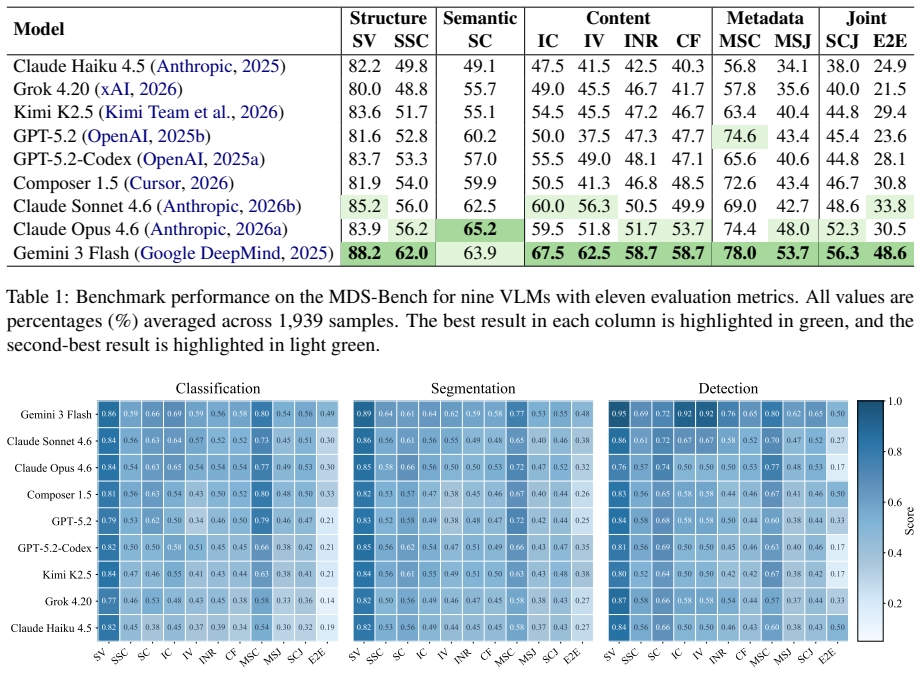
Current vision-language models can often emit schema-valid JSON, yet they fail to complete the full pipeline of source identification, visual conversion, annotation alignment, and content-faithful structuring from raw heterogeneous medical folders. On MDS-Bench the best model reaches only 48.6 percent end-to-end strict success, so raw medical data standardization remains unsolved and limits real-world medical AI.
What carries the argument
MDS-Bench: 1,939 source-traced standardization tasks scored with an eleven-metric protocol whose strict end-to-end pass requires a valid image-JSON pair, exact source match, schema validity at least 0.85, and semantic and content-fidelity scores at least 0.5.
Load-bearing premise
The claim rests on treating human-verified ground truth from public imaging datasets, scored with the authors’ chosen end-to-end thresholds, as a fair proxy for real clinical raw-data environments with private systems and incomplete metadata.
What would settle it
A controlled re-evaluation on private hospital folders (or a public subset with deliberately incomplete metadata) that drives the best model’s end-to-end rate well above or well below 48.6 percent under the same gates would confirm or undermine the bottleneck claim.
Editorial analysis
A structured set of objections, weighed in public.
Referee Report
Summary. The paper argues that medical VLM evaluation has skipped an upstream step: converting raw, heterogeneous clinical dataset folders into source-grounded, VLM-ready image–JSON units. It introduces MDS-Bench (1,939 samples over ~100 public imaging datasets spanning classification, segmentation, and detection; diverse modalities and raw formats) and an eleven-metric protocol that gates field scores on source matching and reports structure, semantic, content, metadata, and joint success, including End-to-End Strict Pass (E2E; Eqs. 2–3). Nine agentic VLMs are evaluated under a staged standardization workflow; Gemini 3 Flash is strongest yet reaches only 48.6% E2E (Table 1), with failures concentrated in content fidelity and joint pipeline success (Table 2, Fig. 6). An inference-strategy ablation (Fig. 7) shows validation-guided complete-candidate selection improves E2E but does not close the gap. The authors conclude that raw medical data standardization is a critical bottleneck for deploying medical VLMs in practice.
Significance. If the empirical picture holds, the work usefully reframes medical multimodal evaluation around a previously under-measured prerequisite rather than only post-curation diagnosis or VQA. Strengths include: a large multi-dataset construction with human verification of source-grounded targets; source matching as a gate for field metrics (methodologically appropriate); equal-weight dataset aggregation; task- and modality-wise breakdowns; error attribution by capability group; and a controlled inference-strategy ablation. The staged agentic task definition and the SCJ/E2E joint metrics make the bottleneck claim falsifiable in a way that schema-only structured-output benchmarks do not. The Limitations section is appropriately candid about public-dataset scope and residual annotation risk. These contributions are of clear interest to medical AI and multimodal agent evaluation, provided the headline quantitative claims are shown to be robust to scoring choices and the agent protocol is fully specified for reproduction.
major comments (3)
- [§3.4 Evaluation Protocol; Eqs. (2)–(3); Table 1] §3.4, Eqs. (2)–(3), Table 1: The central quantitative claim (48.6% E2E for Gemini 3 Flash; Abstract) is defined by three free gates—gi ≥ 0.85, qi ≥ 0.5, fi ≥ 0.5—plus exact source match. The manuscript motivates gi ≥ 0.85 as avoiding over-penalizing minor schema defects, but does not report sensitivity of E2E (or SCJ) under alternative thresholds (e.g., gi ∈ {0.7, 0.9, 1.0}, qi/fi ∈ {0.4, 0.6}). Because SV is already high (80–88%) while joint scores are low, the absolute “bottleneck” percentage may be partly threshold-driven. A short sensitivity table or curve for the top models is needed so readers can separate robust pipeline failure from cutoff choice; without it, the headline number is under-supported even if the qualitative structure–joint gap remains.
- [§4.1 Experimental Setup; §3.3 Staged Reasoning Design] §4.1 Experimental Setup: The evaluation is agentic (file inspection, tools, executable scripts; §3.3), yet the paper does not specify the shared coding-agent environment, available tools, prompt/scaffold text beyond the staged workflow sketch, interaction budget (turns/tool calls), timeout, or whether models may install packages or only use a fixed sandbox. These details are load-bearing for a benchmark whose scores depend on multi-step file recovery and conversion. Please add a reproducible agent protocol (or release the exact harness) so that the 48.6% E2E and model ranking can be re-run under matched conditions.
- [Abstract; §1 Introduction; Limitations] Abstract / §1 / Limitations: The claim that standardization is a “critical bottleneck … in real practice” is only partially supported by evidence from public research datasets with verified folder layouts. Limitations correctly notes missing PACS/EHR linkage, access control, and incomplete clinical metadata. The abstract and conclusion should be tightened to match the evidence (e.g., bottleneck on heterogeneous public raw imaging archives under the defined schema), or the authors should add a small clinical-style stress subset (messy paths, missing sidecars, multi-study folders) that tests the same metrics. As written, the leap from MDS-Bench to clinical deployment overstates what Table 1 measures.
minor comments (6)
- [Figure 5] Figure 5 heatmaps use hard-to-read glyph encodings in the manuscript text dump; ensure the camera-ready figure has clear numeric annotations or a readable colorbar so per-task differences are inspectable without the appendix tables.
- [Figure 6; §4.2] Figure 6 capability weights (0.15/0.20/0.25/0.10/0.30) are free parameters; state that Wgt is a presentation device and that model ranking under equal metric weights (or leave-one-group-out) is unchanged, or move Wgt to appendix.
- [Figure 5; Appendix B.2] Detection has only six datasets (Tables 8–9); the paper already cautions this is indicative—please flag the same caveat in the main-text discussion of Figure 5 so readers do not over-read detection rankings.
- [§3.2 Benchmark Construction; Limitations] Ground-truth construction (§3.2): briefly quantify human verification effort (e.g., fraction of fields corrected from model drafts, inter-annotator check on a subset) to bound residual annotation error mentioned in Limitations.
- [Abstract; §3.2] Minor consistency: Abstract says “manually annotate 1,939” while §3.2 describes model-assisted drafts plus human verification—align wording so the construction pipeline is unambiguous.
- [Appendix C.6; Eq. (15)] Eq. (15) MSJ uses a geometric mean of metadata components times CF; a one-sentence justification for the geometric mean (vs. product or min) would help readers interpret Table 1’s MSJ column.
Circularity Check
Empirical benchmark against human-verified external targets; no derivation that reduces predictions to inputs by construction.
full rationale
MDS-Bench is an evaluation paper, not a first-principles derivation. Models receive raw dataset folders and are scored against independently constructed, source-traced ground truth (manual identification of sources/labels/masks plus human verification of model-assisted drafts; §3.2). The headline 48.6% E2E figure (Abstract; Table 1; Eqs. 2–3) is the fraction of samples that simultaneously meet externally defined gates (valid image–JSON pair, exact source match si=1, gi≥0.85, qi≥0.5, fi≥0.5) relative to that verified target—not a quantity fitted from the same models’ outputs or defined in terms of the claim being proved. Schema validity is high while joint metrics are low precisely because the protocol does not credit schema-only outputs; that gap is measured, not assumed. Self-citations are ordinary related-work pointers and do not load-bear a uniqueness or ansatz claim. Threshold sensitivity of E2E and residual annotation risk (Limitations) are robustness/correctness concerns, not circular reductions. No self-definitional loop, fitted-input-as-prediction, or self-citation uniqueness chain is present.
Axiom & Free-Parameter Ledger
free parameters (4)
- E2E schema-validity gate g_i ≥ 0.85
- E2E semantic and fidelity gates q_i ≥ 0.5 and f_i ≥ 0.5
- Equal-weight average over 100 datasets
- Capability weights in Fig. 6 (0.15/0.20/0.25/0.10/0.30)
axioms (4)
- ad hoc to paper A standardized sample is adequately defined as a VLM-ready image plus schema-constrained per-image and dataset-level JSON that are source-grounded.
- domain assumption Source matching is a hard gate for field-level credit (SC/IC/IV/INR/CF only when s_i > 0).
- domain assumption Public research imaging datasets with heterogeneous formats sufficiently stress real clinical raw-data standardization.
- domain assumption Agentic VLM coding environments with file/tool access are the appropriate evaluation setting for this capability.
invented entities (3)
-
MDS-Bench (1,939 tasks / ~100 datasets)
no independent evidence
-
Eleven-metric protocol including SCJ and E2E strict pass
no independent evidence
-
Staged standardization workflow (source ID → visual conversion → annotation alignment → consistency check)
no independent evidence
read the original abstract
As vision-language models (VLMs) are increasingly applied to medical AI, existing benchmarks mainly focus on evaluating their diagnosis ability over given medical images and texts, implicitly assuming that standardized medical images, texts or question-answer pairs are already prepared. However, this assumption does not hold when we apply VLMs in real clinical practice, where medical data is often raw, heterogeneous, and fragmented across different sources. In this paper, we study this missing step, i.e., raw medical data standardization. Specifically, models are given raw dataset folders and evaluated on their ability to identify source formats, convert raw medical images into VLM-compatible visual inputs, extract relevant textual information, and organize the results into structured image-text pairs. To construct this Medical Data Standardization Benchmark (MDS-Bench), we manually annotate 1,939 raw medical data standardization tasks covering diverse clinical practice, radiology modalities, annotation formats, and directory layouts. Extensive experiments show that even the best performing VLMs, i.e., Gemini 3 Flash, achieve only 48.6% end-to-end success rate. Our research highlights raw medical data standardization as a critical bottleneck for medical AI diagnosis in real practice.
Figures




Reference graph
Works this paper leans on
-
[1]
Aho and Jeffrey D
Alfred V. Aho and Jeffrey D. Ullman , title =. 1972
1972
-
[2]
Publications Manual , year = "1983", publisher =
1983
-
[3]
Ashok K. Chandra and Dexter C. Kozen and Larry J. Stockmeyer , year = "1981", title =. doi:10.1145/322234.322243
-
[4]
Scalable training of
Andrew, Galen and Gao, Jianfeng , booktitle=. Scalable training of
-
[5]
Dan Gusfield , title =. 1997
1997
-
[6]
Tetreault , title =
Mohammad Sadegh Rasooli and Joel R. Tetreault , title =. Computing Research Repository , volume =. 2015 , url =
2015
-
[7]
A Framework for Learning Predictive Structures from Multiple Tasks and Unlabeled Data , Volume =
Ando, Rie Kubota and Zhang, Tong , Issn =. A Framework for Learning Predictive Structures from Multiple Tasks and Unlabeled Data , Volume =. Journal of Machine Learning Research , Month = dec, Numpages =
-
[8]
2025 , month = oct, url =
2025
-
[9]
2026 , month = feb, url =
2026
-
[10]
2025 , month = dec, url =
Update to. 2025 , month = dec, url =
2025
-
[11]
2025 , url =
Addendum to. 2025 , url =
2025
-
[12]
2025 , month = dec, url =
2025
-
[13]
2026 , month = feb, url =
Introducing. 2026 , month = feb, url =
2026
-
[14]
arXiv preprint arXiv:2602.02276 , year =
-
[15]
Nature , volume=
Large language models encode clinical knowledge , author=. Nature , volume=. 2023 , publisher=
2023
-
[16]
European conference on computer vision , pages=
A benchmark for automatic visual classification of clinical skin disease images , author=. European conference on computer vision , pages=. 2016 , organization=
2016
-
[17]
D'Cunha, Ryan and Lozano, Alejandro and Sun, Xiaoxiao and Jarquin, Daniel Vela and Sun, Min Woo and Aklilu, Josiah and Burgess, James and Zhang, Yuhui and Nayebi, Ryan and Avila, Paola and others , journal=
-
[18]
Nature medicine , volume=
Toward expert-level medical question answering with large language models , author=. Nature medicine , volume=. 2025 , publisher=
2025
-
[19]
Overview of
Nentidis, Anastasios and Katsimpras, Georgios and Krithara, Anastasia and Krallinger, Martin and Rodr. Overview of. International Conference of the Cross-Language Evaluation Forum for European Languages , pages=. 2025 , organization=
2025
-
[20]
Pmc-vqa: Visual instruction tuning for medical visual question answering, 2024 , author=. URL https://arxiv. org/abs/2305.10415 , volume=
Pith/arXiv arXiv 2024
-
[21]
Advances in Neural Information Processing Systems , volume=
Gmai-mmbench: A comprehensive multimodal evaluation benchmark towards general medical ai , author=. Advances in Neural Information Processing Systems , volume=
-
[22]
Proceedings of the IEEE/CVF conference on computer vision and pattern recognition , pages=
Mmmu: A massive multi-discipline multimodal understanding and reasoning benchmark for expert agi , author=. Proceedings of the IEEE/CVF conference on computer vision and pattern recognition , pages=
-
[23]
Findings of the Association for Computational Linguistics: ACL 2024 , pages=
Medagents: Large language models as collaborators for zero-shot medical reasoning , author=. Findings of the Association for Computational Linguistics: ACL 2024 , pages=
2024
-
[24]
Federated benchmarking of medical artificial intelligence with
Karargyris, Alexandros and Umeton, Renato and Sheller, Micah J and Aristizabal, Alejandro and George, Johnu and Wuest, Anna and Pati, Sarthak and Kassem, Hasan and Zenk, Maximilian and Baid, Ujjwal and others , journal=. Federated benchmarking of medical artificial intelligence with. 2023 , publisher=
2023
-
[25]
Yang, Jialin and Jiang, Dongfu and He, Lipeng and Siu, Sherman and Zhang, Yuxuan and Liao, Disen and Li, Zhuofeng and Zeng, Huaye and Jia, Yiming and Wang, Haozhe and others , journal=
-
[26]
arXiv preprint arXiv:2501.10868 , year=
Geng, Saibo and Cooper, Hudson and Moskal, Micha. arXiv preprint arXiv:2501.10868 , year=
-
[27]
Advances in Neural Information Processing Systems , volume=
Image2struct: Benchmarking structure extraction for vision-language models , author=. Advances in Neural Information Processing Systems , volume=
-
[28]
Feng, Di and Ma, Kaixin and Nan, Feng and Chen, Haofeng and Zhai, Bohan and Griffiths, David and Gao, Mingfei and Gan, Zhe and Verma, Eshan and Yang, Yinfei and others , journal=
-
[29]
arXiv preprint arXiv:1901.07042 , year=
MIMIC-CXR-JPG, a large publicly available database of labeled chest radiographs , author=. arXiv preprint arXiv:1901.07042 , year=
Pith/arXiv arXiv 1901
-
[30]
Machine learning for health (ML4H) , pages=
Med-flamingo: a multimodal medical few-shot learner , author=. Machine learning for health (ML4H) , pages=. 2023 , organization=
2023
-
[31]
IEEE transactions on medical imaging , volume=
New variants of a method of MRI scale standardization , author=. IEEE transactions on medical imaging , volume=. 2000 , publisher=
2000
-
[32]
Medical image analysis , volume=
A survey on deep learning in medical image analysis , author=. Medical image analysis , volume=. 2017 , publisher=
2017
-
[33]
Medical image analysis , volume=
The liver tumor segmentation benchmark (lits) , author=. Medical image analysis , volume=. 2023 , publisher=
2023
-
[34]
International workshop on simulation and synthesis in medical imaging , pages=
Adversarial image synthesis for unpaired multi-modal cardiac data , author=. International workshop on simulation and synthesis in medical imaging , pages=. 2017 , organization=
2017
-
[35]
Scientific data , volume=
The brain imaging data structure, a format for organizing and describing outputs of neuroimaging experiments , author=. Scientific data , volume=. 2016 , publisher=
2016
-
[36]
Nature communications , volume=
The medical segmentation decathlon , author=. Nature communications , volume=. 2022 , publisher=
2022
-
[37]
International Workshop on Deep Learning in Medical Image Analysis , pages=
Generalised dice overlap as a deep learning loss function for highly unbalanced segmentations , author=. International Workshop on Deep Learning in Medical Image Analysis , pages=. 2017 , organization=
2017
-
[38]
arXiv preprint arXiv:1902.09063 , year=
A large annotated medical image dataset for the development and evaluation of segmentation algorithms , author=. arXiv preprint arXiv:1902.09063 , year=
Pith/arXiv arXiv 1902
-
[39]
Zeitschrift fuer medizinische Physik , volume=
An overview of deep learning in medical imaging focusing on MRI , author=. Zeitschrift fuer medizinische Physik , volume=. 2019 , publisher=
2019
-
[40]
Nature methods , volume=
nnU-Net: a self-configuring method for deep learning-based biomedical image segmentation , author=. Nature methods , volume=. 2021 , publisher=
2021
-
[41]
Scientific Data , volume=
MedSegBench: A comprehensive benchmark for medical image segmentation in diverse data modalities , author=. Scientific Data , volume=. 2024 , publisher=
2024
-
[42]
International Conference on Learning Representations , volume=
Medtrinity-25m: A large-scale multimodal dataset with multigranular annotations for medicine , author=. International Conference on Learning Representations , volume=
-
[43]
Biomedical Engineering Letters , volume=
Vision-language foundation models for medical imaging: a review of current practices and innovations , author=. Biomedical Engineering Letters , volume=. 2025 , publisher=
2025
-
[44]
International Conference on Learning Representations , volume=
Mmed-rag: Versatile multimodal rag system for medical vision language models , author=. International Conference on Learning Representations , volume=
-
[45]
international conference on medical image computing and computer-assisted intervention , pages=
M4oe: A foundation model for medical multimodal image segmentation with mixture of experts , author=. international conference on medical image computing and computer-assisted intervention , pages=. 2024 , organization=
2024
-
[46]
Multimodal foundation model and benchmark for comprehensive retinal
Morano, Jos. Multimodal foundation model and benchmark for comprehensive retinal. NPJ Digital Medicine , volume=. 2025 , publisher=
2025
-
[47]
Nejm Ai , volume=
Towards generalist biomedical AI , author=. Nejm Ai , volume=. 2024 , publisher=
2024
-
[48]
Advances in Neural Information Processing Systems , volume=
Llava-med: Training a large language-and-vision assistant for biomedicine in one day , author=. Advances in Neural Information Processing Systems , volume=
-
[49]
arXiv preprint arXiv:2406.10185 , year=
Detecting and evaluating medical hallucinations in large vision language models , author=. arXiv preprint arXiv:2406.10185 , year=
-
[50]
Physica Medica , volume=
Current challenges of implementing artificial intelligence in medical imaging , author=. Physica Medica , volume=. 2022 , publisher=
2022
-
[51]
Nature methods , volume=
Metrics reloaded: recommendations for image analysis validation , author=. Nature methods , volume=. 2024 , publisher=
2024
-
[52]
arXiv preprint arXiv:2406.04449 , year=
Maira-2: Grounded radiology report generation , author=. arXiv preprint arXiv:2406.04449 , year=
-
[53]
TotalSegmentator: robust segmentation of 104 anatomic structures in
Wasserthal, Jakob and Breit, Hanns-Christian and Meyer, Manfred T and Pradella, Maurice and Hinck, Daniel and Sauter, Alexander W and Heye, Tobias and Boll, Daniel T and Cyriac, Joshy and Yang, Shan and others , journal=. TotalSegmentator: robust segmentation of 104 anatomic structures in. 2023 , publisher=
2023
-
[54]
arXiv preprint arXiv:2210.03629 , year=
React: Synergizing reasoning and acting in language models , author=. arXiv preprint arXiv:2210.03629 , year=
-
[55]
Artificial Intelligence in Medicine , volume=
Medical visual question answering: A survey , author=. Artificial Intelligence in Medicine , volume=. 2023 , publisher=
2023
-
[56]
Wilkinson, Mark D and Dumontier, Michel and Aalbersberg, IJsbrand Jan and Appleton, Gabrielle and Axton, Myles and Baak, Arie and Blomberg, Niklas and Boiten, Jan-Willem and da Silva Santos, Luiz Bonino and Bourne, Philip E and others , journal=. The. 2016 , publisher=
2016
-
[57]
BMC Medical Informatics and Decision Making , volume=
Data quality assessment in healthcare, dimensions, methods and tools: a systematic review , author=. BMC Medical Informatics and Decision Making , volume=. 2025 , publisher=
2025
-
[58]
Computers in biology and medicine , volume=
Medical data quality assessment: On the development of an automated framework for medical data curation , author=. Computers in biology and medicine , volume=. 2019 , publisher=
2019
-
[59]
BMC Medical Informatics and Decision Making , volume=
I-ETL: an interoperability-aware health (meta) data pipeline to enable federated analyses , author=. BMC Medical Informatics and Decision Making , volume=. 2025 , publisher=
2025
-
[60]
Health Information Science and Systems , volume=
A heterogeneous multi-modal medical data fusion framework supporting hybrid data exploration , author=. Health Information Science and Systems , volume=. 2022 , publisher=
2022
-
[61]
Proceedings of the 4th International Conference on Biomedical and Intelligent Systems , pages=
A review of multimodal medical data fusion techniques for personalized medicine , author=. Proceedings of the 4th International Conference on Biomedical and Intelligent Systems , pages=
-
[62]
Proceedings of the AAAI Conference on Artificial Intelligence , volume=
Data wrangling task automation using code-generating language models , author=. Proceedings of the AAAI Conference on Artificial Intelligence , volume=
-
[63]
arXiv preprint arXiv:2412.06724 , year=
Autodcworkflow: Llm-based data cleaning workflow auto-generation and benchmark , author=. arXiv preprint arXiv:2412.06724 , year=
-
[64]
2025 , publisher=
Jiang, Yixing and Black, Kameron C and Geng, Gloria and Park, Danny and Zou, James and Ng, Andrew Y and Chen, Jonathan H , journal=. 2025 , publisher=
2025
discussion (0)
Sign in with ORCID, Apple, or X to comment. Anyone can read and Pith papers without signing in.