REVIEW 2 major objections 4 minor 22 references
LILAC: Layer-Wise Independent LoRAs and Cascaded Conditioning for Multi-Concept Customization of Diffusion Models
T0 review · 2 major / 4 minor · reviewed 2026-07-11 · grok-4.5
Pith's one-line read Composing independently trained LoRAs as separate layers with one adapter active per pass removes multi-subject identity interference without weight merging.
desk verdict Clean inference-time alternative to LoRA weight fusion: one adapter per pass under frozen conditioning, with real same-backbone evidence and the usual absolute-number caveats. read the letter →
The pith
A machine-rendered reading of the paper's core claim, the machinery that carries it, and where it could break.
The reading
What carries the argument
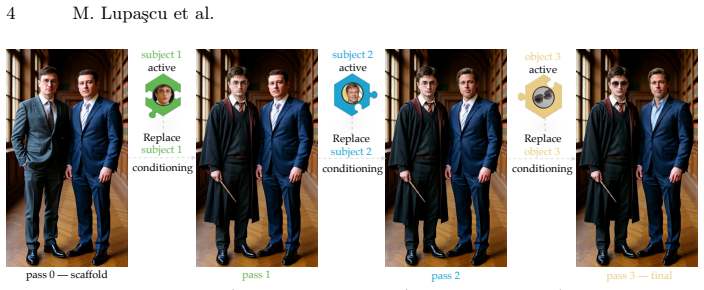
Per-layer LoRA binding with cascaded frozen conditioning: at pass k the backbone runs with only adapter ΔW_k active and is conditioned on the clean latent of the alpha-composited image of subjects 1…k−1; the merged sum of residuals is never formed.
What would settle it
Compose the same multi-subject groups with LILAC’s scaffold protocol and measure ArcFace detection rate as subject count grows and as mutual contact/occlusion increases; a sharp drop below merge-based baselines under contact-rich prompts, or progressive identity drift on earlier subjects after later passes, would falsify the claim that frozen conditioning plus single-adapter binding is sufficient.
Extended reading notes
Core claim
Multi-subject personalization does not require concepts to share a weight space. By binding exactly one independently trained LoRA per generation pass and conditioning each pass on the frozen composite of previously placed subjects, LILAC removes cross-concept parameter interference by construction, so identities cannot blend at the weight level and no joint training or per-composition optimization is needed.
Load-bearing premise
That geometric and photometric coherence among subjects will reliably emerge from frozen clean-latent conditioning alone, and that sequential editing of a running composite will not accumulate identity-destroying drift on earlier subjects—especially when subjects must touch or mutually occlude.
Editorial analysis
A structured set of objections, weighed in public.
Referee Report
Summary. The paper proposes LILAC, a multi-concept personalization method for text-to-image diffusion models that composes independently trained per-concept LoRA adapters at inference time rather than merging them in weight space. Subjects are generated sequentially as layers (or via scaffold/decomposition edits on non-layered backbones), with exactly one adapter active per pass and each generation conditioned on the frozen composite of previously placed subjects. This per-layer binding is claimed to eliminate parameter-level crosstalk by construction (Eq. 7), requiring no joint training or per-composition optimization, scaling linearly with the number of concepts, and remaining backbone-agnostic. Under the Orthogonal Adaptation concept bank and protocol the scaffold configuration on Qwen-Image-Edit reaches an ArcFace detection rate of 0.861 (vs. 0.745 reported for Orthogonal Adaptation on SDXL), with comparable CLIP-I and CLIP-T scores; a same-backbone re-run of Orthogonal Adaptation collapses to 0.000 identity while LILAC holds.
Significance. If the empirical claims hold, LILAC supplies a practical, training-free alternative to weight-space fusion methods (federated averaging, gradient fusion, orthogonality constraints) that currently dominate multi-concept customization. The isolation argument is definitional yet useful: by never forming the merged residual sum it removes a known failure mode (identity confusion, style bleeding) without rank-budget or joint-training costs. Strengths include public code, explicit same-backbone controls, single-concept screening documentation, ordering ablation, scalability curves, and a candid Limitations section. The result is of clear interest to the personalization community and to layered-generation work, even if absolute numbers partly reflect backbone strength.
major comments (2)
- Table 1 / Sec. 4.2: Absolute multi-subject ArcFace (0.861 scaffold) is compared with Orthogonal Adaptation’s 0.745 on SDXL, yet LILAC’s single-concept identity already sits at 0.961 versus 0.740 for the SDXL baselines, and Supplementary B screens out concepts that fail single-concept fidelity before multi-subject evaluation. The same-backbone OA collapse to 0.000 is convincing evidence that parameter-level interference is real, but the paper should more carefully disentangle composition benefit from backbone strength and pre-filtering—e.g., by reporting unscreened multi-subject numbers or matched single-concept baselines on the identical Qwen backbone—so that the headline claim is not overstated.
- Sec. 3.4–3.5 and Limitations: The central premise that geometric/photometric coherence emerges reliably from frozen clean-latent conditioning alone (without spatial losses or joint optimization) is acknowledged to break under close mutual occlusion and physical contact. These are common multi-subject scenarios; a quantitative failure-mode analysis (e.g., fraction of prompts that produce interpenetration artifacts, or a controlled occlusion subset of the Orthogonal Adaptation bank) would make the practical scope of the method clearer and would strengthen rather than weaken the contribution.
minor comments (4)
- Abstract: the sentence “while Orthogonal Adaptation reports 0.745 in its original setting. Adaptation reports 0.745 in its original setting.” is duplicated; remove the second occurrence.
- Fig. 7 caption and Sec. 3.5: the normalized overlap of 0.106 (5.3 imes chance level) is useful supporting evidence; consider adding the precise definition of the normalized Frobenius overlap so readers can reproduce the matrix.
- Sec. 4.4 / Fig. 8: ArcFace detection rate becomes noisy (std > 0.2) at N ≥ 3; a short note clarifying that this is attributed to face size/occlusion rather than identity blending would prevent misreading the scalability claim.
- Implementation details (Supp. B): rank-64 LoRA, 1 000 steps, blank-source training are stated; a one-line note on whether the same hyper-parameters were used for the Orthogonal Adaptation re-run on Qwen would improve reproducibility of the same-backbone comparison.
Circularity Check
No significant circularity; isolation is definitional of the non-merging protocol, metrics are external, and no fitted quantities are re-presented as predictions.
full rationale
LILAC is an empirical systems/methods paper whose central claim is a design choice (per-pass single-adapter binding + frozen clean-latent conditioning) rather than a first-principles derivation. Sec. 3.5 and Eq. 7 correctly observe that the merged residual sum of weight-space fusion is never formed, so parameter-level crosstalk is never instantiated; this is tautological of the procedure, not a circular reduction of a predicted quantity to its own inputs. Identity, concept, and text metrics (ArcFace detection rate, CLIP-I, CLIP-T) are pre-existing external evaluators taken from the Orthogonal Adaptation protocol; no free parameters are fitted on a subset and then called predictions. The LaDe backbone (overlapping authors) is used only as one of two validation platforms; the headline 0.861 number and the same-backbone Orthogonal Adaptation collapse (0.000) are obtained on independent Qwen-Image-Edit models. Concept screening (Supp. B) is an explicit pre-filter, not a hidden circular fit. No uniqueness theorems, ansatzes, or renamed known results appear. The derivation chain is therefore self-contained against external benchmarks.
Assumptions & free parameters
free parameters (4)
- LoRA rank r =
64
- adapter training steps / learning rate =
1000 steps, 1e-4
- ArcFace identity threshold =
0.32 cosine
- anchor selection rule =
max ||ΔW||_F first
assumptions (4)
- domain assumption A diffusion backbone that admits low-rank adaptation and can condition generation on a clean (t=0) latent or image edit channel exists and remains frozen.
- domain assumption An independently trained single-concept LoRA captures identity sufficiently that the subject can be regenerated when its adapter alone is active.
- domain assumption Alpha compositing (or image-edit replacement of placeholders) of sequentially generated layers yields a coherent final image without requiring joint optimization.
- standard math Standard linear algebra of residual adapters (ΔW = BA) and the definition of crosstalk χ_ij = ||ΔW_i^T ΔW_j||_F.
invented entities (3)
-
LILAC cascaded inference protocol (per-layer LoRA binding + frozen composite conditioning)
independent evidence
-
Scaffold configuration for non-layered editors
independent evidence
-
Decomposition configuration via off-the-shelf layer split
independent evidence
Cite this review
Pith. "Pith review of LILAC: Layer-Wise Independent LoRAs and Cascaded Conditioning for Multi-Concept Customization of Diffusion Models." pith.science (2026). https://pith.science/paper/QSTR7EZT
@misc{pith2026260704801,
  author       = {Pith},
  title        = {Pith review of: LILAC: Layer-Wise Independent LoRAs and Cascaded Conditioning for Multi-Concept Customization of Diffusion Models},
  year         = {2026},
  howpublished = {\url{https://pith.science/paper/QSTR7EZT}},
  note         = {Machine review of arXiv:2607.04801}
}
read the original abstract
Personalizing text-to-image diffusion models to render several specific subjects in a coherent image remains challenging: the model must preserve each subject's identity while keeping the scene spatially and visually coherent. Methods that fuse independently trained concept adapters in a shared weight space (via federated averaging, gradient fusion, or orthogonality constraints) suffer from identity confusion and style bleeding and require joint retraining. In this work, we show that composing concepts as separate image layers, instead of merging their adapters in a shared weight space, avoids parameter-level interference. We introduce LILAC, a framework that composes independently trained low-rank adapters at inference time: each subject is conditioned on the frozen composite of previously placed subjects, with exactly one adapter active at a time, therefore identities never interfere at the parameter level. LILAC composes the adapters without any joint training, scales linearly with the number of concepts, and is backbone-agnostic. Under the Orthogonal Adaptation protocol, LILAC applied on Qwen-Image-Edit reaches an ArcFace detection rate of 0.861, while Orthogonal Adaptation reports 0.745 in its original setting. Adaptation reports 0.745 in its original setting. Code is available at https://github.com/marianlupascu/LILAC.
Figures


Figures from the paper (5 more)


Reference graph
Works this paper leans on
-
[1]
161:1–161:10 (2025).https://doi.org/10.1145/3757377.3763987
Abdal,R.,Patashnik,O.,Deyneka,E.,Chen,H.,Siarohin,A.,Tulyakov,S.,Cohen- Or, D., Aberman, K.: Zero-shot dynamic concept personalization with grid-based lora pp. 161:1–161:10 (2025).https://doi.org/10.1145/3757377.3763987
-
[2]
Deng, J., Guo, J., Xue, N., Zafeiriou, S.: Arcface: Additive angular margin loss for deep face recognition. In: IEEE Conference on Computer Vision and Pattern Recognition, CVPR 2019, Long Beach, CA, USA, June 16-20, 2019. pp. 4690–4699. Computer Vision Foundation / IEEE (2019).https://doi.org/10.1109/CVPR. 2019.00482
doi:10.1109/cvpr 2019
-
[3]
In: Leonardis, A., Ricci, E., Roth, S., Russakovsky, O., Sattler, T., Varol, G
Frenkel, Y., Vinker, Y., Shamir, A., Cohen-Or, D.: Implicit style-content sep- aration using b-lora. In: Leonardis, A., Ricci, E., Roth, S., Russakovsky, O., Sattler, T., Varol, G. (eds.) Computer Vision - ECCV 2024 - 18th European Conference, Milan, Italy, September 29-October 4, 2024, Proceedings, Part X. Lecture Notes in Computer Science, vol. 15068, p...
-
[4]
In: International Conference on Learning Representations (ICLR) (2023)
Gal, R., Alaluf, Y., Atzmon, Y., Patashnik, O., Bermano, A.H., Chechik, G., Cohen-Or, D.: An image is worth one word: Personalizing text-to-image generation using textual inversion. In: International Conference on Learning Representations (ICLR) (2023)
2023
-
[5]
In: Oh, A., Naumann, T., Globerson, A., Saenko, K., Hardt, M., Levine, S
Gu, Y., Wang, X., Wu, J.Z., Shi, Y., Chen, Y., Fan, Z., Xiao, W., Zhao, R., Chang, S., Wu, W., Ge, Y., Shan, Y., Shou, M.Z.: Mix-of-show: Decentralized low- rank adaptation for multi-concept customization of diffusion models. In: Oh, A., Naumann, T., Globerson, A., Saenko, K., Hardt, M., Levine, S. (eds.) Advances in Neural Information Processing Systems ...
2023
-
[6]
In: The Tenth International Conference on Learning Representations, ICLR 2022, Virtual Event, April 25-29,
Hu, E.J., Shen, Y., Wallis, P., Allen-Zhu, Z., Li, Y., Wang, S., Wang, L., Chen, W.: Lora: Low-rank adaptation of large language models. In: The Tenth International Conference on Learning Representations, ICLR 2022, Virtual Event, April 25-29,
2022
-
[7]
OpenReview.net (2022)
2022
-
[8]
Lecture Notes in Computer Science, vol
Kong, Z., Zhang, Y., Yang, T., Wang, T., Zhang, K., Wu, B., Chen, G., Liu, W., Luo, W.: Omg: Occlusion-friendly personalized multi-concept generation in diffu- sionmodels.In:ComputerVision-ECCV2024-18thEuropeanConference,Milan, Italy, September 29-October 4, 2024, Proceedings, Part XXXI. Lecture Notes in Computer Science, vol. 15089, pp. 253–270. Springer (2024)
2024
Show all 22 references
-
[9]
In: IEEE/CVF Conference on Computer Vi- sion and Pattern Recognition, CVPR 2023, Vancouver, BC, Canada, June 17-24,
Kumari, N., Zhang, B., Zhang, R., Shechtman, E., Zhu, J.: Multi-concept cus- tomization of text-to-image diffusion. In: IEEE/CVF Conference on Computer Vi- sion and Pattern Recognition, CVPR 2023, Vancouver, BC, Canada, June 17-24,
2023
- [10]
-
[11]
In: IEEE/CVF Conference on Computer Vision and Pattern Recognition, CVPR 2023, Vancouver, BC, Canada, June 17- 24, 2023
Li, Y., Liu, H., Wu, Q., Mu, F., Yang, J., Gao, J., Li, C., Lee, Y.J.: GLIGEN: open- set grounded text-to-image generation. In: IEEE/CVF Conference on Computer Vision and Pattern Recognition, CVPR 2023, Vancouver, BC, Canada, June 17- 24, 2023. pp. 22511–22521. IEEE (2023).htt...
2023 doi
-
[12]
arXiv preprint arXiv:2603.17965 (2026) 16 M
Lungu-Stan, V.C., Mironică, I., Georgescu, M.I.: Lade: Unified multi-layered graphic media generation and decomposition. arXiv preprint arXiv:2603.17965 (2026) 16 M. Lupaşcu et al
2026
-
[13]
In: IEEE/CVF Conference on Computer Vision and Pattern Recog- nition, CVPR 2025, Nashville, TN, USA, June 11-15, 2025
Ouyang, Z., Li, Z., Hou, Q.: K-lora: Unlocking training-free fusion of any subject and style loras. In: IEEE/CVF Conference on Computer Vision and Pattern Recog- nition, CVPR 2025, Nashville, TN, USA, June 11-15, 2025. pp. 13041–13050. Com- puter Vision Foundation / IEEE (2025...
2025 doi
-
[14]
In: IEEE/CVF Conference on Computer Vision and Pattern Recognition, CVPR 2024, Seattle, WA, USA, June 16-22, 2024
Po, R., Yang, G., Aberman, K., Wetzstein, G.: Orthogonal adaptation for modular customization of diffusion models. In: IEEE/CVF Conference on Computer Vision and Pattern Recognition, CVPR 2024, Seattle, WA, USA, June 16-22, 2024. pp. 7964–7973. IEEE (2024).https://doi.org/10.1...
2024 doi
-
[15]
In: International Conference on Machine Learning (ICML) (2021)
Radford, A., Kim, J.W., Hallacy, C., Ramesh, A., Goh, G., Agarwal, S., Sastry, G., Askell, A., Mishkin, P., Clark, J., Krueger, G., Sutskever, I.: Learning transferable visual models from natural language supervision. In: International Conference on Machine Learning (ICML) (2021)
2021
-
[16]
In: Meila, M., Zhang, T
Radford, A., Kim, J.W., Hallacy, C., Ramesh, A., Goh, G., Agarwal, S., Sastry, G., Askell, A., Mishkin, P., Clark, J., Krueger, G., Sutskever, I.: Learning transferable visual models from natural language supervision. In: Meila, M., Zhang, T. (eds.) Proceedings of the 38th Int...
2021
-
[17]
In: IEEE/CVF Conference on Computer Vision and Pattern Recognition, CVPR 2023, Vancouver, BC, Canada, June 17-24, 2023
Ruiz, N., Li, Y., Jampani, V., Pritch, Y., Rubinstein, M., Aberman, K.: Dream- booth: Fine tuning text-to-image diffusion models for subject-driven generation. In: IEEE/CVF Conference on Computer Vision and Pattern Recognition, CVPR 2023, Vancouver, BC, Canada, June 17-24, 202...
2023 doi
-
[18]
In: Leonardis, A., Ricci, E., Roth, S., Russakovsky, O., Sattler, T., Varol, G
Shah, V., Ruiz, N., Cole, F., Lu, E., Lazebnik, S., Li, Y., Jampani, V.: Ziplora: Any subject in any style by effectively merging loras. In: Leonardis, A., Ricci, E., Roth, S., Russakovsky, O., Sattler, T., Varol, G. (eds.) Computer Vision - ECCV 2024 - 18th European Conferenc...
2024 doi
- [19]
-
[20]
Wu, C., Li, J., Zhou, J., Lin, J., Gao, K., Yan, K., Yin, S.m., Bai, S., Xu, X., et al.: Qwen-image technical report (2025)
2025
-
[21]
arXiv preprint arXiv:2512.15603 (2025)
Yin, S., Zhang, Z., Tang, Z., Gao, K., Xu, X., Yan, K., Li, J., Chen, Y., Chen, Y., Shum, H., Ni, L.M., Zhou, J., Lin, J., Wu, C.: Qwen-image-layered: Towards in- herent editability via layer decomposition. arXiv preprint arXiv:2512.15603 (2025)
2025
-
[22]
ACM Trans
Zhang, L., Agrawala, M.: Transparent image layer diffusion using latent trans- parency. ACM Trans. Graph.43(4), 100:1–100:15 (2024).https://doi.org/10. 1145/3658150 LILAC: Layered Multi-Concept Customization of Diffusion Models 17 Orthogonal AdaptationOrthogonal AdaptationOrth...
2024
Reviewed July 11, 2026 · model on record in the stance chip above.
Discussion (0). Sign in to comment.