REVIEW 3 major objections 6 minor 65 references
UNIVERSE: Unified Video Action Models for Autonomous Driving with Flexible Mask-Modulated Modality Generation
T0 review · 3 major / 6 minor · reviewed 2026-07-11 · grok-4.5
Pith's one-line read Co-training future video and ego trajectories inside one shared Diffusion Transformer transfers world dynamics to planning more effectively than separate video and action models.
desk verdict Solid systems paper: shared DiT + future-token mask is a real, useful design for WAMs; the shared-vs-Two-DiT gap is directionally right but not capacity-matched. read the letter →
The pith
A machine-rendered reading of the paper's core claim, the machinery that carries it, and where it could break.
The reading
What carries the argument
Modality-Decoupling Visibility Mask on a single shared Diffusion Transformer: future video and trajectory tokens may attend to the same historical context and to their own modality, but not to each other, yielding coupling-by-parameters and decoupling-by-visibility so one model supports joint, video-only, and trajectory-only rollouts.
What would settle it
Train a matched dual-DiT system with equal total parameters, the same pretrained backbone, and the same training budget on NAVSIM; if its zero-shot L2 and collision rates on nuScenes and Bench2Drive match or beat the single shared DiT, the claim that shared generative parameters are required for the transfer fails.
Extended reading notes
Core claim
Architecture determines how well future-video supervision helps planning: dense video dynamics improve action generalization most when future video latents and ego-trajectory tokens update one shared generative backbone. UNIVERSE places both inside a single Diffusion Transformer under a Modality-Decoupling Visibility Mask that shares history but blocks future video–trajectory attention, so video loss directly shapes trajectory denoising without future-target leakage, and trajectory-only inference remains valid and efficient.
Load-bearing premise
The Two-DiT and no-mask variants are treated as fair controls, so gains are attributed to shared parameters and the visibility mask rather than to capacity, optimization, or the large pretrained video backbone.
Editorial extensions
If this is right
- Trajectory-only deployment can keep video co-training’s generalization benefit without paying multi-frame video diffusion cost at test time.
- Cascaded or dual-DiT world–action designs leave more room for dataset-specific action overfitting than a shared backbone does.
- The same trained weights can switch among trajectory-only planning, video-only simulation, and joint interpretable rollout by changing the mask and instantiated token groups.
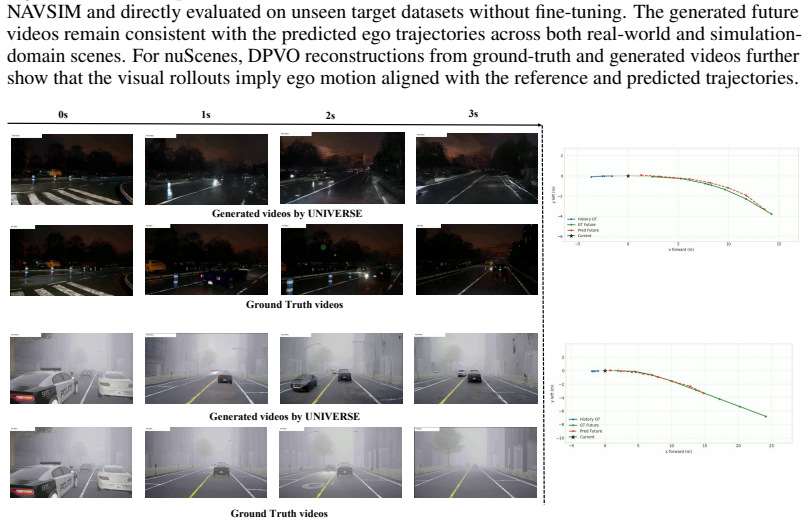
- Future-video prediction is more than auxiliary visualization: removing it measurably hurts closed-loop PDMS and zero-shot safety.
- Ablations that isolate video loss, the visibility mask, and parameter sharing are sufficient to attribute which factor drives transfer.
Reading between the lines
- The same coupling-by-parameters and decoupling-by-visibility pattern could apply to other multi-modal generative policies where one modality is expensive at test time, such as robot manipulation or navigation.
- If training cost is dominated by the large video backbone, distilling the shared DiT into a trajectory-only student may preserve most of the generalization at lower train cost.
- External odometry consistency between generated video and predicted trajectory is a reusable diagnostic for world–action models beyond this paper’s ablations.
- Extending the mask to multi-view, map, or LiDAR tokens would test whether shared-backbone gains grow or shrink once richer history is available.
Editorial analysis
A structured set of objections, weighed in public.
Referee Report
Summary. UNIVERSE proposes a unified video–action world model for autonomous driving built on a single mask-modulated Diffusion Transformer that co-trains future video latents and ego-trajectory tokens under shared generative parameters. A Modality-Decoupling Visibility Mask shares historical context while blocking mutual attention between future video and trajectory tokens, enabling joint, video-only, and trajectory-only inference; trajectory-only rollout removes future-video denoising and yields a reported 4.3× speedup. The central claim is that coupling-by-parameters transfers video-learned dynamics to planning more effectively than cascaded or dual-DiT designs, while decoupling-by-visibility preserves causal validity and efficient deployment. Evidence includes NAVSIM closed-loop PDMS (91.0), controlled variants (no video co-train, no mask, Two-DiT), zero-shot transfer to nuScenes and Bench2Drive, FID/FVD video quality, DPVO-based video–action consistency, and efficiency tables.
Significance. If the architectural thesis holds, the paper offers a clear and practically useful design principle for driving WAMs: dense video supervision should update the same DiT parameters used for trajectory denoising, while future modalities remain causally separated at the token level. The combination of strong zero-shot transfer, flexible inference modes, and efficiency gains over coupled rollout is valuable for planning-oriented world models. Strengths include matched ablations isolating video co-training, the visibility mask, and shared vs. separated DiTs; external-benchmark evaluation; and explicit DPVO consistency checks. These make the work more than a pure systems bake-off and give the community a falsifiable comparison between shared-parameter and dual-DiT video–action designs.
major comments (3)
- [Sec. 3.5, 4.5; Table 5] Sec. 3.5 and Sec. 4.5 treat UNIVERSE Two-DiT as the fair control that preserves video co-training, conditions, losses, tokenization, and schedule while removing shared parameters. Table 5 shows substantially higher training peak memory (88.3 GB vs 52.1 GB) and higher inference memory/latency for Two-DiT, indicating two full DiT stacks rather than a parameter- or FLOP-matched dual backbone. With a large pretrained Wan2.2 backbone and joint flow matching (Eq. 6), the PDMS/zero-shot gap (91.0 vs 89.6; weaker Two-DiT transfer in Table 2) may partly reflect optimization/capacity allocation rather than pure coupling-by-parameters. A width/depth- or parameter-matched dual-DiT control (or explicit parameter/FLOP accounting with multi-seed variance) is needed to isolate the architectural claim.
- [Tables 1–2, 4–5; Sec. 4.5] All headline numbers (NAVSIM PDMS, zero-shot L2/collision, efficiency) appear to be single-run. The shared-vs-Two-DiT and video-co-train gaps are modest in absolute terms on NAVSIM (91.0 vs 89.6 / 88.2) but are used to support the central generalization thesis. Without seed variance, confidence intervals, or repeated training, it is hard to judge whether the architectural ranking is stable. At minimum, multi-seed means/std for the main variants on NAVSIM and one zero-shot setting would make the load-bearing comparisons credible.
- [Sec. 3.2–3.3, 4.5; Tables 1–2, 5] The no-mask variant matches in-domain PDMS (90.9 vs 91.0) but is worse under domain shift and much slower because coupled rollout is required (Tables 1–2, 5). The paper argues this shows the mask’s value for causal validity and flexible deployment. That is plausible, but the train–test dependency argument would be stronger with a direct measurement of train–test mismatch when future video is dropped for a model trained without the mask (e.g., attention-dependency diagnostics or forced trajectory-only evaluation of the no-mask model). Currently the safety/latency costs are shown, but the claimed causal-leakage mechanism is only indirectly supported.
minor comments (6)
- [Abstract, Sec. 1–2] Throughout the manuscript, spacing artifacts appear in acronyms and names (e.g., “W AMs”, “NA VSIM”, “BEV ,”, “WoV oGen”). These should be cleaned for camera-ready readability.
- [Sec. 3.1, Eq. (2)] Eq. (2) reuses Ts for both the text-encoder output and the earlier text-instruction symbol T; a distinct symbol for encoded text tokens would avoid confusion with the raw instruction.
- [Fig. 1–2] Fig. 1 and Fig. 2 are dense; enlarging the mask schematic and explicitly labeling which attention edges are blocked would help readers who skip Sec. 3.2.
- [Table 6; Sec. 4.6] Table 6 shows 12 future frames underperform 8 frames; a short discussion of why longer horizons hurt (noise accumulation, optimization trade-off, or resolution/compute) would help practitioners choose N.
- [Sec. 4.1; Limitations] Limitations correctly note front-view-only input and training cost of the video backbone; stating whether multi-view or map/LiDAR fusion is architecturally compatible with the same mask would clarify the path to more interactive scenes.
- [Sec. 2.2; Fig. 1] Related work is thorough; a short explicit comparison table of cascaded vs dual-DiT vs unified designs (inputs, shared parameters, test-time video required) would make the positioning in Fig. 1 easier to cite.
Circularity Check
No circularity: empirical architecture paper evaluated on external closed-loop and zero-shot benchmarks; claims are not forced by definition or self-citation.
full rationale
UNIVERSE is a systems paper whose load-bearing claims are empirical comparisons (NAVSIM PDMS, nuScenes/Bench2Drive L2 and collision rates, latency/memory) against external benchmarks and controlled ablations (w.o. video co-train, w.o. Mask, Two-DiT). The shared-DiT objective (Eq. 6), Modality-Decoupling Visibility Mask (Sec. 3.2 / Eq. 7), and flexible inference modes do not define the reported metrics in terms of fitted free parameters, nor do they rename a known result as a first-principles derivation. Self-citations (e.g., DriveVA, Fast-WAM positioning) are background, not uniqueness theorems that force the architecture. Capacity-matching concerns about Two-DiT vs shared DiT are experimental-design risks, not circular reductions of prediction to input. Score 0 is appropriate.
Assumptions & free parameters
free parameters (5)
- lambda_vid (video loss weight)
- future video horizon N
- flow sampling steps at inference
- learning rate / batch / training schedule
- history length l and resolution
assumptions (5)
- domain assumption Dense future-video prediction provides useful world-dynamics supervision for ego trajectory generation under domain shift.
- domain assumption Flow matching on latent video and trajectory tokens is a valid generative training objective for planning metrics.
- ad hoc to paper Blocking mutual attention between future video and trajectory tokens preserves causal validity while shared parameters still transfer dynamics.
- domain assumption NAVSIM-trained front-view policies evaluated zero-shot on nuScenes/Bench2Drive measure transferable action priors rather than benchmark artifacts.
- standard math Standard transformer self-attention and DiT blocks can share modalities via token concatenation plus masks.
invented entities (3)
-
UNIVERSE shared mask-modulated video-action DiT
-
Modality-Decoupling Visibility Mask
-
Flexible Inference Controller (trajectory-only / video-only / joint modes)
Cite this review
Pith. "Pith review of UNIVERSE: Unified Video Action Models for Autonomous Driving with Flexible Mask-Modulated Modality Generation." pith.science (2026). https://pith.science/paper/D4N4OO53
@misc{pith2026260705133,
  author       = {Pith},
  title        = {Pith review of: UNIVERSE: Unified Video Action Models for Autonomous Driving with Flexible Mask-Modulated Modality Generation},
  year         = {2026},
  howpublished = {\url{https://pith.science/paper/D4N4OO53}},
  note         = {Machine review of arXiv:2607.05133}
}
abstract
World Action Models (WAMs) have shown strong potential for improving action generalization in autonomous driving by using future video prediction as dense supervision for scene dynamics and temporal causality. However, it remains unclear which architecture better transfers video-modeling benefits to trajectory generation. Existing cascaded or dual-DiT designs separate video imagination from action prediction, weakening the transfer of video-learned world dynamics to the trajectory branch: the action model may still overfit dataset-specific driving priors, while the video model only indirectly regularizes planning. We propose UNIVERSE, a unified video-action model built upon a single mask-modulated Diffusion Transformer. By co-training future video latents and ego-trajectory tokens within shared generative parameters, UNIVERSE allows dense video supervision to directly shape trajectory denoising, leading to stronger cross-domain action generalization. To ensure causal validity and efficient deployment, we introduce a Modality-Decoupling Visibility Mask, which shares historical context across modalities while blocking mutual attention between future video and trajectory tokens. This prevents future-target leakage and enables trajectory-only inference by removing future-video denoising at test time, achieving a $4.3\times$ speedup over joint video-action rollout while maintaining comparable planning accuracy. The same model also supports video-only and joint video-action rollouts. Experiments show that UNIVERSE achieves 91.0 PDMS on NAVSIM (vs. 89.6 for the Two-DiT variant), and demonstrates strong zero-shot transfer to nuScenes and Bench2Drive without fine-tuning, while ablations confirm the importance of single-DiT unification, video co-training, and mask-based modality decoupling.
Figures


Figures from the paper (4 more)


Reference graph
Works this paper leans on
-
[1]
Planning-oriented autonomous driving
Yihan Hu, Jiazhi Yang, Li Chen, Keyu Li, Chonghao Sima, Xizhou Zhu, Siqi Chai, Senyao Du, Tianwei Lin, Wenhai Wang, et al. Planning-oriented autonomous driving. InProceedings of the IEEE/CVF conference on computer vision and pattern recognition, pages 17853–17862, 2023
2023
-
[2]
Transfuser: Imitation with transformer-based sensor fusion for autonomous driving.IEEE transactions on pattern analysis and machine intelligence, 45(11):12878–12895, 2022
Kashyap Chitta, Aditya Prakash, Bernhard Jaeger, Zehao Yu, Katrin Renz, and Andreas Geiger. Transfuser: Imitation with transformer-based sensor fusion for autonomous driving.IEEE transactions on pattern analysis and machine intelligence, 45(11):12878–12895, 2022
2022
-
[3]
Diffusiondrive: Truncated diffusion model for end-to-end autonomous driving
Bencheng Liao, Shaoyu Chen, Haoran Yin, Bo Jiang, Cheng Wang, Sixu Yan, Xinbang Zhang, Xiangyu Li, Ying Zhang, Qian Zhang, et al. Diffusiondrive: Truncated diffusion model for end-to-end autonomous driving. InProceedings of the Computer Vision and Pattern Recognition Conference, pages 12037–12047, 2025
2025
-
[4]
World action models are zero-shot policies.arXiv preprint arXiv:2602.15922, 2026
Seonghyeon Ye, Yunhao Ge, Kaiyuan Zheng, Shenyuan Gao, Sihyun Yu, George Kurian, Suneel Indupuru, You Liang Tan, Chuning Zhu, Jiannan Xiang, et al. World action models are zero-shot policies.arXiv preprint arXiv:2602.15922, 2026
arXiv 2026
-
[5]
A path towards autonomous machine intelligence version 0.9
Yann LeCun. A path towards autonomous machine intelligence version 0.9. 2, 2022-06-27.Open Review, 62(1):1–62, 2022
2022
-
[6]
World models.arXiv preprint arXiv:1803.10122, 2018
David Ha and Jürgen Schmidhuber. World models.arXiv preprint arXiv:1803.10122, 2018
arXiv 2018
-
[8]
Genad: Generative end-to-end autonomous driving
Wenzhao Zheng, Ruiqi Song, Xianda Guo, Chenming Zhang, and Long Chen. Genad: Generative end-to-end autonomous driving. InEuropean Conference on Computer Vision, pages 87–104. Springer, 2024
2024
-
[10]
Dreamgen: Unlocking generalization in robot learning through video world models
Joel Jang, Seonghyeon Ye, Zongyu Lin, Jiannan Xiang, Johan Bjorck, Yu Fang, Fengyuan Hu, Spencer Huang, Kaushil Kundalia, Yen-Chen Lin, Loïc Magne, Ajay Mandlekar, Avnish Narayan, You Liang Tan, Guanzhi Wang, Jing Wang, Qi Wang, Yinzhen Xu, Xiaohui Zeng, Kaiyuan Zheng, Ruijie Zheng, Ming-Yu Liu, Luke Zettlemoyer, Dieter Fox, Jan Kautz, Scott Reed, Yuke Zh...
2025
Show all 65 references
-
[11]
Causal world modeling for robot control.arXiv preprint arXiv:2601.21998, 2026
Lin Li, Qihang Zhang, Yiming Luo, Shuai Yang, Ruilin Wang, Fei Han, Mingrui Yu, Zelin Gao, Nan Xue, Xing Zhu, Yujun Shen, and Yinghao Xu. Causal world modeling for robot control.arXiv preprint arXiv:2601.21998, 2026
2026 arXiv
-
[12]
Unified video action model.arXiv preprint arXiv:2503.00200, 2025
Shuang Li, Yihuai Gao, Dorsa Sadigh, and Shuran Song. Unified video action model.arXiv preprint arXiv:2503.00200, 2025. 10
2025 arXiv
-
[13]
Unified world models: Coupling video and action diffusion for pretraining on large robotic datasets.arXiv preprint arXiv:2504.02792, 2025
Chuning Zhu, Raymond Yu, Siyuan Feng, Benjamin Burchfiel, Paarth Shah, and Abhishek Gupta. Unified world models: Coupling video and action diffusion for pretraining on large robotic datasets.arXiv preprint arXiv:2504.02792, 2025
2025 arXiv
-
[14]
Fast-wam: Do world action models need test-time future imagination?arXiv preprint arXiv:2603.16666, 2026
Tianyuan Yuan, Zibin Dong, Yicheng Liu, and Hang Zhao. Fast-wam: Do world action models need test-time future imagination?arXiv preprint arXiv:2603.16666, 2026
2026 arXiv
-
[15]
Imagidrive: A unified imagination-and-planning framework for autonomous driving.arXiv preprint arXiv:2508.11428, 2025
Jingyu Li, Bozhou Zhang, Xin Jin, Jiankang Deng, Xiatian Zhu, and Li Zhang. Imagidrive: A unified imagination-and-planning framework for autonomous driving.arXiv preprint arXiv:2508.11428, 2025
2025
-
[16]
Driveva: Video action models are zero-shot drivers
Mengmeng Liu, Diankun Zhang, Jiuming Liu, Jianfeng Cui, Hongwei Xie, Guang Chen, Hangjun Ye, Michael Ying Yang, Francesco Nex, and Hao Cheng. Driveva: Video action models are zero-shot drivers. arXiv preprint arXiv:2604.04198, 2026
2026 arXiv
-
[17]
Gigaworld-policy: An efficient action-centered world–action model.arXiv preprint arXiv:2603.17240, 2026
Angen Ye, Boyuan Wang, Chaojun Ni, Guan Huang, Guosheng Zhao, Hao Li, Hengtao Li, Jie Li, Jindi Lv, Jingyu Liu, Min Cao, Peng Li, Qiuping Deng, Wenjun Mei, Xiaofeng Wang, Xinze Chen, Xinyu Zhou, Yang Wang, Yifan Chang, Yifan Li, Yukun Zhou, Yun Ye, Zhichao Liu, and Zheng Zhu. ...
2026
-
[18]
Prophetdwm: A driving world model for rolling out future actions and videos.arXiv preprint arXiv:2505.18650, 2025
Xiaodong Wang and Peixi Peng. Prophetdwm: A driving world model for rolling out future actions and videos.arXiv preprint arXiv:2505.18650, 2025
2025 arXiv
-
[19]
mimic- video: Video-action models for generalizable robot control beyond vlas.arXiv preprint arXiv:2512.15692, 2025
Jonas Pai, Liam Achenbach, Victoriano Montesinos, Benedek Forrai, Oier Mees, and Elvis Nava. mimic- video: Video-action models for generalizable robot control beyond vlas.arXiv preprint arXiv:2512.15692, 2025
2025 arXiv
-
[20]
Video generators are robot policies.arXiv preprint arXiv:2508.00795, 2025
Junbang Liang, Pavel Tokmakov, Ruoshi Liu, Sruthi Sudhakar, Paarth Shah, Rares Ambrus, and Carl V ondrick. Video generators are robot policies.arXiv preprint arXiv:2508.00795, 2025
2025 arXiv
-
[21]
Cosmos policy: Fine-tuning video models for visuomotor control and planning.arXiv preprint arXiv:2601.16163, 2026
Moo Jin Kim, Yihuai Gao, Tsung-Yi Lin, Yen-Chen Lin, Yunhao Ge, Grace Lam, Percy Liang, Shuran Song, Ming-Yu Liu, Chelsea Finn, et al. Cosmos policy: Fine-tuning video models for visuomotor control and planning.arXiv preprint arXiv:2601.16163, 2026
2026 arXiv
-
[22]
Large video planner enables generalizable robot control
Boyuan Chen, Tianyuan Zhang, Haoran Geng, Kiwhan Song, Caiyi Zhang, Peihao Li, William T Freeman, Jitendra Malik, Pieter Abbeel, Russ Tedrake, et al. Large video planner enables generalizable robot control. arXiv preprint arXiv:2512.15840, 2025
2025 arXiv
-
[23]
Scalable diffusion models with transformers
William Peebles and Saining Xie. Scalable diffusion models with transformers. InProceedings of the IEEE/CVF international conference on computer vision, pages 4195–4205, 2023
2023
-
[24]
Dual-stream diffusion for world-model augmented vision-language-action model.arXiv preprint arXiv:2510.27607, 2025
John Won, Kyungmin Lee, Huiwon Jang, Dongyoung Kim, and Jinwoo Shin. Dual-stream diffusion for world-model augmented vision-language-action model.arXiv preprint arXiv:2510.27607, 2025
2025 arXiv
-
[25]
Drivegan: Towards a controllable high-quality neural simulation
Seung Wook Kim, Jonah Philion, Antonio Torralba, and Sanja Fidler. Drivegan: Towards a controllable high-quality neural simulation. InProceedings of the IEEE/CVF Conference on Computer Vision and Pattern Recognition, pages 5820–5829, 2021
2021
-
[26]
Magicdrive: Street view generation with diverse 3d geometry control.arXiv preprint arXiv:2310.02601, 2023
Ruiyuan Gao, Kai Chen, Enze Xie, Lanqing Hong, Zhenguo Li, Dit-Yan Yeung, and Qiang Xu. Magicdrive: Street view generation with diverse 3d geometry control.arXiv preprint arXiv:2310.02601, 2023
2023 arXiv
-
[27]
Drivedreamer: Towards real-world-drive world models for autonomous driving
Xiaofeng Wang, Zheng Zhu, Guan Huang, Xinze Chen, Jiagang Zhu, and Jiwen Lu. Drivedreamer: Towards real-world-drive world models for autonomous driving. InEuropean conference on computer vision, pages 55–72. Springer, 2024
2024
-
[28]
Drivedreamer-2: Llm-enhanced world models for diverse driving video generation
Guosheng Zhao, Xiaofeng Wang, Zheng Zhu, Xinze Chen, Guan Huang, Xiaoyi Bao, and Xingang Wang. Drivedreamer-2: Llm-enhanced world models for diverse driving video generation. InProceedings of the AAAI Conference on Artificial Intelligence, volume 39, pages 10412–10420, 2025
2025
-
[29]
Panacea: Panoramic and controllable video generation for autonomous driving
Yuqing Wen, Yucheng Zhao, Yingfei Liu, Fan Jia, Yanhui Wang, Chong Luo, Chi Zhang, Tiancai Wang, Xiaoyan Sun, and Xiangyu Zhang. Panacea: Panoramic and controllable video generation for autonomous driving. InProceedings of the IEEE/CVF Conference on Computer Vision and Pattern...
2024
-
[30]
Vista: A generalizable driving world model with high fidelity and versatile controllability
Shenyuan Gao, Jiazhi Yang, Li Chen, Kashyap Chitta, Yihang Qiu, Andreas Geiger, Jun Zhang, and Hongyang Li. Vista: A generalizable driving world model with high fidelity and versatile controllability. Advances in Neural Information Processing Systems, 37:91560–91596, 2024
2024
-
[31]
Gaia-1: A generative world model for autonomous driving.arXiv preprint arXiv:2309.17080, 2023
Anthony Hu, Lloyd Russell, Hudson Yeo, Zak Murez, George Fedoseev, Alex Kendall, Jamie Shotton, and Gianluca Corrado. Gaia-1: A generative world model for autonomous driving.arXiv preprint arXiv:2309.17080, 2023. 11
2023 arXiv
-
[32]
Gaia-2: A controllable multi-view generative world model for autonomous driving.arXiv preprint arXiv:2503.20523, 2025
Lloyd Russell, Anthony Hu, Lorenzo Bertoni, George Fedoseev, Jamie Shotton, Elahe Arani, and Gianluca Corrado. Gaia-2: A controllable multi-view generative world model for autonomous driving.arXiv preprint arXiv:2503.20523, 2025
2025 arXiv
-
[33]
Magicdrive-v2: High- resolution long video generation for autonomous driving with adaptive control
Ruiyuan Gao, Kai Chen, Bo Xiao, Lanqing Hong, Zhenguo Li, and Qiang Xu. Magicdrive-v2: High- resolution long video generation for autonomous driving with adaptive control. InProceedings of the IEEE/CVF International Conference on Computer Vision, pages 28135–28144, 2025
2025
-
[34]
Mila: Multi-view intensive-fidelity long-term video generation world model for autonomous driving
Haiguang Wang, Daqi Liu, Hongwei Xie, Haisong Liu, Enhui Ma, Kaicheng Yu, Limin Wang, and Bing Wang. Mila: Multi-view intensive-fidelity long-term video generation world model for autonomous driving. arXiv preprint arXiv:2503.15875, 2025
2025 arXiv
-
[35]
Cogen: 3d consistent video generation via adaptive conditioning for autonomous driving.arXiv preprint arXiv:2503.22231, 2025
Yishen Ji, Ziyue Zhu, Zhenxin Zhu, Kaixin Xiong, Ming Lu, Zhiqi Li, Lijun Zhou, Haiyang Sun, Bing Wang, and Tong Lu. Cogen: 3d consistent video generation via adaptive conditioning for autonomous driving.arXiv preprint arXiv:2503.22231, 2025
2025 arXiv
-
[36]
Genesis: Multimodal driving scene generation with spatio-temporal and cross-modal consistency.arXiv preprint arXiv:2506.07497, 2025
Xiangyu Guo, Zhanqian Wu, Kaixin Xiong, Ziyang Xu, Lijun Zhou, Gangwei Xu, Shaoqing Xu, Haiyang Sun, Bing Wang, Guang Chen, et al. Genesis: Multimodal driving scene generation with spatio-temporal and cross-modal consistency.arXiv preprint arXiv:2506.07497, 2025
2025 arXiv
-
[37]
Omninwm: Omniscient driving navigation world models.arXiv preprint arXiv:2510.18313, 2025
Bohan Li, Zhuang Ma, Dalong Du, Baorui Peng, Zhujin Liang, Zhenqiang Liu, Chao Ma, Yueming Jin, Hao Zhao, Wenjun Zeng, et al. Omninwm: Omniscient driving navigation world models.arXiv preprint arXiv:2510.18313, 2025
2025 arXiv
-
[38]
Occworld: Learning a 3d occupancy world model for autonomous driving
Wenzhao Zheng, Weiliang Chen, Yuanhui Huang, Borui Zhang, Yueqi Duan, and Jiwen Lu. Occworld: Learning a 3d occupancy world model for autonomous driving. InEuropean conference on computer vision, pages 55–72. Springer, 2024
2024
-
[39]
Driveworld: 4d pre-trained scene understanding via world models for autonomous driving
Chen Min, Dawei Zhao, Liang Xiao, Jian Zhao, Xinli Xu, Zheng Zhu, Lei Jin, Jianshu Li, Yulan Guo, Junliang Xing, et al. Driveworld: 4d pre-trained scene understanding via world models for autonomous driving. InProceedings of the IEEE/CVF conference on computer vision and patte...
2024
-
[40]
Drivingworld: Constructing world model for autonomous driving via video gpt.arXiv preprint arXiv:2412.19505, 2024
Xiaotao Hu, Wei Yin, Mingkai Jia, Junyuan Deng, Xiaoyang Guo, Qian Zhang, Xiaoxiao Long, and Ping Tan. Drivingworld: Constructing world model for autonomous driving via video gpt.arXiv preprint arXiv:2412.19505, 2024
2024 arXiv
-
[41]
Wovogen: World volume-aware diffusion for controllable multi-camera driving scene generation
Jiachen Lu, Ze Huang, Zeyu Yang, Jiahui Zhang, and Li Zhang. Wovogen: World volume-aware diffusion for controllable multi-camera driving scene generation. InEuropean Conference on Computer Vision, pages 329–345. Springer, 2024
2024
-
[42]
Uniscene: Unified occupancy-centric driving scene generation
Bohan Li, Jiazhe Guo, Hongsi Liu, Yingshuang Zou, Yikang Ding, Xiwu Chen, Hu Zhu, Feiyang Tan, Chi Zhang, Tiancai Wang, et al. Uniscene: Unified occupancy-centric driving scene generation. InProceedings of the Computer Vision and Pattern Recognition Conference, pages 11971–11981, 2025
2025
-
[43]
Driving into the future: Multiview visual forecasting and planning with world model for autonomous driving
Yuqi Wang, Jiawei He, Lue Fan, Hongxin Li, Yuntao Chen, and Zhaoxiang Zhang. Driving into the future: Multiview visual forecasting and planning with world model for autonomous driving. InProceedings of the IEEE/CVF Conference on Computer Vision and Pattern Recognition, pages 1...
2024
-
[44]
Drivinggpt: Unifying driving world modeling and planning with multi-modal autoregressive transformers
Yuntao Chen, Yuqi Wang, and Zhaoxiang Zhang. Drivinggpt: Unifying driving world modeling and planning with multi-modal autoregressive transformers. InProceedings of the IEEE/CVF International Conference on Computer Vision, pages 26890–26900, 2025
2025
-
[45]
Enhancing end-to-end autonomous driving with latent world model.arXiv preprint arXiv:2406.08481, 2024
Yingyan Li, Lue Fan, Jiawei He, Yuqi Wang, Yuntao Chen, Zhaoxiang Zhang, and Tieniu Tan. Enhancing end-to-end autonomous driving with latent world model.arXiv preprint arXiv:2406.08481, 2024
2024 arXiv
-
[46]
Doe-1: Closed-loop autonomous driving with large world model.arXiv preprint arXiv:2412.09627, 2024
Wenzhao Zheng, Zetian Xia, Yuanhui Huang, Sicheng Zuo, Jie Zhou, and Jiwen Lu. Doe-1: Closed-loop autonomous driving with large world model.arXiv preprint arXiv:2412.09627, 2024
2024 arXiv
-
[47]
Resim: Reliable world simulation for autonomous driving
Jiazhi Yang, Kashyap Chitta, Shenyuan Gao, Long Chen, Yuqian Shao, Xiaosong Jia, Hongyang Li, Andreas Geiger, Xiangyu Yue, and Li Chen. Resim: Reliable world simulation for autonomous driving. arXiv preprint arXiv:2506.09981, 2025
2025 arXiv
-
[48]
End-to-end driving with online trajectory evaluation via bev world model.arXiv preprint arXiv:2504.01941, 2025
Yingyan Li, Yuqi Wang, Yang Liu, Jiawei He, Lue Fan, and Zhaoxiang Zhang. End-to-end driving with online trajectory evaluation via bev world model.arXiv preprint arXiv:2504.01941, 2025
2025 arXiv
-
[49]
Drivelaw: Unifying planning and video generation in a latent driving world.arXiv preprint arXiv:2512.23421, 2025
Tianze Xia, Yongkang Li, Lijun Zhou, Jingfeng Yao, Kaixin Xiong, Haiyang Sun, Bing Wang, Kun Ma, Guang Chen, Hangjun Ye, et al. Drivelaw: Unifying planning and video generation in a latent driving world.arXiv preprint arXiv:2512.23421, 2025. 12
2025 arXiv
-
[50]
Epona: Autoregressive diffusion world model for autonomous driving
Kaiwen Zhang, Zhenyu Tang, Xiaotao Hu, Xingang Pan, Xiaoyang Guo, Yuan Liu, Jingwei Huang, Li Yuan, Qian Zhang, Xiao-Xiao Long, et al. Epona: Autoregressive diffusion world model for autonomous driving. arXiv preprint arXiv:2506.24113, 2025
2025 arXiv
-
[51]
From forecasting to planning: Policy world model for collaborative state-action prediction.arXiv preprint arXiv:2510.19654, 2025
Zhida Zhao, Talas Fu, Yifan Wang, Lijun Wang, and Huchuan Lu. From forecasting to planning: Policy world model for collaborative state-action prediction.arXiv preprint arXiv:2510.19654, 2025
2025
-
[52]
Drivevla-w0: World models amplify data scaling law in autonomous driving.arXiv preprint arXiv:2510.12796, 2025
Yingyan Li, Shuyao Shang, Weisong Liu, Bing Zhan, Haochen Wang, Yuqi Wang, Yuntao Chen, Xiaoman Wang, Yasong An, Chufeng Tang, et al. Drivevla-w0: World models amplify data scaling law in autonomous driving.arXiv preprint arXiv:2510.12796, 2025
2025 arXiv
-
[53]
Wan: Open and advanced large-scale video generative models.arXiv preprint arXiv:2503.20314, 2025
Team Wan, Ang Wang, Baole Ai, Bin Wen, Chaojie Mao, Chen-Wei Xie, Di Chen, et al. Wan: Open and advanced large-scale video generative models.arXiv preprint arXiv:2503.20314, 2025
2025 arXiv
-
[54]
Videovla: Video generators can be generalizable robot manipulators.arXiv preprint arXiv:2512.06963, 2025
Yichao Shen, Fangyun Wei, Zhiying Du, Yaobo Liang, Yan Lu, Jiaolong Yang, Nanning Zheng, and Baining Guo. Videovla: Video generators can be generalizable robot manipulators.arXiv preprint arXiv:2512.06963, 2025
2025
-
[55]
Navsim: Data-driven non-reactive autonomous vehicle simulation and benchmarking.Advances in Neural Information Processing Systems, 37:28706– 28719, 2024
Daniel Dauner, Marcel Hallgarten, Tianyu Li, Xinshuo Weng, Zhiyu Huang, Zetong Yang, Hongyang Li, Igor Gilitschenski, Boris Ivanovic, Marco Pavone, et al. Navsim: Data-driven non-reactive autonomous vehicle simulation and benchmarking.Advances in Neural Information Processing ...
2024
-
[56]
Openscene: The largest up-to-date 3d occupancy prediction benchmark in autonomous driving
OpenScene Contributors. Openscene: The largest up-to-date 3d occupancy prediction benchmark in autonomous driving. InProceedings of the Conference on Computer Vision and Pattern Recognition, Vancouver, Canada, pages 18–22, 2023
2023
-
[57]
nuscenes: A multimodal dataset for autonomous driving
Holger Caesar, Varun Bankiti, Alex H Lang, Sourabh V ora, Venice Erin Liong, Qiang Xu, Anush Krishnan, Yu Pan, Giancarlo Baldan, and Oscar Beijbom. nuscenes: A multimodal dataset for autonomous driving. In Proceedings of the IEEE/CVF conference on computer vision and pattern r...
2020
-
[58]
Vad: Vectorized scene representation for efficient autonomous driving
Bo Jiang, Shaoyu Chen, Qing Xu, Bencheng Liao, Jiajie Chen, Helong Zhou, Qian Zhang, Wenyu Liu, Chang Huang, and Xinggang Wang. Vad: Vectorized scene representation for efficient autonomous driving. InProceedings of the IEEE/CVF International Conference on Computer Vision, pag...
2023
-
[59]
Bench2drive: Towards multi- ability benchmarking of closed-loop end-to-end autonomous driving.Advances in Neural Information Processing Systems, 37:819–844, 2024
Xiaosong Jia, Zhenjie Yang, Qifeng Li, Zhiyuan Zhang, and Junchi Yan. Bench2drive: Towards multi- ability benchmarking of closed-loop end-to-end autonomous driving.Advances in Neural Information Processing Systems, 37:819–844, 2024
2024
-
[60]
Carla: An open urban driving simulator
Alexey Dosovitskiy, German Ros, Felipe Codevilla, Antonio Lopez, and Vladlen Koltun. Carla: An open urban driving simulator. InConference on robot learning, pages 1–16. PMLR, 2017
2017
-
[61]
How simulation helps autonomous driving: A survey of sim2real, digital twins, and parallel intelligence.IEEE Transactions on Intelligent Vehicles, 9(1):593–612, 2023
Xuemin Hu, Shen Li, Tingyu Huang, Bo Tang, Rouxing Huai, and Long Chen. How simulation helps autonomous driving: A survey of sim2real, digital twins, and parallel intelligence.IEEE Transactions on Intelligent Vehicles, 9(1):593–612, 2023
2023
-
[62]
V ADv2: End-to-end autonomous driving via probabilistic planning
Bo Jiang, Shaoyu Chen, Hao Gao, Bencheng Liao, Qian Zhang, Wenyu Liu, and Xinggang Wang. V ADv2: End-to-end autonomous driving via probabilistic planning. InThe Fourteenth International Conference on Learning Representations, 2026
2026
-
[63]
Para-drive: Parallelized architecture for real-time autonomous driving
Xinshuo Weng, Boris Ivanovic, Yan Wang, Yue Wang, and Marco Pavone. Para-drive: Parallelized architecture for real-time autonomous driving. InProceedings of the IEEE/CVF Conference on Computer Vision and Pattern Recognition, pages 15449–15458, 2024
2024
-
[64]
Recogdrive: A reinforced cognitive framework for end-to-end autonomous driving.arXiv preprint arXiv:2506.08052, 2025
Yongkang Li, Kaixin Xiong, Xiangyu Guo, Fang Li, Sixu Yan, Gangwei Xu, Lijun Zhou, Long Chen, Haiyang Sun, Bing Wang, et al. Recogdrive: A reinforced cognitive framework for end-to-end autonomous driving.arXiv preprint arXiv:2506.08052, 2025
2025 arXiv
-
[65]
Deep patch visual odometry.Advances in Neural Information Processing Systems, 36:39033–39051, 2023
Zachary Teed, Lahav Lipson, and Jia Deng. Deep patch visual odometry.Advances in Neural Information Processing Systems, 36:39033–39051, 2023
2023
-
[66]
St-p3: End-to- end vision-based autonomous driving via spatial-temporal feature learning
Shengchao Hu, Li Chen, Penghao Wu, Hongyang Li, Junchi Yan, and Dacheng Tao. St-p3: End-to- end vision-based autonomous driving via spatial-temporal feature learning. InEuropean Conference on Computer Vision, pages 533–549. Springer, 2022
2022
-
[67]
Scene as occupancy
Wenwen Tong, Chonghao Sima, Tai Wang, Li Chen, Silei Wu, Hanming Deng, Yi Gu, Lewei Lu, Ping Luo, Dahua Lin, et al. Scene as occupancy. InProceedings of the IEEE/CVF International Conference on Computer Vision, pages 8406–8415, 2023. 13 A Supplementary Material This supplement...
2023
Reviewed July 11, 2026 · model on record in the stance chip above.
Discussion (0). Sign in to comment.