REVIEW 5 major objections 9 minor 62 references
FlowMark: Mask-Guided Video Watermarking
T0 review · 5 major / 9 minor · reviewed 2026-07-07 · glm-5.2
Pith's one-line read Learned mask placement eliminates flicker in video watermarks
desk verdict Solid engineering advance in video watermarking; the 'flicker elimination' claim needs a real temporal metric. read the letter →
The pith
A machine-rendered reading of the paper's core claim, the machinery that carries it, and where it could break.
The reading
What carries the argument
Mask Predictor (straight-through-estimated binary spatial mask), dark-region adaptive residual modulation (BT.601 luminance thresholding), temporal change consistency loss (Eq. 8), structured 128-bit embedding (112-bit video ID + 16-bit frame index), three-stage training curriculum (clean → image distortions → video codec compression)
What would settle it
A video sequence with rapid, irregular texture changes (e.g., fireworks, fast camera motion through foliage) where the temporal change consistency loss cannot keep the watermark residual co-moving with natural motion, producing measurable flicker under a temporal SSIM variance metric.
Extended reading notes
Core claim
The central mechanism is the combination of a learned spatial mask predictor with a temporal change consistency objective. The mask predictor outputs a binary embedding map via a straight-through estimator, localizing watermark energy in perceptually resilient regions. The temporal change consistency loss (Eq. 8) minimizes the discrepancy between the frame-to-frame difference of watermarked frames and the frame-to-frame difference of original frames, forcing the watermark residual to co-move with natural video dynamics rather than oscillate independently. Together with luminance-adaptive dark-region attenuation and a residual total variation regularizer, this produces watermark residuals the
Load-bearing premise
The paper asserts that flicker is eliminated, but the evidence for temporal stability is primarily qualitative (residual visualizations, difference maps) or proxied by L1 residual norm. No formal flicker metric — such as temporal variance of SSIM or a perceptual flicker index — is reported across frames, so the claim may not hold for high-motion or texture-changing scenes outside the SA-V test distribution.
Editorial extensions
If this is right
- Per-frame unique watermarks with temporal coherence enable fine-grained provenance: each frame in a video can be independently authenticated and ordered, supporting forensic analysis of manipulated video.
- The learned mask predictor could be extended to prioritize embedding in semantically meaningful regions (e.g., faces, text) for targeted provenance or to avoid sensitive regions entirely.
- If the structured bit scheme scales beyond 16-bit frame indices, it could support longer videos or hierarchical provenance chains encoding editing history within the watermark itself.
- The three-stage curriculum strategy (clean → augmentation → codec) may generalize to other media watermarking domains where distortion severity must be introduced gradually.
Reading between the lines
- The claim of 'eliminating perceptual flicker' rests on qualitative visualizations and L1 residual norms rather than a dedicated temporal flicker metric; high-motion scenes with rapid texture changes could expose cases where the temporal consistency loss is insufficient.
- The 128-bit capacity ceiling (112 video ID + 16 frame index) limits frame indices to 65,536 frames — roughly 45 minutes at 24 fps — which may constrain long-form video provenance without re-keying or segmented identifiers.
- The mask predictor's ratio regularization toward 50% coverage may be suboptimal for scenes where the perceptually resilient region is much smaller or larger than half the frame; an adaptive ratio target could improve quality in extreme content.
- Social media robustness was tested on 20 videos from a validation set; broader platform coverage (TikTok, Instagram, WhatsApp) with their specific compression pipelines would strengthen the real-world deployment claim.
Editorial analysis
A structured set of objections, weighed in public.
Referee Report
Summary. FlowMark proposes a mask-guided video watermarking framework that learns spatial embedding regions via a Mask Predictor network, rather than requiring user-supplied masks. The system combines dark-region adaptive residual modulation, a temporal change consistency loss, and a three-stage curriculum training strategy (clean → image augmentations → video codec distortions). A structured 128-bit per-frame embedding (112-bit video ID + 16-bit frame index) enables temporal tamper detection (frame swap, insertion, deletion, resampling, interpolation). Experiments compare against 7 baselines on SA-1B (image) and SA-V (video) datasets across valuemetric, geometric, compression, and combined distortions, plus social media pipeline tests (YouTube, Facebook), temporal edit detection, adversarial attack resilience, and 3 ablation studies. FlowMark reports up to 50.08 dB PSNR, perfect bit accuracy under identity conditions, 100% temporal tamper detection, and VMAF of 98.95 on SA-V.
Significance. The paper addresses a practically important problem: achieving per-frame unique watermarks in video without introducing perceptual flicker, which is a known limitation of frame-independent embedding. The learned mask predictor removes the need for manual mask selection required by prior region-based methods (WAM, MaskWM), which is a meaningful practical contribution. The structured bit embedding for temporal provenance (frame-level traceability) is a useful design choice for content authenticity applications. The experimental evaluation is extensive in scope, covering multiple distortion categories, real-world social media pipelines, and temporal edit scenarios. The three-stage curriculum and the dark-region adaptive modulation are reasonable engineering contributions. However, the central differentiating claim of 'flicker-free temporal consistency' lacks a dedicated quantitative metric, which weakens the evidentiary support for the paper's primary contribution claim.
major comments (5)
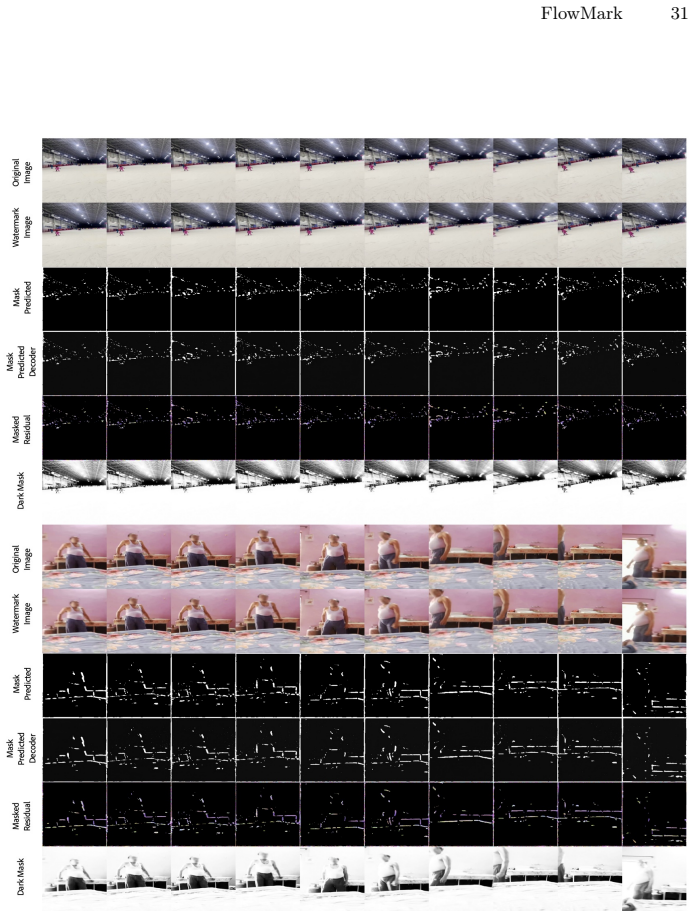
- §4.2, Table 1, and §1 (abstract): The claim that FlowMark 'effectively eliminates perceptual flicker' (abstract) and achieves 'flicker-free temporal consistency' (§4.2) is the primary differentiator from VideoSeal, yet no quantitative temporal flicker metric is reported. The L1 residual norm (||R||_1 = 0.005, Fig. 4) measures embedding magnitude, not temporal variation — a method could have low residual norm yet still flicker if the residual pattern shifts spatially across frames. VMAF (98.95) is a general video quality metric, not a flicker-specific measure. The secret-invariance comparison (Fig. 9) is conducted on SA-I images, not video frames, so it demonstrates spatial stability across secrets but not temporal flicker during video playback. The ablation (Table 3) shows removing L_tcm drops PSNR to 37.19 dB and robust accuracy to 0.79, but neither metric directly measures flicker. The
- claim would be substantially strengthened by reporting a temporal stability metric such as temporal SSIM variance, a perceptual flicker index, or frame-to-frame residual difference norms on actual video sequences. Without such a metric, the 'eliminates perceptual flicker' claim is supported only by qualitative visualizations and proxy metrics.
- §3.2 and §4.3: The structured bit embedding (b_vid || b_frm with 16-bit frame index) supports at most 65,536 unique frame indices. The paper does not discuss what happens for videos exceeding this length, nor whether the frame index wraps or resets. For practical deployment in long-form video or continuous streaming, this limitation should be acknowledged and the handling of overflow specified.
- Table 3 (ablation): Removing the dark mask improves robust accuracy from 0.80 to 0.86 while reducing PSNR from 50.41 to 40.18 dB. The paper frames this as a fidelity-robustness trade-off, but the robustness improvement (0.80 → 0.86) is non-trivial and suggests the dark mask may be overly conservative. The paper should discuss whether a less aggressive dark mask (e.g., higher d_min or τ) could achieve a better operating point, or provide justification for the chosen parameter values beyond the single setting reported.
- §4.3 (social media robustness): The social media robustness test uploads 20 videos to YouTube and Facebook, but no quantitative bit accuracy numbers are reported in the main text — only a qualitative statement that 'FlowMark maintains high bit accuracy.' Figure 5(b) appears to show this result, but the exact bit accuracy values under YouTube and Facebook compression are not tabulated. Given that social media robustness is a headline claim (Fig. 1b), the specific numbers should be reported in a table or explicitly in the text.
minor comments (9)
- §3, Eq. (2): The dark-region mask D(x,y) uses a sigmoid with argument (L(x,y) - τ)^s. When L < τ, (L - τ)^s may be problematic for non-integer s (here s=10 is fine, but the formulation should clarify the sign convention or use an absolute value to avoid ambiguity for general s).
- Table 1: MaskWM is cited as [30] in the table but [31] in the related work text. Please reconcile.
- Table 1: FlowMark's mask accuracy (0.95 on SA-1b, 0.96 on SA-V) is lower than MaskWM (1.00 on both). This is not discussed. A brief note on why FlowMark's mask accuracy is slightly lower would be helpful.
- §4.1: The Adobe Stock video dataset used for training is not described (size, resolution, duration). Since training data composition can affect generalization, a brief description would be appropriate.
- Fig. 9 caption: 'SA-I images' should likely be 'SA-1B images' for consistency with the rest of the paper.
- §6 (Full Resolution Watermarking): The claim that upscaling a 256×256 learned residual to full resolution preserves robustness and perceptual quality is stated without quantitative evaluation at multiple resolutions. Fig. 10 shows qualitative examples but no PSNR/SSIM/bit-accuracy numbers at native resolution. Adding even a small quantitative table would strengthen this section.
- References [23] and [24] both cite VideoSeal but with slightly different formatting (one as 'Video seal', one as 'VideoSeal'). Please consolidate.
- Table 4: The caption mentions 'following VideoSeal [23] evaluation' for GFLOPs, but the reference number should be checked for consistency (VideoSeal is cited as [16] in §3 and [23] elsewhere).
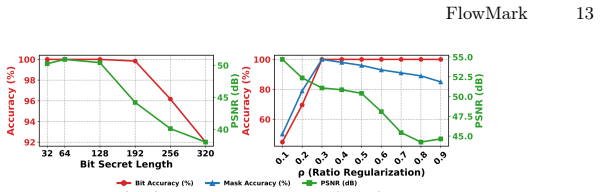
- §4.4: The watermark strength ablation (Fig. 8) uses parameter α, but α is not defined in the method section. It should be clarified whether α corresponds to µ in Eq. (3) or is a separate inference-time parameter.
Simulated Author's Rebuttal
We thank the referee for a thorough and constructive report. The core concern—lack of a dedicated quantitative flicker metric—is well-taken, and we will address it with new experiments. The remaining comments identify legitimate gaps in discussion and reporting that we will incorporate in revision.
read point-by-point responses
-
Referee: The claim that FlowMark 'effectively eliminates perceptual flicker' and achieves 'flicker-free temporal consistency' is the primary differentiator from VideoSeal, yet no quantitative temporal flicker metric is reported. The L1 residual norm measures embedding magnitude, not temporal variation. VMAF is a general video quality metric, not a flicker-specific measure. The secret-invariance comparison is on SA-I images, not video frames. The ablation does not directly measure flicker. The claim would be substantially strengthened by reporting a temporal stability metric such as temporal SSIM variance, a perceptual flicker index, or frame-to-frame residual difference norms on actual video sequences.
Authors: The referee is correct that none of our currently reported metrics directly isolate temporal flicker. The L1 residual norm, VMAF, and secret-invariance analysis are all proxy measures that do not specifically capture frame-to-frame spatial variation of the watermark residual during video playback. We agree this is a genuine gap given that flicker-free temporal consistency is our primary differentiating claim. In revision, we will add a dedicated quantitative flicker metric computed on actual SA-V video sequences. Specifically, we will report frame-to-frame residual difference norms (||R_t - R_{t-1}||_1) and temporal SSIM variance across consecutive watermarked frames for FlowMark and all baselines. This will directly measure whether the residual pattern shifts spatially across frames, which is the mechanism by which frame-independent embedding produces visible flicker. We will also soften the absolute language in the abstract from 'effectively eliminates perceptual flicker' to a more precise claim grounded in the new metric, e.g., 'significantly reduces temporal flicker as measured by [metric].' revision: yes
-
Referee: The structured bit embedding (b_vid || b_frm with 16-bit frame index) supports at most 65,536 unique frame indices. The paper does not discuss what happens for videos exceeding this length, nor whether the frame index wraps or resets. For practical deployment in long-form video or continuous streaming, this limitation should be acknowledged and the handling of overflow specified.
Authors: This is a valid observation that we failed to address. The 16-bit frame index does limit unique frame indexing to 65,536 frames (approximately 45 minutes at 24fps). For longer content, the index would wrap, which could create ambiguity in frame ordering for tamper detection. We will add a paragraph to Section 3.2 acknowledging this limitation and describing the trade-off: allocating more bits to the frame index (e.g., 24 bits, supporting ~18 hours at 24fps) reduces the video ID capacity correspondingly. We will note that for the vast majority of practical use cases—social media clips, short-form video, and typical streaming segments—the 16-bit index is sufficient, and that the allocation is configurable based on deployment requirements. We will also note that for continuous streaming, a segment-based approach with periodic video ID rotation can be used. revision: yes
-
Referee: Removing the dark mask improves robust accuracy from 0.80 to 0.86 while reducing PSNR from 50.41 to 40.18 dB. The paper frames this as a fidelity-robustness trade-off, but the robustness improvement (0.80 to 0.86) is non-trivial and suggests the dark mask may be overly conservative. The paper should discuss whether a less aggressive dark mask could achieve a better operating point, or provide justification for the chosen parameter values beyond the single setting reported.
Authors: The referee raises a fair point. The 6-point robustness gain from removing the dark mask is indeed non-trivial, and our current treatment does not adequately justify the chosen parameters (d_min=0.2, tau=0.3, s=10) or explore intermediate settings. We will address this in two ways. First, we will add discussion acknowledging that the dark mask represents a deliberate fidelity-first operating point chosen for provenance applications where visual quality is paramount and the 0.80 robust accuracy is already strong. Second, we will add an ablation over d_min values (e.g., d_min in {0.0, 0.1, 0.2, 0.4, 0.6}) to show the trade-off curve and demonstrate that intermediate settings exist. We note that d_min=0.0 effectively disables the dark mask (matching the current ablation row), so this sweep will characterize the full spectrum the referee requests. revision: partial
-
Referee: The social media robustness test uploads 20 videos to YouTube and Facebook, but no quantitative bit accuracy numbers are reported in the main text—only a qualitative statement that 'FlowMark maintains high bit accuracy.' Figure 5(b) appears to show this result, but the exact bit accuracy values under YouTube and Facebook compression are not tabulated. Given that social media robustness is a headline claim, the specific numbers should be reported in a table or explicitly in the text.
Authors: The referee is correct. For a headline claim, reporting only a qualitative statement without explicit numerical values is insufficient. We will add a small table reporting bit accuracy for FlowMark under YouTube and Facebook compression separately, alongside the number of videos tested and the corresponding PSNR after platform re-encoding. If space permits in the main text, this will be a dedicated table; otherwise it will appear as explicit numerical values in the text of Section 4.3 with the full table in the supplementary material. revision: yes
Circularity Check
No circularity found: FlowMark is trained end-to-end against external benchmarks and compared to independently developed baselines.
full rationale
FlowMark's derivation chain is self-contained. The model is trained end-to-end on the Adobe Stock video dataset and evaluated on external benchmarks (SA-1B, SA-V) against independently developed baselines (HiDDeN, MBRS, CIN, TrustMark, WAM, MaskWM, VideoSeal). The distortion module is adopted from VideoSeal [23], which is external work by different authors. The GAN-based adversarial loss follows TrustMark [14], authored by Bui et al. — a collaborator, but the cited work is an independently published, externally verifiable result, not an unverified self-citation chain. Self-citations to Asnani et al. (ProMark, CustomMark, proactive manipulation detection) appear only in the related work for context, not as load-bearing premises for any derivation or prediction. The temporal consistency loss (Eq. 8), residual TV loss (Eq. 7), mask predictor, and structured bit embedding are all novel components defined within the paper and validated by ablation (Table 3) against external metrics. No equation or prediction reduces to its own inputs by construction. The 'flicker elimination' claim may be insufficiently validated by quantitative flicker-specific metrics (a correctness concern), but this is not a circularity issue — the loss function (Eq. 8) is a genuine constraint on temporal dynamics, not a tautological restatement of the evaluation metric. The evaluation metrics (PSNR, SSIM, VMAF, bit accuracy) are standard external measures, not quantities defined in terms of the model's own outputs.
Assumptions & free parameters
free parameters (13)
- ρ (target mask ratio) =
0.5
- µ (global embedding strength) =
1.0
- τ (luminance threshold for dark mask) =
0.3
- d_min (minimum watermark strength in dark regions) =
0.2
- s (transition sharpness for dark mask) =
10
- λ_mask =
25
- λ_pix =
1.0
- λ_lpips =
0.3
- λ_rtv =
2.0
- λ_tcm =
0.5
- λ_bit =
20
- λ_GAN =
0.5
- λ_M_hat =
0.5
assumptions (5)
- domain assumption JND (Just Noticeable Difference) modulation from prior watermarking work [23,30,43] provides a valid perceptual scaling for watermark residuals.
- domain assumption The straight-through estimator (STE) provides sufficient gradient flow for training the binary mask predictor.
- domain assumption The differentiable distortion framework from VideoSeal [23] adequately simulates real-world social media compression for training purposes.
- ad hoc to paper Temporal change MSE loss (Eq. 8) is a sufficient proxy for perceptual flicker reduction.
- ad hoc to paper Upscaling a 256×256 learned residual to full resolution preserves watermark robustness and perceptual quality.
invented entities (3)
-
Mask Predictor network
independent evidence
-
Dark-region adaptive residual modulation (Eq. 2)
independent evidence
-
Structured per-frame bit embedding (b_vid || b_frm)
independent evidence
Cite this review
Pith. "Pith review of FlowMark: Mask-Guided Video Watermarking." pith.science (2026). https://pith.science/paper/XJVZQ6H2
@misc{pith2026260705261,
  author       = {Pith},
  title        = {Pith review of: FlowMark: Mask-Guided Video Watermarking},
  year         = {2026},
  howpublished = {\url{https://pith.science/paper/XJVZQ6H2}},
  note         = {Machine review of arXiv:2607.05261}
}
abstract
We present FlowMark, a video watermarking framework guided by automatically predicted object masks. In contrast to prior region-based approaches that require user-supplied mask guidance, FlowMark learns to identify optimal regions for watermark embedding through a dedicated Mask Predictor network. Our end-to-end trainable architecture combines region-aware encoding with noise-augmented training to ensure robustness against compression, geometric transformations, and content variation, while preserving high perceptual quality. Our content-adaptive masking keeps watermark signals coherent with natural video dynamics, effectively eliminating perceptual flicker. Beyond compression robustness, FlowMark maintains reliable watermark recovery under video-native temporal edits (e.g., frame swap, insertion, deletion, resampling, and interpolation) and real-world social media distribution pipelines (e.g., YouTube and Facebook re-encoding). Experimental results on both image and video datasets show that FlowMark reliably embeds $128$-bit messages with up to $50.08$ dB PSNR, offering strong performance for content provenance, temporal authenticity verification, and video integrity protection.
Figures


Figures from the paper (16 more)






Reference graph
Works this paper leans on
-
[1]
IEEE Transactions on Circuits and Systems for Video Technology13(8), 787–800 (Aug 2003)
Alattar, A.M., Lin, E.T., Celik, M.U.: Digital watermarking of low bit-rate ad- vanced simple profile mpeg-4 compressed video. IEEE Transactions on Circuits and Systems for Video Technology13(8), 787–800 (Aug 2003)
work page 2003
- [2]
-
[3]
In: Proceedings of the IEEE/CVF Con- ference on Computer Vision and Pattern Recognition
Asnani, V., Collomosse, J., Bui, T., Liu, X., Agarwal, S.: Promark: Proactive diffu- sion watermarking for causal attribution. In: Proceedings of the IEEE/CVF Con- ference on Computer Vision and Pattern Recognition. pp. 10802–10811 (2024) 22 Asnani et al
work page 2024
-
[4]
Asnani, V., Yin, X., Hassner, T., Liu, S., Liu, X.: Proactive image manipulation detection. In: CVPR (2022)
work page 2022
-
[5]
Baba, S., Krekor, L., Arif, T., Shaaban, Z.: Watermarking scheme for copyright protection of digital images. IJCSNS9(4) (2019)
work page 2019
-
[6]
Balan, K., Black, A., Jenni, S., Gilbert, A., Parsons, A., Collomosse, J.: DECO- RAIT - DECentralized Opt-in/out Registry for AI Training. In: Conference on Vi- sual Media Production (CVMP), 2023 (2023),https://collomosse.com/assets/ pubs/Balan-CVMP-2023.pdf
work page 2023
-
[7]
Balan, K., Gilbert, A., Collomosse, J.: Content ARCs: Decentralized Content Rights in the Age of Generative AI. In: International Conference on AI and the Digital Economy (CADE), 2025 (2025),https://collomosse.com/assets/pubs/ Balan-CADE-2025.pdf
work page 2025
-
[8]
Balan, K., Agarwal, S., Jenni, S., Parsons, A., Gilbert, A., Collomosse, J.: EKILA: Synthetic media provenance and attribution for generative art. In: CVPR (2023)
work page 2023
Show all 62 references
-
[9]
CoSTAR/DECaDE/Sheridans Technical Report (2025), https://collomosse.com/assets/pubs/Bennett-ACCCT-2025.pdf
Bennett, J., Collomosse, J., Gregory-Clarke, R., Jones, J., Love, L., Lycett, M., Saunders, W.: Time to ACCCT: Providing Creative Industries and AI De- velopers with a Copyright Framework of Access, Control, Consent, Compensa- tion and Transparency. CoSTAR/DECaDE/Sheridans Tec...
2025
-
[10]
IEEE Trans
Bharati, A., Moreira, D., Flynn, P., de Rezende Rocha, A., Bowyer, K., Scheirer, W.: Transformation-aware embeddings for image provenance. IEEE Trans. Info. Forensics and Sec.16, 2493–2507 (2021)
2021
-
[11]
IEEE Transactions on Multimedia (TMM), 2020 (2020),https://collomosse.com/assets/pubs/Bui-TMM-2020.pdf
Bui, T., Cooper, D., Collomosse, J., Bell, M., Green, A., Sheridan, J., Higgins, J., Das, A., Keller, J., Thereaux, O.: Tamper-proofing Video with Hierarchical Attention Autoencoder Hashing on Blockchain. IEEE Transactions on Multimedia (TMM), 2020 (2020),https://collomosse.co...
2020
-
[12]
In: CVPR Workshops (Computer Vision, AI and Blockchain), 2019 (2019),https: //collomosse.com/assets/pubs/Bui-CVPRWS-2019.pdf
Bui, T., Cooper, D., Collomosse, J., Bell, M., Green, A., Sheridan, J., Hig- gins, J., Das, A., Keller, J., Thereaux, O., Brown, A.: ARCHANGEL: Tamper- proofing Video Archives using Temporal Content Hashes on the Blockchain. In: CVPR Workshops (Computer Vision, AI and Blockcha...
2019
-
[13]
ArXiv e-prints (Nov 2023)
Bui, T., Agarwal, S., Collomosse, J.: Trustmark: Universal watermarking for arbi- trary resolution images. ArXiv e-prints (Nov 2023)
2023
-
[14]
In: Proceedings of the IEEE/CVF International Conference on Computer Vision
Bui, T., Agarwal, S., Collomosse, J.: Trustmark: Robust watermarking and water- mark removal for arbitrary resolution images. In: Proceedings of the IEEE/CVF International Conference on Computer Vision. pp. 18629–18639 (2025)
2025
-
[15]
In: CVPR (2023)
Bui, T., Agarwal, S., Yu, N., Collomosse, J.: RoSteALS: Robust steganography using autoencoder latent space. In: CVPR (2023)
2023
-
[16]
In: Proceedings of the IEEE/CVF Conference on Computer Vision and Pattern Recognition (CVPR) (2024)
Chang, J., Choi, S., Milanfar, P.: Videoseal: A learned model for robust video watermarking. In: Proceedings of the IEEE/CVF Conference on Computer Vision and Pattern Recognition (CVPR) (2024)
2024
-
[17]
Coalition for Content Provenance and Authenticity: Technical specification 2.2. Tech. rep., C2PA (2025),https://c2pa.org/specifications/specifications/ 2.2/index.html
2025
-
[18]
IEEE Computer Graphics and Applications (IEEE CG&A) (2024)
Collomosse, J., Parsons, A.: To Authenticity, and Beyond! Building Safe and Fair Generative AI upon the Three Pillars of Provenance. IEEE Computer Graphics and Applications (IEEE CG&A) (2024)
2024
-
[19]
IEEE Transactions on Information Forensics and Security3(3), 466–474 (2008) FlowMark 23
Coria, L.E., Pickering, M.R., Nasiopoulos, P., Ward, R.K.: A video watermarking scheme based on the dual-tree complex wavelet transform. IEEE Transactions on Information Forensics and Security3(3), 466–474 (2008) FlowMark 23
2008
-
[20]
Devi, P., Venkatesan, M., Duraiswamy, K.: A fragile watermarking scheme for image authentication with tamper localization using integer wavelet transform. J. Computer Science5(11), 831–837 (2019)
2019
-
[21]
In: Proceedings of the IEEE International Conference on Computing, Communication and Automation
Dutta, A., Gupta, S.: A blind and robust video watermarking technique for h.265/hevc encoded video. In: Proceedings of the IEEE International Conference on Computing, Communication and Automation. pp. 1189–1194 (2018)
2018
-
[22]
In: ICCV (2023)
Fernandez, P., Couairon, G., Jégou, H., Douze, M., Furon, T.: The stable signature: Rooting watermarks in latent diffusion models. In: ICCV (2023)
2023
-
[23]
arXiv preprint arXiv:2412.09492 (2024)
Fernandez, P., Elsahar, H., Yalniz, I.Z., Mourachko, A.: Video seal: Open and efficient video watermarking. arXiv preprint arXiv:2412.09492 (2024)
2024 arXiv
-
[24]
ArXiv e-prints (Dec 2024)
Fernandez, P., Elsahar, H., Yalniz, I.Z., Mourachko, A.: VideoSeal: Open and effi- cient video watermarking. ArXiv e-prints (Dec 2024)
2024
-
[25]
In: Proc
Fernandez, P., Sablayrolles, A., Furon, T., Jégou, H., Douze, M.: Watermarking images in self-supervised latent spaces. In: Proc. ICASSP. pp. 3054–3058. IEEE (2022)
2022
-
[26]
In: TENCON 2011-2011 IEEE Region 10 Conference
Ghazanfari, K., Ghaemmaghami, S., Khosravi, S.R.: Lsb++: An improvement to lsb+ steganography. In: TENCON 2011-2011 IEEE Region 10 Conference. pp. 364–368. IEEE (2011)
2011
-
[27]
Google DeepMind: Identifying AI-generated images with SynthID.https : / / deepmind.google/discover/blog/identifying- ai- generated- images- with- synthid/(2023)
2023
-
[28]
IEEE Transactions on Circuits and Systems for Video Tech- nology20(8), 1164–1170 (2010)
Guo, J., Pan, Y.: Motion vector-based watermarking for h.264 video stream with drift compensation. IEEE Transactions on Circuits and Systems for Video Tech- nology20(8), 1164–1170 (2010)
2010
-
[29]
Signal Processing66(3), 283–301 (May 1998)
Hartung, F., Girod, B.: Watermarking of uncompressed and compressed video. Signal Processing66(3), 283–301 (May 1998)
1998
-
[30]
arXiv preprint arXiv:2405.11135 (2025)
Hu, R., Zhang, J., Zhao, S., Lukas, N., Li, J., Guo, Q., Qiu, H., Zhang, T.: Mask image watermarking. arXiv preprint arXiv:2405.11135 (2025)
2025 arXiv
-
[31]
In: The Thirty-ninth Annual Conference on Neural Information Processing Systems (2025)
Hu, R., Zhang, J., Zhao, S., Lukas, N., Li, J., Guo, Q., Qiu, H., Zhang, T.: Mask im- age watermarking. In: The Thirty-ninth Annual Conference on Neural Information Processing Systems (2025)
2025
-
[32]
IEEE Transactions on Multimedia25, 7364–7377 (2022)
Jia, J., Gao, Z., Zhu, D., Min, X., Hu, M., Zhai, G.: Rivie: Robust inherent video information embedding. IEEE Transactions on Multimedia25, 7364–7377 (2022)
2022
-
[33]
In: Proceedings of the 29th ACM International Conference on Multimedia (2021)
Jia, Z., Fang, H., Zhang, W.: Mbrs: Enhancing robustness of dnn-based water- marking by mini-batch of real and simulated jpeg compression. In: Proceedings of the 29th ACM International Conference on Multimedia (2021)
2021
-
[34]
In: Proceedings of the IEEE/CVF international conference on computer vision
Kirillov, A., Mintun, E., Ravi, N., Mao, H., Rolland, C., Gustafson, L., Xiao, T., Whitehead, S., Berg, A.C., Lo, W.Y., et al.: Segment anything. In: Proceedings of the IEEE/CVF international conference on computer vision. pp. 4015–4026 (2023)
2023
-
[35]
IEEE Transactions on Image Processing (2023)
Luo, X., Li, Y., Chang, H., Liu, C., Milanfar, P., Yang, F.: Dvmark: A deep multi- scale framework for video watermarking. IEEE Transactions on Image Processing (2023)
2023
-
[36]
In: Proceedings of the 30th ACM International Conference on Multimedia
Ma, R., Guo, M., Hou, Y., Yang, F., Li, Y., Jia, H., Xie, X.: Towards blind water- marking: Combining invertible and non-invertible mechanisms. In: Proceedings of the 30th ACM International Conference on Multimedia. pp. 1532–1542 (2022)
2022
-
[37]
In: BMVC
Mishra, A., Kumar, S., Nigam, A., Islam, S.: Vstegnet: Video steganography net- work using spatio-temporal features and micro-bottleneck. In: BMVC. vol. 274 (2019)
2019
-
[38]
In: COMSWARE’08
Navas, K., Ajay, M.C., Lekshmi, M., Archana, T.S., Sasikumar, M.: DWT-DCT- SVD based watermarking. In: COMSWARE’08. pp. 271–274. IEEE (2008) 24 Asnani et al
2008
-
[39]
Netflix, V.: Video multi-method assessment fusion (2019)
2019
-
[40]
In: ICCV (2021)
Nguyen, E., Bui, T., Swaminathan, V., Collomosse, J.: OSCAR-Net: Object-centric scene graph attention for image attribution. In: ICCV (2021)
2021
-
[41]
Rixhon: An update on JPEG trust.https : / / cawg
P. Rixhon: An update on JPEG trust.https : / / cawg . io / meeting - notes / _attachments/2025-01-21/jpeg-trust-presentation.pdf(January 2025)
2025
-
[42]
In: Intl
Petrov, A., Agarwal, S., Torr, P., Bibi, A., Collomosse, J.: On the Coexistence and Ensembling of Watermarks. In: Intl. Conf. Neural Information Processing Sys- tems (NeurIPS), 2025 (2025),https://collomosse.com/assets/pubs/Petrov- NeurIPS-2025.pdf
2025
-
[43]
In: Proc
Sander, T., Fernandez, P., Durmus, A.O., Furon, T., Douze, M.: Watermark any- thing with localized messages. In: Proc. ICLR (2025)
2025
-
[44]
Journal of Information Security and Applications75, 103515 (2023)
Shen, X., Yao, H., Tan, S., Qin, C.: Vhnet: A video hiding network with robust- ness to video coding. Journal of Information Security and Applications75, 103515 (2023)
2023
-
[45]
Multimedia Tools and Applications81(18), 25913–25946 (2022)
Taha, M.S., Rahem, M.S.M., Hashim, M.M., Khalid, H.N.: High payload image steganography scheme with minimum distortion based on distinction grade value method. Multimedia Tools and Applications81(18), 25913–25946 (2022)
2022
-
[46]
In: Proc
Tancik, M., Mildenhall, B., Ng, R.: Stegastamp: Invisible hyperlinks in physical photographs. In: Proc. CVPR. pp. 2117–2126 (2020)
2020
-
[47]
IEEE Transactions on Circuits and Systems for Video Technology 26(1), 65–76 (2016)
Tew, Y., Wong, K.: An efficient video watermarking technique for hevc video au- thentication. IEEE Transactions on Circuits and Systems for Video Technology 26(1), 65–76 (2016)
2016
-
[48]
Neurocomputing (2022)
Wan, W., Wang, J., Zhang, Y., Li, J., Yu, H., Sun, J.: A comprehensive survey on robust image watermarking. Neurocomputing (2022)
2022
-
[49]
Wen, Y., Kirchenbauer, J., Geiping, J., Goldstein, T.: Tree-rings watermarks: Invis- iblefingerprintsfordiffusionimages.In:AdvancesinNeuralInformationProcessing Systems (NeurIPS). vol. 36 (2023)
2023
-
[50]
In: Proc
Weng, X., Li, Y., Chi, L., Mu, Y.: High-capacity convolutional video steganography with temporal residual modeling. In: Proc. ICMR. pp. 87–95 (2019)
2019
-
[51]
In: Proc
Wolfgang, R.B., Delp, E.J.: A watermark for digital images. In: Proc. ICIP. vol. 3, pp. 219–222. IEEE (1996)
1996
-
[52]
IEEE Transactions on Image Processing26(6), 2682–2693 (2017)
Wu, J., Li, L., Dong, W., Shi, G., Lin, W., Kuo, C.C.J.: Enhanced just noticeable difference model for images with pattern complexity. IEEE Transactions on Image Processing26(6), 2682–2693 (2017)
2017
-
[53]
In: Proc
Xu, R., Hu, M., Lei, D., Li, Y., Lowe, D., Gorevski, A., Wang, M., Ching, E., Deng, A., et al.: Invismark: Invisible and robust watermarking for ai-generated image provenance. In: Proc. Winter Conf. on Appl. of Computer Visoin (WACV) (2025)
2025
-
[54]
In: 2023 International Conference on Culture-Oriented Science and Technology (CoST)
Ye, G., Gao, J., Wang, Y., Song, L., Wei, X.: Itov: efficiently adapting deep learning-based image watermarking to video watermarking. In: 2023 International Conference on Culture-Oriented Science and Technology (CoST). pp. 192–197. IEEE (2023)
2023
-
[55]
In: Proceedings of the International Conference on Control, Automation, Robotics and Vision
Yong, M., Yu-Min, T., Yun-Hui, Q.: Adaptive video watermarking algorithm based on mpeg-4 streams. In: Proceedings of the International Conference on Control, Automation, Robotics and Vision. pp. 1084–1088 (2008)
2008
-
[56]
arXiv preprint arXiv:1909.01230 (2019)
Zhang, H., Dong, J., Forgione, P., Collomosse, J.: Rivagan: Robust video water- marking with attention. arXiv preprint arXiv:1909.01230 (2019)
1909 arXiv
-
[57]
IEEE Transactions on Circuits and Systems II: Express Briefs54(2), 205–209 (2007) FlowMark 25
Zhang, J., Ho, A.T.S., Qiu, G., Marziliano, P.: Robust video watermarking of h.264/avc. IEEE Transactions on Circuits and Systems II: Express Briefs54(2), 205–209 (2007) FlowMark 25
2007
-
[58]
Zhang, X., Sun, Z.H., Karaman, S., Chang, S.: Discovering image manipulation history by pairwise relation and forensics tools. IEEE J. Selected Topics in Signal Processing.14(5), 1012–1023 (2020)
2020
-
[59]
In: Proc
Zhang, X., Tang, Z., Xu, Z., Li, R., Xu, Y., Chen, B., Gao, F., Zhang, J.: Omni- guard: Hybrid manipulation localization via augmented versatile deep image wa- termarking. In: Proc. CVPR (2025)
2025
-
[60]
In: Proceedings of the 32nd ACM International Conference on Multimedia
Zhang, X., Xu, Y., Li, R., Yu, J., Li, W., Xu, Z., Zhang, J.: V2a-mark: Versatile deep visual-audio watermarking for manipulation localization and copyright pro- tection. In: Proceedings of the 32nd ACM International Conference on Multimedia. pp. 9818–9827 (2024)
2024
-
[61]
264/avc compression
Zhang, Y., Ni, J., Su, W., Liao, X.: A novel deep video watermarking framework with enhanced robustness to h. 264/avc compression. In: Proceedings of the 31st ACM International Conference on Multimedia. pp. 8095–8104 (2023)
2023
-
[62]
In: Proc
Zhu, J., Kaplan, R., Johnson, J., Fei-Fei, L.: Hidden: Hiding data with deep net- works. In: Proc. ECCV. pp. 657–672 (2018) 26 Asnani et al. Fig. 9:Spatial residual comparison across different secrets on SA-I images. Residuals are visually amplified to reveal differences. For ...
2018
Reviewed July 7, 2026 · model on record in the stance chip above.
Discussion (0). Continue with ORCID to comment.